“Miles could tell me the things he wanted from the drums but I didn’t let him tell me how to play them.”
— Jimmy Cobb, 1979 interview by Rick Mattingly

A drumming blog written by Todd Bishop.
Showing posts with label Rick Mattingly. Show all posts
Showing posts with label Rick Mattingly. Show all posts
Monday, May 25, 2020


Sunday, January 08, 2017
Gadd on time

RM: Jim Chapin quoted you as saying that coming from a jazz background, you
tended to put an edge on the time, and you had to learn to lay back.
SG: Yeah, it had a lot to do with that energy level that I was talking about. It was just that feeling of aggression—that personal thing between me and the drums— and the way I projected that into the music. And then eventually I was able to channel that energy into an enthusiasm for the music, and sort of separate myself from the drums, personally. I was able to channel it and start playing less. You start realizing that when you put that much energy into it, you might be on the upper side of the time. You just have to think about the other way to do it.
RM: How did you eventually learn to lay back? Did you sit down with a metronome and work at it?
SG: It's not that complicated. It was just something I realized I was doing, and when I was aware of it—when I understood it— then I could see how it could be different. It's just an awareness of something you have to look at inside yourself, and all you have to do is listen to yourself. I did it by being in a situation where I was recording, and then when I heard things back, it was like, "It felt one way when I was playing it, but now it doesn't feel the same way." So you have to realize that as comfortable as it felt at the time, this is what it sounds like. I think the only way to find out about playing on top is to put a click on, and then play loud and soft with it. If you can understand that it's real natural to get on top when you're playing loud, then you can start to understand it.
Time is a funny subject. It really is. It's a little bit different every time. And it gets confusing when you start talking about "playing on top" and "laying back" because those phrases are used in so many different situations. One person can say it and mean one thing and another person could say the same thing and mean something else.
RM: I remember the first time I heard one of those terms, years ago. I was playing with a group, and things were really feeling good that night. Afterwards, a guy came up and said, "I really like the way you lay back when you play." I was thinking, "Oh really? I lay back?"
SG: But it felt natural when you were doing it?
RM: Yeah.
SG: That's what I'm saying. Someone came up and said, "It felt good because you were laying back," and you didn't even know what the hell he was talking about. That's how vague it is. So the thing is, when they tell you it was happening because you were laying back, it might make as little sense to you as when they ask you to lay back.
RM: Judging by the letters we get, people are hearing these terms and getting confused about what they mean.
SG: There are a lot of confusing things that don't need to be that confusing. I think it will finally make sense to them when they finally play with people who make sense musically. Then they'll understand.
Tuesday, January 03, 2017
Very occasional quote of the day: Steve Gadd on reading

When sight reading music, first look at the whole piece to figure out what the 'road map' is. See how many bars are in the intro, look for section letters, see how many bars are in each section, and look for repeat signs, D.S., D.C. and coda signs.
If you can keep your place, even if you are unable to make any of the figures, you are still ahead of the game. You can get the figures the next time, or after everyone else does. Keep your place and listen to the music; after you hear the run-down it will make a lot more sense. Don't try to see what it sounds like.
Listen while you look and soon you will be playing the figures the first time through. You will find that the same figure can be written out several different ways—some more complicated than others. Familiarize yourself with all the ways. You'll find that the simplest ways are more commonly used.”
— Steve Gadd, Modern Drummer interview by Rick Mattingly, July, 1983
Also see this early blog piece for Joey Baron's advice on sightreading.
Tuesday, August 02, 2011
Vinnie Colaiuta interview - Percussive Notes, 1995
 |
| Vinnie with friend, c. 1982. |
My other big Vinnie thing on the blog is my Packard Goose transcription, which is a pretty insane piece of drumming. And if Drum! magazine doesn't print my epic transcription of the guitar solo from Keep It Greasey soon, I'll be posting that, as well- maybe when I do my first fund-raising drive...
As with all of the interviews I post/link to, I've pulled out the things that are most significant to me; definitely go read the whole thing.
ODD METERS
...regardless of how many pulses a bar happens to contain, you're going to play it with the same consideration of feel that you would if you were playing 4/4, meaning that you're going to make it feel good no matter what it is. A bar of seven or eleven is not going to feel like four, but it may have subdivisions that give you the feeling of a backbeat for enough of a moment to get that same kind of feeling. By the same token, you can take 4/4 and stretch it like a Gumby.
Some people write in odd times just to be experimental and they actually want it to have a jerky feel. But odd times can inherently be that way unless you approach them from a different angle, not necessarily defining the downbeats in every bar. It becomes a question of, do you want to make the audience a part of this or do you want to lose them? How much of it has to be an intellectual exercise all the time? We played some odd times on the Sting record [Ten Summoner's Tales] but I don't think Sting intended for people to sit there and count the stuff out. He wanted to make it as musical as possible.
SIMPLICITY
It's strange because you hear something driving and feeling good, so you transcribe it and see that there aren't a lot of notes on the page. Sometimes you are surprised by that because it sounded like a lot more than it was, but that's because you can't transcribe drive and attitude.
The other thing is that no two drummers play 4/4 exactly the same way, you know? That's a mystery in itself to me - how you can identify someone through something so simple. It's way beyond how many ticks per beat and all that garbage.
Much more after the break...
Saturday, February 12, 2011
Baby Dodds
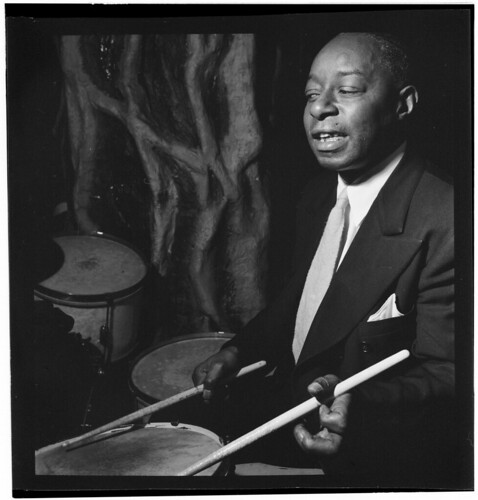
Like most people, I can't say he's been a giant influence- I dug up some records when I was in school, and was struck by his fat, swinging sound, but that's about it. Unless you're playing Dixieland, it's not easy to apply his thing real directly- when playing modern music in the 60's tradition, you generally try to avoid those early stylistic things. Ed Blackwell and Charles Moffett come to mind as people who maybe do a similar thing in a hip way. Maybe I hear a little bit of him in Tony Oxley as well.
I take him as a reminder of the soul of the instrument that got maybe a little bit obscured as it moved into its modern phase- the "drumistic" rudimental melodies, military effects, the little two and three pitch melodies, sound/exotic effects, chokes, the strong use of the bass drum, the dramatic orchestration. Without the historical knowledge, modern drumming can sometimes feel like attempting high-level Christopher Guest style comedy without knowing anything about slapstick.
Here's a track from his famous Talking and Drum Solos record:
An interview excerpt and more clips after the break:
Subscribe to:
Posts (Atom)