Showing posts with label practicing. Show all posts

Tuesday, November 26, 2024

Expanding a concept - 01

This is connected with all the fill related jive we've been dealing with lately. I share it with you to illustrate a thought process, not a particular set of licks. These are some things I did live while practicing recently, without writing anything down, using the following humble page from my own book, Syncopation in 3/4: 


You look at that see a lot of dumb rhythms in 3/4 time; I see an unending fairyland of playing possibilities for the drumset. You may put that in different terms. 

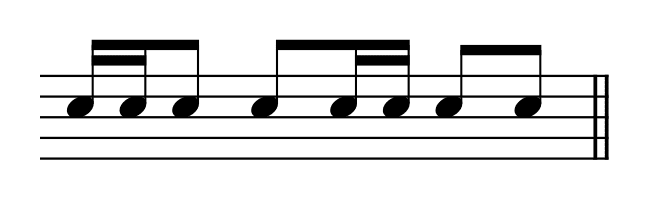
I happened to be playing along with a loop sampled from Herbie Hancock's Cantaloupe Island, which is in 4/4 time, with a straight 8th note groove. I was playing 16th note rate stuff against it, so I needed to double time those rhythms— line one for example:  


Becomes: 


Played in a 4/4 environment that would be:  


For practice purposes, and concept purposes, we're interpreting that time signature as a description of the length of the rhythm pattern, not as a demand that we play in 3/4 time. 

The rhythm suggests a number of possibilities on the drum set just as a fill/solo idea— starting with RH on cymbal, with bass drum, on the 1; remainder of the rhythm played with the LH on the snare drum, with some help from the RH, as the embellishments get more involved. 


Of course we're going to move that around the drums, try some different stickings, accents and embellishments. Generally try to make music out of it. 

Some possibilities for line 2:


And line 4:  


You'll notice: 

- We often add bass drum at the end of the pattern, or between the quarter notes of the original rhythm.
- You can interpret the rhythms as a general pattern outline of fast and slow notes— you can substitute faster rhythms for the 8th notes in the original rhythm.
- You can embellish freely, double or buzz some notes, add flams, add ruffs.  

One facet of a larger topic of drumistic thinking. Drummeristic. Whatever. Drumming is a process, not just playing some notes somebody wrote down. More of this coming. This post may see a major revision when I can think about it while some guys are not reroofing my house. It sounds like Gene Krupa uncrating some wildebeest with a sledgehammer on d-day around here. 

Sunday, September 01, 2024

Snare drum vs. drum set training

The following are some comments I made in a contentious online conversation about snare drum training and drum set training— or playing— and the differences between the two, that I think stand on their own— edited slightly for clarity:

The snare drum and the drum set are different instruments, played differently.

Snare drum training is two handed playing on one drum, dealing with all areas of performance on the snare drum— reading, accents, flams and ruffs, rolls, rudiments. See any method book, technique book, and rudimental book: Podemski, Goldenberg, Stone, Wilcoxon. Intermediate Snare Drum Studies and Rudimental Primer by Mitchell Peters give a reasonable minimum standard for baseline proficiency.

Drum set training means playing the drum set, a four limbed instrument using a snare drum, a bass drum, some cymbals, and some tom toms, as a coordinated thing. Training involves things related to coordination, styles, the functions of the components of the instrument, playing and setting up figures, reading interpretively, improvising, filling, soloing. 

Much of that we develop through the book Syncopation— the most common things done with it are in John Ramsay's Alan Dawson book. I've also written a hundred or so systems for it on my site. Other books broadly outlining that are Steve Houghton's Studio and Big Band Drumming book, Ed Uribe's Brazilian and Afro-Cuban books, and Kim Plainfield's Advanced Concepts book. Those all outline the primary techniques of the instrument, and practice systems for developing them. 

You can't get where those books take you just by getting good with your ratamacues.

Much of ordinary drum set playing doesn't require a lot of technical ability as a snare drummer. Though it can be very helpful, and necessary for some ways of playing. And necessary if someone's going to be a competent professional.

The drum set has its own language now. Approaching the drum set as “snare drumming plus some other stuff” is antiquated.

Reading real old drumming materials it's kind of shocking how contemporary some of it is. And how not. Much of it is oriented around how to play a 2/4 march and how to play a 6/8 march, and that's about it. 2 feel with the bass drum / 4 feel with the bass drum.

On the snare drum alone, I don't see a great logic to playing patterns 1-72 in Stick Control, except it's a different sequence of Rs and Ls. The sequences themselves are an important part of the language of drumming, but I don't know how helpful it truly is to just learn a lot of ways of making static 8th notes on one drum. Except to work on evenness between hands— which is something, but not everything.

It's kind of like making a piano student run their scales with all the notes on the keyboard sounding middle C. The differences in pitches aid understanding the thing, they're the whole reason for the thing.

I don't know of another instrument that requires people to learn complex fingerings while sounding a single pitch.

I learned most of Stone on an actual snare drum, standing up in a little hallway at school— an hour of Stone like that. Flam pages 21-23. It was a miserable way to practice, and ultimately poor practice economy for the effort.

If you play 1-72 from Stone on a drum set with the hands hitting two different sounds, there's an obvious musical difference between the patterns— there is a reason to play one over another, an auditory difference. So you learn the pattern as a piece of musical content, not just as a mathematical sequence. 

Part of why so many drummers are such lousy musicians is they think in terms of Rs and Ls and not in terms of melodic ideas— which we get from that latter thing.

The bigger reason to do a lot of snare drum is not just for how you'll use it directly. Your hands are still where most of your facility is going to be. There are some bodies of SD materials that are pretty essential to more-than-basic drum set playing— accented singles, flam rudiments, paradiddle rudiments, open rolls and drags. And the more advanced snare drum materials cover some things that no drum set materials cover— finer aspects of rhythm, various forms of time changes, finer dynamic control, and timing control.

Different students have different goals. We start on snare drum, and continue with it as necessary, as their goals evolve. The two instruments develop concurrently. 

I teach all levels of people, with all sorts of playing goals that are not mine. Not everyone knows how serious they're going to be about it when they start. Many of them are not irrationally motivated to do it, as I was, and need to be given a chance to get hooked, and get more ambitious about what they want to accomplish with it.

The idea is not to teach limitation, the idea is to find a path forward for everyone, and teach things in a timely manner with the growth of their interest, goals, and commitment.

I get a lot of students who were poorly taught— by themselves, or others. There are a lot of very bad drum teachers (and bad drummers) out there, often teaching ideas they inherited from their teacher, that they never really understood, and never questioned. Or they try to reinvent the instrument based on some popular trends, without understanding what they're reinventing. I'm not thrilled with the way a lot of people do things on this instrument. There are a lot of lingering primitive ideas about how it works.

Nothing half assed about any of this— I put a tremendous amount of energy into helping my students become excellent and creative players to whatever extent they want to pursue it.

How much snare drum would you require before touching a drum set for a nine year old beginner? Or a 70 year old beginner? Or someone with a high pressure job who does music as a distraction from that? 

Also see this post on snare drummers vs. drum set players

Wednesday, July 31, 2024

Practicing Chaffee phrases

Some things I do when practicing these recent Chaffee linear phrases, or any of the rest of them, beyond playing them as written. 

First, at faster tempos, the ones ending with two bass drum notes are a pain— we have to play three 16ths in a row to land on the 1. In addition to the ways I mentioned in the original post, you can also just end the measure with singles on the snare drum: 


These are thought of as fusion vocabulary, but for me, for some reason, at full speed (quarter note = 140-150+) these fall most naturally within a jazz feel. To that end I can start them on beat 4 and end them on 4. With the above phrase:


That also makes it more feasible to play the pattern with the ending double on the bass drum, followed by the snare drum, and a kick on the & of 4: 


I never fully work out complete licks to play verbatim— for me the patterns are conditioning for improvised soloing or filling. I can't tell you if that's the best way of producing reliably flashy results, but it's what I do. I'm noticing the ways these phrases begin: 


I'm also noticing the way they end. A lot of them end like this, which I'll practice as licks themselves, independent of the longer phrase:


I can't think of a close to this, so: enjoy! 

Tuesday, July 30, 2024

New Breed tweak - left hand cymbal accents

Getting through a single system from The New Breed takes some time, longer than I want to have one hand be basically idle, playing just the 2 and 4. Let's give it more to do.

This is a real small thing to do with the backbeat systems— any system with backbeats on the snare drum, and the bass drum playing the melody: catch accents on a cymbal with the left hand. In unison with one or more bass drum notes, or anyplace it doesn't conflict with the backbeat. 

Add a crash on the 1, or the closest bass drum note before or after the 1, and/or some other bass drum note, for example: 


You could also experiment with crashing independent of the bass drum— for that I'd want something quick, an effects cymbal or small crash:


I'm always on the lookout for little multipliers like that. So long as the fundamentals are solid— save it for later if any part of the plain system is raggedy. 

Wednesday, June 26, 2024

How to stop - 01

Kind of a mundane item here— a multi-parter, believe it or not— mainly for teachers, about handling ordinary materials in a more real-life musical way, including how to stop in the conversation. Younger students and novices who haven't done much real playing will often end a practice pattern weakly, petering out.   

How to do it isn't spelled out in drumming materials, which are often written as repeating single measure patterns. They're incomplete statements by themselves— the last note of the measure is usually not the true end of the idea. 

Ending this rock beat this way, for example, makes no musical sense: 


Breaking from a groove with that hanging hihat note is not going to happen in real music— except maybe as an arrangement device simulating a digital edit. The pattern is completed on the 1— the 1 is the beginning of the pattern, and also the end:  


A beat pattern with a bass drum or snare drum on the & of 4 is more complete on its last note— played as an accent the last time: 


You could practice breaking a number of places in the pattern, in fact: 


Or put on another ending altogether, regardless of what's happening in the written beat: 


Usually this gets worked out in the course of doing some real playing, but there's no reason not to include it in regular practicing in preparation for that. I introduce this after students are comfortable playing basic beats, and are ready to begin thinking about orchestration and fills. 

Sunday, June 23, 2024

Open handed redux

This but just me looking like an A-hole
This is a long one. This is what happens every time the subject of “open handed” drumming is raised online— a kind of church revival of drumming wrongness forms. 

It's why I have a blog, so I can correct rafts of grossly wrong things said about drumming, without having to fight every single person I see. Remember the “Crazy 88s” fight in Kill Bill? It'd be like that, except the end result is that I just look like kind of an A-hole. 

So here we have a forum question from someone experiencing problems playing open-handed— they're playing left handed on a right handed drum set— greatly edited for length:

Been playing off and on for four years— open-handed, which felt natural. I hit random hard brick walls with my playing and thought it was due to the following:

Left hand = weaker/slower/less endurance. Fingers don't have finesse. 

My body wants to lead with the right and I'd struggle with getting back to the groove unless I lead with my left. [Unclear to me what this means. -tb]

I felt I should be further along, so I got a teacher this year, who let me continue playing open. Then I was struggling with some parts to songs I'm learning, and he suggested trying playing crossed. [That's what open-handed people call playing right handed on a right handed set. -tb] and I have been. 

I suck at it. It feels like I'm starting over. I feel clumsy, sticks are clashing, dropping sticks, etc. My teacher advised me to take it SLOW and basically build myself back up. It has been humbling.

I'm getting bummed out. Feels like I ran 7 miles down the wrong path. Part of me is like, "if you keep strengthening that left hand and working on left hand leads you can do it" and the other part is like "if you just learn to play cross you'll probably blow past those barriers that were originally giving you issues in the first place".


Clearly, he's struggling with some fundamentals— his cymbal hand, which should be his most practiced hand by now, is weak. That his teacher, who wasn't against him playing open-handed, suggested that he switch to playing normal right handed drums, suggests to me that his playing is in such a rough state that making such a big change doesn't matter— he was going to have to rebuild the student's playing from scratch anyway. That was the situation when I made the same recommendation to a couple of students.     

He unknowingly created a difficult situation for himself, playing open handed and trying to copy things played by people who weren't playing that way. He'll have to make up a lot of one-off solutions to play things that were part of a natural flow for the person he's copying. We've replaced a naturalistic approach with a contrived one.  

On the forum where the question was posted, people were quick to give a lot of beliefs framed as definitive answers. Most of them should have been phrased as questions, like is my thinking about this right? Here I'm going to treat them as questions. I have seen all the major points below again and again, suggesting they're sources of confusion for a lot people. 


Let's put all of that below a page break— it really does go on awhile...

Thursday, September 07, 2023

On the massive overabundance of things to practice

A nagging question with every single thing I post: Am I putting up too much, am I part of the problem— the problem being: there's way too much stuff to practice on the drums now, and it's leading people away from fundamental principles*, stealing their focus, making them neurotic. Promoting the wrong idea that playing the drums requires a lot of preparation and prior knowledge.

* - Which are: you should be playing a lot and listening a lot... and, in third place, also practicing lot. Why did I put this in the fine print? 

Maybe— for people who are going about it the wrong way, through media. The right way is to be involved in music with people. If you're playing music, and hearing people play, all of the excess junk media ideas fall away— not my ideas, which are obviously splendid, I mean all that other junk. It's hard to force that stuff into a real musical life. 
 
So, here are some justifications for the continued existence of this site, some general notes on why I continue writing, and how I think you should relate to my content, and other people's, and to the seeming tsunami of practice materials and media-created demands on your time:


Use your judgment
Who's life is it, again? Everything advertised in drumming media as “crucial” is not actually crucial. Work on what seems relevant to your actual, immediate playing life— your next few years, anyway. You do have to have a playing life, though. Talk to some people, set up a weekly session to play some tunes. 


Practical vs. background
A lot of drummers seem to think that if they just work on some abstract exercises, played in a “neutral” way— Stick Control, say— for a long time, it will translate into freedom to play anything. A lot of materials are oriented that way, and it doesn't work that way. There may be good reasons to do that sometimes, it's not the main thing. Practice mostly what you're going to play, in the way you're going to play it.  


It's a library
Libraries are there for reference, for the future. Maybe you'll use something in ten years, or twenty, maybe never. Maybe you got everything it truly has to offer in glancing at it one time, seeing one other possible way of doing something. 


It's a very long game
Again, some of these things you may not get to for 10 or 20 years, or ever. A lot happens over the course of a playing life— a lot of phases of attitudes about playing, practicing, and everything else to do with music. We're dealing with long term concepts here. 


My niche

I have a pretty specific doctrine: everything is about what you can play with people. Everything should be as easy, natural, and non-technical as possible, so you can focus on the music. And as similar to the real act of playing music as possible. If we do something technical, there's got to be a good reason for it, respecting the time and attention it demands from the user. I tell you when we're doing something non-essential, or non-essential for most people. 


Virtually all Reed systems are worth doing

They're the major proven method for the above thing. You can learn a complete drumming vocabulary, in a form that is relatable to actually playing music, just by learning my Reed systems, and the traditional systems, and nothing else.  


My stuff is normal
What I do is not new. Mostly I fill gaps in proven existing methods— or expand upon them, or occasionally improve on them. Often I'm rewriting an existing thing to make it easier to do what I want with it. See my Chaffee linear phrases. Chaffee's stuff has so much potential it was impossible for him to put it all in a few volumes. Or I'll rewrite / edit / reinvent things just so I don't have to turn pages and edit while I practice.  


There's not that much to do

There's a lot, but most of us got passably up to speed with it in a few years, practicing ordinary stuff. The fundamentals have not changed in the last 50 years. I played my first professional gig five years after I started playing. Hardcore maniacs will spend some years practicing 4+ hours every day. I certainly did that. But getting started does not take much in terms of vocabulary or technique. 

Even for maniacs, there are basically two major areas of drumming: jazz and funk. Those cover every type of music you're going to do. Latin drumming can be another big area, but it's usually up to the individual how deep they want to get into it. 


Massive redundancy
There's a lot of duplication in the hundreds of pages of practice materials I've posted, which is good. Doing the same thing a different way helps you understand it and use it creatively, and develop it for different drumming uses and musical contexts. The same thing different ways = understanding it.  


There are a lot of obsolete materials

Yes, there are a ton of drum books, but a lot of them duplicate each other, or they're formatted badly, or they're badly dated, or they're just not very good. A lot of them are just orphans, out of print or barely in print, and not easy to get, and no one uses them.  


Visit the piano music aisle sometime
If you think there's too much drum stuff to practice, go to a sheet music store and check out the piano section. It's insane. Czerny alone will dominate your entire existence if you let him. 

Printed materials are not the problem 
Videos are the problem. Anyone dealing primarily with printed materials is going to be working more effectively than people watching videos. Partly because you play written music— you watch videos. I don't think anyone just sits there and stares at drum books for hours at a time. 


Narrow your focus

You can't be looking at a page of materials and worrying about all the different ways you're not “mastering” it, or exhausted its potential. Not every page of materials deserves to have its potential exhausted. Maybe it only has a small lesson to teach you. 

Work it out in an hour, day, or week, maybe work at it and meet a reasonable short term goal with it, then reassess. Do something else, or continue working on it, if you find another short term goal you want to meet with it.  


I hope that clarifies some things. As a student in the 80s, this was always a big issue— seemingly so much to do, and being unsure how to prioritize, far to take any of it. It's a 500 times worse now, as drum media has become what it is. Good luck!  

Monday, March 20, 2023

Limitations of loops

There's a good post about playing along with recordings, that everyone should read, over at Ted Warren's Trap'd blog.

Since he commented about playing with loops vs. whole tunes— and I do a lot with loops— I should clarify some things.  


2. Try to play with whole tunes rather than loops.

I've mentioned this before, and I don't want to step on anyone's toes around this, but I feel playing with loops never gives us the whole story. By loops I mean just taking a small section of an already existing tune and have it playing endlessly. When we do this we miss out on a lot of form. Not only the structure of the tune (AABA, 12 Bar Blues etc.) but the form of the whole performance. How do we differentiate between sections of the song like in head to solos, different solos, and last solo to out head? Does the tempo of the tune change from beginning to end? What about the relative volume of the drums at differing sections of the tune? These are important issues!


He's absolutely right. In jazz form is not dispensable, it is the whole thing. A jazz environment is not complete without considering form. All of my jazz loops will include at least one complete time through the form— except when there's a special purpose involved, like learning a figure, or learning to hear the connection from the last A section to the first A section on Stablemates

Once or twice through the form looping is still not the complete picture of performing a jazz tune, but I think we're talking about different practice goals here. Most of what I use the loops for is to take regular focused drumming practice— like, stuff from books— in a more musical direction. So we can hear these book ideas in a context, and try to match them to a musical vibe, and play them in a way that makes sense within a musical phrase, with some continuity. To an extent it's about concentrated exposure to a single figure or vamp, or a single solo. 

Ted's concerns above are bigger picture items re: playing a complete performance of a tune. For me it's hard to do the kind of practice above with complete tracks— the temptation is to just play.  

But it's true, no one should have any illusions that playing with a recording is a replacement for playing with people. They're really entirely different things. The track doesn't listen to you and fall apart when you play something so dumb you caused a train wreck. Or get mad at you and never call you again because you played selfishly. You don't learn anything about support playing with a track. So you have to be very cautious about the lessons you take from playalong practice to playing with people. 

Also see my previous post on this topic, that I wrote in hectoring screed form

Friday, October 28, 2022

Yolanda Mero on practicing the piano

More from the book Piano Mastery by Harriette Brower, here is Yolanda Mero (1887-1963)— like everybody in this book, the type of language she uses is dated, and a little long winded, but everyone will recognize what she's talking about: 

“I do not love technic for its own sake, and therefore I now practice it but little. Of course, I must play scales sometimes not every day, however. You see I have no daily routine, as some pianists have; that is because I am not methodical, in the first place, and, secondly, because that kind of practice seems to me such a waste of time. 

When I am here in my home, between engagements, I practice; but even then I am not systematic about it. When the fever is on then I work with enthusiasm a whole day at a time; but I must be in the mood to work or I accomplish nothing. If I am not in the mood, I would rather keep away from the piano or play only a bit to amuse myself.

My preference is for music filled with ideas, with emotion, not for pieces whose technical display will astonish and dazzle. A work like the Paganini Variations of Brahms, for instance, is full of brilliant technical feats which seem to obscure the deeper meanings of the piece. I play these Variations, to be sure, but they do not greatly appeal to me. 

When there is such a wealth of instrumental music of all kinds, I feel it such a loss of time to spend so much of it on technic, pure and simple. Others may not agree with me however. There is Mme. Sophie Menter, for instance, who has a marvelous technic. She spends hours daily in five-finger technic work. This consists largely of repeating the same note with each finger in succession over and over again, now loud, now soft, with every conceivable variety of touch and tone. The principle she works on is equality. The theory is that as each finger plays the note, the ear must discriminate between the tones and strive to make each tone like all the others. If five fingers can be thus trained to play single notes with absolute evenness they will, it is claimed, preserve this equality in scales, arpeggios or whatever is played. For myself I could never follow such a regime, but she has achieved wonderful results from it.

When I take up a new work I play it through quite as a child would, carefully and slowly, from end to end. I do this over and over till the plan of the piece is in my mind and in my ear, till I can hear it. Then the real study of it begins; then I really work at it.

I do not say to myself: Now I shall add this piece to my repertoire, therefore I will begin at once to memorize it, first one hand and the other, then both together. No, I study the contents of the piece as a whole, then each in detail. The result is that, almost before I know it has happened, I know the notes from memory. This seems to me a better way than to start at once to memorize the notes. For, in the effort to do this, and to play without them, in the early stages, one may miss many signs and marks which would otherwise be observed, if the printed page were before one. 

There is so much technic to be found in pieces, and it is the sort of technic that is interesting, too. To take scales and play them to-ay at a certain speed and tomorrow a little better, or worse, that is not sufficiently absorbing to keep my mind on them; I fall to thinking of other things. But to study a difficult passage in a musical work, to see and hear it grow better and better with practice there is keen zest in that.

In regard to keeping up my technic to concert pitch, I can say that I do not now practice scales and technical forms outside of pieces. Of course in earlier days I had to do a great deal of pure technic study. But now I find all I need in the pieces themselves. 

A person with a beautiful voice, who spends two years or so with a good teacher, can sing in concerts and even go on tour. With perhaps thirty songs and a couple of arias, one is considered ready to come before the public. But to learn thirty songs would hardly match the labor bestowed on one Chopin etude. Then think of the repertoire a public pianist must have !

Very few of the extremely modern things make me feel I cannot rest without learning them, or that I must play them.”

Friday, October 21, 2022

Practice phrase for Chapin

A very small item here, for making your time practicing single measures of independence patterns a little more productive. Try it when practicing Chapin— that Advanced Techniques for the Modern Drummer— or for any other single-voice independence practice— left hand or bass drum independence along with a repeating cymbal rhythm. Art of Bop Drumming. 

Using this exercise from the book for the example: 


Play it as a two measure phrase, first measure with the independent part on snare drum, second measure with it on bass drum. Practice that some more, switching drums one note earlier. Continue until you've cycled through the whole pattern: 


Alternatively you could do this in single measures— start on the snare drum, put the last note on the bass drum; then the last two notes, three notes, and so on. Then start on the bass drum, end on the snare drum. Basically repeating every single measure in the above example. 

This accomplishes a few things: it tricks you into practicing the thing longer, which... there are only eleven patterns in that part of the book, and they're extremely standard vocabulary, you can take a little time with them. And you learn to play the rhythm melodically in an elementary way. And it gets you away from always switching things on the 1. 

It's an idea to throw into that mix, a way of doing an ordinary thing they may help you use it creatively. 

Thursday, October 13, 2022

Brute force freedom

Not Mickey Roker, never will be
In the Josef Hoffman piano technique post I said: 

We read this now and put an emphasis on the freedom part, but he's talking about freedom through massive technical abilities— the music he's playing, and the setting in which he performs it, demands that. And there are definitely drummers active now who agree with it, e.g. Mike Mangini. 

It occurred to me that most people now probably agree with that— you simply dedicate your life acquiring a massive amount of skill, and you'll then be free to play whatever you want. It's popular among segments of the drumming community invested in drumming being as difficult as possible— possibly to explain why they're never able to do it very well. 

But if that's how FREEDOM works, why does Mike Mangini always sound like Mike Mangini? Why does he never sound like Max Roach, or Elvin Jones, or Roy Haynes, or Stewart Copeland? Like, even a little bit? Why can't any of the hyper technically able people sound like Mickey Roker? 

Answer: They can't, and don't, because it's a false concept of freedom. 

There's a video of Jim Keltner hanging out with Terry Bozzio and Vinnie Colaiuta and some other seriously able players, and he talks about his place among players like that. Paraphrasing, he said I can't do what they do, but they can't do what I do. We're so worshipful of ability that it sounds like false comfort, but it's absolutely true— they cannot do what he does, and they don't get called to try to do what he does. 

The acquisition and the non-acquisition of massive technique both shape what you do in ways you have no control over. Both your playing and your career. The massive technique people usually have no desire or inclination to be great in the way the non-massive technique people* are great. None of them are trying to be Connie Kay or Al Jackson Jr. Most of the time, judging from what I hear on recordings, the massive technique people aren't even learning how to use their instrument more effectively, or in a more personal way. 

* - “Non-massive technique people” = most drummers, great and not great, for all time. Massive technique is a historically exceptional weird pursuit

And the reality is that we've got one timeline to work with. One person can really only do one thing at a time, and the path you commit to takes you that way. Mike Mangini is a career prog guy and technical superstar guy, and that's it. He will never be a any kind of rock musician, jazz musician, studio musician, whatever other category you would think he'd be able to fulfill given his abilities. The name Mangini = massive chops, and no one is going to ask him to do those things in any kind of meaningful way. So where's the freedom?   

High art to me doesn't just include concert pianists and massively technical prog drummers. It includes Delta Blues musicians, some rock & rollers, night club musicians, pygmy musicians. A lot of people who don't necessarily dedicate their entire lives to the acquisition of technique. And you can't do what they do just by acquisition of massive technique. 


When you have great music that is impossible to duplicate being made by average non-professional humans, all bets are off. Anyone can create great art— art that was worth more than the time and attention it took from you. How much that is in an individual's control is the question. 

I think freedom is more of an attitude than a technical achievement. The artist Jasper Johns said: 

Sometime during the mid-50s I said, 'I am an artist.' Before that, for many years, I had said, 'I'm going to be an artist.'

He didn't say as soon as I reach X Y and Z technical goalposts I'll be an artist. He's saying what I do is the art. It may be up to others to decide if it's good or bad art, and if it's worth money, but what I do is what it is. It's not on its way to being what it is. 

Where gaining abilities becomes an issue for us drummers, is when we want to become professionals— then there are certain realities where we want to be able to play a lot of different kinds of jobs, and have a lot of knowledge so we're able to teach. That overlaps with the thing of learning the instrument, and music, for its own sake, as a lifestyle. That describes what I do pretty well, and a lot of my peers. I don't know if “freedom” is the goal— I think the motivation is way more complex than that— but developing as players is what we do. 

Saturday, August 13, 2022

It's suspect: nothing but singles, doubles, and flams

New recurring (maybe) feature, inspired by Modern Drummer's It's Questionable column. I'll call it It's Suspect, and say a few words about an annoyingly wrong but persistent drumming myth. 

This question was asked on a forum: 

There is a common sentiment I have heard when it comes to rudiments: "Everything you play is either a single stroke, double stroke, flam, or a combination of the three". What does it mean though? Does it literally mean that I should spend hours simply drilling each of these rudiments?


It's true-ish— I guess— all single strokes are not created equal. And they left out multiple bounce strokes. And I guess rim shots, stick shots, rim clicks, dead strokes, and brush technique generally don't merit inclusion in this equation. Why? I couldn't say. I also cannot say why we've limited our purview to hand technique only; we also have feet, and use them. 

Whatever. It's totally misleading. Let's listen to this record: 


Now, if you say well, Jack Dejohnette is simply playing single strokes, double strokes, and flams, that would be a totally useless analysis. What we want to know is: what is he doing to make it be that, and what do we practice?  

Like, OK, they're singles, doubles, and flams, but they're used in a playing framework. The frameworks are the whole point, that's what you practice. Which are all the normal things you were just about to practice when the guy showed up wasting your time with did you know all of drumming is simply single strokes, double strokes, and flams? 

Maybe this is the product of a snare drummer mentality? You'd have to be a single surface, single instrument, single literature player to think that way. And I don't know what constructive purpose it serves, since it begs the question:

So if I spend hours simply drilling each of these rudiments I'll be fine then?


The answer to which is obviously:
 

No, it's actually about the ways you practice them, which are specific and myriad and are really the whole point of all this, and do not even particularly rely on your ability to play quality singles/doubles/flams in the abstract. So it could be said that the singles/doubles/flams are really incidental to the framework in which you play them, and focusing on them this way has been a diversion and a waste of all of our time, sorry.


Sunday, May 08, 2022

Converting 3/8 hemiola patterns to 2/4

That's it, CRUISE SHIP DRUMMER! is now an all what-I'm-teaching-in-lessons web site. I'm preoccupied with other stuff right now, travel plans and whatnot. 

I started doing this around 2013, and quite a bit lately— changing time signatures of practice materials by repeating beats in the written part. Here, I'm using the hemiola patterns in 3/8 page with a couple of students, which we can expand into a pretty comprehensive basic funk vocabulary for a regular 4/4 environment by just repeating some notes. 

We're putting the 3/8 patterns into 2/4 time by repeating the last 8th note (or first two 16ths) in the measure; or by repeating the first 8th/two 16ths; or by adding the first 8th note/two 16ths in the measure to the end:


We're teaching people that patterns are portable, and about working with patterns without having to see them written out, and about generally being not too boxed in by time signatures.  

I do this only with students who can do it easily— to some people, at some stages of development, it will be confusing, and possibly undermining. There's no need press them to get it if it doesn't immediately make sense to them. 

While we're moving things around, many of the resulting patterns will work better as funk vocabulary if you reverse the beats, starting them on beat 2. For example: 


Try that if the pattern has snare drum on the first note. If that results in a pattern with no bass drum on the first note— like with the last pattern on the fourth line on the page— I'll often have students add bass drum on that note.  

Get the pdf, if you need it. 

Tuesday, March 01, 2022

Too perfect

Perfect and boring
For a long time I thought robotic perfection was basically impossible to achieve for people not practicing massive hours... so you may as well just try your best to achieve it. Lately, as people have more practice time on their hands (no gigs hahahaha -tb), I'm seeing more cases of people actually getting there, and sounding good in a bad way... for my taste. 

The major resulting defects(?) are with some high level players, with whom everything played sounds ironed out, sanded off, and tensionless. I won't name any names, but there are examples of that with “technique” guys, with “musical” guys, and with lifelong practicer/improvers— I'm talking about very accomplished players, so that's a pretty egregious way of characterizing them— but that's kind of how they're known in internet drummer land. More concerning for more of us are the ordinary players fixated on the metronome to the point of sounding robotic. 

And it sucks— we spend our whole lives trying to master this instrument, and then you get there, and somebody says you're too good at it. I'm not criticizing— people have to do what they do. I'm just interested to the extent that it affects my playing, and the music I like. I'm talking about drumming as an art form here.

So, some thoughts on keeping an edge while pursuing mastery: 

Attitude
Start from a position that your job as a drummer is to create emotional energy, and kick a little bit of ass. I had to work backwards from that— I started out always trying to kick ass, and had to learn how to sometimes just play stuff. 

Play right in the moment— don't know what you're going to play until you're playing it. That's not a comfortable place to live, for a lot of people, and it is contrary to what they learn about parts, preparation, correctness.  

I want there to be at least a feeling that there is the possibility of something going wrong. Like, oh my goodness, is he playing too loud? What is he doing? Is he screwing up right now? Can he even play? Those can be open questions at some point in a performance— see Billy Mintz, Paul Motian. The saxophonist John Gross playing a Strayhorn ballad. That creates some tension, which is resolved in the course of the remainder of the performance. Amazing guy comes in and is unambiguously amazing and wins everything is not a very interesting story arc. 

I mean, you see Joe Henderson play and there's never a question of his ability, but he didn't sound worked out and ironed out. He's not being perfectly mellifluous and hanging out a sign saying MUSICALITY HAPPENING NOW. Billy Higgins's humility as a player was so great, you underestimated how great he was. It took you awhile to figure out that you were hearing something great.


Dynamics
Use them dramatically. Roy Haynes and Brian Blade are two drummers who do that extremely well— you can't miss that lesson listening to them.  


Timbre
Stop tuning your drums so pretty. There is such a thing as sounding too good. It's like a Master Series cymbal from Bosphorus; they are fantastically refined instruments, to the point of not sounding like anything. They're beautiful vapor. Any number of jazz drummers play these lovely round, warm tom toms and delightfully woody, tonal 18" bass drums, and it's a sonic snoozefest. Change it up, get some fiberglass drums, put some Black Dots on them, something. 

You also have to play the things in a way that gets an energetic sound— don't just go for optimal timbre, lay into them at times, vary the sound.  


Rhythm
Thinking in terms of a grid is good for baseline competency, but I believe not great for your general musicianship. Think in terms of interlocking rhythms instead— the rhythm (as you might read it in a book like Syncopation), and its opposite. This is another big topic, for a future post.  

Practice with a slow click— whole notes or double whole notes, at whatever actual tempo you're practicing. I believe this develops good musical time, without being painfully exact about it.

Have a deep concept of rhythm, that is grounded in real music. See African drumming, in which rhythm is a matrix, with a deep field of polyrhythmic possibilities coexisting simultaneously. 

Listening
Put on some McCoy Tyner, or some African drumming, and pursue that energy your whole life.  


Ultimately, we're drummers, we're not concert pianists. We're not Apollo articulating principles of geometry and perfection of form, drums are a communication from a hidden wild place. This is a dance hall instrument, an instrument of war— literally and metaphorically— and a religious instrument, that's what I want to do.   

Sunday, February 13, 2022

Max wants you to turn off YouTube

“We used to listen to records and take off the record what the person was doing. You didn't see the person. You'd just hear it. We'd figure out what was happening with our ears. Then we'd duplicate the sound.” 

Another snippet from Scott K. Fish's interview with Max Roach. This is how it's done, using your ears. 

It's also interesting that Max, who moved to New York when he was very young, and was around to see all of the biggest developments in drumming happening in person— the ones he didn't make happen on his own is talking about learning about drumming from records. Most of the story of the next generation of drumming is of other people listening to Max Roach records and doing what he's talking about. 

Tuesday, November 02, 2021

Delayed continuity

I've been looking some piano literature lately, reading an old book called Practising the Piano (British spelling) by Frank Merrick. You can get it on Scribd without having to pay anyone but Scribd. Another site giving away a lot of content, making sure they get paid, if nobody else does. Let's talk about a thing Merrick calls delayed continuity— it's a useful phrase, whether or not we decide to practice the way he suggests: 

Some music is very easy to play phrase by phrase with pauses in between:  


If the pauses are so long that each phrase is mentally or actually sung a tempo before it is played, the player will benefit by this forethought and often excel previous efforts on the spot. If each phrase is also followed by a further pause for reflection and self-criticism the successful playing can be noted as worthy of retention and the unsuccessful as models of what to avoid. The threefold ritual can be abbreviated into three verbs, "plan, play, judge"[...]

Remember that the pause must always be at least as long as the phrase to come. The following shows the minimum length of pauses for Ex. 1:  


This leaves no extra time for criticising your efforts and if the thinking is a really expressive mental rehearsal of what is to come (rather than an apathetic conning over of the mere notes) it will be preferable to add a breathing space to the minimum pause. When the time is also taken for self-criticism, all sorts of practical questions like “Did the fingering, pedaling, etc, all conduce to give me a recognizable copy of  that mental rehearsal?” can be seriously faced. 

Sometimes the desire to try the phrase over and over again is irresistible, but think it through again first. Do not play twice on one mental rehearsal if you can withstand the violent temptation to do so which comes from an over-eager spirit. In this emulate not a hockey player but a golfer. When the latter misses the ball he repeats a very solemn and impressive ceremony known as “addressing the ball” before carrying out a second attempt. 


It's very similar to the way I teach independence/coordination on the drums— except I don't use the word “conduce” in my inner monologue. I use added stops or fermatas to group complex coordination items into manageable bits, and give time to think about what is the next thing. Drumming practice is usually very repetitive, so we'll often just be adding pauses to a single measure of a pattern. Like in my “skiplet” method*, I'll put a fermata on the 1 and 3. When teaching a Mozambique, I'll put a fermata on the rests, or quarter notes. The thinking-ahead phase takes the form of counting the rhythm of the upcoming part, and thinking through the four-way sticking. The criticism phase is instantaneous, and almost unnecessary. If you're doing it right, there will be no mistakes— you go slow enough, with small enough chunks of the overall pattern,  that you can do it perfectly. 

* - I'm too embarrassed to actually say that dumb word skiplet now. I just say spangalang for that little chunk of pattern. 

Playing the drums as a jazz musician is very different from being a concert pianist; Their job is deep learning of lengthy, very involved composed pieces, to be performed perfectly, note for note; there's a serious mental discipline involved with that, which Merrick's method serves— it should also be useful in concert percussion, when learning and memorizing a piece. 

A jazz drummer's job is to improvise a developing texture, with huge latitude for what exact notes are acceptable, if they're played in time. For a concert pianist unplanned notes are mistakes; for drummers unplanned notes are virtually the plan. But this tactic of suspending the time in logical places— usually by making a long note longer— to give yourself a chance to think through the upcoming coordination and count the rhythm, is very useful. 

Monday, October 25, 2021

Very occasional quote of the day: practicing vs. playing

Most important thing on this site: 

DL: How important is it to play, and how important is it to practice on your own?

SM: It's more important to play. I've always felt that playing is the most important thing. You learn something every time you play. It's the experience of playing that, over the years, makes you a good player. Under any conditions, whether it's Lawrence Welk, a wedding, or a bar-mitzvah, you learn something that can be used someplace down the line.

- Shelly Manne, Modern Drummer interview by Dave Levine, 1981

Thursday, October 07, 2021

Tempo and practicing

Yes, it is.
This always hung me up— the seemingly infinite tempo possibilities for any one thing you practice. It was a constantly lurking thing that I'm not doing this fast enough, and you would never feel like you completed something. I think it stole my focus from learning something really well at the tempo at which I was doing it then.   

Some guidelines, then, for thinking about tempo when practicing, for settling down and having a clear purpose about what you're doing: 

Relax about baby tempos 
You need to be able to play the slow tempos great, too, so why the rush to just play faster? Everyone wants to play things at “flow” speed, where your hands are moving in a continuous motion, but many times you just have to carefully place every single note. So practice sounding great while doing that. And having worked it out thoroughly, you'll sound better at tempos where the rate of notes has a more natural flow. 


Know the destined tempo

Tempo suggestions in drumming books may not always be totally realistic. See the absurd "half note = 120" in the hardest parts of Dahlgren & Fine. That's just an invitation by the book's author for you to feel inadequate forever. Go to your record collection and find some playing in the style of what you're practicing, and make that your goal. You mostly don't need  to do very complicated dense stuff extremely fast; sparse things that are dull at slow tempos may be designed to be played fast.    


Technical issues

Beware when you're playing a thing so fast you need to devise a special technique to do it. You may be doing the thing faster than intended. Or possibly your normal technique is needlessly complex and it's slowing you down. Check both things carefully.


Two tempos

Play the page at a moderately slow tempo, then a moderately fast tempo, and move on. A comfortable medium tempo where you can achieve some relaxation, and a faster tempo where you're pushing yourself a little bit. I like the tempos suggested in A Funky Primer: quarter note = 86, and qn = 120. I like qn = 64 if you need to add a level below that.   


Default

It's easy to just start playing without thinking about a tempo beforehand, but don't just play your default tempo all the time. Know what tempo you're playing, and choose your tempos on purpose. 


Out of time

Some very demanding things— eg, heavy independence practice— don't need to be in time, at first. Play them slow to begin with, then take all the extra time you need to get the next note in the pattern. Just try to keep the rhythm roughly proportional to what's on the page.   

Thursday, July 01, 2021

What are we doing

Been having a minor existential crisis in the last week or so— I played my first session in over a year last week, was feeling really unpracticed and generally out of touch with music... and went in and played well, and creatively, and a fine time was had by all. Any time I play in a situation where I play well, I feel like it's a unique situation— something very special has occurred. I'll feel like I learned something, and often will feel like it is the best I've ever played. I wasn't playing at the cutting edge of my technical abilities, but I was very happy with what I accomplished musically in the session. It was a jazz session, by the way; five players in someone's living room, with unamplified piano and bass.

So, good news— musical abilities are persistent, they don't vanish simply because you're feeling out of touch with them at the moment. 

But it triggered a minor crisis of wait a minute, what am I doing with all of this other stuff, then? I accepted in the last few years that a lot of very advanced snare drum practice was largely a waste of time— subject to diminishing returns, at least. I've worked through it, but I use very little of that in my actual playing. I don't have any statement to make sitting down playing complicated snare drum stuff. 

This was a level beyond that— I needed very little of my normal drum set stuff— all of which I designed to teach us to be a great improvising and reading drummers, in the most economical way possible. Most of that stuff was not a factor. What I was playing was more like on the level of the absolute simplest things found on this site— my EZ methods, maybe some items from the Cliché Control page. As economical as I thought my materials were, the real reality is even simpler than that. 

If you listen to real music, and check out many of the transcriptions on the site— even though they are selected for their drumming interest— most of it is not bleeding-edge-of-difficult drumming. Usually someone is playing in a way that is exciting for its musicality, where we feel some creative energy happening, and I'll write out their playing to try to get an idea of where that energy comes from.  

So I don't know how constantly working on greater volumes of stuff is helping that. It may be that playing through that hard stuff, or even my normal-easy stuff, we're actually learning something else, that goes towards reinforcing all of the actually-mostly simple things we do in real playing.   

I don't think you can get there by just working on the easy stuff, however. I don't feel like a highly-practiced player, but I probably do take for granted how much stuff I've actually practiced in my life, and how it affects what I do now, even apparently simple things. 

Obviously playing a lot has something to do with learning to play, and listening a lot, being sensitive and personally engaged in your listening. I think I'm at a place of being very engaged with time structures: execution of rhythm, groove generation, and meter, phrasing, and form. There's a lot of actual stuff that goes into being fluent in those subjects, and being able to handle them intuitively without getting lost, while also listening closely to what the other players are doing. 

There's also something happening with my touch and dynamics that I had to develop on purpose— so when you play something simple it still sounds like music.  

We're meddling in the realm that lies between practicing the drums and being a playing artist, here. Usually this gets figured out, or not, in the field, by individuals, and is rarely actually spoken about explicitly. We're all just supposed to figure out how to make it happen. We'll talk more about it. 

Friday, March 12, 2021

What I'm practicing

I'm at the point where I've published so much stuff on the site, I'm a little embarrassed. I don't want people thinking I'm just fascinated with writing patterns. I do practice this stuff, and otherwise use it. For example, I'm not real happy with the existing literature/methods for young/novice drummers, so I write a lot for my students. The transcriptions are listening projects. I write some library pages because they don't exist, and they could be useful, to someone, someday, maybe. I'll write my own versions of existing materials, to make it easier to practice them the way I want.

And so on. Basically I write for a lot of purposes, and when you develop a regular morning writing habit, you tend to produce a lot of stuff. 

So, for a reality check, here is what I'm actually practicing, usually on different days, right now:    


All of the Three Camps for Drumset pages
 
People adapt this piece for all kinds of rudimental applications, why not make extended jazz texture drills out of them? I'm enjoying these a lot, and I hit them all every time I practice right now. 


Linear double paradiddle / paradiddle-diddle inversions page

This turned out to be a really solid page to have around. The complete patterns are good, and if you break them down further, playing every two beats of them, or even single beats, you've got all the major jazz ways of playing triplets with two voices. Play them along with a jazz cymbal rhythm on the SD/BD, SD/HH, HH/BD. Or play the snare part with both hands in unison, bottom part with BD, HH, or BD/HH in unison. Or play the bottom part with the RH/BD in unison, play the snare part on the snare with the LH. There's a lot you can do with the page to open up your Afro 6 feel for jazz settings. 


Reed methods

Filling in 8ths with the BD during a time feel, new uptempo method, bass drum and snare drum triplet fill ins— those last two are common methods that I don't think I've written about on the site. Play a medium jazz time feel, play the book part on the snare drum, fill out the triplets with the bass drum, or vice versa— book part on bass drum, fill out triplets on the snare drum. 


Mitchell Peters Rudimental Primer

I just got this excellent book. Think of it as Haskell Harr modernized, for concert snare drummers— Peters washed off some of the stink of tradition. Each rudiment gets two full pages of exercises and short solos in different meters— including some in 5/8 and 7/8. Which is appropriate— practicing rudiments just using the list format doesn't make it. Mainly using this to get my traditional grip back in shape. 


Haskell Harr
I'll play through most of Harr's book 2 every time I practice snare drum. It just puts my hands in a nice place of feeling able. 

Wilcoxon
Several of my students are playing out of Rudimental Swing Solos right now, so I need to keep it together. I'll be honest, practicing Wilcoxon doesn't bring me a lot of joy, and I don't know why. It's essential literature, a direct connection to Philly Joe Jones and a lot of other people. I practiced it a lot, for several years, and it made very little difference in my playing. I just don't play rudimental stuff on the snare drum very much. 

All pretty normal stuff that I've been doing, in different forms, for years, or decades. Which is a little strange— why wouldn't I be doing something new? I think at this point in my life and career, I know what I want to play, and what will be required of me, and I want to continue improving my basic thing, and filling in gaps in my abilities with that. And improve my methods, since I'm not an “efficient” practicer.