Showing posts with label reading. Show all posts

Tuesday, November 26, 2024

Expanding a concept - 01

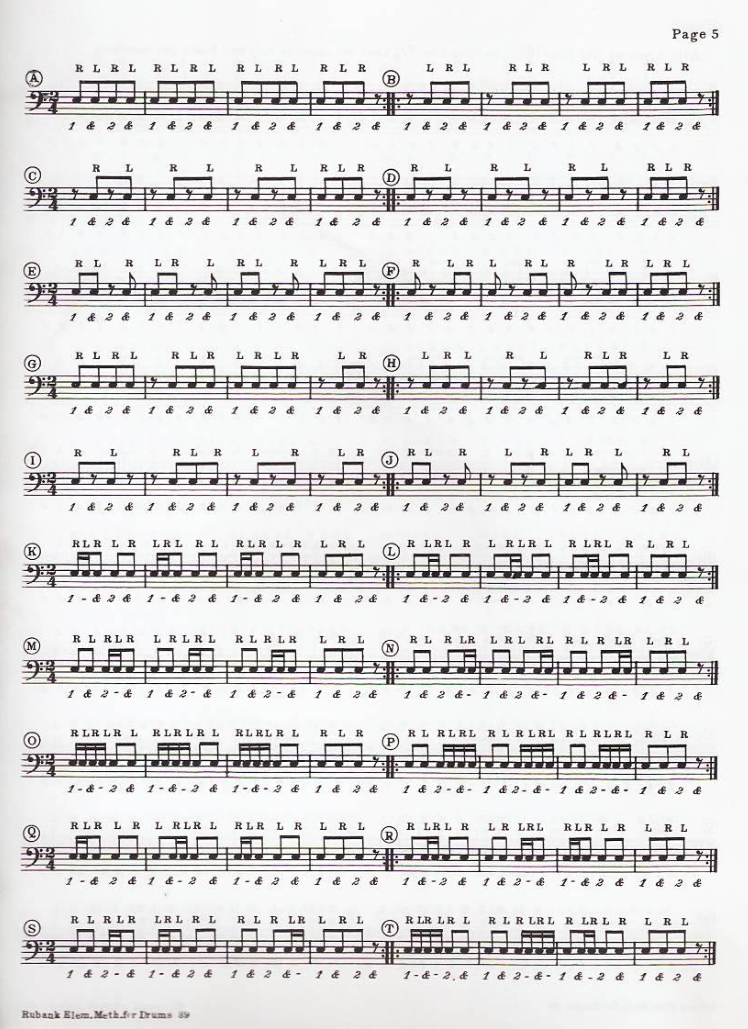
This is connected with all the fill related jive we've been dealing with lately. I share it with you to illustrate a thought process, not a particular set of licks. These are some things I did live while practicing recently, without writing anything down, using the following humble page from my own book, Syncopation in 3/4: 


You look at that see a lot of dumb rhythms in 3/4 time; I see an unending fairyland of playing possibilities for the drumset. You may put that in different terms. 

I happened to be playing along with a loop sampled from Herbie Hancock's Cantaloupe Island, which is in 4/4 time, with a straight 8th note groove. I was playing 16th note rate stuff against it, so I needed to double time those rhythms— line one for example:  


Becomes: 
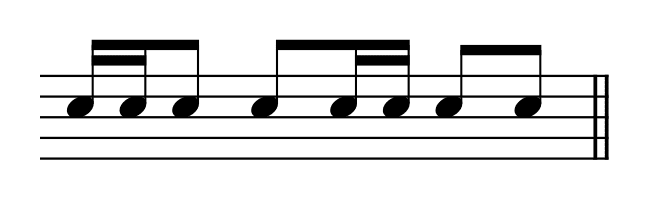

Played in a 4/4 environment that would be:  


For practice purposes, and concept purposes, we're interpreting that time signature as a description of the length of the rhythm pattern, not as a demand that we play in 3/4 time. 

The rhythm suggests a number of possibilities on the drum set just as a fill/solo idea— starting with RH on cymbal, with bass drum, on the 1; remainder of the rhythm played with the LH on the snare drum, with some help from the RH, as the embellishments get more involved. 


Of course we're going to move that around the drums, try some different stickings, accents and embellishments. Generally try to make music out of it. 

Some possibilities for line 2:


And line 4:  


You'll notice: 

- We often add bass drum at the end of the pattern, or between the quarter notes of the original rhythm.
- You can interpret the rhythms as a general pattern outline of fast and slow notes— you can substitute faster rhythms for the 8th notes in the original rhythm.
- You can embellish freely, double or buzz some notes, add flams, add ruffs.  

One facet of a larger topic of drumistic thinking. Drummeristic. Whatever. Drumming is a process, not just playing some notes somebody wrote down. More of this coming. This post may see a major revision when I can think about it while some guys are not reroofing my house. It sounds like Gene Krupa uncrating some wildebeest with a sledgehammer on d-day around here. 

Tuesday, November 19, 2024

Two measure Reed phrases - 02

Another cut-and-paste, hack-and-slash job, extracting some two measures phrases from the full page exercises in Syncopation. For when I want a particular kind of phrase, and don't want to hunt around the eight pages for it, and don't feel like writing it my damn self. These ones all end the same, with a dotted quarter note's worth of space. And they all start with a note on 1, not a rest. 


I had the right hand lead triplet system in mind for these, or any number of the straight 8th RH lead tweaks, that have something special happening in the longer spaces. 

Get the pdf

Saturday, October 19, 2024

Two measure Reed phrases - 01

Another cut and paste item— a specialty of mine— extracting some two measure phrases from the full page exercises in the book Syncopation. In lessons I have to hunt around for phrases I want, and this puts most of them together on one page.  These are all pretty tight rhythms, with no greater than quarter note spacing between notes. 


These will make good jazz solo phrases, in a right hand lead triplet interpretation, here based on pattern 8 on the page (written here with the RH part on cym/bad; the other usual way to do this has RH playing accents on the snare/toms, no bass drum, and LH ghosted on the snare): 


They'll also make slightly less-good funk phrases, with a half time feel funk rhythm in the first measure, and straight 8th right hand lead in the second (again, RH in second measure can also be played on SD/toms, no BD):


Monday, October 07, 2024

Meter-within-meter phrases

A page of meter-within-meter phrases— three beat rhythms played over four measures of 4/4:  


You'll want to be very familiar and comfortable with this kind of rhythm— it happens a lot in jazz, and if you get lost you're dead. Count through the sounding rhythm of each phrase: 


Also play just the first two measures of each line, played twice to make a four measure phrase. 

You can do this with my book Syncopation in 3/4— four measures of any materials in 3/4 = three measures of 4/4. 

Sunday, August 25, 2024

Reading a lead sheet

Some notes on a chart I had to play yesterday, on a festival gig with a pianist I've worked with quite a bit, Jasnam Daya Singh. He's Brazilian, and quite a heavy composer. For a one hour concert, he sent me 36 pages of music for I think 9 tunes.  

He was actually being nice, selecting tunes that we could learn with one rehearsal. It's not as bad as it sounds— they're basically normal combo arrangements... with, frequently, composed intros, outros, A1s/B1s, C sections, interludes, a different solo form, recurring vamps. That can add up to some pages. Fortunately we never had to flip from page 9 to page 1, all of the multipage pieces didn't have any backtracking with the roadmap.   

This was one of the friendlier ones. I was reading piano parts, and I've marked this one up up with some of the things I look for, and think about, and want to know when I'm playing something. I marked some of this on my chart in pencil, some of it I just see. 


STYLE:
It says bossa at the top, but it's a loose, modern instrumental bossa. You can't just play a repeating Girl From Ipanema beat all the way through. 


METER/TEMPO:
Typically Brazilians write sambas and bossas in 2/4 time, which he has done here, with 16th notes as the main subdivision, the cymbal rhythm. Tempo is 58. An American writing the same arrangement in 4/4, with 8th notes as the main subdivision, with a tempo of 116— that's how we're used to thinking of it. I think we played it quite a bit faster than this.   


FORM/ROADMAP:
The tune itself is an AB form, 26 bars long— 14+12. That's the melody of the tune, and the solo form. There is also a 10 bar intro, which occurs again at the end as an outro, preceded by a 12 bar coda phrase.

As I've indicated, the intro is played twice, then the main form is repeated a number of times for the head and solos. The chart says DS al coda, but there is no sign marked— he wanted da capo instead. The coda begins at the top of page 2. There is no coda sign indicated on page 1, but at the bottom of the page it says segue to coda on head out, meaning we play through all of page 1 and go directly to page 2.


MEASURE NUMBERS:
I've marked in measure numbers every four and eight measures, up to the phrase ending where there are extra measures— some phrases 6 and 10 measures long. I also marked the total number of measures at the beginning of each section— 10, 8+6, 8+4, etc— so I know what I'm in for. 

These ended up being a little misleading, because his phrases don't break down that neatly. On the soloing I'd be listening and playing basically 24+2 bars— the last two measures of the B section were distinctive, and made it easy to set up the top of the form. 


PHRASES: He writes a lot of extended phrases, four or eight bars with an extra measure or two at the end. Sometimes just an extra half measure, or one extra beat. Occasionally he'll do shortened phrases, three measures or seven measures long. 


CHORDS:
I look out for home base chords— like the CMaj7 that happens at the beginning of the A section and the intro/outro. I'll also look out for changes in the harmonic rhythm— the number of chord changes per measure— though that wasn't real helpful here. It's helpful to note where there is more than one chord per measure, or where a chord is played for more than one measure. 

In rehearsal I'm also listening for chords that jump out to my ear— like in the rehearsal I noticed the B7(sus 4) in bar 6 of the B section. Those are helpful for staying oriented while not keeping my eyes glued to the page. I played it only once in rehearsal and once on the gig, and didn't get a great feel for that yet. 


THE MELODY:
 On this tune I could state much of the melody rhythm pretty closely on the drums. I'm also looking for spaces in the melody where it might be appropriate to fill, and set something up— syncopated rhythms after a rest, usually. Above I marked in accents in some spots I would want to catch on the drums— syncopated tied notes. I just see those, I don't mark them on my part unless they're big and unexpected. 


Also see my chart reading pyramid post, and my weird tunes post for more on this type of thing. 

Sunday, July 21, 2024

Playing Bellson

Here's a video I made yesterday— there was a slight online mishegoss over me not liking the Reading Text In 4/4, by Louis Bellson, and it was requested that prove myself by playing one of the harder pages in it: 


I played a lot of things of this level of difficulty, and harder, as a student, via the usual snare drum books, but don't normally practice this kind of thing now. For reading difficulty, this isn't the most egregious page in the book, but there are several measures of it that are offensively written, with quarter notes (including dotted) placed on the & of 2 in several spots— that is only acceptable/correct in a couple of special contexts. 

I practiced it for about 20 minutes, put in beat marks on the more wrongly notated measures, then made the video— this was the second take. Tempo is about 90 bpm. 


Let's analyze/critique it like I would somebody else's video:

Accuracy there is 100%, and my time is solid— there's no metronome or anything. I am guessing at the timing of the quarter note triplet— if I was reading ahead better, and practiced the page a little more, I would anticipate it better and have better awareness of where beat 2 falls during that rhythm. Still, the timing is tolerably accurate, I don't believe I would be dinged for that. I'm a little bit seat of the pants in lines 7 and 8— the time flexes just enough to not be purely metronomic, but I don't legitimately drag. For all musical purposes it ends at exactly the same tempo as it started. 

With my touch, I don't think I'll be mistaken for a concert snare drummer. It's a good touch— I don't play hard— but it's a percussive touch, it doesn't scream concert snare drum musicality at you. That's a pretty strong concert f all the way through. If I were preparing this piece further, I would be looking to add some dynamic motion, if not actual dynamic markings. The phrases should feel like they're going somewhere, even when played at the same dynamic level. The writing here is not conducive to doing that automatically. I don't find it easy to make music out of this piece.   

My whole issue with the Bellson book, of course, is that it doesn't work well for what I want to practice on the drum set, which is my main purpose for that kind of book. I have a half dozen similar books I also do not use. Even with Syncopation, which I use all the time, I'll rewrite things, mark it up, and write new stuff to fill in the gaps in it. For the type thing in this video, I'll use any of 6-8 regular snare drum books.  

Wednesday, July 03, 2024

16th note reading boot camp

Plotting out an intensive couple of lessons with a younger student, who has been doing extremely well with his playing the past year, but who is deficient reading 16th note rhythms. It's not unexpected that there be some gaps. When you're young you learn a lot really fast, largely from the actual playing you do, and may not keep up so well with things requiring deliberate study. And the way I teach, I don't force things on people that they're not ready to get into. 

For a normal 14 year old he's about on schedule for getting this together. I'll be spending a pretty rigorous couple of hours with him on the subject to get him up to speed:


Counting 
First, just speaking the syllables counting the major single beat combinations of 8th notes and 16th notes, apart from reading them on the page. Including ghosting counts for rests— e.g., with a 16th rest at the beginning, 1e& becomes (w)e&. He is already good at this. 


Recognizing

Part of becoming functional in reading is simply recognizing a symbol or a one-beat group of symbols as representing a particular counted rhythm. That's mostly how reading is done, at first: people don't fractionally add their way through music, they look at one-beat symbols. 

Looking at the rhythms below, people can recognize that that's a 1e&, that's a 1-a, without actually knowing the values and accounting for each note of it. Which is why people will often mistake the 1e& rhythm for the similar looking 1-&a rhythm.   

When speaking the counts for these rhythms, say them with their proper spacing. Some students will say 1e&, 1-&a, or 1e-a, and space all the syllables evenly— they need to be spaced like the rhythm is played, even in conversation. 


The linear mathematics
Understanding the actual math of how a measure of music progresses, in linear order, from symbol to symbol: based on the value and placement of the current note, what is the count of the next note?

For example, in 4/4 time, a quarter note on beat 1 will be followed with something on beat 2— whatever kind of note or rest it is, it's happening on 2. An 8th rest on any downbeat will be followed by something on the &. A 16th note on the & will be followed by something on the a.  

For this we will be penciling in the counts for every single note or rest on the page. Using a throwaway printed page— not in the book or on the actual practice page. In his normal practicing, I don't want the counts written in. 


Once it's clear he's solid accounting for every single symbol in the measure, we'll do a little bit just putting in beat marks:


The person
Communication is a bitch. Everyone brings their own set of issues to the lesson, and is reprocessing the stuff you tell them their own way. You have to pay attention to your words, and to the person. There are a lot of ways to do it wrong. You don't want to lose the person— by bombarding them with detail, or by not making it easy enough... or by not making the easiness of it obvious to them. People overthink, and will look for a hard answer even when you give them a very clear, simple request or problem. 

You can also craft a lesson that progresses well, with easy steps, but they may also be impatient with that— with the easiness of it. They may have a strong urge to lunge right to the thing they can't do at all, and then give up because it's too hard. That's part of the problem for this student, I believe. He's already good with direct application of rhythm, and likely feels the reading is a hindrance.


Materials

I'll be using:

Syncopation - As briefly as possible, the 16th notes materials in it are boring and formulaic, but good for a specific state of learning them.  

New Breed -  Although it's not a real friendly environment for this student, the pages are well written, and in an engraving style I approve of. 

Funky Primer -  There's a good short 16th note rhythm summary at the beginning. 

Elementary Snare Drum Studies by Mitchell Peters - This has the best overall rhythm summary I've seen, with all ordinary 8th note/16th note rhythms, each written a variety of common ways. See the copied examples above.  

Reading Text in 4/4 by Louis Bellson - For the pencil and paper practice. I'll have him write in the counted syllables for each note or rest on the page. I've already given the reasons I don't like this book for regular practicing. Even for this it's barely useful to me.

Monday, June 24, 2024

Very occasional quote of the day: Grady Tate on reading

“I never dealt with drum music as such, because ninety-five percent of it had nothing to do with what's happening in the band. So many people have destroyed their careers by reading exactly what's written for them.

My thing in recording is to look at the music, listen to what's being done instrumentally, and see what elements of that drum music fit with what's going down with the other instruments.”


- Grady Tate, Modern Drummer interview, June 2001

Sunday, June 16, 2024

Syncopation Ex. 1 - modified for speed

Another one of my cut and paste jobs, this time inflicted on Syncopation Exercise 1, from Reed. P. 37 or 38, depending on the edition. I've modified it so there are no more than two 8th note spaced notes or rests at a time. I've written some other things with that limitation. It's good for speed, with many practice systems— right hand lead especially. 


Enjoy. There is no pdf, you'll have to print it from the image above. 

Saturday, May 11, 2024

What it is: reading music

The world is teeming with resources.

I was just involved in an extended, very contentious online discussion on the topic of reading music— Is it good to be able to read? Is it better to learn, or to refuse to learn? Is refusing to learn to read good musicianship too? Why not? Questions of controversy. 

The problem: people who can't read music don't know what reading music is, how and why it is done, or what it's for, and form their own wrong ideas about those things, and then tell other people about it as if they know something.  

A second order problem is that the same people often do not understand the nature of playing— on the drum set— which is to create a drumming accompaniment as you play it, with no preparation, on a piece of music you don't know, and have never heard before. That's the essence of playing, and reading is an extension of that natural thing. The chart is a guide for that— of varying specificity, depending on the situation, arranger, and employer.

Doing that kind of reading gives you clarity on what your job is as a drummer: playing time, figures, setups, fills, breaks, and percussion parts/effects (I'll clarify that last distinction, drums vs. percussion another time), supporting phrases and form, following a roadmap.    

Many drummers never have to do that kind of reading, and never do that kind of playing. They either play mostly familiar styles, forms and songs (or tunes), or their entire experience playing the drums is to learn “parts” from a recording, which they memorize and perform verbatim. When playing original music, they'll work up their own parts in rehearsal, which they then perform verbatim. What good is learning to read for them? 

It's communication
In terms of learning and practicing the drums, notation is a very fast, and clear, and permanent form of communication to you, from people trying to help you pay better. It makes it easier for you to take in new drumming information, and for you to give information to others. And to form your own drumming ideas. It's more permanent than a live demonstration, and faster than watching a video, or watching someone demonstrate it. It's not reliant on any individual's memory, perception, or perceptiveness.


It's musical structure

Learning how to read notation requires understanding a whole lot of musical fundamentals— the entire system is nothing but symbols for things it's important to know. What is a time signature, measure, beat, what are the rhythm values relative to each other? What are dynamics, tempo markings and alterations, articulations? What is a repeat, first and second ending, DS, DC, coda? 

What are the note names, what are sharps and flats, what is a key signature, and therefore a key? What do the chord symbols mean, and what is the structure of the chords to which they refer? What is harmonic rhythm?
 

What can't be notated
Thinking about areas of music that can't be notated, we can get an idea of how non-reading people have to do things. Swing for example. “Feel.” Whatever else. These are mysterious things, subjects of endless subjective debate— they're largely left up to the individual players, and their communities, to figure out. If somebody is not insightful in the right way, or is not exposed to the right stuff, and the right people, they're likely to figure it out wrong.  

Non-readers are like that about everything— what's a beat, what's a 16th note, what's a time signature. It's all mysterious, debatable, guessed at, figured out by vibe. 

How to start
There are different levels of it— knowing enough so you can use drum books in the practice room vs. knowing how to read professional drum charts, vs. how far you want to go beyond that so you can play another instrument and/or compose.  

Where it all begins is in learning to play basic stuff on a snare drum— playing through a beginning-level snare drum book. Most drummers would benefit by simply playing through the snare drum portion of book 1 of Rubank, and a basic drumset book. Funky Primer. Becoming expert at it is a long process, but the basics can be learned in a few lessons. Interpretive reading as is done with the book Syncopation can be done at virtually all levels of learning. Any and all reading situations are good— playing in school or community band or orchestra is extremely helpful, even if much of the time you are counting rests. 

Friday, March 22, 2024

Mozambique inversions

Library item that occurred to me while writing that last post. That Mozambique bell rhythm seems significant beyond just using it to play a Latin beat, hence this page, running it through its inversions. Half of them. You want to be psycho about it you can get the remainder of them by playing the second measure first.  

On line 1 you can easily see how the rhythm is constructed: a single note plus a double, then a single plus three doubles, like: 

⦾  ⦿⦿  ⦾  ⦿⦿  ⦿⦿  ⦿⦿

The actual Mozambique rhythm, which is on line 3, is an inversion of that. As is another common rhythm associated with Guaguanco, on line 6:


I have of course shared endless other ways of applying these type so rhythms to the drum set.  

Also see this roundup page with a lot more of this type of thing— up to January '23, at least— especially the tresillo/cinquillo inversion pages, and partido alto inversion pages.  

Get the pdf

Thursday, January 18, 2024

Philly Joe set ups

Here's a tune involving a lot of isolated kicks on the & of 2, where we get to hear a lot of different ways Philly Joe Jones sets them up— Blue Roz the Milt Jackson / Wes Montgomery album Bags Meets Wes. I've had a lot of people asking about kicks and set ups lately— here you go:


You can practice those as part of a two-measure phrase like this: 


Also move the kick over to the & of 3: 


Add two measures to the front of that if you need a longer cycle. Get the timing accurate from the cymbal accent to the following beat where you get back to the time— from the & of 2 to the 4 in the first example, from the & of 3 to the 1 in the second. They're easy spots to rush.  

Get the pdf 

Monday, October 30, 2023

Rhythm cycles

Here's a page to print out and staplegun to the wall by your drums: a summary of some major practice rhythms, and their inversions. Sometimes you don't need a readable page, you just need a quick reference to glance at. I should probably expand this and make a poster out of it. I'll certainly be updating it. 

Includes a couple of simple rhythms that don't have a name, and the Charleston rhythm, tresillo, cinquillo, three different rhythms in 3/4, played across the barline in 4/4. 


Play these as independent rhythms along with an ostinato, or in a Reed-style interpretation, or as ensemble rhythms/kicks— at the bottom are some practice phrases for that. Phrases 1 and 3 are good for a kick-type phrase, phrase 2 suggests a rhythm section figure, a la the tune Equinox. Plug in whichever practice rhythm you want in place of the example rhythm, of course. 


Wednesday, July 19, 2023

Basic 8th note rhythms with variations - two bar phrases

Item for one of my students. I generally have people learn their rock beats through Syncopation— once they can do a few basic beats reading them in the conventional way, we go over to my Reed based system to learn them thoroughly (that link is to a very old post, my little e-book covering the same method is more current). I want to convert them from reading a fully written out beat to just reading and counting a single rhythm, and interpreting it to make a rock beat. There are a lot of good reasons for doing it that way. 

These phrases cover the first eight lines from p. 10 in Syncopation— the first measure corresponds with the numbered line in Reed, the second measure is a variation of it, and we end up covering all of the one line exercises except 11, 14 and 15. 


Surprised I haven't needed this earlier. But the book is usually enough. You can't run everybody through every single thing. What's needed for one student may be belaboring the point for another. You can wear people out with that.    

Get the pdf

Friday, June 09, 2023

Kicks and setups with Reed - 01

We covered this cursorily back in 2011, let's talk about it again, with some more detail. 

“Kicks and setups” is big band drummer speak for one of the major jobs of a jazz drummer, or any drummer: playing accents in unison with the rest of the ensemble, and setting them up to help the ensemble play them right, and for musical effect— usually with one note or two notes on a drum, or with a longer fill. So: 

Kick* = ensemble accent played by the drummer. Usually with cymbal and bass drum, or cymbal and snare drum, or snare drum or bass drum alone on staccato accents. 

Setup = what the drummer plays before the kick to support it. One to three 8th notes, or a longer fill.   

* - Not to be confused with the “kick drum” itself— on this site I say bass drum


Some examples of how kicks and set ups are indicated in big band charts or other arrangements: 


The major kicks in those examples are the offbeat tied notes and dotted notes, which typically call for a set up by the drummer.  

So: get out your mark up copy of Syncopation, and go to p. 10, and on the fourth measure of lines 1-8, add a tie to the last in any series of 8th notes. Here's my current working copy, which has a few other extraneous marks:


Notice on line 8 the tie will be at the beginning of the fourth measure. I don't know why I put it there on line 4, I could have put it the end of the line. 

We're only concerned with the tied notes, and the 8th notes right before them. Interpret the rest of the line as slash marks, meaning: play time. So we would read lines 1 and 8 as: 


The tied note is the kick, the other 8th notes are the set up. Play the kick on cymbal, with bass drum in unison, play the set up notes on the snare drum. Play swing time for the rest of the line.   

Here's how you would play lines 1 and 2: 


Play lines 5-8 with all three untied 8ths on the snare drum, or leave the first 8th note on the cymbal, for a two-note set up— which is extremely common. So line 8, both ways, goes: 


Also invert that basic orchestration, with the kick played on cymbal and snare drum, and the set up played on the bass drum. On lines 4-8, put only the last set up note on the bass drum: 


So the first step is to play lines 1-8 both of these ways, including counting the four measure phrase correctly, coming back into the time feel after the kick correctly. Next we'll look at some ways of embellishing this basic framework. 

Saturday, March 11, 2023

Reed Linear Quarters - beat 4 displaced

With a student I've been working on a Blue Note type groove a la Cantaloupe Island, and the linear quarter notes lesson (pp. 8-9) in Ted Reed's Progressive Steps to Syncopation* seemed a good place to start. Just teaching somebody a finished beat off a record and saying OK, now you know “the song”— it don't work that way, there's a creative language involved.

* - I think Google will like me better if I write out the whole title like none of us have heard of it.


So we'll start building that with the linear quarter notes from Reed. A good place to go from there is to do the same thing, but moves some notes around. Like, let's play the note on beat 4 late— put it on the & of 4: 


The easy drum set application for this is to add 8th notes or quarter notes on a cymbal, maybe add hihat with the left foot on beats 2 and 4, or on all four beats. Play rim clicks on the snare drum and we've got some variations for a loose-form boogaloo beat, maybe a cha cha. 

Get the pdf

Thursday, January 19, 2023

Reading round up

I've been using my pages of syncopation rhythms a lot in teaching lately— similar to what's in Ted Reed, but written for a specific purpose, either for a specific drum set application, or to do something not covered in Reed.  

These are all collected under the label reading, but let's get links for the most useful ones all on one page: 

One line exercises: 

Charleston inversions
Tresillo/cinquillo inversions
Tresillo combinations - two measures
Dotted quarter spacing - no more than two in a row w/8th note spacing
Quarter note triplets
Two notes per measure - quarter note or greater spacing - mostly use Charleston page instead
Three note rhythms - mostly use tresillo pages instead
3/4 rhythms - with note on first beat, with no more than two notes in a row


Full page exercises:

Downbeats or &s
Single notes - quarter or dotted-quarter spacing
One or two notes - quarter or dotted-quarter spacing
Two notes per measure - quarter note or greater spacing
P. 38 with ties
Exericise in 3/4 - quarter and dotted-quarter spacing 


Special pages:

Reed in 7/4
7/8 rhythms
Marking up Reed
P. 38 inverted
Reed rhythms in 16th notes - in 2/4
P. 38 (née 37) in 16th notes
Partido alto variations


I also recommend my book Syncopation in 3/4, and Syncopated Rhythms for the Contemporary Drummer by Chuck Kerrigan, if you can find it. Louis Bellson's Reading Text in 4/4 is recommended, with caveats.  

Monday, January 02, 2023

Charleston inversions

Kicking off 2023 with a library item— file this with the pages of tresillo/cinquillo inversions, and this page. The Charleston rhythm is a form of the tresillo rhythm that found its way into mainstream American popular music in the 20s, that we use a lot in jazz drumming today, mainly as a comping rhythm on the snare drum or bass drum. Here I've written out inversions of it, starting on each beat in the measure, and their &s.   


On the second page there are some short exercises combining all of the inversions— in effect they're meter-within-meter phrases, but the idea is just to be able to follow each version of the rhythm some different ways, to not always have to space it the same way.  

Get the pdf

This has come up a lot lately, when people talk about rhythm in jazz— the Charleston rhythm. It's funny how all at once everybody starts saying the same stuff.  Nobody ever told me about it, I just heard it on a Mingus record and it was obviously a thing to play. And I had to play it as an actual thing playing dance music. 

Thursday, December 01, 2022

Best books: revisiting Rubank

The matte industrial looking horizon blue
cover has that depression era band room reek.
A fresh look at the very old, very turgid Rubank drum method books. Rubank, a series of method books for all band instruments, has been around since 1935, and is a core item in modern American school band literature. My only exposure to the book was in the 7th grade, when a teacher printed out a few pages for me. There are elementary, intermediate, and advanced volumes; here I'll mainly look at the elementary book, by Paul Yoger. 

Upshot: it's actually pretty good.  

I've never been completely happy with the available beginning snare drum books. Mitchell Peters's Elementary Snare Drum Studies is the best, but it's a little denser than it needs to be for average 5th-7th graders. 

All of these books have a few pages of fundamentals at the beginning, with a lot of verbiage, instructions on how to tuck a calf skin head, a picture of some jerk standing at a drum... all of which every kid in the world ignores completely. In Rubank there are just two pages of that, which are actually useful, covering grip, explanation of a roll (double stroke only), and a table of rhythm values and time signatures. 

The suggested right hand grip is interesting, a Moeller type grip with the fulcrum in back:


Then is the main body of the book, starting with four very useful pages of four measure rhythm studies, in 4/4, 2/2, 3/4, and 6/8 time. Then sections on 5, 7, and 9 stroke rolls, flams, and dotted notes, with more short studies— about 16 pages of those all together. All have stickings and counts marked in.  They're well graded and presented— better for younger students than Peters, or the Vic Firth and Roy Burns methods, which I have also used. 


It's a pretty quick introduction to the rhythms and time signatures they'll be playing in band class, with the more serious technical practice dedicated to rolls— that will be the hardest part for the target age group. The flam pages are good, and not over-technical.  

There's not a lot of verbiage, and what there is is pretty concise, even if it's not always phrased in a way that will be clear to students. But the point of that is not just for the student to read it and understand it immediately— it's more about giving the teacher the major points to re-explain to the student until they get it. 


There are pretty useless sections covering the bass drum, and some other band percussion instruments— cymbals, triangle, castanets, tom tom, woodblock, tambourine. And several pages of percussion parts for Rubank band pieces. 

There are eight OK pages outlining the 26 snare drum rudiments, and a few extra variants. Most are written in quarter notes, 8th notes, and 16th notes, and with roll notation, if there are rolls involved. The author wants us to play them slow to fast— all are marked with an accelerando— which I don't agree with. Acceptable, better than the usual single page list of rudiments.


The Intermediate book was written Robert Buggert, who has his own very old snare drum method book, that is pretty good, and long out of print. The intermediate Rubank book is all performance pieces for band percussion section— solo snare drum, snare and bass drum, full section. And a few band pieces. It's dated, and not real useful to me. There's also an advanced volume that I haven't seen yet. 

The elementary volume, even as it's pushing 90 years old, is still a pretty good first book for students in the 8-12 year old range. The roll section is a little out of balance for that age group, but rolls were important for that time and setting. Rudiments are covered but not over emphasized— it's not a hard core rudimental book a la Haskell Harr. It's a good overview of what a snare drummer, and band drummer, is. I'll probably use this with some younger students mainly for the rhythm portions.  

Saturday, November 26, 2022

Marking up Reed for chart reading practice

Continuing the kicks/set-ups Reed tweak— in aid of that kind of practicing, let's mark up the full-page exercises in Syncopation some more. You may not want to look at these changes all the time, so print out those pages, or get a second copy.

Exercise 4  on p. 41 has the most of the kind of activity we're looking for, so I'll use that. 

In the last post I suggested penciling in housetop accents on any off-beat long notes after a long space— three 8th notes worth of space before them, or more:


You'll notice a couple of those are not actual long notes— they're 8th notes with a rest after them. In the second and sixth lines. For these purposes we can treat them the same. 

Syncopation has a shortage of long notes on the &s of beats 2 and 4. They happen a lot in real life, they're rare in Reed. So let's make some by adding ties/accents to 8th notes on the & of 2/4, after a long space: 


To make it easier to read, let's mark the spaces where the set ups go. I put a little line there, you could write FILL, or whatever:


Oops, I missed one in the third line.

You can do this with all eight of the regular syncopation exercises in Reed— some are better than others. Start with 1 and 4, exercise 2 is not great. There are also a couple of the syncopation exercises in Louis Bellson's Reading Text in 4/4 that are usable, as well— pp. 18, 21-22. And my book, Syncopation in 3/4

Also see my much simpler post from 2011, Kicks and set ups using Syncopation. And probably my Chart reading pyramid while we're at it. And my 2021 post with other suggestions for marking up Syncopation