Showing posts with label very occasional quote of the day. Show all posts

Thursday, December 05, 2024

Very occasional quote of the day: technique

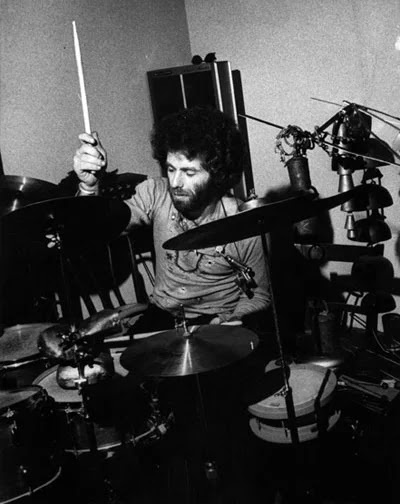
What if you think of something to play that doesn't have a standard technique? That's what jazz cats have been doing since jazz was born. All of a sudden, you want to play something that a flam doesn't encompass, or a paradiddle doesn't encompass, or anything else.

What is it? Maybe it's a flubadub. I don't know, but you play this flubadub, and the only way to play this thing is to use the technique you discovered to play it. So you have added to the standard technique by playing this thing. And if you can use it musically—it works!

There is no right and wrong. If it's musical, it works. So just to sit and practice standardized techniques from drum books will not make you freer. The concept makes you freer, not your technique.

- Barry Altschul, Modern Drummer interview by Rick Mattingly, November, 1982

Monday, November 11, 2024

Very occasional quote of the day: epic

From Hal Galper on Facebook:

“I’d heard a recording of an interview with Coleman Hawkins that stuck in my brain. He said you had to go to the city twice. The first time to learn the city,  the subways, where the jam sessions were and meet the doorman at every jazz club in town. You can then evaluate your playing relative to the scene, figure out what you had to get together and go home to prepare yourself for your next and hopefully permanent visit. It took me three times 

Boston at the time had two top level jazz clubs. George Wien’s Storyville was across the street from The Stable. The NYC bands came to town I'd interrogate them to find out what it was like to go to the city. Everybody had a different story. That's when I realized what happens to you in New York City only happens to you!

I was failing miserably in high school except for Shop as they called it. Grasping at straws, my parents got the idea to send me to a technical prep school my sophomore year in Boston’s Copley Square, coincidentally just across the street from The Stable, Boston’s local jazz club. I had my lunch breaks there, eventually taking a couple of bongo lessons from the club’s janitor just do do something jazzy. I’d bail on the classes spending the rest of day hanging around the club catching the sounds of Serge Chaloff rehearsing from my perch at the top of the ramp that led down to the basement venue. That was where and when I first met and took my first ever jazz piano lesson with Ray Santisi. He hand-wrote out a lead sheet with the melody to Moonlight In Vermont with some simple, nice sounding changes telling me to come back when I’d learned it. I didn’t tell him I couldn’t read. My 2nd lesson, Ray asked me to play the tune. I sat frozen staring at the lead sheet. He opined “forget it kid, you’ll never play.” I remember hearing the receding Doppler Effect of his shoes as he walked up the ramp and out of the club.                                                                                                      

Back in Salem again I came home, unkempt but unbowed. But It was too late, I’d caught the bug. Didn’t know if I could play. How could I? I knew nothing. I spent my senior year of high school cutting classes, jamming with my first trio in the back room of the school’s music director, Mr. Devoe. My bass player was Mary Burke from Tennessee and local drummer, John Pramis. Mr. Devoe, he got me. With an unending supply of pre-signed absentee approval slips in hand I jammed my way through my senior year ostensibly working on “the senior revue.,” which was actually true. Having the courage of my ignorance I played my first trio concert at the Review. Two originals. The first was in the key of C, the only key I knew a little bit about at the time, following with another in C minor, which I knew even knew less about. I knew nothing about form or structure. Considering the absolute silence that ensued, it was at best a head-scratching performance. 

You want this record.

I was facing a bleak and uncertain future until I learned Massachusetts had a State program offering financial support to disadvantaged students for tuition to go to college. I had lost my left eye in a childhood accident and qualified for full tuition at any institution of higher learning of my choosing. Really? Looking forward the end of the semester I expected to be called down to the Dean’s office because my attendance record was so bad.  He said, “Mr. Galper, if you do’t start doing any better you won’t  graduate.” Prepared, I gave him a mental F—K you, asserting I didn’t didn’t need no stinkin’ graduation because I was going to be a jazz musician. I left triumphant. My path was clear and didn’t attend my graduation.

A year later I was studying with Ray again at Berklee College Of Music. He’d play the piano while I sat  beside him, watching his small hands skitter over the keys in awe. If you were quick enough to stop him and ask, he'd show you what he played. I hadn’t become much of a better musician since our abortive encounter at The Stable and didn't learn a thing that semester. However, I studied with him again a year later and redeemed myself. I was much faster and copped royally!

Ray had been playing 6 nights a week at The Stable forever when he handed his seat over to me! I mean, who does that? I was playing seven nights a week, Tuesdays and Thursdays with Herb’s big band, the weekends in a Varty Haroutunian’s quintet with Herb Pomeroy and Monday nights with Sam’s quartet or Gene Distatio’s Quintet. One night he came into the club, pulled me aside to remind me of our first two lessons. I had completely forgotten the incident. He told me he’d learned an important lesson as a teacher. “Never second guess a student, they can surprise you.” Considering the context, his gesture was incredibly sweet and generous. He didn’t have to tell me that and he did so without ego. A lesson in humility learned and never forgotten.

“Never second guess a student, they can surprise you.”


Following 3 years of intense study with the great Madame Chaloff I was overly protective of my new chops. Alan Dawson was the drummer with Herb’s big band. A great drummer and a prince of a man but he was a lick-stepper, following my lines too close, duplicating the rhythms I was playing. I Hate That! Duplication is death to the music. Playing what you play isn’t dialog. All that tells me is you can hear. Don’t play my ideas, play your own ideas! Can’t have a conversation if the other person says the same thing back to you. I’d have to breakup my phrasing to get away from him. Not bad training in itself but I was staring to lose my hard won chops. The crazy part of me got out of the box and I lost my cool. Like an idiot I pressed Herb with an ultimatum, it’s either me or Alan. No one else in town could play the band’s drum charts and they had Ray Santisi. I was promptly fired having unknowingly broken protocol, instantly becoming persona non grata in Boston. Lesson learned. I have since never given an ultimatum to anyone. In any case, no matter what, it’s inevitable you’ll eventually bypass the musicians you came up with. You’ll know when it’s time to leave town when they make you leave. You’re a reminder they didn’t stick to the true path. So I left, giving what few gigs I had to Mike Nock, split with my first wife to Berlin to Paris to test the waters. I was back in Boston a few months later  month without a wife, broke with a brick of hash strapped to my chest, the proceeds of which kept me alive for six months. I figured, gee, I guess it’s time for me to go to The City. Duh! 

Stuffed my life into an old blue Navy B4 ever-expanding suitcase and took a bus out of town. Was told to get off at the Port Authority unawares there were two Port Authority bus stations. I got off at 178th St at 2 am with nineteen cents in my pocket, dragging my B4 down a deserted Broadway to West 75th St where I had a couple of friends I’d met the previous summer who’d let me sleep on their floor until I got my shit together. Tried to bum a penny to get 20 cents for the subway but everyone I asked gave me a weird look. Had I known more about NYC culture I would have asked for a dollar. As I walked downtown B4 in hand I kept thinking “welcome to New York Hal, welcome to New York.”  

Looking back, I'm more than ever convinced most of the important decisions in our lives are made below the level of consciousness, something I expect to expound upon in the future.”

Sunday, September 29, 2024

Very occasional quote of the day: go ahead

“Don't be afraid. Go ahead and play.”

- Charlie Parker, quoted by Miles Davis, interview by George Avakian

Monday, September 02, 2024

Very occasional quote of the day: relationships for leaders

“The only thing that is really important in your relationship with actors is that they must know that you admire them, that you admire their work, and there’s no way to fake that. You must really admire them or you shouldn’t use them. If they know that you admire their work, which they can sense in a thousand different ways, it doesn’t really matter what you think of each other or what you say to them, or whether you are terribly friendly or not. The thing they care about is their work. 

Some actors are very amusing and pleasant and always cheerful. They are, of course, more pleasant to have around than those who are morose, vacant, or enigmatic. But how they behave when you're not shooting has very little to do with what happens when the camera turns over.” 

- Stanley Kubrick, Sight And Sound interview, 1972


Alec Guinness and I were making a film called Tunes of Glory several years ago. At the end of about the first week he was very sulky. He was very low and miserable and grumpy and irritable. I said, “Alec, what’s the matter? We’re all trying very hard and you seem so miserable and depressed and it’s getting us all down. We feel as though we’re not getting a good picture and that you don’t like any of us. Is there anything I can do?” 

He said, “You know, Ronnie, I have been working on this picture for nearly two weeks and not once has anybody ever said to me, ‘'Alec, you are really very, very good. We think you are marvelous.’ 

I said, “Well, good gracious, Alec, we think that you are marvelous. What we are trying to do is live up to you. We have taken it for granted that you know we think you are marvelous.” 

He said, “Ronnie, I have to tell you something about actors.”

- Director Ronald Neame, in Directing The Film, by Eric Sherman

Wednesday, August 28, 2024

Very occasional quote of the day: leading and musical direction

People in a band have a tendency to fall into ruts. They hear things only one way. They don't really want to change that much. The guitar player will only play guitar a certain way. It's very hard for that person to hear what I'm hearing.

On some tunes, I might be looking for someone to sound like Eric Gale, and then on another tune, to sound like Van Halen, and then on another piece, to sound like Ritenour.

That's asking a lot of one player. So I try to keep my mouth shut and take what I get from that individual. I try to see if I can't write in such a way as to get the guitar player to think about a certain genre of music to play inside.

- Billy Cobham, Modern Drummer interview by William F. Miller, July, 1986

Saturday, August 17, 2024

Very occasional quote of the day: better ideas

You know, there are no bad ideas. Only better ones. Let's not say, “That wouldn't work” or, “That's a stupid idea.” If it's a stupid idea, the rule is we don't judge, we just keep moving forward until we find the right answer. Okay?

- Stanley Kubrick, quoted in Full Metal Jacket Diary by Matthew Modine


And stop being against something just because it looks “weird.”

- Boris, a fictional film director modeled after Kubrick. Terry Southern, Blue Movie

Friday, August 09, 2024

Very occasional quote of the day: excitement


MD: You use a lot of dynamics and have a beautiful touch.

JW: I've worked very hard on that lately: just getting the quality of my sound together. It's not that I don't want to play energetically, but whenever people come to see a drummer they almost expect that, and there's an art to bashing. Some people bash away and it sounds contrived.

There's a sound that a drum and cymbal get that's primal, that's part of the tradition of the instrument, and that can only be achieved by hitting them with a certain force and intensity. Now I know that, if during a set I play two and three sweet ballads, a couple of medium-tempo blues, and maybe a hip Latin thing, and if, during an upswing thing, I cut loose for a minute and bash, the average person will go away remembering that I was bashing. So that's part of the drums, but I don't want to be limited by that.

MD: Well, a drummer is supposed to create excitement.

JW: I do enjoy that, definitely: sweating, burning, and swinging hard. That's what our band is about.

- Jeff Watts, Modern Drummer interview by Chip Stern, September 1985

Thursday, August 01, 2024

Very occasional quote of the day: interesting

“It may sound like an extremely obvious thing to say, but I think it is worth saying nevertheless that when you are making a film, in addition to any higher purpose you may have in mind, you must be interesting; visually interesting, narratively interesting, interesting from an acting point of view. 

All ideas for creating interest must be held up against the yardstick of the theme of the story, the narrative requirements and the purpose of the scene; but, within that, you must make a work of art interesting. 

I recall a comment recorded in a book called Stanislavski Directs, in which Stanislavski told an actor that he had the right understanding of the character, the right understanding of the text of the play, that what he was doing was completely believable, but that it was still no good because it wasn’t interesting.”

- Stanley Kubrick, interview from Sight And Sound, 1972


As a drummer you could read that and think OK, I need to play interesting then, and start making some bad playing decisions. You have to be careful how you take advice from other art forms.      

As players, the job is to play. It's an immediate thing of making the performance, while hopefully— though it's not hip to talk about it— communicating some creativity and movement of energy. There are some consummate sidemen whose only concern is truly just to show up and do the job, but I think we all would like to be engaging when we play— that may be a better word than interesting for us.   

Interest is more of a consideration when acting as a bandleader, producer, arranger, or composer. There's time to think about it— in selection of players, repertoire, programming an album or set of music, style of production, and in the actual content of an arrangement or original composition. 

It is more hip for musicians to be thinking strictly about performance and craft aspects, and while we don't want to be preoccupied with audience response— what the hell— unless somebody is a more serious artist than Kubrick, it's worth some consideration. 

Thursday, July 25, 2024

Tailoring the game to your talents

An extended quote from the book Moneyball, about the baseball player Scott Hatteberg, and his approach to hitting, and his experiences with the lavishly funded Boston Red Sox and the meagerly funded Oakland As organizations: 

[Hatteberg's] cultivated approach to hitting— his thoughtfulness, his patience, his need for his decisions to be informed rather than reckless— was regarded by the Boston Red Sox as a deficiency. The Red Sox encouraged their players’ mystical streaks. They brought into the clubhouse a parade of shrinks and motivational speakers to teach the players to harness their aggression. Be men!

Hatty sensed he might be in for trouble when he saw how the Red Sox management treated Wade Boggs. He’d spent a lot of time with Boggs in the batting cage during spring training, trying to learn whatever he could from the master. Boggs, a perennial All-Star, famously never swung at the first pitch—or any pitch after that he didn’t love. Boggs was as efficient a machine as there ever was for acquiring information about opposing pitchers. By the time Wade Boggs was done with his first at bat, his team had seen everything the opposing pitcher had.

Boggs’s refusal to exhibit the necessary aggression led to his ostracism by the Red Sox. “They would get on him for taking a walk when there was a guy on second,” recalled Hatteberg. “They called him selfish for that.”

If Wade Boggs wasn’t allowed his patience, Hatteberg figured, he certainly wouldn’t be, either. When Hatteberg let a pitch go by for a strike— because it was a strike he couldn’t do much with— Red Sox managers would holler at him from the dugout. Coaches would try to tell him that he was hurting the team if he wasn’t more inclined to swing with men on base, or in 2-0 counts. The hitting coach, former Rex Sox slugger Jim Rice, rode Hatty long and hard. Rice called him out in the clubhouse, in front of his teammates, and ridiculed him for having a batting average in the .270s when he hit .500 when he swung at the first pitch.

When you're lavishly endowed with either money or talent— as both an organization and an individual, in this case— your money and talent can cover for bad doctrine. Or doctrine that doesn't work for people not similarly endowed:

“Jim Rice hit like a genetic freak and he wanted everyone else to hit the way he did,” Hatteberg said. “He didn’t understand that the reason I hit .500 when I swung at the first pitch was that I only swung at first pitches that were too good not to swing at.” Hatty had a gift for tailoring the game to talents. It was completely ignored. The effect of Jim Rice on Scott Hatteberg was to convince him that “this is why poor hitters make the best hitting coaches. They don’t try to make you like them, because they sucked.”


The following is about integrity— not in the usual sense of sticking to principles, but of doing something a certain way, even when you are not supported in it, because it's the only way you can do it, it's the only way you know to do it well: 

Each time Scott Hatteberg came to bat for the Boston Red Sox he had, in effect, to take an intellectual stand against his own organization in order to do what was right for the team. Hitting, for him, was a considered act. He didn’t know how to hit without thinking about it, and so he kept right on thinking about it. In retrospect, this was a striking act of self-determination; at the time it just seemed like an unpleasant experience. Not once in his ten years with the Red Sox did anyone in Boston suggest there was anything of value in his approach to hitting— in working the count, narrowing the strike zone, drawing walks, getting on base, in not making outs.
“Never,” he said. “No coach ever said anything. It was more, get up there and slug. Their philosophy was just to buy the best hitters money can buy, and set them loose.” The Red Sox couldn’t have cared less if he had waged some fierce battle at the plate. If he had, say, fought off the pitcher for eight straight pitches and lined out hard to center field. All that mattered was that he had made an out. At the same time, they praised him when he didn’t deserve it. “I’d have games when I’d have two hits and I didn’t take a good swing the whole game,” he said, “and it was like ‘Great game, Hatty.’”

Pro ball never made the slightest attempt to encourage what he did best: take precise measurements of the strike zone and fit his talents to it. The Boston Red Sox were obsessed with outcomes; he with process. That’s what kept him sane. 

The Oakland As took an ensemble approach that emphasized getting on base by any means necessary, including getting walked. By necessity; they didn't have the money to hire star talents, so they sought out undervalued players who were nevertheless very good at getting on base— the “Greek god of walks.”

The moment he arrived in Oakland, the friction in his hitting life vanished. In Oakland, he experienced something like the reverse of his Boston experience. “Here I go 0 for 3 with two lineouts and a walk and the general manager comes by my locker and says, ‘Hey, great at bats.’ For the first time in my career I’ve had people tell me, ‘I love your approach.’ I knew how I approached hitting but I never thought that it was anything anyone cared to think about.” All these things he did just because that’s how he had to do them if he was to succeed were, in Oakland, encouraged. The Oakland A’s had put into words something he had only felt.

“When you go to the plate,” Hatty said, “it’s about the only thing you do that is an individual thing or seems like an individual thing. When you go to the plate, it’s about the only thing you do alone in baseball. Here they have turned it into a team thing.”


I encourage you to read the book— it's relevant on a lot of levels. The movie is fun, and a good hook for that, but the real stuff is in the book. Maybe the most important point is that there's more than one way to do all of this. Not everything has to be done through the obvious front door.  

Thursday, July 11, 2024

Very occasional quote of the day: movies

“[T]here is so much to love in movies be­sides great moviemaking.” 

- Pauline Kael, Movie Love

Kael was a movie reviewer for the New Yorker magazine through the 70s and 80s. I think most of her books are out of print, but you can read them online here. I still keep a falling-apart copy of 5001 Nights At The Movies from ~1985 by my bed. 

Thursday, July 04, 2024

Very occasional quote of the day: play what you hear

“Play what you hear, and if you can't play it, then practice it.”

- Barry Altschul, Modern Drummer interview by Rick Mattingly, November, 1982


Periodic reminder that, creatively, the fundamental equation is real simple. Of course, if you don't hear anything, you have to get some stuff in your ear by listening to records and seeing people play. 

Sunday, June 30, 2024

Very occasional quote of the day: productivity

If people saw the way I lived, they'd realize that I spend a huge amount of time just relaxing and goofing off, watching baseball on television, going to movies, taking walks, playing jazz, and practicing my clarinet. I don't work around the clock at all.

How productive is my output? A film every year at most, probably even a little longer than that, and occasional magazine pieces and that's really it. It's not all that much work. If you work only three to five hours a day, you become quite productive. It's the steadiness of it that counts. Getting to the typewriter every day is what makes for productivity.

- Woody Allen, interview with Robert F. Moss, Saturday Review, 1980

Monday, June 24, 2024

Very occasional quote of the day: Grady Tate on reading

“I never dealt with drum music as such, because ninety-five percent of it had nothing to do with what's happening in the band. So many people have destroyed their careers by reading exactly what's written for them.

My thing in recording is to look at the music, listen to what's being done instrumentally, and see what elements of that drum music fit with what's going down with the other instruments.”


- Grady Tate, Modern Drummer interview, June 2001

Sunday, May 12, 2024

Very occasional quote of the day: mesmerized

“The fault with most drummers is they get carried away, mesmerized by the sound of the instrument.” 

- Larry Ridley, Jr. Modern Drummer, July, 1981

Saturday, April 13, 2024

Very occasional quote of the day: form

“It is easy to forget that the man who writes a good love sonnet needs not only to be enamored of a woman, but also to be enamored of the Sonnet.” 

-C. S. Lewis

Tuesday, April 02, 2024

Very occasional quote of the day: Joe gives advice

“When I was playing the Vanguard with Freddie Hubbard, I went back to the kitchen and Philly Joe was there. He said, 'You're playing good. You gotta kick Freddie's ass, make his lips burn.' All the while Freddie was telling me I was playing too loud.”

-Lenny White, Modern Drummer interview by Aran Wald, 1977

Saturday, March 09, 2024

Very occasional quote of the day: no such thing as better

“We have only to fight as well as the men who stayed and fought at Shiloh. It is not necessary that we should fight better. There can be no such thing as better.”

- Ernest Hemingway, Men At War


That book was compiled and edited by Hemingway during WWII, and was widely read by people serving the US military then. I found the quote in my father's copy, a 1952 paperback edition, which I believe he was reading when he was in the Korean war. It was directed at people who were actually having to do that stuff. 

In drummer terms, you could say we have only to play as well as Art Blakey on Somethin' Else, or Jack Dejohnette on Live Evil. Harvey Mason on Breezin', Billy Higgins on Rejoicing, you pick.  

You're thinking oh, really, is that all?, but it is done all the time. Like the thing Hemingway is talking about, in situations less famous than the one he mentions. The rest of us get to play as good as them sometimes. We may not get as many equivalent playing opportunities, and there are other things that go into making a player, a playing career, and historical profile, but we can handle our available situations as well as they would. 

We don't get to play better than them. You're not going to outplay Blakey by doing harder stuff, by having faster singles, or by executing better. Your favorite awesome drummer isn't going to outplay him. There may be other reasons for working on those things, but to be a better artist than him is not one of them.  

Monday, February 05, 2024

Very occasional quote of the day: religion

“This is my religion. I take long breaks now when I don't perform and I am not myself when I am not performing.”

- Roy Haynes

h/t Sheet Music Library 

Friday, January 19, 2024

Very occasional quote of the day: feel gotten with respect

From Vernon Reid's Twitter feed

Funk ain’t easy. Many ASSUME  that it is. Swing is complex, but it doesn’t grant carte blanche over other styles. Every idiom has its nuances that demand respect & attention to detail. If the particular Feel isn’t gotten with RESPECT ? Not gonna happen.

Sunday, November 26, 2023

Very occasional quote of the day: you call it swing

“You call it swing, but what I’m saying is it’s a rhythmic sophistication that causes a euphoric reaction, and on a folk level that reaction can go anywhere from sensual feelings, to partying, to dancing, to actual meditation… That positive feeling can actually cause healing. 

I sincerely believe that’s one of the main purposes for rhythm, if not for music period, to cause that kind of healing effect.”  

- Billy Hart, Billy Higgins memorial roundtable, by Ted Panken

[h/t to @thenuge at DFO for the link]