Showing posts with label Stick Control. Show all posts

Saturday, October 05, 2024

Stick Control with a backbeat

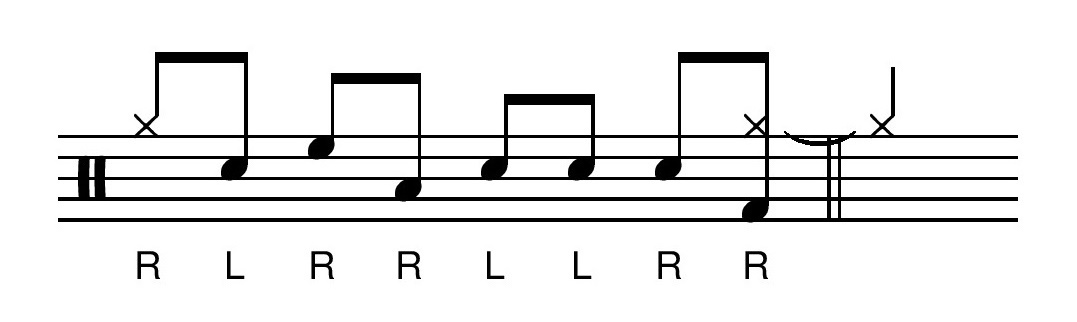
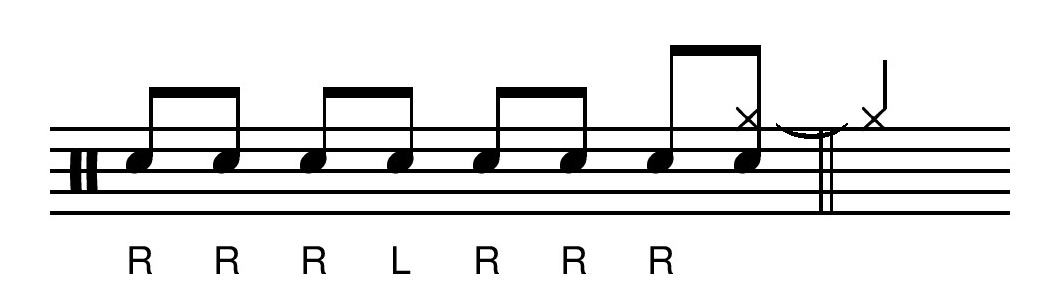
Another little oddball Stick Control related item, for drum set: some Stone-type sticking patterns with accented unisons added, on beats 2-4, and on beat 3. Introducing the idea— if you like it, you could obviously go a lot further working out of Stick Control itself. 


Play the right hand on the cymbal, left hand on the snare drum. Ghost the non-accented LH hand notes, play all the RH notes at an even volume. Add bass drum however you like— a particular kind of nut case could use the reading in New Breed for that.  

See also this other oddball item, and the right hand lead with a backbeat Syncopation system. Similar minor items. These things exist in the cracks between the actual major drumming vocabulary items, to create openings for other things to happen. 

Get the pdf

Monday, August 26, 2024

EZ 8th note groove with Stick Control

A simple 8th note groove sequence using the book Stick Control, played on the drum set. 

Use Stick Control pp. 5-7, or my page of sticking patterns, which I think is in a better order. This is a good thing to do along with music. 

1. Play the sticking pattern from the book with the right hand playing a cymbal, with the bass drum in unison, and the left hand on the snare drum: 


2.
As above, except the right hand plays running 8th notes on the cymbal. So reading from the book, the bass drum plays the Rs, the left hand plays the Ls, and the right hand plays along with everything: 


3.
As above, except the right hand plays quarter notes on the cymbal.


UPDATE: Oh, one other thing: cymbal in unison with Ls. L = both hands/SD-cym, R = bass drum: 


Play those in sequence without stopping, switching from one thing to the next every couple of measures, or every measure, and then as quickly as you can, not necessarily changing right on the 1. The end result hopefully keeps the SD/BD pattern mostly intact, with the cymbal rhythm varying in a loose way. You can probably tell that this connects with some other things we've been doing recently. 

Rock materials for drum set are usually limited to here are some one measure beats, here are some fills. Here's how some guys played some songs, which you should copy exactly. This idea is part of a larger project of mine, devising some methods for a more open approach, for students of all levels. It's about playing, not just learning to play “parts.”

Saturday, August 03, 2024

Rock with Stick Control!

A little thing I improvised while warming up for a rehearsal.  All my rock stuff is oriented around getting off the hihat, getting both hands moving around the drums. A lot of students get locked into that crossed over hihat playing orientation. 

We're playing Stick Control patterns on the cymbals and snare drum, and adding bass drum rhythms from another source. Circled notes are played on the snare drum, other notes are played on the cymbals— R on a right side cymbal, L on a left side one:


The bass drum rhythm can be gotten from any normal rock book, like Funky Primer, or Joel Rothman's books. I use Syncopation, playing p. 38 top to bottom using each sticking, with the bass drum playing the melody rhythm (except I usually omit the bass drum notes on 2/4). I might also accent the cymbal hits that are in unison with the bass drum. 

I would want a student to pretty experienced and comfortable with ordinary materials before messing with this, like after they can to play Syncopation p. 38 all the way through with a basic rock feel.   

Fully worked out, this could look really overchoreographed and stupid, like bad YouTuber stuff. The point is to do it enough to open things up, to have some freer movement. 

See my rock drill, and beats to fills pages, and my wrong stickings game for more like this. 

Monday, January 15, 2024

Stick Control in 7 by Ralph Humphrey

A little item from an old issue of Percussioner International magazine, which I just found in my mom's basement— the Steve Smith issue, from November 1987. 

Here Ralph Humphrey shares some paradiddle-based stick control patterns in 7/8:


Humphrey says:

Practice each exercise with the written accents. But remember that when you begin to apply the patterns to the drum set, you might choose to keep the accents intact, or try a linear approach and set the hands off so that you hear the rhythm that each hand creates. This may change your accents and also change the way the rhythm sounds.


The main drum set application he suggests playing the patterns right hand lead style, with the R on the cymbal and the L on the snare drum (and moving to other drums), adding bass drum as follows: 

The choice of  bass drum placement depends on the style you wish to create, and/or helps to support one of the hands. Notice that not all of one hand's pattern is supported with the kick as this would create a heavy or over-active bass drum part. Learn to abbreviate the kick part so that it supports the hands and stands by itself. Experiment! 


Basically, he adds bass drum along with some, but not all of the RH notes. 

Also see my Stick Control in odd meters posts, and Dahlgren & Fine in 5/4, for some other possibilities for adapting those books into odd meters. And see my Stick Control related posts generally, there's a ton of stuff. 

Tuesday, November 22, 2022

Stickings a la Funky Primer

This is part of why I write so much stuff— you never know what a particular student is going to need, and in what form. For whatever weird reason, somebody will do really well with one thing, so I want to take it further than the original material. 

Like one younger student responded really well to this obnoxious looking page of sticking patterns from A Funky Primer: 


Hence this, taking it a little further: 


In the lesson we did this with his lead hand on the cymbal, other hand on the snare drum, with bass drum added on some or all of the cymbal notes, and the 32nd notes played on the snare or toms. He plays left handed, and we did just the patterns starting with the left hand. 

I'll be playing through it in a right handed orientation all the way— RH on the cymbal on all patterns. You could also do it in a reversed "open-handed" orientation by playing the starting hand on the cymbal.

Get the pdf

Wednesday, November 16, 2022

Sticking patterns for drum set - basic

An item for one of my students— an adult student who is new to reading music: a page of sticking patterns, based on this 2018 post reorganizing the first pages of Stick Control. I could just circle the appropriate patterns in Stone, but I'm trying to be a nice guy and not make people flip around and go cross eyed looking at a page jammed with 500 sticking patterns when they're just starting to read.

These mostly start with the right hand, and are relatable to normal drum set stuff when played with one hand on a cymbal. See also my page of sticking patterns for jazz from a few days ago. 


Play with right hand on a cymbal, plus bass drum in unison / left hand on snare drum. Repeat many times.  Do it with music to stave off boredom. 

Get the pdf

Thursday, November 03, 2022

Stick control patterns for jazz

I posted something like this before, but here it is in a new form, for a different student— we're using some sticking patterns to simplify learning some basic jazz coordination. 


Swing the 8th notes. Play the sticking pattern on the snare drum, and then play the corresponding drum set rhythm by moving the right hand to the cymbal, and adding hihat played with the foot on beats 2 and 4. Practice along with your favorite record or an appropriate loop. 

Saturday, September 24, 2022

Subtractive method: an alternative approach

I just saw this from brother writer Jon McCaslin, over at the excellent and much hipper-named Four On The Floor blog: a Syncopated Stick Control method, which he's using to bring some rhythm interest to practicing Stone. It's sort of a parallel thing to my “subtractive” method. 

Both things are similar to the natural sticking idea, in which you stick mixed 16th note rhythms with the RH on all the #s and &s, and the LH on all the es and as. As if you were playing alternating 16th notes (an RLRL pattern), and dropping out notes to make the rhythm. We're just doing it with sticking patterns other than RLRL. 

It's hard to explain just in writing, much easier— and very worth it— to actually do it. 

Jon is basically eliminating the first note of any doubles, and the third note of any multiples, on either hand, or both hands— and some other things. Read his post, he illustrates it well. 

It's good to have slightly different angles on the same thing— it takes us to a total understanding of the basic materials and ideas we use in learning and teaching the drums, and the different ways might be better for doing some specific things. 

Tuesday, April 12, 2022

Jazz fills with Stone

Another item from a drum lesson. A student and I were playing around with Stick Control, using it as a launch pad for jazz fills. The starting place was my post on rubadub using Stick Control— we went someplace else with it. We can use some rubadub type moves, but it's not the main thing. 

First, play one measure of any line from Stick Control, pp. 5-7, on the snare drum, swing interpretation. Let's start with line 4: 


No problem. The nature of a fill is that it happens in the context of a time feel, so we need to get away from the cymbal, and back to it. Put the last note of the pattern on a cymbal, on the & of 4— as always with a cymbal accent, add bass drum: 


Playing a fill in jazz time, it's most natural to end the time feel on 1, and then start the fill— whatever is written in the book, the 1 of the fill measure will be a RH on the cymbal: 


That's the basic framework. You can then try moving the right hand around the drums: 


To get a non-hokey swing interpretation, usually you'll emphasize the right hand, and don't habitually accent the down beats with either hand. 

With sticking patterns ending with a left hand, you have some options for how to end the fill. You could end with an accent on a drum on the & of 4, and come in with time on the cymbal on 1, normal volume— no accent:


You can add cymbal to that & of 4 accent: 


Or you can just end on the & of 4 with a cymbal and bass drum accent, played with hand indicated in the sticking, or just with the right hand, regardless of the written sticking: 


It's a starting point for trying some things. Play around with it for a few days, and you'll find some useful patterns, and some patterns that don't want to sound goo— so you play them a little longer trying to figure it out. A lot of things in drumming you don't need to work comprehensively— relentlessly drilling all 72 patterns at all tempos— to get something useful from them. Better to find a few easy things you'll do all the time, and improve at some ideas that are hard for you to make sound good. 

Tuesday, February 22, 2022

Stick control in 12/8 - “Afro logic”

Here's what that page of 6/8 sticking patterns was setting up— and that funny joke photoshopped page from Stone: sticking combinations in 12/8, oriented like the Afro “short bell” rhythm, with one pattern on beats 1 and 4, and another pattern on beats 2 and 3. This is for people like me, who do a lot with that Afro groove— it's one of my major personal things.   


I'll be playing through this on the drums, with RH on the cymbal, possibly with the bass drum in unison,  and with the left hand on the snare, playing around with some of the usual moves around the drums. Probably with dotted quarters played with the left foot. 

Get the pdf

Friday, February 18, 2022

Stick control patterns in 6/8

This is part of a larger writing project I'm doing— some things you have to write out to decide if they're going to be of any use. You can see that the logical sequence here is unusual. File this in your library with the myriad of other items in 6/8 on the site. 


I rarely play any kind of stick control-type pattern just on the practice pad— except with students. I'll usually play them on the drum set, with one hand on a cymbal, with the bass drum in unison, or some variation of that. Or with one hand accented and the other hand ghosted.  

Get the pdf

Thursday, February 10, 2022

Stick Control with short bell logic

Another one of my little photoshop gags— I edited a jpeg of the first page of exercises in Stick Control to follow the logic of the Afro “short bell” pattern*, which has beats 1 and 4 the same, and beats 2 and 3 the almost the same. The page is written in cut time, so each beat is four 8th notes long. Look closely and you'll see what's happening: 

* - That page is due for an update— maybe I'll do that soon. 


I got the idea when I was teaching a student that linked Afro 6 page above, and was curious to see how it would play out when written out. I haven't decided if this is actually worth practicing, but this logical orientation is a real world thing— notice that if you play pattern 1 with your right hand on a cymbal, you'll get something very close to a partido alto rhythm— and I won't be surprised if it develops into something creatively useful, with some different stickings.  

Monday, October 04, 2021

Subtractive method overview

Here's a broad overview of this subtractive thing I've been working with. It's a new approach, but not unprecedented, and I think it's worth exploring. The idea starts with a Stone-type 8th note sticking pattern, and applying it to rhythms from Syncopation, leaving out any notes of the pattern that are not in the rhythm. 

It's simply the natural sticking concept applied to more complex patterns. Natural sticking, remember, means sticking a rhythm based on which hand would have played that note if you had been playing alternating singles.

The running 16ths represent the underlying pattern, the bottom part represents that sticking applied to a rhythm: 


We're just applying it to some other stickings, or voicing patterns. For example, if you did the above same rhythm with a paradiddle sticking, you'd get the following:  


The only other critical difference is that we're doing this on drum set, with a snare drum / bass drum pattern instead of a right hand / left hand pattern. I believe it's easier to do this on the drum set, using two different sounds, fulfilling a role in a particular style. Simply doing it on a practice pad with Rs and Ls is too abstract. We'll also be doing the entire system with 8th note patterns and 8th note-based rhythms, counted in 4/4 or 2/2.  

We've essentially done this already with my cut time funk drill— where the 3 is played on the snare drum, and everything else on the bass drum, implying an underlying pattern of:

BBBB SBBB

There's another funk interpretation (see step 2. in the link) where we play the first half of the measure on the bass drum, second half on the snare drum, which implies this pattern: 

BBBB SSSS

My rock method, with snare drum on 2 and 4, and everything else on the bass drum, basically implies this:

BBSB BBSB

To those we would add a cymbal rhythm played with the right hand. In fact those actual practice methods were a little different— if the snare notes were missing from the book rhythm, we would add them, or displace them to match the book rhythm exactly. But the basic principle is similar. 

And it's the same as John Riley's idea we called “that with interruptions”— his phrase— where he would play a SSBB 8th note pattern with a jazz cymbal rhythm, dropping out some notes of the pattern. It's the exact same thing, except now we're arriving at it by reading rhythms from a book, and voicing them according to whatever SB pattern we choose. 

This is a learnable system— personally I've been drilling the original pattern BSSB-SBBS in a funk style, and have had no problem applying it to all the pages listed below. I'm also working on it with the Mozambique bell pattern, which is much more difficult. I can do all the one line exercises, but the long exercises— even with just quarter note rhythms— are progressing much slower. I'll run some of the simpler jazz systems and report back.  

You could do this using all of the stickings from the beginning of Stone, or with my page of funk stickings, playing the Rs on the bass drum and Ls on the snare drum, in any number of styles. But the system is difficult enough that you should be selective about it. 

First patterns for jazz:

SBSB-SBSB
SSBB-SSBB
SSSB-SSSB
SSSS-BBBB
SBBS-SBBS


Funk patterns:
BSBB-SBSS
BSSB-SBBS
BBSB-SSBS
BSBS-SBSB
BSBB-SBBS
BSSB-SSBS

The BBBB-SSSS pattern above is probably the best place to start with the funk patterns; that gives the broad outline of all of the funk patterns, which are generally oriented around bass drum in the first part, and around snare drum in the second part.

Add any additional parts you want; jazz cymbal rhythm and hihat for the jazz patterns, quarter notes, 8th notes, or another rhythm for funk. If you want to tackle the Mozambique rhythm, I suggest starting with the rhythm for the first measure only, repeating, and then do the complete rhythm. 

Use those patterns to voice the top line rhythms for the following pages in Syncopation: 
4-5, 10-11, 30-32, 34-45. 

Warm up with the complete pattern, the complete bass drum part by itself, the complete snare drum part by itself, and then the pattern applied to some simple rhythms, as illustrated in the first post on this topic. 

We'll see where this goes. I'm very encouraged by what I've done so far with the BSSB-SBBS pattern, which has the practical effect of developing a lot of fluency with a tresillo bass drum rhythm— you end up playing a lot of the rhythm itself, and parts of it, and variations on it, with simple added parts on the snare drum. Some applied rhythms create some “hip” inverted/displaced beats; it's nice to arrive at that stuff not by sitting down and contriving something hip, but just by playing normal syncopated rhythms following a normal drumming pattern. More to come on this topic. 

Wednesday, January 27, 2021

Stone flam beats as independence patterns

I like doing this once in awhile: converting familiar materials into another format. Rhythm patterns (plus filler) can be converted to sticking patterns, accent patterns can be converted to rhythm patterns, sticking patterns can be converted to accent patterns... and vice versa. Any of them can be put into another rhythm or meter. We infer a lot of what we do on the drum set from those types of materials.  

Here I've written the eighteen basic flam beat patterns from Stick Control (p. 16) as coordination patterns for two voices, with the flams written as unisons. 


I'll be honest, I don't have a lot of use for this, but I often think about it when I'm practicing those pages. Like, what rhythm is each hand actually playing? It's good to know. For me it does illustrate how inane the Stone patterns are as real drum set vocabulary. It's rather dense nonsense, weighted on the 1. Good for developing an Ed Blackwell style of soloing on the tom toms, though. 

One possible place to take this, to make a Garibaldi-esque funk groove: eliminate the snare hit on every 1, or play that note on the bass drum. Accent the left hand on every beat 2, ghost the other LH notes. Add bass drum to any remaining RH-only notes you wish, or in gaps in the rhythm— es of the beat on patterns 1-7. You may find some connection with this and the funk stick control patterns I wrote back in November. 

Get the pdf

Tuesday, December 22, 2020

Page o' coordination: jazz / RLRR

Working on this Elvin project the last couple of days, I noticed that, similar to Max Roach on another recording, he plays the snare drum in the gap in the cymbal rhythm a lot, for a sticking of: RLRR RLRR. It's almost like a foundation pattern, a home base. This a page using that pattern, adding some basic things to it.  

I already wrote this page, more or less, last year, but this version is easier. I'll use this with a few of my novice jazz students. I really like teaching the same basic thing several different ways. Like if we just teach jazz comping rhythms with Chapin, people start thinking jazz = one-measure left hand independence patterns vs. a static cymbal rhythm. If we only do Syncopation, maybe they won't have all finer points of the coordination worked out. You never know what idea is going to click for what person, so they really understand what they're doing, and are able to use it creatively. 


Swing the 8th notes. Treat the complete exercise patterns as extensions of the base RLRR pattern— they're places to go from the base pattern. Add the hihat on beats 2 and 4, or— and this is another thing I notice Elvin doing a lot— on the & of 1 / & of 3, in unison with the snare drum. Actually Elvin does it most often in unison with the bass drum, but that'll have to wait for another page of stuff.

Also see my other pages of sticking patterns for jazz. Also check out a post from a long time ago, The Kenny Note, in which I noticed the Kenny Clarke sure does play that comping rhythm a lot.  

Wednesday, November 25, 2020

From the zone: ECM feel

Here's something sent in by Ed Stalling of Missoula, Montana. He mentioned being inspired by my ECM feel post from 2012— which definitely needs to be revisited and some links updated— but he's got his own thing happening here. 


I like the idea of notating flam rudiments for two voices this way. Normally on drumset I would write them with two complete rhythms on one set of stems. Here you can ignore some of the notes, and just play the basic sticking pattern, and add the flams to make the more challenging overlapping independent rhythms. It really suggests some interesting possibilities for ways of practicing Stick Control. You could do that with the flam pages from Stone, but I don't find it real inspiring with the flams/unisons in the same place every time.  

Get the pdf

I encourage you to send in your own writings for inclusion in a “FROM THE ZONE” post— seriously, anything scraped off the floor of your practice room, where you wrote something out to figure it out. I don't care how bad it looks. I want it to look bad. Take a picture with your phone and send it to my email link you see in the sidebar. 

Wednesday, November 04, 2020

Stick Control patterns for a certain type of funk

 A thing we do here is to rewrite/re-organize existing materials to make them better for practicing certain things. I hate hunting around the page while I practice, flipping pages, dodging things that are no good for what I'm practicing. 

Playing with a loop from a Meters song, I played some Stick Control combinations on the drumset to make a funk texture— I combined all the four-note patterns starting with an R with all of the four note patterns starting with an L. So beat 1 was an R, beat 3 was an L.  

You could just memorize the first thirteen patterns from Stone and figure out the combinations in your head while you play, as I did— or I can write them out so I have something to post on the blog, and maybe a few people will actually do it. Some of these combinations are already in the book, others are not. There are two pages, the first is most useful. 


Play this in 2/2, with the Rs as cymbal + bass drum, Ls as snare drum— with the appropriate hand. I put an accent on the cut time beat 2; or beat 3 if you're counting in 4/4... look, do this: 


I played quarter notes on the hihat with my foot, and played the unaccented snare drum notes pretty strongly— I wasn't ghosting them. It's an ordinary orchestration we do with Syncopation all the time, but it's hard to do this exact thing without using Stick Control-type patterns. 

It's similar to what Zigaboo Modeliste does at times, de-emphasizing the cymbal rhythm. And it's a lesson in a certain un-intricate concept of funk. I like unintricacy in funk. We're playing an 8th note grid, but it's a grid of interlocking parts, which creates a strong groove. To me, groove-wise, plain 8th notes played on a single sound is a weak structure; interlocking parts is a strong structure. You may not play this way all the time, but it sets you up to move some different directions— especially if you're used to playing funk with a repeating cymbal rhythm, or a linear cymbal rhythm. 

Get the pdf

Thursday, October 08, 2020

Jazz fundamentals: more stick control for jazz

Another jazz fundamentals item, that pairs nicely with Monday's thing. These are some stick control patterns designed to be played on the drumset, for a specific jazz vocabulary lesson. That's a lot of what we do here. I wrote something like this back in March, with a slightly different purpose— a nice thing about having software like Finale is that it's easy to focus our materials.

This page is meant to help with adding the left hand to some basic cymbal rhythms, and also to help get the timing of some common figures— “additive rhythm” style. We'll be seeing that term again in coming days.


Swing the 8th notes. Play the right hand on the cymbal, left hand on the snare drum. Add bass drum to some or all of the RH notes. Add hihat on beats 2 and 4.

Some of the patterns have the option of playing the left hand on beat 1— those are to get the timing of a cymbal accent on the & of 4. 

Get the pdf

Wednesday, July 15, 2020

Stick control exercises, mixed rhythm in 2/4

A page I'm using with some of my students, to learn to fill, and develop basic facility on the drum set. We've been doing a lot with parts of my harmonic coordination method— which is proving to be a lot more of a universal thing than a mere advanced coordination system. You could do these on snare drum as in Stone, but I think that would be a little dull. They're written to be played on drum set, en masse.


Play the exercises a few times on the snare drum, then move the accent(s) to a cymbal, with the bass drum in unison, then improvise moving the non-accented notes around the drums. Speed is not important; timing, sound, and movement around the drums is.

Get the pdf

Saturday, May 23, 2020

Three voice / four note patterns

Continuing in the vein of the recent three voice/three note patterns item. Let's call this series “things I have always been against writing that I am now writing.” I've been playing around with an online combination generator, making some Stick Control-type patterns for the drum set, including combinations of limbs. I'm trying to do it in a rational way; it would be easy to produce an insane collection of patterns that would be totally unusable.

This is a practice-able collection of four-note patterns, written for three drum set voices, including single notes and RH-LH and RH-RF unisons. It adheres to my usual rules for what makes something very playable: no more than two SD or BD hits in a row, and no more than three cymbal hits. It's similar to things found in Dahlgren & Fine, and Chaffee, but different.


So: what is this good for, and how do we practice it?

1. There are 120 patterns, so you have to move as quickly as possible. Try to cover all of the patterns in 15-30 minutes.

2. Use to develop an ECM-type texture, or as conditioning for breaking up a normal funk texture. Could also be played with a swing feel, addressing some possible coordination/timing gaps.

3. The patterns are written as 8th notes in 2/4, but you can play them on a four note or three note subdivision, as 16th notes or triplets. Doing them as triplets, it helps to know how the cymbal portion of the pattern lies in 4/4— a separate cheat sheet for that is coming soon...

4. Try these moves:
• Play the written cymbal/snare unisons as snare/tom unisons, or as flams on any drum— I suggest doing them left-handed, meaning the right hand lands first.
• Play cymbal/bass drum unisons on a different cymbal than the plain RH cymbal notes.
Doing those moves makes this very similar to what I do with my harmonic coordination improved system, except with more potential for speed.

5. Add hihat in unison with the left hand only notes, or the right hand only notes, or the bass drum only notes. Or add hihat in any basic rhythm suitable for the style you're playing.

5. Combine patterns from different sections to make linear funk grooves. Play patterns starting with a bass drum first, and patterns starting with a snare drum second. I arranged them on the page to make that fairly easy— sections A and B combine well, and C and D combine well. You can also do A/D and C/B. Section E could come first or second. That creates a vast number of combinations, which... there may be better ways of working on that sort of thing. I'm not a proponent of endless systems. But it's a possibility.

Get the pdf