Tempo is about 256, solo begins at 2:36.

All the notes are played strongly, except the ones in parentheses. You'll notice not all the left hand stuff lines up perfectly with the cymbal.

A drumming blog written by Todd Bishop.

Here's a drum solo by Billy Higgins, from the tune Third World on Freddie Hubbard's album Bolivia.
I've never played this tune and didn't count out the form. It starts with 8 bars of an ensemble figure with drum fills, which also occurs at the end of every solo chorus. The transcription begins with that section at the end of the piano solo, then Higgins's actual solo begins at bar 9. And you hear Higgins play the figure in the last 8 bars of his solo, then the band comes in with it on the head out.

Snares off. 8th notes are swung, or half-swung. The bass drum is feathered through a good part of this; also there are some random hits I didn't notate. The hihat really isn't used at all, maybe one or two random notes I didn't notate. Look for places to add doubles when moving around the drums— like in measure 11, the first two triplet partials are played with the same hand.
At measure 41 there's a little rhumba part that is difficult to notate There are a variety of sounds happening, and changes in pitch— which I didn't indicate. The regular Xs are rim clicks, the alternate Xs are played on the rim (possibly with the R instead of the L indicated), and the house top accents are rim shots.

The solo starts at 5:18 in the track, or at - in the video of the full album below:
Here's a composed drum duo played by Max Roach and Stan Levey, on their album Drummin' The Blues. They trade off on some parts, and play in unison on others. I believe the whole thing is pre-written— by Roach, from the sound of it— maybe the trading portions are improvised.
Begins at 3:03 in the track, tempo is 127 bpm.

They didn't just breeze in and do the session, they took some trouble to tune their drums the same, and select cymbals that sounded similar, and their execution is very tight— no flamming between players on the unison parts.
If you're able to loop the first four bars, you can hear that bars 1-2 are one player, bars 3-4 are the other, mainly from the pitch of the cymbal. As best I can tell, they're trading twos— soloing two measures each— in the first 8 bars, then playing together. This would be a good recital or jury piece for somebody. If I were going to perform it, I'd look into some creative ways of splitting it up between players, fill it out with some actual improvised trading.
Get the pdf
Duo begins at 7:51 in the video below:
Another archive item— lots of action around here right now, and not a lot of time to write. And I just found some more of my old writing. I wrote a lot of drum stuff in school.
Here I've bashed out a transcription of a four bar drum break by Danny Gottlieb, on the title track from his album Aquamarine. By the end of it I clearly lost patience with it.

I haven't listened to a ton of Danny Gottlieb. This was released in 1987, when fusion was easing into what people started calling “fuzak”, and this record was a little light for me. It's difficult for me now. But I made an effort to listen to it. The break happens at 2:56 in the recording.

Here are the next 30 seconds / 32 bars of Duo, played by Peter Erksine and Bob Mintzer, from Mintzer's record Hymn. The whole track is about three and a half minutes long, so there will be three more of these before we're done.
Here they're trading fours— every second line is Erskine's solo. It's interesting, normally you might think of Erskine as being a very deliberate player, and therefore working with a lot of set patterns? It would be an easy stereotype to make. Here I feel like we're seeing how patterns evolve in the hands of players like this.

Let's look at those Erskine's fours line by line:
Line 2: Hahahaha, he's doing “my” pattern! He plays a three-beat pattern three times— starting on beat 4 at the end of line 1. The second time the notes got shoved around a little bit, if you're going to learn it, just play the straight pattern: RLL-RLR-LBB. In the third measure he does another pattern, RRL-LBB.
Line 4: Again he starts his solo before the 1. There's some overlapping snare drum and bass drum here— at the time I would have associated that with a “New Orleans” kind of thing. The tempo is fast so you don't really hear it, but it was a thing of the time that people were cultivating.
Line 6: Just linear rhythm here, showing you how a couple of small changes in rhythm and dynamics can have a big effect.
Line 8: Some not real particular stuff. You could practice that move going into the second measure, connecting alternating singles with a SBSB pattern, via a double on the bass drum:
||: RLRL :|| RLBB ||: RBRB :||
It's a good idea to practice soloing with alternating singles, and developing some options for varying them and getting out of them, and connecting them to something else.
On each one of those breaks you can hear how the end of his solo is very clear, always setting up the horn in the last two or four beats.
Blogger won't let me embed the video directly, click through to hear the tune on YouTube.
I don't know what younger drummers' current perception of Peter Erskine is, but when I was a student he was one of the top guys, always thought of as being exceedingly musical, with a great sound. And slamming, at times, like here— later on I got the feeling that he regarded overtly exciting playing as a kind of obligation to keep the punters happy.
...I'm still a little annoyed that I didn't get to study with him when I was at USC. He was teaching a couple of the other drummers there, and later became regular faculty. I did get to drive him around and hang a little bit when he came to the U. of Oregon later. A bassist I knew at SC, Jesse Murphy, got to play with him a little bit, and his comment about his time always stuck with me: Where else could it be?
This is from Bob Mintzer's 1992 record Hymn, and is titled Duo, with Mintzer and Erskine playing duo. I had a bunch of records with this group: Erskine, John Abercrombie, Marc Johnson. I missed this one— when it came out I was buying all the Joey Baron records I could afford.
This is the head, the first 30 seconds of the recording. I'm going to try to do the whole thing, in installments. Tempo is 258— getting into the top end of the range where you'd swing the 8ths, and play many triplets.

It's funny, this is all baseline modern vocabulary, but there's a specific thing happening here. I don't recognize it much in my own playing any more, I hear it a lot in my brother's playing— I need to think about it, I'll give whatever kind of analysis I can manage another time...
Blogger is not letting me embed the video directly, click through to hear the tune on YouTube.
More Ben Riley! From the same record as yesterday— Thelonious Monk Live At The It Club— and in fact this is the very next tune they played at the gig, Bemsha Swing. So, two drum solos by Ben Riley, that he played within within 10 minutes of each other.
Bemsha Swing is a 16 bar tune, a miniature AABA— a four bar tune played four times, played in a different key on the bridge. He plays three choruses— 48 bars— in real clean four bar phrases.
The solo starts at 6:37:

Once again there are a lot of abbreviated 16ths, and some triplets. Hihat is spotty, often played on 2 and 4, but not really integral to the main idea. There's also not so much bass drum feathering activity here— often on the longer runs of singles it'll be there.
Lots of phrases start with that 1 &2 & figure with the cymbals. And a lot of obvious paradiddles happening there— anytime you see those lone notes on the floor tom on an e of the beat, and probably elsewhere with the 16th notes.
Again, Blogger isn't letting me embed the video, so you'll have to open it up in YouTube or get out your record to listen.
Solo by Ben Riley on Blues Five Spot, from the Thelonious Monk record Live At The It Club. Great record, and core literature. I think of Ben Riley's playing as maybe the cleanest shot we get at pure, classic-form modern bop drumming. Everything's real clean and worked out, and not idiosyncratic. Still, he plays creatively and has a nice musical sound, and he's real enjoyable to listen to.
The tune is a 12 bar blues, and Riley solos over four choruses— 48 bars. He doesn't seem to be outlining the choruses strongly— especially as he gets into the long roll— but if you sing the tune over the solo, it all makes sense. He does make the end clear by playing rhythm stuff on the last four bars before the head out.

Riley feathers the bass drum basically all the way through this. It's very worked out— if he makes an accent on the & of 2, he probably feathered it on 2, and was back into the feathering on 4. We see something like that in bars 22, 46, and 47. There's very little audible hihat, so I left it out. Occasionally I'll hear it on a beat 2 or 4.
The 16th note moves around the toms are a little unusual, he moves on the es and as— clearly there's some kind of mixed paradiddle type sticking there. Figure out a sticking that works for you, and pencil it in.
Be careful with the abbreviations here— remember how those work: total slashes/beams on a note = note value you play for the duration of the written note. Two slashes and/or beams on a note = play 16ths, three slashes and/or beams = play 32nds, or actually, roll.
Notice some of the abbreviated rhythms have tuplet indications above them— several 5s and a couple of 3s. The 3s indicated a 16th note triplet, likely sticked RRL. The 5s indicate tap five stroke rolls, played in a quintuplet rhythm: RLLRR LRRLL. It's not that unusual a thing. I see I haven't written about abbreviated rhythms yet— see Podemski for a complete breakdown of how that works.
Get the pdf
Blogger isn't letting me embed the video, so listen to the recording here, or dig it out of your record collection, you should own it.
Joey Baron's solo over a 7/4 vamp on Goldfish, from Dave Douglas's 1997 album Stargazer, to which I'm listening a lot this week.
There's not a ton of drumistic content to it, it's more of an attitude— it's a power solo, playing off the structure, for impact. Mostly pretty simple syncopated melodic things on the snare and toms, with big accents on the crash cymbal, with the bass drum or snare drum. You can play this way, solos don't have to be technical.
Actually the vamp is three bars of 7/4 plus one bar of 9/4.

Here we go, tempo is 142 bpm:

He plays quarter notes on the hihat with his foot part of the time, but it's not really central to what he's playing, so I left it out. Play it if it helps you, especially setting up the syncopated rhythms he's playing on the rest of the set.
He's two crash cymbals along with the ride cymbal— one of them is pretty trashy, almost a China sound. The ride cymbal is not the usual taped up thing he was using at the time, every other aspect of his sound is familiar, from that period— punchy toms, very fat snare drum (I still copy that sound, to some extent), he wails on a 16" crash pretty often, 20 or 22" bass drum tuned for a full sound.
There aren't a lot of internal dynamics happening— things are mostly pretty strong, at a pretty even volume. It's a different thing, playing bam-bam style, vs. playing with a lot of soft things mixed in with your loud things.
He does play big dynamics on that single stroke roll at the beginning. That takes a lot of ability.
I am not screwing around people, this is now an ALL Max Roach site. Here he is trading fours on Minor Meeting, from the record Sonny Clark Trio, from 1960— there's another record by that title from 1957 with Paul Chambers and Philly Joe Jones. This would be a good jury or recital project for somebody— it's very clean look at some classic solo stuff.
The chorus of trading begins at 2:07, the tempo is a bright quarter note = 262— compare that with some other well known up tempo tracks.

Apparently there's no tom tom present, as Max plays the whole thing on snare drum, bass drum, and cymbals. I've offered some likely stickings. There seem to be a lot of six stroke rolls happening.
The beginning of most of these breaks is phrased in 3/4 time within 4/4— lines 1-2, 4-5, and 7. On line 3 he plays a 4/4 idea twice, then displaces it. On line 6 he also plays a 4/4 idea twice, then does the meter within meter thing in the third-fourth measures, with a simple running 3/8 pattern.
On this second of two days of major acts of white supremacist violence here in this paradise we call “the USA”, let's retreat into art, with part 2 of the thing from the other day: Max Roach's drum solo on A Little Sweet, from his record The Many Sides of Max.
That's what music is for. It's our job to do it with dedication in the face of a world gone totally insane.
Max's drum solo begins at 1:49 in the track.

Much of this consists of something I called “Max's rubadub”, because of its similarity to Mel Lewis's thing. The bass drum, cymbal, and snare drum are doing a kind of rolling, integrated, New Orleans type of thing. It's worth your time to learn some two and four bar excerpts from this, and some single measures.
More soloing from Billy Higgins, on Dear John, on Freddie Hubbard's record Bolivia. The tune has the same chord changes as John Coltrane's Giant Steps, which is a 16 bar form, but the drum solo here is basically open— it's 55 bars long, with a cued ending, broadly phrased in 8+7+16+16+8 bars. Shifting that one bar one way or the other, depending on how you hear it.
A lot to learn about musical development with him. Sometimes he follows a measure to measure bop type of phrasing, like in the first 8 bars; other times he'll sit on an idea for a while, like most of the middle of this solo, first with the repeated accents on the cymbal, then with the Latin style thing. The last 8 bars is setting up the horns to come in with the head out.

Like the last Billy Higgins solo we looked at, this is mostly about the hands— the bass drum is used mainly for accents. As always, his articulation is very legato. I've given a few stickings, you can assume the same types of things are happening throughout. Figure it out and mark it up yourself. There are some interesting things happening with flams and ruffs in the second line.
Between measures 32-44 he plays a six-beat motif that is easy to see when you write it out with three bars per line, not so easy to follow just listening to somebody solo. I don't if it's a regular thing of his, or if he just vibed it, or what.
Get the pdf
The solo begins at 5:13 in the track, but the video below is of the entire album, so you'll have to find it— the piano and bass play through the top of the form in the first few measures of the transcription.
Some uptempo trading 8s and 4s on Moose the Mooche, from an old favorite album, Wish by Joshua Redman, with Pat Metheny and Charlie Haden, and Billy Higgins on drums. I used to play along with this track a lot.
Tempo is a little over 300 bpm, and trading begins at 2:17:
.jpg)
Virtually all the activity here is with the hands— there is a little feathering the bass drum in half notes in the last 4. Maybe there's more than that, I didn't check. Distinction between accents/non-accents is not extreme, though notes marked as ghosted are definitely ghosted. Obviously there are paradiddle-type stickings happening on the tom tom activity.
A Max Roach epic here, a chorus of fours and two solo choruses on I'll Remember April— not a short tune. This will probably go in an e-book sometime, so get it free while you can. Chuck a few $$$ in where it says DONATE in the sidebar if you feel like it.
It's from Charles Mingus's live recording The Charles Mingus Quintet & Max Roach— Max is sitting in on this tune, the drummer on the rest of the record is Willie Jones. I'll Remember April is a 48 bar tune— ABA, each section is 16 bars. Often the A sections are played 8 bars Latin / 8 bars swing, swing on the bridge. The transcription ends 8 bars before the end of the second chorus— on the last 8 they play a rhythm vamp, and then vamp for 16 more bars before the horn comes in with the head out.
The fours start at 7:24. Tempo is about 180— it picks up some during the solo, and settles back to 180 on the head out. FYI the tune starts around 180, and settles to around 175 through the horn and piano solos.
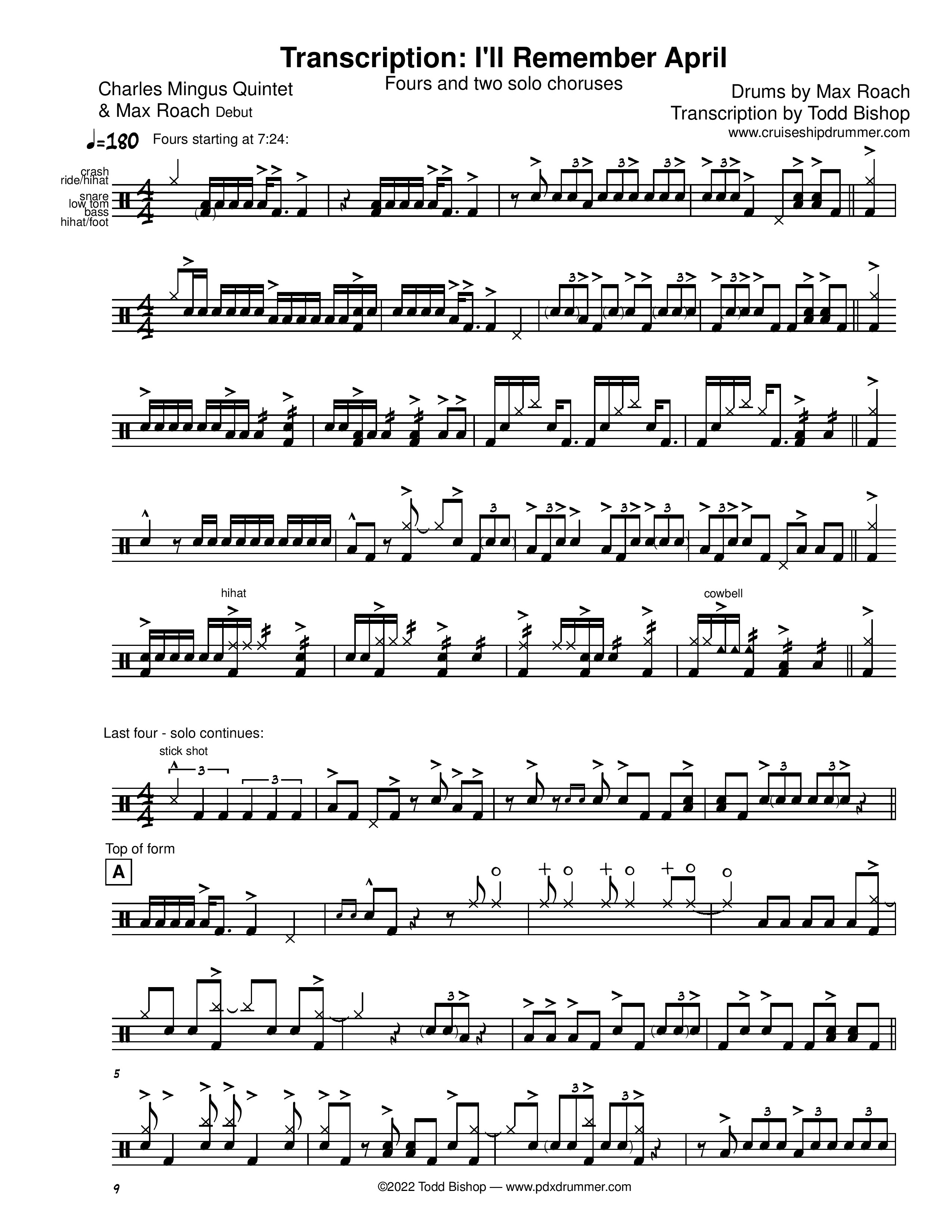
He plays a lot of 16th note singles, so mind the abbreviation— a quarter note with two slashes on it isn't a roll, it's 16ths. Jones's drum set evidently has just one tom tom, a floor tom. There's also a cowbell. He plays a triplet figure repeatedly— you see it in bar 49— the unaccented notes are probably a double.
There are some quintuplets in bar 69-70— I don't know if he's playing them deliberately. I would look for some kind of doubles to be involved on that whole passage, bars 65-71. And rudimental stickings generally— there are a couple of spots where he's obviously playing paradiddles. I think all of the 16th notes on one drum are singles.
Here's Jake Hanna trading fours with Duke Jordan, on Jordan's album Live Live Live— a Japanese import release from the late 90s. This is a pretty ordinary club date; Hanna was almost 70 and Duke was almost 80, so they're not tearing the place down. His execution is impeccable.
I've never listened to a lot of Hanna— he just didn't happen to be on the records I listened to. His style is kind of unusual to my ear— he sounds a little older than he is, like most of his development happened before modern playing was fully formed. The trading choruses start at 6:15. He starts with brushes and switches to sticks.
.jpg)
Mark in your own stickings on the triplet passages— there will certainly be a lot of doubles. He uses some different articulations on the rolls, drags, and ruffs— it's worth listening carefully to that.
Here's Elvin Jones's drum solo on that tune Crisis, from Freddie Hubbard's Ready For Freddie, which we looked at a couple of weeks ago. It contains some classically Elvin stuff, and is good for some close study.

The form is 56 bars long (AABA, 12+4 bar A sections, 8 bar B section), and he plays one full chorus, with a few odd measures— measure 18 is short by about an 8th note, and he adds three 16th notes to measure 25 (you can easily eliminate that when you practice the lick). And he drops two beats during the long roll in the last four bars— I've written a 6/4 bar instead of two measures of 4/4.
I've given some possible stickings, which may be what he played— at least they'll get you in the correct spirit and sound. In measure 19 is the thing that inspired this other recent post. Starting at measure 50 there's a classic thing he does, RLB triplets nested in a quarter note triplet rhythm. The odd looking beat 1 of measure 52 is just a continuation of that— the last note of that beat falls on the last note of a regular 8th note triplet.
This is kind of a special item— I'll go ahead and post the pdf, but if you're not a regular contributor on Patreon or PayPal, I request that you help me out by sending $3 to:
Venmo: @Todd-Bishop-16
PayPal: toddbishop [at] cruiseshipdrummer [dot] com
Thank you!
In honor of what would have been Tony Williams's 76th birthday, here's the first part of a solo I've been listening to since college— Troyland apartments at USC, 1988, to be exact. I put this on and it just went BOOSH. Tune is Moment's Notice, from McCoy Tyner's album Supertrios. Tony and McCoy are both playing in freight train from hell mode on this. Massive power from both of them.
Begins at 3:42 after the solo piano chorus, ends when the piano comes back in. I'll try to transcribe the rest of it over the coming weeks.
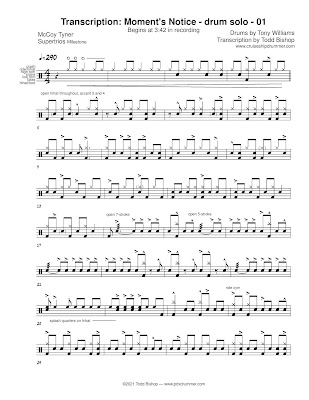
Tempo is 290. Nothing too technical, but lots of overlapping snare drum and bass drum. I haven't really analyzed what's happening with that stuff. Maybe he's doing something of normal difficulty voiced different than normal, or maybe he just has a lot of hard overlapping SD/BD coordination worked up.
Cymbals are very washy throughout; he doesn't wail on them the way he does the snare drum. He's playing them with big ol' sticks so the full cymbal is responding. The sound is interesting, I don't know how to describe it— there was a similar tonality from a 60s A. Zildjian Medium-Heavy I owned, with a dense layer of harmonics in the higher end. Part of that is due to the sticks. What the cymbals lack in definition is made up on the snare drum and bass drum. If you want a unique cymbal sound today, copy that.
Some more from that self-titled Stanley Clarke album. I must have gotten the record in high school. Nobody ever told me to get it, I was just rooting through the stacks at the used record store and I saw that it had Tony Williams on it. These things are just around waiting for you to buy them and you luck onto them because you're looking. This is the drum solo from the tune Life Suite, Part 2.
The solo is 60 bars long, over a 4 bar vamp played 15 times. He takes his time getting off the hihat, and comes back to it during the more soloistic parts, and then takes it out with four bars of hihat at the end. Tempo is a pretty burning 148. Getting up into the natural speed limit for 16th notes in a fusion setting, before they start sounding like massive hyperactivity. Egberto Gismonti's Baiao Malandro, which I transcribed early in the blog, is similar. The transcription begins at 0:40 in the track, or at 2:29 in the YouTube clip below.

Snares off for the entire solo. There's some open hihat activity I didn't bother writing out— at the beginning especially. He's bouncing his left foot for a good portion of it, which creates some half-open sounds on the es and as. I also didn't write out a good amount of left foot activity throughout that doesn't really relate to the rest of what he's playing.
Tony Williams isn't really a textural drummer, is he? Everything he plays here is very direct, with a lot of hihat and bass drum at the beginning, and a lot of cymbal with bass drum generally, along with some stuff with the hands on the snare and tom toms. Mainly alternating sticking. Briefly in measures 53-54 there's some modern textural stuff happening with the cymbal, snare, and bass drum. Tony-like(!) licks are happening in measures 30, 37-38 (same handed flam accents, there), and 55-56. Those crescendo-ing singles in m. 16 and 18 are also very Tony.
Again, the transcription begins at 2:29 in the video:

