Showing posts with label samba. Show all posts

Sunday, August 25, 2024

Reading a lead sheet

Some notes on a chart I had to play yesterday, on a festival gig with a pianist I've worked with quite a bit, Jasnam Daya Singh. He's Brazilian, and quite a heavy composer. For a one hour concert, he sent me 36 pages of music for I think 9 tunes.  

He was actually being nice, selecting tunes that we could learn with one rehearsal. It's not as bad as it sounds— they're basically normal combo arrangements... with, frequently, composed intros, outros, A1s/B1s, C sections, interludes, a different solo form, recurring vamps. That can add up to some pages. Fortunately we never had to flip from page 9 to page 1, all of the multipage pieces didn't have any backtracking with the roadmap.   

This was one of the friendlier ones. I was reading piano parts, and I've marked this one up up with some of the things I look for, and think about, and want to know when I'm playing something. I marked some of this on my chart in pencil, some of it I just see. 


STYLE:
It says bossa at the top, but it's a loose, modern instrumental bossa. You can't just play a repeating Girl From Ipanema beat all the way through. 


METER/TEMPO:
Typically Brazilians write sambas and bossas in 2/4 time, which he has done here, with 16th notes as the main subdivision, the cymbal rhythm. Tempo is 58. An American writing the same arrangement in 4/4, with 8th notes as the main subdivision, with a tempo of 116— that's how we're used to thinking of it. I think we played it quite a bit faster than this.   


FORM/ROADMAP:
The tune itself is an AB form, 26 bars long— 14+12. That's the melody of the tune, and the solo form. There is also a 10 bar intro, which occurs again at the end as an outro, preceded by a 12 bar coda phrase.

As I've indicated, the intro is played twice, then the main form is repeated a number of times for the head and solos. The chart says DS al coda, but there is no sign marked— he wanted da capo instead. The coda begins at the top of page 2. There is no coda sign indicated on page 1, but at the bottom of the page it says segue to coda on head out, meaning we play through all of page 1 and go directly to page 2.


MEASURE NUMBERS:
I've marked in measure numbers every four and eight measures, up to the phrase ending where there are extra measures— some phrases 6 and 10 measures long. I also marked the total number of measures at the beginning of each section— 10, 8+6, 8+4, etc— so I know what I'm in for. 

These ended up being a little misleading, because his phrases don't break down that neatly. On the soloing I'd be listening and playing basically 24+2 bars— the last two measures of the B section were distinctive, and made it easy to set up the top of the form. 


PHRASES: He writes a lot of extended phrases, four or eight bars with an extra measure or two at the end. Sometimes just an extra half measure, or one extra beat. Occasionally he'll do shortened phrases, three measures or seven measures long. 


CHORDS:
I look out for home base chords— like the CMaj7 that happens at the beginning of the A section and the intro/outro. I'll also look out for changes in the harmonic rhythm— the number of chord changes per measure— though that wasn't real helpful here. It's helpful to note where there is more than one chord per measure, or where a chord is played for more than one measure. 

In rehearsal I'm also listening for chords that jump out to my ear— like in the rehearsal I noticed the B7(sus 4) in bar 6 of the B section. Those are helpful for staying oriented while not keeping my eyes glued to the page. I played it only once in rehearsal and once on the gig, and didn't get a great feel for that yet. 


THE MELODY:
 On this tune I could state much of the melody rhythm pretty closely on the drums. I'm also looking for spaces in the melody where it might be appropriate to fill, and set something up— syncopated rhythms after a rest, usually. Above I marked in accents in some spots I would want to catch on the drums— syncopated tied notes. I just see those, I don't mark them on my part unless they're big and unexpected. 


Also see my chart reading pyramid post, and my weird tunes post for more on this type of thing. 

Monday, April 15, 2024

Tresillo unit - 02

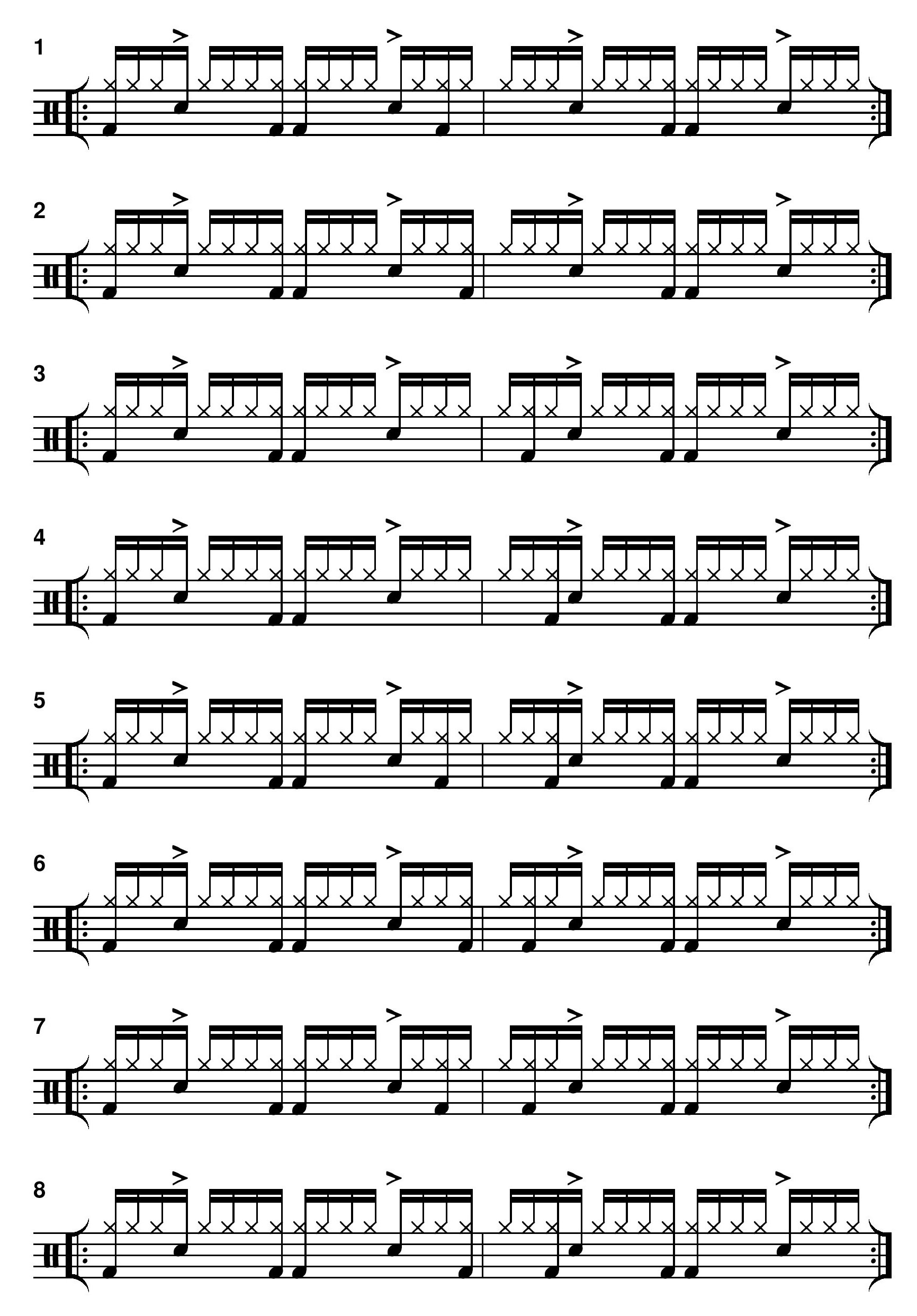
Here's an addendum to a set of stuff I posted back in January— the “tresillo unit.” That was basically a set of variations on a New Breed system. This is a loosely organized collection of things to further develop one of them, that was suggestive of a samba groove.

With these heavily constructed kinds of grooves, every small move and variation you learn becomes kind of a big deal. Changes in dynamics, articulations, and orchestration become a big deal. You can get by with them doing relatively little in terms of actually varying the parts.  


Pattern 1-2 are the plain system, with the right hand moving between the cymbal and the floor tom, and that system with a left hand part to use for the complete stock groove. 

Patterns 3-6 give some accents you can play with the left hand. 

Patterns 7-8 have the left hand doing a partido alto-type rhythm. 

With the following you can work through some of the reading in New Breed, playing the book rhythm with the left hand:  

9-12 show some right hand variations.

13-18 show some bass drum variations. 

Play the hihat where you like for a samba; I play it on the off beats. 

Get the pdf

Saturday, July 15, 2023

Batucada styles

Just did a gig playing all samba and bossa nova, so I've got Brazilian music on the brain. Here's an old record offering a little round up of styles in Brazilian percussion: Batucada, by Paulinho e sua Bateria. Things will have evolved somewhat in the 60 years since this was made, but hey, jazz records from 60 years ago are still relevant. This is good for getting the broad concept. We're just looking to inform the way we play sambas and bossas in a combo setting, ideas to draw from beyond a groove in a drum book.  

Open it up on YouTube for the track listing, which names the styles involved. 


Another set of three records is by Luciano Perrone: Batucada Fantastica, also from the 60s, which rounds up some percussion styles, and the individual instruments. Here's one of the volumes on Soundcloud. Here's a track demonstrating the tamborim, accompanied by surdo and snare drum: 

Saturday, July 08, 2023

Baiao practice sheet

Here's a page of basic left hand rhythms based around a Baiao rhythm (say bye-yo or bye-yohn). You could just use Syncopation for this, but I like starting with rhythms connected to the ostinato somehow— after the basic rhythms 1-10, these are mostly based on the bass drum rhythm. 


As it says, use the hihat or ride cymbal— the open hihat sound emulates a triangle, which is kind of an essential element in this style, so when playing the ride cymbal you could use the bell somehow to get a similar vibe. 

On the snare drum play rim clicks, or varied accents/articulations— rim shots, dead strokes, buzzes, whatever. 

Move the LH between the SD and toms as in the example moves— whatever patterns of movement you can devine from the examples, that makes sense for the rhythm you're playing.  

Get the pdf

Here's a track you could play along with, by Seattle-based Brazilian pianist Jovino Santos Neto, with his long time drummer (and Brazilian drumming expert) Mark Ivester, and some other Seattle friends playing:

Monday, February 06, 2023

Funk samba: moving the 1

I was doing this with some students, using a similar groove to Omar Hakim's Predator groove— vastly simplified. There are a couple of pages of “funk samba” grooves in Roy Burns / Joey Farris's underrated book Studio Funk Drumming that are good.  

I don't know how much of a real legal samba this is, but it's a familiar type of groove, with alternating 16th notes on the hihat, and a displaced backbeat:


We made some two measure phrases out of that by moving the bass drum note on 1 of the second measure. It's one good way of developing some flexibility with a composed groove. Here's what's happening below: 

1. Anticipation— move BD to & of 4 of first measure. 

2. Anticipation— move to a of 4 of first measure.

3. Delayed— move to e of 1 of second measure. 

4. Delayed— move to & of 1 of second measure. 

5. Split the 1— & of 4, & of 1

6. Split the 1— a of 4, e of 1

7. Split— & of 4, e of 1

8. Split— a of 4, e of 1


You could do some similar variations in the middle of the measure to get some variety with the one-bar groove. We've also been adding open sounds, accents, and open rolls/drags to the hihat part, a la the Predator groove. I encourage you to pencil those in. 

Get the pdf

Friday, December 30, 2022

Practice loop: medium bossa

Probably my only post this week— we're having a wild end of 2022 around here, with my family experiencing an ongoing medical emergency, and I'm having to travel to Eugene a lot.  

So here's a nice easy loop for practicing bossa nova, samba and baiao rhythms at a slower tempo, about 110 bpm. Sampled from All Around, from Bebel Gilberto's great self titled album from 2004. 


My labels for Brazilian music related stuff are kind of a mess— most of the transcriptions and practice materials can be found under Bossa Nova and Brazil. 

Anyway happy 2023, in a couple of days— I'll be back with some new stuff next week. 

Friday, October 14, 2022

Paradiddle inversion control - 02

We've been doing a lot with the highly useful RLLR-LRRL paradiddle inversion lately. This is a page I wrote for myself as I'm developing some other Reed methods for it— sometimes you need to see these things written out. Here the right hand is on the cymbal the whole time. 


I usually put the “control” moniker on something when I intend to combine patterns, I don't suggest bothering with that here. Suggested tempo is between 100-150 bpm.   

Thursday, September 15, 2022

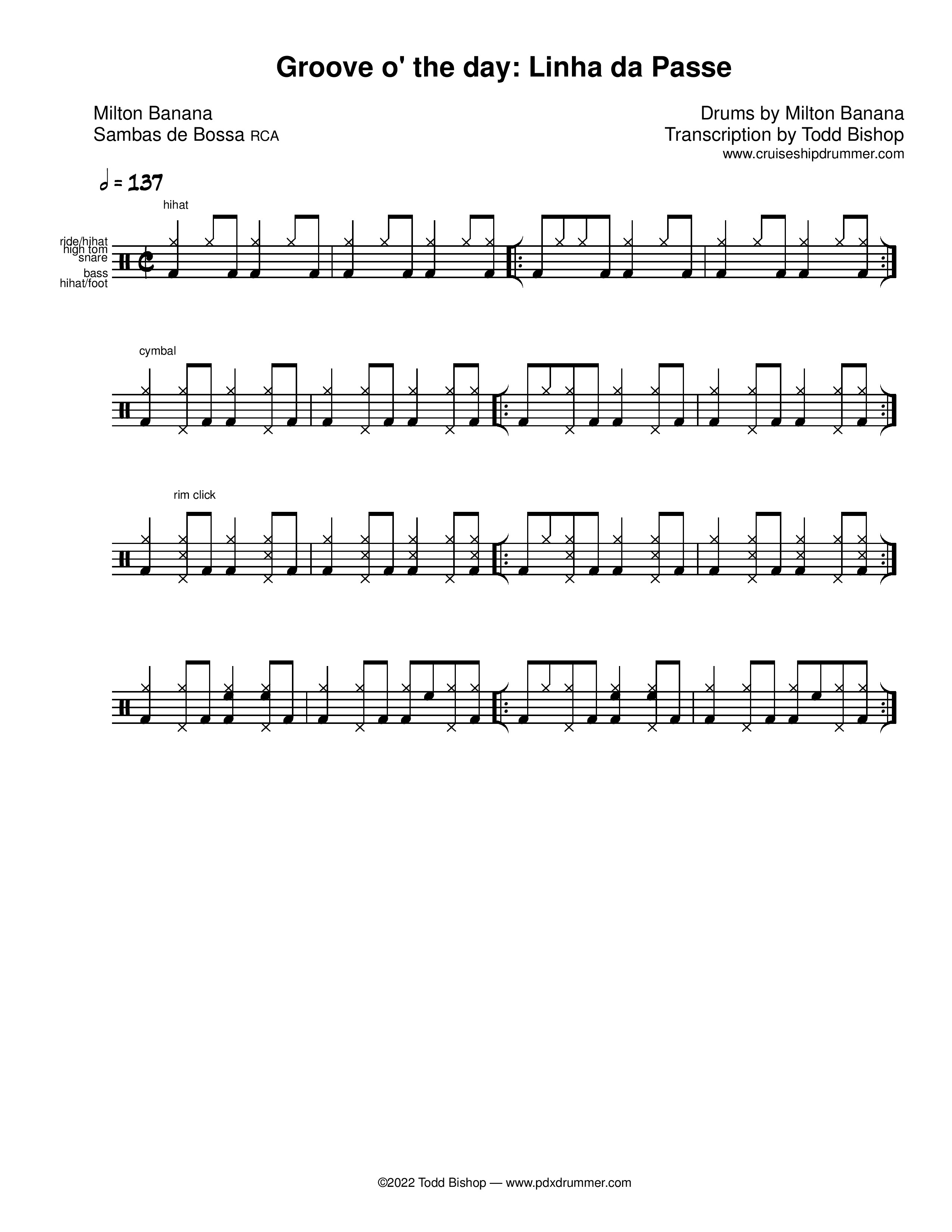
Groove o' the day: Linha da Passe

Bright samba groove from one of my favorite Brazilian drummers, Milton Banana, who was most active in the 60s/70s. The tune is Linha da Passe, which you're most likely find on Banana's compilation album Sambas de Bossa. 

The format here is a little different— the first two measures of each line show how he begins the groove at the start of a section, and the last two measures with the repeat signs show the body of the groove. It's a tight arrangement with lots of stops, so how he begins the groove is important to work out. And the cymbal rhythm matches the melody rhythm on the piano, which hits the 1 at the beginning of the phrase, and the & of 4 for the rest of the phrase. 

Tempo is half note = 137.


First line is closed hihat and bass drum; second line is cymbal and bass drum, with hihat played with the foot on beats 2 and 4. He may be playing some rim clicks on the snare drum during the early parts of the tune, but they're not really audible— we can assume there are a few LH notes in unison with the cymbal. Or not. Third line is how he plays rim clicks later in the tune, fourth line has a rhythm he plays on the tom tom near the end— again, maybe he's moving his LH to the snare drum around beats 1-2

Get the pdf

Thursday, September 01, 2022

First page of Bossa Nova

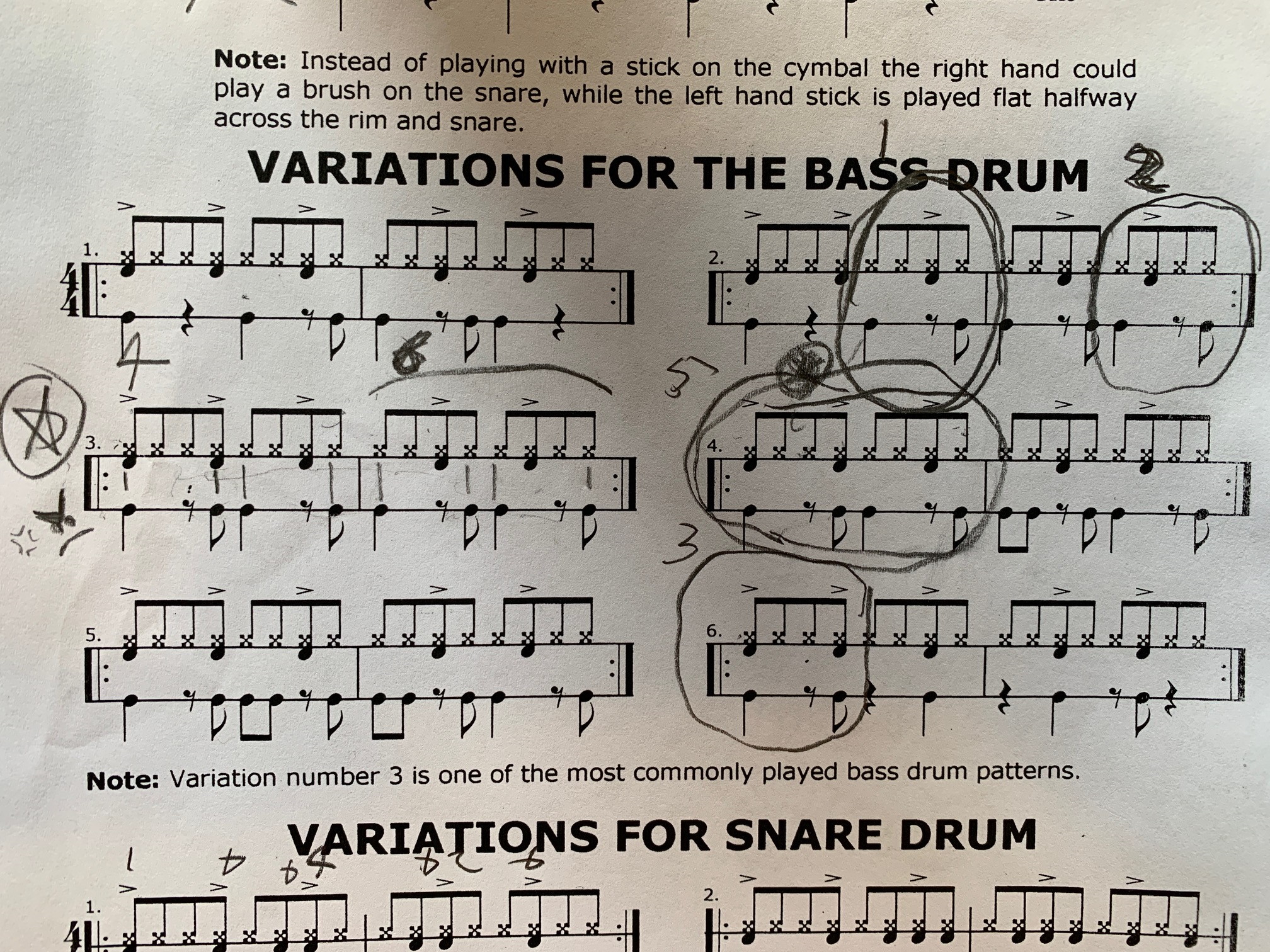
Working on this with a couple of students, I couldn't find a simple straightforward page of Bossa Nova rhythms, with all the parts written out. Seems like a basic thing that should exist somewhere. I had to print out a page from Joel Rothman and crudely circle the parts I wanted him to work on: 


Most serious musicians have pretty good handwriting, mine looks like a Cy Twombly painting: 


Anyhow, here we go— some bossa warmup patterns, and a few performance patterns: 


Play rim clicks on the snare drum with the left hand, play the right hand on any cymbal, or on the snare drum with a brush. Whenever you feel like it, add hihat played with your foot on beats 2 and 4. Tempo range for this is about quarter note = 120-180. 

Get my short book Playing Samba and Bossa Nova for a fuller treatment of playing this style in a combo setting.  

Get the pdf

Tuesday, May 10, 2022

Page o' coordination: quasi-samba - bass drum variations

More student stuff! Someone needed a Latin rhythm for a tune he's playing in a rehearsal combo, and this repeating quasi-samba pattern is what he came up with. So in the lesson we worked through some bass drum possibilities, so he'll have some options for developing the groove over the course of the tune. It's a jazz tune, so the rhythms do not need to be stylistically “correct”, they need to fit and adapt to what's going on with that particular arrangement. 


Repeat each pattern until it settles into a relaxed groove. Hihat can be played on beats 2/4, on all four beats, or on the &s. We discussed that you don't need to assemble a full-blown four limb part for a static groove like this— every change you make to it is a big deal. Adding hihat, taking it away, moving to a different cymbal, switching from rim clicks to hitting the drums normally, adding bass drum, adding slightly busier bass drum.  

Get the pdf

Monday, October 18, 2021

Subtractive method: batucada

This developing subtractive method is becoming really interesting. It makes it much easier to write and communicate more complex orchestrations than in the past— which is not an end in itself, it just makes it easier to adapt the system for specific styles, with specific constraints. 

I've been doing a batucada-type samba of samba thing with it. Part of the thing with this method is that we're converting a Stone-type sticking pattern to do things other than Right hand and Left hand. For this method we'll use A = accent on the snare drum, and B = add bass drum: 
    

AAAA-BBBB
AAAB-BBBB
AAAB-BBBA
AAAB-ABAB


Use either of these as the loose foundation: 


Those accents are default for this style; you don't have to reconcile them with the accents/bass drum in the practice systems. And you don't have to rigorously work out the buzzes/drags. It sounds best if it's not too worked out— let it be a little rough. 

As it says, accent the snare drum on any As in the book rhythm, add bass drum to any Bs. And don't do either of them on notes that aren't sounding in the book rhythm. If that instruction doesn't make sense to you, read the system summary post again.  

Here's how the first line of the p. 38 exercise in Syncopation would be played using the AAAA-BBBB system: 


Play the system accents as rim shots, or accented buzzes, or whatever you like. It's not about doing the system 100% perfectly, it's about using it to go for a sound. 

At slower tempos you could play the 8th notes half-swung— which takes it into more of a New Orleans street-beat type of feel— at faster tempos try the tripteenth-style samba feel, where all four 8th notes get squashed in to the same space as the first-through-last notes of a triplet. 

Wednesday, October 13, 2021

Groove o' the day: Jack Dejohnette - Fiesta

A bright samba groove played by Jack Dejohnette on Fiesta, from Stan Getz' My Foolish Heart album— a live record from the mid-70s. Tempo is about half note = 130. 

Here's the very beginning of the tune:


He plays basically this for most of the body of the tune, with minor variations in the cymbal rhythm, plus fills and left hand activity:


Listen to the whole thing: 

Monday, November 04, 2019

Groove o' the day: Airto - Street Vendors D'Jmbo

A baiao-type drum set groove from Airto— actually I don't know what to call this. I'm not hearing obvious markers of a particular style. Maybe Airto's just playing. Someone who really knows their berimbau rhythms could probably tell us. It's from the track Street Vendors D'Jmbo, on Airto's album Homeless. It's a sort of impressionistic percussion and vocal piece, backed with some synth.

From the intro:


This is the groove for most of the track, with subtle variations— there's a lot of overdubbed percussion and I can't tell what's happening with the left foot, if anything.


It's actually not difficult to hear that second groove backwards, starting on the fourth beat, so the bass drum rhythm is on 2, and the snare drum accent with the buzz is on 3. 

You can hear that he's swinging the 16th notes in an interesting way, that is different from the “tripteenth” interpretation we've discussed before. Some of the effect is due to the interaction of the percussion parts, but it sounds like occasional 16ths on the a are played late. Or perhaps the a is in the normal place and the 1e& is slightly compressed. Something to explore in another post.


Wednesday, October 30, 2019

Reed samba method - basic exercise

This is the first in a multi-post series outlining some ways of using Progressive Steps to Syncopation to do a samba. I usually use actual Brazilian rhythms for that, but many of the rhythms in Reed work too.

The first thing is a preparatory exercise for doing a surdo-type part on the tom toms— a basic structure for that feel, and a couple of rhythmic moves that will occur when working out of Reed. Typically this involves a high drum on 1 and a low drum on 2 (counting in 2/2), and sometimes a low drum on the whole last half of the measure— at the end of a two, four, or eight measure phrase. The sticking is simple, but it does have to be worked out to catch the right drum at the right time.


Accent the toms, especially the low tom on 2. Play the snare drum hits generally quietly, adding some accents as you see fit. You can also play rim clicks on the snare drum. I was doing this with the Hot Sand loop, which is a pretty bright tempo.

You should get my book, Playing Samba and Bossa Nova for some practical guidelines and materials for playing these styles. Also see my series of posts on samba cruzado for another way of doing the type of groove in this post.

Get the pdf

Thursday, October 17, 2019

Groove o' the day: Milton Banana - Samba do Perdão

A moderate samba groove using the tom toms, from one of my favorite Brazilian drummers, Milton Banana. He plays this briefly at the beginning, middle, and end of Samba do Perdão, from his album O Trio. Briefly is the only way to do it; the track is only 1:45 long. The entire record is under 29 minutes.

Here I've transcribed the groove from the end of the tune:


Note that there's no hihat played with the foot— as is often the case with a lot of drummers.

During the body of the tune he uses both of these one-measure grooves— mostly the first one, with the second one as a variation. A few times he plays them both in sequence (minus the rim click on the & of 4) to make a two measure groove.


This tune is the first one in the video, and the transcription above starts at 1:32. Banana has a way of sounding like a conductor when he plays figures and fills— the attitude feels different from someone who's just playing the arrangement.


Tuesday, April 02, 2019

Groove o' the day: more Brazilian funk

Another funk groove with a Brazilian flavor, from Shebaba by the guitarist Bola Sete. The album must have been recorded in Los Angeles, because on it are the saxophonist Hadley Caliman, and my old combo leader at USC, the pianist Dwight Dickerson. He used to do our rehearsals and then go play his regular gig with Tootie Heath.

This is an instrumental arrangement of the Gilberto Gil tune Roda. The drummer is Ronald de Mesquita, a Brazilian who did a lot of road gigs and also lived in LA then.

This arrangement adds a funk interlude and intro:


It's a partido alto funk groove, which you can see most clearly in measure 5— compare that to the Airto and Ivan Conti recordings under that link. He's playing it pretty simply here, basically a Brazilian bell rhythm with snare drum and bass drum added on the accents.

The tune starts at 17:00 in the video, and the transcribed groove happens at 18:33.

Wednesday, March 27, 2019

Groove o' the day: a funk samba

This is kind of a throwaway track by Gal Costa, but the drum groove is cool— both the pattern, and the way it's played. Most people would call it a funk samba, and it has something of a partido alto type thing happening. Maybe somebody who really knows their Brazilian styles can inform us in the comments. The drummer is a very famous Brazilian player we haven't talked about much, Paulinho Braga. The tune is A Mulher, from Costa's album Agua Viva.


He plays basically the same thing on a ride cymbal part of the time, with some accents in unison with the snare and bass parts. The bass drum note on the e of 4 is often omitted. I suspect there are a lot of right hand doubles in the tom fills.


Sunday, March 24, 2019

Daily best music in the world: Tamba Trio

Here are a couple of albums by Tamba Trio, a Brazilian group primarily active in the 60s-80s— the pianist I have used on my last couple of records, Jasnam Daya Singh (née Weber Drummond) was actually the last pianist in this group. There are a number of hip Brazilian piano trios from this period doing a similar thing, with all three members singing as well as doing heavy stuff instrumentally. Quarteto Novo, Jongo Trio, Bossa Trio, for example.

A lot of drummers understand nothing but more intensity, and this music is so light it could sound insipid to them. It's not insipid. It's deep light.

Here is Tamba, from 1974:


And Samba Blim from 1968, with an altered lineup called Tamba 4:

Wednesday, February 13, 2019

Practice loop: Resolução

Practice loop sampled from the intro of Resolução by Edu Lobo, the great Brazilian songwriter. Style is bossa nova, tempo is quarter note = 167— standard bright bossa tempo. The sample is an arranged lick, rather than a straight groove, so maybe this will be a chance to work on your bossa-type stuff without being locked into the stock rhythms.

Listen to the whole tune.

Sunday, November 25, 2018

Transcription: Roberto Silva - Ana Maria

First, a service announcement: I'm heading to Germany in a couple of days, so posting will be rather light. I'll be visiting some teachers and drummers in Berlin and Dresden, and showing them some Cymbal & Gong cymbals. No doubt there will be a couple of posts on this site, but most of the action will be on my Twitter and Facebook pages. If you're in Berlin or Dresden email me and I'll let you know where and when the meetings are— come meet me and play these great cymbals.

I'll try to get a few posts in before I go:

Here is one of my favorite Brazilian drummers, Roberto (or Robertinho) Silva playing the solo section of Ana Maria by Wayne Shorter, from the album Native Dancer. The transcription begins at 3:24 in the recording.


Silva is using five tom toms actively, which makes this transcription look somewhat ugly at times. There is not a lot of repetition happening, and not a lot of independence— he's not playing with an ostinato mentality. Most American drummers, when they learn to play a samba, set-and-forget the feet and play independent stuff with their hands over the top of it. They get locked into the ostinato. Here the bass drum is more interactive with the hands. Silva is more about conducting phrases than maintaining a repetitive groove. There's clearly a slow samba feel throughout, but Silva doesn't have to directly state it every second to maintain it. It reminds me of Milton Banana's approach here.

I was rehearsing this tune recently, and found it difficult to do anything with it. It doesn't just play itself. It's a useful exercise to compare the drumming on this recording with every other combo version of the tune on YouTube. Most people who attempt it are talented college students or professionals. A lot of the drummers play it with a steady groove; a lot of them stick very close to the melody, and the arrangement elements in the real book chart. Many of them double time the feel as soon as they can get away with it. Few (if any) of them are as bold and interesting dynamically as Silva. Or as deeply grooving, or as free. Silva's approach just seems fundamentally different.

It's not just the drummers' fault if these other versions are uninteresting— the rest of the band needs to listening and playing (or be willing to play) bold dynamics for the drumming to work. If they're just going to sit there and be annoyed with the drummer for playing “too loud” during that part, it's not going to happen. Nor if they just turn up their amp and leave it there the first time you get loud. We need to train them better through our playing.

Get the pdf