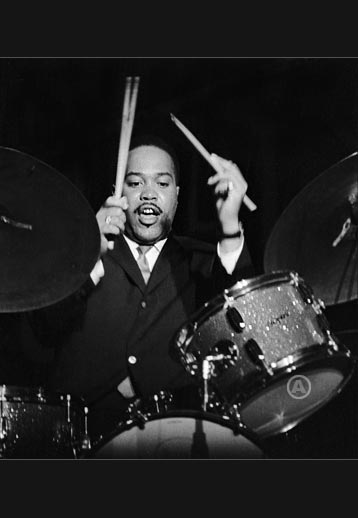
Showing posts with label Frankie Dunlop. Show all posts

Sunday, February 27, 2022

Thelonious's ballad test

From Ben Riley's 1986 interview in Modern Drummer with Jeff Potter:

“In my first experience with [Thelonious Monk], in Amsterdam, we played 'Embraceable You' as a very slow ballad. Then he went into 'Don't Blame Me.' He stood up, looked over to me, and said, 'Drum solo!'

Fortunately for me, I had been working at the Upper East Side supper clubs playing a lot of brushes, and I like brushes. So when I played it, I didn't have to double the tempo, because I was used to playing slow brush tempos. I played it right at the tempo he gave me.

When we were going back to the dressing room, he just walked by me and said, 'How many people you know could have done that?' and he kept on going.”


It seems like Monk liked to spring that on drummers the first time he played with them— in the same situation, Riley apparently fared better than Frankie Dunlop, who shared this horrifying, hilarious story with Scott Fish

Wednesday, December 25, 2019

Happy holidays

Merrry Christmas and whatnot everyone, here's a playlist with all 5 1/2 hours of Scott K. Fish's 1984 interview with one of my favorite drummers, Frankie Dunlop. Put this on while your turkey cooks, or whatever.


Do visit Fish's site. He was one of the main guys at Modern Drummer magazine for many years, and I don't know if people realize, but MD basically created the modern history of drumming by talking to players like Dunlop. Nobody else was interviewing them, and if they did, they weren't talking about drumming. And most of them died before the current explosion of media. But for some guys and a low budget magazine, the literature of drumming as we know it would be much thinner, or non-existent. 

Monday, November 28, 2016

FRANKIE DUNLOP SPEAKS

This is incredible: AUDIO from Scott K. Fish's interview with Frankie Dunlop. A long, hilarious story— and ultimately hair-raising, when you get to the part with Tony Williams et al in the audience— about Monk making him solo on a slow tune:


I already put up some excerpts of Dunlop talking about playing with Monk, from that same interview. It's important to remember that this only exists because Fish, and a few guys like him, at Modern Drummer magazine, took an interest, sought these guys out, and talked to them about their experiences playing. I don't think there's a single other interview with Dunlop where he actually talks about playing the drums. Same goes for a whole lot of other great drummers who are now dead.

Here's another one— on rehearsing with Monk, or the lack thereof. What Monk said to Ben Riley about rehearsing was pretty great: “What do you want to do, learn how to cheat?”


Monday, June 01, 2015

New book, and Dunlop and Krupa

While I'm feverishly working on a new rock-and-funk book for the masses (or maybe a rock volume and a funk volume, if the thing grows out of control), visit Scott K. Fish's blog, where there a bit about Gene Krupa lining up some drums for Frankie Dunlop early in his career. And a whole lot of other great stuff from Fish's no doubt formidable archives— he was an editor at Modern Drummer in the early days, and met and wrote about a whole bunch of people we only dream about getting to talk to today.

The book, anyway, will be a complete system for rock/funk/pan-backbeat-genre drumming, using Ted Reed's Syncopation. The reason jazz drummers can improvise dense-sounding stuff so effortlessly is not because they/we are super-geniuses, it's because we have a good system for learning to play; in this book we'll adapt that system to the needs of backbeat-oriented drumming.

By the way, the Book of Intros, which I promised you late last year, has been basically finished for several months— I delayed putting it out to release the wonderful 2014 Book of the Blog, and now, before I actually release it, I need to open it up again and make sure I didn't embarrass myself by writing something stupid— always an urgent concern. We should be seeing the release of one or the other of these books within 6 weeks.

Thursday, April 30, 2015

Transcription: Frankie Dunlop — Green Chimneys / Rouse's solo

2024 UPDATE: Oops, apparently Ben Riley plays on this record. I need to look at the sleeve before posting these things. It sure sounded like Frankie Dunlop to me. Thanks to Andrew Wicks for the correction.  

Here's a little bit of Frankie Dunlop's playing during the two choruses of Charlie Rouse's solo, on Green Chimneys, from Thelonious Monk's album Straight, No Chaser. It's a good lesson in comping, and in playing the bass drum in a bop setting.


Here Dunlop “feathers”the bass drum quite a bit— plays it lightly as part of his time feel. At times he plays half notes, or quarter notes, or doesn't play it audibly at all; in a couple of places he'll play it lightly on 2 and 4. He creates some pretty subtle gradations of intensity this way, within the overall mf, moderate-intensity vibe of the solo. It wouldn't be a bad exercise to play the transcription along with the recording, playing only the cymbal, bass drum, and hihat.

Get the pdf

The transcription begins at 1:49 in the recording, and ends at the beginning of Monk's solo:

Tuesday, February 03, 2015

Transcription: Frankie Dunlop — Pannonica

Here's Frankie Dunlop, playing a walking ballad— maybe it's a little fast to call it that?— by Thelonious Monk, Pannonica, on the album Criss Cross. I've transcribed just the accompaniment for the Charlie Rouse's saxophone solo. There's a typo in the pdf regarding the start time— the transcription starts at 1:40.


Dunlop maintains the slow, triplety swing feel, with sticks, all the way through the piece. On other Monk recordings of this tune, the drummers Max Roach and Ben Riley suggest a double-time feel much of the time, and play it with brushes. Personally, I prefer not to double-time this tune. Another version with Al Foster on drums, has the feel I like. Dunlop plays the drums strongly during the comping, and tends to play more quarter notes than do a lot of drummers.

Get the pdf

Friday, August 01, 2014

Getting tired of these

Mortality is a real bitch— just in the past couple of days we've lost Idris Muhammad, and Frankie Dunlop. I can't ignore their passing, but I'm no good at just showering superlatives on people, which is usually what's called for here. Dunlop was one of those drummers who will make you work a little bit to figure out why they are so great— he was great in a smaller way than someone like Tony Williams or Jack Dejohnette. If your views and priorities as a musician are out of whack, you could mistake him for a mediocre drummer; so, your response to him can tell you something about your own musical maturity.

I have less history with Muhammad, but he was an exemplar of a different way of playing funk than the alternately hyperactive, formulaic, and harshly forceful style currently in fashion. Seeing him play with Ahmad Jamal in the late 90s, I liked the big, spacious way he handled the tom toms; there was a touch of the funk drummer in it. That's a thing that's missing from a lot of young jazz drummers; they never worked soul gigs, and there's some element of bottom missing from their playing. Idris's recordings are still around, but having the man go away makes him literally less of a living influence, and more of a historical one, which is too bad.


Monday, March 24, 2014

Frankie Dunlop plays an intro

Not much to say about this, except that one of my favorite things ever, Thelonious Monk's Bye-Ya, from the album Monk's Dream, came on KMHD today, and that Frankie Dunlop's opening is just a perfect piece of drumming:


Swing the 8th notes, and use whatever sticking you like— on the triplet licks either LRLRL or RLLRL will work best.

Audio after the break:


Friday, September 06, 2013

Transcription: more Frankie, more Jackie-ing

Let's really Dunlop out during this fundraising drive. Here's part 2 of yesterday's most— Frankie Dunlop's actual solo on Jackie-ing, from Thelonious Monk's Live In Stockholm 1961 album:


Note that he feathers the bass drum most of the way through the solo; written bass drum notes are mostly accents. If you've worked through any of my transcriptions, you'll notice that I don't tend to write accents on the toms— they're usually played strongly by default.

Once again, the solo has gone longer than a single chorus— almost by two full A sections; and the ending is sketchy— Monk effectively makes a measure of 2/4 coming in with the melody where he does. Dunlop seems to be simplifying at the end of the chorus (the last measures of page 1), but maybe his cue wasn't strong enough, or the band was thinking about something else, and they don't come back in with the head there. It gets a little ragged after that— the 1 gets a little ambiguous; maybe Dunlop was slightly flustered. He never wavers, though, and is right on it when Monk comes in in a place he probably didn't expect. People get nit-picky/embarrassed about this stuff, but it happens to the best of them.

This would be a good time to re-read Dunlop's comments on playing with Monk, culled from his old Modern Drummer interview.

Get the pdf

See the previous post for the audio.

Thursday, September 05, 2013

Transcription: Frankie Dunlop — Jackie-ing

Here's Frankie Dunlop's opening solo chorus from Jackie-ing, on Thelonious Monk's Live In Stockholm 1961— a really great record. As I mentioned, I'm transcribing a whole lot of drum intros this week, so far mostly focusing on 40's drummers— the original bop guys, and swing players who updated their style for the bop era. Clearly all of them did a ton of work with swing bands, and the way they play their intros largely reflects that— in the vocabulary, and in seeming kind of workman-like.

Coming to Dunlop after that, we're suddenly in Technicolor. He's playing the whole instrument, where the earlier players tended to mostly play the snare drum and hihats, and a little bit of bass drum. His playing is fully melodic, and, though simple, fully modern— a little abstract, with no apparent baggage of having slogged through many thousands of hours of playing dance bands (though he certainly did his share of that). He sounds like an artist.


Jackie-ing is a 32 bar tune, but here he plays 36; I thought that might be due to repeating the last four bars on the head out, but Monk always takes it right out, ending on the last note of the melody. Since I have another recording with a 42 bar drum intro, the extra four bars appears to be accidental. Usually the reason for that is that is a combination of the band being lazy about following the form while the drums are playing, and are just waiting for a cue, along with the drummer getting wrapped up in playing the solo, and forgetting to set up the end of the form until it's too late. I guess that can even happen with Monk's band.

Swing the 8th notes, of course. Use the stickings of your choice on the 16ths and triplets— very likely there are some paradiddles, double paradiddles, and paradiddle-diddles in there.

Get the pdf

Audio after the break:

Thursday, August 16, 2012

Transcription: Frankie Dunlop -- Hackensack

Let's see how many of these I can do in coming weeks; I've always loved the way Frankie Dunlop plays the heads on the Thelonious Monk records, so here's Hackensack, from the album Criss Cross:


On the top staff I've given the rhythm of the tune, and of Monk's intro, so you can see how Dunlop's playing supports it. He plays melodic, swingy punctuations on the drums with a big sound, while sketchily rendering the time feel; the cymbals are played fairly lightly, with no big punctuations-- he doesn't actually crash on them here. He mixes up his playing a bit between the ride cymbal and the open hihat, but it can actually be a bit hard to distinguish, and since they both fulfill the same function, I haven't attempted to sort out which individual hits are on which cymbal. He does play most of the last A on the hihats. He tends to leave a little space on the first measure of each phrase, and doesn't do the obvious things at the big changes-- at the bridge (at measure 25 of the transcription) or the beginning of the solos-- he does fill into the change, but he doesn't play a strong punctuation at the barline, or kick immediately into a more driving feel.

Get the pdf

YouTube audio after the break:

Saturday, April 02, 2011

Frankie Dunlop on Monk

UPDATE: Scott Fish has posted some of his interview recordings of Dunlop, and they are hilarious. Much about playing with Monk in this interview with Ben Riley from 1986 as well. Do check out my Dunlop transcriptions.

In his 1985 Modern Drummer interview by Scott K. Fish, Frankie Dunlop talks about his time with Thelonious Monk:

...I went with Monk in '61, starting at The Jazz Gallery. That was with John Ore on bass and Charlie Rouse on tenor. I was with Monk for three-and-a-half years. After a while, John Ore left and Butch Warren joined the band.

MD: Monk's bassists always seemed to be restricted to straight timekeeping, more so than his drummers. Even during solos, Monk's bassists rarely broke out of a walking bass line.

FD: That's right. Monk always liked an exceptionally strong bass man and drummer. The reason you heard so much straight playing was because Monk didn't consider it a rhythm section—even though it was a quartet—unless it had the driving sound—the dynamics and the attack of a heavy, hard-driving section like those of Count Basie or Duke Ellington. That was the way Monk thought. Rhythmically, his conception was not like the average quartet. From the first beat, Monk's quartet would be just like the rhythm section of any good big band—just like Woody Herman stomping off "Woodchopper's Ball" or "Northwest Passage." We played a little louder than the average quartet, but basically we played with a lot of dynamics. We were just four pieces, but all of Monk's things would be hard-driving.

Monday, February 21, 2011

Transcription: Frankie Dunlop - Rhythm-a-ning

Finally had time to finish this up- this has been languishing in the archives in dire need of proofing for some time. Here's the the complete drum part for Rhythm-a-ning, by Frankie Dunlop, from Thelonious Monk's Criss Cross.  I've included the rhythm of the head of the tune, and of the tenor and piano solos so you can see how the drums support them.


Get the pdf

Thursday, February 03, 2011

Transcription: Frankie Dunlop - Bolivar Blues

There is just a ton of good stuff on Jon McCaslin's Four on the Floor blog- like this little 2010 piece on the great, under-appreciated drummer Frankie Dunlop, who was with Thelonious Monk for part of the 1960's. I've studied him quite a bit myself, and always recommend him as one of the first people for novice jazz drummers to listen to. He plays busy but simply- you get to hear him make a lot of comping decisions, and it's easy to pick out what he's doing. And he also happens to be on a bunch of great records with tunes you want to learn!

Monk's Dream is really a classic beginner's record, though I don't know how many people use it that way. With the title track, Bye-Ya and Five Spot Blues it's got three hip, semi-common Monk compositions. Bolivar Blues doesn't get played much, but is a very classic, singable blues with a little 3/4 figure in the turnaround- right up there with Freddie Freeloader and Blue Monk for first blues, in my opinion. Based on Sweet Georgia Brown, Bright Mississippi is the friendliest possible introduction to the contrafact concept. Monk and Charlie Rouse make it easy on beginners, too- Rouse's solos are straightforward, melodic and swinging, and Monk tends to play the tune behind the solo.

Here's an easy transcription of the head and piano solo on Bolivar Blues, from Monk's Dream (only $6.99 on Amazon!):

[ image here]

As usual, Blogger is balking at taking my uploaded images- I'll post that as soon as it deems to accept it. In the meantime:

Download the pdf