Showing posts with label Ringo Starr. Show all posts

Tuesday, April 15, 2014

Transcription: more Serge, more Dougie

What the heck, let's do some more Dougie Wright. The last thing was a little goofy, but today's transcription is for me a minor classic of 70's studio rock drumming. The album again is Serge Gainsbourg's Histoire de Melody Nelson, and the song is L'Hotel Particulier. We're very much in post-Ringo mode, meaning: fat bass drum and snare drum, light hihat, big, simple melodic fills on the tom-toms.


The dotted-8th/16th rhythm is slightly swung, in an irregular way; on the other 16th note rhythms, and on the fills, the 16ths are straight. Play the hihat very lightly (sometimes it may even drop out) through the breakdown at the bottom of the first page, then play it more strongly, and half-open through the end of the song. Note that in measure 52 there's one note on a third, lower, tom-tom. And there's a typo on the fill in measure 44: the last note should be snare drum and floor tom together— I'll have to fix that for the next year's book...

Get the pdf

Audio after the break:


Tuesday, February 18, 2014

Transcription: Ringo Starr — Isolation

I hate to keep beating up on our man Kollias— well, I'm not beating up on him, I'm making serious points about music... OK, I wasn't making a serious point about music with the last thing, but I am now. And it's not about him personally; he's an incredible performer-athlete who happens to be working within a genre I believe is basically artistically bankrupt. But hearing today's piece in that context really gets you thinking about the true meaning of the much-abused phrase “less is more.”

The song is Isolation, from John Lennon's Plastic Ono Band record, with Ringo Starr on drums. The production here is stripped down, and while it's a virtually perfect expression of pop craft, it hardly seems made for public consumption. I'm thinking about the difference between this and that metal thing, and all I can think is of walking through the Louvre and seeing a 15 foot high painting by somebody like Delecroix; the frame alone weighs 800 pounds. I'm not being effusive, that's just straightforward analogy— this is objectively a heavier, more impactful piece of work.


Obviously, the rhythm section here is all about the quarter notes. The only subdivisions happening are occasional triplets in the piano, which often happen at the same time as the straight 8th notes on the hihat. The vocal line has a lot of legato 16th notes, both straight and swung; on the drums the 16ths are strongly swung. Crash cymbal hits that are unaccented are just touches. The mood is soft, but the drums are played strongly enough to get a tone. As with our last Ringo/Lennon transcription, the drums track the dynamics of the piano and vocals closely. Ringo is really listening. He also leaves the heavy emotion to the vocals; he doesn't overplay, trying to match its intensity.

Get the pdf

Audio after the break:

Tuesday, May 29, 2012

Transcription: the Birthday break

For once there's not much to say-- here's one of my favorite drum breaks in the world, played by Ringo Starr on Birthday, by the Beatles:


Get the pdf

YouTube audio after the break:

VOQOTD: Keltner on Ringo

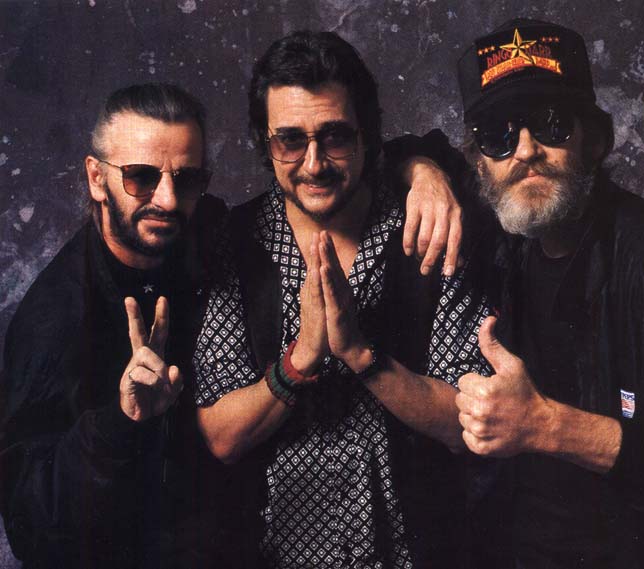
Ringo, Keltner, Levon Helm
I will always be there to support him. He's more than a dear friend. He's like an idol. He's everything to me. I still think of him musically every time I sit down and play drums. He's a very important guy to me.
-Jim Keltner on Ringo Starr

(h/t to Anthony A./Gvdadrummasum)

Wednesday, July 06, 2011

Transcription: Ringo Starr - God

Here's a nice little catalog of compound meter fills by Ringo Starr, playing on the acoustic, Anthology version of God. Reading Andy Newmark's interview got me in the mood for some Jim Keltner, which I thought this was until I looked at the credit (the little "A Day In The Life" quote after the "I don't believe in Beatles" line would've been cute coming from him). It's really worth it to give this at least one close read-through along with the recording- Ringo is very sensitive in his dynamics throughout the piece, and swings the 16ths in a variety of ways- anywhere between a dotted-16th/32nd rhythm to even 16ths.

Download the pdf 

YouTube video of the track after the break: