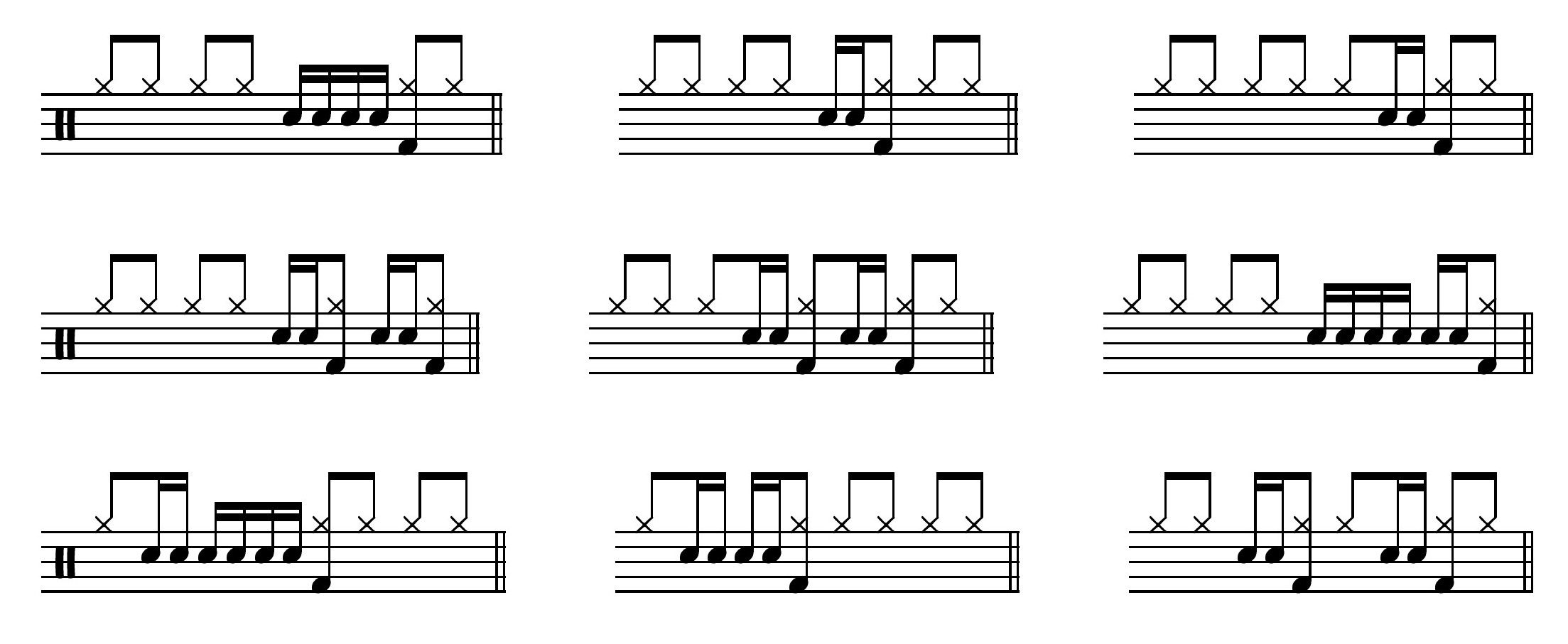
You know the routine, drill the individual things relentlessly for timing, movement around the drums, dynamics, and lastly speed, then play them in the practice phrases on p. 2. All of the phrases are limited to having three 8ths of fill, and that's pretty limiting— next we'll get into some phrases that are more realistic, and varied.
Tuesday, November 12, 2024
Fills in a 4/8 framework - 01
You know the routine, drill the individual things relentlessly for timing, movement around the drums, dynamics, and lastly speed, then play them in the practice phrases on p. 2. All of the phrases are limited to having three 8ths of fill, and that's pretty limiting— next we'll get into some phrases that are more realistic, and varied.
Wednesday, September 04, 2024
Transcription: Flight For Freedom - 01
I really want my thing of notating half-open hihats with a tenuto mark to catch on.
Musescore notes:
I've actually got it pretty close to where I want it, with the appearance of my template, and with using it. Two or three days of fussing around is actually not bad.
Stem length
A lingering visual annoyance was the general stubby appearance of the notes. Under format > style > notes I saw that the shorten stems box was checked by default. I set the shortened stem length to 2.95sp— a little shorter than the default non-shortened stem length.
Entering notes I use the keys a lot— hotkeys for the major drum sounds, arrows for navigating, number pad for rhythm value, + shift key to enter two notes in unison. For drum sounds that don't have a hotkey, I highlight the note/rest then mouse click on the thing I want in the key at the bottom of the window. For anything else I use the mouse to select it.
Really easy. For some reason my version of Finale sucked for exporting pdfs and jpegs— I had to use a pdf printer app (cutepdf, it's quite useful) to export to pdf, and then actually upload it to a web site (online2pdf.com, also quite useful) to convert it to a jpeg. Really dumb, and time consuming.
Musescore has a nice friendly PUBLISH tab at the top of the screen that lets you output it any number of ways quickly and easily.
Note entry is the main thing I need to get sorted out. I'll do a dedicated post for that in the next few days. Or not— I'm not sure how helpful my personal notes will be for people. Just read this page on entering notes and this page on navigating the document.
Monday, August 26, 2024
EZ 8th note groove with Stick Control
A simple 8th note groove sequence using the book Stick Control, played on the drum set.
Use Stick Control pp. 5-7, or my page of sticking patterns, which I think is in a better order. This is a good thing to do along with music.
1. Play the sticking pattern from the book with the right hand playing a cymbal, with the bass drum in unison, and the left hand on the snare drum:
2. As above, except the right hand plays running 8th notes on the cymbal. So reading from the book, the bass drum plays the Rs, the left hand plays the Ls, and the right hand plays along with everything:
3. As above, except the right hand plays quarter notes on the cymbal.
UPDATE: Oh, one other thing: cymbal in unison with Ls. L = both hands/SD-cym, R = bass drum:
Play those in sequence without stopping, switching from one thing to the next every couple of measures, or every measure, and then as quickly as you can, not necessarily changing right on the 1. The end result hopefully keeps the SD/BD pattern mostly intact, with the cymbal rhythm varying in a loose way. You can probably tell that this connects with some other things we've been doing recently.
Rock materials for drum set are usually limited to here are some one measure beats, here are some fills. Here's how some guys played some songs, which you should copy exactly. This idea is part of a larger project of mine, devising some methods for a more open approach, for students of all levels. It's about playing, not just learning to play “parts.”
Sunday, August 04, 2024
Jazz loop, rock loop
Saturday, August 03, 2024
Rock with Stick Control!
Wednesday, June 26, 2024
How to stop - 01
Kind of a mundane item here— a multi-parter, believe it or not— mainly for teachers, about handling ordinary materials in a more real-life musical way, including how to stop in the conversation. Younger students and novices who haven't done much real playing will often end a practice pattern weakly, petering out.
How to do it isn't spelled out in drumming materials, which are often written as repeating single measure patterns. They're incomplete statements by themselves— the last note of the measure is usually not the true end of the idea.
Ending this rock beat this way, for example, makes no musical sense:
Breaking from a groove with that hanging hihat note is not going to happen in real music— except maybe as an arrangement device simulating a digital edit. The pattern is completed on the 1— the 1 is the beginning of the pattern, and also the end:
A beat pattern with a bass drum or snare drum on the & of 4 is more complete on its last note— played as an accent the last time:
You could practice breaking a number of places in the pattern, in fact:
Or put on another ending altogether, regardless of what's happening in the written beat:
Usually this gets worked out in the course of doing some real playing, but there's no reason not to include it in regular practicing in preparation for that. I introduce this after students are comfortable playing basic beats, and are ready to begin thinking about orchestration and fills.
Saturday, June 01, 2024
Beats to fills - key 01
Here is a page of fill possibilities within this “beats to fills” framework, outlined at that link. Here the fill portions are two and four 8th notes long. I'll do a few more pages as necessary, to show what to do with one 8th/three 8th/other lengths of fills.
Briefly, it involves marking a written out rock beat so:
BD/cym notes = as written, played as crashesSee the above link for illustrations and details.
other notes = fill, played a number of ways we'll outline here
I've long felt that one measure beat patterns— the conventional thing— is a very limiting way to learn. The approach here helps people read interpretively and creatively, and to not see a written out groove as an unchangeable, set thing. It's more like professional reading. And it's a really good framework for learning to play fills along with common ensemble accent figures.
Fill number 1 should be practiced several ways, just as an exercise:
• RH on cym / LH on snare
• RH only
• LH only
• both hands in unison
• alternating
Fill 2-8 are all connected, based on fairly small changes to fill 2. Fill 9 uses six stroke rolls, which combines the stickings from 7-8.
Fills 10-14 are various forms of alternating singles.
Fills 15-19 are miscellaneous unique fills, with tom ruffs, paradiddle inversions, and a linear pattern.
People should spend a good amount of time with each of these, trying out different moves around the drums, in addition to working on timing and sound.
Also play them in context as a two measure phrase, one measure written groove / one measure fill.
Saturday, May 25, 2024
EZ fast rock - 02
The first EZ fast rock page was a hit with my students, so here's another like it, more in a fill/variation direction. Combining patterns to make two-measure phrases, most of these will be the second measure.
They're “EZ” in the sense that they're mostly single notes— rarely more than one 8th note-spaced note at a time on any limb— and very little complex coordination. It's a lot of vocabulary they can learn fast, with very little in the way of technical barriers. Towards the bottom of the page we ease into some slightly more demanding stuff.
Get the first page— and the pages in 3/4 and in 5/4, for that matter— learn this page, then combine patterns in two measure phrases. Or four measure phrases— three bars of one thing, one bar of another.
Get the pdf [Sorry, uploading is acting funny right now-- you'll have to print it from the jpeg above]
Tuesday, April 23, 2024
Updated rock loops
Monday, April 01, 2024
Beats to fills
Here's a connecter idea, using some rock beats written normally, a la Funky Primer, but playing them as cymbal accents with fills, as in this rock fill drill— hitting accents on the cymbal/bass drum, and filling in 8th notes on the snare and toms.
That latter thing has been a regular part of my teaching for several years, usually starting with the 8th note accent pages in Syncopation. Those pages are a little dull though. This way will be better because a) the rhythms are more interesting, and b) it will give students some ideas about where to take an ordinary written-out rock beat.
It's quite simple. For example, with beat number 4 from p. 13 of Funky Primer:
You hit the bass drum/cymbal notes as crashes, supported with the bass drum, and hit the rest of the 8th notes on... some drums. Snare or toms, TBD later:
With beat number 8:
- Right hand only
- Left hand only
- Both hands in unison- two cymbals, two drums (or flams on one drum)
- Right hand on cymbal / left hand on drums
- Right hand on cymbal / both hands on drums
- On the snare drum.
- Moving around the drums in a set pattern you make up.
- Moving around the drums freely..
Here's how you could play those in a two measure phrase— one measure of the written beat, one measure accents/fills:
Students get way too hung up on what cymbal or drum they should hit— in the second measure you can take the snare line to mean any drum, and the cymbal part to mean any cymbal. Keep it simple until you can play it, then get creative. You can follow sticking systems 1-5 above at first, then wing it.
Tuesday, November 07, 2023
EZ tom ruff phrases
Here are some more practice phrase ideas for the tom ruffs. This is an underrated item, it should be a lot of fun. Rock out.
As the stickings on patterns 1 and 2 indicate, when there are two cymbal hits in a row, you can play them with alternating hands, on different cymbals. I've put in a Keith Moon-like thing with both hands in unison on the tom toms, with bass drum, on some of these— you can play those notes also just as solo bass drum.
Saturday, October 28, 2023
Rock fills with Reed - 01
Bringing these recent right hand lead Reed tweaks into some basic day to day rock vocabulary. I'll illustrate these using the tom ruffs we looked at recently— try them with any of the other things we've done recently with filling in the larger spaces, or whatever else you can fit in there. My student Jack (age 12) is tearing these up right now.
Here we'll play a two measure phrase, selected from the full page exercises in Syncopation, playing the rhythm as a rock beat in the first measure, then filling in any large spaces— of two or three 8th notes—in the rhythm in the second measure. We can treat some of the surrounding written notes as ensemble accents, and catch them on a crash cymbal, with the bass drum in unison.
Many of the phrases are straightforward. Here's the book rhythm, and that rhythm interpreted as a rock beat, and then with the fill in the second measure, and then with some cymbal accents:
Others may require some creativity to make them work out naturally— especially when the phrase starts with a rest in the book rhythm.
Here are some two measure phrases from p. 38 of Syncopation that are good for this:
You could play through the full page exercise this way, I find that the two measure phrase is better, more similar to actual rock playing, and gives us some space to think about how to orchestrate the fill and cymbal accents. There are several more examples in the pdf. We'll look at some more complex examples, and other possibilities, in part two.
Tuesday, August 22, 2023
Reed tweak: alternating cymbals on rock drill
Incrementalism is the word du jour around here— lately we've been all about supplementing/altering some basic Reed systems in small ways, to make a living, evolving thing out of it, and not just pure formula.
Today's thing introduces some alternating stickings to a rock drill I wrote about in 2019:
• Book rhythm = cymbal (with RH) + bass drum in unison
• Fill spaces with left handed flams, or double stops, on drums
Here's the second line of Exercise 1 on p. 38 in Syncopation, played that way— for clarity, I put the filler notes as double stops, and given the sticking for the cymbal part only:
For today's thing, we'll alternate the cymbal part when there are two or more notes in a row— always starting with the right hand. Single cymbal notes are always played with the right:
We want to maintain it as primarily a right hand lead system— with left handed flams (rL), when flamming— because that gives you some options on the filler:
Whatever you can do with one-three 8th notes worth of space, starting and ending with the right hand:
If you're one of those “weaker hand” guys, you could always learn the baseline system so the left hand is doing all the cymbal hits, and then do all these same variations.
Friday, April 21, 2023
EZ rock in 5 - 3+2
Extending this EZ fast rock / rock in 3 series, with quarter notes on the cymbal: here are some beats and ideas in 5, phrased 3+2. I wrote this series to illustrate the difference between 4, 3, and 5, using similar materials, for a younger student who asked about it.
Learn the beats, then combine them? That may be a more difficult problem than we're generally dealing with here— most of my students for whom this is intended will be preoccupied with staying oriented just in one measure of 5.
Monday, April 03, 2023
EZ Rock in 3/4
Working on my EZ Fast Rock page, a younger student asked a question like what's the difference between playing in 3, 4, or 5? Well, here we go, some similar stuff written in 3/4.
I like this format— one page with a lot of easy patterns, that all together = pretty OK baseline vocabulary for a basic style.
Learn each measure, then combine measures in two measure phrases.
Tuesday, March 21, 2023
EZ Fast Rock Lesson
This page functions both as a page of easy stuff for beginners, and as basic vocabulary for fast-tempo rock drumming. There are a lot of patterns, deliberately. This'll be many students' first shot at processing a lot of stuff quickly.
Like it says, learn the page, then combine patterns to make two measure phrases. Probably obvious groove patterns (like 1-2, 4-5, 10-11) are best to have as the first measure, and fill-like patterns are best for the second measure. Use the ride cymbal half the time, don't just hang out on the hihat all day. 26-27 want to be up on the top cymbals— the ride and crash— they're slightly awkward coming off the hihat.
19-23 are all in aid of doing a one-beat 16th note fill, so observe the sticking on 19-20.
Saturday, September 10, 2022
The natural sticking / fill lesson
These are some steps I was running through with an adult beginner, to get oriented with some normal things you do on the drums, and to practice counting 16th notes. There are a number of directions you could go with it, depending on the student and goal.
The examples will use these rhythms from Syncopation by Ted Reed, pp. 22-27. We counted each rhythm before playing them.
First, we played the rhythms with the right hand on the hihat, left hand on the snare. We're using natural sticking, so the right is playing 1&2&3&4&, and the left hand plays any es and as:
Then we played all the 16th notes on the snare drum— the right hand has to move to the snare a little bit. There was some confusion, that the right was already “playing 8th notes” on the hihat, we fixed that by looking at the rhythm in the book— the notes with two beams go on the snare, the notes with one beam go on the hihat:
Then we added bass drum after the snare drum— the first cymbal note after any 16th notes:
One possible next step is to add bass drum on 1, if it doesn't conflict with anything else we're doing:
Then add the snare drum with the left hand on beat 2 and/or 4, if it doesn't conflict with what we're already doing:
At some point in the process we could play that cymbal note after the 16ths on a crash cymbal:
Now we're at a pretty complete ordinary drumming texture. From here, someone could add some more bass drum— with some or all of the remaining cymbal-only notes; we could add a crash on 1, if it doesn't conflict; we could alternate a measure of groove with these patterns. You decide case by case how far to go pursuing this formula— what you're trying to accomplish for your playing, or your student's, and the limits of tolerance for thoroughness and boredom for all involved.
Wednesday, August 17, 2022
Reed interpretations: triplet feel R&B
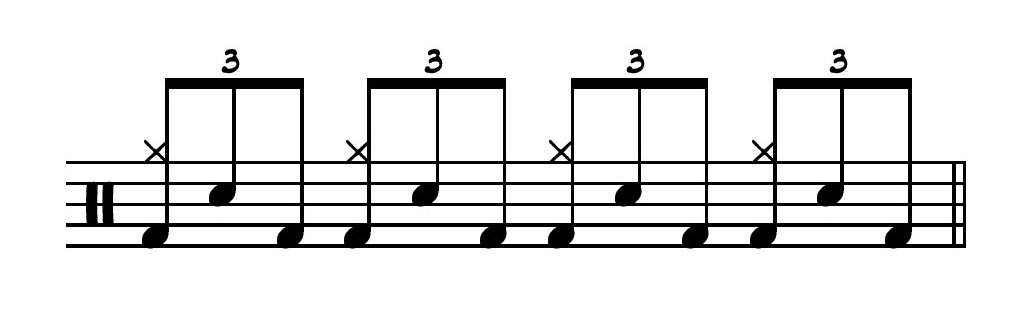
This is a triplet-feel R&B groove practice method we did in a lesson with a student recently. It has a snare drum backbeat on 2 and 4, quarter notes on the cymbal, and some triplet filler on the snare drum. You can do this with pp. 10-11, 30-31, and 34-45 of Syncopation by Ted Reed.
To make this kind of groove it would be simple enough to just play a swing version of our regular rock beat method, but where's the fun in that? This way has more notes.
To illustrate it clearly we'll go through a few steps, but once it's learned it's easy to do the finished method on the fly while reading out of Syncopation.
To begin, let's use the humble line 1 from p. 4:
Play the top line rhythm (coincidentally the same as the bottom line rhythm) on the bass drum, fill in with the left hand on the snare drum to make triplets, add quarter notes on the hihat (coincidentally the same as the pattern rhythm), like so:
We want to have a snare drum backbeat, so let's move the notes on the 2 and 4 to the snare drum— accent them, and play the rest of the triplets softly:
Now see p.11, line 11:
Again, play the top line rhythm with a swing interpretation on the bass drum, fill in the middle of the swing 8th notes on the snare drum, to make triplets; add quarter notes on the hihat:
Move the 2 and 4 to the snare drum, accented:
Now do this rhythm from page 30:
Again: play top line rhythm on bass drum, swing interpretation; fill in with snare drum to make triplets, add quarter notes on the hihat:
When there's bass drum sounding on the & only of beat 1 or 3, like that, you can drop out the first snare drum note on those beats, making a RLB pattern:
So— open your book now— here is how you would play the second line of the famous p. 38 (née 37) exercise:
And the same thing again with the RLB thing where appropriate:
You could also do this method while playing a shuffle rhythm on the cymbal, or a jazz-type rhythm, if you choose. This type of thing is more useful in a jazz setting than you might expect. In that case, I might drop out more of the snare drum filler like so:
In the end, there are no more variations for this than there are for standard rock beats— this is way easier than the large amount of materials in the book suggests.
Wednesday, May 18, 2022
Uptempo rock practice phrase
Here's a quick one— a practice phrase combining two practice systems from the rock drill I posted recently, that's good for fast tempos. It flows really nicely. I give you so many open-ended practice systems, it's nice have some with a narrower scope. You can do this with Syncopation pp. 34-45, maybe 30-31.
There's nothing to it: play two-measure phrases— six beats of groove, two beats of fill.
On the groove portion: book rhythm = bass drum, except hit the 2/4 on the snare drum. If there's no 2 or 4 sounding in the rhythm, add it. Add quarter notes on the ride cymbal.
On the fill portion: book rhythm = accents on the cymbals + bass drum. Fill in 8th notes on the snare drum. Use alternating sticking starting with the right hand.
Here: do the two things I crudely circled from the rock drill page:
So here is how you would play the first three lines of p. 34 of Syncopation:
Accent the snare drum during the fill, and accent the 1 after the fill. Or whatever sounds good for that pattern. Use convenient cymbals for each hand— ride or right side crash for right hand, left side cymbal or open hihats with the left hand.
And here's how you play the first two lines of Exercise One on p. 38:
Practical tempo range for this is about quarter note = 130-200+. After you've done the p.38 exercise, and can sight read the other full page exercises easily, you should have a pretty good flow with this kind of thing.


.jpg)


.jpg)


.jpg)