Showing posts with label movies. Show all posts

Thursday, August 01, 2024

Very occasional quote of the day: interesting

“It may sound like an extremely obvious thing to say, but I think it is worth saying nevertheless that when you are making a film, in addition to any higher purpose you may have in mind, you must be interesting; visually interesting, narratively interesting, interesting from an acting point of view. 

All ideas for creating interest must be held up against the yardstick of the theme of the story, the narrative requirements and the purpose of the scene; but, within that, you must make a work of art interesting. 

I recall a comment recorded in a book called Stanislavski Directs, in which Stanislavski told an actor that he had the right understanding of the character, the right understanding of the text of the play, that what he was doing was completely believable, but that it was still no good because it wasn’t interesting.”

- Stanley Kubrick, interview from Sight And Sound, 1972


As a drummer you could read that and think OK, I need to play interesting then, and start making some bad playing decisions. You have to be careful how you take advice from other art forms.      

As players, the job is to play. It's an immediate thing of making the performance, while hopefully— though it's not hip to talk about it— communicating some creativity and movement of energy. There are some consummate sidemen whose only concern is truly just to show up and do the job, but I think we all would like to be engaging when we play— that may be a better word than interesting for us.   

Interest is more of a consideration when acting as a bandleader, producer, arranger, or composer. There's time to think about it— in selection of players, repertoire, programming an album or set of music, style of production, and in the actual content of an arrangement or original composition. 

It is more hip for musicians to be thinking strictly about performance and craft aspects, and while we don't want to be preoccupied with audience response— what the hell— unless somebody is a more serious artist than Kubrick, it's worth some consideration. 

Thursday, July 11, 2024

Very occasional quote of the day: movies

“[T]here is so much to love in movies be­sides great moviemaking.” 

- Pauline Kael, Movie Love

Kael was a movie reviewer for the New Yorker magazine through the 70s and 80s. I think most of her books are out of print, but you can read them online here. I still keep a falling-apart copy of 5001 Nights At The Movies from ~1985 by my bed. 

Wednesday, November 15, 2023

Art Blakey: Jazz Messenger

Just came across this, quite an amazing documentary about Art Blakey, where they talk to Blakey, Dizzy Gillespie, Wayne Shorter, Benny Golson, Curtis Fuller, many others. I haven't gotten all the way through it yet. I saw him play in Eugene, Oregon, about this time, with this same band. Same heavy Zildjian ride cymbal that we was wailing on. You could see his front bass drum head moving the whole time, it looked like he was playing it pretty strongly. 

Sunday, November 15, 2015

Wagner in Apocalypse Now

Fascinating piece by Walter Murch, film editor and sound designer on the movie Apocalypse Now, several other Francis Ford Coppola and George Lucas films of the 70s, and a lot of other things. Murch tells about fitting Richard Wagner's Ride Of The Valkyries to the famous “Charlie's Point” scene in Apocalypse. A version conducted by Georg Solti, recorded in 1965, was chosen for the scene, and it was edited with that version. But late in the process the record label denied Coppola permission to use it, and Murch had to scramble to find an acceptable substitute, which turned out to be hugely problematic— none of the 19 available stereo recordings of the piece worked.

Here's the scene:


The entire piece is fascinating, but Murch has some things to say about rhythm that are very interesting:

The greatest conductors and orchestras, and Solti and the Vienna Philharmonic were certainly in that group, are able to shape these minute adjustments to the rhythmic signature so closely that they are perceived as regular but in fact are not, thus enhancing the organic, living and breathing nature of the music itself. The problem with many of the versions of “Valkyries” that I rejected was that they were monotonously rhythmic: A metronomic signature had been decided upon and stuck to, regardless of circumstance. The result was a robotic stagger, a simulation of musical life rather than the real thing. 
This is reflected in our intimate relationship with the rhythms of our own bodies, their heartbeat and breathing. We may think that most of the time our heartbeat is regular, but in fact it is not. It is constantly being micro (and sometimes macro) adjusted on a beat-to-beat basis, responding to neurological feedback between the heart, the brain, and the needs of the body for oxygenated blood. And the same applies to our rate of breathing, which is intimately related to our circulatory system. 
The medical term for a healthy but slightly irregular rhythm is “ectopic,” and it is our largely unconscious awareness of this dynamic pulse which reminds us that we are alive. In cases of medical emergency, that closely monitored feedback between the heart and the needs of the body is often weakened or severed, and a machine-like regularity of heartbeat appears, signaling trouble or impending death. 
Similarly, music that lacks this dynamic, quicksilver pulse is perceived, consciously or not, as lacking an essential spark of life. 
Solti’s conducting of the “Valkyries” was instead a sublime example of what we might call ectopic music—a powerful embodiment of the living, pulsing heart and breath of Wagner’s composition.


After the break we'll have the complete recordings of the different versions discussed in the article, and you can get a feel for what he's talking about yourself:

Monday, May 19, 2014

Gordon Willis 1931-2014

Still from Manhattan, by Gordon Willis
When thinking of an era in the arts where there's a strong zeitgeist, I always feel that there a large field of people working within a style, doing this era-defining work. And I'm always surprised when it turns out to be just a handful of people, sometimes only one guy, one group, or one company. Like Saul Bass in the design world. And the cinematographer Gordon Willis, who has just died.

Between Willis, Laszlo Kovacs, Owen Roizman, Conrad Hall, and Robert Surtees— some of my favorite artists ever, in any medium— you cover most of the greatest things done in American film in the 70s. Among Willis's credits are The Godfather, The Parallax View, All The President's Men, and some of Woody Allen's most visually beautiful movies: Annie Hall, Manhattan, Stardust Memories, Zelig, and Broadway Danny Rose.

It's not clear to a lot of people what a cinematographer does; he is the camera man, the photographer— which is not to say he is always the camera operator, a separate job description, lower down the food chain. The usual job title today is director of photography, which gives you more the sense that he is the head of an entire branch of the production.

Because of the popularity of the auteur theory of filmmaking— well, of film criticism, actually— we're prone to giving directors credit for everything that happens in their films, except maybe the acting performances. But there's a lot more involved than just pointing the camera where the director tells you. Unless he was a cinematographer before, the director relies heavily on the artistry of the director of photograpy; shots like the one above could not be executed, or often even conceived, without him. A cinematographer is like a commercial photographer or graphic designer, or studio musician; his art is defined in relation to fulfilling a job in collaboration with a client, which is why the men I listed above are not famous among the general public as artists in their own right. But if you like the way certain movies look as visual art, it's time to start looking past the director, to that DP/cinematographer credit.

Friday, January 24, 2014

Oh, I don't know...

Probable dialogue: “Come on, swing,
you mother— SWIIIIIING! YEAH! YEAAAH!”
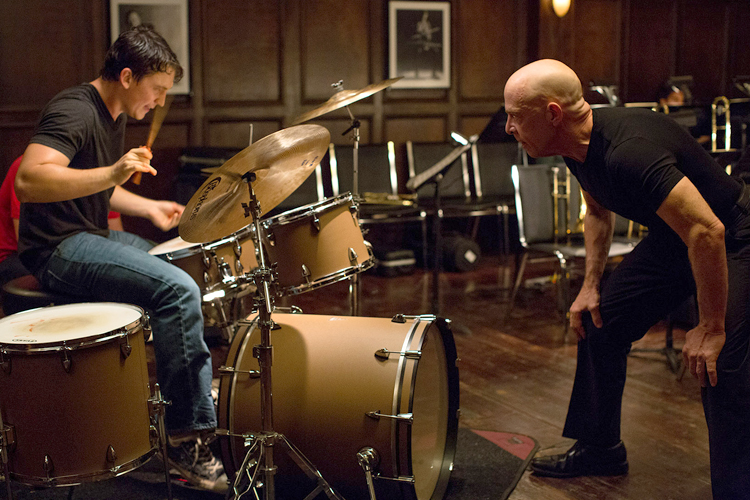
So, I hear the big hit at this year's Sundance Film Festival was Whiplash, a movie about the tumultuous relationship of an abusive, hard-driving jazz drum teacher and his student, and the shatteringly emotional, high-stakes world of jazz education... 

Now, I've been... ahm... I... gaha... yeah. Let's everybody settle down... try to keep it together. 

I guess any mainstream acknowledgement of the existence of jazz, and that playing music is a thing people do, is a good thing, but I have to say, I am cringing from the get-go here. I look at the still, and all I see is a very sympathetic drum teacher understandably screaming at his student for not knowing how to set up his drums, and for having just rotten-looking technique. (Alternate probable dialogue: “You play like an actor who picked up the drums four months ago for a role in some crummy made-for-cable-melodrama!!!”) 


This is a muscular and accomplished work of kinetic cinema built around two tremendous acting performances, and it’s really about teaching and obsession and the complicated question of how to nurture excellence and where the nebulous boundary lies between mentorship and abuse. 
Chazelle [the director] clearly understands the intensely competitive world of music schools in general and jazz education in particular,

Italics mine. College was intensely something, but I don't know if competitive is the first adjective that springs to mind. There was a little bit of that, and there was always some judging of abilities going on among the students, but mostly everybody was just really into music. Maybe I went to the wrong schools.   

but “Whiplash” is about jazz in almost exactly the same way that “Black Swan” is about ballet. Miles Teller (of “21 & Over” and “The Spectacular Now”) really does play the drums, and that’s where his character, a socially awkward 19-year-old conservatory student named Andrew, is most at home. (I’m pretty sure a professional drummer is used for the most difficult passages, but Teller’s pretty good.)

No, he's not. I saw the photo.

The musical performances in the film are intensely compelling, and drive the drama forward to a large extent, just as the big game drives a football movie or opening night drives a backstage musical. Chazelle also captures the fact that music is always a physical endeavor, a fact exaggerated by the demands of the drum kit; Andrew literally sheds blood, sweat and tears in his pursuit of greatness.

Well, Andrew is an asshole. If he's in this for “greatness.” Maybe I could stand to watch a real musician beat some decent artistic and human values into this kid for 90 minutes, after all...

More after the break: