Just came across this, quite an amazing documentary about Art Blakey, where they talk to Blakey, Dizzy Gillespie, Wayne Shorter, Benny Golson, Curtis Fuller, many others. I haven't gotten all the way through it yet. I saw him play in Eugene, Oregon, about this time, with this same band. Same heavy Zildjian ride cymbal that we was wailing on. You could see his front bass drum head moving the whole time, it looked like he was playing it pretty strongly.

A drumming blog written by Todd Bishop.
Showing posts with label Art Blakey. Show all posts
Showing posts with label Art Blakey. Show all posts
Wednesday, November 15, 2023
Art Blakey: Jazz Messenger


Tuesday, August 01, 2023
Listening to Somethin' Else
Somethin' Else is a very famous record by Cannonball Adderley, that really belongs in that “the one jazz record I know” list, along with Kind of Blue and Moanin'. When I was in school nobody could afford to own everything, so between the 4-5 of us that were hanging out, we had an OK record collection.
Recorded in 1958, when Cannonball was in Miles Davis's band— shortly after Milestones was recorded. Somethin' Else has Miles as a sideman, and Hank Jones, Sam Jones, and Art Blakey on drums. Miles basically produced the session, evidently.
I don't know how insightful these comments are— I'm putting down what strikes me that I'm able to put into words, in a reasonable amount of time. The first thing you do in writing about any art is to say what you hear, or see.
Autumn Leaves
This tune has been so beaten to death in school and in jam sessions, it's really hard to play it without feeling this heavy existential dread. This is a very cool rendition, and one of the classic renditions. Composed intro/outro a la Ahmad Jamal, that makes me think of Gil Evans. No stop time— the popular way to do it at jam sessions. Outro is slower than the original tune.
As a player, I want people to be ready to do intros/outros like that spontaneously, to have ideas for doing that. Blakey just plays time throughout, sometimes doing a Latin percussion effect on the snare drum and tom tom. He does that often on this record, simulating a conga player.
Centerpiece of the record. The intro figure is really part of the book of this tune that everybody should know, especially piano and bass players.
Love For Sale
One of the first tunes I learned— we played the Blue Wisp arrangement of this in high school. The tune's not a blank slate, it's a little journey, with some events for the rhythm section to support.
Listening here, it feels like there's a lot of action. There's a rubato solo piano intro, then a brief Ahmad-like Latin vamp (again, cop that figure, pianists). Blakey plays a strong accent when he comes in there. Swing 2 feel with brushes on when Miles comes in with the tune. Latin vamp comes back before the bridge— Blakey uses sticks briefly there, before going back to the brushes for the bridge and last A. At the end of the form there are some arranged kicks and four bars of the Latin vamp. Apart from the Latin parts, Sam Jones plays in 2 for the whole head.
Cannonball is the only soloist, and he plays two choruses. Rhythm section swings in 4 the whole time, except in the first chorus Blakey momentarily plays the Latin groove going into the bridge. Blakey plays sticks, with a bongo groove with the left hand. They play the straight through the form, none of the added kicks or Latin parts.
Back to brushes on the head out, Miles plays the A sections, Hank Jones plays the bridge. Sam Jones walks until the last A, where he goes into 2. None of the added Latin parts happen, except at the very end, as an outro. It seems to come as a surprise, because Blakey plays the first few bars with brushes, and then switches to sticks.
There's a lot of power to having everything clean and in its place like this. These changes like going from brushes to sticks have a big impact when there aren't a lot of distractions.
Somethin' Else
Bright tempo blues written by Miles, with an oblique kind of melody and some funny changes— somebody with more harmonic knowledge than me could tell you what's happening here. There's more comping activity from Blakey here, but it's all balanced to be softer than the ride cymbal. There's a tight little dynamic envelope happening there.
There's a little air between the attack on the cymbal and Sam Jones's attack on the bass. It's fooling my ear a little bit— I think Jones is in front, Blakey in back, and could totally be wrong. They're both absolutely solid and come off as being right on the beat, and driving. There's just a little space between their attacks.
Around 3:57 Blakey double times in a way I don't hear much any more. Dick Berk, a great drummer I used to see a lot in the 90s, used to do that a lot.
One For Daddy-O
Slow blues in 2, again with the conga beat on the drums, brush in the right hand, stick in the left hand. The brush is beating quarter notes out of a circular motion, from the sound of it.
Blakey goes to sticks and the bass goes into 4 as Cannonball's solo starts. Blakey continues the conga beat through the rest of the tune. On the head out, the bass goes back into 2, Blakey continues that beat.
Dancing In The Dark
This is a Cannonball feature, he plays the head and has the only solo. Bass walks during the solo, Blakey plays a basic time feel with the brushes all the way. Like on the rest of the record, it takes a lot of patience to play that way. It's its own effect, just playing time and not doing anything else. That doesn't even register as a way to play for most ambitious players today, it's off the table. Change it up.
In my years working the titular gig of this site I played this tune a lot, with several excellent, though young, tenor players, and this was the type of tune they always hated play, and they could never do much with it. Listening here, obviously the problem was not the tune. They were prepared to do a lot of modern improvising and playing hip stuff, but had a harder time just playing a tune and making that good. They all learned, because they were good, but it took some time.
Alison's Uncle
Bonus track, a loose medium up bebop tune. Blakey plays a little more, and gets to solo— he gets a chorus, and the bridge on the head out. He plays a hip variation on his conga beat for part of Miles solo. You could pull a lot of clichés (that's not a pejorative) out of Blakey's solo, if you were inclined that way. Not a lot happening with the bass drum, he's mostly using his hands, with the hihat strongly on 2 and 4 all the way through. One of these days I'll check out more closely how he phrases his solos— here they're basically neat little four bar phrases that develop nicely, they take a little turn in the second two measures.
Sunday, June 25, 2023
Listening to Thelonious Monk With John Coltrane
Some notes on the record Thelonious Monk With John Coltrane. I've been listening to Monk's Carnegie Hall record a lot this week, let's get into this one. I never owned it, and haven't listened to it much. I always gravitated to the Monk records with the bigger name drummers on them, and we used to be more limited to records a) that we could afford, b) that our friends owned, c) that the record stores carried... second-hand, especially...
This record is mostly a quartet with Shadow Wilson on drums; two tracks are septet with Art Blakey, apparently from the same session as the album Monk's Music, which also had Blakey and Coleman Hawkins.
A drummer named Chris Conrade— a very knowledgeable and rather prickly Portland character— once asked me who I thought was Monk's favorite drummer. I said Art Blakey, he told me it was Shadow Wilson. I guessed it was because he was basically a swing drummer; the only thing I knew about him I got from the Dejohnette/Perry book, which mentions him as an example of “updated swing style” playing— swing drumming reflecting bebop innovations, which became the new standard way of playing the drums, with time played on the ride cymbal, less pronounced bass drum, hihat played with the foot on beats 2 and 4, more or less independent snare drum. While generally reflecting a time-keeping, arrangement-playing, big band-like approach to the drums.
Jon McCaslin @ Four On The Floor has written about Wilson, and given some other examples of his playing, that's highly worth reading.
Ruby, My Dear
Very famous ballad that doesn't seem to get played as much as it once did. Shadow Wilson playing time on the hihat on the head, with brushes, then on the snare drum during Coltrane's solo, then double time on Monk's solo— notice his left hand is also sweeping the slow 4 feel during that.
Monk's tunes are so well structured— the tunes, and the background/supporting figures, form a very distinct interlocking structure for you to work with. There'a never any question about where you are, and you always have options for what to play off of.
Trinkle Tinkle
There's a classic jazz sounding cymbal for you. Probably an 18" K., and he plays it beautifully. Sounds like a 22" bass drum. He is playing it as part of his time feel (“FEATHERING” it, if you insist), in a fairly pronounced way. The things he plays on the head in support of the tune are very slick— on the head he plays extremely smooth rolls going into the second A section, and the bridge. The tune is quirky, and he plays some quirky stuff in support of it.
The cymbal is the main voice we hear from him; the snare drum, bass drum, and hihat, all of which he plays pretty constantly/actively, are balanced underneath it.
Off Minor
Art Blakey here. The triplet thing on the snare drum is real distinctively Blakey, as is the strong 2/4 with the hihat. He's really rocking the hihat here. He doesn't play as ferociously as he does on his own records, but he's more aggressive with his dynamics than Wilson. Drummers get into a macho thing where that's automatically thought the better way to be, but I honestly enjoy Wilson's playing on this record more than Blakey's.
Nutty
Back to Shadow Wilson. Coming off of Art Blakey, Wilson plays the snare drum and hihat much more discreetly. There's this lovely buoyancy in the way he plays the cymbal. We also get a good picture how he plays the hihats with sticks— another completely classic sounding set of cymbals there.
It strikes me here how much Coltrane was basically not about swinging. He immediately goes into double time on his solo, and plays a lot of stuff. He would play very lyrically at times, and he did play rhythm, but he wasn't really a groove guy, was he? Compare with Coleman Hawkins's solo on Off Minor. Coltrane's like listening to Bach, he's on some other kind of mission here.
Epistrophy
Blakey, obviously. Big aggressive drum intro, strong hihat again— the hihats dominate the time feel, the way Blakey plays the ride cymbal is fuzzier than Wilson. There's a driving quarter note pulse happening, but the articulated cymbal rhythm is not what's swinging the time.
You hear the contrast between Blakey's and Wilson's playing here— Blakey makes bigger statements, that are more distinctively “modern”, and draw more attention to themselves. He's also not always strictly in time with some things— on the head out, he's playing some percussion/rhythm effects that are not perfectly in rhythm. You can hear what he's basically doing, but it floats a little bit.
Some of the things Blakey plays with Monk are practically part of the arrangement of the tunes, in my mind— at least, they're distinct enough that you can refer to them when you play these tunes, and people will know what you're doing. What he does on the head out here is an example of that.
Functional
Solo piano, a blues. Blues is more than just a 12-bar form. Learning to say something real with the form is a major mission for any jazz drummer— everybody should be listening to piano players and copying their moves— however you would make that happen on the drums.
Friday, September 30, 2022
Listening to Blue Mitchell
Put on your headphones, here's a little listening this morning: this is Blues On My Mind from Blue Mitchell's album Out Of The Blue. A lot of blue there, and blues. Playing on it are Benny Golson, Wynton Kelly, Sam Jones, and Art Blakey on drums. Everybody sounds fantastic on it, I'm particularly in love with Sam Jones here.
The tune is a 12-bar blues, the feel is a nice relaxed shuffle. It's a hip tune, written by Benny Golson, not a stock hard bop item at all. There's no lead sheet for it in any of the usual books, you can purchase a transcription of the complete track (the head and solos anyway) via Qpress, a site that looks to be an excellent source for brass players.
Drummers tend to overplay when somebody mentions Blakey, shuffles, and hard bop. And when you give them/us an arrangement to play. So it's good to pay close attention to what's happening here, and dispel some perhaps one-dimensional concepts of those things. I know how you guys are, because I'm that way. Away from the actual thing you form these simplistic ideas about them. Maybe it's just me.
I would listen to this at least a half dozen times, including a couple times just paying attention to the quality of the groove, and the dynamics:
There are a number of stops and rhythm figures on the head, Blakey doesn't set them up except at the end of the form. He's very sensitive with the dynamics— the bar 1 is strong, bars 2-5 are soft, bars 6-12 are stronger. Each of those parts has dynamic movement within it. Check where he catches the cymbal and mutes it, or let's it ring out.
Blakey takes it easy, mostly playing straight time throughout, but he hits some pretty strong accents— usually at the end of solos. Most of us would be shy about punching them that hard when playing this smoothly overall.
As you would expect with a shuffle, he's keeping a straight rhythm on the cymbal, and there's some activity on the snare drum— a backbeat, and usually some part of the expected shuffle rhythm. At no point does he wail on the snare drum. He's playing the cymbal with a strong quarter note pulse, accenting on all four beats— he's not accenting just the 2 and 4, as if often stated about him. The hihat is on a solid regular 2 and 4 all the way. Blakey played the bass drum in his time feel, but I'm hearing none of it except for the accents. Maybe during the bass solo.
An aside: I don't know, once again, I think the popular concept of “feathering” is just misguided— especially as I see people focused on it to the exclusion of the audible elements. And as if it's one thing and one technique. The feeling I'm getting here is of a little pressure on the bottom with the foot, like the beater isn't even coming off the head.
The groove is seated very deep, and is definitely human created. As is often the case, you can feel the swing element being pulled some different directions. And the main pulse. There are some wild factors there. Religiously resolving everything to a perfect grid is a 21st century deformity— it's not what swing is. Blakey's cymbal beat is close to a dotted-8th/16th rhythm here; between the cymbal and the snare drum there's a suggestion of a double time feel at times. The soloists are generally swinging off more of a triplet foundation, when they're not double timing. The swing comes from the tension between the different concepts. In part.
For a moment I was going to say that this track is a lesson in not playing based on genre stereotypes, but stepping back it really is just a straightforward shuffle. I think the fact that I'm listening to this straightforward shuffle, and all I can hear is the ways that it's a unique piece of music, and not a genre stereotype, is a clue about how you're supposed to listen. It does help that these players are all so great, it makes the fact that we're hearing living music pretty unavoidable.
Wednesday, July 27, 2022
Art Blakey - The Core
Here's something great that deserves much better than the cursory treatment I'm about to give it: The Core, from Art Blakey's record Free For All. Blakey's doing a little bit of an Elvin Jones thing on this record— like it says, it's very hard core.
On a forum someone asked what he's doing on this tune. On a big part of it he's playing off of this piano figure from the intro, that recurs for extended passages throughout:
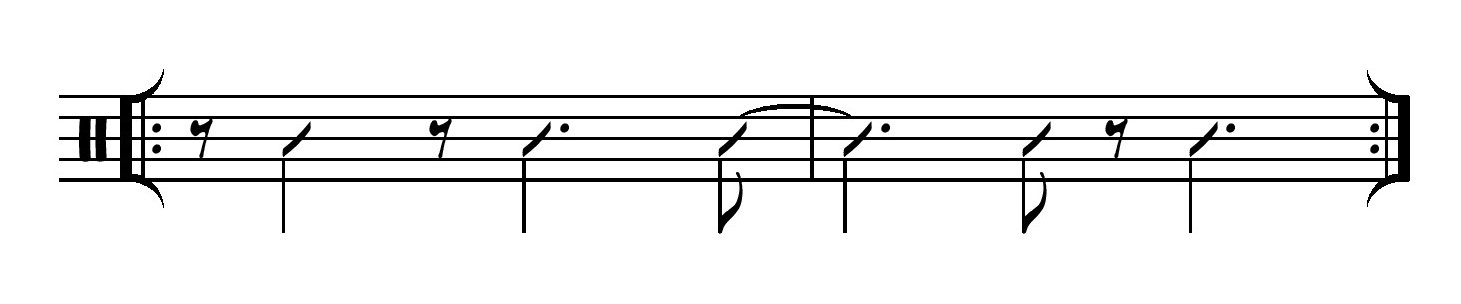
He does a sort of rubadub treatment— these are two two-measure examples from the intro:

It gets pretty raggedy, so the transcription hardly does it justice. The occasional triplets are hardly calculated; when playing at the edge of your abilities things can weird— things emerge that are not in your control. A lot of other stuff happens. There's a section with some horn hits. Part of the solos swing. Sometimes he deviates from that basic figure during those sections— he'll extend playing in 3 over 4/4 time a la Elvin. It's hot as hell in my office right now (101° in Portland today) and I have neither the patience nor the focus to listen through and figure out the form.
Monday, May 16, 2022
Max on the bass drum

SF: Back in the '50s and '60s jazz drummers were primarily using the smaller size drums: 18" bass, 12" mounted tom and 14" floor tom. I've heard that one of the main reasons drummers used that size drum was because they were easier to transport than larger drums.
MR: Exactly. It made it easier to get from town to town. Pack up your gear, put it in your car, and off you go. That was one of the main reasons I think.
Plus, the bass drum had begun to become less and less an integral part of the whole musical set-up. It's different now. The bass drum, at that time, would stamp out what was happening with the acoustic bass. Even the pianists would leave that part. They would voice their chords so the bottom of the piano would be in thirds and sevenths instead of tonics and fifths. They left that part for the acoustic bass. So, your bass drum would only be used for accents and supports.
So the small drum was great, plus, you didn't have all the electronics around you, so you didn't need that power there. There were many reasons for it. But, today you do need that power with the electronic scene.
The italics are mine, and it's maybe a revealing part of the comment. Max typically played the bass drum in the way we now call feathering, but he doesn't bring it up as a role of the bass drum in modern jazz. It's important to note that at the time of the interview, larger bass drums were generally in favor— usually 20-22". And at that time bebop was not the only thing happening in jazz— many big players of the 60s had moved in a more fusion direction.
But imagine Mel Lewis addressing this topic— well, we don't have to. He's rather strident on it. Art Blakey said something similar in his '80s MD interview:
Like playing the bass drum: A lot of drummers today have no bottom. They talk about punctuating, but they don't keep that feeling in there, and that bass drum is the basis of the whole thing. And if you let that go it sounds like s*t to me.
I don't know what Max would say if he was asked specifically about it— he absolutely might agree with Lewis and Blakey. Maybe somebody reading has talked to him or studied with him, or been to a clinic. But feathering the bass drum in a bop setting has become such a dogmatic thing, especially with jazz hobbyists on the internet, and I thought it was an interesting omission.
I originally wrote about this in 2012, and my thinking has changed a little bit— maybe it's time to revisit that.
Friday, February 26, 2021
Transcription: Art Blakey - This Is Life
From maybe the first jazz record I ever checked out on my own, Golden Boy by Art Blakey. Kind of an obscure record on the Colpix label, that I dug out of my dad's record collection. Along with that Charlie Parker recording I mentioned the other day, and a Jazz At The Philharmonic album, and Kind of Blue. Anyway, Blakey does an extended solo at the beginning of This Is Life, and it was the first idea of jazz drumming I ever got from a record. I think all I knew about Blakey was the rough looking picture of him in the Zildjian cymbal guide, and my brother mentioning that he played really loud.

The tempo starts around 192, picks up a bit to about 210 by the end of the solo, and is about 178 after the band comes in.
I wrote the bass drum part as accurately as possible in measures 19-22, but if you're going to play this solo, do not mess with trying to do what I've written— listen to the vibe of what he's doing and copy that. Basically he's flailing it in there, and his foot wants to do quarter note triplets or straight 8th notes.
He “feathers” the bass drum through the first part of this, but that seems the wrong word— some old guys say “pats”, and that's really what he's doing here. It's a dry leathery sound, barely a tonal sound.
By the way, the cymbal he's using here is squarely in the middle of Cymbal & Gong-land. The first 20" Holy Grail video I pulled up is damn close to it— except that HG is a little heavier. I quickly found a couple more that were close. Of what I have in stock right now, “Amos” is the closest match to this cymbal.
...have I mentioned there is a sale on cymbals going right now! 10% off Holy Grails purchased with a 30% off Leon— and I never give discounts on Holy Grails.
On the Cymbalistic blog I mentioned a different Blakey cymbal, the one used on The Big Beat and Indestructible, and also found a good match in my past stock of Holy Grails. I've only sold about thirteen 20" Holy Grail Jazz Rides since I've been doing this, and at least 4-5 of them are reasonably exact matches for something Art Blakey played. The rest of them are right there in the same family. What I'm trying to communicate to you is that these cymbals are it— there's a reason I'm so excited about them.
Tuesday, November 24, 2020
Transcription: Art Blakey fours - Well, You Needn't
Just a couple of solo 4s from Art Blakey, from the 1953 Miles Davis 10-inch release, Vol. 3. You'll most likely find it on a later Blue Note compilation. The tune is Well, You Needn't. Miles and Blakey trade on the first two A sections of the head out, Miles plays the melody on the bridge. The first drum break happens at 4:18.

He's mostly playing stick shots on the snare drum, as you can see. The normal snare hits are played with the left hand, the shots with the right. He feathers the bass drum throughout.
Wednesday, August 12, 2020
Groove o' the day: Art Blakey tom tom groove
This is a fast Latin groove played by Art Blakey during a solo on a concert video filmed in Japan, posted on Twitter by jazz writer Ted Gioia. I'm sure Blakey plays it on his records, too— first place I would look would be A Night In Tunisia.
For clarity I put the left hand, which plays rim clicks on the snare drum, on its own line— the rest of it is played with the right hand. Play with the snares off. He's probably playing the bass drum, either quarter notes or half notes, but I can't hear it. Tempo is above half note = 150.

He plays this variation:

You can see the video here, as long as it stays on Gioia's Twitter feed. It happens at about 1:15.
For clarity I put the left hand, which plays rim clicks on the snare drum, on its own line— the rest of it is played with the right hand. Play with the snares off. He's probably playing the bass drum, either quarter notes or half notes, but I can't hear it. Tempo is above half note = 150.

He plays this variation:

You can see the video here, as long as it stays on Gioia's Twitter feed. It happens at about 1:15.
Friday, July 31, 2020
Grooves o' the day: Art Blakey Latin
Two very similar Latin grooves recorded by Art Blakey in 1960 and '61. On both of them the bell pattern has that little syncopated move across the barline that we see a few years later in the Mozambique rhythm. There was a lot of Latin music happening in New York in the 40s-50s, but I'm nowhere near informed enough about it to try speculate on where Blakey and others got that motif; it does also happen in Cuban conga de comparsa, from which the Mozambique is derived.
Johnny's Blue, from the Jazz Messengers album Like Someone In Love:

There's no audible bass drum on either thing. On both tracks when Blakey comes in he starts with an accent on the high tom on beat 1. Note that he swings the cymbal rhythm when he first comes in.
El Toro, from the Jazz Messengers album The Freedom Rider:

A little brighter tempo, using two tom toms, with a broken rhythm on the cymbal in the first measure.
Johnny's Blue, from the Jazz Messengers album Like Someone In Love:

There's no audible bass drum on either thing. On both tracks when Blakey comes in he starts with an accent on the high tom on beat 1. Note that he swings the cymbal rhythm when he first comes in.
El Toro, from the Jazz Messengers album The Freedom Rider:

A little brighter tempo, using two tom toms, with a broken rhythm on the cymbal in the first measure.
Monday, June 01, 2020
Listening: Art Blakey groove number
Let's do some more guided listening. Here's Art Blakey playing a little Quincy Jones groove arrangement with a nine piece ensemble: Plenty, Plenty Soul, from the Milt Jackson album of the same title. The form is 12-bar blues. I'm surprised to see that it's 9 1/2 minutes long; it feels like a little four minute radio number.
Put on the headphones and give this at least three close listens:
It's a clean, understated performance, with none of Blakey's trademark ferocity. At no point do you feel he's playing louder to compete with the five horns. I might say it's a professional performance, meaning he's playing it like a hired studio drummer, rather than like a featured show performer, which is more the vibe of his Jazz Messengers stuff. That's not to suggest that his playing there is “unprofessional.”
He plays a backbeat most of the time; it's deeply grooving but not at all loud. Most of the time he's playing the little shuffle pick up before it. He's playing a strong (not loud!) quarter pulse with the cymbal rhythm, typically with a dotted-8th/16th rhythm. The snare drum rhythm has a similar, very tight timing— it's not a triplet. You can hear at the points where he does play triplets in a fill, it's a very different rhythm from the main groove of the piece. No doubt he's playing quarter notes or half notes on the bass drum through most of this, but you never hear it except where he's making a deliberate accent or punctuation, or on the tutti sections.
There's some air between the bass (played by Percy Heath) and the drums. Generally sounds like the attack of the ride cymbal is a little ahead of the bass, and the snare drum is behind everything— playing the shuffle rhythm the way he does is a way of getting that behind-the-beat feel with it. At some points it sounds to me like the bass is more on the front of the beat. Your ears can fool you. It's worth it to give a very close listen to the timing of the major events on this track— everything is not perfectly squared off. That's not a flaw.
Blakey does a double time groove a few times— after 5:00 for example.

Mostly he does it with a straight 2 and 4 on the snare drum— no extra little shuffle note. He often comes in with that in the last two bars of the chorus. He may double times just those two bars, or continue it through the complete following chorus, or he may goes back to regular time on the turnaround— bar 9 of the form. Where things happen in the form is important information for playing blues. We're not just punctuating randomly.
There is no bebop-type comping activity at all. Instead he makes big statements here and there; usually at the end of a solo, leading into the next solo. He may do his crescendoing press roll, a Blakey trademark, or triplets on the tom toms. At the end of the trombone solo he does a pitch bend thing on a tom tom.
His playing on the arranged passages is simple, with simple one or two note set ups for the horn kicks; he'll keep playing the 2 and 4 until the end, when he hits the big figure in unison with the horns. He does a ruff on the toms/bass drum during the horn fall at the end of the short ensemble interlude passages— he lands on the 1 of the second bar of the new chorus with that.
At first I thought he was using two cymbals— but I think he's using one 20" sizzle cymbal and varying his playing area and touch. Listen closely to it— there is no more classic jazz sound than that, and it's very similar to the Cymbal & Gong cymbals [PLUG PLUG PLUG— tb]. The accent sound at 2:00 is exactly the explosive crash sound we look for in a ride cymbal. People call this a “dark” sound, but it's more accurate to call it complex; there are trebly elements to it.
Put on the headphones and give this at least three close listens:
It's a clean, understated performance, with none of Blakey's trademark ferocity. At no point do you feel he's playing louder to compete with the five horns. I might say it's a professional performance, meaning he's playing it like a hired studio drummer, rather than like a featured show performer, which is more the vibe of his Jazz Messengers stuff. That's not to suggest that his playing there is “unprofessional.”
He plays a backbeat most of the time; it's deeply grooving but not at all loud. Most of the time he's playing the little shuffle pick up before it. He's playing a strong (not loud!) quarter pulse with the cymbal rhythm, typically with a dotted-8th/16th rhythm. The snare drum rhythm has a similar, very tight timing— it's not a triplet. You can hear at the points where he does play triplets in a fill, it's a very different rhythm from the main groove of the piece. No doubt he's playing quarter notes or half notes on the bass drum through most of this, but you never hear it except where he's making a deliberate accent or punctuation, or on the tutti sections.
There's some air between the bass (played by Percy Heath) and the drums. Generally sounds like the attack of the ride cymbal is a little ahead of the bass, and the snare drum is behind everything— playing the shuffle rhythm the way he does is a way of getting that behind-the-beat feel with it. At some points it sounds to me like the bass is more on the front of the beat. Your ears can fool you. It's worth it to give a very close listen to the timing of the major events on this track— everything is not perfectly squared off. That's not a flaw.
Blakey does a double time groove a few times— after 5:00 for example.

Mostly he does it with a straight 2 and 4 on the snare drum— no extra little shuffle note. He often comes in with that in the last two bars of the chorus. He may double times just those two bars, or continue it through the complete following chorus, or he may goes back to regular time on the turnaround— bar 9 of the form. Where things happen in the form is important information for playing blues. We're not just punctuating randomly.
There is no bebop-type comping activity at all. Instead he makes big statements here and there; usually at the end of a solo, leading into the next solo. He may do his crescendoing press roll, a Blakey trademark, or triplets on the tom toms. At the end of the trombone solo he does a pitch bend thing on a tom tom.
His playing on the arranged passages is simple, with simple one or two note set ups for the horn kicks; he'll keep playing the 2 and 4 until the end, when he hits the big figure in unison with the horns. He does a ruff on the toms/bass drum during the horn fall at the end of the short ensemble interlude passages— he lands on the 1 of the second bar of the new chorus with that.
At first I thought he was using two cymbals— but I think he's using one 20" sizzle cymbal and varying his playing area and touch. Listen closely to it— there is no more classic jazz sound than that, and it's very similar to the Cymbal & Gong cymbals [PLUG PLUG PLUG— tb]. The accent sound at 2:00 is exactly the explosive crash sound we look for in a ride cymbal. People call this a “dark” sound, but it's more accurate to call it complex; there are trebly elements to it.
Sunday, June 23, 2019
Transcription: Art Blakey - The Egyptian
Here's a drum intro... hey, this could go in my Book of Intros, which HAHAHAHA is still languishing a few hours of work away from completion... a drum intro, played by Art Blakey on The Egyptian, from the Jazz Messengers album Indestructible. I was checking this out for the cymbal sound; he's using a rather famous 20" K. Zildjian ride that he also plays on The Big Beat. But what he's playing is a little Art Blakey microcosm— it includes several little stylistic things he does quite often.

Some of these things don't resolve exactly the way they look in the transcription. In bars 13-14, what Blakey plays is actually somewhere between these two things. There's also a second cymbal note at the end, right before the following downbeat, which I didn't even try to include.

Something similar happens in bars 19-20— six notes seemingly evenly-spaced notes, like in the first example, except he starts it on the & of 4, like in the second example:

I actually think he plays it the second way, and that my ears were just fooled into hearing the fill as six evenly spaced notes— he does play the extra space as in the second way.
Get the pdf

Some of these things don't resolve exactly the way they look in the transcription. In bars 13-14, what Blakey plays is actually somewhere between these two things. There's also a second cymbal note at the end, right before the following downbeat, which I didn't even try to include.

Something similar happens in bars 19-20— six notes seemingly evenly-spaced notes, like in the first example, except he starts it on the & of 4, like in the second example:

I actually think he plays it the second way, and that my ears were just fooled into hearing the fill as six evenly spaced notes— he does play the extra space as in the second way.
Get the pdf
Tuesday, September 19, 2017
Transcription: Blues March - two intros
Two intros to a famous tune: Blues March, by Benny Golson. One is by Art Blakey, from the Jazz Messengers album Moanin', and the other is by Lex Humphries, from Art Farmer and Benny Golson album Meet The Jazztet.

Swing the 8th notes on both intros, except the roll-off in the last two measures, which is played with straight 8ths. And of course the 16th note part of the Humphries intro does not swing. Rolls are all multiple-bounce— 16th note pulsation 5-stroke and 9-stroke for the short rolls, triplet pulsation 13-stroke for the longer rolls. Both drummers play their flams pretty flat; the grace note is so tight against the main note it's sometimes hard to tell if they are playing flams. It's noteworthy that on each recording when the band comes in the tempo slows down— to 130 on the Blakey version, and 140 on the Farmer/Golson version. Maybe that happens all the time; it never occurred to me to check that on other recordings.
Get the pdf
Audio of the tracks is after the break.

Swing the 8th notes on both intros, except the roll-off in the last two measures, which is played with straight 8ths. And of course the 16th note part of the Humphries intro does not swing. Rolls are all multiple-bounce— 16th note pulsation 5-stroke and 9-stroke for the short rolls, triplet pulsation 13-stroke for the longer rolls. Both drummers play their flams pretty flat; the grace note is so tight against the main note it's sometimes hard to tell if they are playing flams. It's noteworthy that on each recording when the band comes in the tempo slows down— to 130 on the Blakey version, and 140 on the Farmer/Golson version. Maybe that happens all the time; it never occurred to me to check that on other recordings.
Get the pdf
Audio of the tracks is after the break.
Tuesday, April 18, 2017
Transcription: Art Blakey - Afrique
Here's the drum solo from the same tune as our GOTD the other day: Afrique, from The Witch Doctor, by Art Blakey & The Jazz Messengers. Blakey's solos with his group often serve a compositional function, and also a show function. They're not just about look how well I can play, or here's me playing these changes. There's also nothing contemplative about this solo— it's all about power and rising intensity. The volume is uniformly very loud all the way through— basically every note is accented. The housetop accents are rim shots, and extra strong.

The solo is 32 bars long, with four 8-bar sections. The first and third sections are cleanly composed of 2-bar phrases; the second and fourth sections are each more an undifferentiated wall of triplets. His phrasing is interesting to me, changes are marked more by doing something new in the first measure of the phrase than by building or changing in the last measure of a phrase, or by placing an accent on 1— I don't know why that seems surprising to me. He plays bigger on measure 17, the first measure of the bridge, for example.
I would take those moving triplet passages as an invitation to experiment and figure out a similar thing that works for you. You can hear there's quite a roar happening, and I may not be getting every single note he played. Figure out your own version of whatever showy crossover thing he's doing. It's less likely to be some kind of mixed sticking with singles and doubles.
Note the pitch bends that happen in the middle— play these by turning the snares off and pressing into the head with one stick, or your elbow— Han Bennink uses the heel of his foot. It probably helps to use calf heads and to not cranking your drum too high.
Heading back into the Afro vamp at the end of the solo, it's easier to notate the transition by putting it in 6/8— as a “groove o' the day” I put it in 3/4, since on the vamp the other instruments are playing strongly in 3.
Get the pdf

The solo is 32 bars long, with four 8-bar sections. The first and third sections are cleanly composed of 2-bar phrases; the second and fourth sections are each more an undifferentiated wall of triplets. His phrasing is interesting to me, changes are marked more by doing something new in the first measure of the phrase than by building or changing in the last measure of a phrase, or by placing an accent on 1— I don't know why that seems surprising to me. He plays bigger on measure 17, the first measure of the bridge, for example.
I would take those moving triplet passages as an invitation to experiment and figure out a similar thing that works for you. You can hear there's quite a roar happening, and I may not be getting every single note he played. Figure out your own version of whatever showy crossover thing he's doing. It's less likely to be some kind of mixed sticking with singles and doubles.
Note the pitch bends that happen in the middle— play these by turning the snares off and pressing into the head with one stick, or your elbow— Han Bennink uses the heel of his foot. It probably helps to use calf heads and to not cranking your drum too high.
Heading back into the Afro vamp at the end of the solo, it's easier to notate the transition by putting it in 6/8— as a “groove o' the day” I put it in 3/4, since on the vamp the other instruments are playing strongly in 3.
Get the pdf
Sunday, April 16, 2017
Groove o' the day: Art Blakey - Afrique
Here's Art Blakey playing an Afro 6 feel in 1961, on Afrique, from the Jazz Messengers album The Witch Doctor— the first Blakey record I ever bought. I should start noticing when this type of groove found its way into jazz. Certainly Blakey was one of the early adopters, and here he plays it in a fairly rudimentary form, without the usual bell pattern we expect to hear in actual Cuban music, or in later jazz.

I've written it in 3/4, but it could have been written in 6/4, or 6/8, or 12/8. Going into the solos there is a metric modulation into 4/4— the dotted quarter during this intro groove becomes the quarter note in the 4/4— which would argue for writing it in an */8 meter, but the accompanying parts are so strongly in 3/4, that's the meter I put it in. Wayne Shorter's and Lee Morgan's solos on this are great. Transcription of Blakey's solo on this tune coming soon...

I've written it in 3/4, but it could have been written in 6/4, or 6/8, or 12/8. Going into the solos there is a metric modulation into 4/4— the dotted quarter during this intro groove becomes the quarter note in the 4/4— which would argue for writing it in an */8 meter, but the accompanying parts are so strongly in 3/4, that's the meter I put it in. Wayne Shorter's and Lee Morgan's solos on this are great. Transcription of Blakey's solo on this tune coming soon...
Sunday, January 29, 2017
Art Blakey in '85
Here's video of Art Blakey playing in 1985. I saw him in Eugene, Oregon during this same tour, when I was a senior in high school. He played impressively loud— he had this heavy ride cymbal, same one in this video, that was very metallic sounding, and he really laid into it. All these years I thought it was a Paiste heavy, but I'm certain it's the same cymbal as in this video. Also noted that his bass drum was wide open— no muffling at all, but when he played it it just sounded big. Also noted that the front head was moving all the time— he was clearly playing it as part of his time feel, sometimes obviously pretty strongly.
Saturday, October 11, 2014
Groove o' the day: Art Blakey afro
This is a triplet Afro feel by Art Blakey, one of the major people playing that feel in a hard bop setting in the late 50s/early 60s. I usually call it a 6/8 feel— some people call it 12/8— here the tune is clearly in 4, so we'll call it 12/8. This groove appears to be something he made up, rather than a “correct” African/Latin feel. The bell pattern is derived from our usual pattern, the so-called “short” bell pattern— with the triplets filled out in the last two beats.
On the solos, Blakey goes into a heavy shuffle— the way only he can play it— and stays with it for the rest of the tune, up to the fade out, when he switches back to this feel.

The bass drum is barely audible on the recording, so he could be playing something different for all I know; this matches what the bass player is doing, anyway. The floor tom hit on 4 is softer than the other left hand notes, hence the parentheses.
Listening to the complete track, can you imagine a jazz drummer in a small group today playing as loud as Blakey does, for as long as he does, on this track? He's playing loud. Modern players have basically retired that effect from their playing— that simple, sustained, deep, powerful, groove.
On the solos, Blakey goes into a heavy shuffle— the way only he can play it— and stays with it for the rest of the tune, up to the fade out, when he switches back to this feel.
The bass drum is barely audible on the recording, so he could be playing something different for all I know; this matches what the bass player is doing, anyway. The floor tom hit on 4 is softer than the other left hand notes, hence the parentheses.
Listening to the complete track, can you imagine a jazz drummer in a small group today playing as loud as Blakey does, for as long as he does, on this track? He's playing loud. Modern players have basically retired that effect from their playing— that simple, sustained, deep, powerful, groove.
Tuesday, January 28, 2014
Art Blakey in a nutshell
 |
| Play it strong. |
Monday, October 07, 2013
Drum intro: Art Blakey — Straight, No Chaser
Every part of this is just so classically Art Blakey— except maybe his touch, which is somewhat gentler than usual. This is his intro on Straight, No Chaser, from Thelonious Monk's album Genius of Modern Music, vol. 2, on Blue Note. This will be included in our upcoming Book of Intros, which will be ready to go hopefully before my tour in November:

At the beginning and end there are big accents played on the open hihat with the left hand, along with the cymbal. All of the snare drum notes are played as rim clicks, and Blakey feathers quarter notes on the bass drum up until the hihat lick in the last two measures. A figurative gold star goes to whoever finds the missing rim click— that will be corrected when the book comes out...
Get the pdf
Audio after the break:

At the beginning and end there are big accents played on the open hihat with the left hand, along with the cymbal. All of the snare drum notes are played as rim clicks, and Blakey feathers quarter notes on the bass drum up until the hihat lick in the last two measures. A figurative gold star goes to whoever finds the missing rim click— that will be corrected when the book comes out...
Get the pdf
Audio after the break:
Tuesday, January 08, 2013
VOQOTD: the Blakey hang
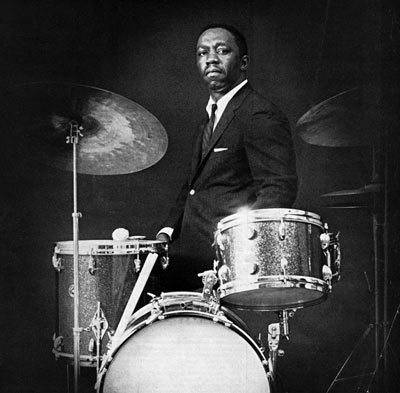
— Art Blakey, Modern Drummer, September, 1984
Interview by Chip Stern
Subscribe to:
Posts (Atom)