We haven't done anything new with samba in awhile, because I'm still digesting all of the stuff we've done previously. But here's something new that came up yesterday, using open and muffled tones on the bass drum to emulate the surdo. It would also be helpful to run the third surdo parts from O Batuque Carioca, as well as my bossa bass drum variations, and the standard dotted-8th/16th samba pattern with this. This feel combines well with samba cruzado, which we've discussed before.
Notes:
- Play the snare drum with the "tripteenth" feel; the '#' and the 'a' of each beat of 16ths line up almost exactly with the first and last notes of a triplet. Play with or without the buzz on the 'e', with sticks or brushes.
- Use either hihat pattern. The second pattern uses a closed note on beat 1, and a splash on beat 2.
- Play staccato bass drum notes as a dead stroke- bury the beater in the head to make a muffled sound. Play the tenuto notes as an open tone, allowing the beater to rebound. This works best with a drum with little or no muffling.
- Bass drum patterns with rests are preparatory studies. Patterns without rests are performance patterns.
- Also substitute dotted-8th/16th rhythm for the 8th notes or the 16th-8th-16th rhythm on the performance patterns.
Get the pdf
YouTube examples after the break:
Tuesday, January 10, 2012
Monday, January 09, 2012
...or, to just fail.
I would add:
- Think of your work as being in competition with that of all artists, everywhere, at all levels of the business, past and present.
- Imagine that your every creative move and decision is being judged by people better than you.
- Be dominated by your weaknesses. Be oblivious to your strengths.
h/t to Ed Domer and Universal Audio
Sunday, January 08, 2012
Another Drum! Magazine piece
Oh, hey, it looks like Drum! Magazine is going to publish another piece of mine, "Cross Rhythms Using Stone", which outlines a polyrhythmic application for using the 3/8 portions of Stick Control in 4/4, on the drum set. Just awaiting final confirmation and street date...
Transcription: three Philly Joe intros
Must do shorter, faster posts. That last one took way too many hours. Here:
Get the pdf
Get Dance of the Infidels | get Hank by Hank Mobley
Get I'll Never Smile Again | get Interplay by Bill Evans
Get Philly Mignon | get Here to Stay by Freddie Hubbard
YouTube audio after the break:
Get the pdf
Get Dance of the Infidels | get Hank by Hank Mobley
Get I'll Never Smile Again | get Interplay by Bill Evans
Get Philly Mignon | get Here to Stay by Freddie Hubbard
YouTube audio after the break:
Saturday, January 07, 2012
On “feathering” the bass drum
![]() |
| what is this |
Apart from the word itself, what bothers me the most about that way of playing itself is that it's vestigial. It's left over from the days when the bass drum was played for the same reason anything is played: to be heard. Now we're doing something to not be heard, that you still have to learn to do as well as everything else you do, that's going to make you sound bad if you don't get it to the right level of inaudible perfection. We spend a lot of time eliminating non-functional elements from our playing, and our movements when playing, and this just seems completely contrary to that.
As I said, through the swing era, drummers played the bass drum to be heard. In the 1940s bop drummers de-emphasized it dramatically, but they kept doing it because that's how they knew how to play. More modern players, without the same swing background as many of the bop drummers, began dropping it out altogether. Maybe this debate over whether to play the bass drum, and how loud, was happening as this was all developing— I suspect the justifications for feathering it came later. All of these developments happened before I was born.
When I first began playing jazz in the 1980's, drumming as I knew it was in a very post-Tony Williams state. The sense I got from the best players I was around was that playing the bass drum that way was antiquated, and that in modern playing the time feel was centered in the cymbal and hihats; the bass drum and snare drum were for comping, punctuations, for funky/Latin feels, or as part of a texture (a la Elvin Jones). Playing quarters on the bass was regarded as an unsophisticated use of the instrument, and a big turn-off when it was abused... particularly by rock drummers, for whom it was a crutch. So, I've never played the bass drum as part of my time feel, except when playing shuffles, or in specifically very traditional swing settings.
Nevertheless: In recent years I've re-evaluated all of this somewhat, and I play more unaccented quarter notes than I used to. Understanding the traditional role of the bass drum is important, and you can only get that with a physical connection, by playing it. I rarely play a whole tune or even a whole chorus that way, but I'll put it lightly on 1 and 3 at slower tempos, or at certain points emphasizing a heavier groove. And I have some other ways of approaching it in a more modern and open way.
For example:
Alan Dawson's Syncopation long note exerciseThis is a Reed interpretation in which you play the short notes (untied 8th notes) on the snare, and the long notes (tied 8ths, quarters, and dotted quarters) on the bass drum, while keeping time with the cymbal and hihat. The way the exercises are written, you'll end up playing a lot of quarter notes on the bass drum, giving your time a nice grounded feeling, while never getting into full-on 1938 groove. For someone like me who was always trying to “hiply” emphasize the &s- this was a big change in direction.
If you're not familiar with it, here's a line of exercise from the book:
Here's how that would be played, with jazz time on the cymbal and hihat added:
Suggesting a funk feelOften a half time feel with the snare drum on three. This can be done explicitly, but I try to be subtle and non-repetitive about it, so it doesn't actually sound like a feel change, or like a funk drummer trying to play jazz:
Quasi-second line feel
In which the bass and snare split a running syncopated line:
The emphasis is on the quasi with that example— that's much more partido alto than second line. The result of writing it too quickly. But you get the picture.
Labels:
bass drum,
drums,
feathering,
jazz,
syncopation,
Ted Reed,
time
Brushes... fast... hoo...
As I finish up the thing I'm working on, do yourself a favor and visit The Melodic Drummer for an excellent post on playing brushes at really, really fast tempos. You can also brush up (gah!) on your Kenny Washington with his profile at the Jazz Profiles blog- I'll be with you in a moment.
Thursday, January 05, 2012
DBMITW: The Beta Band
Let's feature somebody with an actual video for once:
A few more after the break:
Wednesday, January 04, 2012
Transcription: one hour with Live Evil
This morning I sat down with one of my favorite pieces of music- Sivad, from Miles Davis' Live Evil, with Jack Dejohnette on drums- to see what I could do with it in a reasonable amount of time. Fourteen measures in sixty minutes, it turns out. The stopping place is arbitrary- there are four more hell-of-notes measures until the horn comes in, and I knew it would take me another half hour to get them, so I figured that was enough for one post.
You can make the opening little crescendoing half note roll plus swing 16th on the BD yourself. Play the drags as 32nd note doubles. The 32nd sixtuplets appears to be doubles, and most of the remaining 32nd notes are likely singles. I think. Do what works best for you.
I've been playing with Charlie Perry's Beyond the Rockin' Bass book recently, and it reminds me a lot of Dejohnette's funky playing on this record- it's a lot of fun to work with.
Get the pdf
You can make the opening little crescendoing half note roll plus swing 16th on the BD yourself. Play the drags as 32nd note doubles. The 32nd sixtuplets appears to be doubles, and most of the remaining 32nd notes are likely singles. I think. Do what works best for you.
I've been playing with Charlie Perry's Beyond the Rockin' Bass book recently, and it reminds me a lot of Dejohnette's funky playing on this record- it's a lot of fun to work with.
Get the pdf
Monday, January 02, 2012
Dahlgren & Fine and me
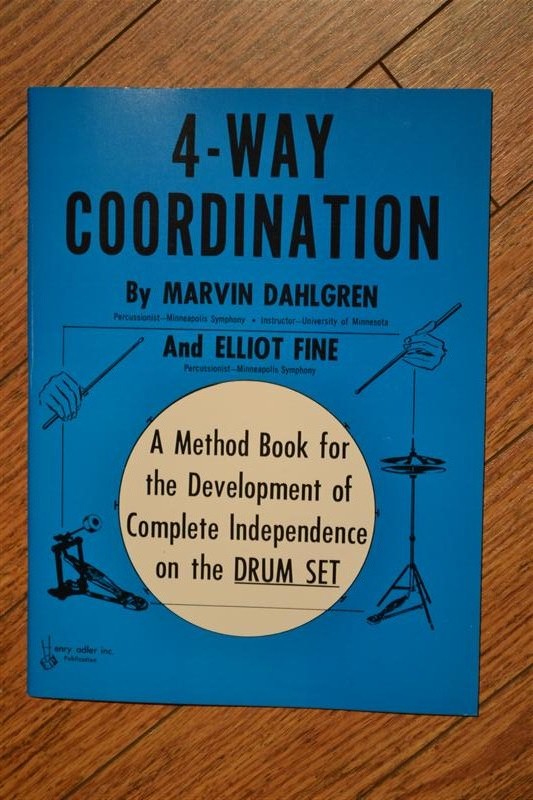
4-Way Coordination by Dahlgren & Fine is a major piece of drumming literature that I've always had a lot of problems using. There's been a lot of discussion about it on the Drummerworld forum lately, so I've been trying to get to the bottom of my reservations about it. If you don't own it (and you should), you can peruse it online here.
Published in 1963, this is the first book I am aware of to attempt to isolate the problem of independence at the drumset. It opens with the abstract "melodic" and "harmonic" coordination sections (pp. 3-26), which could be described as the the first section of Stick Control applied to four limbs. As written they're very nearly style-free; they feel pretty remote from linear drumming as you encounter it in fusion, modern funk or jazz. I treat them as conditioning exercises, a la Stick Control, or as jumping-off points for developing into something usable. I've had friends disappear down the rabbit hole with this section, with the idea of really getting their fundamentals together once and for all, free of any stylistic baggage; for me there's too little musical hook to spend a lot of time with it. It's too thin.
The last section of jazz exercises ("Four-way coordination on the Drum Set", pp. 27-53) is a much more diluted form of the concept, and is for me the most useful part of the book. It still should be approached with caution; I treat these more as idiomatic conditioners rather than as performance vocabulary. That is, they're jazz-style technical exercises, but are not written/organized in a way that they're easy to recall and play in a musical way in performance. They're good for putting things in your muscle memory, but as presented they don't connect well with actual music. For that you need a different method.
The structure of this section is unique, allowing you to put the patterns in a number of different meters. Each section of pp. 33-48 consists of a base ostinato plus six lines of variations. Each line consists of two 2/4 measures and two 3/4 measures, labeled A, B, C, and D, which you can combine to make measures of 4/4, 5/4, 6/4, and 7/4. I think it's most constructive to practice each measure individually for all sections- that is, play the A measures only for sections 1-22, then the B measures, and so on.
In general, I'm not wild about the premise of the book, which treats a drum part as four independent, equal voices. It can be good practice, but it's fundamentally different from the way jazz drumming is normally conceived. In real playing there are "leader" notes and "follower" notes; important notes and filler.
Contrast that with system based on Ted Reed's Syncopation, which derives any number of complex four-limb drum set parts from a single, relatively simple melodic line. This is fundamental to jazz drumming; basing a drum part off of a written melodic part- a lead sheet, lead trumpet part, big band chart, or sung/heard tune. So the value here for me is more in the way of filling the coordination gaps, of getting under your hands things that don't come up in the usual methods.
4-Way Coordination is a classic book that belongs in every drummer's library, but it fulfills a very narrow purpose.
Published in 1963, this is the first book I am aware of to attempt to isolate the problem of independence at the drumset. It opens with the abstract "melodic" and "harmonic" coordination sections (pp. 3-26), which could be described as the the first section of Stick Control applied to four limbs. As written they're very nearly style-free; they feel pretty remote from linear drumming as you encounter it in fusion, modern funk or jazz. I treat them as conditioning exercises, a la Stick Control, or as jumping-off points for developing into something usable. I've had friends disappear down the rabbit hole with this section, with the idea of really getting their fundamentals together once and for all, free of any stylistic baggage; for me there's too little musical hook to spend a lot of time with it. It's too thin.
The last section of jazz exercises ("Four-way coordination on the Drum Set", pp. 27-53) is a much more diluted form of the concept, and is for me the most useful part of the book. It still should be approached with caution; I treat these more as idiomatic conditioners rather than as performance vocabulary. That is, they're jazz-style technical exercises, but are not written/organized in a way that they're easy to recall and play in a musical way in performance. They're good for putting things in your muscle memory, but as presented they don't connect well with actual music. For that you need a different method.
The structure of this section is unique, allowing you to put the patterns in a number of different meters. Each section of pp. 33-48 consists of a base ostinato plus six lines of variations. Each line consists of two 2/4 measures and two 3/4 measures, labeled A, B, C, and D, which you can combine to make measures of 4/4, 5/4, 6/4, and 7/4. I think it's most constructive to practice each measure individually for all sections- that is, play the A measures only for sections 1-22, then the B measures, and so on.
In general, I'm not wild about the premise of the book, which treats a drum part as four independent, equal voices. It can be good practice, but it's fundamentally different from the way jazz drumming is normally conceived. In real playing there are "leader" notes and "follower" notes; important notes and filler.
Contrast that with system based on Ted Reed's Syncopation, which derives any number of complex four-limb drum set parts from a single, relatively simple melodic line. This is fundamental to jazz drumming; basing a drum part off of a written melodic part- a lead sheet, lead trumpet part, big band chart, or sung/heard tune. So the value here for me is more in the way of filling the coordination gaps, of getting under your hands things that don't come up in the usual methods.
4-Way Coordination is a classic book that belongs in every drummer's library, but it fulfills a very narrow purpose.
Subscribe to:
Posts (Atom)