Showing posts with label Ted Reed. Show all posts

Saturday, October 19, 2024

Two measure Reed phrases - 01

Another cut and paste item— a specialty of mine— extracting some two measure phrases from the full page exercises in the book Syncopation. In lessons I have to hunt around for phrases I want, and this puts most of them together on one page.  These are all pretty tight rhythms, with no greater than quarter note spacing between notes. 


These will make good jazz solo phrases, in a right hand lead triplet interpretation, here based on pattern 8 on the page (written here with the RH part on cym/bad; the other usual way to do this has RH playing accents on the snare/toms, no bass drum, and LH ghosted on the snare): 


They'll also make slightly less-good funk phrases, with a half time feel funk rhythm in the first measure, and straight 8th right hand lead in the second (again, RH in second measure can also be played on SD/toms, no BD):


Sunday, April 28, 2024

Reed tweak: filling in 16ths - 02

Boy, if you're not doing all my Reed stuff, you're really missing out. These things square away a ton of stuff that people generally have to put together piecemeal— I had to do that. Figure it out, contact me for a lesson if you need to. 

This is a preliminary item to part 1, but I didn't feel like posting this first. A very simple tweak to the basic RH lead system, filling in the bass drum after each snare drum note. Basically every snare drum note becomes two 16ths, split between the snare and bass. There's an option of filling in a 16th before each snare note as well. 


Take it as a bass drum endurance drill. It should be easy to get it up to a pretty bright tempo— with both systems the bass drum should just flutter. If you're leaning into it with a funk kind of touch, you're dead. 

You can take this a step further and play the snare drum notes with an alternating sticking— each group of two or more snare hits after a cymbal hit— starting with the left hand (or two lefts, if doing the optional filler in patterns 6/9. There's room to develop that more if the reading materials have more space in them— like in Chuck Kerrigan's excellent Syncopated Rhythms book

Tuesday, August 22, 2023

Reed tweak: alternating cymbals on rock drill

Incrementalism is the word du jour around here— lately we've been all about supplementing/altering some basic Reed systems in small ways, to make a living, evolving thing out of it, and not just pure formula. 

Today's thing introduces some alternating stickings to a rock drill I wrote about in 2019:

•  Book rhythm = cymbal (with RH) + bass drum in unison
•  Fill spaces with left handed flams, or double stops, on drums

Here's the second line of Exercise 1 on p. 38 in Syncopation, played that way— for clarity, I put the filler notes as double stops, and given the sticking for the cymbal part only: 


For today's thing, we'll alternate the cymbal part when there are two or more notes in a row— always starting with the right hand. Single cymbal notes are always played with the right:  


We want to maintain it as primarily a right hand lead system— with left handed flams (rL), when flamming— because that gives you some options on the filler: 


Whatever you can do with one-three 8th notes worth of space, starting and ending with the right hand:  


If you're one of those “weaker hand” guys, you could always learn the baseline system so the left hand is doing all the cymbal hits, and then do all these same variations. 

Saturday, September 24, 2022

Subtractive method: an alternative approach

I just saw this from brother writer Jon McCaslin, over at the excellent and much hipper-named Four On The Floor blog: a Syncopated Stick Control method, which he's using to bring some rhythm interest to practicing Stone. It's sort of a parallel thing to my “subtractive” method. 

Both things are similar to the natural sticking idea, in which you stick mixed 16th note rhythms with the RH on all the #s and &s, and the LH on all the es and as. As if you were playing alternating 16th notes (an RLRL pattern), and dropping out notes to make the rhythm. We're just doing it with sticking patterns other than RLRL. 

It's hard to explain just in writing, much easier— and very worth it— to actually do it. 

Jon is basically eliminating the first note of any doubles, and the third note of any multiples, on either hand, or both hands— and some other things. Read his post, he illustrates it well. 

It's good to have slightly different angles on the same thing— it takes us to a total understanding of the basic materials and ideas we use in learning and teaching the drums, and the different ways might be better for doing some specific things. 

Wednesday, November 18, 2020

Reed method: bass drum with quarter note triplet filler - key

See, this is what I'm talking about— writing/organizing materials a certain way, you get practice ideas you wouldn't have gotten just practicing the books. I could have used this 30 years ago, but it came up yesterday when I was practicing my syncopation exercise with two notes per measure. It's totally impractical and pointless to do this with the regular exercises in Syncopation, and a pretty obvious thing to do with my two-note pages.   

We're playing jazz time, with the exercise melody rhythm on the bass drum, and filling in the remainder of the quarter note triplet, or inverted quarter note triplet, on the snare drum. Creating an Elvin Jones-like texture.  


Play through the examples on this page, then run the method with my two-note, one line exercises, and then yesterday's full page exercise. I left out the hihat for visual clarity— play the hihat on beats 2 and 4, or whatever you want to do with it. 

Get the pdf

Monday, November 16, 2020

Syncopation exercise: two notes per measure - 01

Another syncopation exercise written with a special set of parameters— this one just has two notes per measure, with quarter note or greater spacing. Last year I did a page of one-line exercises that way. This is good for basic jazz comping at faster tempos. I always include a stems-down part in quarter notes just for tradition, out of respect for Ted Reed. I never incorporate them with any of my practice methods. 


And a basic solo method this is good for: Hit the melody notes on a cymbal + bass drum, fill the rest of the grid on the snare drum with 8th notes or triplets, alternating sticking, playing the fill notes as taps or double strokes, or multiple bounce strokes.  

Get the pdf

Friday, February 28, 2020

Progressive Steps to Syncopation - an itemized critique

I spend so much time talking about how great Ted Reed's Progressive Steps to Syncopation (commonly known as “Syncopation”) is, and how you can do everything with it— and should— and how it's the only book you ever need to own. Along with my derivative book, Syncopation in 3/4.  So let's talk about what's wrong with it.

If this were YouTube this would be titled IS SYNCOPATION USELESS? or BISHOP EVISCERATES REED, with a picture of me looking surprised for no reason, holding up a copy of the book. But this is just a little editorial critique.

I'm going to refer to it by “lesson” numbers from the new edition. I'll try to just talk about what is there, and not about things I wish were included. 

First, read the introduction to the new volume so you can appreciate the quite insane amount of work that surrounded its creation. This wasn't written by some guy trying to make a name for himself musing about drum patterns— it was written by a man with a ridiculous student load, and no photocopiers or printers because they didn't exist, who was desperately fending off tendinitis from doing hours of repetitive writing every day.

So when I point out something I don't like, that's just speaking for my own purposes. Certainly everything included had an important purpose in Reed's teaching practice. 

To begin: 

Lessons 1-3: Quarter notes and rests— with running bass drum, SD/BD unisons, linear. People don't do enough with the quarter note sections of the book. The linear quarter notes section should be as well known as the first page of Stick Control. 

Lesson 4: 8th notes and quarter notes. People don't use this enough, either. I use it a lot for teaching rock beats, for a cut time funk bass drum work out, and for teaching kicks and setups.

OK, this is a really long post, and really of interest only to major geeks, so let's put a page break in it:

Sunday, April 29, 2018

Three-note syncopation rhythms

Here are a couple of pages of syncopation rhythms in 4/4. Most of them can already be found in Progressive Steps to Syncopation, in one form or another, but sometimes I want to have certain things grouped together. In this case, I was playing along and I wanted to see all the variations,  displacements, and similar rhythms to a Cuban tresillo rhythm— all possible three-note rhythms in 4/4, with a quarter note or greater spacing, on an 8th note subdivision.


You can of course do any of the usual practice practice routines with these pages, in 4/4 or 2/2. I wanted them to use as independence rhythms for the left hand and bass drum, with a Mozambique cymbal rhythm, moving the rhythms around the drums. You could use them as jazz comping rhythms on the snare and/or bass drum; or as bass drum variations in a samba, bossa nova, or baiao, alternating measures with the usual rhythm; or for bass drum independence practice in other Cuban/salsa/Caribbean styles like mamboguaguanco, or songo.

Like I said, I see many of these rhythms as variations on the familiar tresillo rhythm (written on line 5), with an accented & of 2, which occurs in Cuban music, New Orleans music, and Brazilian music; rhythms with a quarter note on beat 2 (or 2 and 3) relate to the 2 side of a clave rhythm; rhythms with a note on 3 (or 3 and 1) relate to a samba surdo part— all the kinds of connections you need to make to play creatively in those styles.

Get the pdf

Monday, September 12, 2016

EZ Reed interpretation: another triplet lick

I like these Reed interpretations using the early part of the book. You can just play through fifteen lines of exercises, plus a 16-20 bar exercise, and be done with it. FINITE ASSIGNMENTS, people. Not as sexy as some of the fancier things using the heavier reading later in the book, but I'm really appreciating the value of a potent quarter note pulse. Doing these easy methods using this portion of the book really reinforces that, and helps you learn to be creative with it.

For the uninitiated, I'm talking about applying an interpretation to things written in the book Progressive Steps to Syncopation by Ted Reed, something jazz drummers do all the time, and which I've been looking to apply more to rock and funk drumming. Today we'll be developing some fluency with the eternally popular rock & roll floogeda-floogeda lick. I think Elvin Jones was actually the first person to do it, but the rock people have really run with it, right into the ground. But it's still fun to play, and sounds impressive, so:

Look at the triplet and quarter note section of Syncopation, pp. 14-15, which I think is called Lesson 5 in the new edition of the book. We'll use line 5 for all the examples:


Ignoring the stems-down part, play the written triplets RLB, with the hand notes played on the tom toms. Play the quarter notes on the bass drum:


On the quarter notes we're going to add some notes that aren't on the page— we're going to play triplets on those beats, too. Keep doing what you were doing, but now filling out the last two notes of the triplet with the RL on the drums:


Basically then, book triplets = triplets played RLB, and book quarter notes = triplets played BRL.

These are meant to be played fast, so play them in cut time, with your metronome clicking half notes. If you're having trouble getting them up to performance speed consistently (around half note = 90-140ish) play some running RLB unisons— all three limbs at the same time— at quarter note speed at your target tempo for a few minutes every day:


Once you can play through the exercises perfectly without stopping at a reasonable performance tempo (anything above about half note = 90), you can play a time feel during the first two or three measures of each line. I've written out some basic possibilities for moving the hands around the drums on the fills:


Improvising a slightly more complex groove on the first three measures:


You can also do these in a jazz feel, of course— alter your touch, and play a swing feel during the time portions. You guys know what you're doing, I don't need to write it out. I should also direct your attention to this companion EZ triplet method, to which the “another” in the title of this piece refers. Have fun!

Wednesday, June 29, 2016

A good book you should all chase down

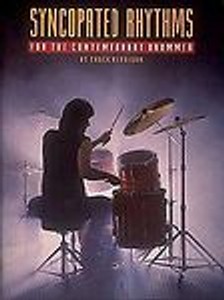
Look for the book with
the really goofy cover.
I just want to take a moment again to recommend you all try to find a copy of the book Syncopated Rhythms for the Contemporary Drummer by Chuck Kerrigan. If you're doing a lot with Ted Reed's book, as I do, you'll want this one too. It includes more stuff similar to the most-used parts of Reed, with the addition of triplet and 16th note rhythms in the same vein. And more quarter note-based stuff, which I think people use more, and a few studies in 3/4 and 5/4. A better Reed supplement than Louis Bellson's book, if I may be so bold. It's out of print, but there are always a few copies floating around on eBay or Amazon for $6-10.

Friday, May 06, 2016

EZ Tony Williams-like method

EZ-ish. The concept is extremely simple, anyway. Scarcely worth writing up, but here it is. And when I say Tony Williams-like, I mean “it reminds me of one thing he kind of did on a thing I listened to a lot.” I know on the internet his name is just shorthand for five notes on the cymbal, fast, and that's it, but he occasionally played some other things. Here and there. And this thing, when I was practicing it and improvising with it, reminded me of the vibe from the blowing on Frelon Brun. It's an entry point, anyway.

We'll use the Syncopation section from Reed— Syncopation Sets 1 and 2, plus full-page Exercises 1-8. Heck, you could also use “Lesson 4” (new edition lingo— the pages with the quarter notes and 8th notes early in the book). Here's a passage that should be plaguing your dreams:


Like I said, it's easy: play the short notes (untied 8th notes) on the snare drum, long notes (quarter notes, dotted-quarters, tied notes) on the bass drum. Play the cymbal with everything. That's backwards. Play the melody rhythm on the cymbal, add snare drum on the short notes and add bass drum on the long notes, like so:


Not much to it. Sometimes you need to just play a rhythm, simply voiced. You can't play genius stuff 100% of the time.

Do whatever you want with the hihat. Play quarter notes with it for an extra Tony Williams-like effect.


Or play it on 2 and 4, or play it in unison with the bass drum, making a splash sound.


Here and there you can do some runs of just cymbal and bass drum:


Where you get longer runs of 8th notes, if you'd like, you can come off the cymbal, add some embellishments, whatever. Like with this passage from Exercise 2:


You could do something like this:


Like I said, this is an entry point. You can certainly open it up and let your own stuff find its way into the texture, or let things drift away from a strict rendering of the method. Just playing the method verbatim at a bright tempo is an excellent workout, too, though.

Sunday, April 24, 2016

Why Syncopation is so great

Here's a question that comes up often, and which I always I feel I have to address every time I have a new student buy Ted Reed's Progressive Steps To Syncopation:
Whuh— this is just a bunch of snare drum rhythms... what's the big deal? What am I supposed to do with that?” 

Mainly: It's not the book so much as it is the method used with it, which is the best method for learning to improvise and read musically on the drums. You read the rhythms in the book, and, using a galaxy of creative interpretations, create a complete drum set part from it. It's the primary method many good drummers use to play amazing-sounding stuff with minimal mental effort, while still sounding musical.

Also: You're learning to read rhythms the way they are written by professional writers and arrangers, the way they will appear on professional charts.

You learn to play off of a single, changing melodic line— like, a complicated one 32 bars long, figuring out complex interpretations on the fly. Once you've done several of those, improvising becomes very easy.

You learn to think like a horn, conceiving your drumming in terms of a single melodic line. It's a big deal for your musicianship when you think of your drumming that way— even complex, four-limb textures— and not just as a bunch of drum parts.

The format reinforces reinforces thinking in four bar phrases. In Reed, even the one-measure patterns are written out in four measure phrases. You get used to seeing four measures at a time, and you get used to moving your eye along the page even when you're reading something easy.

Even if you don't think you'll ever need to read music when you're playing, this reading-based method is still the best way to learn to play. While you're learning to read, count, and play these rhythms, you're also learning to hear them; and listening is your primary means of fitting in with the music around you, whether you're not using a chart or not. Learning through reading this way gives you clarity about what you're doing, while reducing it to its simplest form mentally, freeing you to concentrate on the music.

“Buh-but, what about all the things that are missing? Complicated 16th note rhythms, meters other than 4/4, triplet partials, quarter note triplets, etc?”

I like to give my hypothetical questioners a stammer. The point is well taken regarding other meters, and quarter note triplets. I'd like to have seen some two-measure rhythms, and some things developing meter-within-meter ideas, too. I've also had need for Reed-type exercises adapted to certain styles, with a limited range of note values, and of varying rhythmic density. I've made up some reading rules, and written up a lot of pages of exercises, and picked up some other books to cover some of those things.

The absence of 16th note rhythms is not so glaring as it seems— you can arrive at similar rhythms by playing the book in 2/2. Reed rhythms in 2/2 are functionally like complex 16th note rhythms in 4/4. True, you're not getting used to seeing the actual 16th note rhythms on the page; for that you could buy Louis Bellson's book, or use the exercises in The New Breed. I personally don't get very many charts written with those types of rhythms.

About the triplet partials— mainly the middle note of the triplet, or the last two notes of the triplet: the book is really about interpreting melodies, and we don't really see those written into melodies often. I've told you how I feel about the middle of the triplet. I don't feel it's a terrible omission. And we do play those notes with many of the interpretations, we just aren't reading them.


“OK, I get that, JEEZ! But there's hardly any words in it! I have a ton of questions!”

There are a lot of other ways to get your specific questions answered— talking to people, listening to music, and playing music. And, as a last resort, other books. It is quite possible to be an excellent drummer with very little defined verbal information. What we get in Syncopation is not verbal information, but an extremely versatile and efficient universal method for playing the drums, and interacting with music creatively.

Tuesday, March 22, 2016

Cut time funk method: two-measure grooves

I've been working quite a bit with this cut time funk method from last year— part of what I've been doing instead of writing more blog posts. I'm not just writing junk to burn up bandwidth, man! Previously we had been applying a variety of two-handed hihat parts (which we get from the book Syncopation) over some one-measure funk grooves in 2/2. Now we're going to start using some four beat long patterns:


Get the pdf, we'll talk about what to do with this after the break.

Monday, November 10, 2014

A Reed method for 16th notes in jazz— reading 8th notes

Continuing our previous Reed interpretation for comping with 16th notes in jazz, this time using the 8th note section of Syncopation— pp. 10-11, or “Lesson 4” in the new edition.

The written rhythms on those pages are 8th notes and quarter notes; we'll be giving the 8th notes a dotted 8th/16th interpretation:


Just so we're clear, that is not a normal way of playing swing 8th notes; as a rule they should have a more rounded, triplety feel most often. If a horn player played a Charlie Parker tune interpreting the 8th notes with that dotted 8th/16th feel, he would sound unbelievably hokey, and you would fire him. So we're really using this interpretation only to generate drum ideas to go with the swing cymbal pattern, which may have that 16th note feel, at certain tempos, or where a certain vibe is called for; or for accompanying soloists using 16th notes. It's a fairly fine distinction. I just don't want you going into your next lesson with Joe Chambers and saying “Cruise Ship Drummer! told me to play swing 8th notes as a dotted 8th and 16th!”

We will be using that cymbal rhythm, more or less strictly. Play it accurately, but try to keep a legato feel:


To walk through the steps of the first interpretation, then: when reading the first exercise in Reed, p. 10:


We'll ignore the bass drum line, and play that main rhythm as follows:


In fact, the exercises are written in this form on pp. 12-13 of Syncopation, so you can use those pages if you want. But the next step of this method will require you to translate the 8th notes that way, so you may as well get used to it now, while the reading is easy.

We'll be orchestrating that on the drums as follows: play the exercise rhythm on the bass drum, and fill in the inside notes of the dotted 8th/16th rhythm— the e-&— on the snare drum. Fill out the written quarter notes as we did in the previous entry— in this example, the es and as:


Add the cymbal pattern, and hihat, as above [There is a typo here— there is a missing snare note on the a of 2.]:


More examples and another exercise after the break:


Sunday, November 02, 2014

A Reed method for 16th notes in jazz — reading the quarter note sections

Over the course of a few posts I'll break down my method for developing jazz comping with 16th notes, using Syncopation by Ted Reed. 16th notes are used a lot in jazz, and drummers neglecting them can lead to fairly one-dimensional playing. In jazz this rhythm needs to be legato; if you articulate your 16ths the way you do in other kinds of music, they will sound quite bad. Play them the way the horn does on Confirmation:


First we'll look at some things you can do with the quarter note sections of Reed. We'll be ignoring the written bass drum part— the stems-down part— so any of the three two-page quarter note lessons will do. We will play the ride pattern with a dotted-8th/16th rhythm; again, don't play it too staccato. Try to make it flow. It looks funny when you see it written; this used to be a standard way to write and play the pattern, but you don't see it much any more:


The first two interpretations are straightforward: play the above time pattern along with the written melody line (the stems-up part in Reed) on the bass drum, while filling in a couple of different 16th note rhythms on the snare drum. For the examples, we'll use this written exercise in Reed:


In the book that's one measure of page 4 (Lesson One, in the new edition), line 7. Reading that exercise without playing the left hand, the time feel plus our bass drum part would look like this:


First, fill in the &-as on with the snare:


Then fill in the es and as:


Much more after the break:

Friday, September 12, 2014

Reed interpretation: fast within slow — alternative sticking

Here's another set of stickings for that last “fast within slow” Reed interpretation. The major thing we'll be using is the sixtuplet form of the six stroke roll— or the “Swiss” sixtuplet, as I sometimes call it (which is not Swiss)— any place where the fill-in is two complete 16th note triplets, the sticking will be RLL-RRL. Single 16th note triplets will be RRL, and three triplets will be RLL-RRL-RRL. Everything else uses combinations of those. Also, any time there are two accented notes in a row, we will alternate them. The filler triplets will always start with the right hand. You can, of course, run the whole mess starting with the left hand, as well.

Here are these stickings applied to the examples from last time:


Just a quick refresher on how we're arriving at the interpreted rhythm. Take the written rhythm, and:
1) Swing the 8th notes— play the &s late, so they line up with the last note of a triplet.
2) Accent the written rhythm.
3) Fill in the spaces between the written notes with quiet 8th note triplets.
4) For each of those filler notes, play a 16th note triplet.
5) Badabing, you're doing the rhythms you see above.

So, you should be to get these pretty smoking fast with these stickings— they're designed for that.

Get the pdf

Sunday, September 07, 2014

Reed interpretation: fast within slow

Our philosophy around here is to never stray too far from Reed without good reason— I have to relearn that every few years. So here's a thing for beginning to develop the Jack Dejohnette-style “fast within slow” thing using Syncopation, by Ted Reed. It's step one, anyway:


The examples cover several different sections of the book: quarter notes, 8th notes, 8th note rests, 8th note triplets, and syncopation.

You can go for ridiculous speed if you want— I'd say if you can survive around quarter note = 96 you've got the pure speed thing amply covered for actual music played on real drums. I'll be mainly focusing on fluency and solidity in a range of tempos and dynamics, and on figuring out how to use this to make something other than just a tidal wave of BS on the drumset.

Get the pdf

Friday, May 02, 2014

Syncopation exercises in 3/4 — 01

This is a straight library piece: some syncopation exercises in 3/4, similar to the one-measure exercises in the middle section of Ted Reed's Syncopation, for doing all of the usual things you do with that book. We'll probably be seeing more of these, soon.


I've kept the format from Reed, with the quarter notes in the bass drum, even though I always ignore that part.

Get the pdf

Thursday, January 02, 2014

Doubling up a ballad feel with Syncopation

Happy new year, everybody. I'm practicing a lot of slow tempos lately, so here are some Reed interpretations that will be familiar to all jazz students, written out to suggest double time during a ballad. You'll be using sticks to play the exercises, but once you've gotten these together, you should be able to render something similar with brushes. First, without getting too much beyond the scope of a little blog post, we should clarify a few things about this feel. Give a listen to this recording of Dexter Gordon playing Body & Soul:


The tune is in 4/4, with a quarter note pulse of about 57 beats per minute, using what I call a compound subdivision of both triplets and straight 8th notes— any musician may play off of either subdivision at any time. You can also hear that at different moments, they may generate a swing feel based on the even 8ths, as if they were quarter notes at ~114 beats per minute. You can hear that most clearly during the piano solo after about 4:58.

Reading out of Syncopation, then, the slow quarter note pulse of our imaginary original ballad feel will fall on the half notes in Reed. So one measure of ballad 4/4 will equal two measures out of Reed, using this time feel:


To further muddy the waters, if we forget about the ballad thing, and just play Reed at a medium tempo (say, oh, 114 bpm), with the above time feel, we're actually making a half-time feel out of it by putting the hihat on beat 3, and playing half notes (plus the skip note) on the ride cymbal. But that's rarely done in jazz— virtually all of the time you play this feel, it will be because you are doubling up on a slow tempo. So we are learning vocabulary for an implied time feel, and you should not expect to see this exact feel, with the hihat on 3, “in nature.”

Now that we've settled that, on the examples, we'll be using the first four measures of the long exercise on p. 37, which should be very familiar to you. We'll be orchestrating the melody line— the top line— with our time feel, and ignoring the bottom line. You'll be practicing these applications while reading pages 32-44 of Reed.


See how we'll apply this to our ballad feel after the break:


Sunday, September 22, 2013

Good reading

Ignore the model's bad posture, tucked-in
muscle shirt, and Bay City Rollers
hairdo, and buy the book. 
If you've worked with Ted Reed's Syncopation in any serious way you've probably sensed that it has a few limitations. It's also such a central text— you can and should do nearly everything with it— that you can get to the point where you feel you've worked its raw material to death, if not its possibilities. The style of notation can be a little formulaic, and there are a few subjects that aren't given the famous page 37 treatment: 16th notes, triplets, and any meter other than 4/4, for starters.

A good supplement, then, is Syncopated Rhythms for the Contemporary Drummer, by Chuck Kerrigan. It's 101 pages long, written in a similar style to the middle part (about pp. 29-44) of Syncopation, and has sections dealing with quarter notes, 8th notes, triplets, and 16th notes. It's mostly in 4/4, but there are also exercises in 3/4 and 5/4. Exercises are one, 12, 16, and 32 measures long. One-measure ideas are presented in four-measure phrases, with varied notation and accenting:


This varied way of writing the same basic rhythm is very helpful— it's not the same rhythm, actually, because the lengths of the notes are different; but the notes all begin in the same places from measure to measure— so the exercises read more like a real piece of music than do those in Reed, and gets you (or your students) thinking about how to handle variably long and short notes. A similar thing is done in Louis Bellson's Reading Text in 4/4, another popular Reed alternative, but the notation in that book is so far out that it is, for me, impractical— you're not likely to see rhythms written the way they often are in Bellson, and if you did, they would be considered extremely poor practice on the part of the copyist. Kerrigan offers a nice, realistic middle ground.

You can see that he includes written accents, which are not present in Syncopation— I haven't incorporated them into any of my own methods, but they add another level of possibility to the exercises.

The triplet section will be welcome to a lot of people, as drummers seem to be getting serious about dealing with triplet partials in a systematic way. In Reed, the middle note of the triplet is purely incidental— it is only present with the rest of the triplet, or as an un-notated filler note. Which is actually the correct place for it; it's not normally used in jazz, except along with the rest of the triplet, or as part of a quarter note or half note triplet, or as a “late” note— an effect. But now drummers like Ari Hoenig* are making it a regular part of the language, and Kerrigan's exercises will help develop that. It's more a native thing to African and Afro-Cuban music, which is how I use them— along with the Afro 6/8 bell pattern, for example.

Likewise, people working a lot with The New Breed, or who are just more accustomed to thinking in terms of 16th notes, will appreciate the 16th note section.

In the Reed tradition, Kerrigan includes a simplified bass drum part, which will likely be ignored by everyone, the same as it is with Reed. He has also added a hihat part, with notes in parenthesis indicating optional notes, or silent notes “played” with the heel of the foot when playing the hihat with a stepped, heel-toe type of technique.

Self-teachers will also appreciate the included summary of interpretive methods— sixteen of them—  for applying the rhythms to the drumset. I know the Internet is rife with people who bought Syncopation on the recommendation of, well, everyone in the world, but then didn't know what to do with it, because they didn't have a teacher, and the book doesn't really explain itself.

Now that I've sold you on the book, you'll be happy to know that it appears to be out of print! Hence the goofy mid-late-80's cover art. But there are ample links to it on Google, and you should be able to pick up a used copy on Amazon, Ebay, or somewhere else for about $10 or less.

* - It's not really fair to credit Hoenig with that, because drummers have obviously been messing with it for quite some time now; but he's the main guy who's make a point of talking about it lately.