Showing posts with label drum books. Show all posts

Tuesday, October 15, 2024

Best books: The Drummer's/Musician's Lifeline

Looking at two little books co-authored by Peter Erskine and Dave Black— The Drummer's Lifeline, and The Musician's Lifeline, subtitled, respectively, as Quick Fixes, Hacks, And Tips Of The Trade, and Advice For All Musicians, Student to Professional.

The Musician's Lifeline is the larger and more broadly focused of the two, and is more interesting to me. It's packed with advice from a whole lot of famous players, relating to every aspect of doing music as a job, career, and art form, largely in one-liner format. It's a little values sketch of a particular community* of musicians— many top jazz and studio professionals, performers, educators, and the tier under them— what they think about, how they generally look at things. It will be most valuable to jazz studies majors— this is the field your education is for.    

* - And it's my same community, though in terms of career accomplishment I'm in the category scrappers below the least-biggest person here. Everyone in the book is doing big gigs, or more likely is the big gig. But I know a few of these people, been in workshops with many of them in school, and/or there's one degree of separation with many more of them, via my peers. 

The Drummer's Lifeline is shorter, with a lot of duplicate materials, but with more that is narrowly of interest to drummers, mostly from Erskine and Black. The unique materials are largely minutia, mostly related to gear— I don't sense a larger philosophical center to it as with the other book. 

Much of what the books cover will be familiar to professionals, and to many serious students. There are some choice bits that were new to me. And it's good to have obvious things restated and reinforced. There's a lot that will be good for people to hear early in their playing life, before they learn it the hard way. 


On the other hand, we live in a neurotic age. If you're prone to general anxiety over ever doing anything wrong... or prone to focusing on minutia at the expense of actually playing your instrument... or to preparation neurosis, where you're permanently in a state of feeling a need to do more to be ready to play with people... maybe you don't need more voices in your head issuing dire instructions. Musician's Lifeline in particular gets a little overbearing just from the sheer volume of wonderful advice.  

At least the sources are unimpeachable— these are not just a bunch of chattering youtubers. You can readily dismiss any contrary advice you've been worrying about. And there is some helpful advice dismissing some areas of worry— like where Erskine realistically assesses the variety and difficulty of most of the reading he has had to do in his career (that is, basically never any Zappa level stuff).

They're worthwhile, and you should be buying books. Get them from Steve Weiss Music: 

The Drummer's Lifeline by Peter Erskine & Dave Black - Alfred - 191 pages
The Musician's Lifeline by Peter Erskine & Dave Black -  Alfred - 126 pages

Saturday, March 25, 2023

Wilcoxon's Junior Drummer

I've had this copy of Charley Wilcoxon's book The Junior Drummer* lying around for some time, let's take a look at it, see how it holds up for modern usage. I have the Ludwig Masters edition pictured on the left.  

* - Full title: Fundamental Instruction For The Junior Drummer


It's not exactly a normal beginning snare drum method— it's more of an old fashioned drum set book, a “double drumming” book, intended for one player playing snare drum and bass drum. There are studies dedicated to bass drum, and to snare/bass interaction starting in the earliest pages. And there are some studies using a cymbal, hihat, and tom toms. It's not unlike Wilcoxon's Drum Method, but aimed at younger drummers. 

It's well graded, and I can imagine the entire book would be playable by an average student in a year or so. The focus is on rhythm, introducing the basic rudiments, and playing the snare drum and bass drum together. It does get into some fairly complex rhythm, with syncopation, ties, and 16th rests. It's never very technically demanding, and handling of rudiments is never real dense. Rolls are dealt with in rhythm form, in quarters, eighths, or 16ths— never in closed/long tone form, in 32nd note rhythm. 

Like in Wilcoxon's Drum Method, the text is heavily marked up at times, including counts, note durations/values, stickings, stroke movements, stick heights and dynamics. All that is probably mostly of interest to historically minded teachers and writers; it's pretty dense for beginning students to read: 


The book is 52 pages long, here's how it breaks down broadly by page numbers:

1-5 - introductory text, explanations of grips and rhythm.
6-16 - studies in quarter note and longer values. Rolls and paradiddles introduced. 
17-25 - studies in 8th notes and quarter notes.
26-32 - studies in 3/4 time, including 8th rests and syncopation.
33-42 - studies in 2/4, including 16th notes and rests.
43-47 - studies in 3/8 time.
48-52 - studies in 6/8 time. 

Sixteen pages are full-page solos, with titles like The Snare And Bass Polka, The Helena Waltz, The Swingster, In The Jungle.
 
There is one page where the student is intended to hum a tune while playing the drums. Tunes are decrepit chestnuts including Yankee Doodle, Oh! Susanna, Jingle Bells, Dixie. 


Conclusion:
It's more a historical item than a usable modern drum book. I think Junior Drummer and Wilcoxon's Drum Method would actually be good companions to Stone's Technique of Percussion, if one were doing a historical study of the techniques of American show drumming in the 1920s-30s.

There is one good page of one measure 16th note exercises in 2/4, that I will use:


I like that a first year student could play the whole book, and learn many of the basics of music without major technical hurdles— like having to be able to play a “closed” roll at normal march tempo.  

Otherwise, much of the book is too heavily marked up for me to use with my students. Notation for cymbals, and especially hihat, is archaic, and not usable today. The drum set and musical aspects are pretty antiquated, geared to a long-gone form of vaudeville/show drumming. It doesn't really qualify even as a beginning drum set book for modern purposes, unless a teacher wanted to ground their students in a really old style of playing— someone could make a case for doing that. 

Thursday, December 01, 2022

Best books: revisiting Rubank

The matte industrial looking horizon blue
cover has that depression era band room reek.
A fresh look at the very old, very turgid Rubank drum method books. Rubank, a series of method books for all band instruments, has been around since 1935, and is a core item in modern American school band literature. My only exposure to the book was in the 7th grade, when a teacher printed out a few pages for me. There are elementary, intermediate, and advanced volumes; here I'll mainly look at the elementary book, by Paul Yoger. 

Upshot: it's actually pretty good.  

I've never been completely happy with the available beginning snare drum books. Mitchell Peters's Elementary Snare Drum Studies is the best, but it's a little denser than it needs to be for average 5th-7th graders. 

All of these books have a few pages of fundamentals at the beginning, with a lot of verbiage, instructions on how to tuck a calf skin head, a picture of some jerk standing at a drum... all of which every kid in the world ignores completely. In Rubank there are just two pages of that, which are actually useful, covering grip, explanation of a roll (double stroke only), and a table of rhythm values and time signatures. 

The suggested right hand grip is interesting, a Moeller type grip with the fulcrum in back:


Then is the main body of the book, starting with four very useful pages of four measure rhythm studies, in 4/4, 2/2, 3/4, and 6/8 time. Then sections on 5, 7, and 9 stroke rolls, flams, and dotted notes, with more short studies— about 16 pages of those all together. All have stickings and counts marked in.  They're well graded and presented— better for younger students than Peters, or the Vic Firth and Roy Burns methods, which I have also used. 


It's a pretty quick introduction to the rhythms and time signatures they'll be playing in band class, with the more serious technical practice dedicated to rolls— that will be the hardest part for the target age group. The flam pages are good, and not over-technical.  

There's not a lot of verbiage, and what there is is pretty concise, even if it's not always phrased in a way that will be clear to students. But the point of that is not just for the student to read it and understand it immediately— it's more about giving the teacher the major points to re-explain to the student until they get it. 


There are pretty useless sections covering the bass drum, and some other band percussion instruments— cymbals, triangle, castanets, tom tom, woodblock, tambourine. And several pages of percussion parts for Rubank band pieces. 

There are eight OK pages outlining the 26 snare drum rudiments, and a few extra variants. Most are written in quarter notes, 8th notes, and 16th notes, and with roll notation, if there are rolls involved. The author wants us to play them slow to fast— all are marked with an accelerando— which I don't agree with. Acceptable, better than the usual single page list of rudiments.


The Intermediate book was written Robert Buggert, who has his own very old snare drum method book, that is pretty good, and long out of print. The intermediate Rubank book is all performance pieces for band percussion section— solo snare drum, snare and bass drum, full section. And a few band pieces. It's dated, and not real useful to me. There's also an advanced volume that I haven't seen yet. 

The elementary volume, even as it's pushing 90 years old, is still a pretty good first book for students in the 8-12 year old range. The roll section is a little out of balance for that age group, but rolls were important for that time and setting. Rudiments are covered but not over emphasized— it's not a hard core rudimental book a la Haskell Harr. It's a good overview of what a snare drummer, and band drummer, is. I'll probably use this with some younger students mainly for the rhythm portions.  

Monday, May 23, 2022

Dodge Drum Chart

An interesting item: the Dodge Drum Chart, by Frank Dodge, edited and published by George Lawrence Stone. It was advertised on the back cover of my first copy of Stick Control, so it's one of the first pieces of drumming literature I was ever aware of, but I never saw what's in it until recently. 

It's basically a key to interpreting rhythm notation, using technical charts converting a grid of equal-value notes and rests— the same format as most drum machines and sequencers use today—  into standard notation. 

It's also about one apparent common way of snare drumming, historically: it gives a sticking system based on natural sticking— so the right hand plays any #s and &s in the rhythm, the left hand plays any es and as— and flamming on the downbeats. The book describes the stickings as being based on the flamacue and the flam accent #1; it doesn't indicate the usual left hand accent we expect on the e of the beat with a flamacue. 

The key row at the top shows how the grid is counted in 2/4 time (today we generally say 1 e & a). Below that is the sequential count for each place in the grid— 1-8. Below that is the sticking— Right hand, Left hand, right hand Flam, left hand Flam, and below that is the full rhythm.

In the left hand column is the time signature, and the pattern numbers. To the right of that is the pattern grid, which has the rhythm in question in notes and rests. To the right of that is the sequential count (1-8) of the rests, and to the right of that is one common way of writing the rhythm. 


The idea is that you look up a rhythm that's troubling you in the right hand column, then look at the columns to the left to explain how to play it.  

The target audience appears to be professional and semi-professional drummers who nevertheless don't read very well. Possibly that was the norm when the book was published, and there wasn't a ton of practice literature available, so people needed a reference pamphlet like this in their trap case. Using it takes some knowledge— it's not a tutorial, and total non-readers would likely be lost using it.

The book could be occasionally useful today, in teaching, but we generally now just learn to read. We get a teacher, and get Podemski, Goldenberg, Reed, or whatever book, and do it. I was fluent with these kinds of rhythms in high school, without ever needing anything like this. 

It's somewhat interesting historically— it suggests some things about the playing of show/vaudeville drummers in the early 20th century. The major genres of “groove” it covers are the 2/4 march, the 6/8 march, and the foxtrot— there's a similar emphasis in the collection of Stone articles, Technique of Percussion. That 6/8 march was apparently a big part of people's lives then. Flamming on the downbeats was evidently standard enough practice that they don't mind baking it into the method. As well as using natural sticking (or “Straight” sticking, after Edward B. Straight.

All together it's a sort of quasi-rudimental performance language for snare drum, that is different from current common practice in band/orchestra playing. Today alternating sticking is the default, and we generally perform written parts literally— no ad lib embellishments. The march grooves are not a huge part of our playing lives, but the foxtrot category and type of notation survives in jazz.    

Most regular online stores are sold out of the book right now. You can also look at it on Scribd. Best to contact Stone publications directly if you want to buy it. 

Monday, April 04, 2022

Best books: The Art of Modern Jazz Drumming - Dejohnette / Perry

“As our mental image becomes more precise, we are better able to select muscle movements which will achieve our goals quickly, efficiently, and accurately.”

I'm surprised I haven't written much about this book already— The Art of Modern Jazz Drumming, by Jack Dejohnette and Charlie Perry. It's my favorite jazz drumming book, after Syncopation. Together with Bob Moses's Drum Wisdom, it makes up a pretty expansive 60s-70s era doctrine of creative jazz drumming, that I very much agree with.  

It includes a lot of practice materials, but also a lot of informational text, which may be the most important parts of it. There are sections on listening, the general elements of contemporary jazz drumming, a historical overview of modern drumming, improvisation, drums-band interaction and improvisation, the cymbal line, cymbal interpretation, interaction of parts of the drum set, meter-within-meter playing, song form, the rhythm section, clave rhythm, phrasing, muscular tension, and body motion. Each thing is well illustrated, with recorded examples cited. Now that all music is instantly available on the internet, I need to reread it and actually listen to the recordings I was never able to find as a student.  

It is purely a book about creative playing, for the drum set as a four limbed instrument. There's nothing in here purely about the hands. Not much about the job of playing structurally, except broadly. 

Book I deals with meter-within-meter playing— mostly, playing 3/4 ideas in a 4/4 setting. Some of the patterns are similar Mel Lewis's rubadub idea. There are a lot of practice patterns written in a very loose format. It's a very valuable chapter that nevertheless could have used some editing/polishing— that doesn't matter, you figure out what to do with it. 

Book II deals with triplet patterns with the hands and feet, played as solo patterns, and played along with a cymbal rhythm. 

Book III deals with modern feet and left hand independence with a cymbal rhythm, in triplet partials. I certainly practiced this a lot; today I feel like there may be better ways of developing the same thing. Then again, we're not supposed to be living in book exercises, you're supposed to use them as a starting place. The entire book requires you to take a creative approach— you practice the pattern a little bit, then improvise with the broad idea of it. 

My complaints/caveats are: 

Too focused on triplets. Triplets are a fairly narrow range of what happens in jazz drumming. I think it's better to have 8th notes— swung or not— and quarter notes as your primary orientation. 

The book may even over-emphasize the creative, improvisatory, interactive aspects of playing. As a feral young jazz student, it took me awhile to figure out that my job was also to provide a foundation. My education was imperfect, that's not the book's fault. 

The meter-within-meter section could have been more developed, and polished. Many of the patterns seem redundant as written. It takes some creativity to get full value from it.  

The notation style is somewhat archaic, though that doesn't wreck the book, as it does many others. 

That's all fine— I don't think it's good to be looking for complete answers from any book. 

There's a big contrast in attitude between it and the most popular jazz drumming book ever— Art of Bop Drumming. AOBD is largely a style guide— a creative framework within a pretty particular set of boundaries. AOMJD is more of an open ended map of the creative terrain. They do serve different purposes. In retrospect I could have use some of the boundaries AOBD provides; I think many more people are missing the perspective AOMJD provides.  

120 pages. 

Wednesday, September 15, 2021

A few rare items

I found some interesting things on one of those shady pdf download sites— a couple of rare books, and very old versions of a couple of unusual books. Worth getting if you're into that sort of thing:

An old hand copied version of Alan Dawson's Rudimental Ritual.

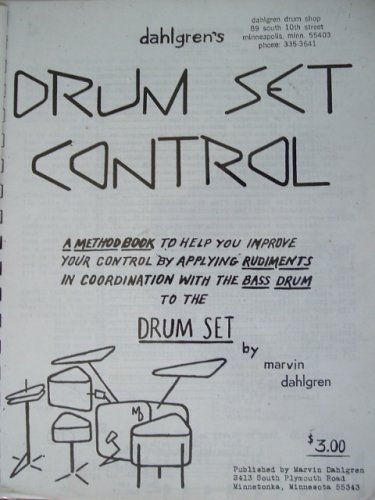
A 1963 version of Marvin Dahlgren's Drum Set Control with the layout done on a typewriter. For awhile this book (and a lot of other of Dahlgren's books) was available on Ron Keezer's Really Good Music Publishing site, but Ron passed away last year and the site has been down. I need to write to his son Geoff Keezer and find out what's the status of that company, and if the books can still be gotten. 

An old version of Vernel Fournier's Drum Techniques— or Drum Technique's, as it is written on the hand drawn cover. Doesn't include the Poinciana transcription that is in the current published version.

Handwritten, hand-stapled version of John Lombardo's Rockin' Bass Drum. It's a good old rock book, probably better than Funky Primer, except for the archaic style of notation. It's still usable. And this version looks cool. 

Fred Albright's Rhythmic Analysis for the Snare Drum. I believe this is completely out of print. Maybe it's an early version of his Polyrhythmic Studies for Snare Drum, I don't know— I don't own that book. Includes a good, very extensive explanation of polyrhythms, and a lot of very challenging snare drum solos, some including a bass drum part, a la Reed.  

I don't know why these pdfs are only on this site. Someone must have scanned his dad's/grampaw's drum book collection and uploaded it. Grab them fast, who knows how long this site will remain in existence. Let everyone know in the comments if you find anything else interesting.  

Monday, March 16, 2020

Book reviews: Two new Stone books

Two new works by and about George Lawrence Stone have just been released:

Technique of Percussion is a compilation of articles Stone wrote for International Musician Magazine in the 1940s-60s. It's over 400 pages long, with hundreds of musical examples in the author's own handwriting. It's a fascinating look at the drumming world in the early to mid 20th century, and it's a major addition to the literature of percussion. If you teach, if you are in concert percussion, or if you have any interest in the history of the instrument, just buy it now. It's an essential library item.

The articles, plus W. Lee Vinson's extended introduction, give a much fuller picture of Stone himself than we have had so far. Most of us only know him through his technical books Stick Control and Accents & Rebounds— typically on the internet he is invoked as a kind of technique oracle, and author of page 5 of Stick Control, and that's it. But he was a complete musician and percussionist, who performed and toured as a vaudeville and classical musician, and ran a teaching studio, and was involved with drum corps and NARD.

The book really illustrates a music centered approach to percussion. There is relatively little about technique in the modern high-performance sense, and much more about execution and interpretation— which is much more interesting and valuable information, to me. This focus feels very familiar, like the basic approach I learned (painfully and incompletely) from Charles Dowd, which Dowd got from Saul Goodman, whose career was contemporaneous with these columns. It's a professional concert percussionist's approach, centered on how you execute a part musically; with technique mainly about sound, presentation, and making the part— less as a means for achieving ultimate virtuosity.

The book also gives a more complete picture of the world of early modern drumming— for me almost a prehistoric period. Early recording technology was not up to the task of recording drums; there were  fewer drum books, many of them hindered by archaic notation and terms; and the authors were largely not genius theorists or communicators. The columns in this book were written in mid-century, but they refer to the entire 20th century, and before— Stone's career in percussion spanned the whole century until his death in 1967, and his father was a professional drummer in the late 19th century. Technique of Percussion gives the first living, relatable picture of that period I have seen. There are mentions of correspondences with Sanford Moeller, Alan Abel, Edward B. Straight, Charley Wilcoxon, Fritz Berger, and many other venerable figures, discussing ordinary problems with students and points of music and technique.

In fact Technique of Percussion shows a remarkable continuity between then and now. Percussionists of that era were dealing with many of the same issues as we do now: discrepancies between “ancient” and modern practices, interpretation of drum notation, and problems with it; points of terminology; use of rebound; whether to play left-handed or right-handed; developing speed. Excuses given by students for not counting out loud. What's a flam. What's a ruff. When to alternate and when to use “side” (non-alternating) stickings. There's a lot about interpreting and executing rolls— still a very poorly understood area. He mentions things I do that I haven't seen others talk about much: “side” triplets (RLL/LRR/RRL/LLR sticking), use of the B (both hands) sticking, for example.

Stone's writing style in the columns is conversational, and quite dated— this is a personality formed in the 19-oughts. But it is readable, his terms are modern, or at least not opaquely old fashioned. The information that is not fully relevant to modern practice is at least very interesting history. This book is essential for anyone serious about percussion. Buy it now.

An index would be helpful for future editions.


The second book is Drum Lessons with George Lawrence Stone, 90 pages long. Written by Barry James in collaboration with Joe Morello— both students of Stone's— and completed after Morello's death. It is advertised as “a personal account on how to use Stick Control” and “based on actual drum lessons” taught by Stone. The beginning of the book reinforces the idea that this is at last the real story of how to practice Stick Control. Vic Firth, in his introduction, calls it “Stick Control 2.”

...now, I consider Accents & Rebounds and Joe Morello's Master Studies I and II to be Stick Controls 2, 3 and 4, but to continue...

Having one “right” answer on how to use Stick Control is a sort of holy grail for a lot of people, but this book is really not about that. I see it more as a practice room companion to Technique of Percussion. It consists mainly of written examples from that book, re-engraved, with re-edited text, and commentary by Morello and James, printed in a more convenient drum book format. I haven't checked to see how many lessons are pulled from TOP, but many are.

There is an effort towards making this a general method book, with an extended introduction about technique, explanation of the level system, and a list of rudiments, and some other fundamentals. It is presented in “lessons”, but the organization feels quite scattered. As a practice book, it's very text heavy, with most of the musical examples are illustrating something in the text. There are practicable materials, but they are scattered throughout the book, which I don't find to be conducive to practicing them in an orderly way.

For example, the subjects of lessons 20-25— from one to the next they couldn't be further afield:

20. Interpreting the single and double drags
21. Alla breve
22. The finger roll
23. Left hand velocity
24. Breaks and solos
25. Embellishments with grace notes

It also includes some things from TOP which are questionably relevant today: “the 6/8 band and 2/4 drummer”, for example— who knows what performance problem (circa 1920s? Teens?) that lesson was addressing. Interesting as a historical item, but not particularly relevant to present day drumming, certainly not something I need to think about in the practice room. The hihat lesson is another example; a major standalone issue for show drummers in the 1930s, today it's just one item in a larger jazz education.

So part of my problem is figuring out what to do with this. It could be thought of as a condensed teacher's guide for digesting materials in TOP. Or a collection of general pointers for serious students and enthusiasts.

This book is a little unsatisfying for my purposes, but it is still worth purchasing— for taking the things in TOP to the practice room, and for James's and Morello's additional insights into Stone's teaching methods. Get it here.

Monday, September 19, 2016

Very occasional quote of the day: Bozzio studies

I always loved this photo from the
original interview. First copy of MD
I ever read. Also had Jim Keltner
and Ed Blackwell.
In his 1981 Modern Drummer interview with Robin Tolleson, Terry Bozzio discusses his study methods when he was in school, and the books he worked out of:

[I] studied Haskell Harr's books. And then I got into Stick Control, which I thought was a little bit better practical application of that, rather than having all the fancy notation. And I studied that, and I studied out of Ted Reed's book Syncopation, and Louie Bellson's books, and this other book Portraits In Rhythm by Anthony Cirone. That's a real good book for dynamics, and classical snare drumming. [...] I studied [...] that Morris Goldenberg snare drum book.  
So I would go up there with head phones and a cassette recorder, and practice and work out Tony Williams Lifetime licks from this tape thing, and write them all down. My whole way of learning at that point was sort of to take all the drummers that I loved, like Tony and Eric (Gravatt) mainly, and whenever they would do a lick that I thought was really cool, I would write that lick out, and practice it, and learn the technique involved, and then make up my own licks using those techniques. And that's probably the main way I learned to do what I do, at least musically. That's a good thing to do, because that way you don't get stuck with just doing their licks, but it does open up a lot of doors. Because when a lot of people start, they hear things and they don't know what
the hell is going on. You just have to listen to that section over and over to get it.

Monday, February 08, 2016

NOW AVAILABLE: 2015 Book of the Blog

2015 Book of the Blog
UPDATE: I'm going to keep this pinned to the top of the blog a little while longer, so scroll down for new posts. 

The 2015 Book of the Blog is now available! It's 102 pages of intermediate-to-professional level practice materials from the blog in 2015, printed up in a single handsome volume. If you're a follower of the blog, yer gonna want it...

Highlights and the complete table contents are listed after the break:

Tuesday, April 14, 2015

Quick takes: MD's 25 timeless drum books list

Perhaps not the best superlative for a list of books on drumming, but we get the picture. Here I've given some brief opinions on the entries in Modern Drummer's list of 25 timeless drum books. I've bolded the titles I think everyone should own.


1. STICK CONTROL FOR THE SNARE DRUMMER by George Lawrence Stone (Alfred)
Every drummer should own this, that's all. You do have to play the whole thing, not just the first page.


2. MASTER STUDIES by Joe Morello (Modern Drummer Publications)
Expands on some ideas found in Stone's Stick Control and Accents & Rebounds (which was actually ghost-co-written by Morello). This is really a complete system for practicing and playing the snare drum, that is not rudimentally based. It's similar to the rudimental system, and overlaps with it, but it's different. There's also a Master Studies II— best to own both volumes.


3. THE NEW BREED by Gary Chester (Modern Drummer Publications)
The major book for post Dave Weckl-style fusion drumming, and all-around pan-genre studio funk— Lately I feel that that type of playing is a bit of a plague, and I rarely crack this book. And you know I'm not really down with the open-handed stuff. Whatever. It's a major book.


4. ADVANCED FUNK STUDIES by Rick Latham (Latham Publications)
More a collection of licks and ideas than a method book. That's not a bad thing, but I was never able to do much with them in the form they're presented here. It's probably a decent book for getting your fusion clichés together.


5. REALISTIC ROCK by Carmine Appice (Alfred)
I really dislike the archaic notation system used here, so I have never used this book. Plus nobody I know ever used it that I'm aware of. I would need to see an updated edition with modern notation to really give it a fair shot.


6. GROOVE ALCHEMY by Stanton Moore (Hudson Music)
Great history book and style guide for certain areas of funk drumming. Moore's method for creating new grooves by combining elements of old ones, is not really for me. It's fine, I just don't think that way or play that way.


7. THE COMMANDMENTS OF R&B DRUMMING by Zoro (Alfred)
I have seen this book but don't own it; it looks like a solid player's history of R&B drumming.


8. FUTURE SOUNDS by David Garibaldi (Alfred)
Modern funk book a lot of people use. I learned a lot from Garibaldi's materials when I was in school, but the method here is just a little too abstract for me. If you work through this book and New Breed you'll definitely have your 80s-and-later fusion thing together.


9. THE DRUMSET MUSICIAN by Rod Morgenstein and Rick Mattingly (Hal Leonard)
I think this is the best all-around introduction to the drum set I've seen. Maybe best for mature beginning and intermediate players.


10. ADVANCED TECHNIQUES FOR THE MODERN DRUMMER by Jim Chapin (Alfred)
Another primary text for jazz drummers, that is showing its age now. I prefer using other books for this type of thing, but you do have to own this.


11. THE ART OF BOP DRUMMING by John Riley (Manhattan Music/Alfred)
Great introduction to jazz drumming. Contains a lot of information that students previously had to luck into— maybe you'd get exposed to that info, and maybe you wouldn't. You had to have a good teacher or be in a good scene.

2020 UPDATE: After writing this post, I wrote about some of my feelings about this book. Also someone online asked a question expressing similar sentiments, to which Riley responded directly.


12. MODERN RUDIMENTAL SWING SOLOS by Charley Wilcoxon (Ludwig Music)
This is a book many of your favorite jazz drummers worked through, so if you want to participate in that tradition, you probably should, too.


13. PATTERNS, VOLUME 1, 2, 3, 4 by Gary Chaffee (Alfred)
The major source for super advanced, Vinnie Colaiuta-style rhythm, as well as advanced fusion drumming. I spent a lot of time with these books, and am not sure 100% of it was well spent— I have never had to use the extremely advanced rhythms from vol 1 and 2 in actual music. When I use these books today, I ignore virtually all of the odd-tuplet related stuff. I use volume 3 (Time Functioning) extensively.


14. 4-WAY COORDINATION by Marvin Dahlgren and Elliot Fine (Alfred)
I've had my issues with this book in the past, but have come to terms with it. I developed my own version of the very difficult “harmonic” section, which I prefer to the original.


15. EVEN IN THE ODDS by Ralph Humphrey (C.L. Barnhouse)
This is a great drum method book. Not as sexily futuristic as Gary Chaffee's Patterns series, but for me it has been far more practical.


16. DRUMSET ESSENTIALS, VOLUME 1 by Peter Erskine (Alfred)
Never read or used this book, but Erskine is a great drum author and educator— I own several of his books, and all are extremely valuable.


17. THE ENCYCLOPEDIA OF DOUBLE BASS DRUMMING by Bobby Rondinelli and Michael Lauren (Modern Drummer Publications)
Never used this book, never looked at it, probably never will.


18. BASS DRUM CONTROL by Colin Bailey (Hal Leonard)
Not bad, but I glance at it every few years and am never moved to practice from it. Similar linear patterns to those found in Gary Chaffee's Patterns books.


19. THE SOUND OF BRUSHES by Ed Thigpen (Alfred)
When it came out in the 80s, this was a big leap forward for books on brushes, but the notation system is still pretty obscure. There's a more recent Berklee book on brushes which I found a little more usable. All jazz drummers should own it, though— it's by Ed Thigpen.


20. PROGRESSIVE STEPS TO SYNCOPATION FOR THE MODERN DRUMMER by Ted Reed (Alfred)
This book really belongs at the top of the list. The one absolutely essential, indispensable drum book. You can do everything that matters with it— everything in 4, anyway.

2020 UPDATE: Here's a post I wrote going into a little more detail about why Syncopation is so great.


21. BUDDY RICH’S MODERN INTERPRETATION OF SNARE DRUM RUDIMENTS by Buddy Rich and Henry Adler (Music Sales Corporation)
I reckon this is the bible for rudimental, snare drum-oriented jazz drummers in the Buddy Rich camp. I've never used it.


22. PORTRAITS IN RHYTHM by Anthony J. Cirone (Alfred)
Advanced college-level book of snare drum etudes. Extremely challenging reading, and absolutely one of the modern classics of drumming literature. Most drummers will not know what to do with it.


23. MODERN READING TEXT IN 4/4 by Louie Bellson and Gil Breines (Alfred)
This is a standard book, but I've not used it a whole lot. Maybe it's balanced a little too much towards creating reading challenges, rather than just building basic familiarity with normal reading, as with Reed. Though it does fill some gaps in Reed, so it's worth having around.


24. AFRO-CUBAN RHYTHMS FOR DRUMSET by Frank Malabe and Bob Weiner (Alfred)
In the late 80s, this was the big modern Afro-Cuban/Salsa book. Today I prefer Ed Uribe's The Essence of Afro-Cuban Percussion and Drum Set. This book is more concise, but Uribe's book, though massively intimidating, has been better to practice from, and does a better job of demystifying this music.


25. WEST AFRICAN RHYTHMS FOR DRUMSET by Royal Hartigan (Alfred)
I've never looked at this, or used it. It's probably great. It's a little bit of a niche item for north American drummers, but if including it on the list got some people to investigate African music, it's a good thing.

Monday, January 12, 2015

2014 Book of the Blog now available!

2014 Book of the Blog
Scroll down for new posts— I'll keep this pinned near the top of the blog for a few days.

All right, continuing our frenzy of new product, the 2014 Book of the Blog is now available for purchase. 80 pages of intermediate-to-very-challenging stuff. There are robust sections on the jazz waltz and Afro-Cuban drumming; and a nice collection of snare drum exercises that have been on my stand for several weeks now. Transcriptions of the drumming of Tony Williams, Jeff “Tain” Watts, Ed Blackwell, Dannie Richmond, Ringo Starr, Funkadelic, and 70s studio greats Rick Marotta and John Guerin, and more!

It's such an excellent companion to the 2013 Book of the Blog, I'm going to go ahead and discount that book 20% to encourage you buy them both. I don't know how long I'll leave that up, so git it now, if you're gonna...

And also: the print version of our e-book, Playing Samba and Bossa Nova, is now ready to purchase. It's a svelte little 30-page manual with all the basic information you need to begin playing this style with people, and to continue your education with that music. It's basically everything else you wanted to know after somebody showed you a bossa nova beat, and you didn't know what else you were supposed to do with it. “OK, fine, I can play the beat— now what?” Well, here...

There is of course the Kindle version available, too, if you swing that way. Viewable on Kindle, and on other devices using the free Kindle app.

Friday, December 19, 2014

Hell of books

YAAAAHHH! AAAHHHH!!
This has been sitting in my drafts folder awhile, and seems timely, as I'm encouraging you to buy my new Bossa/Samba book, and am discounting my previous ones:

One thing there is no shortage of, right now, is of drum stuff to work on. On this blog, we're barfing up mass quantities of new stuff on a quasi-daily basis— more like quasi-weekly, recently— and there are hundreds of books out there, and reams of new stuff in the drumming magazines every month. It can be overwhelming for students, who feel bad because they're not learning all of their books cover to cover, or because they haven't really “learned what they already have in front of them.” And writers like me can wonder just what the hell is the point of doing more. Hasn't everything been done already?

These feelings are wrong. I own over a hundred books, and may work out of out of 15-20 of them in the course of a week, and I still need to write more stuff.

Drum books are an incredible value. If you learn one thing of real value from it, what did it cost you? Around $8-25, usually. And by “learn”, I mean you acquired something in your playing, and maybe some verbal information about music, and/or gained some kind of general understanding that actually helps you in your playing. If you're able to dedicate dozens or hundreds of hours of practice to a single book, you've really gotten value much greater than the book's cover price.

Format and organization matter. Especially when you start using your materials creatively. Little changes in format, can make big differences in what you can easily do with the materials, how productively you are able to use them, and what you learn in using them.

Remember, it's a multi-year, multi-decade process. You're going to have these books around for the rest of your life. Maybe you'll find a use for some other parts of them in five years, ten years, or twenty years. Don't think of a new book as an assignment, think of it as an addition to your library; a resource that will be instantly available if, someday, you need it.

Limiting yourself to one book you are really limiting yourself to one author's vision, to the extent that he was able to put a complete vision accurately into book form. No one is able to cover everything, and not everyone is that good a writer; nor are everyone's methods are good enough to dedicate years of your life to working on. And just because of the nature of communication, you may need to hear the same message put several different ways to really understand it. So I'm extremely skeptical of very expensive all-in-one collections that claim to cover everything you'll ever need to know and practice.

The exception to that is the body of methods associated with Ted Reed's Syncopation— an $8 book. Most players could just learn that really well, listen a lot and play a lot, and be done with it. You can become a great drummer with just that, and you'd be missing very little of practical importance. Still, it doesn't cover absolutely everything.

You're supposed to have a lot of books. Especially if you're teaching. As a professional, you're supposed to build and maintain a personal library both of books and recorded music. It's just part of your infrastructure.

Just what is the point of writing more stuff is a larger subject I may have to save for another day. I think that if you're thinking about the playing process, and the practicing process, and writing for contemporary needs, there will always be room for more materials.

Monday, June 16, 2014

Safe to buy Wilcoxon again?

They obviously don't quite get why
people are buying these books, but OK.
Here's some good news: a student of mine brought in a new copy of Charley Wilcoxon's Rudimental Swing Solos, and it appears the current publishers of Wilcoxon's books have recognized the shortcomings of the Richard Sakal editions, and have begun selling the books in their original form. The covers are new, and quite goofy, but the actual contents have their older, presumably Wilcoxon-approved layout.

As we've documented, there are several annoying typos in Rudimental Swing Solos, but Rolling In Rhythm is really just a horrible, unusable mess in the Sakal edition. I'm very much looking forward to comparing editions there— I'm guessing it will be a real bloodbath.

 I would order by phone to ensure you're not getting old Sakal-edition stock.

Sunday, September 22, 2013

Good reading

Ignore the model's bad posture, tucked-in
muscle shirt, and Bay City Rollers
hairdo, and buy the book. 
If you've worked with Ted Reed's Syncopation in any serious way you've probably sensed that it has a few limitations. It's also such a central text— you can and should do nearly everything with it— that you can get to the point where you feel you've worked its raw material to death, if not its possibilities. The style of notation can be a little formulaic, and there are a few subjects that aren't given the famous page 37 treatment: 16th notes, triplets, and any meter other than 4/4, for starters.

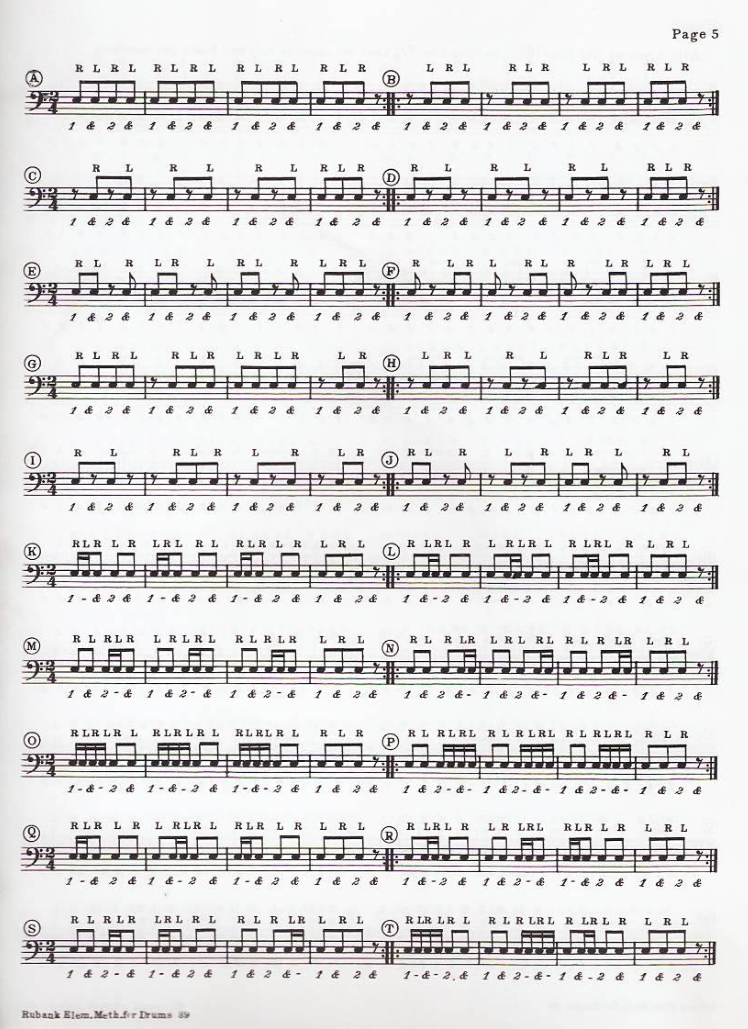
A good supplement, then, is Syncopated Rhythms for the Contemporary Drummer, by Chuck Kerrigan. It's 101 pages long, written in a similar style to the middle part (about pp. 29-44) of Syncopation, and has sections dealing with quarter notes, 8th notes, triplets, and 16th notes. It's mostly in 4/4, but there are also exercises in 3/4 and 5/4. Exercises are one, 12, 16, and 32 measures long. One-measure ideas are presented in four-measure phrases, with varied notation and accenting:


This varied way of writing the same basic rhythm is very helpful— it's not the same rhythm, actually, because the lengths of the notes are different; but the notes all begin in the same places from measure to measure— so the exercises read more like a real piece of music than do those in Reed, and gets you (or your students) thinking about how to handle variably long and short notes. A similar thing is done in Louis Bellson's Reading Text in 4/4, another popular Reed alternative, but the notation in that book is so far out that it is, for me, impractical— you're not likely to see rhythms written the way they often are in Bellson, and if you did, they would be considered extremely poor practice on the part of the copyist. Kerrigan offers a nice, realistic middle ground.

You can see that he includes written accents, which are not present in Syncopation— I haven't incorporated them into any of my own methods, but they add another level of possibility to the exercises.

The triplet section will be welcome to a lot of people, as drummers seem to be getting serious about dealing with triplet partials in a systematic way. In Reed, the middle note of the triplet is purely incidental— it is only present with the rest of the triplet, or as an un-notated filler note. Which is actually the correct place for it; it's not normally used in jazz, except along with the rest of the triplet, or as part of a quarter note or half note triplet, or as a “late” note— an effect. But now drummers like Ari Hoenig* are making it a regular part of the language, and Kerrigan's exercises will help develop that. It's more a native thing to African and Afro-Cuban music, which is how I use them— along with the Afro 6/8 bell pattern, for example.

Likewise, people working a lot with The New Breed, or who are just more accustomed to thinking in terms of 16th notes, will appreciate the 16th note section.

In the Reed tradition, Kerrigan includes a simplified bass drum part, which will likely be ignored by everyone, the same as it is with Reed. He has also added a hihat part, with notes in parenthesis indicating optional notes, or silent notes “played” with the heel of the foot when playing the hihat with a stepped, heel-toe type of technique.

Self-teachers will also appreciate the included summary of interpretive methods— sixteen of them—  for applying the rhythms to the drumset. I know the Internet is rife with people who bought Syncopation on the recommendation of, well, everyone in the world, but then didn't know what to do with it, because they didn't have a teacher, and the book doesn't really explain itself.

Now that I've sold you on the book, you'll be happy to know that it appears to be out of print! Hence the goofy mid-late-80's cover art. But there are ample links to it on Google, and you should be able to pick up a used copy on Amazon, Ebay, or somewhere else for about $10 or less.

* - It's not really fair to credit Hoenig with that, because drummers have obviously been messing with it for quite some time now; but he's the main guy who's make a point of talking about it lately.

Sunday, March 24, 2013

Gary Chaffee linear patterns

In the coming days we'll be doing a little extension of a thing found in vol. 3 of Gary Chaffee's Patterns series— an appendix, really— and since that's not an everyday title like Reed or Stone, I need to show you the core of the idea as presented in the book. Patterns is one of the major entries in the literature of drumming to come out of the 1980's. Chaffee was Vinnie Colaiuta's teacher for a time, and seems to have had a big influence on his playing; the books seem very Vinnie, handling a lot of heavy Zappa-esque rhythm. I've been working with them off and on since the later 80's, with periods of years when I'm not able to do much of anything with them.

We'll be working with the linear patterns, found on pp. 40-53; they are three to eight notes long, played with the hands on the drums, and ending in one or two bass drum notes:


The sticking and orchestration on the drums is indeterminate; usually I play them alternating, starting with the right hand, and improvise moving them around the drums. The book presents combinations of these patterns in 16th note and 8th note triplet rhythms in 4/4— for my own practice I've written out the combinations in 3/4 and 5/4, which is what I'll be posting this week.

There's much further exploration of this in the book than I will be doing here, and you will of course want to get these together in 4/4 as well, so it's highly recommended that you buy the book— it really belongs in every serious drummer's library.

Saturday, March 16, 2013

Free shipping on book orders

I should let you know that Lulu, the company that prints our books, is offering free shipping on book orders over $50 through March 17— tomorrow night. So you can save big if you order, oh, both of the Cruise Ship Drummer! books, plus one of the many other drumming books available through the site.

Two of the more interesting-looking things I found:

The epic The Drummer's Workbook by Jay Lawrence, a 223 page, “six pronged” approach to nearly everything to do with drumming.

Chordal Drumming by Maximilian Oepen, which looks like an interesting reinterpretation and refinement of the things found in the middle, “harmonic” section of Dahlgren & Fine.


Monday, December 10, 2012

New CSD! book: 100 Grooves

OK, here it is, just in time for Christmas— our new book, 100 Grooves - vol. 1, is now available for purchase.

It contains over 100 transcribed drum grooves by people like Elvin Jones, Ed Blackwell, Airto, Billy Cobham, Zigaboo Modeliste, James Gadson, Clyde Stubblefield, Art Blakey, Mike Clark, Billy Higgins, and, as they say, many, many more. Explanatory text is by yours truly, Todd Bishop.

Some of the entries have been featured on the blog as past “grooves o' the day”, but approximately 70% of them have never been published anywhere before. Contains a whole lot of funk, Latin jazz, fusion, soul, odd meters, and the Afro 6/8 grooves I'm so fond of.

I've found that the printer, Lulu, is surprisingly fast— my past orders have made it to Portland in seven business days or less using the cheapest shipping option— but order ASAP to receive your book(s) in time to make Christmas gifts out of them.

By the way, you can still get the 2011 transcriptions book at a 10% discount— the per-note value is still the best on the Internet.

Thursday, June 28, 2012

On Marv Dahlgren's prodigious output and the purpose of a library

Three bucks to purchase,
hundreds of hours to master.
As I was idly visiting the Really Good Music Publishing site-- the people, you'll recall, who have reissued several out of print Marvin Dahlgren books- an overwhelming amount of material-- checking to see if they had come out with volume 2 of his Variations on Three Camps book, I discovered that they have not released that book yet. Which is fine, because just the first couple of pages of variations have been dominating my pad practice time since I got the book.

No, that volume has not been released yet. Instead, there are a ten or so other new or reissued Dahlgren books: Drum Set Control in 3/4 Time, Drum Set Control in 5/4 Time, Hihat Control, 16th Note Stickings, Triplet Stickings, Setudes (drum set etudes), and on and on. The man is a machine.

Between all of that, his more famous Four Way Coordination, and his slightly-more-familiar Accent On Accents (Vol. 1 and 2)-- all together more than a lifetime's worth of practice materials; in fact very few drummers could claim to have exhausted the possibilities of any one of those books-- you begin to have to confront the question of the point of it all. Why have on hand piles of books if there is virtually no possibility of ever being able to master them? Why buy more books when you haven't completely learned the ones you have? What the hell are we doing?

A few thoughts on those questions after the break:

Sunday, June 10, 2012

Cracking 5/4: the library

Essential.
Again following my normal process of doing the easy stuff first, here is the library of practice materials I've used for finally getting my act together in 5/4. Normally you would put this at the end of the series-- like in an appendix-- but I thought people might like a chance to order one or more of these books to have on hand when we get to the real discussion.

You don't need to own all of these, by any means-- the Humphrey book along with the Rothman and the blog posts will be enough to give you a very robust introduction into this meter.


Drum set books:

Even in the Odds by Ralph Humphrey. Essential. Includes sections on swing and rock feels in 5/4, as well as extensive solo materials. The section in 5/8 is also helpful. This is one of my favorite method books on any topic-- you can read my earlier review for more on this one.

3, 5, 7, 9, Jazz!
by Joel Rothman. Jazz and generic Latin. This was my primary supplement to Even in the Odds. Jazz comping materials have an Elvin-like bent to them, using the middle of the triplet, and quarter note triplets. Good materials for developing ECM and Latin feels, and common kicks/anticipations as well.

Jazz Drummer's Workshop
by John Riley. Good, concise introduction to the meter in a swing feel. Illustrates a similar process to Humphrey's, and to what we'll be discussing in the rest of the series.

Four Way Coordination
by Marvin Dahlgren & Elliot Fine. Independence studies in a swing feel.

Continued after the break:

Friday, May 04, 2012

HFS, part two

Last time I was moved to so eloquent a title I had just received the massive Paiste 22" 602 dark ride; today I received a massive library of 180+ dense pages in three volumes by Marvin Dahlgren, newly available from Really Good Music Publishing. I'm just trying to get my head around the enormity of what I'm dealing with here, but here's my immediate impression:


Drum Set Control by Marvin Dahlgren

This is the one I was looking for when I turned these up. It mostly consists of studies for getting around the drums in 8th notes, triplets, and 16th notes, in singles and rudimental stickings. It's sort of a Joe Cusatis' Rudimental Studies on steroids, with incorporated bass drum, and the distinct mathematical/logical bent you would expect.


One thing: I'm happy to report that Dahlgren's names for made-up rudiments are no better than mine; his 5-note paradiddle is called "par-e-a-diddle", which is arguably worse than my "paradiddle-a". I guess we could compromise and put the 'e' sound into mine, and call it "paradiddle-y". 


Variations on Three Camps, Book 1 by Marvin Dahlgren

I was never aware of this, possibly because it appears to have been pulled directly out of the author's personal library. Each page is notated by hand, signed by Dahlgren, many handwritten notes. 60ish pages of Three Camps rendered in a variety of different stickings, meters, and rhythms. It has a little bit of the feel of a Bhagavad Gita of drumming- many years of accumulated materials, gathered from many sources.

There's much too much here to summarize, but he applies a number of rudiments and stickings to the piece, and translates it into 3/4 and 5/4, in triplets and 16th notes.


Two more books after the break: