Here's an item from jazz writer Mark Stryker, which caught Peter Erksine's attention on Twitter. Cannonball Adderley playing a fast tempo with Louis Hayes on drums, on an Adderley record I've never owned, Nippon Soul.
Stryker says: “This duo with Louis Hayes is prime Cannonball, and one of the best examples of Louis' distinctive cymbal beat and how he's the link between Philly Joe and Tony Williams at this tempo.”
You can hear what he's talking about, even if it doesn't work exactly that way— it's burning:

A drumming blog written by Todd Bishop.
Showing posts with label fast tempos. Show all posts
Showing posts with label fast tempos. Show all posts
Monday, April 15, 2024
Daily best music in the world: Louis Hayes with Cannonball


Thursday, June 15, 2023
Two handed brush variations for fast tempos
UPDATE: I added some video of me practicing this.
I've been practicing my fast tempos lately, both with sticks and brushes. I'm talking about jazz, tempos above ~290 bpm. I haven't had to do a lot of it my playing career, so I have to do it in the practice room and in sessions— I haven't had the chance to develop it naturally, on the gig.
I can't/won't approach this as a pure technical thing, by working on my chops for playing the cymbal rhythm fast, and then learning coordination patterns to go with it— the way people initially learn to play jazz, learning a swing beat and adding some comping rhythms from Chapin.
Basically my approach is to play complete phrases, change it up, have a lot of tactics available. This is one tactic for playing brushes: a varying and evolving two handed time pattern.
Play these with brushes on the snare drum, playing each pattern one, several, or many times, before moving directly into any other pattern that connects easily with it. [UPDATE: Or whatever. You can see in the video below, I'm not really doing that at all.] We're in 4/4 the whole time, with the hihat on beats 2 and 4. The 3/4 patterns are generally meant to be connecting the 2/4 measures, you can also repeat them for a meter-within-meter effect.

The left hand is sweeping sideways, so one hit will land in the middle of the drum, and the next one will be closer to the edge. Personally, I play matched grip, and my left hand tends to sweep left to right rather than in a circular motion. Finding your own left hand motion through the changing patterns is part of the deal here. We do need to hear the attack of the LH note as part of the rhythm, even as it's sweeping the drum after you hit it.
I do this at 300 bpm, with a metronome set to 75 bpm— whole notes— while thinking Cherokee or whatever tune.
UPDATE: In the comments, our man in Berlin, Michael Griener, who plays a lot of fast music, asked for some VIDEO of this stuff. So here we go:
This is basically how I practice this— I'm not systematic. I'm looking at the page and trying to work those patterns into a regular time feel, and connect them to each other. I think I'm doing patterns 1 and 3 together a lot, which is the crux of the idea— I'm building a time feel out of mixed RRLs and LRRs. You can hear that when I'm doing that, it basically sounds like the complete spangalang rhythm— the lefts are speaking as part of that rhythm. Though I am playing the complete rhythm with my right hand some times.
The tempo is just under 300, I think. I'm not using a metronome here.
Yeah. This page is kind of a failure. The basic idea works ok, for me, but the way I wrote that page isn't great for working on it, for me. Take it as a sketch pad.
Friday, May 19, 2023
Know your tempos: Workin' / Steamin' / Cookin' / Relaxin'
 |
| You can buy them all in one collection now. |
Workin'
It Never Entered My Mind - 58
Four - 207
In Your Own Sweet Way - 114
The Theme (take 1) - 137
Trane's Blues - 164
Ahmad's Blues - 114
Half Nelson - 257
The Theme (take 2) - 132
Cookin'
My Funny Valentine - 67
Blues By Five - 177
Airegin - 292
Tune Up - 315
When Lights Are Low - 123
Steamin'
Surrey With The Fringe On Top - 128
Salt Peanuts - 350
Something I Dreamed Last Night - 56
Diane - 143
Well, You Needn't - 230
When I Fall In Love - 67
Relaxin'
If I Were A Bell - 184
You're My Everything - 57
I Could Write A Book - 227
Oleo - 258
It Could Happen To You - 188
Woody'n You - 256
All of them, again, in ascending order:
Something I Dreamed Last Night - 56
You're My Everything - 57
It Never Entered My Mind - 58
My Funny Valentine - 67
When I Fall In Love - 67
Ahmad's Blues - 114
In Your Own Sweet Way - 114
When Lights Are Low - 123
Surrey With The Fringe On Top - 128
The Theme (take 2) - 132
The Theme (take 1) - 137
Diane - 143
Trane's Blues - 164
Blues By Five - 177
If I Were A Bell - 184
It Could Happen To You - 188
Four - 207
I Could Write A Book - 227
Well, You Needn't - 230
Woody'n You - 256
Half Nelson - 257
Oleo - 258
Airegin - 292
Tune Up - 315
Salt Peanuts - 350
It's good to attach a number to these things, and know that Miles ballads, in this period at least, gravitated around 57 and 67 bpm. Those showy numbers like Half Nelson and Woody'n You are around 257. Those slow medium items @ 114, and two different types of bright swingers around ~185 and ~230.
And here— for my own peculiar interest— are all of them doubled or halved to put them in the familiar ~100-200 range— the medium to top end of standard metronome range. Useful and helpful as a practical thing dealing with time. There's got to be some kind of useful information in Miles putting a lot of tunes in tempos that equalize to the low to mid teens, or high 120s to mid 130s.
Four - 103
Something I Dreamed Last Night - 112
You're My Everything - 114
Ahmad's Blues - 114
In Your Own Sweet Way - 114
I Could Write A Book - 114
Well, You Needn't - 115
It Never Entered My Mind - 116
When Lights Are Low - 123
Surrey With The Fringe On Top - 128
Woody'n You - 128
Half Nelson - 129
Oleo - 129
The Theme (take 2) - 132
My Funny Valentine - 134
When I Fall In Love - 134
The Theme (take 1) - 137
Diane - 143
Airegin - 146
Tune Up - 157
Trane's Blues - 164
Salt Peanuts - 175
Blues By Five - 177
If I Were A Bell - 184
It Could Happen To You - 188
Tuesday, April 11, 2023
Reed tweak: yet another uptempo method
Minor tweak to an ordinary right hand lead Reed system, making an approach to playing jazz at fast tempos. I've probably written something like this before, I can't be bothered to check. This way has some stages so people can tailor it to their current level of development. Hopefully between the different systems I've shared, people will have some tactics for approaching this difficult area better than just brute force “play your bop stuff really, really fast.”
For the examples we'll use this rhythm from Syncopation, p. 34:

Play a straight 8th right hand lead interpretation— play the rhythm on the cymbal, with bass drum in unison, fill in the spaces with the left hand on the snare drum. Add hihat with the foot on the &s:
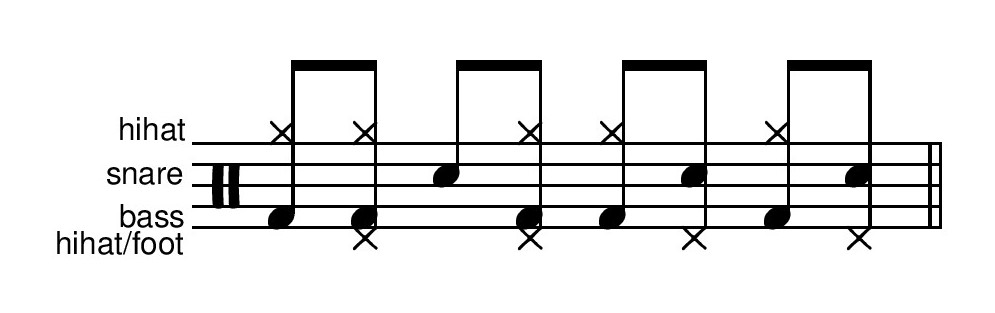
Then you can then double the last of any run of 8th note spaced notes on the cymbal:

Note that we're making the jazz time as a double time feel, implying this two measure phrase in a fast 4:
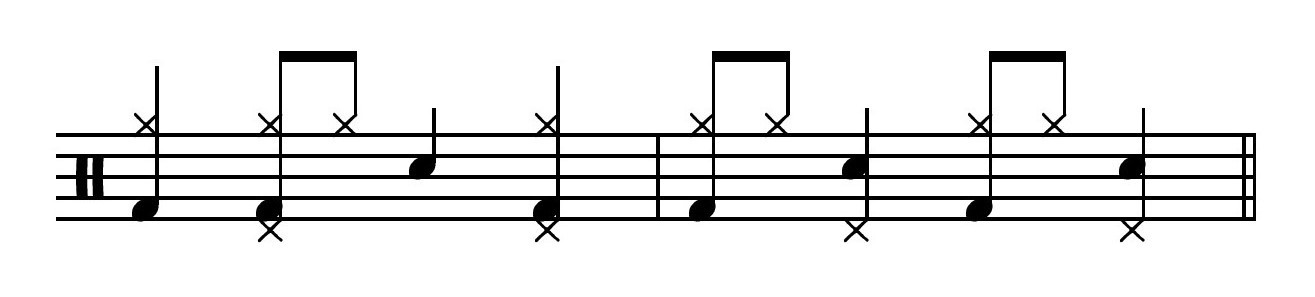
I recommend spending of time with just that, at increasing tempos, and not going straight for the following denser options. But from there you could double any single left hand notes (which is all of them, in this example):

From there you could fill in any remaining 16th notes— notice that the hands are doing a paradiddle diddle sticking here:

Here we're playing the RH doubles on the bass drum as well, and taking away the single notes:

Or you could take way the bass drum altogether. Try some different things.
I don't know how useful it would be to play the full page exercises this way. Not all the one line rhythms in Reed will work equally well as actual playing texture— consider them more as calisthenic drills than literal playing vocabulary. Actual tempos for the above could be 120-200, making implied tempos of 240-400 bpm.
Sunday, April 09, 2023
Transcription: Billy Higgins trading
Some uptempo trading 8s and 4s on Moose the Mooche, from an old favorite album, Wish by Joshua Redman, with Pat Metheny and Charlie Haden, and Billy Higgins on drums. I used to play along with this track a lot.
Tempo is a little over 300 bpm, and trading begins at 2:17:

Virtually all the activity here is with the hands— there is a little feathering the bass drum in half notes in the last 4. Maybe there's more than that, I didn't check. Distinction between accents/non-accents is not extreme, though notes marked as ghosted are definitely ghosted. Obviously there are paradiddle-type stickings happening on the tom tom activity.
Tuesday, March 21, 2023
EZ Fast Rock Lesson
This page functions both as a page of easy stuff for beginners, and as basic vocabulary for fast-tempo rock drumming. There are a lot of patterns, deliberately. This'll be many students' first shot at processing a lot of stuff quickly.

Like it says, learn the page, then combine patterns to make two measure phrases. Probably obvious groove patterns (like 1-2, 4-5, 10-11) are best to have as the first measure, and fill-like patterns are best for the second measure. Use the ride cymbal half the time, don't just hang out on the hihat all day. 26-27 want to be up on the top cymbals— the ride and crash— they're slightly awkward coming off the hihat.
19-23 are all in aid of doing a one-beat 16th note fill, so observe the sticking on 19-20.
Monday, February 20, 2023
Uptempo drill a la Riley
Major rehash alert: an uptempo jazz drill I was playing yesterday, using what John Riley once called “my C major scale”: an SSBB pattern in 8th notes, with notes omitted. The page below is very similar to what I wrote about that, but in a better sequence for fast tempos.
Here are some key starter patterns:

I practice it reading out of Syncopation, using my subtractive method*— voicing the book rhythm according to that SSBB pattern. Anything sounding on a 1&/3& is played on the snare, anything sounding on a 2&/4& is played on the bass drum.
* - Rated by the same Mr. Riley as “convoluted, but sometimes that's necessary.”
Here are some key starter patterns:

Do this with Syncopation pp. 9-10, 30-31, and 34-45.
Tempo goals are half note = 120, 130, 143, 150, and beyond. Play straight 8ths at all tempos, even tempos you would normally swing when performing. I usually practice these playing double time along with a straight 8th jazz/fusion/modern music loop.
I've written a number of these drills over the years, and there's another good one in Riley's book Beyond Bop Drumming. The best drill is the one you do— whatever works for you.
Monday, September 05, 2022
Transcription: Ndugu Leon Chancler - Man in the Green Shirt
Quick little transcription that includes one of the great opening drum fills ever— Ndugu Leon Chancler playing Man in the Green Shirt, from Weather Report's album Tale Spinnin'. I've just written out the opening, some of the main drum groove, and an ensemble section at about 1:30, and some of the half time groove he plays after it.
The tempo is fast, about 154 bpm. To me that's about the natural tempo limit for 16th note funk/fusion vocabulary— above that it starts sounding silly. For another fusion burner in a similar tempo range see my transcription of Egberto Gismonti's Baiao Malandro, with Roberto Silva on drums.

Ndugu has a couple of extra drums here— a concert tom and a second floor tom. Or a middle tom tuned very low. He's also using a China cymbal, and plays the bell of the ride quite a bit. That opening fill moves from drum to drum in a funny way, assuming the drums are arranged normally, and he's leading with his right hand. I'm not going to worry about how he did it, just note that with that kind of movement it doesn't sound quite like a normal bonehead Hawaii 5-0 fill.
I was expecting him to vary the cymbal rhythm to accommodate the 16th notes he's playing on the snare and bass, but he plays straight 8th notes. Listen beyond the transcription, to how he uses the bell of the cymbal, he'll use it for accents, or go to it for a few bars to build intensity, or play it sort of randomly.
Be sure to go read that GREAT recent Joe Zawinul interview for more about Ndugu playing with Weather Report.
Wednesday, January 05, 2022
Plain talk about fast tempos
 |
| “Billy, can we talk?” |
About 15 years ago a couple of friends of mine were moving to New York, and were intimidated that they would not be good enough at playing playing really fast tempos— and a list of whatever hard tunes— so we did some regular sessions to work on that.
We concluded, after a few months of this: half note = 150-160 was manageable and playable, 165-175 was getting frenetic, above ~ 175 was getting ridiculous and we could barely keep it together. That's the approximate range of tempos on Four & More.
Many people never play anything faster than about the highest traditional metronome marking: quarter note = 208. They'll say “let's burn one” and then count off ~200 bpm. Most other people rarely get much above ~ Passion Dance / Chasin' The Trane tempo— let's say quarter note = 240.
Roy Haynes's magic tempo, around half note = 143— the approximate tempo on his famous recordings of Matrix, Have You Met Miss Jones?, Reaching Fourth, All The Things You Are— is extremely fast for most people. I think it's a tempo at which every ambitious player should be able to really kill it— I'll call that normal fast.
A little above that, we're getting into the high range where the subdivisions are playable and sound like regular notes, fast but not hyperactive.
At the very high end, half note = 200 is a nice round number, and John Riley mentions it in his book The Art of Bop Drumming, so a lot of us think of that as the number to strive for as our upper limit. And it's truly absurd. You'll hear things in that vicinity on records occasionally, and usually everyone sounds bad except maybe the guy who's session it is. As fast as those 60s Miles records are, they never get that fast, and they never sound bad like that.
But I don't know, here's Woody Herman's band playing Caldonia, the tune Riley mentioned, and they keep it together at around 400 bpm. They were a touring band, so they were doing this together every night. And the rhythm section breaks it up by laying out a couple of times, and playing some half time. Bob Leonard is on drums, watch carefully what he's actually doing. Watch what everyone does at these tempos— most often they're not playing a complete, perfectly composed bebop drum part.
More often where those numbers come up in everyday life is when people get called to play with a touring performer, who calls at least one absolute barn burner. That's where normal players get burned— normal excellent players. It's an unfair situation, because they're probably just playing with the guy the one time.
My principled objection to insane tempos is that they're BS. Speeding something up to the point that “the beat” is really a subdivision, and you're supposed to be creative in a subdivision of that— it's BS. It's not music, it's a jazz-cultural terror weapon.
[...]
...which is totally irrelevant when you were called to play with Godzilla and he's making you do something insane, and you have to do it because you took the gig and you're on stage and this is happening. You get no opportunity to get up and debate the merits of it. There will be no opportunity to rationally present your position that your priorities were directed at more substantive musical pursuits.
So, I'm not saying don't work on this, just keep it in perspective— who are you going to be playing with, and when. If you want to do ordinary jazz gigs and jam sessions locally, just be very good within traditional metronome range, up to about 208. As a broad rule, everyone should be able to do that. And there is a lot of work to do just learning to play well in that range. That's the point of this entire conversation.
If you're a serious college level student, be pushing that up into that Passion Dance range— sounding very good at quarter note = 250+. You may be called on to hack through something faster than that.
If you're very ambitious about your playing, and want to play with the very best players in any region of the country, you want to be able to kill it at Roy Haynes tempo. Check out the Pat Metheny record Question & Answer, which has a lot of fast tunes on it— you want to be able to hang with everything on there. When you can do that, that's when you should be thinking about how will I survive when thrust into a super-fast situation.
In fact you'll want to be able to hang and sound good in the full Four & More spectrum— say, half note = 145-175. At least be able to survive at the upper end of that.
The absolutely absurdly fast range... if you can do these other things, you can probably survive, somehow. I don't know if anyone has that perfectly worked out in the practice room and ready to go in a fully finished state when called upon to do it. Max Roach had to learn to do it on stage, and most of us do not get the opportunity to do that any more.
POSTSCRIPT: Oh, when my guys got to New York nobody they played with was playing fast, either, and they were all playing ordinary tunes.
Tuesday, July 20, 2021
Transcription: Jack Dejohnette - Climax - drum solo
Another drum solo from a Jackie McLean record. Jack Dejohnette early in his career, soloing on a fast tune from McLean's album Jackknife. The tune is Climax, tempo is about half note = 160. We looked at another tune from this record awhile back.
If you ever worried about not being able to solo at fast tempos, check this out. It's fast but very simple, using a few basic “non-independent” patterns, with hands in unison opposite the bass drum. He's not panicking about not throwing in enough stuff, or changing ideas fast enough.
The solo begins at 6:55 in the track.

Listening closely, Dejohnette's execution is quite loose— the unisons between hands are pretty wide flams.
That measure of 9/8 near the end is nothing, ignore it. Just an extra 8th note seemed to work its way in there.
Sunday, June 13, 2021
Three Camps for drumset - jazz / uptempo - 01
I wrote this to isolate some things used in my main uptempo Reed method— which I continue to find an excellent method. This is good if you need to polish a few of those bass drum patterns in a more focused way.

I've simplified the structure somewhat— the third camp just repeats the last two measures of the second camp, backwards. The piece really needed that tiny bit of variety, and I find this a little dull to practice. I'll probably skip the whole last section altogether. Still, it's better than just practicing a one measure pattern over and over again, right?
Saturday, May 29, 2021
Latest uptempo drill
I'll be honest, most of my uptempo things I improvise while practicing, and then work on them maybe a few times over a week or two. But taken together, they give you more than a one-dimensional idea of how to practice dealing with fast tempos. They're mostly basically inspired by John Riley's uptempo drill in his book Beyond Bop Drumming.
This is another one I basically improvised while practicing the pages with the quarter note pages in Syncopation with an uptempo jazz feel. It's pretty straightforward— we're doing the unison pattern from Reed, then the equivalent linear pattern, then the unison pattern split, with the bass drum after the snare drum, then split with the snare drum coming early. All easy to do just looking at the book, except the last one.

Do these along with quarter notes on the cymbal, or the regular uptempo cymbal rhythm, plus hihat on beats 2 and 4. There are a lot of patterns over two pages, so I try to move through them quickly, in maybe 10-15 minutes of practicing.
By the way, I've added a new label, uptempo methods, grouping all of my fast tempo jazz practice materials together, distinct from fast tempo posts broadly.
Friday, April 16, 2021
Transcription: Roy Haynes - It's Time
Roy Haynes playing behind Herbie Hancock's solo, on the title track of Jackie McLean's record It's Time. There's a lot of what people call “broken” time here, and meter-within-meter playing. The tune is in 4, but Haynes is playing with a strong broken up 3 feel all the way through. If you check out my “world's shortest Roy Haynes lesson”, and play those 3/4 patterns over 4/4, you'll have some similar stuff.
Tempo is 266— generally the range where a swing feel evens out into straight 8ths. Haynes is playing a very legato swing feel here— almost straight 8ths, not quite. It would be a good analysis project to print this out and add phrase markings indicating his two, three, and four beat phrases.

The transcription was a little tricky to make, and may be a little deceptive— there are lots of tied notes and ghosted notes— there's so much quiet stuff happening, it suggests a lot of physical activity where no notes are sounding, or barely sounding. The transcription could turn into a real nightmare of random looking stuff if I tried catching all of that, which is really not central to the main idea of what he's playing.
There are a lot of unisons happening— both hands together, both feet together, and everything together with the cymbal. Not much linearity, or “independent” lines against an ostinato. The hihat is quite sparse, and often in unison with accents on the bass or snare. A few times he'll play it on 2 after a couple of measures of floating meter-within-meter playing. The bass drum is less sparse, and there seems to be more activity than I was able to notate. For the most part the bass drum is not loud— his playing here seems centered mostly on the hands.
Friday, March 05, 2021
Daily best music in the world: Al Harewood fast
Digging around for some Al Harewood— I mostly know him from the 60s Blue Note records he's on, but he was active into the 90s— I found this killing live track from George Benson, in 1973. This is one of those records you find in the $2 jazz clearance bin, that nobody thinks to buy. Everyone is great on this, Mickey Tucker, wow.
The tempo is generally around 330— half note = 165. You can hear Harewood is mostly playing quarter notes on the cymbal. His solo is pretty raggedy, and who cares. He kills on this whole thing.
Wednesday, March 03, 2021
Reed interpretations: new uptempo method
All right, I found the way to use Reed at faster jazz tempos. My “the way”, anyhow. I've mostly been winging my uptempo jazz comping until now— I never had materials I really liked for working on that.
We're doing the first practice method everyone learns— playing the book part on the snare drum, along with jazz cymbal and hihat rhythms. To make a complete snare drum/bass drum texture, and to make it easier to execute at fast tempos, we'll use the bass drum to break up any runs of more than two 8th note-rate notes.
I've written out the possible orchestrations of those multiple-8th runs, along with the first four lines of Syncopation Exercise 2. It looks like a lot of stuff, but with a little practice it's not difficult to do this on the fly.

This gives us a realistic comping texture, with a nice flow of chatter on the snare drum— much of which can be ghosted— and the bass drum is realistically sparse. Those bass drum doubles give us a nice Tony Williams-like thing. It's good to use the alternative orchestrations liberally, to vary the texture.
This will sound good at all tempos— for students good initial goals would be quarter note = 238 (“Elvin's tempo”, so-called by me because of Passion Dance and Chasin' the Trane) and quarter note = 286 / half note = 143 (“Roy Haynes's tempo”, because of Matrix, Have You Met Miss Jones, and half the stuff on Pat Metheny's Question & Answer).
Exercise 2 is by far the hardest full page exercise for this type of thing, so practice it last. The other seven usual pages are all manageably easy— e.g., Exercise 1 will have less than ten bass drum notes total.
Friday, February 05, 2021
Velocity stickings for Syncopation, Lesson 10
For a couple of my students I've written a set of velocity stickings to use with Lesson 10 (pp. 22-23) in Syncopation. They're designed to be played fast, hey? These will be a godsend for everyone trying to do that hyperactive contemporary thing with the super fast embellishments— like if you have your eye on some hihats with giant holes in them, and are really digging super high, dry, white noise-like percussion sounds... what every single drummer in the world under ~ age 30 is into right now.
This should really be expanded into a new e-book, so I won't overdo it writing a maximal number of patterns. I've given my suggested release note(s), but any sticking ending with a single R or L can release on either hand; stickings ending with a double should release on the opposite hand. Some stickings will start with the same hand every measure, others will switch lead hands every measure.
Play the 8th note portion of each measure however you like. I suggest starting with all R hand, all L hand, alternating starting with R, and alternating starting with L.
To simplify the first measure of each drill, on exercises with 16ths crossing the barline (lines 8, 12, 13), I play 8th notes until I hit the first full two or three beat run of 16ths, starting on beats 3 or 4. Or just use my example rhythms below. Interpret these in cut time, so the 16th notes function as 32nd notes— the eight-note subdivision.
1. One beat of 16ths - lines 1-4, 14-15
RLLR R/L - LRRL L/R
RRLR L - LLRL R
RLRR L - LRLL R

2. Two beats of 16ths - lines 5-8
RLLR LRRL R/L - LRRL RLLR L/R
RLLR LRLL R - LRRL RLRR L
RLLR LLRL R/L - LRRL RRLR L/R
RLLR LLRR L - LRRL RRLL R
RRLR LRRL R - LLRL RLLR L
RRLR LRLL R - LLRL RLRR L
RRLR RLRR L - LLRL LRLL R
RLRR LRRL R - LRLL RLLR L
RLRR LLRR L - LRLL RRLL R
RLRR LLRL R - LRLL RRLR L

3. Three beats of 16ths - lines 9-10, 12-13
RLLR LRRL RLLR R/L - LRRL RLLR LRRL L/R
RLLR LRRL LRRL R/L - LRRL RLLR RLLR L/R
RLLR LRLL RLLR L - LRRL RLRR RLLR L
RLLR RLRL LRRL R - LRRL LRLR RLLR L
RLRL LRLR LRRL R - LRLR RLRL RLLR L
RLRL RLLR LRLR L/R - LRLR LRRL RLRL R/L
RLRL RRLR RLRL R - LRLR LLRL LRLR L
RLRL LRRL RLLR L - LRLR RLLR LRRL R
RLRR LRRL RLLR L - LRLL RLLR LRRL R
RLRR LRRL LRRL R - LRLL RLLR RLLR L
RLRR LLRL LRRL R - LRLL RRLR LRRL L
RLRR LRRL LRLL R - LRLL RLLR RLRR L

4. Four beats of 16ths - line 11
I'm skipping this for now. Try repeating any of the two-beat stickings that release on the same hand they start with.

Perhaps we'll see a new e-book on this topic in the coming weeks/months! In the meantime see my e-book 13 Essential Stickings, which is designed around this basic premise of stickings that are easy to play fast, as well as my page of velocity stickings in 3/4 and 12/8.
Monday, January 18, 2021
Very occasional quote of the day: Max Roach fast

Those sessions were unbelievable, but it makes you strong and teaches you how all four limbs have the responsibility to create the illusion that you're playing super fast.”
- Max Roach
Quoted from Roach's Percussive Arts Society Hall of Fame entry.
Monday, January 04, 2021
Listening: holy shnikeys
A couple of standards from the album The Hub of Hubbard, by Freddie Hubbard. With Louis Hayes on drums and Richard Davis on bass, plus Roland Hanna and Eddie Daniels. Recorded in Germany in 1969 while this group was on tour. Normally one would expect a band to be sounding really tight after a tour— here it led to something really wild. When Without A Song came up in a mix, my impression during the first 30 seconds was this sounds bad.
And some of it does— that happens. Hayes is real busy, blowing through the parts where a drummer would normally be playing arrangement stuff— it doesn't work for me. And the bass and drums are generally in different time zones, with the bass often way ahead, to the point that Davis's quarter notes are landing on Hayes's &s. It creates a real chaotic edge, and leads to some real confusion at times— like at the end of the tenor solo. I've heard Davis do this in a less extreme a way on other records— floating it in, playing around with being way ahead of the beat. Music can sound good when it's on the edge of falling apart— at best here there's a kind of wild Mingus-like energy; at worst it sounds like everybody is powering it in from different wings of the building and conflicting with each other.
Next they play Just One Of Those Things rather quickly. The tempo starts around quarter note = 430, and gets up to around 470 at times. Much of it hangs around 450... insofar as it's possible to get an accurate tempo from that. That's more relatable as whole notes, at 108-117. In my mind the normal top absurd tempo is around 400, or whole note = 100. As an experiment you can try playing 16th notes with one hand at 100, 108, and 117, that gives you an idea of the scale of tempos we're dealing with. It's all totally ridiculous.
Louis Hayes starts it with an intro played on the cymbals, reminiscent of Philly Joe Jones playing Tune Up with Miles Davis— to me two notable occurrences = a pattern, and now that's something you do when playing real fast tempos.
Strange things happen when you try to play a jazz feel at a tempo where it's impossible to do so. Hayes's default time feel is sort of a mutant Charleston— following the rhythm of the tune. You hear something like this during the head and for much of Hubbard's solo:

His quarter notes on the cymbal are shuffling out— that's the actual rhythm he plays, when you slow down the recording— and there's no hihat at all that I can hear. The time feel is mostly driven by half notes and dotted half notes played on the bass drum and cymbal, with a little snare drum. He's fluffing in some texture in between as best he can. Really the harmonic rhythm is the primary pulse all of this is hanging off of.
Eddie Daniels half-times the last chorus of his solo, which you would think would be a big smoking invitation for the rhythm section to join him for a breather, maybe play half time on the piano solo— but they don't take it— some kind of ethic of not punking out, perhaps. As wild as it all sounds, Hayes is right on it when Hubbard comes in on the head out. Freddie Hubbard is horrifying through all of this— a pure freight train. At the end of the track one of the players says “Now let's try it at the real tempo.”
The other tunes on the album are a medium blues and a ballad, and they sound great.
Sunday, May 31, 2020
Tootie Heath brush lesson
True old school guys approach things a whole different way from the modern technocratic thing. Here's Tootie Heath giving a brush lesson:
h/t to Larry Appelbaum
h/t to Larry Appelbaum
Thursday, October 31, 2019
Very occasional quote of the day: Fast City

RT : How did you learn to play bop so fast?
OH : I don't know. With much difficulty. No, with me, playing fast is a relaxation thing. You start to come up with tricks to get that right hand moving. And then it's not always the cymbals; you've got the hi-hat you're working with. To play that kind of bebop is a hands thing. The bass drum is giving the accents and dropping the bombs during the solos. The bass drum is weaving. “Fast City” is one of the fastest songs I've ever played. There were a couple of songs I did like that with Mike Mainieri, but you learn your tricks for doing it.
RT : But it's funny you would say you had to relax to play at that speed.
OH : You've got to relax. Before you tense up, you've immediately got to say it's not fast. Victor and I had a long discussion about that when we were learning it. Don't think of it as fast. It's not fast. Never mind the fact that you're going to pass out when it's over; it's not fast.
Here's the tune he's talking about— Fast City by Weather Report, here with Peter Erskine on drums:
Subscribe to:
Posts (Atom)