Showing posts with label around the drums. Show all posts

Thursday, May 29, 2014

Todd's tom tom thing — part 1

This is something that has come up organically in my own playing, which I've been trying to get a handle on more systematically— we saw a little bit of this before with my “quasi-African” tom lick. Mainly, we're combining moving around the drums with sound/articulation changes with the left hand. This is mainly a soloing thing, but the kind of fluency we'll be developing should generally apply when playing Latin styles that are mainly on the drums, like a rhumba, or calypso; or when you want a texture change on a Latin tune, like during a bass solo.

This sort of thing looks like hell on the page, so we'll break it down as much as possible:


Play the snare drum with the snares off. The left hand will be playing the snare drum normally, rim clicks, rim shots, and ghost notes. The right hand moves between the snare drum (played normally) and floor tom. Once you can do the basic moves, you can begin to play with your sound— adding some accents, changing the quality of your rim shots, and experimenting with the way your left hand muffles the drum during the rim clicks. If you want to use your feet, you can play quarter notes (or dotted quarters in 12/8) on the hihat, or with both feet, to start.

Get the pdf

Tuesday, August 14, 2012

Tom moves revisited

I've been using these moves around the drums a lot in my own practice-- if you've been working with the Elvin's Afro Waltz series, you probably have too-- and have evolved them slightly, so I thought I'd share that with you. As you can see here, I've added some inversions of the main moves:

Key:
S = snare drum (normal stroke, or rim click)
H = high tom
L = low tom

Between two drums:
S H S H / H S H S
S L S L / L S L S
H L H L / L H L H

Away from/back to one drum:
S H S L / H S L S / L S H S
H S H L / S H L H / L H S H
L S L H / S L H L / H L S L

Down / up the drums, or clockwise / counterclockwise: 
S H L / H L S / L S H
S L H / L S H / H S L

The reason for the extra inversions is that when doing a moving part with the same number of notes per measure as there are in the move, the resulting pattern will start on the same drum every measure. So, you may want to explore some other possibilities. It takes more time to do the extra patterns, so I do them when I want to hear something else happen musically with a pattern; I don't necessarily do them routinely. There's certainly no need to do them when the pattern starts on a different drum every measure/repeat.

One more thing: You could do these with one note only per drum, but I will generally put doubles or multiples on one drum, and do the moves when there's enough time to make them easily. So, this pattern from the first installment of the Elvin thing:


...would be played like this when using the SHL move:

Wednesday, April 25, 2012

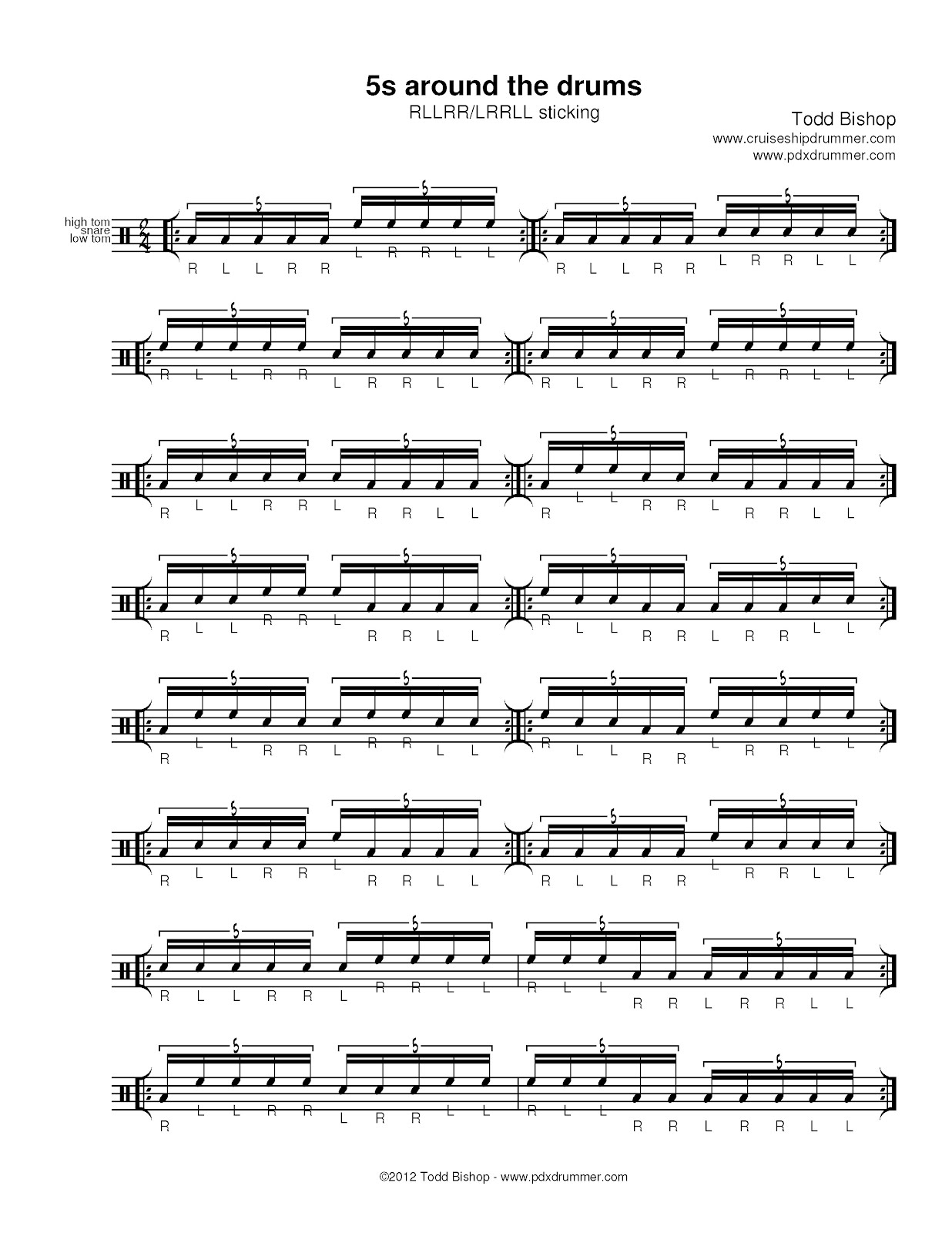
5s around the drums

I've enjoying practicing my previous around-the-drums things so much, I thought I'd run it through a few iterations- similar to my multi-page paradiddle exercise- and see what we get. Today it's 16th note 5s, using  the easily-flowing RLLRR/LRRLL sticking:


As I've outlined previously, once the single measures are happening, start combining measures- the notes in parentheses are to facilitate that without having to do a crossover. On the second page I've also given some formats for playing these as 8th notes or 16th notes in 5/4 or 5/8.

Get the pdf

Tuesday, March 13, 2012

Six stroke rolls around the drums

I'm just cranking them out today. I've been using the last paradiddles around the drums thing so much I decided to write up something similar using another familiar solo pattern, the six stroke roll (as it's often called) in a sixtuplet rhythm: RLLRRL. What they really are is a paradiddle-diddle inversion. I've written them in 6/8, but you can play them in 2/4 as sixtuplets, or as 16ths in 3/4, giving a 6/8 feel, or as 16ths in 4/4, for a meter-within-meter thing. Or as triplets within a fast 4/4. I'll write up an outline of the possibilities when I have the time. This rudiment is usually played with accents on the singles- I suggest playing these with and without them.

Refer to the paradiddles post for more ways of practicing these.

Oh, and go see Andrew @ the Melodic Drummer- he's put up some around-the-drums conditioners of his own.

Get the pdf

Friday, March 02, 2012

First-inversion paradiddles around the drums

2024 UPDATE: Wow, this page looks like crap. See my new bigger and better page of this. 

This came up in my own practice today— straight conditioning movements around the drums, using the very traditional Joe Cusatis books. I try not to think of this as learning licks; it's more about programming into my muscle memory some moves that I might not do on the fly. First inversion paradiddles (that's the RLLR LRRL sticking) are one of the key patterns for playing "hip", and I use them a lot, so they're a more logical starting place for me than regular paradiddles.


Notes:
  • Practice measures individually, then in the following sequence:
    Ex. 1-2, 1-3, 1-4... 2-3, 2-4, 2-5... 3-4, 3-5, 3-6... etc.
    On sequences, play each measure once or twice:
    Ex. 1-2-1-2..., or 1-1-2-2-1-1-2-2... etc. 
  • Notes in parenthesis are for making transitions between exercises without a crossover.  
  • Practice these in the quarter note = 120-160 range. You should be able to fly around the drums with these. 
  • Typo alert: Ex.8, second beat- play the right hand double on the floor tom. 

Get the pdf