Showing posts with label 5/4. Show all posts

Tuesday, July 16, 2024

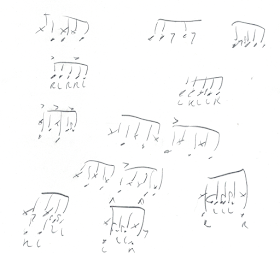
Triplet burnout with the jazz waltz telephone page

Here are some things I do over the course of 15-20 minutes playing that jazz waltz telephone page, in addition to just playing repeating measures as written, in 3/4 time: 

1. Play each measure in 4/4 by adding the first beat of the following measure. 
2. Play each measure in 4/4 by adding the last beat of the previous measure.
3. Play in 2/4 by playing just the first two beats of each measure.
4. Play in 5/4 by adding the first two beats of the next measure. 
5. Play each two beats of each line, moving ahead one beat at a time. 
6. Play each 3/4 measure within 4/4 time. 


The page is just for illustration, you do these looking at the original page. I won't necessarily rigorously play through the entire page each of those ways, but I'll do them for awhile, moving quickly from thing to thing— it's a lot to play through. Obviously you have to have this stuff together already pretty thoroughly, so it's about conditioning, rather than learning new stuff. It's a triplet burnout drill. 

I play the cymbal as written through all of those changes, and add hihat as appropriate for the time signature. 

Get the pdf

Tuesday, July 02, 2024

Daily best music in the world: Dannie Richmond with Don Pullen / George Adams

Title track from Earth Beams, a great record by George Adams & Don Pullen, with Dannie Richmond on the drums— all three are Charles Mingus band alumni. Richmond was a key partner in that relationship for a long time, and is one of my favorite drummers. 


This is really fundamental to what a jazz musician is— the groundedness in blues, the way they handle the jazz musical environment. Not about chops, or even pure groove— in the details the time and rhythm can be a little squishy, though the overall feeling of drive is there, and overwhelming. You can tell players who just live in that playing environment. Polish is not the point.    

Here's another one, a gospel 5/4, which you didn't even know was a thing. It's so deep it took me a minute to realize they were playing in 5. 


This is what anyone would call modern playing, but it's defiant to analysis— by me, anyway. I can't approach it looking for vocabulary. The point is the total playing entity.   

Monday, July 01, 2024

One measure 5/4 triplet fills with Reed!

Another one of my hack and slash jobs. This is something I improvised in a lesson— a student is working on some of the Pages o' Coordination in 5/4, based on an Elvin Jones groove, and we made some fills using the accented triplet pages from Syncopation, alternating between one measure of groove, one measure of fill. There's a good way of handling triplet stickings so you always come out on the right hand here, in whatever time signature. 

First, we'll be using the accented triplet pages from Syncopation, putting them into 5/4 time, playing the first five beats of each line, repeating, as I've brutally scribbled in here: 


Here are all the one line exercises copied and pasted in into 5/4, jammed onto one page: 

Get the pdf - Reed accented triplets in 5/4. There is another pdf to download below. 

On the drum set, the accented notes are played on a cymbal, with the right hand, supported by the bass drum, and the unaccented notes are played on the snare drum— and later moved around the drums. 

To get the cymbal notes onto the right hand, and to get in and out of the fill easily, we had to use some different stickings. Following some simple-ish rules:

All cymbal notes played with RH 

All snare notes start with LH: 

1-2 notes on SD: LH only
3 notes on SD: alternate - LRL
4 notes on SD: LH paradiddle or inversion: LRLL, LRRL
5 notes: alternate - LRLRL
6 notes: LH double paradiddle or inverion: LRLRLL, LRRLRL 
7 notes: alternate - LRLRLRL
8 notes: LH triple paradiddle or inversion: LRLRLRLL, LRRLRLRL

You get the picture:

•  odd number of SD notes = alternate
•  even number = alternate with LL double at end, or RR double after first note 


I prefer the second type of paradiddle sticking, but there are good reasons to do either. The timing of the next cymbal accent may influence what feels best to somebody. 

This page illustrates all the above possibilities, in the two-measure phrase I described:

When the fill begins with snare drum, you can add bass drum to the last note of the groove measure— to begin the fill more strongly. 

Get the pdf - Reed triplet patterns as fill with Elvin Jones groove

Friday, April 21, 2023

EZ rock in 5 - 3+2

Extending this EZ fast rock / rock in 3 series, with quarter notes on the cymbal: here are some beats and ideas in 5, phrased 3+2. I wrote this series to illustrate the difference between 4, 3, and 5, using similar materials, for a younger student who asked about it. 


Learn the beats, then combine them? That may be a more difficult problem than we're generally dealing with here— most of my students for whom this is intended will be preoccupied with staying oriented just in one measure of 5.  

Get the pdf

Sunday, June 12, 2022

The big 7

Please pardon the lack of content. I've been occupied with other things this week, like our upcoming cymbal meets in Germany, and those couple of gigs with all the odd meters.  Which worked out well— I learned a lot from it. I'll do a full run down of what we did, but first let's talk about one angle on playing odd meters. 

Usually, when playing odd time signatures with an 8 as the bottom number— 5/8, 7/8, some forms of 9/8, 11/8, etc— the measures will have a lopsided feel, with long beats and short beats: 


Which you play from a foundation of groups of two and three 8th notes: 


Often that will be counted in 2+2+3/8: 1-2-1-2-1-2-3. 

Several of the tunes we played were written in 7/8, but were better felt in 7/4, with a steady quarter note beat, instead of the uneven quarter-quarter-dotted-quarter beat. A couple that were written in 5/4 strongly suggested a 5/8 phrasing. So there was (almost) always a strong feeling of */8 and */4 versions of a meter happening at the same time— 7/8 and 7/4, or 5/8 and 5/4. 

Because of that, many of the grooves had a partido alto-like feel to them— with several quarter notes in a row, alternating with several &s in a row: 


Part of one arrangement was in 6/4, with a similar rhythm: 


There was also a section of a tune in 9/8: 


Which I played like: 


And if you transcribe the main pulses of two measures of the 7/8 rhythm at the top of the post into one measure of 7/4, you get this: 


A notable thing about how you play that, and my main point here: when the tune is written in 7/8, with chords changing on the 1, but you're playing it in a 7/4 feel— the chord will change in the middle of the measure, on the & of 4. So you need to build that anticipation into your main groove. So this will be your rhythm framework, rather than steady quarter notes: 


Playing the big 5 in 5/8 doesn't seem to help much— or it didn't with this music. The problem with 5 generally is that it turns around so fast you're never get fully grounded. More on that later. 

Monday, June 06, 2022

5/8 control, part 2

Hastily scribbled practice notes
It has been an interesting journey this week, preparing this challenging music— moderately challenging, I guess; there are a few grooves in time signatures I'm not used to, but I'm being ambitious about how I want to play them. When it's all over I'll give you a complete rundown of all the tunes, how I handled them, and how it worked out.

If you're in Oregon, you can come see us at the 1905 Club in Portland at 5:30 pm on Friday the 10th, or the Old World Deli in Corvallis at 7pm on the 11th. Antonio Sanchez is playing with Thana Alexa right after us at the 1905, so you can make a night of it.  

Yes, it is a little intimidating knowing King Kong may be in the house while I'm playing this stuff. But whatever, if I eat it somehow, and he's even around, I'll remember Frankie Dunlop. 

The 5/8 thing is coming along nicely. I needed to figure out a way to vamp on it, and learn a few key rhythms— claves, almost. Generally learning a lot of simple variations on basic things.  

Here's another page of 5/8 patterns based on the notes above, that I wrote while I was practicing, and some practice notes— to myself, they may make no sense to you.  


You can fudge it 
You don't need to play a perfect 5/8 subdivision all the time. This is not prog. In fact, if you're playing off the 1, a lot of almost-normal stuff can happen in the middle. 

And 5/8 rhythms can resemble normal things, pushed around a little bit, for example: 


But increasingly I've found I can just stay on the quintuplet groove— it just requires a focused and deliberate approach. Which is not my forte— as a musician I'm actually kind of a feral individual. Just playing the notes feels like cheating to me.   

Recovering from mistakes. 
I'm learning to bail out fast when something lands in a way I didn't intend— without immediately hitting something else, which will also be very wrong, to try to save the continuity. 

You also have to have the 5/8 in your ear well enough that you can drop in a note, and know where you are from hearing it. 


Playing free
It's also possible to just play free over the vamp— but there's a right way to do that. You have to listen, and you can't lapse into playing patterns that fight with the vamp. It's also nice to be able to play four measures totally free, and land on the 1 with the band, which I can do.    

The actual parameters
You look at a chart like that and you think oh my God I've got to learn to play 5/8, but really, it's one six minute tune, and one tempo. On the 5/8 portion of the head the drums are doing a light percussive background thing. The middle of the tune and the horn solo are in 6/4. The drum solo in 5/8 is really equivalent to an 8 measure break in 4. And the other players are used to holding it together with different drummers who don't know their music real well— or they better be. They won't be relying on me to be their foundation. 

Get the pdf

Thursday, March 03, 2022

Groove o' the day: Afro 10/8

An interesting groove by Billy Kilson, on A Seeking Spirit, from Dave Holland's Prime Directive album, one of the big records of the late 90s. If you're not familiar, he had a very high powered band that did a lot with odd meters. 


There's a strong quarter note pulse throughout, so this could easily be counted in 5, but there's something interesting happening with the bass drum rhythm, and in the percussion part, which suggests a kind of 10/8 Afro phrasing: 


Compare with the usual form of that rhythm in 12/8:


That 10/8 bell rhythm essentially shaves two 8th notes off the end of the traditional rhythm:


There are some other interesting things happening as the track progresses, which pull it some other directions, so it's worth some further analysis— maybe I'll get into that later. 

Having done this, I'm not finding a free way to listen to it online, so you'll have to buy the record, or sign up for Amazon music, or YouTube music, or something. 

Wednesday, November 10, 2021

Page o' coordination: basic triplet texture in 5/4

Continuing this little series. You could warm up for this by just playing the original 4/4 page, repeating beat 1 at the end of each measure— effectively playing ||: 1-2-3-4-1 :||. Like we originally played it in 3/4 by just chopping off beat 4. That's kind of fun. 

But I wanted to place the bass drum differently— this page better suits what I want to do with 5/4: 


It's very straightforward. Just play them down, and begin improvising similar textures on your own. 5/4 is a peculiar time signature, and not easy to feel at all at first, so you should probably be counting your way through. See my old series Cracking 5/4 for some pointers on that, and try playing along with my corny Jesus Christ Superstar loop.    

Get the pdf

Wednesday, November 03, 2021

Hemiola funk patterns in 5/8

Here's a nice easy page of hemiola funk patterns in 5/8— based on our friend the 3:2 polyrhythm. World's fastest way of getting your students playing hip stuff in 5, if you already (wisely) ran them through my previous hemiola funk pages. 


These will also work in a bright 5/4— 8th notes = quarter notes, in that case. You can also swing the 16ths, add hihat (on 2 and 5) and alter the cymbal rhythm (add skip notes on 2 and 5) to make a 5/4 jazz feel, which is an excellent idea.

Get the pdf

Tuesday, September 14, 2021

Page o' coordination: yet another Elvin 5/4

Here's a page o' coordination based on Elvin Jones's playing on Lazy Afternoon, from Grant Green's album Street of Dreams. It's a medium slow 5/4— the tempo is about 109. He plays the ostinato below fairly regularly, with many small variations. I've given the approximate default thing he plays on the snare drum, and then my usual kind of independence exercises with the ostinato:


Try my dopey old Jesus Christ Superstar loop with this one. Once you learn the patterns, move your left hand around the drums— improvise the moves, or use this set of stock moves I do with all of these. Add the circled bass drum note in the ostinato if you feel like it. 

See my other Elvin-like POCs, based on his playing on Your Lady (adapted into 5/4), a variation on that, and on That 5/4 Bag, 

Get the pdf

Thursday, August 27, 2020

Syncopation in 5/4 - another format

A little throwaway item, as I continue working out the formatting for my upcoming book, Syncopation in 5/4, to be released God knows when. The problem is how to deal with phrasing the measures 2+3 or 3+2— both normal ways of phrasing 5/4, that affect the way you write the rhythms. Here I've borrowed the format used by Rick Kvistad in his accents book I reviewed recently— he just writes back to back measures of 2+3 and 3+2.


It's a pretty good option for one-line exercises. With the full page exercises I may have just do them half in one, half in the other. As always I welcome any feedback.

Get the pdf

Tuesday, August 18, 2020

Chapin exercises in 5

This is what you do during quarantine when it's too hot to practice or doing anything else serious: capture jpegs of a well known drum book, open it up in Paint.net, and cut it up to put it in a new time signature.

We talked about this a few days ago in the Easiest 5/4 post. This is the first part of Jim Chapin's Advanced Techniques for the Modern Drummer, with the first beat of each pattern pasted onto the end to turn the 4/4 patterns into 5/4. I could have just written this up in Finale, but this is more fun.


Hihat goes on 2 and 4, add a bass drum on 1. After doing this you should get the formula, and be able to work through the rest of ATFTMD in 5 without seeing it printed out. Easy variations you can do to get a little more vocabulary mileage out of this might be:

• On beat 5 just play a quarter note on the cymbal, or on the snare and cymbal with both hands in unison.
• Leave out any snare drum in unison with the bass drum on 1.

I'll write up a summary of some other possible variations soon. I find them to be an important part of the process of learning to play in 5. 

Get the pdf

Thursday, August 06, 2020

Syncopation rhythms in 5/4

Hey, who wants some practice rhythms in 5/4? Here are several pages of them. I'm working on a new book, Syncopation in 5/4— companion to my other book Syncopation in 3/4. There are some formatting decisions to be made, mainly to reflect a 2+3 phrasing or a 3+2 phrasing, which I'm working out here. I want the same exercises to be usable in either phrasing, and I think there may not be an ideal solution. Let me know in the comments if there's one version you like for that purpose.


Here's a fresh link to my practice methods for this type of thing. for See also John Ramsay's book The Complete Drummer's Vocabulary.

Get the pdf

Sunday, August 02, 2020

EZiest swing in 5/4

Teachers' item here. In working with various beginners, younger students, and hobbyists, you have to be flexible and creative in how you show them things. At those stages, differences in how people learn are really amplified— they're slow to get some things, and faster to get others, with no consistency from individual to individual. I don't want them getting hung up if a certain part of the process is not working for them yet, and I don't need them to learn things in a specific order, so I'll try a lot of different things to help them get their foot in the door. Then they can learn the hard thing over time, while still progressing with their actual playing.

This is an easy procedure for teaching a 5/4 swing groove without the student having to read it, or even learn a new pattern. It should be simple for anyone who can play a jazz beat in 4/4, and more natural and direct than just throwing a book at them.

First, play one measure of a jazz feel, with bass drum on the first note, and stop on 1 of the second measure. With new things, I often have them play it one time only, followed by a long, unmetered pause.

Play this one time, counting out loud: 1 2 3 4 1. Swing the 8th notes. 


Do it again, one time, except count 1 2 3 4 5: 


Despite the written time signature, we're effectively in 5/4 now. Play the above thing repeating. At first I may have them put a long pause in between measures— without counting or tapping their foot during the pause: 


They can shorten that pause until they're just playing the repeating pattern in time. Continue counting in 5.

Of course many students won't need to do all that, and some may need more help, which I improvise based on whatever seems to be hanging them up.  

More advanced students will want some independence patterns to go with that, for which you can just go to Jim Chapin's Advanced Techniques for the Modern Drummer. Just add an extra beat one to the end of the pattern. So this: 


Through the magic of Photoshop, becomes this:


And this pattern: 


Becomes this: 


Just repeat the first beat. Or don't. You can play the book pattern exactly as written, and simply add a quarter note on the cymbal at the end.

See my series Cracking 5/4 for more introductory materials/concepts for learning to play this time signature. 

Saturday, February 01, 2020

Transcription: Billy Higgins solo in 5

Billy Higgins drum solo in 5, on the tune 5/4 Thing by George Coleman, from the album Eastern Rebellion by Cedar Walton. The transcription begins at 5:44.

It's short, kind of a percussion interlude. A lot of Higgins's solos are unassuming, and you have to listen a couple of times to realize there's something very musical happening. You could think he's not really comfortable playing in 5, or hmm he's just playing stuff with his hands over a bass drum pulse. Why doesn't he have more stuff worked out. A lot of irrelevant stuff. He's actually a lot deeper than the superficial elements of what he's doing. I could try to build a case for that, but really you just listen to him, and keep listening, and it's all right there.


Stickings will be mostly alternating or natural. Generally his singles are not even— the right hand is a little louder than the left. There may be a right hand double or two in the that funny measure 15. That measure looks weird, but it's certainly coming from an organic place. Same with the bass drum in measure 16— it would be hard to play that on purpose at this tempo; I think there's a little slop happening that works out to be musically really cool. There are some tied rolls that are played normally, the untied buzzes are played with both hands in unison— or almost in unison.

Get the pdf

Friday, May 03, 2019

Page o' coordination: Afro 15

Hey, as long as we're working on weird, non-traditional perversions of the natural world, here is a page of “Afro 6” groove in 5. Or 15/8, which is a triplet feel in 5.

This groove in the original 6/8 is one of my main means for understanding the world of rhythm, drumming, and the drum set. I work on it a lot, and it influences my playing even when I'm not playing that groove. So naturally adapting it into 5 will help my playing in 5 more broadly.


Learn to play the entire page without stopping, then drill it with my stock left hand moves. You could practice it with this cheesy loop sampled from the Jesus Christ Superstar OST.

Get the pdf

Friday, February 01, 2019

EZ rock beats in 5/4 - 02

More “EZ” rock beats in 5/4, this batch written to be easy to play at fast tempos, in 2+3 and 3+2 phrasing:


Ways of practice— good for any page of grooves:
• Repeat each pattern many times.
• Play the entire page without stopping, playing each pattern two or more times.
• Improvise variations on the grooves. Play 1x as written / 1x variation.
• Accent the 1 every two measures, or four measures.
• Vary the cymbal sound; move to the ride, bell, or hihats, play hihats half open, etc.
• Omit the bass drum on 1, then displace it— move it to the & of 5. Cymbal rhythm stays the same.

Get the pdf

Thursday, January 17, 2019

EZ rock beats in 5/4 - 01

For one of my students, an easy page of rock beats in 5/4. We did one of these a few years ago, but this page illustrates the 2+3 / 3+2 phrasing of this time signature, and the beats are a little easier for younger students.


Count in 5, or in 2+3/3+2 (e.g, say “1-2-1-2-3” while you play). Once you can play the patterns consistently and solidly, begin playing in two measure phrases, improvising simple variations or fills in the second measure.

See that earlier page for some ways of practicing these beats to improve your phrasing, and general concept for playing in 5.

Get the pdf

Wednesday, November 14, 2018

Accents in 5/4 - mixed rhythm - 01

Exhibit A for why we keep writing. I was practicing yesterday, and I thought hmmm I want to work on this one thing, and out the thousands of pages of drumming materials in my studio, none of them had this— accent exercises with a changing rhythm. It's not exactly a far-out idea.

The page is in 5/4, but that's not the point— six 8th notes and six triplets is just an easy starting place for this idea, and it happens to make 5/4.


Use an alternating sticking, starting with either hand. Easy variations would be to play the unaccented notes as double strokes, or play the accents as flams. Keeping stick heights consistently low will help your dynamics in combo playing— 4-6" for accents, 1-2" for unaccented notes.

Get the pdf

Sunday, October 14, 2018

Chop busters in 5/8 - 01

Hey, two odd meter things in two days. I've really turned around my thinking on the value of this subject— it really forces you to have a heightened awareness of rhythm, which is a good thing. I used to be more of a exterminate rational thought kind of guy— still am, at times— but it's nice to be able to play and know what you're doing sometimes.

So here is a page of technical exercises in 5/8, format, concept, and title borrowed from Ron Fink. I still use his book regularly— it's nice for when you don't feel like drilling whole pages of Stick Control or whatever.


I've given the tempos in 8th notes; you can do the calculations to set your metronome however you like. Tempos are in the high range for normal usage of the underlying ideas— most people will have to work to them up to that speed, some maniacs will do them faster.

Get the pdf
