Showing posts with label exercises. Show all posts

Monday, October 14, 2024

First inversion paradiddles around the drums

Updating a very crummy looking page I wrote in 2012— some calisthenic patterns moving the highly hip and useful RLLR-LRRL paradiddle inversion around the drums. 


Drill them blazing fast, and also for control and accuracy at moderate tempos. Don't have a big hole where you sound bad with these because the tempo isn't fast enough. As it says, practice ending the patterns with a bass drum on the last 16th note in the measure, plus a cymbal/bass drum. 

Get the pdf

Saturday, October 05, 2024

Stick Control with a backbeat

Another little oddball Stick Control related item, for drum set: some Stone-type sticking patterns with accented unisons added, on beats 2-4, and on beat 3. Introducing the idea— if you like it, you could obviously go a lot further working out of Stick Control itself. 


Play the right hand on the cymbal, left hand on the snare drum. Ghost the non-accented LH hand notes, play all the RH notes at an even volume. Add bass drum however you like— a particular kind of nut case could use the reading in New Breed for that.  

See also this other oddball item, and the right hand lead with a backbeat Syncopation system. Similar minor items. These things exist in the cracks between the actual major drumming vocabulary items, to create openings for other things to happen. 

Get the pdf

Friday, September 27, 2024

Three Camps in first inversion paradiddles - UPDATED

Updating a really horrible looking page I wrote ten years ago. Musescore actually kind of rocks, this took me no time at all, and looks way better. Musescore would make me work to make it look as bad as the old version. 

It's Three Camps, adapted for your paradiddle inversion burnout needs. Play it a lot, and fast: 


This is in Frank Arsenault form— the third camp different than I've seen it elsewhere. We get to play the third camp twice, without the extra repetition of the second camp afterwards. 

Monday, August 26, 2024

EZ 8th note groove with Stick Control

A simple 8th note groove sequence using the book Stick Control, played on the drum set. 

Use Stick Control pp. 5-7, or my page of sticking patterns, which I think is in a better order. This is a good thing to do along with music

1. Play the sticking pattern from the book with the right hand playing a cymbal, with the bass drum in unison, and the left hand on the snare drum: 


2.
As above, except the right hand plays running 8th notes on the cymbal. So reading from the book, the bass drum plays the Rs, the left hand plays the Ls, and the right hand plays along with everything: 


3.
As above, except the right hand plays quarter notes on the cymbal.


UPDATE: Oh, one other thing: cymbal in unison with Ls. L = both hands/SD-cym, R = bass drum: 


Play those in sequence without stopping, switching from one thing to the next every couple of measures, or every measure, and then as quickly as you can, not necessarily changing right on the 1. The end result hopefully keeps the SD/BD pattern mostly intact, with the cymbal rhythm varying in a loose way. You can probably tell that this connects with some other things we've been doing recently

Rock materials for drum set are usually limited to here are some one measure beats, here are some fills. Here's how some guys played some songs, which you should copy exactly. This idea is part of a larger project of mine, devising some methods for a more open approach, for students of all levels. It's about playing, not just learning to play “parts.”

Saturday, July 27, 2024

Jazz waltz triplet burnout - 01

Updating this page as my purposes with it have evolved, into an endurance drill. I've made it harder, with larger changes from measure to measure, with an eye on how it progresses playing through it two beats at a time. 

This is a good long term project, you can work this up to about quarter note = 238. The Chasin' The Trane tempo. You'll get there quicker using the previous page. 


Play whatever hihat rhythm you want. This whole mess could be done substituting the hihat for the bass drum— for me that is a separate mission. It's too much to do all together, and the hihat will bog you down. 

In case I didn't give you enough practice options, I was also playing it in 4 by repeating the middle beat. So this written measure: 


Is played like this: 


Another thing to trick you into doing this longer, which is the whole point, do it for a long time. 

Get the pdf

Saturday, January 27, 2024

Chop busters: syncopated flammed 16ths

More rooting around in my archives, with a stealth from the zone item. I found this in one of my notebooks from high school, and it's worth playing, with some mixed 16th note rhythms with flams in funny places. So I wrote it up nicely so people can actually read it: 


There are accents on all the flams, and I believe the stickings alternate all the way through.   

...aaand as I look at it, it appears that this is just one pattern displaced by a 16th note from line to line. There are a couple of small variations, but those are probably mistakes. See my December page of flammed 16ths for something a little more challenging. 

Here's the original sheet scanned from my notebook: 


Get the pdf

Tuesday, December 26, 2023

Jazz coordination - feet in unison

This page is for one of my students— his jazz playing has a nice feel with just his hands, but with the feet involved it gets a little uncentered. So we're going to experiment with remedying that by playing the feet in unison. Probably it wouldn't hurt for others to do a little bit of that. 


We'll be working through these at slow to moderate tempos, ~60-110 bpm. 

Wednesday, December 13, 2023

Hemiola inverted and combined

An easy page of rhythm exploration here, inverting a polyrhythm, combining inversions, and then inverting that. I've been encouraged to write these things after noticing that, starting with a simple 3:2 polyrhythm (or hemiola), running some simple mathematical permutations, and/or putting them into 2/4 or 4/4 time, we get some very common rhythms in north American and Latin music. 


There's no grand goal here, except to know rhythm a little better. Most people can play it in one or two practice sessions, then leave it. 

I encourage you to count the combined rhythm of each exercise, and think of them as sticking— variations on B RLR (B for both hands in unison). As we get into the inversions there are some RLRLR and RLB. Play first with hands only, then add the bass drum at the beginning of the pattern.

You can move your left hand between drums, and add some more bass drum. Try some things, it won't be difficult to make some interesting Afro-type grooves with this.   

Get the pdf

Monday, December 04, 2023

Chop busters: flammed 16ths

Another small item, while I power through writing my new book: a page of 16th notes with flams, designed to be rather technically challenging, in the manner of Ron Fink's book Chop Busters


Alternating sticking unless otherwise indicated. The first two reverse hands on the repeat, the others repeat on the same hand. 

Get the pdf

Wednesday, November 08, 2023

Reed tweak: RH lead triplets - five stroke rolls

This is where my thinking is going lately, towards breaking up some Reed practice systems so they're not pure formula. Which I have always done anyway, just not very systematically. We want to make our practice systems non-systematic systematically... skip it.   

This tweak is pretty specific, for the extremely useful right hand lead triplet system, played at medium tempos, putting a five-stroke roll at the end of the longer runs of filler. If you review the basics of that method, the right hand plays the rhythm in the book, and the left hand fills in the triplets, with the right hand helping break up longer multiple notes of filler, to aid in playing it at faster tempos.  

This requires a slightly different sticking system— most of the multiple-note filler will simply alternate, with doubles on the last two notes. With the most common situation, illustrated in reading example 1, the sticking is the same for the original system and for this tweak, LLRL.  


Play the warm ups, analyze the reading examples, and you're ready to run this reading out of Syncopation, pp. 30-45, assuming you could do that in the first place.  

Get the pdf

Monday, September 18, 2023

Warm ups for Alan Dawson's “Para Bossa” system

Alan Dawson's Para Bossa system, from John Ramsay's book, The Drummer's Complete Vocabulary, is a way of interpreting exercises in Ted Reed's Syncopation as 16th note paradiddles, and extended paradiddles, with a samba rhythm in the feet. I was going over it with a student yesterday, and we thought it would be helpful to write out some warmups. Mainly for lining it up with the feet. 

For each line, on the left is the rhythm written as it appears (or would appear) in Syncopation, on the right is the interpreted pattern for it: 


No, there's no 6/4, in Syncopation, but if you play these exercises you'll be covered for all the ways the similar rhythms do appear there. 

Play all the warm ups— starting with the left hand, as well— then practice the system reading from Synopation, pp. 30-45. First with hands only, then add samba rhythm with the feet. 

Get the pdf

Monday, September 11, 2023

Reed interpretations: tom ruffs

Fun item inspired by watching some Bob Newhart Show reruns— I watched it a lot as a kid, and the drumming on the theme music made an impression well before I started playing. 

In the fourth season they did a funkier arrangement of the theme song, that had a cool fill at the end, with a ruff on the tom toms, ending on the bass drum. They used the toms differently then, and very effectively:


I say “they” used the toms differently, maybe it's just John Guerin, the drummer here. Any time I hear a lot of concert toms on some 70s movie or TV music,  he's my first guess. There's a real school of using the tom toms there. Somebody should write a paper. Thanks to David Crigger for sharing that credit.   

It was a hip item at the time, and one of the first licks I tried to figure out on the drums. Now it seems a little dated, and ripe for revival.  


Play the warm ups, then work it out with Reed, as a variation on the right hand lead system. You fit the ruffs into any quarter note (or longer) length space in the book rhythm— where there are two or more filler notes. On the three 8th note long spaces, play the first filler note normally, then the ruff on the last two— that's illustrated with warmups 4 and 5. Notice also the added flams there, which you can do after getting the system together. They sound cool. 

For more of this, see my transcription of Deep Purple's Lay Down, Stay Down, played by Ian Paice, from way back.

Get the pdf

Saturday, September 02, 2023

Round up of recent Reed tweaks

In the last few months we've done a number of tweaks to the basic right hand lead method used with the book Syncopation, and I thought it would be good to summarize them on one page. It's a good collection of stuff for rock and funk, and other straight 8th feels. The examples are all based on line 8 from p. 38 of Syncopation. 

The examples are: 

  1. Basic RH lead system. 
  2. Alternate sticking on runs of three or more notes, in either part. Click link for the exception on longer runs of notes. 
  3. Add LH flam on last note of filler on runs of two or more notes.
  4. Add LH flam (or double stop on two different drums) on every note of filler.
  5. Play all filler as alternating RH lead 16ths (see above link).
  6. On previous two: also alternate all runs of two or more cymbal notes; always begin with RH.
  7. Fill with paradiddle inversion on runs of two or more notes. 
  8. Play backbeat; SD accent on beat 3, replacing BD if necessary. Cym rhythm stays the same. 


Practical tempo range for this is up to around 200 bpm, or the cut time equivalent.

It's kind of hard to read crammed onto one page like this, but that's not how you do it. Learn the principle, and then practice it by reading out of Syncopation. 

You can develop these using pp. 6-7, 10-11, 30-33, 34-45. Depending on how simply you or your student needs to begin. A good practice drill would be to run all the systems with p. 38, or with any single long exercise from the above pages. You could also alternate one measure groove / one measure system— groove could be an ad lib beat, or a rock or funk beat based on the book rhythm, or the backbeat system above.  

There are some different possibilities for the filler substitutions as well. 

Get the pdf

Thursday, August 31, 2023

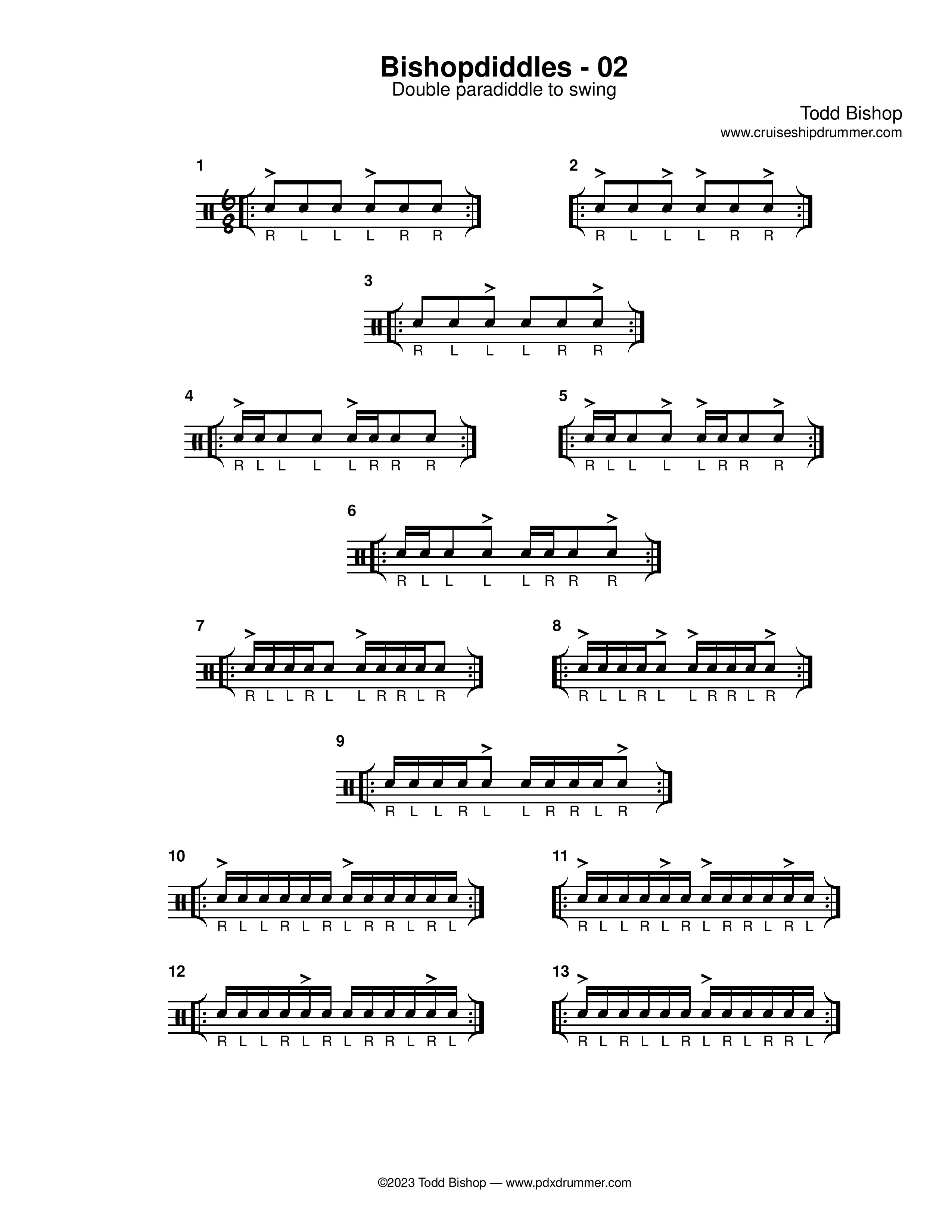
Bishopdiddles - 02: double paradiddles to swing 8ths

Listen: do not show these to somebody and call them “BISHOPDIDDLES.” You're going to get both of us beaten up.  

One thing I like about this double paradiddle inversion is that it's possible to accent the first and last notes of a triplet (or beat of compound 8th notes) with it, so it fits nicer in a slower tempo swing 8ths environment, and we can make a Reed system for practicing it. 

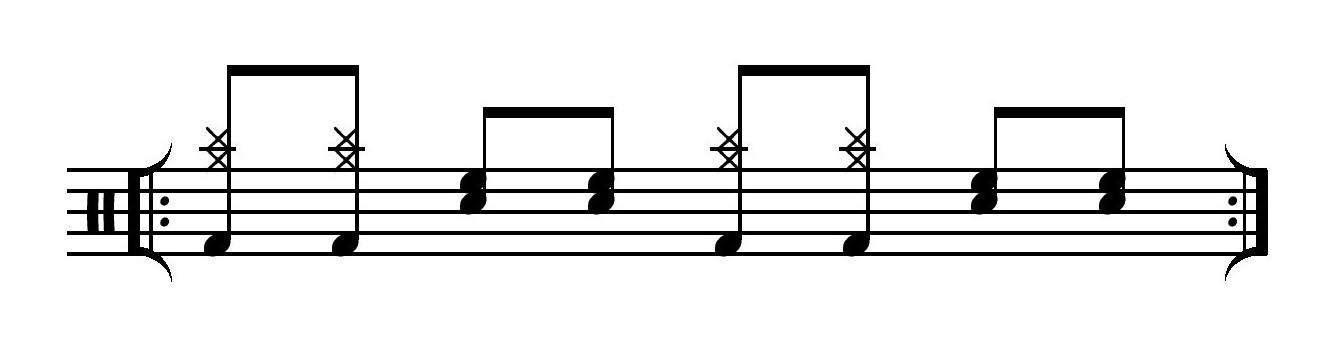
Regular double paradiddles accent naturally on the first two triplet or compound 8th partials: 


This inversion puts the natural accents on the first and last partials, which of course coincides with a common swing 8th note interpretation: 


This, then, is a collection of drills for developing it fully:


You can use patterns 1-3, 4-6, 7-9, and 10-12 (I don't know why 13 is there) as foundation patterns for practicing this out of Syncopation. Play p.38 all those ways. 

I mostly only use these patterns once at a time, not hand to hand like this, so this may not be much more than a technical drill, but I think it's a good technical drill. 

Get the pdf

Thursday, August 24, 2023

P. 38 canon

This is purely a writing experiment, pay no attention. Like, run away to some other web site right now

Actually this is a pretty good exercise for working up an Ed Blackwell kind of solo texture, if you played it on the tom toms. I just took good old p. 38 from Reed and transcribed it for two hands, with the second part displaced by an 8th note. This kind of coordination happens a lot in Latin drumming as well. 


There are really just two major combinations at work here, which I've highlighted on the segments labeled “warm up pattern.” Practice those a little bit by themselves, and you should be good to go. To make an Ed Blackwell thing out of it, play your hands on two different tom toms, add BD on 1/3, HH on 2/4, or both feet in unison on 1/3. 

Thursday, June 01, 2023

Reed interpretation: slow tempo / fast singles

I guess you could do this with Reed— or just practice the page below by itself and start using it.

NOTE: After completing this post, I see that I wrote two very similar things back in 2014— I like this way better than either of those— hit those links to check them out. 

This is based one of the basic Reed systems, right hand lead triplets— swing the book rhythm, played on a cymbal with the RH, with BD in unison, filling in the triplets on the snare drum with the LH. 

Here we're going to fill the spaces in the book rhythm with 16th triplets— each triplet partial of filler gets a 16th triplet. We'll play them as singles, always starting with the RH. 

With a couple of modifications:

•  Let's catch the second cymbal hit with the left when they're on adjacent triplet partials (see exercises 3-5, 9-10). Use a cymbal on the left for that. On some of those you hit the cymbal with the R the first time, with the L on the repeat. 
•  We want the singles to start and end with the RH, so where there's just one triplet of filler, stick them RLL or RRL, or just play a left handed flam (see ex. 3-4). Where there is a full beat of filler, play 32nd notes instead— eight notes (exs. 6-7, 8, 11).

I'm not even going to spell out again how these exercises connect to the rhythms in Reed— if you should doing this, it should be obvious: 


We see hear some of this kind of thing from Jack Dejohnette on John Scofield's Time On My Hands record— playing fast on a slow tempo. Peter Erksine, who produced that record, gave a master class at the U. of Oregon about this time, and remarked that Dejohnette was the only person he knew who could do that. Of course you have to be able to hear it as well as do it. 

I was doing this with a loop of Mr. Syms, from Coltrane Plays The Blues, tempo about 98 bpm, and that's getting close to the practical speed limit on this idea. You can do it faster, hyper speed singles just start sounding ridiculous at some point. 

Get the pdf

Monday, May 29, 2023

5/8 flam accents

Page of rudimental patterns in 5/8, based on a flam accent #1. We've just extended it a couple of notes. You could connect some of these with a whole lot of rudiments: flam drags, pataflaflas, flamadiddles, flamacues. Do these along with my 5/8 control pages from last year. 


Pretty straightforward. If you use a metronome, put it on the 1, or the 1 every two bars, or on the 1/3 or 1/4 of the 5/8, or set it for quarter notes in 5/4, resolving with the 1s in unison every two bars. I guess if you should be doing that, you don't need me to tell you...

Get the pdf

Saturday, May 27, 2023

Reed singles drill

Simple system for working on singles, that I worked up with a student who plays a lot of Metal. I don't know anything about Metal drumming, so we have to work together to come up with something that's going to be relevant to his major idiom. 

It's a variation on a collection of stuff I file under harmonic coordination— so-called because it's derived from the section of the same name in the book Four-Way Coordination. Not everything I do with it involves much “harmonic” coordination however. 

Do this with the accent pages in Syncopation; accents are played on a cymbal, plus bass drum in unison; the unaccented notes are played on the snare drum... with the modifications below. 

I'll illustrate it with line 1 on p. 47 of Reed: 


You can do this with any of the 8th note, triplet, or 16th note accent patterns you want. Here's how it's structured so you know how to do that: 


1. Play it with both hands in unison— two different cymbals and two different drums (or left-handed flam on the snare drum— rL)


2. Then double the rate of the notes, alternating sticking, with the accents spaced the same:


3. Play the written pattern alternating in double time: 


Then do the whole mess altogether, pyramid-style, playing things 1-2-3-2, 1 to 4 times each, and repeat the entire phrase: 

Slash marks on the quarter notes are abbreviations for 8th notes
and 16th notes— play exactly like the examples above.


On repeating back around to the 8th note part, hit the cymbal with the right hand only the first time.

Here's how you would handle line 11. Both hands in unison: 


Same accent spacing, doubled rhythm:


Double time:


Complete practice phrase:


You won't need to do many of these— the point is to do it, this is just a framework. For longer runs of singles unbroken by cymbal hits, use the 16th note accent pages, pp. 60-63. It would be an excellent idea to plot and drill some moves around the drums with the singles. 

Saturday, May 06, 2023

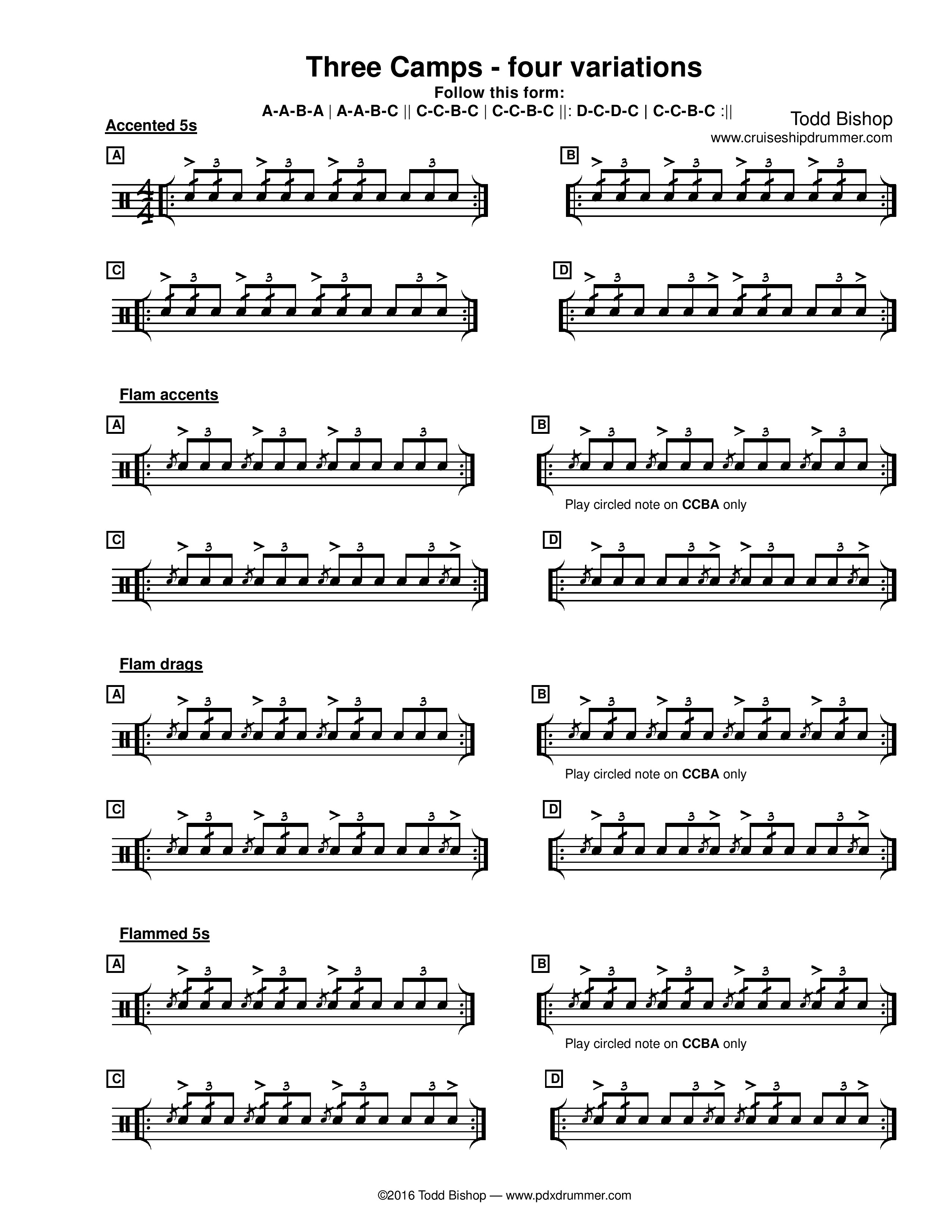
Three camps: four variations

Four alternative ways of playing the rudimental piece Three Camps, that I'm practicing this week, accented 5 stroke rolls, flam accents, flam drags, and flammed 5s.  


Learn each measure individually, then play them in the form given at the top of the page. Chop out. 

Get the pdf

Tuesday, March 21, 2023

EZ Fast Rock Lesson

This page functions both as a page of easy stuff for beginners, and as basic vocabulary for fast-tempo rock drumming. There are a lot of patterns, deliberately. This'll be many students' first shot at processing a lot of stuff quickly. 


Like it says, learn the page, then combine patterns to make two measure phrases. Probably obvious groove patterns (like 1-2, 4-5, 10-11) are best to have as the first measure, and fill-like patterns are best for the second measure. Use the ride cymbal half the time, don't just hang out on the hihat all day. 26-27 want to be up on the top cymbals— the ride and crash— they're slightly awkward coming off the hihat. 

19-23 are all in aid of doing a one-beat 16th note fill, so observe the sticking on 19-20. 

Get the pdf