Showing posts with label Elvin's afro-waltz. Show all posts

Wednesday, July 10, 2024

Jazz waltz telephone - 01

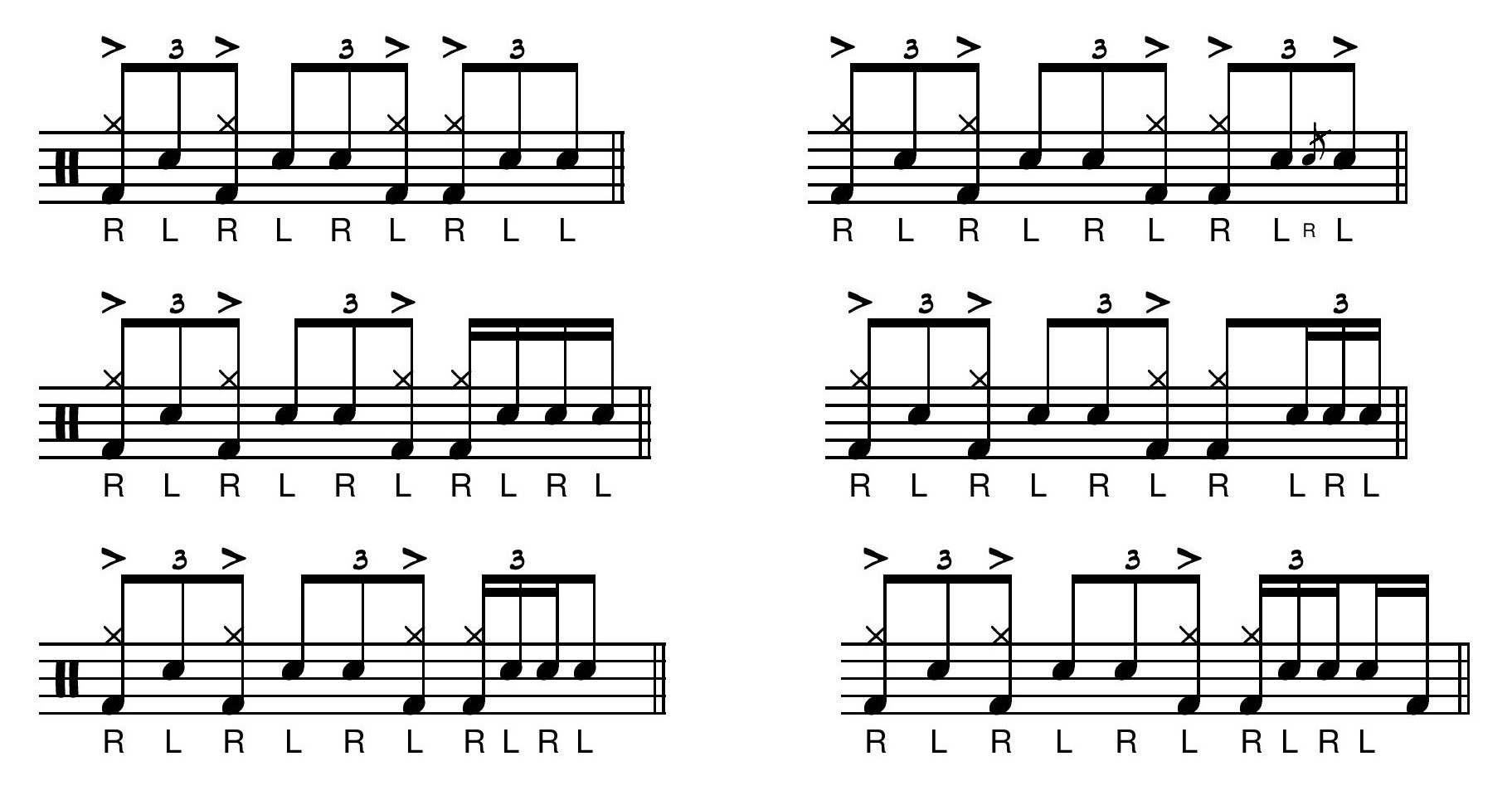
This is a writing experiment, starting with a jazz waltz cymbal rhythm with triplets filled in, changing one note per measure— or two notes. The cymbal rhythm stays the same, and bass drum is added, but no hihat. Everything here is handled in different materials already, I just like coming at things from different angles. This will be useful for at least one student of mine.


Play one measure at a time, then complete lines, then the full page. You could also alternate measures, say, the first measure of line 1 combined with every other measure on the page. Pencil in hihat rhythms if you want. 

UPDATE: This is actually good. This is what anybody should be playing when they sit down to do this kind of thing, and for about the amount of time it plays through the page, playing around with each measure a little bit. The hidden thing with all the one measure drum patterns out there is that you're supposed to play it for a long time, and make some variations on it. So materials that trick you into doing those things = good.    

Get the pdf

Sunday, March 17, 2024

Elvinized Mozambique

An item I was working out with a student— making an Elvin Jones-like Latin groove/texture out of a Mozambique rhythm, for medium tempos, with swing 8th notes. It's an entry, just the first, most obvious things I could think of for taking the groove that direction. 


Swing the 8ths on everything here. At the top of the page is a Mozambique bell rhythm written Syncopation-style, then some basic left hand variations, which you can move around the drums however you like.

Then there is the bell rhythm written out as RH lead triplets— RH plays the complete cymbal part, LH plays the complete snare part. Which you can play as a fill at the end of the groove— note the circled bass drum notes on patterns 6-9, play them with those notes, and without them. As illustrated, you can end the fill with a cymbal/BD accent on 1, or on the end of beat 4.  

With item 10, as it says, play the hand parts with one, some, or all of the written bass drum notes. Try some combinations. We'll explore that more fully in another installment. 

Sunday, February 18, 2024

Groove o' the day: Elvin waltz by Kenny Washington

Here's Kenny Washington playing an Elvin Jones-type of waltz groove on Simple Waltz, on Clark Terry's 1991 record Live at the Village Gate. It's kind of an obscure item now, I bought the record then to check out some Kenny Washington. I used to play along with it a lot. 

It's actually really Elvin like, though Washington has a different way of playing time from him— and sound, and touch. See my groove o' the day and transcription of John Coltrane's Your Lady. There's also a page o' coordination based on it. 


On the intro he plays the ties, when the band comes in he plays the straight cymbal rhythm as written, no ties. 

Tuesday, May 09, 2023

Reed tweak: alternating triplets in 3

This came up while I was practicing out of my book, Syncopation in 3. An extremely ordinary practice system used with Syncopation is to a) swing the top line rhythm, b) fill in the remaining triplets softly, and c) play the whole thing with an alternating sticking. For example: 

a) Book rhythm: 


b) That rhythm swung: 


c) Triplets filled in, played with alternating sticking: 


Using this on the drumset, there's some value to being able to consistently land with the right hand on 1— it takes a little extra attention to land on the left. With alternating triplets, your right hand lands on a downbeat every two beats— your hands are telling you you're playing in 2.    

So, following are some ways of always landing with the right hand on 1, some of which I've been doing for years, without thinking about it— it only just now occurred to me to write it down. We get into some cool Elvin-like stuff here. 

Playing book rhythms that have a quarter note on the third beat, like the one above, there are a number of interesting options— I'll write it out for drum set, playing the accents on the cymbals, with bass drum in unison: 


Typo alert: I left off the accents on some of the cymbal hits on 3. Accent all the cymbal notes, or don't.

Some of those work better than others, depending on what's happening on the 1 when you repeat, or in the next measure, if you're reading the full page syncopation exercises. 

If the book rhythm ends with an 8th note on the & of 3, it's simpler— just don't hit the cymbal on that note, but do play the bass drum. So these two rhythms: 


Would be played: 


And you can take that a little further with some Elvin type things: 


You have to take a loose attitude about all of this stuff— the goal is not always to do a pristine rendering of the system, it's to make something musical out of it that is personal to you.

Monday, May 08, 2023

WSRHWL addendum!

A couple of pages to go with my wild, sprawling, scattershot world's shortest Roy Haynes waltz lesson. That contains a lot of raw concepts for someone who is listening to a lot of Roy Haynes to come up with their own version of his kind of thing, in 3/4 time. Or a 3/4 feel in 4/4 time. 

Here I've given some sticking patterns, put them on a cymbal and snare drum, and then changed them a little bit: 


Like a lot of my stuff, the point is to work through a lot of basically equally-difficult things in one session. See the original WSRHWL for suggestions on where to take these. Briefly: 

•  Add stock rhythms with the feet: BD on 1, HH on 2, or 2 and 3
•  Add BD along with some or all of the cymbal notes. 


There are some more advanced options involving the left foot:

• Play the LF in unison with the LH, or replacing the LH, or replacing the LH on some notes. 
• Along with whatever you do with the LF, add BD along with some or all of the cymbal notes.   


Some things to try. Listen to a lot of Roy and play them your own way, and don't stop for mistakes.    

Get the pdf

Saturday, December 03, 2022

Page o' coordination: Juju

I'm transcribing a little bit of Elvin Jones's playing on the Wayne Shorter tune Juju, which I originally did off the LP around 1988. It'll take some time to finish it, so here's a page developing the main groove from it— a version of the thing I've been calling an “Afro waltz.” Most people would probably say “Elvin waltz.”

Slightly different format from the usual POCs, exercises 1-10 build the particular groove Elvin played on the recording, and have specific drums assigned, including some changes to the bass drum rhythm. Exercises 11-18 have other left hand rhythms for basic fluency. 


Swing the 8th notes. Practice with and without the tie on the cymbal rhythm in the first measure. On exercises 11-18 you can do the stock left hand moves I use with these pages. 

Get the pdf

Here's the tune, it's a record you should know well:

Monday, January 31, 2022

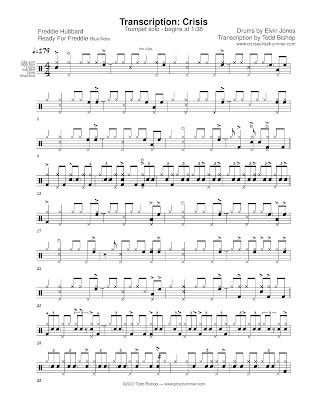
Transcription: Elvin Jones - Crisis

Does the site need another Elvin Jones transcription? I don't know. I'm just putting in my devotional time listening very closely to Elvin. What you all do with it is up to you. 

This is his playing behind Freddie Hubbard's solo on the tune Crisis, from Hubbard's album Ready For Freddie. Form is 56 bars, AABA— A sections are 12+4 bars of Latin alternating with swing; the B section swings for 8 bars. Funnily enough, the tune is rather similar to my tune Headlights, and Jorge Rossy's identical tune Post-Catholic Waltz. 

The transcription begins at 1:38, tempo is quarter note = 179. The action really starts happening on the tenor solo— maybe I'll do that another time. He also plays a good drum solo. 


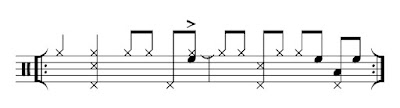
Here's the basic form of the Latin groove, played with a light swing feel. Those 8th notes on the toms are played with both hands— LRL sticking: 


On the third page he plays this three-beat triplet figure in basically textbook form: 


This is a free download— I am starting to ask for a donation for the more substantial downloads. If you feel like throwing in a few dollars: 

Venmo: @todd-bishop-16
PayPal: toddbishop@[cruiseshipdrummer dot com]

If you like what I'm doing, and want to contribute on an ongoing basis, you can do that through Patreon or one of the other services.

Get the pdf

Tuesday, January 18, 2022

Groove o' the day: Jack Dejohnette - Soft Blue

Another item from Jack Dejohnette, playing on Jackie McLean's album Jackknife— Dejohnette's first major recording, made when he was 24 years old. We've seen a couple of other things from this album, a groove o' the day and a longer transcription. His playing on it is very interesting— like the previous GOTD, he's playing an Elvin-like groove, very repetitively. At this point when everyone is letting it all hang out, he virtually never deviates from the exact pattern below. A curious decision on a jazz record— I guess they wanted to make an instrumental single out of it, a la Lee Morgan:


He does add another tom hit on the & of 3 of the first measure, occasionally. And there are some very small variations in the cymbal occasionally. He plays the little ensemble figure on the head exactly, on the snare and cymbal, with no embellishment. If there are any fills at all I missed them. He handles dynamics very sensitively. 

Saturday, October 30, 2021

Page o' coordination: basic triplet texture in 3/4

Same deal as the recent triplet texture in 4/4 page, done in 3/4. A simple linear triplet pattern with added bass drum variations. I already did this with a student, looking at the page in 4— we just ignored beat 4. Similar to the other thing we did recently putting Chapin in 5 by repeating beat 1 at the end of the measure. Both of them work surprisingly well. It's an easy way of adapting your normal jazz materials into other meters. 

Here I've rewritten the bass drum parts to put them in a more logical order for 3/4: 


Play them through, and have fun. This is an easy way to get novice students into an Elvin Jones type of texture. Try playing them along with my All Blues loop when you're ready. 

Get the pdf

Thursday, September 03, 2020

Roy Haynes waltz lesson - practice suggestions

So, I wrote that Roy Haynes waltz lesson in about ten minutes— I just listened to the tune and picked out the most obvious possible ways to cop the basic thing he's doing there. And since I titled it WORLD'S SHORTEST ROY HAYNES WALTZ LESSON, one could get the impression that it's something you can learn to do quickly. Not so! Just playing through the things on the page takes some time, then you have to learn to improvise a texture from those ideas. When I sit down with something like that I inevitably do a lot more with each thing.

On this page we'll look at the first pattern for that lesson, and run through some of the things I play when I practice it. I do as many of these as I can on the fly, but a few of them I would need to see written down. Not all of these are suited for the tempo on the Chick Corea recording— not right away, anyway.


I would also play the bass drum one note per measure, on every single note of the cymbal rhythm, especially if trying to cop the Roy thing. There's only so much you can put on one page. You can add the hihat on beat 2 and/or the bass drum on beat 1 wherever you like. Swing the 8th notes.

Continue thusly with the other sticking patterns on the lesson page. I hope everybody knows you have to find your own groove with these things— you speed through some things, and work longer on the ones that are harder for you, or that have a lot of creative and musical possibilities for you. That goes for everything else on the site and everything else in drumming. No written materials anywhere are a linear map for getting good. 

Get the pdf

Wednesday, April 08, 2020

Page o' coordination: Olé - 01

A Portland jazz educator asked me about what Elvin Jones was doing on the tune Olé, by John Coltrane, so I wrote this up. He plays a few different major patterns, and this might be the easiest one— and I've simplified it a little bit.


There are a couple of different options with the bass drum; you can eliminate the circled note, and/or add bass drum on 2 or the & of 2 in the first measure. Or, hell, you could eliminate the bass drum altogether while you get the hands happening. You could also pencil in a hihat on 3 in the second measure if you want. He often plays it on 2 in the first measure and 2 and 3 in the second measure.

Do my stock left hand moves. With this Elvin type thing, maybe play the snare drum hits as rim clicks.

Get the pdf

Friday, February 07, 2020

Listening to Keith Copeland

Let's listen some more. This is Charlie Rouse playing After the Morning, a tune in 3/4 by John Hicks. The great Keith Copeland, who left us too soon, is on drums. This is normal modern, mainstream jazz drumming to me— having obviously assimilated a lot of developments since Philly Joe Jones's day.

It was recorded in 1981, and the drum sound is quite dated now: there's a 20", non-tonal bass drum, and a wet, Steve Gaddish snare drum sound. Drum sounds today are very cute in comparison. And Copeland is playing with a somewhat Gadd like energy, very deep in the pocket. It's a sound and feel I associate with people who have also played a lot of R&B— with a lot of bottom. There is a lot of activity with the bass drum and snare drum, and they really drive the groove. A lot of what he plays you would get by doing normal jazz triplet methods with my book Syncopation in 3/4.  For the most part he's keeping a straight waltz rhythm happening with the cymbal and hihats. It's kind of an exceptional level of independence, given how expressive he is with the two drums. In my listening, I feel like most players don't bother with it.

The tune has strong harmonic motion, and he's largely playing in support of that. It's a good example of playing actively but not intrusively. He does interact with the soloists, but when his rhythms line up with them, he doesn't do the obvious college student thing of continuing it and making a big climax out of it. He lets the parts diverge, and finishes the phrase differently. And he doesn't obviously jump on the soloists' rhythms to begin with.


Courtesty of Daron in the comments, here's another great version of this tune, played by Hicks, Cecil McBee, and Elvin Jones.

Friday, July 26, 2019

Groove o' the day: Chico Hamilton waltz

Here's Chico Hamilton playing his version of an Elvin-type waltz in 1962. I've always assumed it was Elvin's thing, that everybody else was copying. Maybe it was a type of groove everyone hip was doing, and Elvin just did it best. Chico Hamilton was an LA player who was not particularly highly thought of as a drummer, but he was a successful bandleader and had a lot of high profile people pass through his group in the 50s and 60s.

This is from the first section of the tune Lady Gabor, from the album Passin' Thru. I found this in my dad's record collection, and was surprised to meet the trombonist on it, George Bohanon, in the jazz department at USC. George was a grad student at SC when I was there, about 25 years after this recording.


Swing the 8th notes. That third tom tom note on beat 1 of the second measure happens occasionally; often he plays it almost inaudibly. Hamilton plays this pretty repetitively.


Monday, October 29, 2018

Page o' coordination: basic jazz waltz - 01

After doing this feature for about five years, I finally get around to doing a basic jazz waltz. Doing easy stuff wasn't supposed to be its purpose, but it's a familiar format, and not everyone has the time to laboriously go through Syncopation in 3/4 and work out all the coordination on the fly— the preferred method.

This is not necessarily a page of “comping ideas”; it's for learning basic coordination, so you can do the normal learning process more easily— listening to records, playing with people, getting ideas into your ears, then playing them.


This is a jazz feel, so swing the 8th notes. Learn all of the exercises as written, then learn them again omitting the circled bass drum note. Once you can play all the patterns, you can continue practicing them while doing some stock left hand moves. Try playing it with this loop.

Get the pdf

Monday, October 08, 2018

Page o' coordination: RLH in 3

Slightly different format for a Page o'coordination. Usually we have an ostinato with a variable left hand part; here the cymbal part and bass drum part change. This is sort of an appendix to some things we did with the Elvin-style waltz in 2012, with a dotted quarter note cymbal rhythm— we're filling in some coordination gaps, setting the stage for being able to improvise better.


Try this Eddie Palmieri loop to do this page with straight 8ths (that's in 6/8, but it's easy to count the bass line in 3), or this Miles Davis loop to play it swing. You could also use this Jimmy Garrison loop. Play all of the bass drum parts with patterns 1-8. Do the left hand tom moves if you have some time to kill— it's a long page of stuff even without that.

Get the pdf

Friday, October 05, 2018

Groove o' the day: Jack Dejohnette - On the Nile

Here's Jack Dejohnette early in his career, soon after his move from Chicago to New York. He's playing in a very Elvin Jones-like mode with Jackie McLean, who is himself writing in a Coltrane Quartet-like mode. The tune is On The Nile, from the record Jack Knife.

This is the groove from the head of the tune. Swing the 8th notes. 


He plays this on the solo vamp:


He plays these grooves pretty repetitively throughout, which is interesting. For some reason it reminds me of Robert Rauschenberg's Factum I and Factum II, where the famously freewheeling painter made two identical pictures. On the solo vamp Dejohnette sometimes plays 16th notes a la Elvin in the second measure—just double the middle note of the triplet and spread it all out to make legato 16th notes.


Wednesday, August 01, 2018

Page o' coordination: jazz waltz with feet in unison - syncopated

I realized while running through these other recent jazz waltz POCs with the syncopated polyrhythmic thing in the feet, these things are kind of hard, actually! So I wrote up this page, that's a little easier, using a similar idea. The feet are in unison with each other, which I think is something we should all do more of. Be more non-independent. Ed Blackwell did a lot of that, as did John Guerin.

There are a ton of these POCs now, most of them covering the same little batch of vocabulary, in a slightly different way. We're trying to create more available options for when you go on the gig and wing it. I certainly never approach these things like I'm going to memorize them and then try to barf them up verbatim when I'm playing. 


I think you should play your left foot heel-down. You'll have more freedom, and you'll have a more relaxed, detached posture at the drums, which is good. You can splash all of the hihat notes, or just the last one, or just the first one. Just the middle one if you're a real weirdo. Do my left hand moves if you wish.

Get the pdf

Sunday, July 22, 2018

Practice loop in 6/4: Greensleeves

Practice loop in 6/4, sampled from Greensleeves, recorded by John Coltrane on the album Africa/Brass. Here we just have the bass line played by Jimmy Garrison. Tempo is 142 bpm.

Garrison is phrasing the 6/4 as 2+2+2/4, but you can do all of my Elvin Jones-type stuff in 3 with this. This “figure control” page based on Stereolab's Free Design actually uses a very similar rhythm to what Garrison is playing here, just add a swing interpretation. Also see my other stuff in 6/4.


Monday, July 16, 2018

Page o' coordination: jazz waltz with syncopated 4:3 - 02

Here's a variation on the last jazz waltz POC we did, which has a syncopated 4:3 polyrhythm in the feet. Here the bass drum plays dotted quarter notes, and the hihat plays half notes, starting on the & of 2. The polyrhythm isn't actually important. This is more about developing some left hand/left foot independence within a normal modern jazz waltz feel, which will often have a strong dotted quarter note pulse throughout. The other page did something similar with the bass drum, vs. an Elvin-like hihat rhythm I use a lot

I've said before: once you do a few of these pages in a given style, you've kind of got the style covered. And you've learned most of what this format has to teach you; the more pages you do, the smaller the thing you're actually gaining in your playing. It's probably a good sign for your playing if you start practicing yet another one of these things, and it starts feeling somewhat redundant.


Swing the 8th notes. I don't feel it's as important to do all the left hand moves with some of the jazz waltz pages, but here's a fresh link to them if you want to do them. Move to a different drum on every note (or two notes, where there are doubles), according to the patterns at that link.

Get the pdf

Friday, June 15, 2018

Page o' coordination: jazz waltz with syncopated 4:3

Here's a jazz waltz page o' coordination with a syncopated polyrhythm in the feet— if you must know, a 4:3 polyrhythm in half notes and dotted quarter notes, starting on the & of 3 of the second measure. The math doesn't matter. Think of it as an Elvin Jones-style waltz rhythm with the bass drum phrased in half notes:


Swing the 8th notes. Page o' coordination methodology says you learn the ostinato at the top of the page, then learn the sixteen exercises, playing each exercise many times. Start by playing the left hand on the snare drum, then move it around the drums.

You could also play an open sound with the hihat on the note with both feet in the second measure of the ostinato:


Get the pdf