Showing posts with label paradiddle-diddles. Show all posts

Saturday, August 26, 2023

Bishopdiddles

Minor item, corralling some similar sticking ideas that have been floating around the site. I noticed that with paradiddle-like stickings, I like inverting them so the double is up front, right after the first accent. These all follow that pattern:   


DISCLAIMER: I don't want to mislead anyone with that BISHOPDIDDLES™© headline— I obviously didn't invent the RLLR-LRRL paradiddle inversion. The George Lawrence Stone estate would be working me over in court right now if I made that claim. My God. Or that RLLRRL sticking. The other two probably exist in some book somewhere*, but I got them from my own usage. 

* - I see now they're in Rudimental Swing Solos, with accents on the double, for some reason. 

 
So there they are as a single group of patterns. You can see them applied in this cool Reed system

Why do do this? When improvising with them on the drum set, you can hear the natural accents of the sticking, and they affect the way you can move around the drums. That's fine with me, it's natural texture, it's what I want. 

The double and triple paradiddles start with these strong singles, and end weakly with a double. They die at the end. However strongly you play the double, that's the structure of those patterns. 

With my wonderful stickings, the double slipstreams behind the starting accent— naturally a long sound— and the pattern finishes strongly, with singles: diga-diga-POW. If we accent all the leading singles, you can see how the natural momentum goes with each one:


I generally only use the double/triple paradiddle inversions once at a time, but they have some very interesting possibilities, I'll be writing some ways of doing them continuously. 

Get the pdf

Tuesday, April 11, 2023

Reed tweak: yet another uptempo method

Minor tweak to an ordinary right hand lead Reed system, making an approach to playing jazz at fast tempos. I've probably written something like this before, I can't be bothered to check. This way has some stages so people can tailor it to their current level of development. Hopefully between the different systems I've shared, people will have some tactics for approaching this difficult area better than just brute force “play your bop stuff really, really fast.”

For the examples we'll use this rhythm from Syncopation, p. 34: 


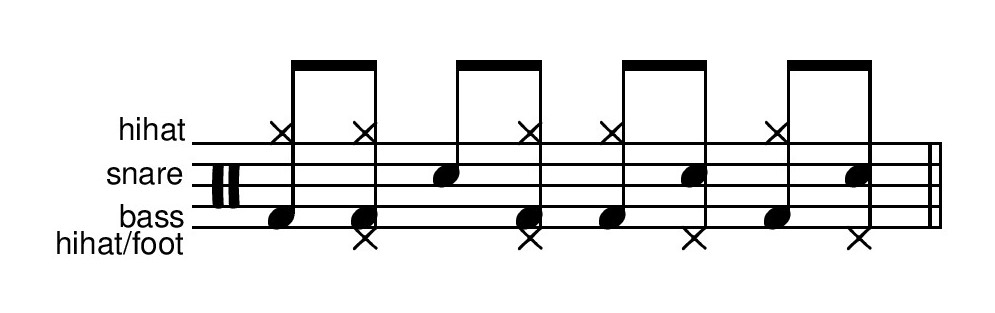
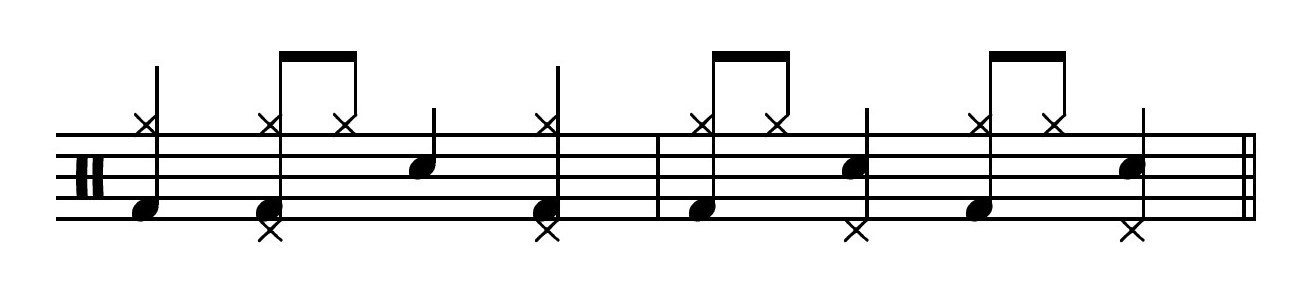
Play a straight 8th right hand lead interpretation— play the rhythm on the cymbal, with bass drum in unison, fill in the spaces with the left hand on the snare drum. Add hihat with the foot on the &s: 


Then you can then double the last of any run of 8th note spaced notes on the cymbal: 


Note that we're making the jazz time as a double time feel, implying this two measure phrase in a fast 4:


I recommend spending of time with just that, at increasing tempos, and not going straight for the following denser options. But from there you could double any single left hand notes (which is all of them, in this example):


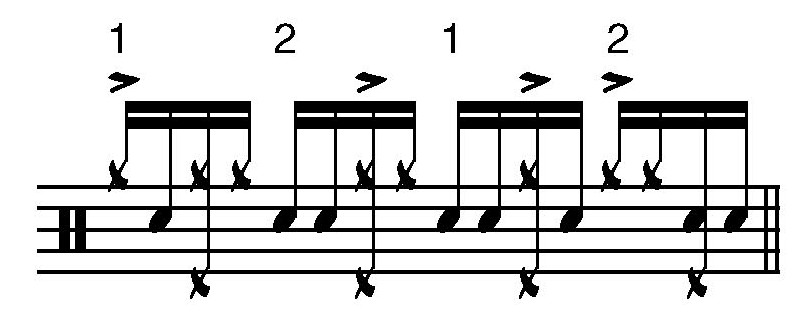
From there you could fill in any remaining 16th notes— notice that the hands are doing a paradiddle diddle sticking here: 


Here we're playing the RH doubles on the bass drum as well, and taking away the single notes: 


Or you could take way the bass drum altogether. Try some different things. 

I don't know how useful it would be to play the full page exercises this way. Not all the one line rhythms in Reed will work equally well as actual playing texture— consider them more as calisthenic drills than literal playing vocabulary. Actual tempos for the above could be 120-200, making implied tempos of 240-400 bpm. 

Sunday, February 26, 2023

Paradiddle-diddle game

Everybody Good Knows The Same Stuff, Part 1000:

Another handout from a clinic Russ Tincher at UC Berkeley in 1989— I confirmed that's where it was from. Here he shows how to interpret triplets with Reed or Bellson, and details a practice system for it, based on paradiddle-diddles. Or six stroke rolls, more accurately— that terminology wasn't universal then.  


In John Ramsay's Alan Dawson book there's a similar system he calls “Ruff bossa.” The only difference is in how you interpret a (written) beat of 8th notes. Dawson plays them as alternating swing 8th notes, without filling in the triplet: 


Tincher fills in the triplet, and plays it with an alternating sticking, which you see in the first example below. With certain rhythms that may take the system in a different direction, so it leads with the left hand a good part of the time. With Dawson's system the lead is very consistent, with a simple alternating motion no matter what you're reading. 


This system is probably best for using with the first couple of pages of Bellson, which has just quarter notes and offbeat 8th notes only, but we'll see, I'll play around with it when I have some time to practice. 

Wednesday, September 23, 2020

Double-paradiddle / paradiddle-diddle inversions - linear, all on one page

I wrote this up for myself, maybe you'll use it, too. These are the 6/8 linear versions of the double paradiddle and paradiddle-diddle inversions page, written for snare drum and bass drum— that's easier for me to read for what I'm doing with them. Doing lots of triplets lately.


I've written the accents just to show where the inverted rudiment begins. You don't need to play the accent. I'm using these as independence patterns along with a jazz cymbal rhythm. Also playing them with the hands in unison— snare and cymbal, two drums, or flams on one drum. And playing with cymbal added on the bass drum notes. If you play these with the measures reversed, and play each measure of 6/8 individually, that adds up to a pretty complete unit of triplet patterns for jazz.

Get the pdf

Wednesday, September 16, 2020

Paradiddle-diddle inversions

Remember that page of double paradiddle inversions I wrote back in April? April 2020. Or, ~198,000 United States COVID deaths ago, for those of you who have abandoned calendars and moved over to a death-count based time scale.   

....

Anyhoo, I like that double paradiddle page, and I always keep it close at hand in my pile of practice materials. Here I've done the same thing with alternating paradiddle-diddles— writing them as 8th notes in 6/8, as a two-voice linear pattern, and as a rhythm (based on the right hand part) in 3/4. Doing them alternating makes the inversions a little more interesting, and also has us doing three notes in a row on each hand or part.


The accent on linear version is just so you can see where the inverted pattern begins— usually I would accent the right hand, and vary the accents with the left hand. The linear version is written as RH/cymbal-LH/snare, but you can play it on any two limbs/sounds. See the practice suggestions on the second page of the pdf.

Get the pdf

Sunday, March 31, 2019

Three Camps in paradiddle-diddles

For such a simple piece, Three Camps sure is a notation headache. There's next to nothing happening in it, but it takes a whole lot of ink to write it out, and it never looks very good.

Here it is with sixtuplet paradiddle-diddles as the main thing. There are three things in it: 1. accented paradiddle-diddles, 2. unaccented paradiddle-diddles, 3. a single paradiddle ending in a left hand accent. And 4. an ending— I've adapted the traditional ending, rather than the long fp roll I usually do.


Play it many times as written, and with the stickings reversed, starting with the left hand. Don't be confused by the abbreviated notation I've used— those are just more accented paradiddle-diddles in a sixtuplet rhythm.

Get the pdf

Thursday, July 23, 2015

Paradiddle exercises in 7/8

UPDATE: Man, I am getting sloppy. There were a bunch of typos and duplicate exercises in the original pdf— I've updated it, and included some accent variations in the triple paradiddle exercises. 

Hey, breaking our little dry spell, here's something to go with our last set of stuff in 7/8— some paradiddle exercises, using a variety of inversions and variations:


On the RLLR/LRRL inversions you can lose either of the accents for each beat— practice them with both accents, without the second accent, and without the first accent. Moving these to the drumset, you can play every 1 on the cymbal together with the bass drum; or play all the accents on a cymbal with the bass drum; or play the RH on the cymbal or hihat and the LH on the snare, with the bass drum in unison with some or all of the RH notes.

Get the pdf

Wednesday, March 26, 2014

CSD! listicle: seven useful rudiments

People always seem to want to know what's the deal with rudiments, what do you use them for, and which ones are the best, coolest, most valuable. So here I'll just shotgun some of my favorites:


Four-stroke ruff
Just a super-useful embellishment. Indispensable when playing brushes. A proper, classically-executed 4SR is three very soft grace notes and a main note, played as tight as you can make them— it should not sound like a rhythm. On the drums we have more freedom with them. You can also do them rock & roll style, and make a 16th note triplet out of them, a la Neil Peart. And you can put them around the drums to make a lick that was very popular in the early 70's.


Six-stroke roll

Either 16th note or sixtuplet form. Hip, and fun to play. Steve Gadd plays them a lot, as does Dave Weckl.

Here's how they are played, and how they are usually written in 16th note pulsation form— a Stewart Copeland-like thing is to play these on the hihat:


Paradiddles — first inversion

It's just a hip rudiment. It's all over this performance, which basically defined modern fusion drumming— just move your right hand to the cymbal or hihat, and add bass drum. You can also mix up the accents between the two single notes. Useful for sambas.


Flamacue

This very old-fashioned rudimental flourish happens to be very good for getting your shuffles together.

Continued after the break:

Thursday, July 11, 2013

Paradiddle-diddle variations, for jazz

Hey, we haven't done anything for the snare drum in awhile— in my own practicing I've been preoccupied with Dahlgren & Fine's Accent On Accents books, and Buster Bailey's Wrist Twisters, and my students are doing other things. But a Drummerworld forum member requested some snare drum exercises suitable for developing jazz coordination, so here we are. Paradiddle-diddles are extremely well-suited to this task, since playing them with your right hand on a cymbal makes the standard jazz ride pattern, with the left hand filling out the triplets on the snare drum. Varying the accents and adding flams will develop some left hand chops, while exploring some different ride interpretations with the right.


Only the right hand lead form is given, because the goal is to turn this directly into a jazz coordination pattern; but do them left hand lead, too. When playing them as triplets on the drumset, you can also play the bass drum lightly on all four beats, or on 1 and 3.

Get the pdf

Wednesday, April 10, 2013

From the zone: Vinnie's paradiddle-diddles

With this next entry we've got dueling fusion-era paradiddle-diddle licks, this time by Vinnie Colaiuta. This was sent in by fellow blogger Mark Feldman, who transcribed it back in the day from the 1987 Zildjian Day video— I haven't been able to find it on YouTube, but maybe if Mark is reading he can get us a link and time of the lick in the comments.


More iterations of this lick after the break:

Wednesday, March 20, 2013

From the zone: Weckl's paradiddle-diddles

It took awhile, but I finally stumbled across some old scribbled-out exercises conceivably worth sharing as part of this from the zone series. So far the only person brave enough to submit anything has been Marco from the Netherlands— and he sent me a few more cool things I'll be sharing soon. So, once again, if you have any hard, weird, scribbled-out relics of your personal woodshed time, I invite you to hastily scan them, or take a digital photo of them, and send them in. That they look like hell is kind of the point, so don't worry about your penmanship. I can even share them anonymously if you're embarrassed to ever have conceived of such a thing.

I think this is from about 1987, scribbled in the margin of Vol. III of Gary Chaffee's Patterns. It's a thing I call (starting now) Weckl's paradiddle-diddles, with some variations. There's probably at least equal justification for calling it Gadd's or Elvin's or somebody else's paradiddle-diddles, but I got it from Dave Weckl. It's a RLRRLL pattern, beginning with two accents, with the final left hand double played on the bass drum. Some of the variations put the left hand accent before the right, or put the bass drum double right after the accents, but the basic idea is the same:


This came up when I was transcribing a bunch of stuff with Weckl on it— Why Not? by Michel Camilo, Gdansk by Paquito d'Rivera, whatever else I could get my hands on— and it turned up a lot. He really seemed to favor the first two: RLRRBB and especially RLLBBL, which he would play RLLBBR-L, ending with a left hand accent on the snare drum or tom. It occurs here at 0:28 and several times after 0:44:


Friday, September 21, 2012

Rudimental Reed: paradiddles

Another entry in our “Rudimental Reed” series, in which we outline some methods for apply rudiments to the long exercises in Ted Reed's Syncopation, this time using paradiddles. Here's that well-known opening line from the first long syncopation exercise in Reed, p. 37 in the old editions, as written:


First, play the quarter notes (or the equivalent) as 16th note paradiddles. On the longer values/rests, play a paradiddle with an unaccented ending note, as on beat three of the second and last measures:


Next, apply an appropriate paradiddle-type sticking to the longer values/spaces— double paradiddles / paradiddle-diddles, or triple paradiddles / paradiddle-diddle, diddles as I'll call them (there aren't enough commas in rudiment names for my taste) since that rudiment doesn't exist to my knowledge. I chose the latter rudiments:


With that last, we arrive at something pretty similar to an interpretation in Ramsay's Alan Dawson book; the one additional step there is to play the 8th notes as two alternating 16th notes, with an accent on the first.

Another example after the break:

Tuesday, March 13, 2012

Six stroke rolls around the drums

I'm just cranking them out today. I've been using the last paradiddles around the drums thing so much I decided to write up something similar using another familiar solo pattern, the six stroke roll (as it's often called) in a sixtuplet rhythm: RLLRRL. What they really are is a paradiddle-diddle inversion. I've written them in 6/8, but you can play them in 2/4 as sixtuplets, or as 16ths in 3/4, giving a 6/8 feel, or as 16ths in 4/4, for a meter-within-meter thing. Or as triplets within a fast 4/4. I'll write up an outline of the possibilities when I have the time. This rudiment is usually played with accents on the singles- I suggest playing these with and without them.

Refer to the paradiddles post for more ways of practicing these.

Oh, and go see Andrew @ the Melodic Drummer- he's put up some around-the-drums conditioners of his own.

Get the pdf

Tuesday, January 17, 2012

Paradiddle-diddle method for uptempo jazz

This is something I developed for both for getting some relief while playing fast tempos, and for doing a modern feel without getting your cymbal pattern lost in the weeds. The seed of the idea comes from Bob Moses (see "Non-independent method" in Drum Wisdom) and John Riley (see "Fast face-lift" in Jazz Drummer's Workshop). It's actually pretty straightforward, once you're able to read through this batch of syncopation exercises using the method outlined in the last post; first move your right hand to the ride cymbal, leaving the left on the snare, and add the hihat on the &s, with your foot:


We'll need to convert the 16th notes of the exercise to 8th notes, so one measure of 16ths becomes two measures of 8ths. If you can't do that instantly, start by counting 1-2-1-2 instead of 1-2-3-4:


Think of the 16th notes as 8th notes. Counting your fast tempos in a moderate 2 is actually preferable to counting a fast 4:


After the break I'll give a few options for the bass drum part.