Showing posts with label Ed Uribe. Show all posts

Wednesday, July 22, 2015

Best books: The Essence of Afro-Cuban Percussion & Drum Set by Ed Uribe

Buy the book
Leafing through a copy of Ed Uribe's book The Essence of Afro-Cuban Percussion & Drum Set, you may be inclined to Google Map the location of the nearest bridge, and then drive your car off it, with you and your drums in it. It's about 325 pages long, with a lot of verbiage, and a bewildering array of drumming and song styles, terms, and instruments you are supposed to learn; and including several practice regimens of hundreds of systems each. Early in the book is this not-very-encouraging passage:

[In Latin American music t]here is no glory, no media glitz, or peer respect in being a lightweight player— like there often is in American pop culture. In this type of drumming the more prevalent attitude is that there are those who can play and then there's everybody else. You either play or you don't, and if you don't, you have nothing to say. This is not meant to intimidate. It is merely a fact to accept. 

It's not meant to intimidate, but it is nevertheless intimidating music to take up, with some big scary issues for the uninitiated:

  • Clave. What is it, how do you play within it, what happens to you if you violate it? Do you die? 
  • A culture of correctness-oriented musicians (that's my experience with a lot of Anglo-American practitioners, anyway) combined with a dearth of hard information. In conversations about this music, you notice a lot of talk about right and wrong; mysterious terms and concepts which are nevertheless enforced for correctness. 
  • Apparently much more demanding independence than is required for other types of music. In playing this music on the drum set, we are combining percussion parts which were not originally intended to be played by one person. 
  • Usually these groups have a percussion section. As the drum set player, you are the non-traditional odd man, and you must adapt to a variety of possible instrumentations, avoiding duplicating the other players' parts, and filling in whatever parts are not present.

Uribe addresses these issues, and prescribes a very intense, decade-long program just for acquiring the materials he gives you in the book. Fortunately, for jazz drummers like me, it is possible to engage it with a level of commitment balanced with all of the other things we are doing in music, and still get something out of it. This music is actually played by human beings, not all of them insanely gifted Latin American gods, so becoming reasonably competent with it should be possible for anyone with a little talent, and a normal-serious level of commitment of time, interest, and dedication.

So, this is a very serious, big book, if I haven't communicated that yet. Fortunately, you can algebra away quite a bit of it; there is a lot of redundancy— the same pieces of information may occur in multiple sections, which insures that you don't miss the really important things in the extremely likely event you are unable to ingest the book whole. There is also a lot of overlap in the drumming for different song styles— the basic Mambo and Cha Cha approaches, for example, each apply to several styles. And there are a number of obscure or folkloric styles you will probably will never be asked to play, which you can treat as optional— Cha Cha Lokua Fun, Abakwa (which is actually a hip thing to work on). If you stay based in reality somewhat— like, what am I listening to, and who is playing this music locally that I might be asked to play with— you can prioritize what you need to work on.

Like Uribe's other great book, The Essence of Brazilian Percussion & Drum Set, this book has the style of a professional field manual. He lets you know what is expected from you on a professional gig, and where you have some freedom, vs. where you need to play the parts. Playing through his practice systems you begin to develop some freedom within the complex coordination, and you are able to reorchestrate the parts and do variations without having the whole groove fall apart. There are two long chapters on clave, which gets into the finer points of what it is, and supports you in learning to trust your ears in finding it. Through all of this, you begin to find the special mindset of playing this music on the drumset, which is different from anything else in drumming.

I'm not a well-enough educated Salsa/Cuban music player to have serious criticisms about its correctness; as someone who knows how to be a student, I have one or two small reservations, or just open questions after having spent a year or two with it. But a book is not supposed to tell you everything, though, nor can it; nor is it supposed to replace interaction with human beings, so this is my fault for learning this music just through books and recordings, and a few gigs. It was obviously a huge feat putting together a volume of this size and completeness, and it's the best practical resource I've yet seen for approaching this very demanding field of music.

Wednesday, September 18, 2013

Page of Mozambique — UPDATED

I've been working with our earlier page of Mozambique quite a bit (yes, I do in fact practice the non-transcription stuff I post here), and thought it could use a bit of refining, so here we are. Mainly, I've included some bass drum variations, and made the order of practice a little clearer:


You can form a concise-to-substantial workout by combining all of the hand parts with all of the feet parts. Ed Uribe says you need to play the entire array of combinations with your right hand on the cymbal bell, and then the whole thing again with your RH on the cowbell, the hihat, and the shell or rim of the floor tom. That may seem excessive, but it certainly forces enough repetition that you will know the pattern. It will also develop your touch on each of those parts of the instrument— playing the shell of the floor tom is not the same as playing the bell of the cymbal.

That's a big workout, and you will have to prioritize at first. Once you've run each measure individually, and are ready to play them with hihat and bass drum together, learn the page thoroughly with just one hihat part, and one bass drum part. Then run the whole page with the same HH part, with each of the bass drum variations in turn. You might start introducing the hihat variations (there is one written, but five implied) at the same time as you are repeating all of the patterns with your RH playing the different sounds. I would put the lowest priority on playing the clave rhythms with your left foot.

Get the pdf

Friday, August 26, 2011

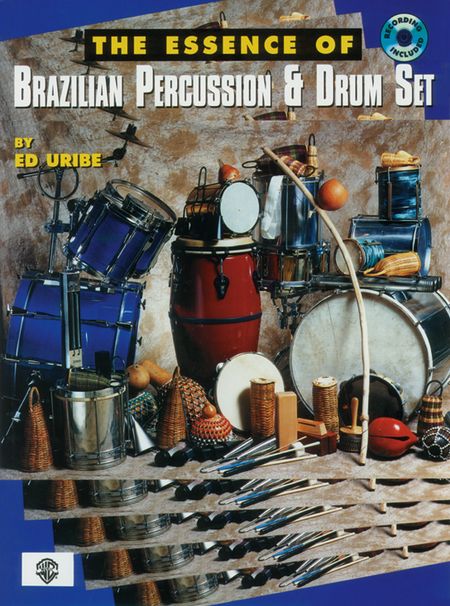
Best books: The Essence of Brazilian Percussion and Drum Set by Ed Uribe

The Essence of Brazilian Percussion and Drum Set is the little sister of Uribe's massive volume on Afro-Cuban percussion. I've been using it almost daily for several months now, and not only is it a model of what a genre book should be, it's quickly turning into one of my favorite drum books, period. It reads and operates- very appealingly- more like a professional manual than a typical drum book (Ralph Humphrey's Even in the Odds would be another one with that feeling about it).

In 144 pages it presents a huge amount of information in very concise, manageable chapters. In addition to practice material, there are sections with historical background of Brazilian music and history, notes on sound of the instruments, explanations of the various song styles, examples of rhythm section parts, and a very useful glossary. Styles covered include bossa nova (in 4, 5, 6, and 7/4), samba (in 2, 3, and 7, plus batucada-style, samba with brushes, samba cruzado) , baiao, samba marcha, partido alto, marcha and frevo, choro/chorinho, afoxe, and catarete. With a number of simple but very robust creative methods presented, it has an extremely open system, and I think no two players approaching it would come out sounding the same.

A large portion of the book is dedicated to introducing each of the common percussion instruments used in samba, which is important even if, like me, you aren't particularly interested in learning to play them all. They are the basis for each of the parts of the drum set grooves, and being familiar with them is one of the keys to playing creatively with any authenticity. That does seem to be Uribe's major point in including them- he does not give a lot of instruction on how to run or play in a bateria.

In some genre books, there is a fairly inescapable feeling that the user is an outsider to the music, and that a high degree of deference is expected. Rather than presenting the music in a folkloric manner, in which the music is more or less fixed, this book has improvisation at the core of its method; the music is presented as very much a living thing, and though not of the culture, the user is treated as a creator and participant.

One of my few reservations about it is that the unique Brazilian swing feel is handled imprecisely, with only general instructions that are maybe a bit misleading (or which at least require a demonstration)- the essence of Uribe's explanation is to slur the "a 1 e" of the repinicado rhythm, and "pull back a little on the time". As you can see from my posts on the subject, my philosophy is that, like with swing in jazz, it should be reduced to something quantifiable and reasonably close- from there it's a short leap for the player to get to an authentic feel through listening and playing. It's one of the most difficult subjects related to this music, so it's an easy shortcoming to forgive, but it would've been nice to see the usage and relationships between even 16ths, triplets, and "tripteenths"- all of which occur in Brazilian music- explored and explained more deeply.

But this is a great book- a true player's book. Highly recommended.

Tuesday, April 19, 2011

Method book round up: Brazilian drumming

As some of you may have noticed, I've been thinking a lot about Samba of late. And as my friend Blake Thomas, an expert cuica (not to mention caixa and zbumba) player has loaned me a few of his books on the subject, I thought this would be a good time to give an overview of some of them. So he we are- the good, the great, and the fine:

Brazilian Rhythms for Drumset. By Duduka da Fonseca and Bob Weiner.

This has become a modern classic- the first serious attempt at dealing with the style authentically; at least the first gaining widespread usage in the US. Includes robust text dealing with historical background, the percussion instruments, performance/practice notes, glossary and discography. Takes you through fifteen pages of batucada-style samba, with the hands on the snare drum and toms, mimicking caixa, tamborim and surdo, before getting to the more familiar (to Americans) cymbal and snare drum based style. Covers Samba, Bossa Nova, and Baiao thoroughly, with  shorter sections on Maracatu, Marcha and Frevo, and odd meters.

The presentation is a little haphazard; some concepts that could've been easily explained verbally are instead written out as exercises, many (but not all) exercises have a written stop at the end, for reasons that are not explained. I believe the text could've benefited from some aggressive editing- many explanations for exercises contain no more information than the title of the exercise. For example:
Exercise 13 Samba Cruzado - Variation #4 - With 16th-notes on hi-hat 
Is explained:
Try playing sixteenth-notes on the hi-hat instead of on the snare. 

It's a small thing, but that kind of sludgy build-up of text is a little bit of a distraction. The book offers excellent information, but also feels somewhat laborious to work through for these reasons. Nevertheless, it's an essential book every drummer interested in Brazilian music should own.

More after the break: