Showing posts with label salsa. Show all posts

Friday, November 03, 2023

Songo brushup

I have some dates coming up where I need to use a Songo-type groove (the chart says “samba”, but it's really not)— which I don't have to play that often, so I'm brushing up on it a bit, playing through a bunch of stuff: 


After learning the three complete grooves at the top of the page, start playing through the other possible combinations of cymbal rhythms, bass drum variations, left hand parts, and linear patterns. My recent rhythm page is good for this as well. 

Use the “subtractive” patterns at the bottom of the page to revoice rhythms from the book Syncopation to fit this style, playing the notes in the book on the snare drum or bass drum, corresponding with those patterns. I've settled on a kind of hybrid system for that— I play the complete bass drum rhythm whether it's sounding in the book rhythm or not. It's a little harder to read, but it works well. 

I'm doing all this with a couple of mp3 loops sampled from Eddie Palmieri, playing a Mozambique rhythm, on the tunes Bamboleate and Azucar Para Te. 

Get the pdf

Thursday, May 23, 2019

Filling a Mozambique

This is something I was working through with a student recently: filling during a Mozambique groove. Latin grooves need to be worked out more than other things, so it's a good idea to break it down substantially, so you can get back to the groove after the fill. Start by practicing these mostly non-repeating: play them one time, stop, and play them again. I've put all of the fills on the high tom tom in these examples; you can move them around however you like, vary the accents, play rim shots, embellish with flams or ruffs, use whatever sticking you like.

Here's the basic groove— for hands only. Learn to play it, if you haven't already:


There are a few key points: the & of 4 of the first measure, where we'll be breaking to get into the fill; the & of 1 of the second measure, where we'll be starting the fill; the 2 of the first measure, where we'll often be getting back into the groove pattern.

First, practice starting the groove on 2:


Then build a simple fill with alternating 8th notes, starting with two rights. Practice each of the following phrases repeating, then add two measures of the groove at the beginning, making a four measure phrase with the fill at the end. Note that the first four notes of the fill have the same rhythm and sticking as the second measure of the groove pattern: RRLR.


Then grab some rhythms from the book Syncopation, and play them as a lead-in to the groove pattern, accenting the last note of the syncopation rhythm— if possible with a cymbal in unison. If the fill ends with running 8th notes, just end it with a rim shot. Then come in with the groove on beat 2:


Then play some syncopation rhythms as a fill, with the complete context. Use rhythms that start with an 8th rest, and start the fill with your right hand. So these fills all start the same way as the previous one. Play the first measure of the groove, break on the & of 4, play the fill, accenting the last note as above, and come back in with the groove on beat 2:


I suggest practicing these last two things non-repeating; stop after a couple of measures of the groove at the end, and restart. You can easily use this same structure to practice hitting a bass drum/cymbal accent on beat 1 after the fill, which isn't that hip, but you will do it a lot.

Wednesday, May 01, 2019

Q&A: Cuban for jazz

I got a surprisingly tough question from a reader the other day:

What's a good book for playing Cuban styles in jazz?

Part of the difficulty with answering this is, what do we mean by Cuban styles in jazz? Unlike with Brazilian music, there aren't many tunes from the Cuban literature in the standard jazz repertoire. Some tunes have a Latin section as part of the stock arrangement (e.g, A Night In Tunisia), or are commonly played with alternating swing and Latin feels (e.g. The Night Has A Thousand Eyes, On Green Dolphin Street), or any tune can be played with a Latin feel— whatever that means to the players present. In normal Salsa arrangements, the entire thing is based on clave— the melody and arrangement rhythms, and the percussion and rhythm section parts. With the jazz tunes, there is usually no special effort to follow clave in the arrangement or accompaniment.

Without the clave element, we can't really say we're playing a Cuban style. What we're more doing is playing straight 8th tunes with a quasi-Latin flavor. What is done on many recordings— especially from the 50s and 60s— is that the drummer plays a repeating groove, maybe with some basic fills. There may be very little else done stylistically to make the performance “Latin.”

The books on Cuban drumming don't address that situation— they are typically about how to play Cuban/Salsa music correctly with Salsa musicians, which is a different set of concerns. The advice and even the rhythms given won't necessarily apply to a normal jazz setting, where the biggest challenge may be adapting your parts to fit with the Latin style as your bandmates (mis-?)conceive it.

Frankly, many or most jazz drummers* do not make a serious study of Cuban percussion. Just like a lot of jazz musicians don't study Cuban music as it pertains to their instrument. Probably most drummers could just learn my Mozambique-related blog items, and whichever Afro-Cuban related items seem applicable, and be covered for most jazz applications.

That doesn't excuse us from learning more about Cuban music, and Salsa more broadly. It's a major percussion art form, which should be interesting to any drummer. And it would just be nice to not embarrass ourselves when playing with good Salsa musicians... or when teaching it... or writing about it...

So here are the major books I recommend:

The Essence of Afro-Cuban Percussion and Drum Set by Ed Uribe
Big, scary book. Read my review of it here.

Afro-Cuban Rhythms for Drum Set by Malabe/Weiner
This was the first serious Cuban music book I was aware of in the 80s. Still good, though I find the notation hard to read, and it's generally difficult to draw a concise drum set lesson from it.

Rhythms and Techniques for Latin Timbales by Victor Rendon
Good book, and it's free. And since the bulk of what's played on the drum set in this music is derived from the timbales, it's extremely useful for drummers.

Afro-Caribbean and Brazilian Rhythms for the Drums
by mulitiple authors, released by Drummer's Collective
Concise introductions to a number of Latin styles. Maybe a good place to start.

Conversations in Clave by Horacio Hernandez
Popular book, with an actual method for improvising. Includes interesting studies for acquiring the correct feel.

There are other books, notably Clave Matrix, and the Beyond Salsa series, that are worth looking into. Except for the Drummer's Collective book, none of these are designed for quick study. It's a hard subject to write about and notate, and I find most of the books difficult to work with. It's such a large area of study that, if you're not dedicating your entire life to it, you have to proceed on faith that your playing will benefit from spending a lot of time learning any part of it.

* - Myself included.

Wednesday, August 22, 2018

Groove o' the day: Evolution of Songo - 03

Here's the promised transcription from the previous entry in this Evolution of Songo series— the breakdown from Pero a Mi Manera by Los Van Van, with Changuito playing the drums. For most of the tune he plays the transcribed groove from the last post; during this breakdown he plays something very much like the modern Songo pattern most of us are familiar with. The transcription begins at 2:19 in the track:


The right hand part is played on a catá, but you can substitute a jam block or hihat; left hand part is played as rim clicks on the snare drum. In the third measure the rhythm is played with a rather triplified interpretation— the left hand part has a strong pull towards an inverted quarter note triplet rhythm. As you've probably noticed from the previous Songo posts, the 16th note rhythms have a legato, triplet-like feel overall, that is similar to the Brazilian swing interpretation we discussed a few years ago. In the 8th measure there's a 32nd note/dotted-16th note rhythm; it's sort of an inverted flam, with the first note landing on the beat.

Get the pdf

Sunday, August 12, 2018

Groove o' the day: Evolution of Songo - 02

Here is the second groove from the Changuito history of Songo video; Changuito is the drummer for Los Van Van, and is a major innovator in Cuban drumming. The last entry covered a groove created by the previous drummer in that band, Blas Egües. As is explained in the video, this is the first type of groove Changuito developed out of that, that more resembles the Songo groove as it's commonly known in the United States.

This is played on woodblock (or bamboo catá/guagua— it's mislabeled as hihat below), snare drum (rim clicks), bass drum, and tom tom; the 2/3 rumba clave rhythm is included for reference:


These are some variations he plays while demonstrating the groove:


Discussion of this groove starts at 10:10:


Heres' a single by Los Van Van that uses this groove. There's a break after 2:15 with some improvisation— check back soon for a transcription of that. Other recordings of this tune use a different groove with a more pronounced snare drum part.

Friday, August 03, 2018

Groove o' the day: evolution of Songo - 01

First of a mini-series of Afro-Cuban grooves o' the day, transcribed from the history of Songo video below. Grooves are by Changuito, the percussionist who created the Songo drumming style playing with the Cuban band Los Van Van. This is an early version of the groove used by the band's first drummer Blas Egües in 1970.

The groove is played on snare drum (playing rim clicks), tom tom, bass drum, and wood block— here a jam block, originally a bamboo catá or guagua. I included 2/3 rumba clave for reference:


The discussion of this groove occurs starting at about 4:50 in the video:


Here's an early single by the band that appears to use this groove:

Thursday, July 26, 2018

Bass drum rhythms for Latin

These bass drum rhythms are lifted from a page of Songo independence exercises I posted a few years ago. I thought it would be good to have them presented by themselves, apart from all the Songo jibber jabber, for use with that Victor Rendon timbale book, and other things.


I've included the 2-3 Son clave rhythm for reference— you can play that rhythm, or not. Use these with the bell pattern practice section from the Rendon book, or with my recent Mozambique page o' coordination, or anything else clave-based, either Son or Rumba clave. Whatever practice materials you use them with, be sure to use the same clave orientation; if you're using materials written in 3-2, you'll have to reverse the order of the measures on one of the sources so they match.

Patterns 1-3 are the ones you should use routinely with all clave-based playing. Patterns 4-6 will give you a little bit of freedom using those rhythms. Patterns 7-12 give you some more basic creative possibilities. Patterns 13-18 are advanced options, for denser, more fusion-like playing.

Get the pdf

Saturday, June 30, 2018

Page o' coordination: Mozambique - hands only - 01

A page of technical independence patterns for a Mozambique bell part— a hip, very useful bell rhythm. For more practical left hand parts for this bell rhythm, see my updated Page of Mozambique. Also see my other posts about Mozambique for listening and background on this style.


Play the left hand on the snare drum as a rim click, then you can move between the snare and the high tom, or do all my usual tom moves. You can practice this along with this Cal Tjader practice loop— the bell/cascara rhythms are slightly different, but they're both in the 2-3 clave orientation

The hihat part is optional; you could do this page with your hands alone. There are other hihat rhythms you might want to use in an actual Salsa/Cuban-style music setting; this one works best when playing with jazz musicians. If you want to add bass drum, start by putting it on the & of 2 of the second measure, or of both measures.

Get the pdf

Monday, February 19, 2018

Page o' coordination: linear pattern for Latin soloing

The 5+3 note phrase is one of the easiest and most useful of Gary Chaffee's basic linear phrases. If you start phrase on the a of 2, the bass drum part makes a Latin tumbao rhythm, which makes it very useful for soloing in music where you want that type of bass drum ostinato. It's easy enough to just play the pattern and move it around the drums, but we can do a lot more with it by making some small changes in the right hand or left hand parts, which is what we're doing here:


The first two things at the top of the page show the basic pattern in book form, and displaced. The numbered exercises show the pattern with the right hand on a cymbal and left hand on the snare drum, with variations. Pay special attention to exercise 2; I've added accents and moved the right hand to the floor tom on some notes to outline 3-2 Rumba clave.

You can do the usual left hand moves, or just improvise moving both hands around the drums. It'll be more stylistically correct to mix up the articulation/timbre with the left hand— rim shots, rim clicks, doubles, buzzes, dead strokes. You should also vary the accents.

Add the left foot on quarter notes, on the &s, or on 8th notes. Or don't play it at all. It's also a good idea with any Cuban-style Latin patterns to practice getting into the pattern starting on any note of it— don't always start playing it on 1. You may also want to alternate the solo phrases with an equivalent number of measures of a time feel— Songo, Mozambique, or Guaguanco, for example.

Get the pdf

Saturday, September 02, 2017

Best books: Timbale Solo Transcriptions by Victor Rendon

Just a link share today for anyone interested in Salsa, Cuban music, and related musics. From Unlocking Clave's Facebook feed, here's a nice free book, Timbale Solo Transcriptions by Victor Rendon.

Do give Unlocking Clave and Rendon a follow.

Get the pdf

Wednesday, July 22, 2015

Best books: The Essence of Afro-Cuban Percussion & Drum Set by Ed Uribe

Buy the book
Leafing through a copy of Ed Uribe's book The Essence of Afro-Cuban Percussion & Drum Set, you may be inclined to Google Map the location of the nearest bridge, and then drive your car off it, with you and your drums in it. It's about 325 pages long, with a lot of verbiage, and a bewildering array of drumming and song styles, terms, and instruments you are supposed to learn; and including several practice regimens of hundreds of systems each. Early in the book is this not-very-encouraging passage:

[In Latin American music t]here is no glory, no media glitz, or peer respect in being a lightweight player— like there often is in American pop culture. In this type of drumming the more prevalent attitude is that there are those who can play and then there's everybody else. You either play or you don't, and if you don't, you have nothing to say. This is not meant to intimidate. It is merely a fact to accept. 

It's not meant to intimidate, but it is nevertheless intimidating music to take up, with some big scary issues for the uninitiated:

  • Clave. What is it, how do you play within it, what happens to you if you violate it? Do you die? 
  • A culture of correctness-oriented musicians (that's my experience with a lot of Anglo-American practitioners, anyway) combined with a dearth of hard information. In conversations about this music, you notice a lot of talk about right and wrong; mysterious terms and concepts which are nevertheless enforced for correctness. 
  • Apparently much more demanding independence than is required for other types of music. In playing this music on the drum set, we are combining percussion parts which were not originally intended to be played by one person. 
  • Usually these groups have a percussion section. As the drum set player, you are the non-traditional odd man, and you must adapt to a variety of possible instrumentations, avoiding duplicating the other players' parts, and filling in whatever parts are not present.

Uribe addresses these issues, and prescribes a very intense, decade-long program just for acquiring the materials he gives you in the book. Fortunately, for jazz drummers like me, it is possible to engage it with a level of commitment balanced with all of the other things we are doing in music, and still get something out of it. This music is actually played by human beings, not all of them insanely gifted Latin American gods, so becoming reasonably competent with it should be possible for anyone with a little talent, and a normal-serious level of commitment of time, interest, and dedication.

So, this is a very serious, big book, if I haven't communicated that yet. Fortunately, you can algebra away quite a bit of it; there is a lot of redundancy— the same pieces of information may occur in multiple sections, which insures that you don't miss the really important things in the extremely likely event you are unable to ingest the book whole. There is also a lot of overlap in the drumming for different song styles— the basic Mambo and Cha Cha approaches, for example, each apply to several styles. And there are a number of obscure or folkloric styles you will probably will never be asked to play, which you can treat as optional— Cha Cha Lokua Fun, Abakwa (which is actually a hip thing to work on). If you stay based in reality somewhat— like, what am I listening to, and who is playing this music locally that I might be asked to play with— you can prioritize what you need to work on.

Like Uribe's other great book, The Essence of Brazilian Percussion & Drum Set, this book has the style of a professional field manual. He lets you know what is expected from you on a professional gig, and where you have some freedom, vs. where you need to play the parts. Playing through his practice systems you begin to develop some freedom within the complex coordination, and you are able to reorchestrate the parts and do variations without having the whole groove fall apart. There are two long chapters on clave, which gets into the finer points of what it is, and supports you in learning to trust your ears in finding it. Through all of this, you begin to find the special mindset of playing this music on the drumset, which is different from anything else in drumming.

I'm not a well-enough educated Salsa/Cuban music player to have serious criticisms about its correctness; as someone who knows how to be a student, I have one or two small reservations, or just open questions after having spent a year or two with it. But a book is not supposed to tell you everything, though, nor can it; nor is it supposed to replace interaction with human beings, so this is my fault for learning this music just through books and recordings, and a few gigs. It was obviously a huge feat putting together a volume of this size and completeness, and it's the best practical resource I've yet seen for approaching this very demanding field of music.

Thursday, March 19, 2015

Mozambique listening

Here is a YouTube playlist of the tracks cited in the Mozambique variations post, plus a few things:


After the break I'll give some brief notes on some of the tracks:

Wednesday, March 18, 2015

Mozambique variations

With apologies for the late lack of posting, here is a little bit of a retread/refinement of my earlier Page of Mozambique. I've been working with this feel quite a bit, but have struggled to come up with a reasonable method for developing it; which is not shocking, me being the Salsa/Cuban music tourist that I am. The patterns here are based on the New York/Eddie Palmieri classic version of the style— apparently it has not a lot in common with the original Cuban Mozambique, which was a craze for a little while in the 60s, and then died out. The clave orientation here is 2-3 Son— that's usually the case on Palmieri's recordings.


Learn all the patterns, listen to (and play along with) the suggested tracks at the bottom of the pdf, and then improvise your own variations— mainly, moving the left hand more freely, using different sounds (especially rim shots and dead strokes).

Do the listening and you'll learn how to prioritize the variations to stay with the style; there's a sort of hierarchy to the notes you play on the drums:

  • & of 2 (“bombo”— primary) of the second measure — always present, always strong
  • & of 2 (bombo— secondary) of the first measure — often/usually present, usually strong, or pretty strong
  • 4 of either measure (“ponche”)  — emphasized, but not as strongly as the prior two; usually stronger in the second measure
  • 1 of the first measure — usually not played on the drums, definitely not strongly (this is contrary to the popular Steve Gadd/fusion version of the groove, which plays the one strongly).
  • 1 of the second measure — same, but even less so


You might also try running the bell part and bass drum variations with the left hand parts in our generic Latin method— as written they fit with the 2-3 clave orientation of these patterns. Review all of my previous posts on Mozambique, as well.

Get the pdf

Thursday, February 12, 2015

Daily best music in the world: Mozambique

Melao Para El Sapo, a New York-style Mozambique by Eddie Palmieri. I'm finding that my page of Mozambique from 2013 is holding up pretty well as a method for getting some basic fluency with this groove, which also serves well as a generic Cuban-style Latin groove when playing jazz. I suck at identifying Cuban song styles, but NY Mozambique seems recognizable by the bell pattern, the tumbao (the & of 2 and 4, especially on the 3 side of clave) played strongly by the timbales, and the vocal “Mozambique” riff.

Sunday, September 28, 2014

Generic Latin method for Syncopation: part 1

Here's a basic method for doing a generic, Afro-Cuban-derived Latin feel using the book Syncopation. We'll be taking rhythmic patterns out of Reed, and using them as our bell pattern, playing them with the right hand on the cymbal or cowbell, and adding several left hand parts, and basic bass/hihat ostinatos to them. Usually clave is an issue with anything Salsa/Cuban-oriented, but we are not actually doing clave-based music here; these grooves are really non-clave jazz with a Latin flavor.


Use this method with pp. 10-11, and 29-44 of Syncopation (page numbers from the old edition— part of the new edition is one page off from that)— that does include the long syncopation exercises, played straight through, top to bottom.

Start just playing each of the LH parts along with one line of Reed, then add each of the foot parts, moving on to the next line/exercise after you've done all possible of hand/feet parts. Shoot for doing one or two pages out of Reed, plus improvising, per practice session.

Get the pdf

Monday, April 21, 2014

Son clave basic coordination

Here's a companion piece to our page of Rumba clave coordination, this time using Son clave. The format is basically same: the first patterns are logical, and the later ones build a few common Afro-Cuban bell patterns. The main exercises are for the hands only.


Once you can play down the entire page at a moderate tempo, repeating each exercise several times, I would find a Salsa/Afro-Cuban recording you like, not too fast, and play the exercises along with it.

On the second page there are several basic patterns for the feet, which you can add individually, and then in combinations after the hands-only exercises are grooving. There are also a couple of alternate left hand parts if you want to run the main exercises again with your left foot playing clave.

Get the pdf

Monday, March 17, 2014

More Guaguancó

OK, my new record is done, my taxes are done, and it's time to get back to business as usual. Here I've found here an interesting version of Guaguanco, a very popular traditional Afro-Cuban rumba style. The usual approach drumset people take with these things is to make a complete beat out of them, but I think it's better to learn the parts one individually, and in twos, and then adding the remaining limbs/parts; it gives you more flexibility in orchestrating the parts on the drumset.

We should listen to this first, then look at the notation:


Here's the cascara pattern— the same as our bell pattern from our previous page of Guaguanco; usually on the drumset you'll play this on the shell or rim of the floor tom, on cowbell, or on the bell of the cymbal. Be careful how you handle the accent on beat 3 of the second measure; when I've seen this written, the accent is given on the & of 3, but that's not what I'm hearing in this case. I've included the clave rhythm (3-2 rumba) for reference, but you could also play it with the left foot or left hand.


 Even though I've written this in 4/4, the feel here is played “in 1”, with one primary pulse per measure. On the recording one of the drummers is playing a slap sound on the rhythm given below; you can play this as a rim click on the snare drum:


The familiar Guaguanco tonal melody on the drums is present here, oriented to the 3 side of clave, which I associate with non-traditional versions of this feel. But the group on this recording, Conjunto Clave y Guaguanco, is definitely traditional, so I guess it's a legit thing. There are also some cool some muffled tones, which I've included. The staccato notes are muffled (you could play them as dead strokes), and the long notes are open tones. The short strokes could also be played on the high drum instead.

Typo alert— I've given Son clave in the next few examples; shove the clave note on beat 4 of the first measure over to the & of 4, like in the other examples.


Much more after the break:


Tuesday, January 21, 2014

Lighting round: four new books

New to me, anyway— I think these have all been around awhile. I thought I'd give my rapid-fire opinion on some things I just got in the mail:

Daily Drumset Workout by Claus Hessler
We'll see about this one. It came highly recommended by a good professional drummer friend, so I'm going to give it ample opportunity to prove itself, despite my feeling a little mixed about it on first glance. It nominally consists of about 100 two-page workouts (one page exercises, one page notes); I see that many small differences which could be explained verbally are given their own fully-written-out workout, so I call it quite a bit fewer than that, actually. Many of the entries appear to consist of written-out versions of things normally done with Syncopation, which may be good for some students, but which I ultimately do not dig. But the book is broken down into manageable portions, and appears to stay oriented in musical reality. Initial verdict: You could probably do worse than to let this command 20 minutes of your practice routine every day.


Odd Time Stickings by Gary Chaffee
An extension of Vol. 2 of Chaffee's Patterns series of books, and I daresay more useful. Gives practice phrases for his seven usual sticking patterns, in 3/4, 5/8, 5/4, 7/8, 11/8, 13/16, and 15/8. Even if you don't anticipate playing in many of those meters any time soon, with a little creativity, you can adapt the exercises to whatever meter and subdivision you choose by making the exercise part of a measure. For example, you can play an exercise in 3/4 as the least three beats of a measure of 4/4, and so on. Chaffee's stickings are few, and easy to play fast, making this an ideal book for getting your “Gospel chops”-type blazing fills together.


Understanding Clave and Clave Changes by Kevin Moore
Part of the Beyond Salsa series of books, which I was not familiar with before stumbling across it on Amazon— it looks like a pretty heavy series, and I'll be checking it out further. This book is a supplement aimed at musicians and non-musicians, explaining absolute beginning to advanced clave concepts, using conventional rhythmic notation, and a couple of varieties of “tabs”, and many recorded examples— both its own accompanying tracks and references to commercial recordings. I haven't had much of a chance to sit down with it yet. Looks good for fleshing out ideas that typically get covered in a page or two of other books, for learning the correct terminology, and, especially important to me, for learning what will get you into trouble with actual Salsa cats.


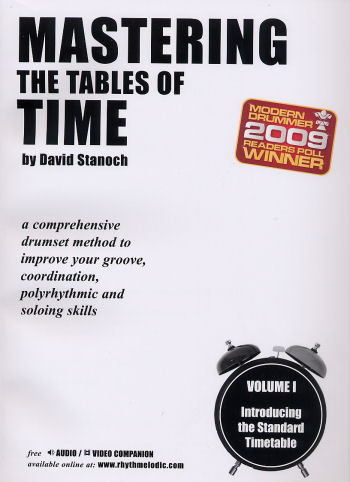
Mastering the Tables of Time by David Stanoch
Stanoch is a former student of Eliot Fine, who wrote the introduction here, and at once, this does look like an extension of Dahlgren and Fine's books— the format and ideas are very similar to things found in Four Way Coordination, Accent on Accents, and Dahlgren's Drum Set Control. Though I'm using their books on a daily basis these days, I do have reservations about using their stuff as the foundation of your playing— their logic is a little alien to a player's mental processes. MTTOT is maybe a little better than their books in that regard, and is especially good for helping students get the most out of an idea— it will help many to just recognize the idea in the licks they play in the first place. It's certainly more approachable than the other books I mentioned, and I do like that it takes some creativity to figure out what's hip about it.

Tuesday, December 10, 2013

The Abanico

The Abanico (meaning “fan” in Spanish) is the name of a stock set-up that occurs in Salsa, Afro-Cuban music, whatever you choose to call it. It is played by the timbale player— the timbalero—to bring in a new section after a stop. It occurs in two basic forms, depending on the clave orientation of the piece: 3-2, or 2-3.

Here is the 3-2 version; the top line is clave— son, in this case— whether or not anyone in the ensemble is actually playing that rhythm, the music is oriented around it. The bottom line is the percussion. Usually the figure is played on a high timbale, but since we're all about the drumset here at CSD!, you'll likely play it on a high tom, or on the snare drum, with the snares off. The accents are rim shots, played near the edge of the drum. The roll can be played open or closed, or as singles, depending on the tempo, and the personal style of the player— you have some latitude in how you choose to do it.


And in the 2-3:


As drummers in the North American mode, we're used to starting our grooves on beat 1, maybe just substituting a crash cymbal for the ordinary ride sound. But here we're ending the fill on a drum on beat 1, so you'll have to get used to coming in with your salsa grooves on beat 2, as in the case of this 2-3 Mozambique:


Recorded examples after the break:

Friday, October 25, 2013

Transcription: Raymond "Monchito" Muñoz — Caminando

Here we have a Latin percussionist funking out a little bit on Caminando, a hip cha cha* recorded by Eddie Palmieri on his great album Vamonos Pa'l Monte. The drummer, Raymond “Monchito” Muñoz, brings very much a percussionist's sensibility to the drumset; almost the entire track is played on the hihat alone, with little variation, and with very sparing use of the bass drum and snare drum. The funky parts happen at the end of the first interlude, and on the outro.

There is little information about Muñoz online, and I had never heard of him before. From what I gather, he is a Puerto Rican percussionist active in New York and PR since the 60's, or earlier. Apparently he studied with Henry Adler. From his Facebook page, it appears that he was seriously ill recently.


It seens that Muñoz's primary instrument is timbales, and he plays the drumset with what I imagine to be a timbalero's touch— for whatever that observation is worth. He draws a variety of sounds out of the snare drum (and hihats, to a lesser degree), playing loosely and not very loud, blending volume of the drumset with the congas. You never get the feeling that he's playing into the drums, the way many funk drummers do. I would be tempted to approach this by just learning and playing each measure— or group of two measures— as a groove in its own right.

* — If you're better than me at IDing salsa styles, please let us know in the comments.

Get the pdf

Audio after the break: