Showing posts with label bossa. Show all posts

Thursday, September 01, 2022

First page of Bossa Nova

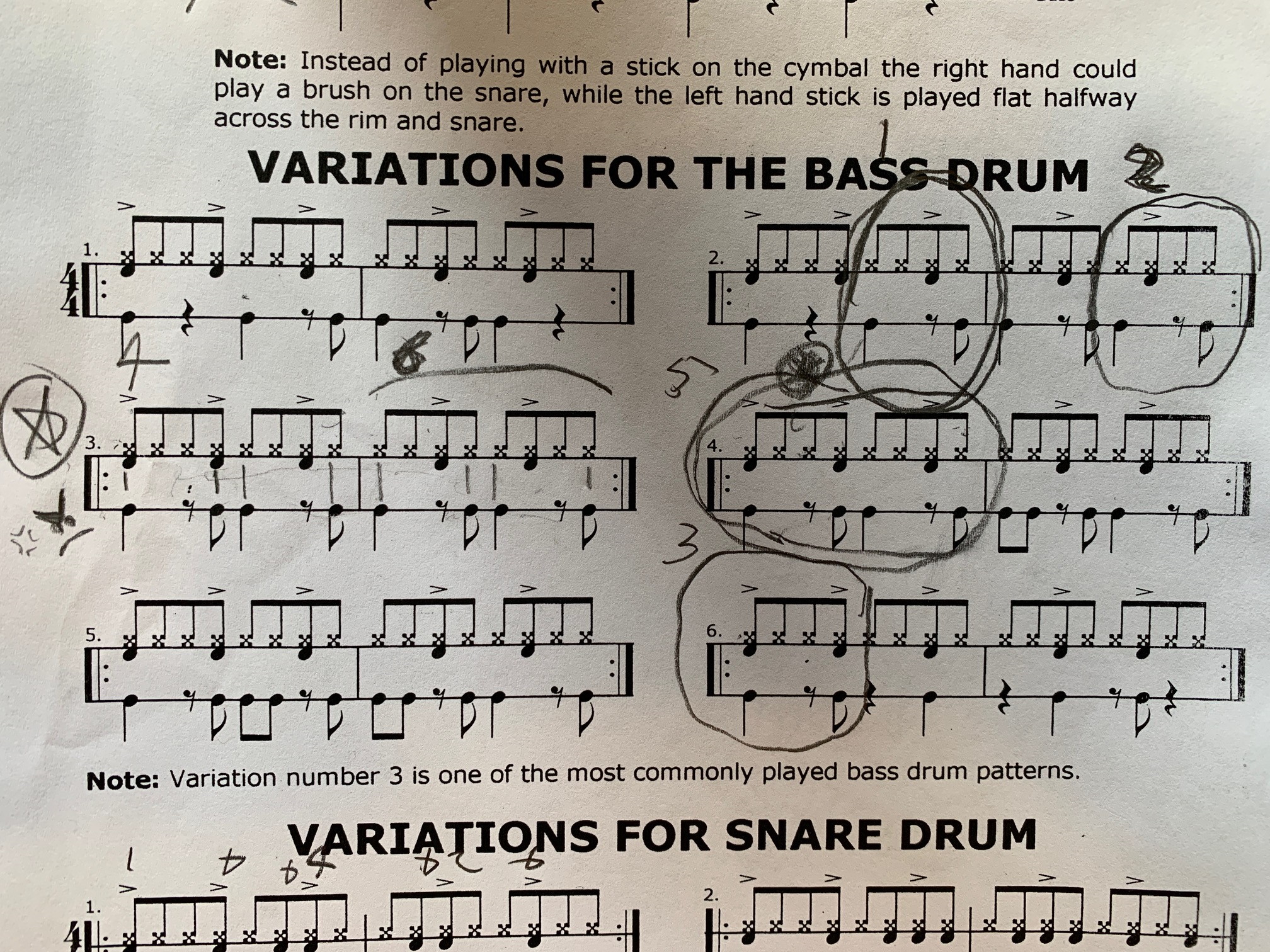
Working on this with a couple of students, I couldn't find a simple straightforward page of Bossa Nova rhythms, with all the parts written out. Seems like a basic thing that should exist somewhere. I had to print out a page from Joel Rothman and crudely circle the parts I wanted him to work on: 


Most serious musicians have pretty good handwriting, mine looks like a Cy Twombly painting: 


Anyhow, here we go— some bossa warmup patterns, and a few performance patterns: 


Play rim clicks on the snare drum with the left hand, play the right hand on any cymbal, or on the snare drum with a brush. Whenever you feel like it, add hihat played with your foot on beats 2 and 4. Tempo range for this is about quarter note = 120-180. 

Get my short book Playing Samba and Bossa Nova for a fuller treatment of playing this style in a combo setting.  

Get the pdf

Thursday, February 01, 2018

Groove o' the day: Bernard Purdie Bossa

Hey, this is kind of a hip variation on the stock Bossa Nova groove everyone plays— played by Bernard Purdie on his Soul Drums record, on the tune Soul Bossa Nova. From the intro:


He also does this surdo-like rhythm on the intro and for much of the body of the tune:


I've written a couple of other pages for opening up some possibilities with the bass drum when Brazilian styles— check them out. There's no reason to be locked into that usual ostinato our entire lives.


Saturday, June 10, 2017

Transcription: Billy Hart - Batuki

UPDATE: Jeez, what a moron. Naturally I spelled the title wrong on the actual page. It's Batuki, not Batuka. Well, we'll fix it for the book...

Here's an interesting little bit of playing by Billy Hart, playing with Buster Williams, on the album Pinnacle. The tune is Batuki, and I've transcribed the drums from Woody Shaw's trumpet solo, starting at 3:10 in the track. I don't know if there's anything extremely exciting in the transcription, maybe it's more an entry to understanding modern playing, and giving the entire recording a really close listen— which you should do.

The style is a 70s Bossa-derived Latin— if there were a style indication on the page, it would probably just by “Latin”— but you'll notice Hart is playing very little that's recognizable as a standard Bossa Nova groove. It's very open and modern, with a lot of space, dynamic shape, and big fills at appropriate places in the form.


It's a very musical performance, and while there's plenty of drums, there's isn't much happening that's particularly technical— throughout the entire track. In measure 20 there's a floor tom hit which could be a little awkward; absolutely no reason not to do something easier there. In measure 24 the rolls are played as single strokes. I neglected to mark the tempo— it's quarter note = 126.

Get the pdf

Sunday, February 14, 2016

Groove o' the day: Elvin Jones - Rose Marie

Something from the record I've been running in my car all week: The Peacocks, by Stan Getz and Jimmy Rowles. The tune is Rose Marie, a song from the 20s which was a country hit in the 50s. Getz's studio band, with  Elvin Jones on drums, plays it as a samba. The drum performance is interesting because Elvin plays a running dotted quarter note rhythm— which loops at three measures long— rather than a standard Brazilian rhythm:


Actually, just the first two measures form a very conventional and familiar Bossa Nova rhythm, but he extends it to make the unbroken dotted quarter note pulse. He plays that with his left hand on the snare drum and toms, so the complete groove looks like this:


It's a familiar feature of Elvin's playing that he will emphasize the dotted quarter note, essentially playing in 3 while the rest of the band is in 4, but it's still rather striking that he does it so aggressively here. Just so we're clear, the tune has normal eight-measure phrases— if you're going to practice this groove, you have to emphasize the eight-measure phrases of the tune, not the three-measure phrase of the drum pattern.

You can move your left hand to the toms where the music builds. There's nothing significant going on with the left foot— you can play it conventionally on 2 and 4 if you want. At a few points Elvin breaks up the bass drum part like this, accenting the bass drum strongly, further emphasizing the cross rhythm. Listen for this in the middle of the saxophone solo:


He maintains this groove pretty consistently, but he does break it up to fit the tune, like with these phrase-ending fills early in the track— these are each measures 7 and 8 of their phrase:


And this:


At the beginning of a new phrase, after playing a fill, he usually does start the pattern at the beginning, with the rim click on 2. But not always— he begins the piano solo with a rim click on the & of 2, continuing the dotted-quarter rhythm from there. If you're going to use this in your playing, don't over-think it— use your ears and play instinctively. We want to know what Elvin is doing, but in real playing just learn the patterns, and then put all your focus on playing the tune at hand.


Saturday, December 20, 2014

New CSD! e-book: Bossa Nova / Samba Field Manual

UPDATE: Thanks for the review, Kenneth!

Time to unveil one of the things I've been doing instead of delivering the promised Book of Intros, which is languishing maybe 3-5 hours of work away from completion, stupidly...

...but, yes, I say, it's time to unveil a new Cruise Ship Drummer! Kindle book:

Playing Samba and Bossa Nova: a field manual for drummers

It's a concise, practical guide covering the essential information you need to play those styles on a professional job, in a jazz band or lounge band context. The format is a little different than regular drum books; in addition to the drum patterns, it tells you all of the other things that go into actually perform music in the style: your job as drummer, how to play with a band, and a lot of other important background info for playing the music creatively and authentically.

The level is approximately high school, through college, through professional who just doesn't know a whole lot about these styles (which is a lot of them, actually!). An excellent resource for teachers and band directors, too.

Right now it's only available as an e-book for Kindle, or for Kindle apps on your tablet, phone, or computer— you can get the app free of charge from the book's Amazon page. I do believe in owning real paper books, so we'll see about making it available in hard format, at some point.

Get yours now! Price is an extraordinarily reasonable $6.95.

Saturday, February 15, 2014

Another page of Brazilian rhythms

Here is another page of Brazilian rhythms, written in 4/4. The last set was written as 8th and 16th notes in 2/4, the native meter of much of Brazilian music, but when playing lead sheets made by Americans (like out of The Real Book), they will usually be written in 4/4. These are transcribed mainly from tunes by Airto and Dom Um Romao. Some are left hand parts played on drumset, others are percussion parts— tamborim or agogo— a few are horn parts or rhythm section parts. That's why you want to listen to, and play along with, the actual music from Brazil: all the players know the percussion rhythms, and play them.


You also need to listen to develop an ear for how they are inflected; most of them are played with varying accents, long or short notes, and multiple pitches. Where there is a circled note, play the rhythm with that note and without it. Here are a couple of (well, pretty obvious) ways of putting these into context, using this rhythm, for example:


Play the rhythm as rim clicks on the snare drum, with 8th notes on the cymbal, and the usual Samba/Bossa Nova feet parts:


Or play both hands in unison on the snare and cymbal:


Get the pdf

A couple of the tunes these came from are after the break:

Thursday, June 20, 2013

A page of Brazilian rhythms

Here I've pulled the snare drum parts from a random selection of bossa nova/samba records— by Baden Powell, Tamba Trio, Milton Banana, and others. Some of these are played fairly repetitively on the recording, some are variations, and played only once. A few of them were played on tamborim, the instrument the commonly-played rim clicks on the snare drum are meant to emulate.


Along with the ostinatos I've given (or a Baião foot pattern), play these rhythms on the snare drum, either as rim clicks, or normally on the drum, while varying the accents/articulation— using rim shots, buzzes, ghosting some notes, or whatever. Once you have the patterns together improvise variations on them— alternate playing the given pattern one time with an improvised variation on it. And play them along with recordings featuring actual Brazilian musicians, not American jazz musicians playing bossa nova style— you'll find that with the Brazilians, the entire ensemble derives their parts from these types of rhythms, and you will fall right into a groove with them.

Get the pdf

Wednesday, April 24, 2013

Bass drum variations for Bossa Nova — adding left hand

This is something I've been meaning to do for some time. I like the page of bossa nova bass drum variations I did before, but it's a little difficult to visualize the left hand part along with them, so I've gone ahead and added one here. I've used the partido alto rhythm, which I favor over the standard left hand part— maybe at some point I'll slap this together with that rhythm for you. Once again, these variations are good for phrase endings and breaks— they are not meant to be played repetitively when you use them in actual music. It's a good idea to practice these along with a recording of actual Brazilian bossa nova— get hold of some Milton Banana recordings.


We're actually developing a little bit of excess capacity here, because in most of the bossa nova I listen to, bass drum variations are infrequent, and when they do happen, the left hand does not continue its independent part— it either stops, or follows the BD variation somehow. In fact, a good way to practice this page is to stop the time feel on the second measure and just play the right hand (on the cymbal or hihat) in unison with the bass drum. You can feel free to mix in the left hand (either rim click or on the drum normally) in unison with the RH/RF as well. What you're basically doing there is practicing your ensemble figures— they are usually handled simply like that.  

Get the pdf

Tuesday, March 19, 2013

Odd meter samba?

This line from Peter Erskine's The Drum Perspective is pretty much an instant classic:

I've felt strongly, for a long time now, that instead of seducing and encouraging the younger and learning drummer to practice, among other things, funk-rock beats in 7/4, odd-time sambas(!) or other marginally important aspects of the craft, young drummers should be encouraged to think. To play creatively. To compose on the instrument.

That parenthetical exclamation point speaks volumes— what the hell are you thinking, it says. This is an abomination. You're taking one of the most perfect, human dance musics of the world and turning it into an intellectual game, or a vehicle for exercising your technical prowess. It was compelling to me, and though I've never been much of a thinker in my playing, I've tried to live by that statement in my own way, particularly with regards to playing creatively, and not bothering with stuff that was marginal to what was going on in my own musical world.

And yet here we are. Let's listen:


Here's the primary groove, from the beginning of the tune; there is a lot of variation in the left hand part:


More transcribed grooves, and a few thoughts on this after the break:

Wednesday, March 06, 2013

Page o' coordination: “Baby” groove

Well, it took long enough, but I finally have a name for the post-Elvin phase of this coordination series. I don't expect many people will follow me down this particular rabbit hole, but whatever. This is based on the groove for one particular Brazilian tune, “Baby”, by Caetano Veloso, as played by Gal Costa. There are plenty of bossa tunes in 3, but Americans don't seem to play them much; probably the only way I'll end up playing this particular one on a gig is if I put it in my own book.

But no matter. There is a special thing going on with the groove; there is a 4:3 polyrhythm is built into it, with the bass playing in 3 and the guitar in 4, and the percussion mixing it up between them. Maybe that's a common thing, and I just haven't heard enough Brazilian music in 3. There's actually very little drums on the recording, so I put together some parts that seem to work, and are reasonably correct.


The left hand parts are meant to be quasi-functional. I think there's enough activity here to do these without the tom moves, but if you want to go crazy with this— crazier— I can't stop you. If you need more action, I would try experimenting with the tonality on the bass drum, playing the 1 and the 3 as dead strokes, and 2 as an open sound. Note that the e of 3 is accented in the percussion on the recording— do what you will with that information.

More likely you will need to simplify. At first, try losing a) the right hand floor tom note on 2, b) the accent/hihat splash on 2, c) the left foot altogether. Or just play your left foot in unison with the bass drum. Don't freak out when you get to the last line; take it slow, and apply what you know about the dotted 16th/32nd rhythm. I've also written that pattern in half time, so if you need to, you can use that to get the coordination together.

Obviously, on the real tune the feel is very delicate, and sparse. Learning these by playing them with the 1969 recording of the tune by Gal Costa will help keep this a musical study and not just a goofy coordination workout.

Get the pdf

Audio after the break:

Saturday, January 26, 2013

Another samba builder

Our previous “samba builder” was very batucada-focused (and probably in need of an update); this has more to do with samba as played on the drums, like in our Milton Banana pieces. The method is straightforward; work up a good feel with the feet/right hand parts, and add the various left hand parts to them. Treat the phrase-ending bass drum variations almost as fills; the left hand part can defer to them when you decide to throw them in.


Keep the feel light, but solid and driving. Play the right hand near the bell of the hihat or ride cymbal. You can play the left hand as rim clicks, high-pitched rimshots near the edge of the snare (not too loud!), or with a variety of accents and articulations; you can also improvise moves between drums. Also play the left hand parts with both hands in unison, along with the first, feet-only pattern. To develop the left hand more comprehensively, see the 16th note section of Louis Bellson's Modern Reading Text in 4/4, pp. 26-46

We've dedicated considerable ink— well, bytes, anyway— to the subject of the special type of swing found in samba, but in most drumset applications the 16ths are basically be played evenly. Exceptions to that would come when emulating the more folkloric styles, or a batucada feel. You can listen to, and play along with, the Salve a Mocidade recording to get an idea of the type of feel we're after here. 

Get the pdf

Friday, December 14, 2012

Transcription: Milton Banana — O Samba Da Minha Terra

Another Milton Banana transcription, this time the batucada-style intro to O Samba Da Minha Terra, from the same Sambas De Bossa album as last time. We'll probably be seeing more of these, because I really like listening to Banana's playing, and transcribing really makes you listen closely.


I've isolated the main groove at the bottom of the page, with my best guess at a sticking for it. It's a little awkward, with the three lefts in a row around beat 2, but it seems to be the most practical option given the accents— at one point or another there are snare drum accents everywhere but on the second or third notes of the three lefts. It's possible (likely?) he's doing something else, maybe a non-obvious sticking that facilitates the feel, and/or possibly using a unique sticking for each of the three or four different things that happen here. An easy solution to all of this would be to eliminate the left hand on beat 2, and do the entire pattern with an alternating sticking— that's the most common way of making this feel.

This would be a good time to revisit my posts on samba feel— I'd direct you to someone more authoritative, but none of those people seem to be writing about this on the Internet— while giving this a close listen. Here Banana plays a moderately swingy “tripteenth” feel (which basically squishes the four 16th notes into the space of the first and last notes of the triplet); the triplet pull is not extremely strong, but  he's obviously not playing even 16ths, either.

Get the pdf

Audio after the break:

Tuesday, November 20, 2012

Transcription: Milton Banana — Flor de Liz

As I mentioned before Milton Banana is one of the great Bossa Nova drummers, and since that tends to be an under-understood style (by the whole rhythm section, actually), I want to go a little bit deeper into what's happening with his playing. So here's a transcription the head of the tune Flor de Liz, from his 1984 album, Sambas de Bossa (originally titled Linha de Passe):


The first note of the piece— the pickup on 4 with the bass drum— is very commonly used for setting up the beginning of a tune or a new section after a stop. For the body of the tune he uses the partido alto pattern on the snare drum, with the quarter notes in the middle (often it's played with the measures reversed):


The accents that occur on the cymbal later in the tune are approximate; they are not exactly even in sound or in volume— you could play them on the cymbal near the bell, and different places on the bell itself. Also notice that the ensemble figures are very clean; he gives himself a little stop before them, and reenters with the groove on beat 2 after the hits on the & of 4 (as in measure 9). The fills at measures 26 and 49 are basically the same, except he pushes the first one a little faster, so it ends ahead of beat 3 slightly.

Get the pdf

Audio after the break:

Sunday, December 04, 2011

Transcription: Dom Um Romão - Agua de Beber

A little companion piece to my bossa BD variations post- this should be helpful in giving your bossa someplace to go; as I mentioned before, a lot of people get married to the standard time feel and don't know where to take it from there.

Here I've transcribed just the left hand part from Dom Um Romão's performance on Agua de Beber, written and played by Antonio Carlos Jobim. The right hand plays 8th notes on the hihat or cymbal with a brush throughout, along with the standard bossa pattern on the bass drum. Where the bass drum or hihat are notated, he's doing something special with them; after that you can go back to the standard parts.


Measures 3 and 4 appear to be the foundational pattern for the tune, but as you can see, there is a lot of variety to the part; much of which follows the melody. It's notable that many of the section transitions are very softly handled- he'll leave space at the end of a phrase-ending fill (as in measures 16 and 32), and he usually doesn't punctuate the beginning of the new phrase.

Get the pdf

More bossa nova-related posts.

YouTube clip after the break:

Sunday, November 20, 2011

Bass drum variations for bossa nova

Bossa nova can be a very static style for novices- I've noticed in teaching that they have a hard time getting away from the standard, repetitive pattern. And, aside from Ed Uribe's book, I really haven't seen much in the way of methods for developing it. So here's a page of exercises which will help to open up the bass drum part, and to become more flexible in general with this style.

The usual place you would use the variations would be at phrase endings, or freely during the body of the tune, if you want a more open feel. I've written them in a two-measure format to give context, with the standard bossa pattern at the beginning and the variation at the end; in performance you would play the variations much more sparsely. It would be very unusual to play these exercises exactly as written (that is, as repeated two-measure vamps) in actual music.


These will tend to give your bossa a little more funky and samba-like feel, which won't be appropriate for every tune or situation. The bass drum is usually handled very delicately in bossa nova, so apply this with a lot of sensitivity. The variations can be treated somewhat as light fills, and played a little stronger than the body of the groove. Doing a lot of listening is vital, of course.

Get the pdf.

After the break are some practice suggestions:

Friday, August 26, 2011

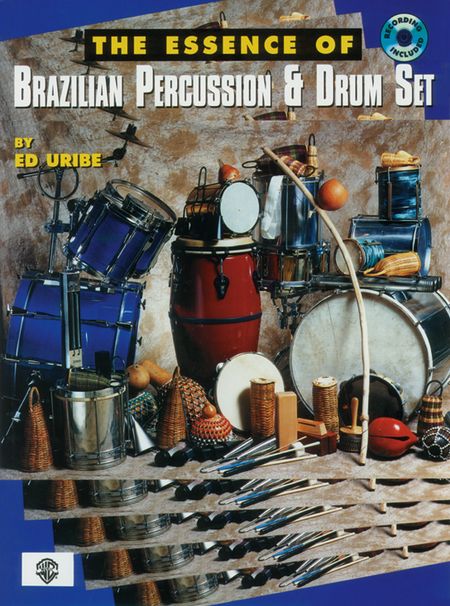
Best books: The Essence of Brazilian Percussion and Drum Set by Ed Uribe

The Essence of Brazilian Percussion and Drum Set is the little sister of Uribe's massive volume on Afro-Cuban percussion. I've been using it almost daily for several months now, and not only is it a model of what a genre book should be, it's quickly turning into one of my favorite drum books, period. It reads and operates- very appealingly- more like a professional manual than a typical drum book (Ralph Humphrey's Even in the Odds would be another one with that feeling about it).

In 144 pages it presents a huge amount of information in very concise, manageable chapters. In addition to practice material, there are sections with historical background of Brazilian music and history, notes on sound of the instruments, explanations of the various song styles, examples of rhythm section parts, and a very useful glossary. Styles covered include bossa nova (in 4, 5, 6, and 7/4), samba (in 2, 3, and 7, plus batucada-style, samba with brushes, samba cruzado) , baiao, samba marcha, partido alto, marcha and frevo, choro/chorinho, afoxe, and catarete. With a number of simple but very robust creative methods presented, it has an extremely open system, and I think no two players approaching it would come out sounding the same.

A large portion of the book is dedicated to introducing each of the common percussion instruments used in samba, which is important even if, like me, you aren't particularly interested in learning to play them all. They are the basis for each of the parts of the drum set grooves, and being familiar with them is one of the keys to playing creatively with any authenticity. That does seem to be Uribe's major point in including them- he does not give a lot of instruction on how to run or play in a bateria.

In some genre books, there is a fairly inescapable feeling that the user is an outsider to the music, and that a high degree of deference is expected. Rather than presenting the music in a folkloric manner, in which the music is more or less fixed, this book has improvisation at the core of its method; the music is presented as very much a living thing, and though not of the culture, the user is treated as a creator and participant.

One of my few reservations about it is that the unique Brazilian swing feel is handled imprecisely, with only general instructions that are maybe a bit misleading (or which at least require a demonstration)- the essence of Uribe's explanation is to slur the "a 1 e" of the repinicado rhythm, and "pull back a little on the time". As you can see from my posts on the subject, my philosophy is that, like with swing in jazz, it should be reduced to something quantifiable and reasonably close- from there it's a short leap for the player to get to an authentic feel through listening and playing. It's one of the most difficult subjects related to this music, so it's an easy shortcoming to forgive, but it would've been nice to see the usage and relationships between even 16ths, triplets, and "tripteenths"- all of which occur in Brazilian music- explored and explained more deeply.

But this is a great book- a true player's book. Highly recommended.

Saturday, July 30, 2011

Stanley's Page of Bossa Nova

Here is a page of basic Bossa Nova patterns, which I wrote up for a couple of my students. I've included the standard pattern that will be familiar to a lot of people, a Partido Alto-type pattern, some one-measure patterns, and several warm-ups.


Get the pdf.

Monday, April 25, 2011

Caixa blow out: part 1

Here are a couple of pages of caixa (that's a Brazilian snare drum) patterns which are in common use in Portland, along with some of their variations from other sources. Includes a partial illustration of the "tripteenth" (Michael Spiro's term) concept, which may be helpful in getting the feel happening. These are primarily for use in a batucada group, though set players trying to cop that style are going to want to know them, for information if nothing else. Part two will feature patterns more commonly used on the drum set.

Download the pdf.
UPDATE: the Lions of Batucada, a group I performed with in the mid-00's, has their caixa rides written in tablature and posted online. Several of them replace or are alternatives to the ones I've presented here.

After the break are several fun and helpful videos:

Tuesday, April 19, 2011

Method book round up: Brazilian drumming

As some of you may have noticed, I've been thinking a lot about Samba of late. And as my friend Blake Thomas, an expert cuica (not to mention caixa and zbumba) player has loaned me a few of his books on the subject, I thought this would be a good time to give an overview of some of them. So he we are- the good, the great, and the fine:

Brazilian Rhythms for Drumset. By Duduka da Fonseca and Bob Weiner.

This has become a modern classic- the first serious attempt at dealing with the style authentically; at least the first gaining widespread usage in the US. Includes robust text dealing with historical background, the percussion instruments, performance/practice notes, glossary and discography. Takes you through fifteen pages of batucada-style samba, with the hands on the snare drum and toms, mimicking caixa, tamborim and surdo, before getting to the more familiar (to Americans) cymbal and snare drum based style. Covers Samba, Bossa Nova, and Baiao thoroughly, with  shorter sections on Maracatu, Marcha and Frevo, and odd meters.

The presentation is a little haphazard; some concepts that could've been easily explained verbally are instead written out as exercises, many (but not all) exercises have a written stop at the end, for reasons that are not explained. I believe the text could've benefited from some aggressive editing- many explanations for exercises contain no more information than the title of the exercise. For example:
Exercise 13 Samba Cruzado - Variation #4 - With 16th-notes on hi-hat 
Is explained:
Try playing sixteenth-notes on the hi-hat instead of on the snare. 

It's a small thing, but that kind of sludgy build-up of text is a little bit of a distraction. The book offers excellent information, but also feels somewhat laborious to work through for these reasons. Nevertheless, it's an essential book every drummer interested in Brazilian music should own.

More after the break:

Monday, March 28, 2011

Todd's Methods: Samba builder

Here's a little method I improvised for developing some flexibility with the samba- I put this together pretty quickly away from the drums, so I'm sure I'll add to it as I work with it in my own practice. The idea here is to get comfortable with bringing the feet in and out, making changes in dynamics, and using the bass drum independently, like a surdo player, instead of being locked into the usual dotted-8th/16th pattern. Check out the notes at the end for some fairly important things about interpretation. A good first approach is to work from a base of the most comfortable hand part, and practice making adds and changes to that.

 
Update: my man Boomka over at the Drummerworld.com forum offered a couple of excellent links- an interview with Duduka da Fonseca where he discusses the importance of a sensitive approach to the bass drum, plus a video demonstrating the feel of the repinicado part (video embedded after the break).

Download the pdf.