Showing posts with label books. Show all posts

Thursday, July 25, 2024

Tailoring the game to your talents

An extended quote from the book Moneyball, about the baseball player Scott Hatteberg, and his approach to hitting, and his experiences with the lavishly funded Boston Red Sox and the meagerly funded Oakland As organizations: 

[Hatteberg's] cultivated approach to hitting— his thoughtfulness, his patience, his need for his decisions to be informed rather than reckless— was regarded by the Boston Red Sox as a deficiency. The Red Sox encouraged their players’ mystical streaks. They brought into the clubhouse a parade of shrinks and motivational speakers to teach the players to harness their aggression. Be men!

Hatty sensed he might be in for trouble when he saw how the Red Sox management treated Wade Boggs. He’d spent a lot of time with Boggs in the batting cage during spring training, trying to learn whatever he could from the master. Boggs, a perennial All-Star, famously never swung at the first pitch—or any pitch after that he didn’t love. Boggs was as efficient a machine as there ever was for acquiring information about opposing pitchers. By the time Wade Boggs was done with his first at bat, his team had seen everything the opposing pitcher had.

Boggs’s refusal to exhibit the necessary aggression led to his ostracism by the Red Sox. “They would get on him for taking a walk when there was a guy on second,” recalled Hatteberg. “They called him selfish for that.”

If Wade Boggs wasn’t allowed his patience, Hatteberg figured, he certainly wouldn’t be, either. When Hatteberg let a pitch go by for a strike— because it was a strike he couldn’t do much with— Red Sox managers would holler at him from the dugout. Coaches would try to tell him that he was hurting the team if he wasn’t more inclined to swing with men on base, or in 2-0 counts. The hitting coach, former Rex Sox slugger Jim Rice, rode Hatty long and hard. Rice called him out in the clubhouse, in front of his teammates, and ridiculed him for having a batting average in the .270s when he hit .500 when he swung at the first pitch.

When you're lavishly endowed with either money or talent— as both an organization and an individual, in this case— your money and talent can cover for bad doctrine. Or doctrine that doesn't work for people not similarly endowed:

“Jim Rice hit like a genetic freak and he wanted everyone else to hit the way he did,” Hatteberg said. “He didn’t understand that the reason I hit .500 when I swung at the first pitch was that I only swung at first pitches that were too good not to swing at.” Hatty had a gift for tailoring the game to talents. It was completely ignored. The effect of Jim Rice on Scott Hatteberg was to convince him that “this is why poor hitters make the best hitting coaches. They don’t try to make you like them, because they sucked.”


The following is about integrity— not in the usual sense of sticking to principles, but of doing something a certain way, even when you are not supported in it, because it's the only way you can do it, it's the only way you know to do it well: 

Each time Scott Hatteberg came to bat for the Boston Red Sox he had, in effect, to take an intellectual stand against his own organization in order to do what was right for the team. Hitting, for him, was a considered act. He didn’t know how to hit without thinking about it, and so he kept right on thinking about it. In retrospect, this was a striking act of self-determination; at the time it just seemed like an unpleasant experience. Not once in his ten years with the Red Sox did anyone in Boston suggest there was anything of value in his approach to hitting— in working the count, narrowing the strike zone, drawing walks, getting on base, in not making outs.
“Never,” he said. “No coach ever said anything. It was more, get up there and slug. Their philosophy was just to buy the best hitters money can buy, and set them loose.” The Red Sox couldn’t have cared less if he had waged some fierce battle at the plate. If he had, say, fought off the pitcher for eight straight pitches and lined out hard to center field. All that mattered was that he had made an out. At the same time, they praised him when he didn’t deserve it. “I’d have games when I’d have two hits and I didn’t take a good swing the whole game,” he said, “and it was like ‘Great game, Hatty.’”

Pro ball never made the slightest attempt to encourage what he did best: take precise measurements of the strike zone and fit his talents to it. The Boston Red Sox were obsessed with outcomes; he with process. That’s what kept him sane. 

The Oakland As took an ensemble approach that emphasized getting on base by any means necessary, including getting walked. By necessity; they didn't have the money to hire star talents, so they sought out undervalued players who were nevertheless very good at getting on base— the “Greek god of walks.”

The moment he arrived in Oakland, the friction in his hitting life vanished. In Oakland, he experienced something like the reverse of his Boston experience. “Here I go 0 for 3 with two lineouts and a walk and the general manager comes by my locker and says, ‘Hey, great at bats.’ For the first time in my career I’ve had people tell me, ‘I love your approach.’ I knew how I approached hitting but I never thought that it was anything anyone cared to think about.” All these things he did just because that’s how he had to do them if he was to succeed were, in Oakland, encouraged. The Oakland A’s had put into words something he had only felt.

“When you go to the plate,” Hatty said, “it’s about the only thing you do that is an individual thing or seems like an individual thing. When you go to the plate, it’s about the only thing you do alone in baseball. Here they have turned it into a team thing.”


I encourage you to read the book— it's relevant on a lot of levels. The movie is fun, and a good hook for that, but the real stuff is in the book. Maybe the most important point is that there's more than one way to do all of this. Not everything has to be done through the obvious front door.  

Monday, May 06, 2024

Best books: Working Space

Here's an old favorite, by the painter Frank Stella, who died this week: Working Space— you can read it online at that link. It's pretty dense, but there's a lot to learn about art in it. You may have to blow past some of the more intense verbiage, as I did. He worries the concept of “pictoriality”, which I never fully grasped. 

Here's Stella in the documentary film Painters Painting— he's verbose, but what he's talking about is mostly simple— what he's doing, and what's in his pictures, which is not a whole lot. He was considered to be a minimalist early in his career, less so later on. 


It turns out that it's not that easy to make a simple picture, if you have some ideas about how it's supposed to go— like if you want people to get the picture instantly, and without alluding to any kind of three dimensional space. Hence everything he has to say about it there.

Where people get into trouble with work like his— and with that level of conversation about it— is they think the artist is demanding that they take it as some kind of profoundly meaningful thing. Which they do not feel, so they become hostile. But the pictures really just are what they are, they're pretty quick experiences, you see the thing, maybe notice the logic of its design, and that's it. If that's hard to accept, maybe you think about art a little bit, about why that's not enough for you, and about what you want from it. 

Stella seems to be coming from the same kind of place as the critic Clement Greenberg, who was real worried about pictures being abstract enough, and flat-looking enough— he wanted no illusion of space. History demanded it, in his mind. You can get a little bit of what he's about in the essay “American-type Painting” here. He also liked to assign things status as “major” and “minor” art, which is BS, purely him asserting own status as a New York art world “power broker” or whatever. He was kind of full of it. 

It would be easy to dismiss Stella as part of the same category, but as someone who builds things, he's more grounded in reality. It's worth spending some time with him, even if you don't have a lot of affinity for his work. Which I don't. It's a little too cool for me, and I want something I can look at for awhile. But he gives you a lot to think about. 

Monday, April 22, 2024

On Effortless Mastery

Service announcement: the next couple of months will continue to be very busy for me, so I'll be posting irregularly for awhile longer. Quality of language will be unpolished, wisdom coarsely hewn, logic poorly articulated, as I dash these things off in order to post some damn thing. Maybe the site will get a lot better, who knows. This is a great time to write me with questions. 


When Effortless Mastery, by the pianist Kenny Werner, was published in the late 1990s, it was one of the first books to talk seriously about the inner game of being a jazz student and musician, getting into some lurking personal issues a lot of us have, or have had, in that pursuit. I got an advance copy at the time of its release, and digested it off and on for a number of years after that. More recently Werner released a follow up book, Becoming The Instrument

The title, Effortless Mastery, does not mean “becoming a master quickly without working at it.” It means “becoming effortless in the mastery you beat your brains out obtaining.” In BTI he clarifies:

Here’s what I didn’t say in my first book: It takes a lot of effort to become effortless!

I wish I had because many misinterpreted that book to mean that one did not have to practice to acquire virtuosity.


Dealing with the creative neuroses and inhibitions you develop while practicing eight hours a day trying to be great. The first 75 pages address the subject of fear related to the creative and learning processes— playing, listening, composing, practicing, and teaching. That part is quite useful. The remainder of the book gets into some pretty airy stuff, with a lot of affirmations, breathing exercises and long meditations on repetitive themes like “I am great, I am a master.” 

And he writes at length advocating an approach to technique involving total release— maybe a legit thing to study at the hands of the master who taught it to him, but a technical experiment for people self-teaching it via a book. Putting in the amount of time he suggests would be a pretty speculative venture. 

Becoming The Instrument goes a lot further into a quasi-religious/self-help zone. You can tell when a musician bought one of the books, because they suddenly become God guy for awhile, taking on a forced kind of mystical air. We've all done silly stuff in the course of figuring things out. In processing it I think it's good to keep Zen master Shunryu Suzuki's advice close at hand: 

Do not be too interested in Zen. 


It gets quite heavy, and you get a sense of the intended audience, in the negative, as if he's addressing a kind of spiritual void, or void of purpose. Maybe he sees a lot a type of younger player, that is talented and driven, but is without a real visceral emotional center, without real meaning, with no great reason for doing any of this, beyond a desire for recognition. He fills that void with a kind of religion of playing, or of a particular state of being when playing. From here that resembles an extreme level of self-absorption— which is fine, but I don't believe it's a substitute for substance. And it doesn't provide it. I don't come away from it feeling I know more about what's real about myself.    

The book was very welcome when it was published, but there was a limit to how far I can go with it. I don't get much from affirming my greatness and mastery, the words aren't real motivating to me. I gained more confidence from real instances of me playing good than I was by the meditations. You learn detachment through playing more— burning out playing way too many gigs would be preferred. You hear yourself recorded enough times— on occasions when you hated what you were doing— and realize, after you forgot what you were trying to do, that you sound fine. Good even. You can play the drums, and your judgments about your playing are not your playing. I'll have to get into my ideas of what musical substance is, and where it comes from, another time. 

Both books are worth having in your permanent library. I included links above where you can preview the books quasi-legally, but you should buy them. Don't screw around, buy hard copies of everything. 

Friday, December 22, 2023

More on New Breed

Since that last piece about the book The New Breed, by Gary Chester, I've been working with that book fairly seriously— I can already play the drums, it won't kill me to spend some time trying out somebody else's hard thing. 

...my writing persona apparently seems opinionated to some people, but I'm very suggestible. If somebody I trust tells me what to do, I'll go with it. I may not care if a lot of open handed drumming enthusiasts are into this book, but when some former Chester students, professionals doing demanding jobs— e.g. Broadway shows, Blue Man Group, Cirque du Soleil— advocate for it, I'll take it seriously. So despite some reservations I have about some aspects of the method, it's proof of usefulness and effectiveness for some people who are doing real work. 


So, having spent more time with the book, I have some more thoughts on it: 

Broadly, The New Breed is a framework for practicing multiple ways of counting or singing over some drum set ostinatos, while reading an independent melody part, a la Syncopation— though more 16th note oriented.

As I noted last time, as an independence concept, it's rather simplified— not simple to do, it's often extremely difficult— and similar to the massive second volume of Chapin's Advanced Techniques book, which deals with layering unrelated rhythms in different limbs. Possibly New Breed is the highest practical form of that “pure” independence concept. 

There are some other second order things, that are more particular to Chester, that have not been universally adopted by any stretch— the open handed angle, the unusual set up he recommends. Not agreeing with those things and not wanting to do thatm are part of the reason I never used the book much. But on those players' recommendations I'll play the exercises, adapted for a normal drum set, even as I don't plan to develop the open handed thing in my actual playing. 

All of that together it amounts to a method for developing some deep time and coordination superstructure. Dave Weckl is an example of what I mean by that word— hearing him play, you're hearing a lot of superstructure

[h/t to David Crigger for the video]

Clearly multiple layers of stuff happening there— not just in what he's actually playing. You don't just learn to do that on the job, you can't just try to cop it. I don't regularly listen to a lot of players like that. For comparison, you could listen to Billy Hart, who would be a more natural, organically developed player. 

That counting/singing imperative, combined with the hard independence problems, is the main thing— developing a heavy duty internal time/coordination matrix. Working on it has often felt similar learning some Bach on the piano— i.e., slow and painstaking— which is for me the interesting part of it.  

As a grand method of drumming, what I'm missing with this book is a simple core concept. For example, on this site, the major doctrine is that what we do on the drums should be fundamentally simple in concept, for ease of execution, and for improvising. It's based on one rhythm, that is the rhythm you sing, read, and play. We might elaborate on it or orchestrate it on the drums in some complicated ways, but it's fundamentally about one rhythm. With New Breed is the core concept is the mass of work that went into doing it.  

I'm also missing fundamental bodies of vocabulary. It's not a complete what-you-play book. The Reed systems, Gary Chaffee's sticking and linear systems, etc are all bodies of vocabulary— the substance of what you actually play on the drums. New Breed is certainly very thorough on the subject of groove creation, but that doesn't cover everything you actually play. 

So: it's not a complete drumming method. I think its real purpose is as a finishing system for professionally-bound players. Normally, drummers learn a whole ton of stuff fast, between about age 12-21; New Breed seems to be about disciplining that and correcting a lot of detail, ironing things out, justifying everything into a nice professional package.     

About the open handed angle: Part of the reason Chester suggests riding with the left is that it's funkier, he says; because it's controlled by the right side of the brain, which is said to be more creative. That is now a discredited theory, and I would suggest that it's because the left hand is less conditioned for that role, and will remain so, despite the work we're doing on it with the book. I consider the work on it here to be independence practice, not a total drumming orientation. 

I'll be writing more on this as I figure out as I figure it out— what the benefits are, how to incorporate it with my normal practice/teaching methods, how to approach it without being a full blown devotee, etc. 

Wednesday, September 20, 2023

Book review: Note Groupings and Combinations for Drumset

Giving a shout out to, and a few comments about, a new book by Jeff W. Johnson: Note Groupings And Combinations For Drumset. Johnson wrote another good book, The Level System— pretty much the definitive practice manual on that subject. 

I'll put up front that this book is really good. Essentially we have some things suggested in Gary Chaffee's books, totally reinvented as complete practical system, in a form suitable for normal modern music.  

It's not a simple concept to describe, and the title and description are a little obscure:

[This book] demystifies the concept of note groupings: a system of arranging notes that span over the beat (and over the barline). We'll start with an introduction to the groupings in their basic forms before using them in grooves and fills. Then, by combining note groupings together, we create even more rhythmic possibilities. The concepts in this book will increase your rhythmic vocabulary and creativity, all while remaining musical.   


Or you could say: 

We're gonna group some 16th notes in 3s 5s 6s and 7s, and then group some triplets in 2s 4s and 5s, and do some different stickings, and then do some other stuff with that. 


Grouping rhythms differently than their normal subdivisions, essentially. Here's the basic template— go to the book's site for more sample pages.  

There you see some 16th notes, in 4/4 time, accented every five notes. There are some suggested stickings, and suggested four measure phrases (I would also practice each measure individually, and each two measures.) This is repeated for a number of different groupings of 8th notes, 16th notes, and triplets in 4/4 time. 

That is covered in about a dozen pages. The remainder of the book presents options for rudimental stickings, and for drumset applications, and for applying them to a musical phrase. 

On the one hand the idea here involves cross rhythms in 4/4— “metric modulation” as it's often called. For players it's is a normal-advanced idea— perhaps not thrillingly novel to people fascinated with advancedness. Doing it over an entire phrase is a particular effect that is usually done sparingly. I think people using the book would be best off using it as part of learning where all the notes in the measure are, and breaking open the box created by the time signature, while using the exact patterns in a more fragmentary way as fills, or as part of an improvised texture. 

Johnson does his job and figures out a focused mission with it, which is a big deal*. I like books that are scaled to a normal drumming life; average semi-ambitious drummers could learn a little something in a short time with it, or hardcore maniacs can do their thing with it, and take it much further, and he suggests some ways of doing that. It's hard to get that balance without swamping the fundamental concept. 

* - ...I'm increasingly annoyed[!] with maximalist books that, if you followed the author's instructions, would dominate your whole life forever. Fresh rant on that subject coming soon... 


So, it's $15, buy it. It presents a nice clear concept that you can explore in a short time, and continue using as a basic practice template for many years. 

100 pages, wisely self-published by Johnson, and available through his site, or from Amazon

Thursday, September 07, 2023

On the massive overabundance of things to practice

A nagging question with every single thing I post: Am I putting up too much, am I part of the problem— the problem being: there's way too much stuff to practice on the drums now, and it's leading people away from fundamental principles*, stealing their focus, making them neurotic. Promoting the wrong idea that playing the drums requires a lot of preparation and prior knowledge.

* - Which are: you should be playing a lot and listening a lot... and, in third place, also practicing lot. Why did I put this in the fine print? 

Maybe— for people who are going about it the wrong way, through media. The right way is to be involved in music with people. If you're playing music, and hearing people play, all of the excess junk media ideas fall away— not my ideas, which are obviously splendid, I mean all that other junk. It's hard to force that stuff into a real musical life. 
 
So, here are some justifications for the continued existence of this site, some general notes on why I continue writing, and how I think you should relate to my content, and other people's, and to the seeming tsunami of practice materials and media-created demands on your time:


Use your judgment
Who's life is it, again? Everything advertised in drumming media as “crucial” is not actually crucial. Work on what seems relevant to your actual, immediate playing life— your next few years, anyway. You do have to have a playing life, though. Talk to some people, set up a weekly session to play some tunes. 


Practical vs. background
A lot of drummers seem to think that if they just work on some abstract exercises, played in a “neutral” way— Stick Control, say— for a long time, it will translate into freedom to play anything. A lot of materials are oriented that way, and it doesn't work that way. There may be good reasons to do that sometimes, it's not the main thing. Practice mostly what you're going to play, in the way you're going to play it.  


It's a library
Libraries are there for reference, for the future. Maybe you'll use something in ten years, or twenty, maybe never. Maybe you got everything it truly has to offer in glancing at it one time, seeing one other possible way of doing something. 


It's a very long game
Again, some of these things you may not get to for 10 or 20 years, or ever. A lot happens over the course of a playing life— a lot of phases of attitudes about playing, practicing, and everything else to do with music. We're dealing with long term concepts here. 


My niche

I have a pretty specific doctrine: everything is about what you can play with people. Everything should be as easy, natural, and non-technical as possible, so you can focus on the music. And as similar to the real act of playing music as possible. If we do something technical, there's got to be a good reason for it, respecting the time and attention it demands from the user. I tell you when we're doing something non-essential, or non-essential for most people. 


Virtually all Reed systems are worth doing

They're the major proven method for the above thing. You can learn a complete drumming vocabulary, in a form that is relatable to actually playing music, just by learning my Reed systems, and the traditional systems, and nothing else.  


My stuff is normal
What I do is not new. Mostly I fill gaps in proven existing methods— or expand upon them, or occasionally improve on them. Often I'm rewriting an existing thing to make it easier to do what I want with it. See my Chaffee linear phrases. Chaffee's stuff has so much potential it was impossible for him to put it all in a few volumes. Or I'll rewrite / edit / reinvent things just so I don't have to turn pages and edit while I practice.  


There's not that much to do

There's a lot, but most of us got passably up to speed with it in a few years, practicing ordinary stuff. The fundamentals have not changed in the last 50 years. I played my first professional gig five years after I started playing. Hardcore maniacs will spend some years practicing 4+ hours every day. I certainly did that. But getting started does not take much in terms of vocabulary or technique. 

Even for maniacs, there are basically two major areas of drumming: jazz and funk. Those cover every type of music you're going to do. Latin drumming can be another big area, but it's usually up to the individual how deep they want to get into it. 


Massive redundancy
There's a lot of duplication in the hundreds of pages of practice materials I've posted, which is good. Doing the same thing a different way helps you understand it and use it creatively, and develop it for different drumming uses and musical contexts. The same thing different ways = understanding it.  


There are a lot of obsolete materials

Yes, there are a ton of drum books, but a lot of them duplicate each other, or they're formatted badly, or they're badly dated, or they're just not very good. A lot of them are just orphans, out of print or barely in print, and not easy to get, and no one uses them.  


Visit the piano music aisle sometime
If you think there's too much drum stuff to practice, go to a sheet music store and check out the piano section. It's insane. Czerny alone will dominate your entire existence if you let him. 

Printed materials are not the problem 
Videos are the problem. Anyone dealing primarily with printed materials is going to be working more effectively than people watching videos. Partly because you play written music— you watch videos. I don't think anyone just sits there and stares at drum books for hours at a time. 


Narrow your focus

You can't be looking at a page of materials and worrying about all the different ways you're not “mastering” it, or exhausted its potential. Not every page of materials deserves to have its potential exhausted. Maybe it only has a small lesson to teach you. 

Work it out in an hour, day, or week, maybe work at it and meet a reasonable short term goal with it, then reassess. Do something else, or continue working on it, if you find another short term goal you want to meet with it.  


I hope that clarifies some things. As a student in the 80s, this was always a big issue— seemingly so much to do, and being unsure how to prioritize, far to take any of it. It's a 500 times worse now, as drum media has become what it is. Good luck!  

Saturday, July 01, 2023

Surveying styles of drum notation

I was recently critiqued on my notation style, by someone who knows their stuff— who also knows their stuff— and I got paranoid that I was writing in a stupid way, so I went to my library to re-check what other people actually do. 

You may have noticed, I virtually always put drum set materials on one set of stems. It's a doctrinal thing I decided to follow a long time ago: the drum set is one instrument, what we play on it is one rhythm, using four limbs. It's a common way of writing, but not the only way. In the past, drum set music was generally written as if the different parts were being played by different people, like a band part for snare drum and bass drum.

It's a difficult problem, because the drums are not normally played by reading a mapped out drum part verbatim— most of what we play is basically improvised, possibly with a sketched out groove suggested by a drum chart. But in the practice room we need to read a lot more particular, complex things than we would normally see in a drum chart, and that's where judgments about style come in, with the concerns being the best way to render an idea for the purposes of the materials.   

So let's check out what is done in some some drumming library favorites (and otherwise): 

Jim Chapin - Advanced Techniques For The Modern Drummer - 1948
The earliest modern representation of drumming independence that I'm aware of. He writes the main exercises both with the cymbal and snare drum and cymbal parts separately, but with them unified into a single rhythm, on a single set of stems:  


And those are still the main ways drums are notated today. They each have advantages. The single-stem way for the reasons I gave above. The two-part way because it's clearer what rhythm we're doing with the independent part. 

Rhythmic Patterns - Joe Cusatis - 1963
This kind of situation is more usual in older drum set notation— and it's totally barbaric and unreadable. At least the drums played with the hands are on the same stems. 


Further, each page includes a big key at the top of the page reminding you which line goes with which drum, as well as the markings you see here, like you're going to forget from page to page, or as you move your eye down the page. 

This is kind of a long post— much more below the fold: 

Saturday, March 25, 2023

Wilcoxon's Junior Drummer

I've had this copy of Charley Wilcoxon's book The Junior Drummer* lying around for some time, let's take a look at it, see how it holds up for modern usage. I have the Ludwig Masters edition pictured on the left.  

* - Full title: Fundamental Instruction For The Junior Drummer


It's not exactly a normal beginning snare drum method— it's more of an old fashioned drum set book, a “double drumming” book, intended for one player playing snare drum and bass drum. There are studies dedicated to bass drum, and to snare/bass interaction starting in the earliest pages. And there are some studies using a cymbal, hihat, and tom toms. It's not unlike Wilcoxon's Drum Method, but aimed at younger drummers. 

It's well graded, and I can imagine the entire book would be playable by an average student in a year or so. The focus is on rhythm, introducing the basic rudiments, and playing the snare drum and bass drum together. It does get into some fairly complex rhythm, with syncopation, ties, and 16th rests. It's never very technically demanding, and handling of rudiments is never real dense. Rolls are dealt with in rhythm form, in quarters, eighths, or 16ths— never in closed/long tone form, in 32nd note rhythm. 

Like in Wilcoxon's Drum Method, the text is heavily marked up at times, including counts, note durations/values, stickings, stroke movements, stick heights and dynamics. All that is probably mostly of interest to historically minded teachers and writers; it's pretty dense for beginning students to read: 


The book is 52 pages long, here's how it breaks down broadly by page numbers:

1-5 - introductory text, explanations of grips and rhythm.
6-16 - studies in quarter note and longer values. Rolls and paradiddles introduced. 
17-25 - studies in 8th notes and quarter notes.
26-32 - studies in 3/4 time, including 8th rests and syncopation.
33-42 - studies in 2/4, including 16th notes and rests.
43-47 - studies in 3/8 time.
48-52 - studies in 6/8 time. 

Sixteen pages are full-page solos, with titles like The Snare And Bass Polka, The Helena Waltz, The Swingster, In The Jungle.
 
There is one page where the student is intended to hum a tune while playing the drums. Tunes are decrepit chestnuts including Yankee Doodle, Oh! Susanna, Jingle Bells, Dixie


Conclusion:
It's more a historical item than a usable modern drum book. I think Junior Drummer and Wilcoxon's Drum Method would actually be good companions to Stone's Technique of Percussion, if one were doing a historical study of the techniques of American show drumming in the 1920s-30s.

There is one good page of one measure 16th note exercises in 2/4, that I will use:


I like that a first year student could play the whole book, and learn many of the basics of music without major technical hurdles— like having to be able to play a “closed” roll at normal march tempo.  

Otherwise, much of the book is too heavily marked up for me to use with my students. Notation for cymbals, and especially hihat, is archaic, and not usable today. The drum set and musical aspects are pretty antiquated, geared to a long-gone form of vaudeville/show drumming. It doesn't really qualify even as a beginning drum set book for modern purposes, unless a teacher wanted to ground their students in a really old style of playing— someone could make a case for doing that. 

Thursday, December 01, 2022

Best books: revisiting Rubank

The matte industrial looking horizon blue
cover has that depression era band room reek.
A fresh look at the very old, very turgid Rubank drum method books. Rubank, a series of method books for all band instruments, has been around since 1935, and is a core item in modern American school band literature. My only exposure to the book was in the 7th grade, when a teacher printed out a few pages for me. There are elementary, intermediate, and advanced volumes; here I'll mainly look at the elementary book, by Paul Yoger. 

Upshot: it's actually pretty good.  

I've never been completely happy with the available beginning snare drum books. Mitchell Peters's Elementary Snare Drum Studies is the best, but it's a little denser than it needs to be for average 5th-7th graders. 

All of these books have a few pages of fundamentals at the beginning, with a lot of verbiage, instructions on how to tuck a calf skin head, a picture of some jerk standing at a drum... all of which every kid in the world ignores completely. In Rubank there are just two pages of that, which are actually useful, covering grip, explanation of a roll (double stroke only), and a table of rhythm values and time signatures. 

The suggested right hand grip is interesting, a Moeller type grip with the fulcrum in back:


Then is the main body of the book, starting with four very useful pages of four measure rhythm studies, in 4/4, 2/2, 3/4, and 6/8 time. Then sections on 5, 7, and 9 stroke rolls, flams, and dotted notes, with more short studies— about 16 pages of those all together. All have stickings and counts marked in.  They're well graded and presented— better for younger students than Peters, or the Vic Firth and Roy Burns methods, which I have also used. 


It's a pretty quick introduction to the rhythms and time signatures they'll be playing in band class, with the more serious technical practice dedicated to rolls— that will be the hardest part for the target age group. The flam pages are good, and not over-technical.  

There's not a lot of verbiage, and what there is is pretty concise, even if it's not always phrased in a way that will be clear to students. But the point of that is not just for the student to read it and understand it immediately— it's more about giving the teacher the major points to re-explain to the student until they get it. 


There are pretty useless sections covering the bass drum, and some other band percussion instruments— cymbals, triangle, castanets, tom tom, woodblock, tambourine. And several pages of percussion parts for Rubank band pieces. 

There are eight OK pages outlining the 26 snare drum rudiments, and a few extra variants. Most are written in quarter notes, 8th notes, and 16th notes, and with roll notation, if there are rolls involved. The author wants us to play them slow to fast— all are marked with an accelerando— which I don't agree with. Acceptable, better than the usual single page list of rudiments.


The Intermediate book was written Robert Buggert, who has his own very old snare drum method book, that is pretty good, and long out of print. The intermediate Rubank book is all performance pieces for band percussion section— solo snare drum, snare and bass drum, full section. And a few band pieces. It's dated, and not real useful to me. There's also an advanced volume that I haven't seen yet. 

The elementary volume, even as it's pushing 90 years old, is still a pretty good first book for students in the 8-12 year old range. The roll section is a little out of balance for that age group, but rolls were important for that time and setting. Rudiments are covered but not over emphasized— it's not a hard core rudimental book a la Haskell Harr. It's a good overview of what a snare drummer, and band drummer, is. I'll probably use this with some younger students mainly for the rhythm portions.  

Monday, May 23, 2022

Dodge Drum Chart

An interesting item: the Dodge Drum Chart, by Frank Dodge, edited and published by George Lawrence Stone. It was advertised on the back cover of my first copy of Stick Control, so it's one of the first pieces of drumming literature I was ever aware of, but I never saw what's in it until recently. 

It's basically a key to interpreting rhythm notation, using technical charts converting a grid of equal-value notes and rests— the same format as most drum machines and sequencers use today—  into standard notation. 

It's also about one apparent common way of snare drumming, historically: it gives a sticking system based on natural sticking— so the right hand plays any #s and &s in the rhythm, the left hand plays any es and as— and flamming on the downbeats. The book describes the stickings as being based on the flamacue and the flam accent #1; it doesn't indicate the usual left hand accent we expect on the e of the beat with a flamacue. 

The key row at the top shows how the grid is counted in 2/4 time (today we generally say 1 e & a). Below that is the sequential count for each place in the grid— 1-8. Below that is the sticking— Right hand, Left hand, right hand Flam, left hand Flam, and below that is the full rhythm.

In the left hand column is the time signature, and the pattern numbers. To the right of that is the pattern grid, which has the rhythm in question in notes and rests. To the right of that is the sequential count (1-8) of the rests, and to the right of that is one common way of writing the rhythm. 


The idea is that you look up a rhythm that's troubling you in the right hand column, then look at the columns to the left to explain how to play it.  

The target audience appears to be professional and semi-professional drummers who nevertheless don't read very well. Possibly that was the norm when the book was published, and there wasn't a ton of practice literature available, so people needed a reference pamphlet like this in their trap case. Using it takes some knowledge— it's not a tutorial, and total non-readers would likely be lost using it.

The book could be occasionally useful today, in teaching, but we generally now just learn to read. We get a teacher, and get Podemski, Goldenberg, Reed, or whatever book, and do it. I was fluent with these kinds of rhythms in high school, without ever needing anything like this. 

It's somewhat interesting historically— it suggests some things about the playing of show/vaudeville drummers in the early 20th century. The major genres of “groove” it covers are the 2/4 march, the 6/8 march, and the foxtrot— there's a similar emphasis in the collection of Stone articles, Technique of Percussion. That 6/8 march was apparently a big part of people's lives then. Flamming on the downbeats was evidently standard enough practice that they don't mind baking it into the method. As well as using natural sticking (or “Straight” sticking, after Edward B. Straight.

All together it's a sort of quasi-rudimental performance language for snare drum, that is different from current common practice in band/orchestra playing. Today alternating sticking is the default, and we generally perform written parts literally— no ad lib embellishments. The march grooves are not a huge part of our playing lives, but the foxtrot category and type of notation survives in jazz.    

Most regular online stores are sold out of the book right now. You can also look at it on Scribd. Best to contact Stone publications directly if you want to buy it. 

Saturday, April 09, 2022

Get it while you can: Different Drummers

4/23 update: It's gone. You can try reaching Mr. Mintz through his website, to purchase a copy of the book, if he's selling it, and/or send him some money for the illegal download.

Now available to download from Scribd*: Different Drummers by Billy Mintz. I was aware of the book being available by mail for a little while in the 80s, and never saw it again. I could have used it— it would have occupied a similar place to the Dejohnette/Perry book in my library.  

It includes some short drum set studies and exercises on some finer points of rhythm and interpretation, mainly in jazz, and then multiple short profiles of well known players, with playing examples in their “styles”, referring to specific recordings. 

For awhile it was posted on Scribd, but it wasn't possible to download it; now you can download it, but don't count on that being the case forever. They do have a lot of good stuff under the documents tab— some bootlegged currently available books, and some out of print or non-commercial publications. You should buy the actual print books whenever possible.  

* - One of those wonderful new internet businesses that gives away everything in the world for next to nothing, while at least making sure they get paid, even if nobody else does. 

Motto: “That's our money!”

Monday, April 04, 2022

Best books: The Art of Modern Jazz Drumming - Dejohnette / Perry

“As our mental image becomes more precise, we are better able to select muscle movements which will achieve our goals quickly, efficiently, and accurately.”

I'm surprised I haven't written much about this book already— The Art of Modern Jazz Drumming, by Jack Dejohnette and Charlie Perry. It's my favorite jazz drumming book, after Syncopation. Together with Bob Moses's Drum Wisdom, it makes up a pretty expansive 60s-70s era doctrine of creative jazz drumming, that I very much agree with.  

It includes a lot of practice materials, but also a lot of informational text, which may be the most important parts of it. There are sections on listening, the general elements of contemporary jazz drumming, a historical overview of modern drumming, improvisation, drums-band interaction and improvisation, the cymbal line, cymbal interpretation, interaction of parts of the drum set, meter-within-meter playing, song form, the rhythm section, clave rhythm, phrasing, muscular tension, and body motion. Each thing is well illustrated, with recorded examples cited. Now that all music is instantly available on the internet, I need to reread it and actually listen to the recordings I was never able to find as a student.  

It is purely a book about creative playing, for the drum set as a four limbed instrument. There's nothing in here purely about the hands. Not much about the job of playing structurally, except broadly. 

Book I deals with meter-within-meter playing— mostly, playing 3/4 ideas in a 4/4 setting. Some of the patterns are similar Mel Lewis's rubadub idea. There are a lot of practice patterns written in a very loose format. It's a very valuable chapter that nevertheless could have used some editing/polishing— that doesn't matter, you figure out what to do with it. 

Book II deals with triplet patterns with the hands and feet, played as solo patterns, and played along with a cymbal rhythm. 

Book III deals with modern feet and left hand independence with a cymbal rhythm, in triplet partials. I certainly practiced this a lot; today I feel like there may be better ways of developing the same thing. Then again, we're not supposed to be living in book exercises, you're supposed to use them as a starting place. The entire book requires you to take a creative approach— you practice the pattern a little bit, then improvise with the broad idea of it. 

My complaints/caveats are: 

Too focused on triplets. Triplets are a fairly narrow range of what happens in jazz drumming. I think it's better to have 8th notes— swung or not— and quarter notes as your primary orientation. 

The book may even over-emphasize the creative, improvisatory, interactive aspects of playing. As a feral young jazz student, it took me awhile to figure out that my job was also to provide a foundation. My education was imperfect, that's not the book's fault. 

The meter-within-meter section could have been more developed, and polished. Many of the patterns seem redundant as written. It takes some creativity to get full value from it.  

The notation style is somewhat archaic, though that doesn't wreck the book, as it does many others. 

That's all fine— I don't think it's good to be looking for complete answers from any book. 

There's a big contrast in attitude between it and the most popular jazz drumming book ever— Art of Bop Drumming. AOBD is largely a style guide— a creative framework within a pretty particular set of boundaries. AOMJD is more of an open ended map of the creative terrain. They do serve different purposes. In retrospect I could have use some of the boundaries AOBD provides; I think many more people are missing the perspective AOMJD provides.  

120 pages. 

Monday, January 24, 2022

Freehand sketching

A couple of interesting art books available “free” on Scribd, for anyone interested in art, or in getting into art, and trying some non-music related creativity.

... which I highly recommend. I gave myself permission to start painting from a drummer friend when I was at USC. He had a pretty cushy set up, studying with Erskine, and Freddy Gruber, and also had some kind of therapist who encouraged him to do something creative in an area he didn't know anything about, so he could turn off the constant critical judgment that he felt was messing with his creativity in music. 

So I got some paint and did it, except I quickly started being serious about it— in a rock & roll kind of way. I decided to paint a lot and study a lot, and do the best pictures I could, without getting into developing a lot of technique. I've done pretty well with it, for a few years in the 90s I was making more money as an artist than I was making as a musician.    

So, the books: Freehand Drawing and Sketching by Karl Christian Heuser, and the Paul Klee notebooks, of which there are several.

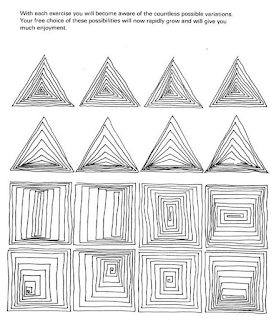
In Heuser's book, the thing most interesting thing to me related to drumming, are the exercises aimed at developing control of the hand and pencil, and hand/eye coordination. Doing exercises like the ones you see above, I found was very similar to working with touch and timing on the drums. You become very  aware in of the movement and mechanics of your arm, shoulder, and hand. The exercises themselves also have a logic analogous to things we do in drumming— working with simple forms and their logical permutations.  

The book is also very good for getting people into the idea of drawing, who may be hesitant to do it. The level of information quickly becomes overwhelming, but it's always stimulating, if you keep the focus on playing around, rather than mastery. It doesn't require any kind of artistic  ideas, or “vision”, or wanting anything other than to do it; the practice forms are enough. They're nice to look at, they become art. 

In music, getting playing ideas from exercises and patterns is not very musically pure, but it happens on some level. Maybe the drawing will help us appreciate the music in these mechanical form— pure music people, like me.  

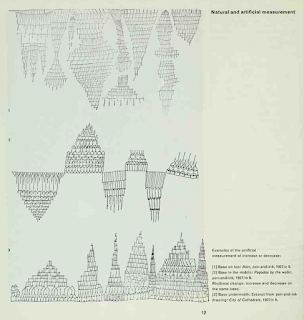
The Paul Klee notebooks are similar, but vastly more inspirational— the written content is intellectually way above my head. He explores basically everything in the world about the logic, function, and use of lines on paper. The illustrations are mostly simple, many look rather childish— which gives you an easy opening to trying it yourself. Getting into art, you have to be into art that looks like you could do it. 

Wednesday, September 15, 2021

A few rare items

I found some interesting things on one of those shady pdf download sites— a couple of rare books, and very old versions of a couple of unusual books. Worth getting if you're into that sort of thing:

An old hand copied version of Alan Dawson's Rudimental Ritual.

A 1963 version of Marvin Dahlgren's Drum Set Control with the layout done on a typewriter. For awhile this book (and a lot of other of Dahlgren's books) was available on Ron Keezer's Really Good Music Publishing site, but Ron passed away last year and the site has been down. I need to write to his son Geoff Keezer and find out what's the status of that company, and if the books can still be gotten. 

An old version of Vernel Fournier's Drum Techniques— or Drum Technique's, as it is written on the hand drawn cover. Doesn't include the Poinciana transcription that is in the current published version.

Handwritten, hand-stapled version of John Lombardo's Rockin' Bass Drum. It's a good old rock book, probably better than Funky Primer, except for the archaic style of notation. It's still usable. And this version looks cool. 

Fred Albright's Rhythmic Analysis for the Snare Drum. I believe this is completely out of print. Maybe it's an early version of his Polyrhythmic Studies for Snare Drum, I don't know— I don't own that book. Includes a good, very extensive explanation of polyrhythms, and a lot of very challenging snare drum solos, some including a bass drum part, a la Reed.  

I don't know why these pdfs are only on this site. Someone must have scanned his dad's/grampaw's drum book collection and uploaded it. Grab them fast, who knows how long this site will remain in existence. Let everyone know in the comments if you find anything else interesting.  

Wednesday, September 08, 2021

Best books: Rudimental Primer by Mitchell Peters

Mitchell Peters is becoming the guy for snare drum literature, for me— his books form a thorough and complete vocabulary for the snare drum as it is played in the real world. They're adequately challenging for most players, but they never get into the technical/reading absurdity we get from some other authors. All together they're cleanest presentation of the core craft of snare drumming I've found. 

Peters is well known in conservatory percussion, but his books are somewhat low profile in the broader drumming world— they're published by the Professional Drum Shop in Los Angeles, which is not super aggressive about promoting them. 

Rudimental Primer seems like a rudimental book for the non-rudimental world— concert percussion and drumset musicians. It covers all 40 of the Percussive Arts Society's list of international drum rudiments. Each rudiment gets two dedicated, very dense pages, with some preparatory studies for learning the the basic movements, and a number of short exercises in different rhythms and meters, plus a few short solo etudes. This is the real format for learning rudiments— not simply playing the through the PAS list

The solos are quasi-traditional, not unlike those in Haskell Harr. But these don't have that general stink of tradition. Everything in them is there for a reason. It's a modern book, and he includes solos in non-traditional meters, like 3/4 and 5/8. Peters generally doesn't try to do the teacher's job in the text— this book, like his others, is virtually 100% music. There are no hand movements (upstrokes and downstrokes) or dynamics marked in, apart from the stickings and accents. It's a book for the practice room— you could practice for half an hour without turning a page. Nothing needs to be filtered. 

Haskell Harr's and Charley Wilcoxon's books are my other most frequently used rudimental books, but they each have their drawbacks. The Buddy Rich rudiment book, which I never use, is not terrible, but it's overloaded with extraneous stuff, short on studies preparing for and developing many rudiments. Corps people will want to use a book with drumline-type hand motions written in, like Matt Savage's Rudimental Workshop. 

Rudimental Primer is a serious practice book for mature players and teachers, who know how the fundamentals of do this stuff, and how to teach teach it; and for pretty serious students— teenagers and up— who need to learn the rudiments.  

71 pages. Distributed by Professional Drum Shop, Inc, published by Try Publishing. 

I also recommend: 

Elementary Snare Drum Studies

Intermediate Snare Drum Studies

Advanced Snare Drum Studies (though I don't use it much)

Odd Meter Calisthenics (thanks Ed!)

Odd Meter Rudimental Etudes

All are available from Steve Weiss Music, and from the Pro Drum Shop

Sunday, August 15, 2021

Louis Bellson reading text in 4/4

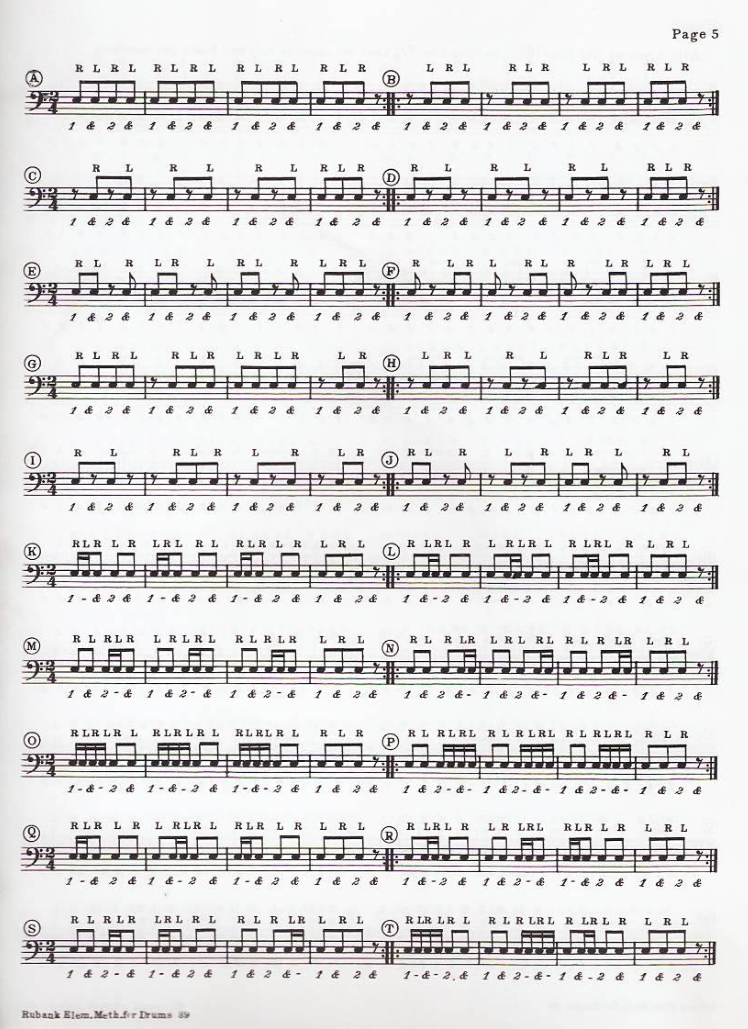
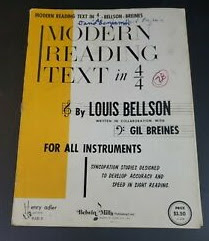
 Here are CRUISE SHIP DRUMMER! we spend a lot of time with the book Syncopation, and not so much with its more expansive, more serious-seeming companion, Louis Bellson's Modern Reading Text in 4/4. I use Reed a lot, I never use Bellson— both in my practicing and my teaching. I've owned Bellson for many years, and have tried using it, but it never stays on my stand very long. Let's take a look at what's in it and figure out why.  

The book is comprised of full-page and half-page composed exercises covering all the variations on a single rhythm idea, or summarizing several rhythm ideas. In Reed, by contrast, the individual rhythm variations are written out on one full four-measure line of music; the longer exercises are the rhythm summaries or composed exercises. 

You can play Bellson the same way you do Reed, playing each measure of the exercise several times, and then playing the exercise straight through, but I prefer the one line format in Reed, especially for teaching students of different ages and abilities. The graphical representation of the four measure phrase is helpful, and it encourages better reading habits— the student can move his eye along the line of music and then repeat back to the beginning of the line, or look ahead to the next line and continue to the next exercise. That's normal reading; looking at one measure in a line of music and repeating it over and over is not so normal. 

Looking at the individual parts of Bellson: 

Whither quarter notes
There is no dedicated section dealing with quarter notes and longer rhythms. I think that's a mistake. Fluency with quarter notes is kind of an overlooked area, and I would have liked some studies including whole notes, half notes, and dotted half notes for use at fast tempos.  


Pages 4-8 - Quarter notes, 8th notes, 8th rests

These are good pages, and a little more in depth than the equivalent pages in Reed— includes many rhythms only written with syncopated-style notation in Reed, which I don't really need.


Pp. 9-11 - Introducing the tie

Ties are important, but to me these pages aren't well balanced for drumming practice. The Reed p. 33 summary of 8th rest/tie/syncopated summary illustrates the concept more quickly and clearly. 


Pp. 12-13

Introduce some 16th note and triplet rhythms, that are rather disruptive to doing systematic drumming practice. We get that stuff from snare drum books— Delecluse, Peters Podemski. I don't really need it for developing drum set reading, and drum set practice systems. 


Pp. 14-25 - Syncopation

The first two pages are summaries of how syncopated notation works, but again I think p. 33 of Syncopation is a better summary of this. The ten syncopation exercises on pp. 25 are fine, I just never use them. They include some non-standard notation, like writing three 8th rests in a row, or putting a syncopated quarter rest between two 8th notes, or tying two 8th notes where the first one falls on the beat, or violating the “imaginary barline” between beats 2 and 3. Yes, reading those probably helps my reading, but learning to read bad notation is not at all my primary purpose in using these books. 


Pp. 26-39 - 16th notes and rests, tied 16ths

These pages cover a large gap in Reed, and should be very useful, but I find them quite tedious. Full pages dealing with a single type of 16th note rhythm, written as many different ways as possible. This is


where the book becomes increasingly focused on creating reading problems. It sacrifices its usefulness as an everyday practice book for the sake of forcing you to deal with exceptional reading situations. Like there's one measure with nine 16th rests. It's exhausting to look at.  

And for all that, it totally ignores some common ways these rhythms are written—the e& page, for example, always writes that rhythm with all 16th notes or 16th rests, or tied 16ths. Never as is it is commonly seen in drumming literature, 16th rest-16th note-8th note.

This section is also not as useful as it might be because on drumset, in real life, I don't have to read many 16th notes. When I need to practice a four note subdivision on the drum set, I practice Reed in 2/2. I teach reading 16th notes with a combination of snare drum and funk books. 


Pp. 40-46 - Ten syncopated exercises with 16th notes
These are not terrible, I just have little use for them. Each exercise is so varied they're mainly only good for comping/independence practice— to do the other interesting and useful things involving filling in the gaps in the written rhythm, we would have to devise some new methods. Maybe that would be worthwhile, I just haven't felt the need.   

P. 47-60 - Eighth note triplets
All about triplets and triplet partials using rests and ties. This seemingly fills a large gap in Syncopation. But we do play a lot of triplets through the usual Reed methods, they're just implied, and not written out. I don't find it to be a problem, from a reading perspective, because, again, I don't often have to read them in music for drum set. 

And once again, this section quickly devolves into graduate-level reading puzzles. At a certain point, this focus on fragmentation begins to detract from the fundamental concept. It's not that ambitious students shouldn't be able to read it; that focus just detracts from the book's day to day usefulness.  


Pp. 61-64 - Introducing the quarter note triplet

Another valuable subject missing from Reed... that instantly descends into flyshit-reading hell. Same goes for the half note triplet section after it. 


Pp. 66-67 - Syncopation with triplets

Not terrible, but random. Put a permanent book mark on these pages, or tear out all the intervening pages. Not worth the effort to me. 


Pp. 68-81 - Fourteen exercises

Regular syncopation exercises with 16th notes and triplets included. These are reasonable, decent reading exercises, but again, the variety of rhythms makes them difficult to use for daily drumming practice— beyond just using them as complicated independence rhythms. 


Pp. 82-85 - 16th note triplets and 32nd notes

Not terrible, but you would have to devise a use for them on the drum set. Or just play them on the snare drum. Delecluse and Cirone are full of stuff like this. I've never seen anything like this when reading for drum set. 


Pp. 86-87 - Introducing double time

This is useful; we get some common syncopated rhythms, together with their double-time equivalent. But once again, the authors can't resist messing with us by writing the rhythms in a bad, difficult to read style. How about if we learn THE CONCEPT, then you can teach us all the wrong ways it might be written?


Conclusion
So this is only partly a rhythm book— it's at least 50% a reading-bad-notation book. I don't know who needs to master performing this level of reading in their day to day professional life— LA studio musicians? Classical musicians? Math-genre people? I think a lot of this is better covered with regular literature written or transcribed for the user's actual instrument. 

At some point with this crap, you're just teaching people bad notation style. OK, we want to be prepared to read “anything”, but here bad notation is way over-represented, and the actual good notation is just part of the undifferentiated notation-bomb debris field. So some composition student works through this thing and thinks “hell yes, I can write a quarter note on the & of 2 any time I want, why not.”

Reed has it's limitations, but as a day to day practice volume for drummers of all levels, it's vastly superior to this— that just isn't what Bellson's Reading Text is. And you can fill in all the major gaps in Reed by just finding a copy of Chuck Kerrigan's out of print Syncopated Rhythms for the Contemporary Drummer. Those two books form a drummer's complete core rhythm vocabulary, to which, having mastered it, you can add whatever other oddball things you want. 


By the way

Bellson's other reading book, Odd Time Reading Text, is even worse. Maybe 15-20 of its 130 pages are useful— which may be good enough reason to buy it. 

UPDATE A FEW DAYS LATER: Compelled to force myself into an embarrassed retraction of this whole piece, by finding a real invaluable drumming purpose for the book— so I'm practicing out of it more than I normally would. So far I'm a little more annoyed than I already was. 

For example, if I know ahead of time that all the 16th notes on p. 30 are on the e&, it kind of defeats the purpose of writing it all kinds of crazy ways to trip me up. You're not teaching me to read crazy notation, you're teaching me to ignore the notation based on prior information. Is that the intended lesson? I don't think so. 

And the formula of repeating a measure with the rhythm notated differently, or repeating the same rhythm except with 8th notes substituted for quarter notes— it gets tiresome. Mix it up, let me pretend I'm playing a piece. 

Wednesday, June 23, 2021

A needlessly difficult book

This has been sitting in my drafts folder for a few weeks. I wasn't going to post it, but I'm having a hard time finishing anything lately. So here we are: 

A book I've never seen before, Drumming In All Directions, by David Dieni, a drummer/percussionist from the Bay Area, was mentioned on a drumming forum, and I want to give a few opinionated comments on what I see in the online preview. I'm not bringing it up to try to sell you on not buying somebody's book— I want to use it to talk about what I want in practice materials, and why— and maybe give some things to think about for others who write.    

What's in the book is real stuff— I, and others, do some similar things using Reed, Dahlgren & Fine, and other books— I just don't dig this presentation. 

Just in terms of understanding what we're supposed to do, the book doesn't go easy on us explaining its methods. This example illustrates the book's system, and wow:


I already know what he's doing, and it's hard for me to figure it out from reading that. The concept is to play some composed two-voice practice phrases, using a few different coordination systems— actually unison stickings: 

Hands vs. Feet - RH/LH vs. RF/LF
Right Side vs. Left Side - RH/RF vs. LH/LF
Opposite side unisons - RH/LF vs. LH/RF 

It's quite similar to the harmonic coordination section of Dahlgren & Fine. He also uses some worked out tom moves, as I do, and many others. So far, so good— you could do the same thing with those stickings with Reed (filling in the gaps in the written rhythm) or Stone (substituting those stickings for the Rs and Ls).   

My major problem is that the practice phrases (called groove melodies in the book— really they're solo phrases) are just very remote from musical reality as I know it. For example, I never want to look at anything like this when I'm practicing the drums:


I don't understand the purpose of writing these exercises as 32nd notes— I don't consider this level of fluency with reading them to be an essential skill for a drummer. I don't believe I've ever read a 32nd note in the course of playing music professionally, and I read them pretty rarely when practicing drum set. If I were ever to play anything similar to that in real life, I would be thinking in terms of 16th notes double timed. Maybe even 8th notes quadruple timed.

Materials written for two voices, or written as a sticking, do have a purpose, but most of the time I want to practice, play, read, and think in terms of a single melody rhythm, and inferring the second voice— Reed style. These phrases have rests, which are hard to duplicate with standard Reed methods or Stone-type sticking patterns. But if that were considered very important, we could devise some methods to include rests, and then improvise some similar things. Which in the end is the entire point— learning to improvise.   

I'm also not fond of the drum-theoretical content. For example, there is a lengthy description of drumming coordination as a progression from “control of individual limbs” to “independence” to “interdependence”:


I don't recognize this from my own experience at all. Independence is not a step along the way to interdependence, it's simply a defunct theory of how drumming coordination works. At every step of development, there is only deliberate coordination of parts, or there is guessing at it. 

How you write these things is important, because so much of drumming involves people figuring things out for themselves— no matter how good of instruction and information they get, they still have to figure it out in the practice room. So when a major topic like coordination is badly framed, it misguides readers' thinking and gets them pursuing phantom abilities, and it's a massive time waster.    

In the end, it's not difficult to write a lot of hard stuff to play on the drums; it's more difficult to present it clearly, and communicate clearly, and to make it relevant to the real world of playing music. And to be economical with the demands you make on people's time practicing it. It's not that this is a terrible book (from what I see in the preview)— I think it's needlessly difficult for what it aims to achieve for users. 

Friday, March 12, 2021

What I'm practicing

I'm at the point where I've published so much stuff on the site, I'm a little embarrassed. I don't want people thinking I'm just fascinated with writing patterns. I do practice this stuff, and otherwise use it. For example, I'm not real happy with the existing literature/methods for young/novice drummers, so I write a lot for my students. The transcriptions are listening projects. I write some library pages because they don't exist, and they could be useful, to someone, someday, maybe. I'll write my own versions of existing materials, to make it easier to practice them the way I want.

And so on. Basically I write for a lot of purposes, and when you develop a regular morning writing habit, you tend to produce a lot of stuff. 

So, for a reality check, here is what I'm actually practicing, usually on different days, right now:    


All of the Three Camps for Drumset pages
 
People adapt this piece for all kinds of rudimental applications, why not make extended jazz texture drills out of them? I'm enjoying these a lot, and I hit them all every time I practice right now. 


Linear double paradiddle / paradiddle-diddle inversions page

This turned out to be a really solid page to have around. The complete patterns are good, and if you break them down further, playing every two beats of them, or even single beats, you've got all the major jazz ways of playing triplets with two voices. Play them along with a jazz cymbal rhythm on the SD/BD, SD/HH, HH/BD. Or play the snare part with both hands in unison, bottom part with BD, HH, or BD/HH in unison. Or play the bottom part with the RH/BD in unison, play the snare part on the snare with the LH. There's a lot you can do with the page to open up your Afro 6 feel for jazz settings. 


Reed methods

Filling in 8ths with the BD during a time feel, new uptempo method, bass drum and snare drum triplet fill ins— those last two are common methods that I don't think I've written about on the site. Play a medium jazz time feel, play the book part on the snare drum, fill out the triplets with the bass drum, or vice versa— book part on bass drum, fill out triplets on the snare drum. 


Mitchell Peters Rudimental Primer

I just got this excellent book. Think of it as Haskell Harr modernized, for concert snare drummers— Peters washed off some of the stink of tradition. Each rudiment gets two full pages of exercises and short solos in different meters— including some in 5/8 and 7/8. Which is appropriate— practicing rudiments just using the list format doesn't make it. Mainly using this to get my traditional grip back in shape. 


Haskell Harr
I'll play through most of Harr's book 2 every time I practice snare drum. It just puts my hands in a nice place of feeling able. 

Wilcoxon
Several of my students are playing out of Rudimental Swing Solos right now, so I need to keep it together. I'll be honest, practicing Wilcoxon doesn't bring me a lot of joy, and I don't know why. It's essential literature, a direct connection to Philly Joe Jones and a lot of other people. I practiced it a lot, for several years, and it made very little difference in my playing. I just don't play rudimental stuff on the snare drum very much. 

All pretty normal stuff that I've been doing, in different forms, for years, or decades. Which is a little strange— why wouldn't I be doing something new? I think at this point in my life and career, I know what I want to play, and what will be required of me, and I want to continue improving my basic thing, and filling in gaps in my abilities with that. And improve my methods, since I'm not an “efficient” practicer.