Tempo is about 256, solo begins at 2:36.

All the notes are played strongly, except the ones in parentheses. You'll notice not all the left hand stuff lines up perfectly with the cymbal.

A drumming blog written by Todd Bishop.
Here's a drum solo by Billy Higgins, from the tune Third World on Freddie Hubbard's album Bolivia.
I've never played this tune and didn't count out the form. It starts with 8 bars of an ensemble figure with drum fills, which also occurs at the end of every solo chorus. The transcription begins with that section at the end of the piano solo, then Higgins's actual solo begins at bar 9. And you hear Higgins play the figure in the last 8 bars of his solo, then the band comes in with it on the head out.

Snares off. 8th notes are swung, or half-swung. The bass drum is feathered through a good part of this; also there are some random hits I didn't notate. The hihat really isn't used at all, maybe one or two random notes I didn't notate. Look for places to add doubles when moving around the drums— like in measure 11, the first two triplet partials are played with the same hand.
At measure 41 there's a little rhumba part that is difficult to notate There are a variety of sounds happening, and changes in pitch— which I didn't indicate. The regular Xs are rim clicks, the alternate Xs are played on the rim (possibly with the R instead of the L indicated), and the house top accents are rim shots.

The solo starts at 5:18 in the track, or at - in the video of the full album below:
More Ben Riley! From the same record as yesterday— Thelonious Monk Live At The It Club— and in fact this is the very next tune they played at the gig, Bemsha Swing. So, two drum solos by Ben Riley, that he played within within 10 minutes of each other.
Bemsha Swing is a 16 bar tune, a miniature AABA— a four bar tune played four times, played in a different key on the bridge. He plays three choruses— 48 bars— in real clean four bar phrases.
The solo starts at 6:37:

Once again there are a lot of abbreviated 16ths, and some triplets. Hihat is spotty, often played on 2 and 4, but not really integral to the main idea. There's also not so much bass drum feathering activity here— often on the longer runs of singles it'll be there.
Lots of phrases start with that 1 &2 & figure with the cymbals. And a lot of obvious paradiddles happening there— anytime you see those lone notes on the floor tom on an e of the beat, and probably elsewhere with the 16th notes.
Again, Blogger isn't letting me embed the video, so you'll have to open it up in YouTube or get out your record to listen.
Solo by Ben Riley on Blues Five Spot, from the Thelonious Monk record Live At The It Club. Great record, and core literature. I think of Ben Riley's playing as maybe the cleanest shot we get at pure, classic-form modern bop drumming. Everything's real clean and worked out, and not idiosyncratic. Still, he plays creatively and has a nice musical sound, and he's real enjoyable to listen to.
The tune is a 12 bar blues, and Riley solos over four choruses— 48 bars. He doesn't seem to be outlining the choruses strongly— especially as he gets into the long roll— but if you sing the tune over the solo, it all makes sense. He does make the end clear by playing rhythm stuff on the last four bars before the head out.

Riley feathers the bass drum basically all the way through this. It's very worked out— if he makes an accent on the & of 2, he probably feathered it on 2, and was back into the feathering on 4. We see something like that in bars 22, 46, and 47. There's very little audible hihat, so I left it out. Occasionally I'll hear it on a beat 2 or 4.
The 16th note moves around the toms are a little unusual, he moves on the es and as— clearly there's some kind of mixed paradiddle type sticking there. Figure out a sticking that works for you, and pencil it in.
Be careful with the abbreviations here— remember how those work: total slashes/beams on a note = note value you play for the duration of the written note. Two slashes and/or beams on a note = play 16ths, three slashes and/or beams = play 32nds, or actually, roll.
Notice some of the abbreviated rhythms have tuplet indications above them— several 5s and a couple of 3s. The 3s indicated a 16th note triplet, likely sticked RRL. The 5s indicate tap five stroke rolls, played in a quintuplet rhythm: RLLRR LRRLL. It's not that unusual a thing. I see I haven't written about abbreviated rhythms yet— see Podemski for a complete breakdown of how that works.
Get the pdf
Blogger isn't letting me embed the video, so listen to the recording here, or dig it out of your record collection, you should own it.
Some uptempo trading 8s and 4s on Moose the Mooche, from an old favorite album, Wish by Joshua Redman, with Pat Metheny and Charlie Haden, and Billy Higgins on drums. I used to play along with this track a lot.
Tempo is a little over 300 bpm, and trading begins at 2:17:

Virtually all the activity here is with the hands— there is a little feathering the bass drum in half notes in the last 4. Maybe there's more than that, I didn't check. Distinction between accents/non-accents is not extreme, though notes marked as ghosted are definitely ghosted. Obviously there are paradiddle-type stickings happening on the tom tom activity.
Some more from that self-titled Stanley Clarke album. I must have gotten the record in high school. Nobody ever told me to get it, I was just rooting through the stacks at the used record store and I saw that it had Tony Williams on it. These things are just around waiting for you to buy them and you luck onto them because you're looking. This is the drum solo from the tune Life Suite, Part 2.
The solo is 60 bars long, over a 4 bar vamp played 15 times. He takes his time getting off the hihat, and comes back to it during the more soloistic parts, and then takes it out with four bars of hihat at the end. Tempo is a pretty burning 148. Getting up into the natural speed limit for 16th notes in a fusion setting, before they start sounding like massive hyperactivity. Egberto Gismonti's Baiao Malandro, which I transcribed early in the blog, is similar. The transcription begins at 0:40 in the track, or at 2:29 in the YouTube clip below.

Snares off for the entire solo. There's some open hihat activity I didn't bother writing out— at the beginning especially. He's bouncing his left foot for a good portion of it, which creates some half-open sounds on the es and as. I also didn't write out a good amount of left foot activity throughout that doesn't really relate to the rest of what he's playing.
Tony Williams isn't really a textural drummer, is he? Everything he plays here is very direct, with a lot of hihat and bass drum at the beginning, and a lot of cymbal with bass drum generally, along with some stuff with the hands on the snare and tom toms. Mainly alternating sticking. Briefly in measures 53-54 there's some modern textural stuff happening with the cymbal, snare, and bass drum. Tony-like(!) licks are happening in measures 30, 37-38 (same handed flam accents, there), and 55-56. Those crescendo-ing singles in m. 16 and 18 are also very Tony.
Again, the transcription begins at 2:29 in the video:
Another drum solo from a Jackie McLean record. Jack Dejohnette early in his career, soloing on a fast tune from McLean's album Jackknife. The tune is Climax, tempo is about half note = 160. We looked at another tune from this record awhile back.
If you ever worried about not being able to solo at fast tempos, check this out. It's fast but very simple, using a few basic “non-independent” patterns, with hands in unison opposite the bass drum. He's not panicking about not throwing in enough stuff, or changing ideas fast enough.
The solo begins at 6:55 in the track.

That measure of 9/8 near the end is nothing, ignore it. Just an extra 8th note seemed to work its way in there.
Here's Roy Haynes's drum solo from the title track of a Jackie McLean record we visited a few months ago, It's Time. The solo begins at 5:31.
Pull up my Cliché Control page and start comparing this with things found in this and some other solos. I feel like I'm seeing a lot of the same stuff. This also contains a lot of patterns in 3, so there's some conceptual overlap with my Roy Haynes waltz lesson.

The tempo on the tune overall moves around a little bit, all within natural tolerances. The last three solos are Herbie Hancock, Cecil McBee, Roy. Herbie's solo starts at ~266, Cecil's solo ends at around 248, Roy's solo ends at around 280 or above. After the horns come in with the head out the tempo settles a little bit.
This week I may finally be getting a handle on this Jimmy Cobb fellow, after 40 years of listening to him. It turns out his records with Wynton Kelly are the ones to listen to. Obvious, but when you're mostly monofocused on a paltry 300? 500? records, there are going to be gaps.
This is an extended solo from Out Front, from Kelly's record Undiluted. It's a 32 bar tune, and Cobb solos for three choruses. Tempo is in Roy Haynes territory, 283 bpm. It's rather macho— he's on the spot for three choruses and he burns it out in a big way. We talk about “ideas” and “chops” and “musicality”, but there's also a basic jazz musician thing where you just bring it and that's it.

Still, his phrases are nicely composed, and they're good basic vocabulary at more moderate tempos. You could practice them two or four measures at a time.
Dynamics are dramatic— the ghosted notes (indicated with parentheses) are extremely soft. So soft I may be missing some things there.
He keeps the hihat going on beats 2 and 4 for the first chorus, drops it out in the second chorus, and feathers the bass drum for most of the first two A sections of the third chorus. Like a lot of players of this period, this is played mostly with the hands on the drums, with the bass drum used mainly for accents, or as part of worked out licks. I'm not hearing evidence of a lot of rudiments happening— it's mostly accented singles. There are probably doubles happening where there's one or two beats of triplets. At the beginning of the third chorus there are some Flam Accent #2s, or something like it.
I felt like many two measure phrases started after the down beat, often on the & of 1.
From maybe the first jazz record I ever checked out on my own, Golden Boy by Art Blakey. Kind of an obscure record on the Colpix label, that I dug out of my dad's record collection. Along with that Charlie Parker recording I mentioned the other day, and a Jazz At The Philharmonic album, and Kind of Blue. Anyway, Blakey does an extended solo at the beginning of This Is Life, and it was the first idea of jazz drumming I ever got from a record. I think all I knew about Blakey was the rough looking picture of him in the Zildjian cymbal guide, and my brother mentioning that he played really loud.

The tempo starts around 192, picks up a bit to about 210 by the end of the solo, and is about 178 after the band comes in.
I wrote the bass drum part as accurately as possible in measures 19-22, but if you're going to play this solo, do not mess with trying to do what I've written— listen to the vibe of what he's doing and copy that. Basically he's flailing it in there, and his foot wants to do quarter note triplets or straight 8th notes.
He “feathers” the bass drum through the first part of this, but that seems the wrong word— some old guys say “pats”, and that's really what he's doing here. It's a dry leathery sound, barely a tonal sound.
By the way, the cymbal he's using here is squarely in the middle of Cymbal & Gong-land. The first 20" Holy Grail video I pulled up is damn close to it— except that HG is a little heavier. I quickly found a couple more that were close. Of what I have in stock right now, “Amos” is the closest match to this cymbal.
...have I mentioned there is a sale on cymbals going right now! 10% off Holy Grails purchased with a 30% off Leon— and I never give discounts on Holy Grails.
On the Cymbalistic blog I mentioned a different Blakey cymbal, the one used on The Big Beat and Indestructible, and also found a good match in my past stock of Holy Grails. I've only sold about thirteen 20" Holy Grail Jazz Rides since I've been doing this, and at least 4-5 of them are reasonably exact matches for something Art Blakey played. The rest of them are right there in the same family. What I'm trying to communicate to you is that these cymbals are it— there's a reason I'm so excited about them.
Something released in a year starting with a 2, for once. Here Bill Stewart solos during James, from Pat Metheny's Trio - Live record. Stewart is a few months older than me, and is sort of the archetypal drummer artist of my generation. I first heard him on John Scofield's Meant To Be in 1991, and it was instantly obvious that he was doing something fresh and extra-musical. It's routine now for drummers to sound like him, with that pretty tom tom sound.
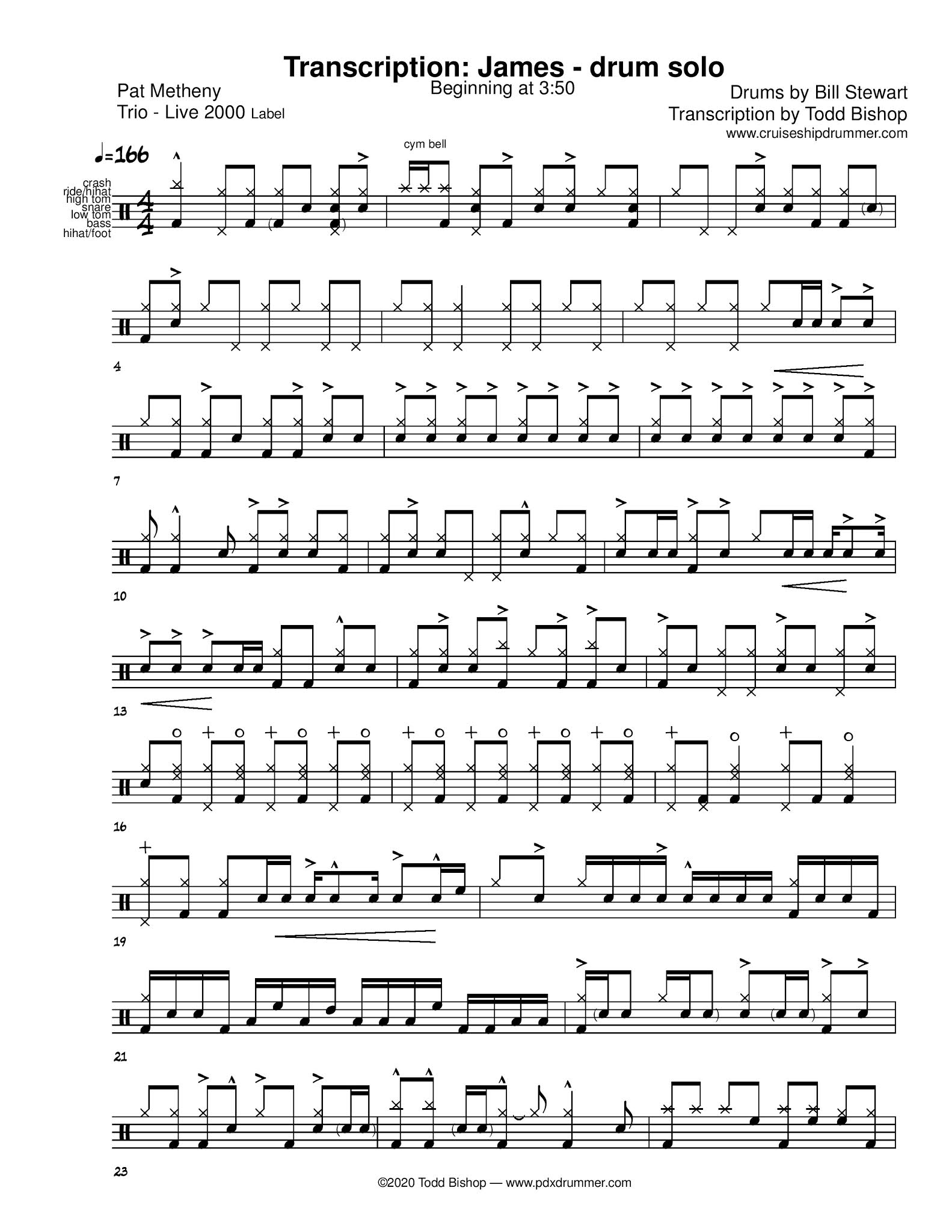
The solo begins at 3:50, the tempo is quarter note = 166— on the real scale of tempos, that's pretty bright to be double timing, playing 16th notes. I'll talk about what I mean by that another time.
It's mostly 8th notes, and he mostly stays on the cymbal and snare drum. There are some open drags with the left hand— that's the occasional 16th notes you see— and a big 16th note lick near the end of the first page. He plays his one note on the third tom tom on that. There's a passage of 16th notes in the second page, too— notice he repeats the same idea in measures 30, 31, and 33. Plus a BSSB pattern with a cymbal on the first note.
He uses that pattern repeatedly. As I do— it's extremely useful and sounds cool— it's good to get very friendly with it. Let's credit Elvin Jones for originating that one.
The open hihat lick in the middle of the first page is questionable. I've written it as if he plays the open notes with his left hand, but he could be splashing it with his foot. If that's the case it's a pretty developed technique, which you'll need to spend some time with.
Just a couple of solo 4s from Art Blakey, from the 1953 Miles Davis 10-inch release, Vol. 3. You'll most likely find it on a later Blue Note compilation. The tune is Well, You Needn't. Miles and Blakey trade on the first two A sections of the head out, Miles plays the melody on the bridge. The first drum break happens at 4:18.

He's mostly playing stick shots on the snare drum, as you can see. The normal snare hits are played with the left hand, the shots with the right. He feathers the bass drum throughout.


