The pdf links for last week's Zappa features are now down, so, to assuage the pain for those of you who missed them, here's Vinnie Colaiuta's drum groove from The Central Scrutinizer, the opening track from Joe's Garage. In 1985, during the long drum corps tour bus rides, and in the following year in school, I managed to transcribe a big chunk of the drumming on that record; I've been coming back to it a bit recently to see if the experience is any different after nearly 30(?!) years.
Note that there are two toms played, and they are written on the top space, and the line below it. There are a lot of variations in the bass drum part, especially on beat 3. These exact variations occur frequently on beats 1 and 4:
I was going to write out the whole thing, but the track is essentially just a 4-bar vamp with a little B-section, and obviously recorded blind, with the vocals and sound effects mixed in later— Zappa likely just had the rhythm section play generically off of the vamp for a few minutes, and that was it— and I kind of lost interest. But Vinnie's fills are fun, and there's a nostalgia factor at work, so maybe we'll get to a full transcription a little later.
Audio after the break:
Showing posts with label Vinnie. Show all posts
Saturday, September 14, 2013
Sunday, December 18, 2011
Vinnie Colaiuta Q & A
Here's 37 minutes of audio from the question and answer portion of a Vinnie Colaiuta clinic. He opens with some discussion of playing in 19/16 on Keep It Greasey, from Joe's Garage by Frank Zappa (which reminds me, I think maybe Santa might have a transcription for you coming up). At a certain point in my life I would've worn out the cassette hanging on every word of this, despite the quality being a little rough:
As I'm listening through: He discusses getting an authentic feel in samba and baiao, which is something else we've talked about here, and also the non-alternating flam drag, which is similar to one of my licks.
h/t to Stitch Kaboodle @ Drummerworld
As I'm listening through: He discusses getting an authentic feel in samba and baiao, which is something else we've talked about here, and also the non-alternating flam drag, which is similar to one of my licks.
h/t to Stitch Kaboodle @ Drummerworld
Wednesday, September 07, 2011
My Vinnie Year - part 3 - superimposed metric modulation
This is a technical piece by Vinnie Colaiuta, which accompanied his 1987 Percussioner magazine interview, and he now shares with us on vinniecolaiuta.com. I spent considerable time with this- way too much, actually, considering that it's not exactly a daily-user, and there were more ahem pressing matters for me to attend to.
Be sure to read his explanatory text, and remember his closing advice, with a big emphasis on the if:
"...if you find that you have the place where you can use something like this, above all else, be musical!"
Be sure to read his explanatory text, and remember his closing advice, with a big emphasis on the if:
"...if you find that you have the place where you can use something like this, above all else, be musical!"
Tuesday, September 06, 2011
My Vinnie Year - part 2 - Percussioner magazine interview
Sometimes I think the whole purpose of this blog is just for me to gather all the things I ever did, heard, read, or listened to about the drums a put them in one little basket. One little, ratty basket. Fine. Here's part two of MVY, with Vinnie Colaiuta's other 1987 interview, this time with the short-lived Percussioner magazine:
MUSICAL IDENTITY:
"I tried to actually sound like Tony Williams when I played certain things; I tried to play like Steve Gadd when I played other things; I tried to sound like David Garibaldi for other things; and I really got into Billy Cobham for other things, to the point where it just melded together and my own style emerged. I knew that I was sounding a lot like other people and I wanted my own identity.
I don't know how it came about because it was so evolutionary but, I knew my style wasn't going to come out by copying somebody else. My brain must have said, 'you're copying this guy. No, go to him. No, don't. Do this, do that', and I came out with myself. When I was playing with Frank, I had to find a way. There, I was presented with something different on the drums that I could not rely on my predecessors to show me how to play. I could draw on their influences to play fusion beats and certain licks but when it came to applying polyrhythms, I had to do it my own way."
LEARNING A STYLE:
"I was in London with Frank and he wanted to play a reggae tune. I heard one thing and I knew the bass drum was on 2 and 4 and I just took it from there and made up my own thing. The beat was kind of a swing, not straight eighths up and down, but subdivided so I had some room to play around and it went over. People liked it. Then, I heard the authentic stuff and mixed that in with it. So I kind of went about it the backwards way. I once heard Steve Gadd play one reggae groove on a Joe Cocker record and I said, 'Yeah, that's it.'
So, a lot of my stuff came from groping and I came up with my own style. But, sometimes I still play stuff that sounds like someone else and I don't cover it up. Like, Gadd played something that I love and it's a great move and I'll play it if I can pull it off, if I am playing the kind of music that warrants it. Since Steve recorded so many things with Tom Scott, it was like he wrote the book on it. At least, I couldn't find a way to play it any better than he played it, so it felt comfortable for me to assimilate his way. I didn't sound exactly like him. It's like one saxophonist playing 'In The Mood' and another saxophonist plays the same melody. It is not going to be exactly the same, but it will be close."
AFTER ZAPPA:
"I wanted to take what I had learned and apply it to other things but I found out soon enough there was no room for it anywhere, unless I did my own thing which I still haven't really done yet. Music is like language - if you don't speak it, it stays up in your head and you just stammer at it."
MUSICAL IDENTITY:
"I tried to actually sound like Tony Williams when I played certain things; I tried to play like Steve Gadd when I played other things; I tried to sound like David Garibaldi for other things; and I really got into Billy Cobham for other things, to the point where it just melded together and my own style emerged. I knew that I was sounding a lot like other people and I wanted my own identity.
I don't know how it came about because it was so evolutionary but, I knew my style wasn't going to come out by copying somebody else. My brain must have said, 'you're copying this guy. No, go to him. No, don't. Do this, do that', and I came out with myself. When I was playing with Frank, I had to find a way. There, I was presented with something different on the drums that I could not rely on my predecessors to show me how to play. I could draw on their influences to play fusion beats and certain licks but when it came to applying polyrhythms, I had to do it my own way."
LEARNING A STYLE:
"I was in London with Frank and he wanted to play a reggae tune. I heard one thing and I knew the bass drum was on 2 and 4 and I just took it from there and made up my own thing. The beat was kind of a swing, not straight eighths up and down, but subdivided so I had some room to play around and it went over. People liked it. Then, I heard the authentic stuff and mixed that in with it. So I kind of went about it the backwards way. I once heard Steve Gadd play one reggae groove on a Joe Cocker record and I said, 'Yeah, that's it.'
So, a lot of my stuff came from groping and I came up with my own style. But, sometimes I still play stuff that sounds like someone else and I don't cover it up. Like, Gadd played something that I love and it's a great move and I'll play it if I can pull it off, if I am playing the kind of music that warrants it. Since Steve recorded so many things with Tom Scott, it was like he wrote the book on it. At least, I couldn't find a way to play it any better than he played it, so it felt comfortable for me to assimilate his way. I didn't sound exactly like him. It's like one saxophonist playing 'In The Mood' and another saxophonist plays the same melody. It is not going to be exactly the same, but it will be close."
AFTER ZAPPA:
"I wanted to take what I had learned and apply it to other things but I found out soon enough there was no room for it anywhere, unless I did my own thing which I still haven't really done yet. Music is like language - if you don't speak it, it stays up in your head and you just stammer at it."
Monday, September 05, 2011
My Vinnie Year - part 1 - "My left hand is kind of funky."
It was actually more like three or four years closely studying Vinnie Colaiuta's playing, but this sounds better. Anyway, '87 was when I was really deep in it- or so I thought- and he happened to get a lot of press that year. I had been chipping away at transcribing Joe's Garage since '84, I saw his legendary PASIC performance in '85, which of course made a big impact, and spent '86 and '87 absorbing some of his thing through Gary Chaffee's Patterns series
of books. My bassist friend Kirk Ross had moved to LA and sought him out and befriended him; Kirk would send me bootleg cassettes of Vinnie's gigs, and passed along my crappy transcriptions to him.
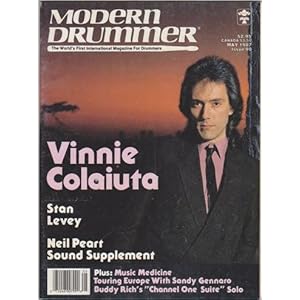
So here, from Vinnie's web site, is part one of some stuff I was immersed in at the time, first some excerpts from Vinnie's 1987 interview in Modern Drummer, with Robyn Flans:
RF: You made a comment recently that you would like a teacher to revamp your technique. Could you explain that comment?
VC: [laughs] It's self-explanatory. I was looking for somebody who I could sit down with and say, "Hey, look. Here are my hands. What do you think of them?" I'm at a crossroads, where I'm just doing whatever is coming out and not really thinking that much about how I'm hitting the drums. Consequently, I've developed some bad habits, I think.
RF: What kind of bad habits?
VC: My left hand is kind of funky.
[...] The posture of my left hand is not so good. My sitting posture is weird now. I was going through a little changing thing before. It was a period that had to do with my changing the way I approach the drums, and it changed the way I thought about playing.
[...] It made me feel a certain way, and I just wanted to approach the drums from that angle when I played, which is part of the reason I sat so low.
[...] I've [since] raised my seat height.
[...] I was starting to develop some lower-back problems. One night, I made a move while I was playing, and I was frozen still. I screamed out, and it was horrible. So I've been gradually changing it; I'm still changing it, because I want to get better leverage. My right foot feels weird, which I think is partially because it's still healing since I fractured it.
So here, from Vinnie's web site, is part one of some stuff I was immersed in at the time, first some excerpts from Vinnie's 1987 interview in Modern Drummer, with Robyn Flans:
RF: You made a comment recently that you would like a teacher to revamp your technique. Could you explain that comment?
VC: [laughs] It's self-explanatory. I was looking for somebody who I could sit down with and say, "Hey, look. Here are my hands. What do you think of them?" I'm at a crossroads, where I'm just doing whatever is coming out and not really thinking that much about how I'm hitting the drums. Consequently, I've developed some bad habits, I think.
RF: What kind of bad habits?
VC: My left hand is kind of funky.
[...] The posture of my left hand is not so good. My sitting posture is weird now. I was going through a little changing thing before. It was a period that had to do with my changing the way I approach the drums, and it changed the way I thought about playing.
[...] It made me feel a certain way, and I just wanted to approach the drums from that angle when I played, which is part of the reason I sat so low.
[...] I've [since] raised my seat height.
[...] I was starting to develop some lower-back problems. One night, I made a move while I was playing, and I was frozen still. I screamed out, and it was horrible. So I've been gradually changing it; I'm still changing it, because I want to get better leverage. My right foot feels weird, which I think is partially because it's still healing since I fractured it.
Tuesday, January 18, 2011
Vinnie Colaiuta transcription - Frank Zappa's Packard Goose
This is one of the hairier transcriptions I have ever done- Vinnie Colaiuta's drum part from the guitar solo on Packard Goose, from Frank Zappa's Joe's Garage. I originally transcribed this- along with much of the rest of the album- in 1988. Since I couldn't find my old notebook, and it was probably riddled with errors anyway, I re-wrote it to prove something to someone on the Drummerworld.com forum, and as a naked display of transcribing prowess.

It's mostly playable, though there are a few spots where I'm pretty sure the internals of what is being played are inaudible; you can only hear the accents, and the "drumistic" logic of the passage is lost. In those cases the transcription is just a foot print. The worst instances happen around measure 93. You can't purchase the mp3 on Amazon, but you can listen to it on YouTube:

It's mostly playable, though there are a few spots where I'm pretty sure the internals of what is being played are inaudible; you can only hear the accents, and the "drumistic" logic of the passage is lost. In those cases the transcription is just a foot print. The worst instances happen around measure 93. You can't purchase the mp3 on Amazon, but you can listen to it on YouTube:
Subscribe to:
Posts (Atom)