Showing posts with label polymeter. Show all posts

Wednesday, March 01, 2023

Metric modulation a la Silverman - 01

A student brought in a copy of Chuck Silverman's Practical Applications: Afro-Caribbean Rhythms for Drum Set, and we worked through a part of it together, dealing with metric modulations— or more accurately superimposed metric modulations (Vinnie Colaiuta's term).

It means an illusory tempo/time change while remaining in the original meter. It's a drumming hot topic; as a musical device it's mainly a trap, a bad decision. But it's worth pursuing a little bit to learn something about rhythm. 


Patterns 1 and 2 are warm ups; line 3 is the pattern as it appears in Silverman's book. Lines 4-10 are my own variations, making some basic funk rhythms, superimposed. 

As an exercise, you could play four measures of a simple half time feel groove with the same cymbal rhythm, alternating with four measures of the above patterns: 


Try it along with a Afro 6 type loop— here's a reasonable-tempo one, and a faster one. 

Here's a similar page I wrote in 2019. 

Get the pdf

Sunday, June 03, 2018

Hemiola basics - UPDATED

On the sage advice of a fifth grade student, I've revised this old page introducing the 3:2 polyrhythm, or hemiola. I've added a few variations and inversions, added stickings and syllables for counting... and deleted the whole triplet/compound meter portion— to be revisited in another post.

This has been such an important concept to me for so long that you'd think I would have a complete pitch for it worked out, but I don't. It's just a piece of African rhythmic DNA that is a fundamental source of natural complexity in any music using the drum set— and by complexity, I mean anything deeper than march rhythms and two-beats. I think of it not as a lick or an idea, but as a form of compound pulse that is constantly running whether anyone is playing it or not, which can be drawn from at any time.

Hence, you want to be really familiar with it in all its forms: with its unbroken, polymetric form (the first four lines of exercises), and with the various ways it fits into a single measure of 2 or 4 (the last two lines on page 1 and all of page 2). 


Play all of the exercises as written, with hands only, then play them with all combinations of limbs: RH/RF, RH/LF, LH/RF, LH/LF, RF/LF. Count out loud, two ways: count the exact rhythm, and count beats only. Repeat all exercises many times.

Get the pdf

Tuesday, August 22, 2017

Meter-within-meter: 5/8 in 4/4 rock - 01

This is something inspired by Joey Baron's playing on Bill Frisell's Child At Heart— I always come back to the same few things, and that's a particularly fertile, mainly simple, piece of drumming. Some of what he does sounds like it's derived from another meter, which leads us to what we're doing today: playing a rock beat in 5/8 in 4/4.

I'll state up front that the “metric modulation” thing currently fascinating the internet is not what we're about here. This is more about bringing a way of phrasing into your rock playing which you would not arrive at just thinking in straight 4/4.


On the page we have the basic idea in 5/8; then played twice metered in 5/4; then in 4/4 several one, two, three-measure (with an extra measure of 4/4 time at the beginning), and four-measure practice phrases, with the 5/8 pattern starting on 1, and with the 5/8 pattern on the end of the measure— the last five 8th notes of the measure. The accents are mainly for the hihat, but you can also accent the bass drum— notice that the first note of the 5/8 pattern is accented, and the last is not. It's not a terrible idea to count out loud in 4, especially on the longer practice phrases.

Practice the phrases, run them with the Child At Heart practice loop, and let this idea come into your actual playing in an organic way. You should at least hear some new phrasing possibilities even if you don't want to do this thing exactly.

Get the pdf

Monday, January 06, 2014

Groove o' the day: Tony Williams — Footprints

Here's a Latin-style groove Tony Williams plays at one point in the odyssey of jazz percussion that is Footprints, a tune by Wayne Shorter, from Miles Davis's album Miles Smiles. The tune is in 6/4, phrased like a waltz, as 3/4+3/4:


But Tony's groove at around 2:20 in the track is in 2, based off of a dotted 8th note, or 4:3 (four quarter notes played in the space of three) pulse:


You can read more about how this 4:3 polyrhythm works, if you'd like, but it's not strictly necessary here, and may actually slow you down a bit. Just be aware that he is playing off of a four note pulse, floated over the waltz feel of the bass line.

So here's Tony's groove in its “native” 2/2— you can also think of it as 4/4, like in the second example below. Learn it this way, then we'll figure out how to fit that with the 6/4:


If he plays any bass drum on it, it is irregular and/or inaudible. He plays this hihat part for a few measures, then goes to straight “quarter notes” (thinking of it in 2/2).

Here you can see how Tony's groove lines up with the bass line, and with the “downbeats” within the 6/4. The only notes that will line up exactly are the dotted half notes in 6/4— beats 1 and 4— which correspond with the 1 and the 3 in the groove in 4/4:


We could write out Tony's rhythm literally in 6/4 by dotting all of the notes in the 4/4 pattern, but what would be the point? You can play it as cleanly as Tony does by just learning the pattern in 2/2 or 4/4, and then fitting it together with the strong beats in the bass line— the 1 and the 4, in 6/4.

Finally, the recording. Tony starts playing this groove, and variations on it, at about 2:20. You can hear that it's rather loose. None of this was pre-planned, and I don't believe the players have the mathematics and internal coordination of the rhythms fully worked out. Just the way I like it:

Sunday, August 25, 2013

More meter-within-meter phrases

Here's a little supplement to the meter-within-meter introduction of a few days ago: some additional two, four, and eight measure practice phrases:


It's easy to get yourself into trouble with this, so it's important to count out loud until you're very familiar with how the 3/4 lays against the longer phrases in 4/4. Once the phrases are feeling good as written, substitute the alternative 3/4 patterns from the previous entry. Also practice alternating each phrase with a few measures of normal jazz time— paying attention to how you get into and out of the 3.

Get the pdf

Tuesday, December 18, 2012

Dotted-quarter cymbal in 5/4 — two measures

We seem to be having a little bit of an early Christmas/Saturnalia with all of these downloads, as I make up for a slow November. This is yet another extension of one of the Elvin series of posts (which has long since stopped being just about the so-called “Afro waltz”), using here a 3/4 dotted-quarter note cymbal pattern extended over two measures of 5/4. You'll want to have mastered these same patterns in plain old 3/4 before attempting this. Also see the page of one measure 5/4 patterns with this same cymbal pattern.


Here's a fresh link for the left hand tom moves I like to apply to these pages. If you can do these exercises with the moves, while counting out loud (just “1, 2, 3, 4, 5”), you should be well on your way to achieving a pretty unshakable 5/4.

Get the pdf

Monday, August 20, 2012

Coordination with a dotted-quarter cymbal pattern - part 2

Here's part two of our series of Elvin-esque four way coordination in a waltz feel, with a dotted-quarter note cymbal rhythm. Here the bass drum is in unison with the cymbal, and it's a little easier than the last entry.  It would've made a nice part one for that reason, but that's blogging for you-- things don't always follow logical sequence. Maybe I'll switch them around in next year's Book of the Blog.


In addition to our previous instructions, I think it's a good idea to count out loud while working these out-- it's rather challenging at first on the 4/4 phrase-- count "1 2 3 4 2 2 3 4 3 2 3 4 4 2 3 4" there. A good variation to make on these would be to add another cymbal note on the & of 3, completing the metric modulation-- we'll get into that later.

Get the pdf

Monday, August 13, 2012

Coordination with a dotted-quarter cymbal pattern - part 1

There's got to be a better title for that, but I don't know what it is. Frankly, I'm just lucky if I can get anything posted at all at this point. Here we're looking at developing dotted-quarter time within 3/4 and 4/4-- an extremely common thing in Elvin Jones's playing, among others-- starting with another challenging page of coordination in the tradition of my Elvin's Afro Waltz series of posts:


Learn them in 3/4, then apply them to the 4/4 phrase at the end of the page. It's probably a good idea to put a few measures of time in 3/4 or 4/4 in between exercises. As always, play these with the tom moves, while keeping track of the four-measure phrase. If necessary, you can simplify the ostinato by eliminating the bass drum on the & of beat 3.

Get the pdf

Thursday, March 22, 2012

Four in three in four in 4/4

This an item inspired by Elvin Jones' rolling triplet thing, written by my friend Stephen Pancerev- we just spent an afternoon rifling through his notebooks of original exercises, cryptic scribblings, etc, and this is the one we decided to write up. "The illusion of speeding up and slowing down is rooted within," he tells me, somewhat enigmatically. It uses accelerating rhythms, with a three note pattern (RLF applied to duple rhythms), or a four note pattern (RLFF applied to triplet rhythms), hence the four in three / three in four title.


There are some instructions at the end of the piece for places you can go with this- changing the pattern of limbs, starting at a different place in the pattern, or changing sounds you play. You could also try adding the hihat with the foot on quarter notes, or on beats two and four, or doubling one part of the pattern with it. Or you can add sixtuplet, half note triplet, or dotted 8th note rhythmic values into the mix.

Get the pdf.

Sunday, November 27, 2011

Something key

Jon McCaslin presents a very core principle of modern jazz drumming, via a lesson from Alan Dawson. The 3/8-within-4/4 polyrhythm has been present in a variety of forms in jazz since the beginning, and became a core part of the rhythm section concept  with the Miles Davis, John Coltrane, and Bill Evans groups of the early '60's. It comes from African music, and is a very elemental way of conceiving and expressing time and meter.

In Dawson's approach, as presented by McCaslin, it's treated as a melodic idea, in the bebop fashion- the recurring dotted quarter (and rhythms derived from it) is something of a special occasion within distinctly 4/4 bop playing. In post-60's playing, I regard it as more or less ever-present, whether it's stated directly or not- I may be a little bit of an extremist that way. It's often used (and abused) as a tension-producing device- "metric modulation", the currently popular pre-packaged indicator of amazingness, is the most egregious example of this.

This isn't exactly a how-to piece, but you can begin to introduce this into your playing by following the instructions at 4OTF, by getting very familiar with the way 3/8 and 3/4 lay against various 4/4 phrases, by getting your snare drum stuff together in 3/8 and 3/4 (here's a clue for how to begin applying that to the drums), by studying the difference between/similarity of 3/4 and 6/8, and especially by doing a lot of listening to the great drummers since the 1960's, including Elvin Jones, Roy Haynes, Jack Dejohnette, Bob Moses, Billy Hart, Jon Christiansen, Barry Altschul, et al, and to African, Afro-Cuban, and Brazilian drumming. I didn't say it was easy...

Wednesday, September 07, 2011

My Vinnie Year - part 3 - superimposed metric modulation

This is a technical piece by Vinnie Colaiuta, which accompanied his 1987 Percussioner magazine interview, and he now shares with us on  vinniecolaiuta.com. I spent considerable time with this- way too much, actually, considering that it's not exactly a daily-user, and there were more ahem pressing matters for me to attend to.

Be sure to read his explanatory text, and remember his closing advice, with a big emphasis on the if:  

"...if you find that you have the place where you can use something like this, above all else, be musical!"


Sunday, March 13, 2011

More metric modulation: 4:3 warm-ups and more

My last hastily-slapped together piece on 4:3 metric modulation was such a hit with my Drummerworld.com poeple, that I thought I should backfill some preparatory exercises for it. Here the emphasis is on keeping the hi-hat on 2 and 4 in the original tempo- you should also try them putting it on the 2 and 4 in the implied time, as in the previous pdf. In addition to some very basic and explanatory examples, I've given some practice phrases in 3/4 and 4/4, and some ways of filling out the time Elvin Jones-style, with a couple of bonus "hot licks".

I haven't been exactly systematic with either of these pieces- when and if I hammer this into a complete and coherent presentation it will be going into a book or magazine submission- but I'm a big advocate of incomplete information anyway. You learn better this way.

Download the pdf.

Wednesday, March 02, 2011

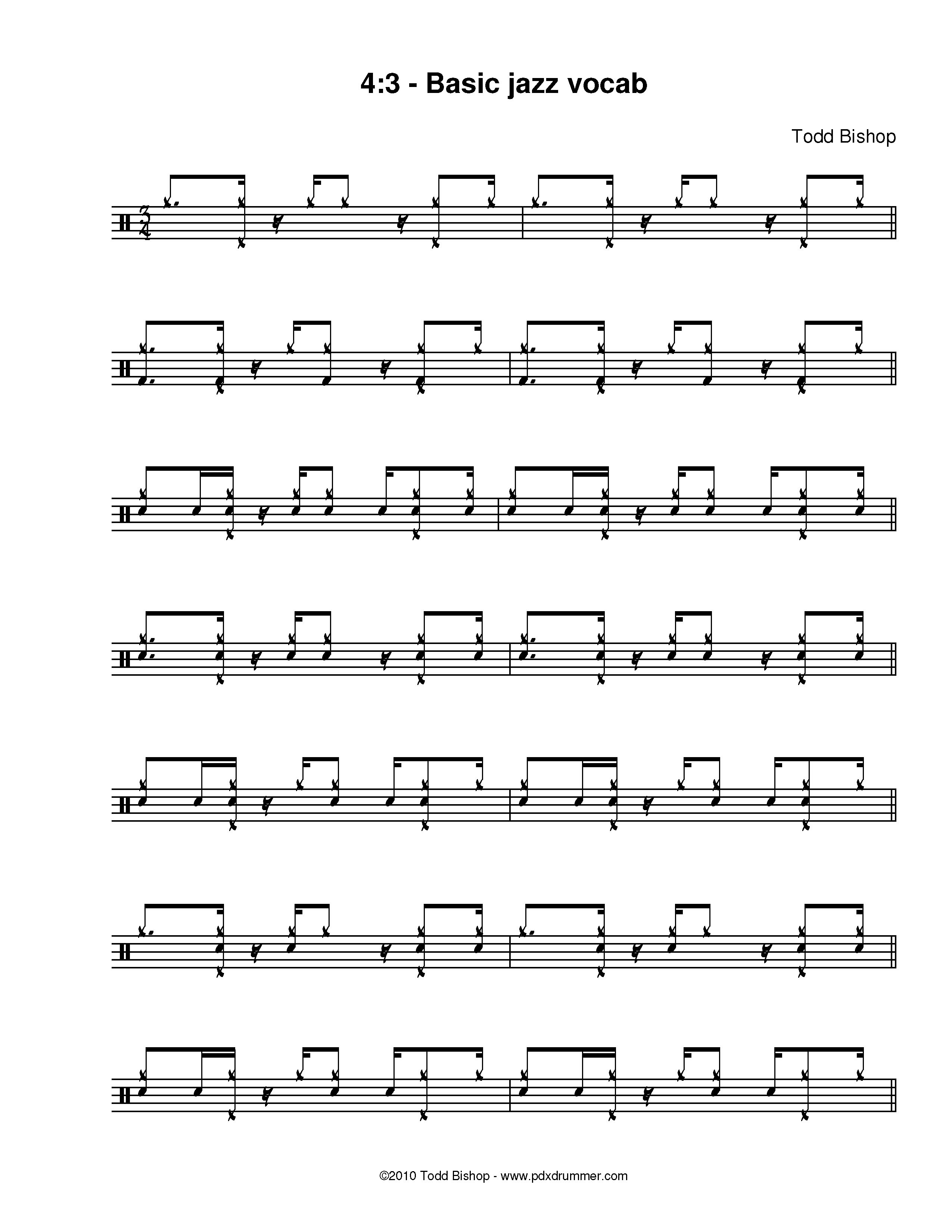
4:3 metric modulation in jazz

Here's a little thing I put together to develop the 4:3 cross rhythm/metric modulation in jazz. Normally you actually want to explain an advanced concept like this, but really, if you don't recognize it right away, you're not at a stage where you should be working on it. Improperly applied, it's a recipe for all kinds of bad playing. Plus I screwed up my back a little bit today, and oddly enough explaining things makes it worse.

So here we are- basically I've translated the first batch of exercises in Jim Chapin's Advanced Techniques into dotted-8th pulse:


I recommend running each line very slowly, counting out loud in 3/4- the hardest thing about this modulation is remembering the original pulse. You could also do a few measures of jazz waltz time in between exercises.

As it gets more comfortable, put it into 4/4: count two lines of exercise as three measures of 4/4 (still counting quarter notes- at no point do you count in the "implied" meter). Then play one (or three, or five) measures of jazz time in 4/4 and then two or four repetitions of each exercise.

Download the pdf.