A selection of grooves played by Max Roach on the Miles Davis album At Last!— a live recording made at The Lighthouse in LA in 1953, and released thirty years later. Max here has been playing the tune every night for years, and the way he handles the whole thing is loose and interesting. Comparing how he handles the tune on the different recordings of it would be a good term paper project for somebody.
First is a mambo-type cowbell groove he plays during the intro. Then on the head he plays a rhumba beat, with a lot of variety to it— I transcribed five measures of it to show that. On the A section the second time through he plays an interesting five note pattern, for which I gave a likely sticking. The last thing is four measures of the rhumba as he plays it on the head out. Snares are off the first time he plays it, and on on the head out.
That rhumba beat is kind of an underrated item. I think most people how to figure out how to play it on the gig— there's no reason to practice it, there's nothing to practice. People get locked into it as a rather stiff/corny repeating beat, but you can handle it very loosely and have some fun with it, make your own personal thing out of it.
A light little 60s pop beat by Idris Muhammad— I don't know what to call it, part boogaloo, part bossa nova— from George Benson's album Shape Of Things To Come. The whole record is like this, little 3-5 minute pop covers meant to go over on radio. If somebody turns on a pocket transistor radio on TV or in a movie, it's the kind of music you'd hear. Gilligan's Island, Hawaii 5-0, Thomas Crowne Affair, that type of thing.
It begins very light, and gains some intensity throughout the arrangement— early on, very flat dynamics between all the parts of the set; more varied later. You'll hear more activity on the bass drum in the last minute or so— he plays it more strongly as well.
The stuff I've transcribed covers almost 100% of what he actually plays— a couple of variations on the main beat, and he catches a rhythm figure at the end of the form. There is one more figure I didn't write out, you'll hear it. His only fill or embellishment is that little five stroke roll at the end of the measure, which he does quite often later in the track.
I have a couple of larger transcriptions going right now, from a couple of Elvin Jones live albums, but don't have time to complete them, so here are the major grooves from them.
The first one is an Afro 6/8, on Tin Tin Deo on the album Very R.A.R.E.:
He is using three tom toms there, but it barely matters.
Note on the word feel, here: you see it's written in 4/4 as 8th note triplets— because the tune is in 4/4, if you were looking at a lead sheet. The 6/8 or 12/8 groove is being played as a feel within the 4/4 time, with the beat in the same place, which makes the 6/8 rhythm into triplets. Calling it 6/8 or whatever refers to the normal meter of the groove, not the meter of this setting.
The other is on A Love Supreme, from Elvin Jones Jazz Machine Live in Japan— a Latin groove with a Mozambique rhythm on the cymbal bell— very timely as we've been working on an “Elvinized” Mozambique lately. Here's the groove as he plays it with one note on the tom tom, and with two:
Again, he's playing this in 16th notes as a double time feel— the feet are stating the underlying 4/4, and they're in half time compared to what we would normally expect with this groove.
Here's the groove written out as a two measure, 8th note based rhythm, which is how I would normally write it. Obviously the feet are in half time there, with the bass drum on 1 and the hihat on 3:
He plays the repeating rhythm without a lot of major variations or fills, but he does a lot with it dynamically. At times he'll lean into these accents in the bell part:
The groove comes in after the opening rubato section— it takes a few bars before it develops into the grooves we see here:
Here's Kenny Washington playing an Elvin Jones-type of waltz groove on Simple Waltz, on Clark Terry's 1991 record Live at the Village Gate. It's kind of an obscure item now, I bought the record then to check out some Kenny Washington. I used to play along with it a lot.
It's actually really Elvin like, though Washington has a different way of playing time from him— and sound, and touch. See my groove o' the day and transcription of John Coltrane's Your Lady. There's also a page o' coordination based on it.
On the intro he plays the ties, when the band comes in he plays the straight cymbal rhythm as written, no ties.
Hey, happy new year— let's roll in 2024 with a snazzy Dave Weckl groove, which inspired some conversation. It's from 1994— hey, 30 years ago now— and Weckl is in his zone. He's been writing a lot, doing big gigs, he's fully world class:
A lot happening there— so many syncopations that it's hard to get fully oriented.
Having never heard it before, and me being a smart guy, I made a hasty, crappy guess about it being in an odd meter. On second listen it seemed more clearly to be in 6/8, or 12/8, seemingly based around 3-2 Rumba clave:
With the first few bars of the track going:
...incidentally, I believe the hihat part there is played on two sets of cymbals— the regular hihats, and some x-hats on the right. I'm pretty sure the right hand is doing a normal “long” or “short” bell rhythm there, and the left hand filling in the other notes.
David Crigger, an LA pro who has done a ton of stuff, decided that the tune was in 3/2 (the time signature*, not the clave rhythm), with the downbeat an 8th note later:
* - 3/2 time is a time signature with three beats per measure, each a half note long. 3-2 Rumba clave is a Latin rhythm, so called because it's comprised of groupings of three notes and two notes.
So the opening of the track would go:
It may be hard to hear that, so he made an mp3 with a click giving the 3/2 pulse:
It actually sits really easily that way— at least for that part of the tune— I just don't think that's what they're doing. I think they're doing an Afro 12/8, and getting cute with it rhythmically. It's part of the nature of this feel that there are cross rhythms other than that of the main “actual” time signature, that are strong enough to plausibly be an alternative time signature. There's a lot going on, a lot of major accents not happening on the 1.
Those would seem to be totally opposed interpretations, following quite different major pulses, and putting the 1 of each measure an 8th note apart, but they're actually not.
Notice that the beats in 3/2 time, when added to my transcribed groove in 12/8:
Are quite similar to 3-2 Rumba clave:
So if a player were orienting around the clave rhythm, rather than the dotted quarter note beat of the 12/8, they would actually be doing both things— putting the 1 where it obviously seems to be at the beginning of the track, and playing the rest of the major orienting rhythm agreeing with 3/2 time in Crigger's orientation.
I think that's what's happening. Who knows whether they're observing clave throughout, or if that's just a rhythm he used in writing the main groove for the arrangement.
Part of the deal here is, it's not difficult to confound even an educated listener— we're not privy to all the information they had making the recording. If you write some ambiguous/deceptive stuff and then don't show people the lead sheet, it's going to be hard for people to figure out what you're doing. Obviously they're all really sharp players, and don't have to put down a lot of auditory markers that are apparent as such without being able to see the chart.
Here's a lot of ink for you, for eight measures. Mickey Roker playing a funk groove with a lot of detail to it, on Goin' Down South, a Joe Sample tune from Bobby Hutcherson's record San Francisco. The transcription starts at the beginning of the track:
The hihat, snare drum and bass drum are pretty layered here, there's no master plan of simplified coordination underlying it, of the type I'm always pushing. Like he doesn't avoid unisons between the SD and BD. I don't know how much he worked out his funk stuff. I've been listening to Roker playing some absurdly fast tempos with Dizzy Gillespie— to me this sounds like independence inherited from his jazz drumming. Everything about him sounds like it evolved through constant playing, on the gig.
Point of notation: as I often do, I'm using a tenuto mark to indicate a half-open, sizzling hihat. I like it, it makes sense, and I think we should use standard articulations as much as possible.
By request here's a groove by played by Greg Errico on If I'm In Luck I Might Get Picked Up by Betty Davis (née Mabry) on her self-titled album. Which was also produced by Greg Errico. It's one of the funkier things ever.
This is the first four measures of the track— by the third measure he settles on the main groove he'll be repeating throughout this section of the song.
People try to groove like this by hitting the drums harder, and it doesn't work, it just sounds harsh. He's not playing loud, but he's getting a deep sound, a great sound out of the snare drum.
Hihats are played all with the right hand, accenting on the 8th notes. There's some interesting texture happening on the snare drum with the ghost notes, including a 32nd note triplet at the end of the measure.
On the recording you can hear what sounds like concert toms occasionally— they conflict with the ghost notes on the snare drum, so they're either played by somebody else, or they're overdubbed, or another instrument is doing something that reads like concert toms to my ear. I wrote that out so you can emulate that if you want.
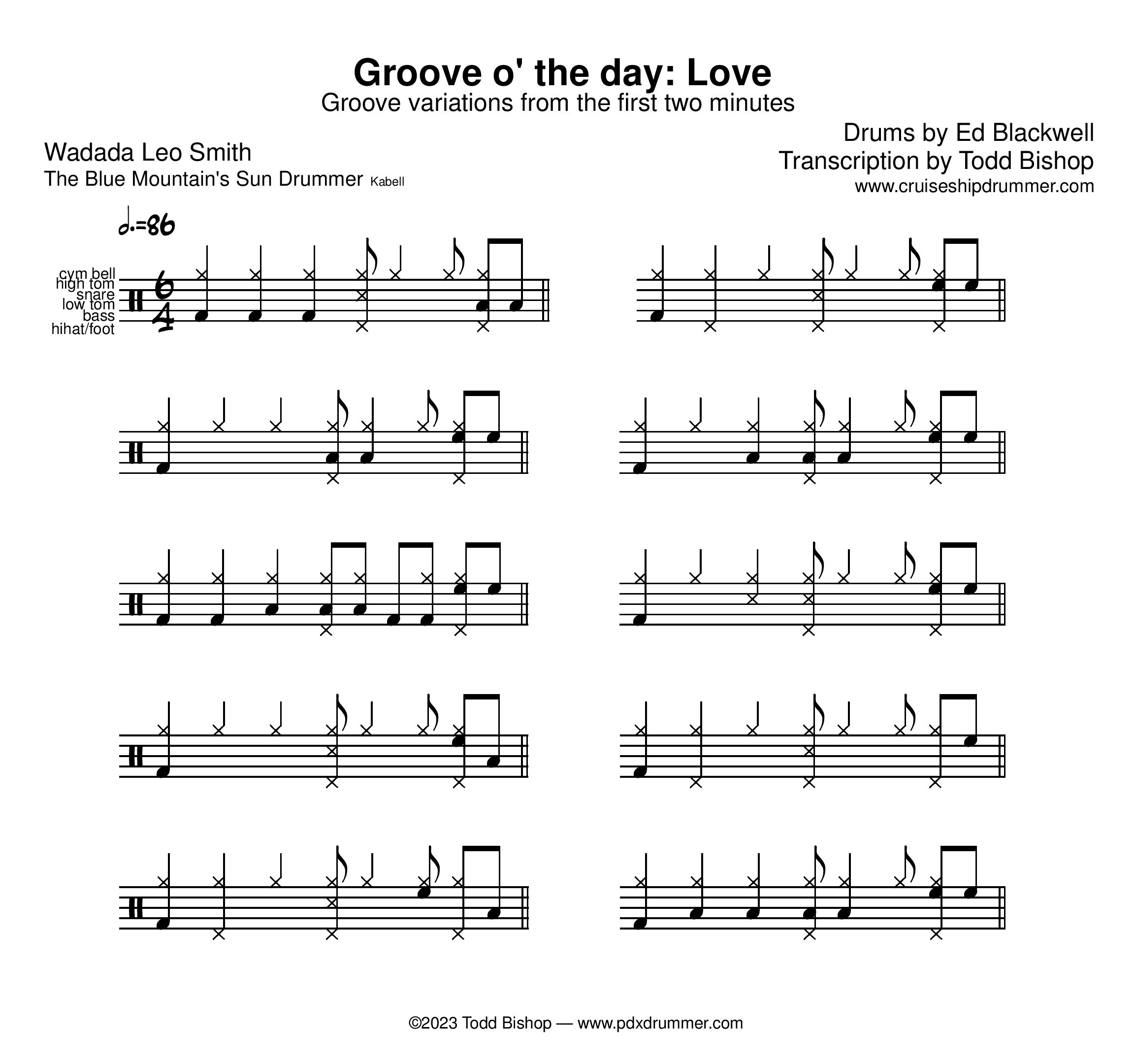
Here's a fast 6/4 Afro type of groove from Ed Blackwell, on the track Love, from a duo record with Wadada Leo Smith, The Blue Mountain's Sun Drummer. There's no tune, it's just free blowing over a groove. People should do that more. These are some variations from about the first 90 seconds of the track.
We're in kind of a compound 6/4 here— the dotted half note gets the beat, at about 86 bpm. Or if you're counting quarter notes, ~260.
Addendum to yesterday's Billy Higgins transcription— here's the Latin groove he plays on the A sections of the head on Moose the Mooche, from Joshua Redman's album Wish.
More or less— it takes a couple of measures to settle on it, and he moves his hands around a little bit. This appears to be the core groove:
Grady Tate playing a heavy Afro-Cuban style groove, or Afro 6, as I've been calling it, on Grant Green's The Final Comedown movie soundtrack. The track is Soul Food African Shop, and the transcription is of the percussion break starting at 0:48.
Bar 7 is probably the cleanest shot of his baseline groove here. He's hitting the bell of the cymbal, except in bar 6 where he moves his hand between a couple of cymbals. He hits the the drums strongly all the way, with a feeling of building into the next beat 1, a standard thing with this style.
Feet are in unison on the dotted quarters throughout— there is some dynamic variance in them, mainly occasional ghosted notes in the bass drum, which I wouldn't call accidental. I think he's very aware of the dynamic movement from beat to beat, and is sometimes getting the bass drum to help with that, mainly coming down with it in the middle of the measure, or on beat 3 as he builds into the next downbeat.
Here's Flamenco beat played by Billy Cobham on a cover of the Jefferson Airplane song White Rabbit, from George Benson's album of the same name. I've been listening to it on my drives to Eugene and back, the last couple of weeks.
Here's the basic thing he plays, with a lot of variations, when the rhythm section comes in. I don't imagine he had a stock flamenco beat worked up before the recording session. He does add hihat played with the foot on beats 2 and 4.
As it develops he makes a funk beat out of it:
Further on he moves that to the bell of the ride cymbal, generally accenting on the & of the beat, even as the actual rhythm varies:
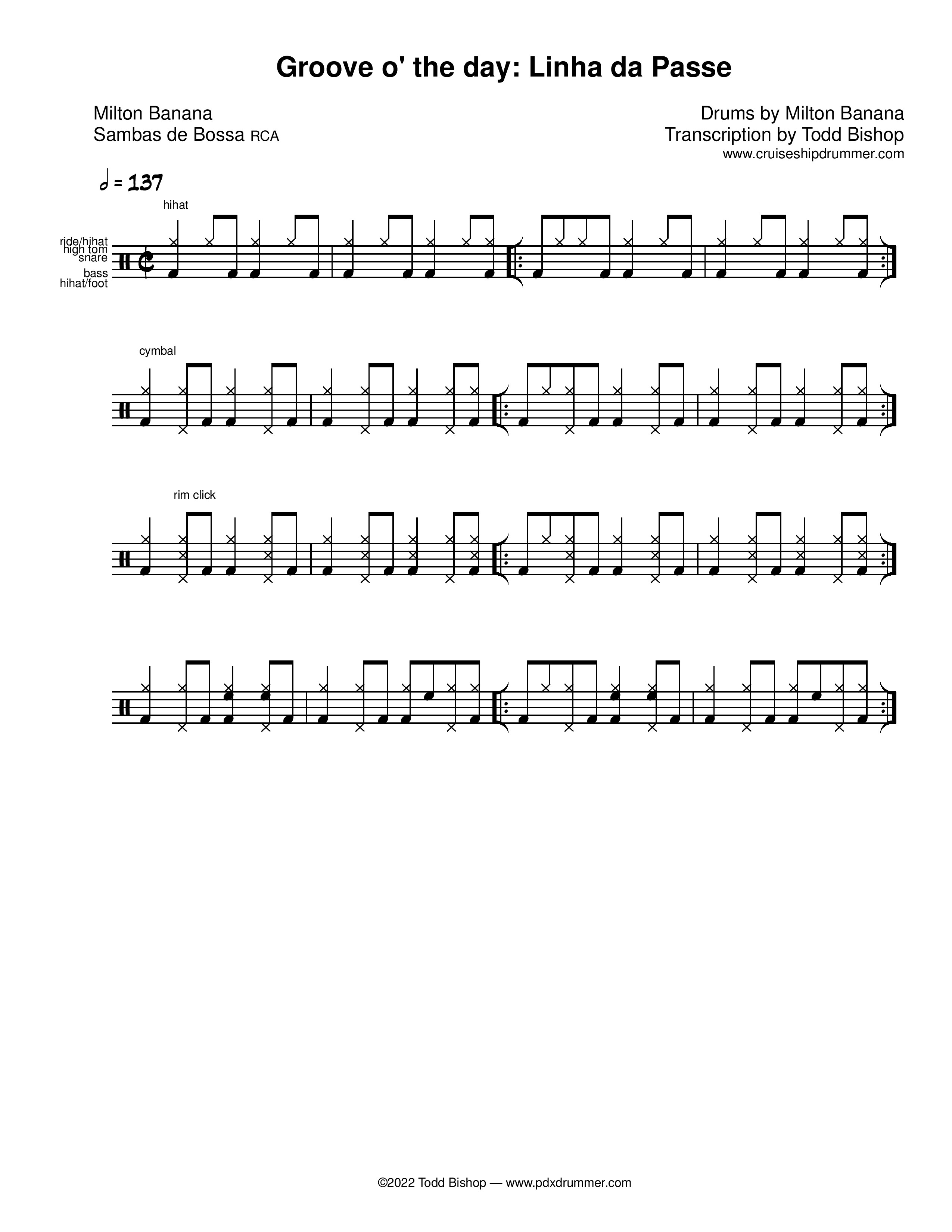
Bright samba groove from one of my favorite Brazilian drummers, Milton Banana, who was most active in the 60s/70s. The tune is Linha da Passe, which you're most likely find on Banana's compilation album Sambas de Bossa.
The format here is a little different— the first two measures of each line show how he begins the groove at the start of a section, and the last two measures with the repeat signs show the body of the groove. It's a tight arrangement with lots of stops, so how he begins the groove is important to work out. And the cymbal rhythm matches the melody rhythm on the piano, which hits the 1 at the beginning of the phrase, and the & of 4 for the rest of the phrase.
Tempo is half note = 137.
First line is closed hihat and bass drum; second line is cymbal and bass drum, with hihat played with the foot on beats 2 and 4. He may be playing some rim clicks on the snare drum during the early parts of the tune, but they're not really audible— we can assume there are a few LH notes in unison with the cymbal. Or not. Third line is how he plays rim clicks later in the tune, fourth line has a rhythm he plays on the tom tom near the end— again, maybe he's moving his LH to the snare drum around beats 1-2
An Afro 6* groove played by Airto, on the intro of Casa Forte, on Flora Purim's 1974 record Stories To Tell. It has some big shot LA musicians on it, including saxophonist Hadley Caliman, who was a Seattle fixture for years, and trombonist George Bohannon, who was a grad student at USC when I went there.
It's a rather simplified groove, with the hands largely in unison. The percussion, also played by Airto, multitracked, fills out more of the rhythm.
* - Right, I notated it in 12/8, but Afro 6 is the generic name I've chosen to use for this kind of groove.
We like thinking in terms of stickings, and filling in spaces, and playing linear, but unisons are powerful. It's worth thinking about.
There are some open sounds with the hihat played with the foot, that I didn't indicate.
Quick little transcription that includes one of the great opening drum fills ever— Ndugu Leon Chancler playing Man in the Green Shirt, from Weather Report's album Tale Spinnin'. I've just written out the opening, some of the main drum groove, and an ensemble section at about 1:30, and some of the half time groove he plays after it.
The tempo is fast, about 154 bpm. To me that's about the natural tempo limit for 16th note funk/fusion vocabulary— above that it starts sounding silly. For another fusion burner in a similar tempo range see my transcription of Egberto Gismonti's Baiao Malandro, with Roberto Silva on drums.
Ndugu has a couple of extra drums here— a concert tom and a second floor tom. Or a middle tom tuned very low. He's also using a China cymbal, and plays the bell of the ride quite a bit. That opening fill moves from drum to drum in a funny way, assuming the drums are arranged normally, and he's leading with his right hand. I'm not going to worry about how he did it, just note that with that kind of movement it doesn't sound quite like a normal bonehead Hawaii 5-0 fill.
I was expecting him to vary the cymbal rhythm to accommodate the 16th notes he's playing on the snare and bass, but he plays straight 8th notes. Listen beyond the transcription, to how he uses the bell of the cymbal, he'll use it for accents, or go to it for a few bars to build intensity, or play it sort of randomly.
Idris Muhammad plays a hip train beat on George Benson's cover of a Monkees hit, Last Train To Clarkesville, from his 1968 album Shape Of Things To Come. He's playing rim clicks with a stick in a bossa rhythm with his left hand, and filling in with a brush with his right:
Both hands work together to build this groove— he accents the last note of those doubles; the RH accent right before the rim click gives the rhythm some structure. He plays the straight groove all the way through, with a few stops. No bass drum at all except on the breaks.
Listening to someone play a composed beat like this, I'm always listening for how (and if) they vary it, and develop it, and how they make ensemble accents, and get away from it to do a fill— and get back to it afterwards. All those little ordinary things you do without thinking when playing a stock groove, create a special problem when doing a specific worked-out groove. Usually people have to scale way back on the other stuff, and mostly just play the groove, and that's basically what's happening here.
Jack Dejohnette playing a straight 8th groove on Freddie Hubbard's Polar AC. This gets called an ECM feel today, but maybe we should start calling it a CTI feel. Change it up, direct people to some other records.
I've transcribed the intro of the tune, right up until the trumpet comes in:
The groove suggests a 2/2 or half time feel— a free texture somewhere between a samba and funk feel. The main point of interest is the mostly-linear snare drum and bass drum activity, with some overlapping. The accents are subtle— he plays the snare drum at a pretty even volume.
An interesting groove by Billy Kilson, on A Seeking Spirit, from Dave Holland's Prime Directive album, one of the big records of the late 90s. If you're not familiar, he had a very high powered band that did a lot with odd meters.
There's a strong quarter note pulse throughout, so this could easily be counted in 5, but there's something interesting happening with the bass drum rhythm, and in the percussion part, which suggests a kind of 10/8 Afro phrasing:
Compare with the usual form of that rhythm in 12/8:
That 10/8 bell rhythm essentially shaves two 8th notes off the end of the traditional rhythm:
There are some other interesting things happening as the track progresses, which pull it some other directions, so it's worth some further analysis— maybe I'll get into that later.
Having done this, I'm not finding a free way to listen to it online, so you'll have to buy the record, or sign up for Amazon music, or YouTube music, or something.
Another item from Jack Dejohnette, playing on Jackie McLean's album Jackknife— Dejohnette's first major recording, made when he was 24 years old. We've seen a couple of other things from this album, a groove o' the day and a longer transcription. His playing on it is very interesting— like the previous GOTD, he's playing an Elvin-like groove, very repetitively. At this point when everyone is letting it all hang out, he virtually never deviates from the exact pattern below. A curious decision on a jazz record— I guess they wanted to make an instrumental single out of it, a la Lee Morgan:
He does add another tom hit on the & of 3 of the first measure, occasionally. And there are some very small variations in the cymbal occasionally. He plays the little ensemble figure on the head exactly, on the snare and cymbal, with no embellishment. If there are any fills at all I missed them. He handles dynamics very sensitively.
Alphonse Mouzon's groove from McCoy Tyner's Walk Spirit, Talk Spirit— as he plays it in the live video below, from 1973. The tune was originally recorded on Tyner's album Enlightenment— a 24 minute spiritual journey.
As it says, he's playing with the snares off, stick in the right hand, mallet in the left hand. He's playing the bell of the cymbal, with the tip of the stick— it's not that piercing shoulder of the stick sound. The bass drum part varies to fit around what the hands are doing; it's there to provide a pulse, it's not really a featured part of the groove.
Here are some variations in the left hand part he plays near the beginning of the video below:
A bright samba groove played by Jack Dejohnette on Fiesta, from Stan Getz' My Foolish Heart album— a live record from the mid-70s. Tempo is about half note = 130.
Here's the very beginning of the tune:
He plays basically this for most of the body of the tune, with minor variations in the cymbal rhythm, plus fills and left hand activity: