For one of my students, a new page of warmups introducing an Afro 6 groove— or various forms of it. It's as deep a thing as there is in drumming, and to begin understanding it we want to approach it from a few different angles. This is mostly for the hands, see also this page which works out the coordination with the feet.
Play those, be able to count in 3 or in 4, depending on the time signature, as in ex. 1 and 2. It may help to count the combined rhythm of all the parts before playing a pattern, and/or to work it out as a sticking— including R hand, L hand, and Both hands.
A page of groove fragments, really, for one of my students— to help get oriented working out of New Breed. We were having some difficulties with this particular cymbal rhythm.
You could play this page by itself, or use it to work out how the coordination will work when playing a similar system in New Breed.
1. Play the sticking pattern from the book with the right hand playing a cymbal, with the bass drum in unison, and the left hand on the snare drum:
2. As above, except the right hand plays running 8th notes on the cymbal. So reading from the book, the bass drum plays the Rs, the left hand plays the Ls, and the right hand plays along with everything:
3. As above, except the right hand plays quarter notes on the cymbal.
UPDATE: Oh, one other thing: cymbal in unison with Ls. L = both hands/SD-cym, R = bass drum:
Play those in sequence without stopping, switching from one thing to the next every couple of measures, or every measure, and then as quickly as you can, not necessarily changing right on the 1. The end result hopefully keeps the SD/BD pattern mostly intact, with the cymbal rhythm varying in a loose way. You can probably tell that this connects with some other things we've been doing recently.
Rock materials for drum set are usually limited to here are some one measure beats, here are some fills. Here's how some guys played some songs, which you should copy exactly. This idea is part of a larger project of mine, devising some methods for a more open approach, for students of all levels. It's about playing, not just learning to play “parts.”
A selection of grooves played by Max Roach on the Miles Davis album At Last!— a live recording made at The Lighthouse in LA in 1953, and released thirty years later. Max here has been playing the tune every night for years, and the way he handles the whole thing is loose and interesting. Comparing how he handles the tune on the different recordings of it would be a good term paper project for somebody.
First is a mambo-type cowbell groove he plays during the intro. Then on the head he plays a rhumba beat, with a lot of variety to it— I transcribed five measures of it to show that. On the A section the second time through he plays an interesting five note pattern, for which I gave a likely sticking. The last thing is four measures of the rhumba as he plays it on the head out. Snares are off the first time he plays it, and on on the head out.
That rhumba beat is kind of an underrated item. I think most people how to figure out how to play it on the gig— there's no reason to practice it, there's nothing to practice. People get locked into it as a rather stiff/corny repeating beat, but you can handle it very loosely and have some fun with it, make your own personal thing out of it.
A light little 60s pop beat by Idris Muhammad— I don't know what to call it, part boogaloo, part bossa nova— from George Benson's album Shape Of Things To Come. The whole record is like this, little 3-5 minute pop covers meant to go over on radio. If somebody turns on a pocket transistor radio on TV or in a movie, it's the kind of music you'd hear. Gilligan's Island, Hawaii 5-0, Thomas Crowne Affair, that type of thing.
It begins very light, and gains some intensity throughout the arrangement— early on, very flat dynamics between all the parts of the set; more varied later. You'll hear more activity on the bass drum in the last minute or so— he plays it more strongly as well.
The stuff I've transcribed covers almost 100% of what he actually plays— a couple of variations on the main beat, and he catches a rhythm figure at the end of the form. There is one more figure I didn't write out, you'll hear it. His only fill or embellishment is that little five stroke roll at the end of the measure, which he does quite often later in the track.
Getting through a single system from The New Breed takes some time, longer than I want to have one hand be basically idle, playing just the 2 and 4. Let's give it more to do.
This is a real small thing to do with the backbeat systems— any system with backbeats on the snare drum, and the bass drum playing the melody: catch accents on a cymbal with the left hand. In unison with one or more bass drum notes, or anyplace it doesn't conflict with the backbeat.
Add a crash on the 1, or the closest bass drum note before or after the 1, and/or some other bass drum note, for example:
You could also experiment with crashing independent of the bass drum— for that I'd want something quick, an effects cymbal or small crash:
I'm always on the lookout for little multipliers like that. So long as the fundamentals are solid— save it for later if any part of the plain system is raggedy.
The first EZ fast rock page was a hit with my students, so here's another like it, more in a fill/variation direction. Combining patterns to make two-measure phrases, most of these will be the second measure.
They're “EZ” in the sense that they're mostly single notes— rarely more than one 8th note-spaced note at a time on any limb— and very little complex coordination. It's a lot of vocabulary they can learn fast, with very little in the way of technical barriers. Towards the bottom of the page we ease into some slightly more demanding stuff.
Get the first page— and the pages in 3/4 and in 5/4, for that matter— learn this page, then combine patterns in two measure phrases. Or four measure phrases— three bars of one thing, one bar of another.
Get the pdf [Sorry, uploading is acting funny right now-- you'll have to print it from the jpeg above]
Here's an addendum to a set of stuff I posted back in January— the “tresillo unit.” That was basically a set of variations on a New Breed system. This is a loosely organized collection of things to further develop one of them, that was suggestive of a samba groove.
With these heavily constructed kinds of grooves, every small move and variation you learn becomes kind of a big deal. Changes in dynamics, articulations, and orchestration become a big deal. You can get by with them doing relatively little in terms of actually varying the parts.
Pattern 1-2 are the plain system, with the right hand moving between the cymbal and the floor tom, and that system with a left hand part to use for the complete stock groove.
Patterns 3-6 give some accents you can play with the left hand.
Patterns 7-8 have the left hand doing a partido alto-type rhythm.
With the following you can work through some of the reading in New Breed, playing the book rhythm with the left hand:
9-12 show some right hand variations.
13-18 show some bass drum variations.
Play the hihat where you like for a samba; I play it on the off beats.
Something I'm working out, that needed to be written out to do it: straight 8ths on the bass drum within a funk-style Afro 12/8 groove. I work a lot with this whole area of groove. This is worth working through even if you don't have an application for it, it makes you put a fine point on your accuracy with your bass drum.
Play the accent like a backbeat and ghost the rest of the snare drum notes. At first omit the circled notes on the cymbal with patterns 3-4 and bass drum with patterns 5-16, if it helps you get them.
A page for a student, age 12, who bought a cowbell, and didn't know what to do with it. Basically two kinds of beats— basic rock beats, and a kind of Latin-rock beat with a cinquillo rhythm on the bell. We covered a number of these verbally in the lesson— several of them were his idea— this develops them further.
Get the pdf, then get the vibe by listening to some Def Leppard:
An item I was working out with a student— making an Elvin Jones-like Latin groove/texture out of a Mozambique rhythm, for medium tempos, with swing 8th notes. It's an entry, just the first, most obvious things I could think of for taking the groove that direction.
Swing the 8ths on everything here. At the top of the page is a Mozambique bell rhythm written Syncopation-style, then some basic left hand variations, which you can move around the drums however you like.
Then there is the bell rhythm written out as RH lead triplets— RH plays the complete cymbal part, LH plays the complete snare part. Which you can play as a fill at the end of the groove— note the circled bass drum notes on patterns 6-9, play them with those notes, and without them. As illustrated, you can end the fill with a cymbal/BD accent on 1, or on the end of beat 4.
With item 10, as it says, play the hand parts with one, some, or all of the written bass drum notes. Try some combinations. We'll explore that more fully in another installment.
For a couple of weeks I've been working with an area of stuff covering several different styles— grooves with a tresillo rhythm, or part of it, in the bass drum. I've been polishing it for a recording session today.
That bass drum rhythm occurs most famously in New Orleans drumming, Songo and other Caribbean styles, and Baiao. All different things from different countries, but with jazz groups things have a way of getting mashed up. The chart we're recording is marked “samba”, but the bass line is based on this type of rhythm, and nothing else about the piece is particularly samba-like.
We have there:
Systems for New Breed I've been doing a few ostinato variations with the reading in The New Breed— which I've decided I like a lot. The reading portion of that book is different enough from Syncopation to be worth doing— more space, fewer runs of multiple notes, and of course 16th notes are the main subdivision.
The ostinatos are played by the right hand on a cymbal, bass drum, and hihat played with the foot. On a couple of them the right hand moves to the floor tom.
Subtractive method Practicing from the book Syncopation, I've been running a subtractive thing I detailed before (the item at that link would actually be good to include in this unit)— voicing the melody rhythm in the book corresponding with a BSSB-SBBS pattern.
Songo variations A couple of different songo grooves, with fills, making variations on the fly.
Street beat / alternating singles Played on either the snare drum or hihat, varying the accents/articulations, with a move to the floor tom.
I have some dates coming up where I need to use a Songo-type groove (the chart says “samba”, but it's really not)— which I don't have to play that often, so I'm brushing up on it a bit, playing through a bunch of stuff:
After learning the three complete grooves at the top of the page, start playing through the other possible combinations of cymbal rhythms, bass drum variations, left hand parts, and linear patterns. My recent rhythm page is good for this as well.
Use the “subtractive” patterns at the bottom of the page to revoice rhythms from the book Syncopation to fit this style, playing the notes in the book on the snare drum or bass drum, corresponding with those patterns. I've settled on a kind of hybrid system for that— I play the complete bass drum rhythm whether it's sounding in the book rhythm or not. It's a little harder to read, but it works well.
I'm doing all this with a couple of mp3 loops sampled from Eddie Palmieri, playing a Mozambique rhythm, on the tunes Bamboleate and Azucar Para Te.
Here's a page for my students, working through the basics of a half time funk shuffle groove. It gets mentioned a lot more online than it comes up in real life, but it's a thing.
There are a number of ways to write it; I've put it in 6/8 and 12/8. In real life I might expect it to come up most often as a sixtuplet feel in 4/4.
Pay careful attention to the dynamics on the snare drum; play the accent strongly and ghost the other notes. I also accent the downbeats of the cymbal rhythm, you can do that if you choose.
Here's a page of basic left hand rhythms based around a Baiao rhythm (say bye-yo or bye-yohn). You could just use Syncopation for this, but I like starting with rhythms connected to the ostinato somehow— after the basic rhythms 1-10, these are mostly based on the bass drum rhythm.
As it says, use the hihat or ride cymbal— the open hihat sound emulates a triangle, which is kind of an essential element in this style, so when playing the ride cymbal you could use the bell somehow to get a similar vibe.
On the snare drum play rim clicks, or varied accents/articulations— rim shots, dead strokes, buzzes, whatever.
Move the LH between the SD and toms as in the example moves— whatever patterns of movement you can devine from the examples, that makes sense for the rhythm you're playing.
Here's a track you could play along with, by Seattle-based Brazilian pianist Jovino Santos Neto, with his long time drummer (and Brazilian drumming expert) Mark Ivester, and some other Seattle friends playing:
By request here's a groove by played by Greg Errico on If I'm In Luck I Might Get Picked Up by Betty Davis (née Mabry) on her self-titled album. Which was also produced by Greg Errico. It's one of the funkier things ever.
This is the first four measures of the track— by the third measure he settles on the main groove he'll be repeating throughout this section of the song.
People try to groove like this by hitting the drums harder, and it doesn't work, it just sounds harsh. He's not playing loud, but he's getting a deep sound, a great sound out of the snare drum.
Hihats are played all with the right hand, accenting on the 8th notes. There's some interesting texture happening on the snare drum with the ghost notes, including a 32nd note triplet at the end of the measure.
On the recording you can hear what sounds like concert toms occasionally— they conflict with the ghost notes on the snare drum, so they're either played by somebody else, or they're overdubbed, or another instrument is doing something that reads like concert toms to my ear. I wrote that out so you can emulate that if you want.
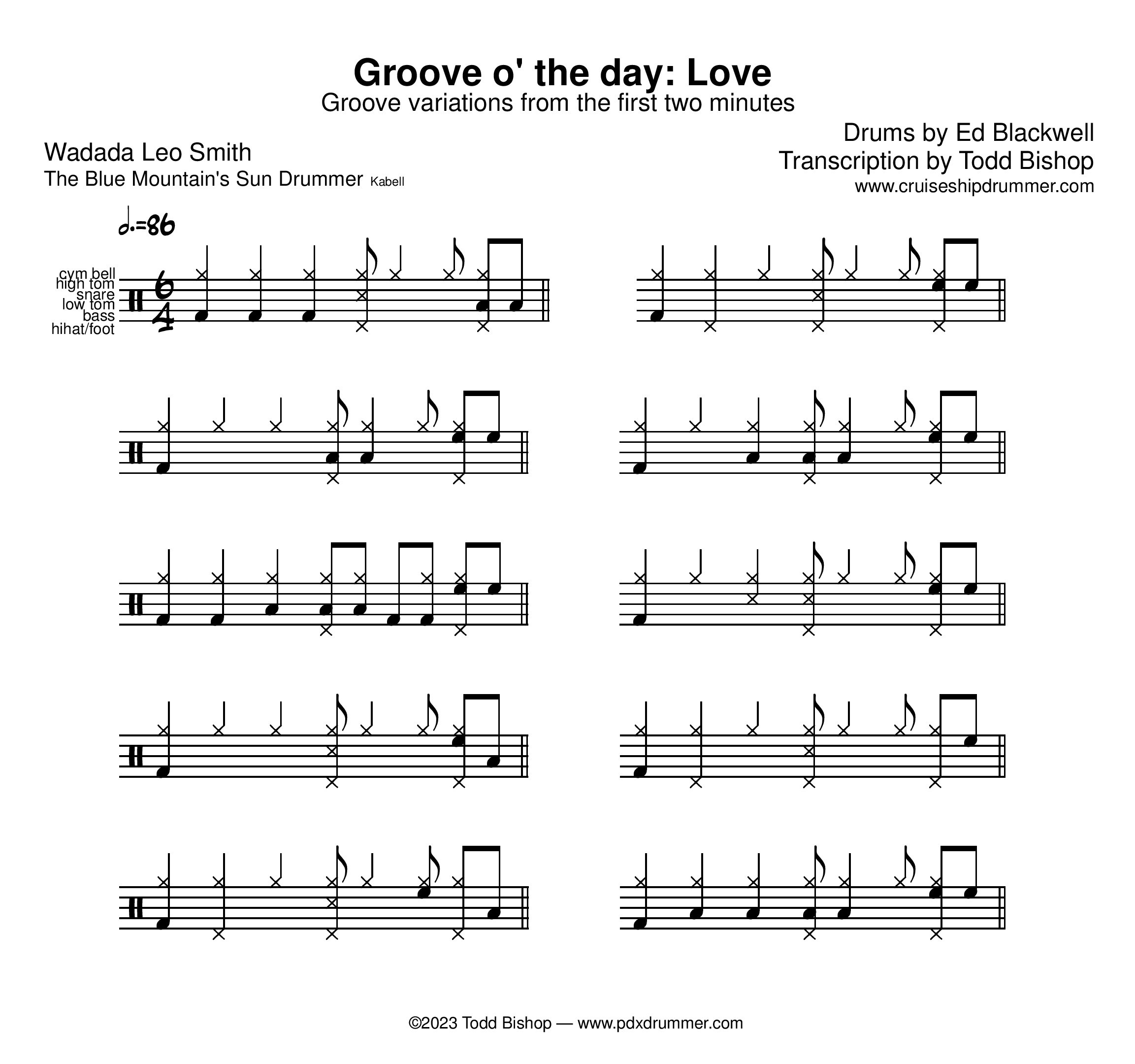
Here's a fast 6/4 Afro type of groove from Ed Blackwell, on the track Love, from a duo record with Wadada Leo Smith, The Blue Mountain's Sun Drummer. There's no tune, it's just free blowing over a groove. People should do that more. These are some variations from about the first 90 seconds of the track.
We're in kind of a compound 6/4 here— the dotted half note gets the beat, at about 86 bpm. Or if you're counting quarter notes, ~260.
Extending this EZ fast rock / rock in 3 series, with quarter notes on the cymbal: here are some beats and ideas in 5, phrased 3+2. I wrote this series to illustrate the difference between 4, 3, and 5, using similar materials, for a younger student who asked about it.
Learn the beats, then combine them? That may be a more difficult problem than we're generally dealing with here— most of my students for whom this is intended will be preoccupied with staying oriented just in one measure of 5.
Addendum to yesterday's Billy Higgins transcription— here's the Latin groove he plays on the A sections of the head on Moose the Mooche, from Joshua Redman's album Wish.
More or less— it takes a couple of measures to settle on it, and he moves his hands around a little bit. This appears to be the core groove:
Grady Tate playing a heavy Afro-Cuban style groove, or Afro 6, as I've been calling it, on Grant Green's The Final Comedown movie soundtrack. The track is Soul Food African Shop, and the transcription is of the percussion break starting at 0:48.
Bar 7 is probably the cleanest shot of his baseline groove here. He's hitting the bell of the cymbal, except in bar 6 where he moves his hand between a couple of cymbals. He hits the the drums strongly all the way, with a feeling of building into the next beat 1, a standard thing with this style.
Feet are in unison on the dotted quarters throughout— there is some dynamic variance in them, mainly occasional ghosted notes in the bass drum, which I wouldn't call accidental. I think he's very aware of the dynamic movement from beat to beat, and is sometimes getting the bass drum to help with that, mainly coming down with it in the middle of the measure, or on beat 3 as he builds into the next downbeat.


.jpg)


.jpg)