Showing posts with label five stroke rolls. Show all posts

Friday, May 24, 2024

All American Drummer Solo No. 128

Here's a raggedy little video I made of Solo No. 128 from Wilcoxon's All American Drummer— in response to an online question. Never played it before, I worked it up in about 15 minutes. Tempo is 74 bpm. 


And here is the solo written out: 


As always, the notation is a little screwy and imprecise. They really didn't know how to write some basic things back then. Or maybe it's the engravers' fault. When you encounter something weird and impossible looking, smooth it out and make it normal. Play the 7 stroke rolls in the first line with a 16th note pulsation— roll is 32nd doubles on the e&a of the beat, for example. 

Play the 11 stroke rolls in the second line with a quintuplet pulsation. It's a little irregular the way I play it, but it sounds cool. 

The 10 stroke rolls in lines 3-4 and 6-8 are straight out of Three Camps— as are the fast 5 stroke rolls next to them in lines 6-8— play them with a sixtuplet pulsation.  

It's another poorly-balanced Wilcoxon solo. Those 10s impose a definite speed limit, but if you can't do them fast the rest of the solo is so slow it falls apart. There's maybe a 10 bpm range where the thing is playable without sounding stupid [or not!]. Have fun! 

Monday, March 11, 2024

Building a hybrid Reed interpretation

A short item— that's all I have time for lately: some hybrid Syncopation-based systems are brewing, where we do one basic thing, and alter it one step further, creating some connections between ideas, and opening things up, so it's not pure formula. It also creates some problems in devising a consistent system, and with interpreting it on the fly, when reading the full page exercises. 

Here we'll use a bebop-type system based on 5-stroke rolls ending in a stick shot— similar to this one. Everywhere you see an 8th note followed by a quarter note, play a 5-stroke roll (starting with the RH) ending with a stick shot (R stick hitting L stick, which is pressed into the drum head). Play the remaining notes as taps, mostly alternating sticking— starting with the LH, after the stick shots.

So the first two lines of page 38 in Syncopation would be played like this: 


That leaves a lot of open single notes, which we can fill in in a different way— like with the stupidly-named paradiddle inversion stickings we did recently: RLLR/LRRL/RLLRLR/LRRLRL. Pick the appropriate-length pattern for the space you're filling. Add more alternating singles at the end of the pattern if you run into some longer spaces between notes. 

Here's how you could handle some single line exercises from p. 34 in Reed: 


Note that the 16ths can connect directly with the roll, but you don't go directly into the 16ths from the stick shot. Also, we have to plan ahead for what hand to start the 16ths with, so you end on the right hand, to make the roll. 

This is probably strictly a system for practicing one measure licks, using pp. 34-37 in Reed. If you try playing one of the full page exercises, you'll notice that a) it's pretty hard to interpret on the fly, and b) it's hard to know which hand to start the 16ths with. You would have to figure out which hand to start with, and mark it on the page. 

Listen to some Roy Haynes soloing, and have fun. 

Saturday, May 06, 2023

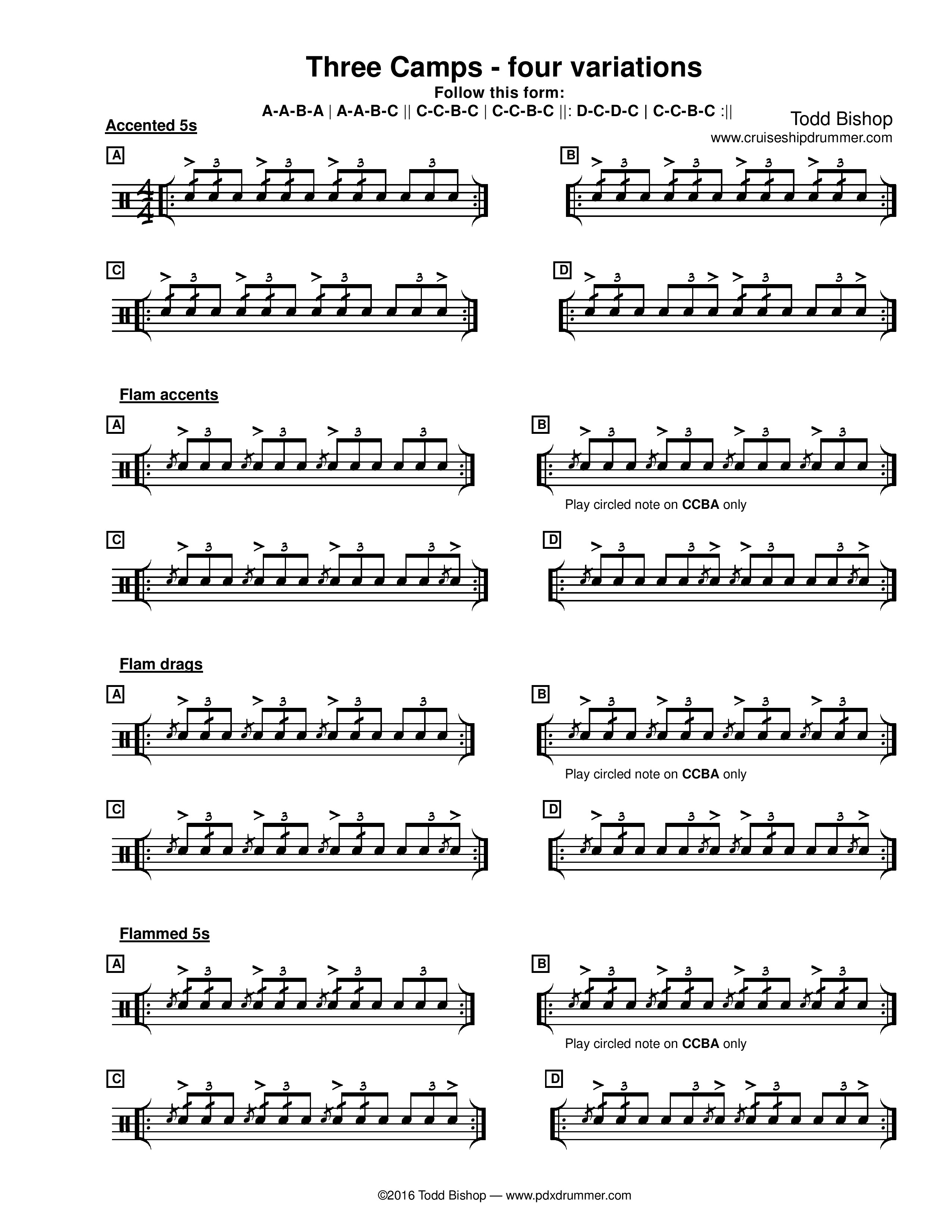
Three camps: four variations

Four alternative ways of playing the rudimental piece Three Camps, that I'm practicing this week, accented 5 stroke rolls, flam accents, flam drags, and flammed 5s.  


Learn each measure individually, then play them in the form given at the top of the page. Chop out. 

Get the pdf

Monday, January 23, 2023

Reed interpretation: short rolls

An easy thing to do with Syncopation, adding short rolls. This will be a no-brainer any time you want to work on your rolls without a lot of extraneous stuff, using familiar materials. I wrote something like this in 2012, and it kind of sucked. This way is better. 

Do this with 5 stroke rolls (16th note pulsation), 7 stroke rolls (16th triplet pulsation), or 9 stroke rolls (32nd note pulsation)— at whatever tempos give you quality rolls in each of those rates.  

First, you can just play a roll on the first note of any two (or more) notes with an 8th note spacing: 


If you want, you can do some different things when there are more than two 8th note spaced notes in a row. Like when there are three notes, you can put the roll on the first note, or on the middle note: 


When there are four notes, you can put the roll on the first note, or on the second or third note (after one or two taps), or do two rolls: 


Same deal with longer runs of 8ths: first note, second note, third note, next to last note, or fit as many rolls as you can starting on the first, second, third notes:


You could put a jazz inflection on it by accenting the one or two taps at the beginning of the run, and the last note of the run:


Obviously there's no need to do this exhaustively— do it how you like. It would be good to play through all the options once just to know them, and test your reading by doing them with the full page exercises. Putting the roll at the very end of the longer runs of 8ths, say, while playing the full page Exercise 2 does force you to read ahead and plan ahead— that's a good exercise.  

Sunday, April 22, 2018

Basic short roll studies with continuous motion

UPDATE: Download link is working!

I've got to stop putting “EZ” on every single normal-difficulty thing I post. This is an easy page of roll studies I wrote to prepare a couple of younger students to play Rolling In Rhythm, a Charley Wilcoxon etude I teach to a lot of my students. We'll also see a similar page of drag studies soon.


The main thing about this page, which is similar to the Wilcoxon etude, is that the exercises have a continuous 8th note rate hand motion, with some of the notes played as singles, and some as doubles. When you get into the upper tempo range— above about quarter note = 160— count in 2/2. So if you're playing the exercises at 160, set your metronome to 80, and count metronome pulses in 2.

Get the pdf

Thursday, March 01, 2018

Single stroke 5s - 32nd notes

A set of exercises I improvised on my leg at the start of a rehearsal yesterday— and this would actually be good as part of a warmup. These are 5 stroke rolls in single strokes, in a 32nd note rhythm, accented a couple of different ways. It's very straightforward, and once you can play a single stroke 5 fast starting with your right or left hand, you should be able to knock this page down quickly.


If you can do one of these you can basically do all of them, so there's little point in lingering on any one exercise. You should be able to do everything you need to do with this page within 10-15 minutes, or within 2-5 minutes as part of a warmup. This would be a good page to play with brushes.

Get the pdf