Showing posts with label rudimental. Show all posts

Friday, May 24, 2024

All American Drummer Solo No. 128

Here's a raggedy little video I made of Solo No. 128 from Wilcoxon's All American Drummer— in response to an online question. Never played it before, I worked it up in about 15 minutes. Tempo is 74 bpm. 


And here is the solo written out: 


As always, the notation is a little screwy and imprecise. They really didn't know how to write some basic things back then. Or maybe it's the engravers' fault. When you encounter something weird and impossible looking, smooth it out and make it normal. Play the 7 stroke rolls in the first line with a 16th note pulsation— roll is 32nd doubles on the e&a of the beat, for example. 

Play the 11 stroke rolls in the second line with a quintuplet pulsation. It's a little irregular the way I play it, but it sounds cool. 

The 10 stroke rolls in lines 3-4 and 6-8 are straight out of Three Camps— as are the fast 5 stroke rolls next to them in lines 6-8— play them with a sixtuplet pulsation.  

It's another poorly-balanced Wilcoxon solo. Those 10s impose a definite speed limit, but if you can't do them fast the rest of the solo is so slow it falls apart. There's maybe a 10 bpm range where the thing is playable without sounding stupid [or not!]. Have fun! 

Saturday, February 24, 2024

Ruffs, drags, and general correctness in snare drumming

The correct way to play ruffs (or drags if you prefer) on the snare drum is an extremely attractive topic for repeated, endless debate. Evidently. I've seen it again and again, people going nuts for the topic. 

The major burning issues seem to be: 

a) What they should be called— ruff or drag.   
b) How to play the embellishment— double stroke, multiple bounce, or...?


Around here we call them ruffs, and my concept of correctness playing them came from a kind of Charles Dowd / Tony Cirone / Fred Sanford axis. Mainly, most of my teachers and corps instructors, and many professional acquaintances, were students of one or all of them. Dowd and Sanford both studied with Cirone. Dowd and Cirone both studied with Saul Goodman— primarily known as a timpanist, but played and taught all orchestral percussion instruments. He's as important a figure as anyone in modern percussion. All four of those individuals taught many thousands of professionals over many decades, so there's a sizable community of players for whom this is part of their frame of reference, at least. 

Summarizing my views, and what I teach, this is from Cirone's book Orchestral Techniques Of The Standard Percussion Instruments


Except: in drum corps, we played them multiple bounce, not double stroke, with the buzz very tight against the main note. I believe that way of playing them in that setting was likely Fred Sanford and Bob Kalkoffen's innovation. More traditionally they were played with a double stroke. 

Also in corps: in practice, the term drag didn't refer to a specific rudimental pattern, but to a single metered open double played as part of an ongoing rhythm, which might be referred to as a drag passage, like: 


A real traditional rudimental geek could analyze each of those phrases as a series of named rudiments,  and I'm glad I never learned that way. For me this was always just a continuing rhythm with some of the strokes doubled. In fact there are some passages from traditional rudimental solos that could be interpreted that way, with the drag strokes metered. This line from Charley Wilcoxon's Roughing The Single Drag:  


Could be played: 


Continuing with the common ruff (or drag) here's another excellent description from Percussion For Musicians by Robert McCormick, edited by Cirone: 


So McCormick and Cirone are talking about interpreting that notation, and performing it on the snare drum in orchestra, wind ensemble, and other concert snare drum settings, and that is my baseline standard for how to do things. There are other reputable professionals who say they should be played with a double stroke— they are amply represented on YouTube— all you have to do is think the word ruff and you'll be presented with a lot of videos telling about that. I think they are offering incomplete information if they don't mention anything about the performance context. 

Friend/friend of the site and excellent drummer Ed Pierce (and author Alain Rieder) has pointed out that there is a Porcaro/Igoe/Henry Adler/Al Lepak lineage of players who refer to any three note single stroke pattern as a ruff. Ralph Humphrey as well. That's different from what we've been talking about— you would not read a snare drum part, or etude, with the above ruff notation and automatically play them as single strokes. In fact I don't know how that interpretation would be applied to written music, other than to assign a rudimental name to a written rhythm (calling a 1e& 2e& rhythm ruffs, for example). With this usage we're just giving that name to a simple rhythm structure, a cluster of three notes. 

There is an exception: you do play ruffs as alternating singles when you encounter that notation for most other percussion instruments— timpani, for example. 

This all may beg the question: what even is the purpose of doing it one way or another? Why does doing it “correctly” according to a certain school of thought matter? Who decides what's correct to begin with? 

I don't believe there's any real technical or hand-conditioning benefit to doing it one way of the other— it's purely a question of convention, taste, and musical effect and expression. 

If you're involved in concert snare drumming, you'll be working with conductors, band directors, other percussionists, professors and other teachers, and miscellaneous judges— via competitions, juries, auditions— each of whom may have opinions or demands about how you should play, which may be difficult to ignore completely.   

In rudimental drumming it is decided by the individual organization— marching bands, drum and bugle corps, other drum lines, will each have their individual style standards that players need to follow. Much of the rehearsal process is about learning those standards, you don't necessarily need to have them prepared in advance. 

As individual players, we're generally free to do whatever we want—  hopefully guided by some kind of sound idea, and a good musical ear. Generally it's best to to have a baseline of ability that fits with what the rest of the drumming world is doing, doing things the way other good players do them, until you're experienced enough to form a different idea about it. Someone doing something in a grossly unconventional way in a formal performance setting is most often taken as evidence the player doesn't know what he or she is doing. 

Postscript: In the comments there's a good question about diddles as distinct from drags. 

Saturday, January 27, 2024

Chop busters: syncopated flammed 16ths

More rooting around in my archives, with a stealth from the zone item. I found this in one of my notebooks from high school, and it's worth playing, with some mixed 16th note rhythms with flams in funny places. So I wrote it up nicely so people can actually read it: 


There are accents on all the flams, and I believe the stickings alternate all the way through.   

...aaand as I look at it, it appears that this is just one pattern displaced by a 16th note from line to line. There are a couple of small variations, but those are probably mistakes. See my December page of flammed 16ths for something a little more challenging. 

Here's the original sheet scanned from my notebook: 


Get the pdf

Monday, December 04, 2023

Chop busters: flammed 16ths

Another small item, while I power through writing my new book: a page of 16th notes with flams, designed to be rather technically challenging, in the manner of Ron Fink's book Chop Busters


Alternating sticking unless otherwise indicated. The first two reverse hands on the repeat, the others repeat on the same hand. 

Get the pdf

Monday, September 18, 2023

Warm ups for Alan Dawson's “Para Bossa” system

Alan Dawson's Para Bossa system, from John Ramsay's book, The Drummer's Complete Vocabulary, is a way of interpreting exercises in Ted Reed's Syncopation as 16th note paradiddles, and extended paradiddles, with a samba rhythm in the feet. I was going over it with a student yesterday, and we thought it would be helpful to write out some warmups. Mainly for lining it up with the feet. 

For each line, on the left is the rhythm written as it appears (or would appear) in Syncopation, on the right is the interpreted pattern for it: 


No, there's no 6/4, in Syncopation, but if you play these exercises you'll be covered for all the ways the similar rhythms do appear there. 

Play all the warm ups— starting with the left hand, as well— then practice the system reading from Synopation, pp. 30-45. First with hands only, then add samba rhythm with the feet. 

Get the pdf

Thursday, August 31, 2023

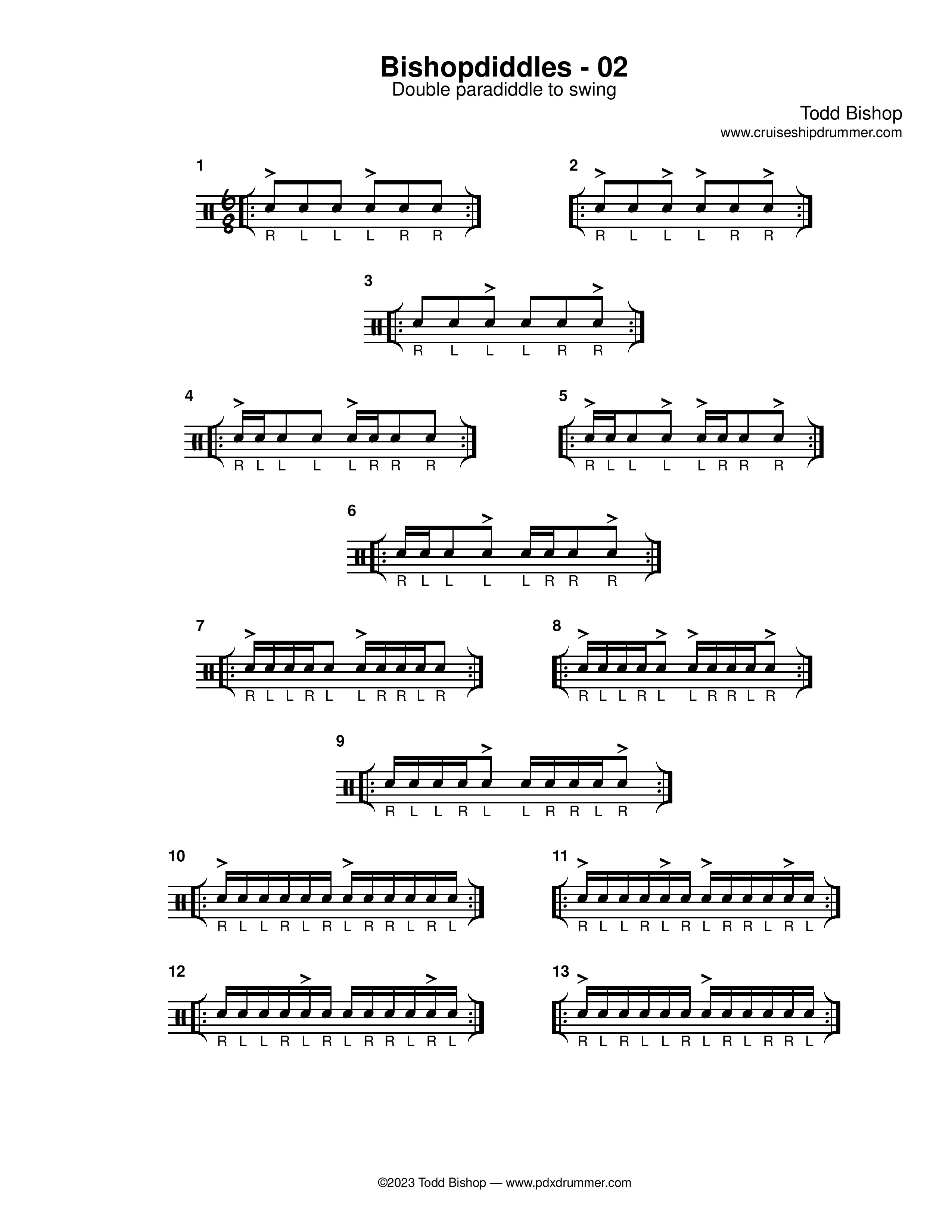
Bishopdiddles - 02: double paradiddles to swing 8ths

Listen: do not show these to somebody and call them “BISHOPDIDDLES.” You're going to get both of us beaten up.  

One thing I like about this double paradiddle inversion is that it's possible to accent the first and last notes of a triplet (or beat of compound 8th notes) with it, so it fits nicer in a slower tempo swing 8ths environment, and we can make a Reed system for practicing it. 

Regular double paradiddles accent naturally on the first two triplet or compound 8th partials: 


This inversion puts the natural accents on the first and last partials, which of course coincides with a common swing 8th note interpretation: 


This, then, is a collection of drills for developing it fully:


You can use patterns 1-3, 4-6, 7-9, and 10-12 (I don't know why 13 is there) as foundation patterns for practicing this out of Syncopation. Play p.38 all those ways. 

I mostly only use these patterns once at a time, not hand to hand like this, so this may not be much more than a technical drill, but I think it's a good technical drill. 

Get the pdf

Saturday, August 26, 2023

Bishopdiddles

Minor item, corralling some similar sticking ideas that have been floating around the site. I noticed that with paradiddle-like stickings, I like inverting them so the double is up front, right after the first accent. These all follow that pattern:   


DISCLAIMER: I don't want to mislead anyone with that BISHOPDIDDLES™© headline— I obviously didn't invent the RLLR-LRRL paradiddle inversion. The George Lawrence Stone estate would be working me over in court right now if I made that claim. My God. Or that RLLRRL sticking. The other two probably exist in some book somewhere*, but I got them from my own usage. 

* - I see now they're in Rudimental Swing Solos, with accents on the double, for some reason. 

 
So there they are as a single group of patterns. You can see them applied in this cool Reed system

Why do do this? When improvising with them on the drum set, you can hear the natural accents of the sticking, and they affect the way you can move around the drums. That's fine with me, it's natural texture, it's what I want. 

The double and triple paradiddles start with these strong singles, and end weakly with a double. They die at the end. However strongly you play the double, that's the structure of those patterns. 

With my wonderful stickings, the double slipstreams behind the starting accent— naturally a long sound— and the pattern finishes strongly, with singles: diga-diga-POW. If we accent all the leading singles, you can see how the natural momentum goes with each one:


I generally only use the double/triple paradiddle inversions once at a time, but they have some very interesting possibilities, I'll be writing some ways of doing them continuously. 

Get the pdf

Monday, May 29, 2023

5/8 flam accents

Page of rudimental patterns in 5/8, based on a flam accent #1. We've just extended it a couple of notes. You could connect some of these with a whole lot of rudiments: flam drags, pataflaflas, flamadiddles, flamacues. Do these along with my 5/8 control pages from last year. 


Pretty straightforward. If you use a metronome, put it on the 1, or the 1 every two bars, or on the 1/3 or 1/4 of the 5/8, or set it for quarter notes in 5/4, resolving with the 1s in unison every two bars. I guess if you should be doing that, you don't need me to tell you...

Get the pdf

Thursday, March 02, 2023

From the zone: SD chops

Another notebook item from the later 80s, as I get my act together following recent personal developments. Cleaning out my mom's basement, I found a bunch of my old notebooks and music materials.

Basically, I've been doing all this for a long time— here's a page summarizing my snare drum practice circa 1987:  


My instructions to myself: 

- Play from both Stone books [Stick Control and Accents & Rebounds] 
- Slow down the things that are causing tension— don't play faster than you can [play] relaxed— but push yourself— don't play the same d*mn speed for six months. 
- Cover as much material from the books as possible. [I'm not sure what books I meant, other than Stone— in my lessons I was working from Goldenberg, Cirone, Delecluse]


Identifying those rudiments by column, we have: 

Paradiddles
Flamadiddles
Windmills
Flam taps
Inverted flam taps
Dragadiddles
Flamadiddles again
Flam drag-adiddles

Flam Accent #1
Swiss Triplets
Flam Drags
Flam Drag #2 - I made that name up just now
Flammed 5 stroke rolls
Paradiddle diddles
Flam tap-adiddles - another name I made up right now
Inverted flam tap-adiddles - no sticking indicated, I assume it's connected to the thing above it

Ratamacues - my own form, inverted
Double ratamacues
Triple ratamacues
Double paradiddles
Flam double paradiddles
Pataflaflas

Flams
Ruffs
Four stroke ruffs
Tap 7 stroke rolls
Tap 5 stroke rolls - triplets
6 stroke roll - taps at the beginning
5 stroke roll - triplets
6 stroke roll - taps at end
6 stroke roll - usual format
Drag pataflaflas

Tuesday, December 13, 2022

Elvin's Biddy Oats

No, this is an ALL Elvin Jones site. I think we have to earn it if we're going to talk about him, put in some work, have some humility, don't be a leech. I imagine at D*umeo they refer to him as a “premium name”, with the monetary impact every time they use him all mapped out. Optimizing the Elvin Jones product to attract high-value consumers and suck off the most credibility and appearance of soul algorithmically.  

It's not cool, Elvin Jones is special. 

Anyway, following up on that post about that Haskell Harr march he played, I've transcribed exactly what he plays, more or less. There were some minor variations on the different recordings. The main difference from the original version is the added bass drum, the fp rolls at the beginning of the second half, and the roll off at the end:


The rolls are all multiple-bounce. The 5 an d 7 stroke markings are from the original piece, I didn't check to see if he did them that way. On the fp rolls he sometimes does that Elvin thing of putting putting in an extra bass drum note before the downbeat.  

A scholarly cat could dedicate some study to just how he handled the roll off solo break off on all the different recordings. He played it pretty loose. My scholarly instructions would be to vibe it, and don't be too exact about it. Make them come in on the 1 where you put it, not where it would be if there was a metronome running. 

In fact I think the study of Elvin Jones requires a serious commitment to figuring things out by vibe. It can't all be done analytically. Let's talk about that sometime. 

Get the pdf

Here it is on the new bootleg recording they just put out: 

Monday, October 17, 2022

Elvin's march

“I did go through [Harr's snare drum book] as a matter of fact. I went to public school in Pontiac, Michigan, so I didn't do anything extra. [...] I didn't have that advantage of being able to take private lessons, so I had to get everything that I had, at least up to that point, for myself. [...] So I got that book and that night I went home and sat over it and pored over it and read it from cover to cover, trying to make some sense out of it. Finally, all of a sudden I understood what it was. I knew exactly what it meant, what all of it (meant) from page one to the back cover. I pondered over that the next day, and so I learned how to do it. In two days, I mastered that book, and the rudiments.”

- Elvin Jones, Percussive Notes interview

UPDATE: See this post where I transcribed the way he actually plays this, usually. 

A little piece of Elvin Jones musical lore here today. Elvin has a march beat he plays, maybe most famously on Zoltan, from Larry Young's album Unity— I got this record in 1987:


Here he is playing it with his trio, I don't know this tune— maybe he wrote it?  

[Update: It's Keiko's Birthday March— thanks Ed Pierce! -t]

[Update again: It's also The Long 2/4 by Donald Bird! Same tune, released on Pepper Adams's 10 To 4 At The Five Spot in 1958— I don't know what happened there, but thanks Paul Wells! ]


I'm sure there are other recordings— he also played it at a clinic I attended in the early oughts.

It basically comes straight out of Haskell Harr, book 2— page 80 in my edition. He plays this almost verbatim on both records:  


He's playing bass drum on some of the accents. He plays longer rolls in the middle of the second line, after the repeat sign— 13 stroke rolls with an extra bass drum note at the end. He also hits the cymbals there. On the live thing he ends it with his own kind of roll off— it starts normally, and ends with a big Elvin style fill. 

On the live video he plays the full thing with repeats at the top, and after his solo. On Zoltan he switches to the Latin groove in the fourth measure of the repeat of the B section— the organ march vamp starts at the top of the repeat of the first part, then the horns come in with their fanfare thing in the fifth bar, and then the organ starts the Latin vamp in the fourth bar of the repeat of the B section. The fanfare section is 15 bars of 2/4 total. I wrote out the Latin groove from this tune in 2016. 

There you go— I've been listening to him play this for about 35 years, and just thought to look it up in Haskell Harr today. 

Wednesday, October 05, 2022

Cinquillodiddles

This one occurred to me thinking about Wilby Fletcher playing with McCoy Tyner...


The cinquillo rhythm— I'm calling it that now for ease of reference— is a very useful one measure Latin rhythm, and a common velocity cymbal rhythm, that can be played, with left hand accompaniment, as a paradiddle inversion: RLRR-LRRL.

So here are a few patterns for playing it on practice pad, with some RH flams added to develop left hand “independence”— the RH rhythm doesn't change. 

And since we did it for the cinquillo, we may as well do it for tresillo. That works, too: RLLR-LLRL. The RH is sparser on that one, so I've added some LH flams to create some variations for the RH part.


The accents are a starting place, you can accent however you want. I suggest starting with any single left hand notes. I'm practicing these with drum set in mind, with the RH on a cymbal, so I'm not too worried about perfect snare drumistic form and dynamics on the flams or accents.  

Get the pdf

Tuesday, September 27, 2022

Triplets to paradiddles

A brief set of exercises illustrating the similarity of alternating triplets and paradiddle inversions. We want connections between things that seem different, even when there's a seeming hard mathematical difference, like between a triplet and a 16th note. We're looking for fine expressive control of rhythm, within a groove-music context. 

Both measures of each exercise have the same sticking, with a different rhythm. 1-4 are the basic exercises, 5-8 are a little more involved, but are not essential to the basic concept. 


Play the exercises with and without the drags. You could take this a little further and try to find some in-between versions of each thing— as long as the accents are steady, you have some room to play with everything in between. For example, you can take the 16th note measures in Brazilian direction by squashing them into the space of a triplet, so the # and a counts line up with the first and last triplet partials. In fact this is an excellent way to learn to do those Brazilian “tripteenths”, in some very useful stickings.

Get the pdf

Monday, February 07, 2022

An Elvin-inspired lick

A page inspired by something that came up on Elvin Jones's solo on the tune Crisis, which I partially transcribed last week. It's not even a lick, it's something funny that happened with his timing, that's worth exploring.   

Pattern 1 is the key part— the triplet portion is really just a distortion of the alternating 16th notes. The sticking for both parts is RLRL, we've just pushed the rhythm around and put in an odd accent. Apart from this thing as a solo idea, it would be worth playing pattern 1 for awhile as a stick control pattern— teaching your hands a triplet expression of that ordinary RLRL sticking. 


The rest of the page are some possibilities for moving it to the drum set. Play around with it, move it around the drums, have some fun. 

Get the pdf

Monday, January 10, 2022

10 and 11 stroke rolls in Wilcoxon's Rolling In Rhythm - continued

Continuing with this nerdly topic of problems with roll notation in Charley Wilcoxon's book Rolling In Rhythm; it should have been the authoritative book on rudimental rolls, but is compromised at times by some very sketchy, archaic notation. Last time we looked at 11-stroke rolls on p. 24, until I got tired of it. Today we'll do the 10-stroke rolls on pp. 25-26. Also check out my old post on 7-stroke roll notation in Wilcoxon

Here's the 10 stroke roll in “triplet” / compound meter form. That's it's native form, probably most familiar to everyone as it occurs throughout the rudimental piece Three Camps:  


And here it is in 3/4: 


I'm going to try to find literal interpretations of the following notational weirdness, but most likely, those are the intended forms for all of them— maybe in double time, or in a different time signature, but with the same rhythmic structure. The barely-literate rudimental drummer attitude about notation basically goes ehh just fit a 10 stroke roll into this space. The 1s need to be in the right spot, and that's about it.  

So let's blast off into la-la land, with the next thing on the page:   


With that second ruff of each measure, the book repeats the most problematic thing we saw last time; I believe the double is meant to fall on the beat, and the main note (the last 8th note in the measure) is played a 16th note later than it's notated, like this:


Thus violating the modern universal rule of ruff notation, which is to play the main rhythm precisely, and add the ruff strokes to it— the ruff strokes will fall before the beat, and are usually unmetered. Or course there's no way to squeeze that ruff stroke in between the written 32nd notes and the following 8th note. 

On the next line on the page we have this: 


If that were meant to be played the same as the previous example, it would be a real atrocity— there's not even the ruff notation as a cue that that last 8th note should be played late. Without any other context, I might guess that this was meant to be played with a 16th note triplet pulsation. We see a lot of 8th note length 7-stroke rolls in these studies— this would simply be that, with an extra double at the beginning:


But that would be too fast for the indicated tempo, and there are no other studies using that interpretation— I only suggest it because I'm futilely trying to find a precise interpretation of the notation. 

This also illustrates the ass-backwards (and tempo-dependent) nature of rudimental writing in general. Normally, a musical part indicates a roll, and the performing drummer decides what type of roll should be used, based on the tempo, and other musical considerations, to get the best quality roll. Writing into a part ok, monkey, now roll super fast is peculiar to rudimental writers. 

Now look at this: 


Lots to unpack there. The “open” 10 is played as 16th notes and ends on beat 4; the “closed” 10 ends on beat 3, so we'll have to play it faster to fit it in. They're using the archaic definitions of  open and closed to simply mean slow and fast. In my training, open meant double strokes, and closed meant multiple-bounce strokes— those are the modern meanings of the terms, around here. 

The closed example is a complete mess. First, it violates the note values big time— here is that measure of music without the roll: 


But if you look at the way the roll stokes line up with the bass drum part, the roll begins before beat 2, right in the middle of that dotted quarter note. Going by the previous interpretations, you could play that either of these ways— as 16th notes with that 8th note played late:


...or as 16th note triplets, with the 8th note played as written:


Either of those interpretations put an unnaturally large space between that opening accent and the roll itself, which, again, we don't see anywhere else. Normally with a 10-stroke roll, we expect the starting and ending accents to be at the same pulsation speed as the body of the roll, like in the first two examples.   

And of course playing either of those interpretations at half note = 96 doesn't work at all. So probably what's actually intended is to just play this, or something close to it: 


Clearly we have to relax our modern standards for precision with some of this stuff. Hit the 1 and 3 accurately and get the right number of notes and you're golden. That's close enough, apparently. In fact, these posts seem to have been a very long winded way of saying “traditional rudimental notation was shamefully imprecise, slovenly, and often misleading.”

Friday, December 31, 2021

10 and 11 stroke rolls in Wilcoxon's Rolling In Rhythm

Let's ring in the new year drummer-style, by complaining about a Charley Wilcoxon book maybe two or three of you own, Rolling In Rhythm! Even without the book, there's something to be learned about archaic drum notation, and rudimental-form rolls, and drum notation generally. It's funny, remembering that much of George L. Stone's Technique of Percussion, written 70-90 years ago, is dedicated to this same problem of interpreting drumming notation. Apparently it's an eternal thing.   

See my 2018 post All About Rolls if there's any confusion about the terminology in this post.

Rolling In Rhythm should be the ultimate book on rudimental rolls, especially in that swing-era type of phrasing, best known to us now through Philly Joe Jones's playing, and a lot of other bop drummers. It's a 30s thing that was a dominant form of soloing and filling in jazz for another 30-40 years. Unfortunately, the book a mess. There is a lot of bad, archaic notation in it, which is not aided in the typo-riddled edition by Richard Sakal, which seems to be the only version available now

The pages covering 10-stroke rolls and 11-stroke rolls are especially egregious— pp.24-26. 

We commonly encounter both of those roll types in triplet form in the piece Three Camps, either as two beats of triplets* with an accent at the beginning, rolling on the remainder:  


* - Since the example is in 3/8 time— a compound meter— these are not actual triplets— they are played with a triplet feel, however. I say triplets here for convenience, because that's what the same rhythm is in 4/4, and 4/4 is a familiar point of reference, and triplet is the familiar term for notes played with that feel. When the time signature has an 8 in the bottom, if I say triplet, I mean 8th notes played in a triplet feel. Compound meter 8th notes. 

Or as two beats of triplets with accents on the beginning and end, rolling in the middle: 


Starting with an accented single, the 11-stroke roll above would be called a “tap 11.” Another form begins with the roll on the downbeat:


So far so good. Things begin going off the rails in the next line, with this oddly-displaced 11-stroke roll:  


First, the editor put the time signature as 6/8, but put the actual barlines in 3/8. I scratched out the extra barlines and added a beat of rest at the end to make it actually 6/8. No big deal. He also put the wrong sticking on beat 2 of the third measure. OK. 

Further on we get into a bit of archaic rudimental drummer notation hell. I believe the intention is that the first two measures, and the second two measures, are each intended to be played the same: 


In measure 2, we get some ruff-type notation that is intended to be played as a metered rhythm, at the same speed as the rest of the body of the roll, like in the first measure. That's weird for me; in my training, ruff notation always indicates an unmetered embellishment, usually played as a buzz. 

The fourth measure is cursed— that ending ruff. The main note visually lines up with the bass drum on beat 3, but is actually intended to be played as 3e&, like the third measure. This happens fairly often in rudimental notation, and it's a major violation of space-time laws. I can deal with putting the ruff in rhythm, I cannot deal with distorting the plain rhythm on the page to accommodate the embellishment. Forget it, that is wrong. 

Moving along, the weirdness begins to compound on us: 


Again, the first four measures, and the last two measures, are each intended to be played the same. The last two measures are fine; it's a tap roll at 16th note rate— although 96 bpm is rather fast for that. 

The first four measures all have the roll starting on the beat, with the release written on the last 8th note in the measure. With the untied rolls in the third/fourth measures, there is an implied release. That is illustrated in the roll studies in Stick Control (see the heading Ties, Releases, Taps, and Accents here). 

PROBLEM: Making the above roll at a 16th note rate displaces that last 8th note to fall on the last 16th note of the measure: 


I think that's what we're intended to play. It's what they did to us in the previous example with the written ruff on 4. But I don't know what we're expected to do with that bass drum note in the third measure. Probably play it at the same time as the release of the roll. I'm beginning to sense that these old rudimental guys are playing fast and loose with rhythm.

We could play the 8th note release in its notated timing by playing the roll at a quintuplet rate, which you might actually do at times, but not at this tempo. There is some of that kind of thing in Stone, there is nothing like it elsewhere in Wilcoxon. 


The purpose of that is to produce a quality roll at tempos where it's difficult to do that at more normal pulsation rates. It's a good thing to practice, but it's not what's intended with the book, so you'll be creating inconsistencies within the book materials. If you follow the screwed up archaic interpretation, at the book materials will be consistent within themselves. 

That's enough of this for one day, we'll chronicle the 10-stroke roll atrocities another time. Happy New Year!  

Friday, September 24, 2021

A little technique video

Let's talk more about me. I just posted a little technique video in response to a forum conversation. Someone was confused about the meanings of the stroke types, and wanted evidence of my competency to speak on the subject. With that handy visual reference, let's talk a little bit about technique.

Also see my Three Bloggers post about technique, and my other long post about it. 

I do a quick demonstration of the level system stroke types, then flams, an open roll, and Swiss triplets, because that's what the cat wanted: 


I say all the time I'm not a technique guy, I'm not a snare drummer, I'm not a chops guy— it doesn't mean I'm not proficient. I can still do most of what most professionals can do on the drum, and more than many. What we're seeing here is my unconditioned baseline, when I haven't practiced snare drum in a couple of weeks. 

Something about those Remo pads makes me always revert to 80s power drummer mode. I don't play like that normally; it's a detriment to the playing I do on the drum set. My grip, with my index finger hanging off the stick, is roughly what Dom Famularo described (in a lesson with him ~1989) as a “power grip.”

First, notice the stroke types: full, down, tap, up. I'm more picky about these than most people. I do the strokes fast, especially the lift after the full stroke and the up stroke. Fast hand movement. You'll notice I don't lift the stick before the stroke— most people habitually lift the stick when attacking a note, even when the stick was already at the height you wanted for the next note. It's totally unnecessary, and it can't be accomplishing anything but slowing you down and making it harder to play the dynamics you want. I attack the note by directly moving the stick downward. No “here we go” lift motion. I've talked about this before.

With that full stroke I am not doing a “free”stroke, where you fling the stick at the head and catch it when it bounces back in your face. It's all wrist, my hand never opens up. My grip is controlled but light. The up stroke is also important— you have to pick up the stick. You get no assistance from surface bounce, if you're attempting some kind of Moellery/Famularo-y bounce technique. When practicing technique I always do that motion as fast as possible, regardless of the timing of the notes. The more practice you get doing a very fast lift, the more prepared you'll be for playing flam rudiments fast, and anything else requiring a fast upstroke, like a shuffle. 

On the flams, notice that I don't lift the grace note— maybe very slightly, because my hands are not real conditioned at the moment— the stick is already in position after its downstroke in the previous flam, so any lift in the stroke only makes the grace note louder than I want it. Mastering this no-lift thing was the major thing that finally gave me real control over my dynamics. 

I play the open roll slow-fast-slow, which I never do when practicing. I want to be practicing everything in time, so I'm against that in principle. I may start doing it just to see what happens, though. At the slow end I'm playing each double as two full strokes, all with the wrist. As we get into actual roll speed, there's a rebound happening, but I'm not changing my grip. I'm not opening up my hand or using fingers or anything. Just the motion and the natural flex of your hand creates those powerful doubles. At the fastest speed the doubles are getting a little crushed because my hands aren't conditioned and I'm a little tense, and my left hand seems to be slicing somewhat. Generally my stick heights are all over the place. That isn't really acceptable if you're trying to polish your technique, or are playing in a drum line, or whatever serious purpose. For day to day life as a jazz musician... whatever.   

The Swiss triplets: I feel like I haven't practiced a Swiss triplet in five years, so I'm surprised they didn't fall apart at the faster end. I don't have a lot to say about them. They're possibly good conditioning for open rolls— they'll often turn into an open roll when you try to play them faster than you're able.  

I'll repeat what I've said elsewhere, this controlled grip needs to be done carefully, so you don't stiffen up. Light grip, well articulated wrists— it's hard for a lot of people to actually move their wrist joint. Emphasis is on a fast motion, all strokes, quiet or loud, moving at the same speed. Dynamics come from stick heights, not force. 

Wednesday, September 08, 2021

Best books: Rudimental Primer by Mitchell Peters

Mitchell Peters is becoming the guy for snare drum literature, for me— his books form a thorough and complete vocabulary for the snare drum as it is played in the real world. They're adequately challenging for most players, but they never get into the technical/reading absurdity we get from some other authors. All together they're cleanest presentation of the core craft of snare drumming I've found. 

Peters is well known in conservatory percussion, but his books are somewhat low profile in the broader drumming world— they're published by the Professional Drum Shop in Los Angeles, which is not super aggressive about promoting them. 

Rudimental Primer seems like a rudimental book for the non-rudimental world— concert percussion and drumset musicians. It covers all 40 of the Percussive Arts Society's list of international drum rudiments. Each rudiment gets two dedicated, very dense pages, with some preparatory studies for learning the the basic movements, and a number of short exercises in different rhythms and meters, plus a few short solo etudes. This is the real format for learning rudiments— not simply playing the through the PAS list

The solos are quasi-traditional, not unlike those in Haskell Harr. But these don't have that general stink of tradition. Everything in them is there for a reason. It's a modern book, and he includes solos in non-traditional meters, like 3/4 and 5/8. Peters generally doesn't try to do the teacher's job in the text— this book, like his others, is virtually 100% music. There are no hand movements (upstrokes and downstrokes) or dynamics marked in, apart from the stickings and accents. It's a book for the practice room— you could practice for half an hour without turning a page. Nothing needs to be filtered. 

Haskell Harr's and Charley Wilcoxon's books are my other most frequently used rudimental books, but they each have their drawbacks. The Buddy Rich rudiment book, which I never use, is not terrible, but it's overloaded with extraneous stuff, short on studies preparing for and developing many rudiments. Corps people will want to use a book with drumline-type hand motions written in, like Matt Savage's Rudimental Workshop. 

Rudimental Primer is a serious practice book for mature players and teachers, who know how the fundamentals of do this stuff, and how to teach teach it; and for pretty serious students— teenagers and up— who need to learn the rudiments.  

71 pages. Distributed by Professional Drum Shop, Inc, published by Try Publishing. 

I also recommend: 

Elementary Snare Drum Studies

Intermediate Snare Drum Studies

Advanced Snare Drum Studies (though I don't use it much)

Odd Meter Calisthenics (thanks Ed!)

Odd Meter Rudimental Etudes

All are available from Steve Weiss Music, and from the Pro Drum Shop

Saturday, February 13, 2021

New rudiment: Swisscues

New rudiment time: a flam rudiment combining a Swiss Triplet and a Flamacue. It's so basic I can't imagine it doesn't already exist somewhere, but I'm not digging through the lists of 50,000 hybrid rudiments to check it out. They just started happening when I was hitting the practice pad, and I stopped to figure out what they were. We'll call them Swisscues, or Swiss Cues if you prefer— though calling it “Swiss [thing]” is misleading, because it's not a legit Swiss rudiment as far as I am aware.  

...I wanted to call them “swissamacues”, just to make it extra-embarrassing to say. Decided against it. 

Anyway here it is, with some exercises to develop it, plus a solo, adapted from Haskell Harr (Drum Method Book 2, p. 80, “Harold Pitcock”):


You can see from ex. 4 that we've simply doubled the right hand, and changed the rhythm to a sixtuplet. You can substitute these for regular flamacues found in Harr, or Wilcoxon, or the NARD collection. Have fun. 

Oh, there's a little typo in measure 15 of the solo—the release of the roll on beat two should be a right hand, as it is throughout the rest of the solo. All of those rolls are 7-stroke rolls starting on the left hand, ending on the right, with a 16th note triplet pulsation. 

Get the pdf

Tuesday, January 26, 2021

“Snare Conditioner” in 6/8

I mentioned to Adam Osmianski that I wanted a 6/8 version of his transcription of the found-music malfunctioning air conditioner drum solo, and he encouraged me to go ahead and do it myself, so here we are. It sounds really hip in 4/4 or in 6/8— it reminds me of Billy Higgins playing on Shimmy Shewobble, which I transcribed back in 2015. Sort of an Africanized march. These versions in 6/8 should be good for filling and soloing during an Afro 6 feel


Tempo is about dotted-quarter note = 150. I've given two versions, one with the first note of the recording on beat 1, the other with the first note as an anticipation. The first one has a lot of successive measures leaning heavily on the middle subdivision— see the third and fourth lines on the first page; the second version has less of that. The second one will be a little easier for most people. 

Go to thatdrumblog.blogspot.com to get the original version in 4/4.

Get the pdf of the 6/8 versions