Showing posts with label flam drags. Show all posts

Monday, May 29, 2023

5/8 flam accents

Page of rudimental patterns in 5/8, based on a flam accent #1. We've just extended it a couple of notes. You could connect some of these with a whole lot of rudiments: flam drags, pataflaflas, flamadiddles, flamacues. Do these along with my 5/8 control pages from last year. 


Pretty straightforward. If you use a metronome, put it on the 1, or the 1 every two bars, or on the 1/3 or 1/4 of the 5/8, or set it for quarter notes in 5/4, resolving with the 1s in unison every two bars. I guess if you should be doing that, you don't need me to tell you...

Get the pdf

Saturday, May 06, 2023

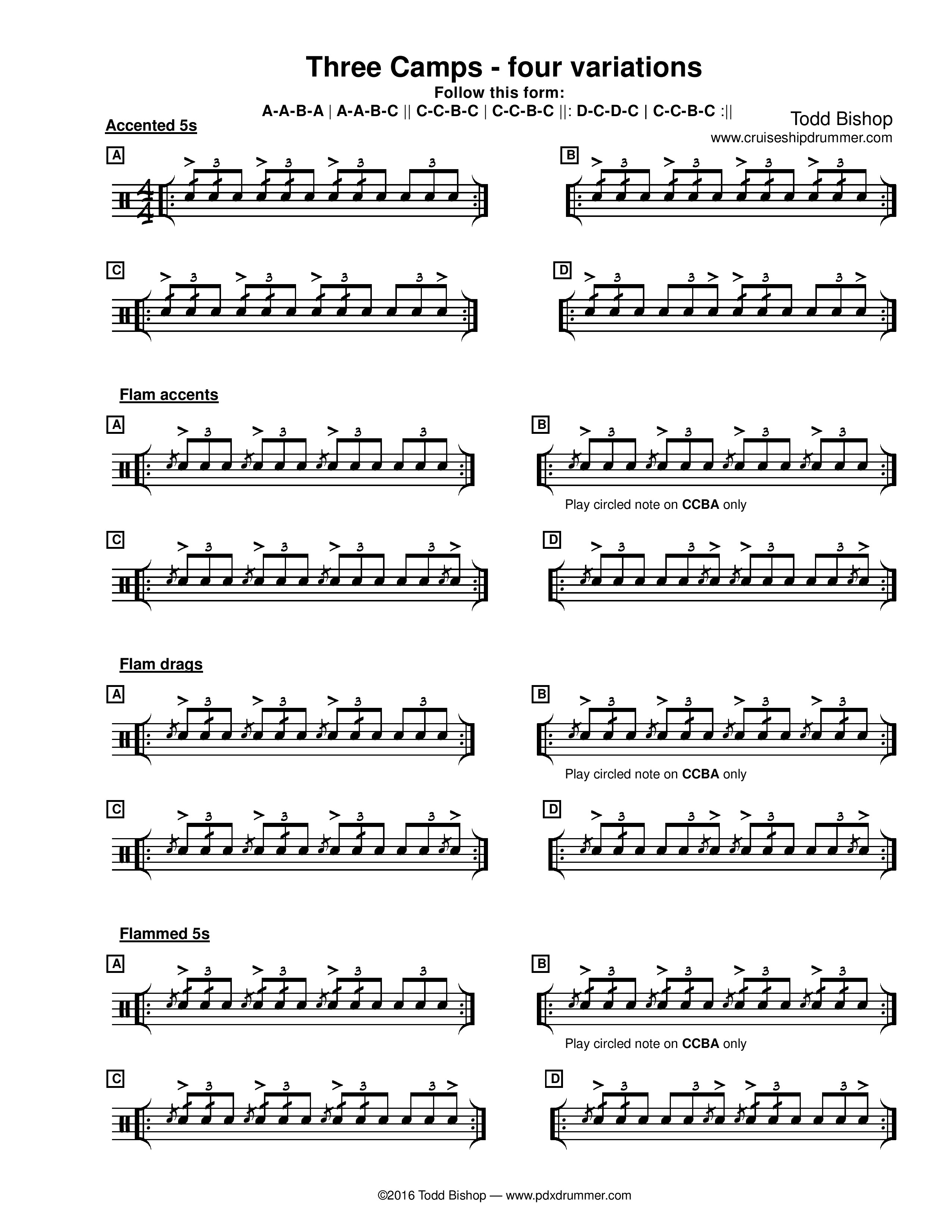
Three camps: four variations

Four alternative ways of playing the rudimental piece Three Camps, that I'm practicing this week, accented 5 stroke rolls, flam accents, flam drags, and flammed 5s.  


Learn each measure individually, then play them in the form given at the top of the page. Chop out. 

Get the pdf

Monday, August 10, 2020

Alternating flam rudiments tree

Just a little throwaway graphic illustrating the connectedness of flam rudiments. People think of them as “omg a bunch of different things”, but they use very similar motions.


The key rudiment here is the Flam Accent #1— you get the others after it by just doubling one note, and playing with the rhythm. The pattern named Unnamed Awesome Rudiment is now named Unnamed Awesome Rudiment, or UAR. I like it better than the other 16th note flam rudiments— Windmills are easy but dull, Flamadiddles are just loathsome. UARs are difficult but hip.

Saturday, September 15, 2018

Left handed rudimental study - 01

This relates to my old, old same handed flam accents post, and my more recent left hand lead developer post. This is very left hand-intensive, with a lot of those same-handed flam accents I like so much, and some flam drags and partial pataflaflas. I'm making videos today— maybe I'll post a video of me playing this a little later.


Repeat as many times as you like and end at the fine in the second complete measure. You can play the rolls open or closed— double stroke or multiple bounce. I'm playing them multiple bounce. 7-stroke rolls here have a 16th note triplet pulsation. The 11-stroke rolls have a quintuplet pulsation— this is a more common thing than you may think. At certain tempos it gives a better sounding roll than a 16th note or sixtuplet pulsation. The quintuplet pulsation should tell you this piece will be played fairly slowly.

Observe the dynamics on the long roll at the bottom of the page— there's a fp accent at the beginning, and the rest of it is soft, and it ends soft. Alternatively, you could start it strong and do a long decrescendo, ending pp; or if you're a crass SOB, you could start it softly and crescendo to the end.

Get the pdf

Saturday, March 28, 2015

Snare drum workout in 6/8 — 01

I thought I posted this weeks ago, but, if Blogger's kind-of sucky search engine is to be trusted, it seems I haven't. Best to find what you're looking for using the labels at the bottom of each post, and/or the site archives in the sidebar. One of these days I'll move the blog over to Wordpress, which I understand is a fairyland of things not sucking as bad as they do with Blogger...

Anyway, here's a snare drum workout in 6/8, using Stone stickings, and a mixed rhythm, with flams and a flamacue-like structure— an unaccented flam followed by an accent. No, I know of no more concise way of describing it.


I try to use as little ink as possible with these things, but this one is complex enough that we really need all the stickings written in, for both RH and LH lead. My usual rules these days are: 1) Play the dynamics. 2) Make it through the whole page every session. 3) Keep stick heights generally low— 1" grace notes, 3-4" taps, 5-6" accents.

Get the pdf

Sunday, December 07, 2014

Snare drum workout in 6/8

I'm all about the one-page workouts these days, so here's another one, for snare drum, in 6/8.

The first goal is just to be able to play each of the patterns individually; probably some of the later ones will hang some people up. After you can play them all at a moderate tempo, then you can begin doing the actual drill, playing each exercises 2, 4, or 8 times, and going on to the next one without stopping, all the way down the page. You could do that every day for a week or two, upping the tempo as you feel like it, then move on to something else.


Sticking is alternating, unless otherwise indicated. Play the drags open, with two notes per stroke. Observe the dynamics carefully— grace notes should be played 1" off the drum, unaccented notes and drags ~2-5", and accented notes ~4-10". Personally, I do most of my snare drum practice with very low heights these days, with 2-4" taps  and 4-6" accents. Remember, 6/8 is a compound meter counted in 2— there are two triplet-feel beats per measure— so set your metronome to click on the first and fourth 8th notes of every measure.

Get the pdf

Tuesday, July 22, 2014

Snare drum workout in 2/4

Easing back into posting stuff, this is a short snare drum workout in 2/4, based on a simple accent pattern, developing a quasi-rudimental, flam drag/flam accent/flamacue-thing I improvised while warming up on a practice pad. If you don't have your flam drags together, it should be fairly challenging.  


Assume an alternating sticking , except where indicated. A complete workout with this thing would be to play each exercise 4-8 times, going on to the next one without stopping until you've finished the page. I would do that at two tempos: one comfortable, one challenging. Then repeat the entire process leading with the left hand.

Get the pdf

Saturday, September 07, 2013

It's a flam accent throwdown!

Oh, it's on.* I guess. At least, Sam Nadel has posted a nice flammed triplet warm-up, and, inspired by that, I wrote a similar one of my own, with flam drags, and same-handed flam accents, a pseudo-rudiment I use a lot:


It's short, so you could stretch it out by repeating each line, and the entire four measure “hot lick”, maybe playing the drags on the repeat only. In its complete form it's pretty challenging, so you'll certainly want to leave the drags out at first— and maybe even the flams, and get the lay of it just playing accented triplets, with the mixed sticking.

And just so drag notation is clear to everybody, the first measure would be played like this:


Get the pdf