This is in Frank Arsenault form— the third camp different than I've seen it elsewhere. We get to play the third camp twice, without the extra repetition of the second camp afterwards.
Friday, September 27, 2024
Three Camps in first inversion paradiddles - UPDATED
This is in Frank Arsenault form— the third camp different than I've seen it elsewhere. We get to play the third camp twice, without the extra repetition of the second camp afterwards.
Sunday, September 01, 2024
Snare drum vs. drum set training
The following are some comments I made in a contentious online conversation about snare drum training and drum set training— or playing— and the differences between the two, that I think stand on their own— edited slightly for clarity:
The snare drum and the drum set are different instruments, played differently.
Snare drum training is two handed playing on one drum, dealing with all areas of performance on the snare drum— reading, accents, flams and ruffs, rolls, rudiments. See any method book, technique book, and rudimental book: Podemski, Goldenberg, Stone, Wilcoxon. Intermediate Snare Drum Studies and Rudimental Primer by Mitchell Peters give a reasonable minimum standard for baseline proficiency.
Drum set training means playing the drum set, a four limbed instrument using a snare drum, a bass drum, some cymbals, and some tom toms, as a coordinated thing. Training involves things related to coordination, styles, the functions of the components of the instrument, playing and setting up figures, reading interpretively, improvising, filling, soloing.
Much of that we develop through the book Syncopation— the most common things done with it are in John Ramsay's Alan Dawson book. I've also written a hundred or so systems for it on my site. Other books broadly outlining that are Steve Houghton's Studio and Big Band Drumming book, Ed Uribe's Brazilian and Afro-Cuban books, and Kim Plainfield's Advanced Concepts book. Those all outline the primary techniques of the instrument, and practice systems for developing them.
You can't get where those books take you just by getting good with your ratamacues.
Much of ordinary drum set playing doesn't require a lot of technical ability as a snare drummer. Though it can be very helpful, and necessary for some ways of playing. And necessary if someone's going to be a competent professional.
The drum set has its own language now. Approaching the drum set as “snare drumming plus some other stuff” is antiquated.
Reading real old drumming materials it's kind of shocking how contemporary some of it is. And how not. Much of it is oriented around how to play a 2/4 march and how to play a 6/8 march, and that's about it. 2 feel with the bass drum / 4 feel with the bass drum.
On the snare drum alone, I don't see a great logic to playing patterns 1-72 in Stick Control, except it's a different sequence of Rs and Ls. The sequences themselves are an important part of the language of drumming, but I don't know how helpful it truly is to just learn a lot of ways of making static 8th notes on one drum. Except to work on evenness between hands— which is something, but not everything.
It's kind of like making a piano student run their scales with all the notes on the keyboard sounding middle C. The differences in pitches aid understanding the thing, they're the whole reason for the thing.
I don't know of another instrument that requires people to learn complex fingerings while sounding a single pitch.
I learned most of Stone on an actual snare drum, standing up in a little hallway at school— an hour of Stone like that. Flam pages 21-23. It was a miserable way to practice, and ultimately poor practice economy for the effort.
If you play 1-72 from Stone on a drum set with the hands hitting two different sounds, there's an obvious musical difference between the patterns— there is a reason to play one over another, an auditory difference. So you learn the pattern as a piece of musical content, not just as a mathematical sequence.
Part of why so many drummers are such lousy musicians is they think in terms of Rs and Ls and not in terms of melodic ideas— which we get from that latter thing.
The bigger reason to do a lot of snare drum is not just for how you'll use it directly. Your hands are still where most of your facility is going to be. There are some bodies of SD materials that are pretty essential to more-than-basic drum set playing— accented singles, flam rudiments, paradiddle rudiments, open rolls and drags. And the more advanced snare drum materials cover some things that no drum set materials cover— finer aspects of rhythm, various forms of time changes, finer dynamic control, and timing control.
Different students have different goals. We start on snare drum, and continue with it as necessary, as their goals evolve. The two instruments develop concurrently.
I teach all levels of people, with all sorts of playing goals that are not mine. Not everyone knows how serious they're going to be about it when they start. Many of them are not irrationally motivated to do it, as I was, and need to be given a chance to get hooked, and get more ambitious about what they want to accomplish with it.
The idea is not to teach limitation, the idea is to find a path forward for everyone, and teach things in a timely manner with the growth of their interest, goals, and commitment.
I get a lot of students who were poorly taught— by themselves, or others. There are a lot of very bad drum teachers (and bad drummers) out there, often teaching ideas they inherited from their teacher, that they never really understood, and never questioned. Or they try to reinvent the instrument based on some popular trends, without understanding what they're reinventing. I'm not thrilled with the way a lot of people do things on this instrument. There are a lot of lingering primitive ideas about how it works.
Nothing half assed about any of this— I put a tremendous amount of energy into helping my students become excellent and creative players to whatever extent they want to pursue it.
How much snare drum would you require before touching a drum set for a nine year old beginner? Or a 70 year old beginner? Or someone with a high pressure job who does music as a distraction from that?
Also see this post on snare drummers vs. drum set players.
Sunday, July 21, 2024
Playing Bellson
Here's a video I made yesterday— there was a slight online mishegoss over me not liking the Reading Text In 4/4, by Louis Bellson, and it was requested that prove myself by playing one of the harder pages in it:
I played a lot of things of this level of difficulty, and harder, as a student, via the usual snare drum books, but don't normally practice this kind of thing now. For reading difficulty, this isn't the most egregious page in the book, but there are several measures of it that are offensively written, with quarter notes (including dotted) placed on the & of 2 in several spots— that is only acceptable/correct in a couple of special contexts.
I practiced it for about 20 minutes, put in beat marks on the more wrongly notated measures, then made the video— this was the second take. Tempo is about 90 bpm.
Let's analyze/critique it like I would somebody else's video:
Accuracy there is 100%, and my time is solid— there's no metronome or anything. I am guessing at the timing of the quarter note triplet— if I was reading ahead better, and practiced the page a little more, I would anticipate it better and have better awareness of where beat 2 falls during that rhythm. Still, the timing is tolerably accurate, I don't believe I would be dinged for that. I'm a little bit seat of the pants in lines 7 and 8— the time flexes just enough to not be purely metronomic, but I don't legitimately drag. For all musical purposes it ends at exactly the same tempo as it started.
With my touch, I don't think I'll be mistaken for a concert snare drummer. It's a good touch— I don't play hard— but it's a percussive touch, it doesn't scream concert snare drum musicality at you. That's a pretty strong concert f all the way through. If I were preparing this piece further, I would be looking to add some dynamic motion, if not actual dynamic markings. The phrases should feel like they're going somewhere, even when played at the same dynamic level. The writing here is not conducive to doing that automatically. I don't find it easy to make music out of this piece.
My whole issue with the Bellson book, of course, is that it doesn't work well for what I want to practice on the drum set, which is my main purpose for that kind of book. I have a half dozen similar books I also do not use. Even with Syncopation, which I use all the time, I'll rewrite things, mark it up, and write new stuff to fill in the gaps in it. For the type thing in this video, I'll use any of 6-8 regular snare drum books.
Friday, May 24, 2024
All American Drummer Solo No. 128
Here's a raggedy little video I made of Solo No. 128 from Wilcoxon's All American Drummer— in response to an online question. Never played it before, I worked it up in about 15 minutes. Tempo is 74 bpm.
And here is the solo written out:
As always, the notation is a little screwy and imprecise. They really didn't know how to write some basic things back then. Or maybe it's the engravers' fault. When you encounter something weird and impossible looking, smooth it out and make it normal. Play the 7 stroke rolls in the first line with a 16th note pulsation— roll is 32nd doubles on the e&a of the beat, for example.
Play the 11 stroke rolls in the second line with a quintuplet pulsation. It's a little irregular the way I play it, but it sounds cool.
The 10 stroke rolls in lines 3-4 and 6-8 are straight out of Three Camps— as are the fast 5 stroke rolls next to them in lines 6-8— play them with a sixtuplet pulsation.
It's another poorly-balanced Wilcoxon solo. Those 10s impose a definite speed limit, but if you can't do them fast the rest of the solo is so slow it falls apart. There's maybe a 10 bpm range where the thing is playable without sounding stupid [or not!]. Have fun!
Saturday, April 27, 2024
Leading with SD/cym accent
I don't know what to call this category of thing— I was listening to some Jack Dejohnette, where he would play something on the snare drum, beginning with a unison accent on the snare and a cymbal. And with no air between the SD/cym accent and the snare drum stuff. Shades of Tony Williams in there too. It's sort of a unique move, that I've never worked on specifically. So these are some things to play around with to develop it.
The “B” sticking of course means Both hands in unison. The only stickings that matter are at the front of the measure, pencil in whatever you like at the end of the measure.
Saturday, February 24, 2024
Ruffs, drags, and general correctness in snare drumming
The correct way to play ruffs (or drags if you prefer) on the snare drum is an extremely attractive topic for repeated, endless debate. Evidently. I've seen it again and again, people going nuts for the topic.
The major burning issues seem to be:
a) What they should be called— ruff or drag.
b) How to play the embellishment— double stroke, multiple bounce, or...?
Around here we call them ruffs, and my concept of correctness playing them came from a kind of Charles Dowd / Tony Cirone / Fred Sanford axis. Mainly, most of my teachers and corps instructors, and many professional acquaintances, were students of one or all of them. Dowd and Sanford both studied with Cirone. Dowd and Cirone both studied with Saul Goodman— primarily known as a timpanist, but played and taught all orchestral percussion instruments. He's as important a figure as anyone in modern percussion. All four of those individuals taught many thousands of professionals over many decades, so there's a sizable community of players for whom this is part of their frame of reference, at least.
Summarizing my views, and what I teach, this is from Cirone's book Orchestral Techniques Of The Standard Percussion Instruments:
Except: in drum corps, we played them multiple bounce, not double stroke, with the buzz very tight against the main note. I believe that way of playing them in that setting was likely Fred Sanford and Bob Kalkoffen's innovation. More traditionally they were played with a double stroke.
Also in corps: in practice, the term drag didn't refer to a specific rudimental pattern, but to a single metered open double played as part of an ongoing rhythm, which might be referred to as a drag passage, like:
A real traditional rudimental geek could analyze each of those phrases as a series of named rudiments, and I'm glad I never learned that way. For me this was always just a continuing rhythm with some of the strokes doubled. In fact there are some passages from traditional rudimental solos that could be interpreted that way, with the drag strokes metered. This line from Charley Wilcoxon's Roughing The Single Drag:
Could be played:
Continuing with the common ruff (or drag) here's another excellent description from Percussion For Musicians by Robert McCormick, edited by Cirone:
Friend/friend of the site and excellent drummer Ed Pierce (and author Alain Rieder) has pointed out that there is a Porcaro/Igoe/Henry Adler/Al Lepak lineage of players who refer to any three note single stroke pattern as a ruff. Ralph Humphrey as well. That's different from what we've been talking about— you would not read a snare drum part, or etude, with the above ruff notation and automatically play them as single strokes. In fact I don't know how that interpretation would be applied to written music, other than to assign a rudimental name to a written rhythm (calling a 1e& 2e& rhythm ruffs, for example). With this usage we're just giving that name to a simple rhythm structure, a cluster of three notes.
There is an exception: you do play ruffs as alternating singles when you encounter that notation for most other percussion instruments— timpani, for example.
This all may beg the question: what even is the purpose of doing it one way or another? Why does doing it “correctly” according to a certain school of thought matter? Who decides what's correct to begin with?
I don't believe there's any real technical or hand-conditioning benefit to doing it one way of the other— it's purely a question of convention, taste, and musical effect and expression.
If you're involved in concert snare drumming, you'll be working with conductors, band directors, other percussionists, professors and other teachers, and miscellaneous judges— via competitions, juries, auditions— each of whom may have opinions or demands about how you should play, which may be difficult to ignore completely.
In rudimental drumming it is decided by the individual organization— marching bands, drum and bugle corps, other drum lines, will each have their individual style standards that players need to follow. Much of the rehearsal process is about learning those standards, you don't necessarily need to have them prepared in advance.
As individual players, we're generally free to do whatever we want— hopefully guided by some kind of sound idea, and a good musical ear. Generally it's best to to have a baseline of ability that fits with what the rest of the drumming world is doing, doing things the way other good players do them, until you're experienced enough to form a different idea about it. Someone doing something in a grossly unconventional way in a formal performance setting is most often taken as evidence the player doesn't know what he or she is doing.
Postscript: In the comments there's a good question about diddles as distinct from drags.
Monday, December 04, 2023
Chop busters: flammed 16ths
Thursday, August 31, 2023
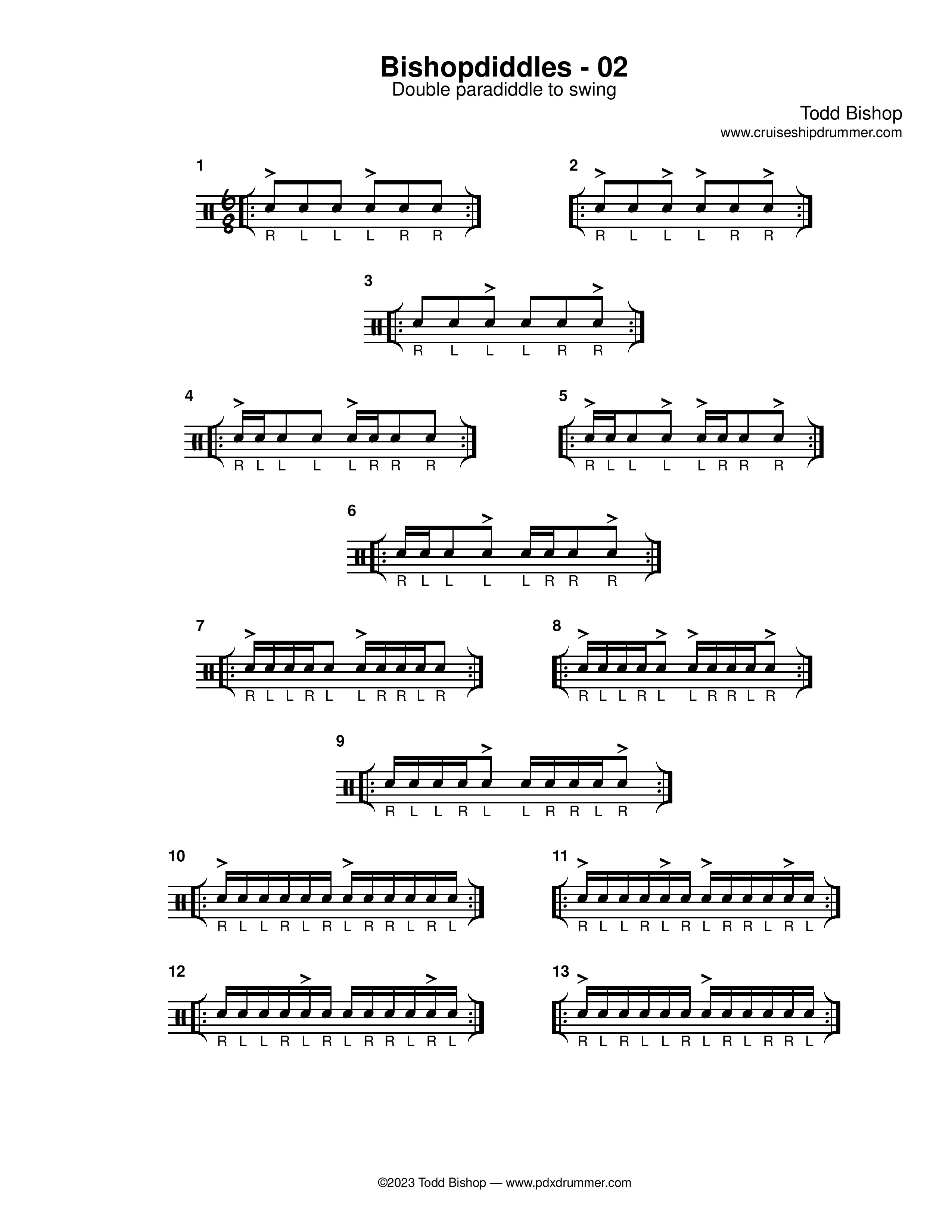
Bishopdiddles - 02: double paradiddles to swing 8ths
Listen: do not show these to somebody and call them “BISHOPDIDDLES.” You're going to get both of us beaten up.
One thing I like about this double paradiddle inversion is that it's possible to accent the first and last notes of a triplet (or beat of compound 8th notes) with it, so it fits nicer in a slower tempo swing 8ths environment, and we can make a Reed system for practicing it.
Regular double paradiddles accent naturally on the first two triplet or compound 8th partials:
This inversion puts the natural accents on the first and last partials, which of course coincides with a common swing 8th note interpretation:
This, then, is a collection of drills for developing it fully:
You can use patterns 1-3, 4-6, 7-9, and 10-12 (I don't know why 13 is there) as foundation patterns for practicing this out of Syncopation. Play p.38 all those ways.
I mostly only use these patterns once at a time, not hand to hand like this, so this may not be much more than a technical drill, but I think it's a good technical drill.
Saturday, August 26, 2023
Bishopdiddles
Minor item, corralling some similar sticking ideas that have been floating around the site. I noticed that with paradiddle-like stickings, I like inverting them so the double is up front, right after the first accent. These all follow that pattern:
DISCLAIMER: I don't want to mislead anyone with that BISHOPDIDDLES™© headline— I obviously didn't invent the RLLR-LRRL paradiddle inversion. The George Lawrence Stone estate would be working me over in court right now if I made that claim. My God. Or that RLLRRL sticking. The other two probably exist in some book somewhere*, but I got them from my own usage.
* - I see now they're in Rudimental Swing Solos, with accents on the double, for some reason.
So there they are as a single group of patterns. You can see them applied in this cool Reed system.
Why do do this? When improvising with them on the drum set, you can hear the natural accents of the sticking, and they affect the way you can move around the drums. That's fine with me, it's natural texture, it's what I want.
The double and triple paradiddles start with these strong singles, and end weakly with a double. They die at the end. However strongly you play the double, that's the structure of those patterns.
With my wonderful stickings, the double slipstreams behind the starting accent— naturally a long sound— and the pattern finishes strongly, with singles: diga-diga-POW. If we accent all the leading singles, you can see how the natural momentum goes with each one:
I generally only use the double/triple paradiddle inversions once at a time, but they have some very interesting possibilities, I'll be writing some ways of doing them continuously.
Saturday, May 06, 2023
Three camps: four variations
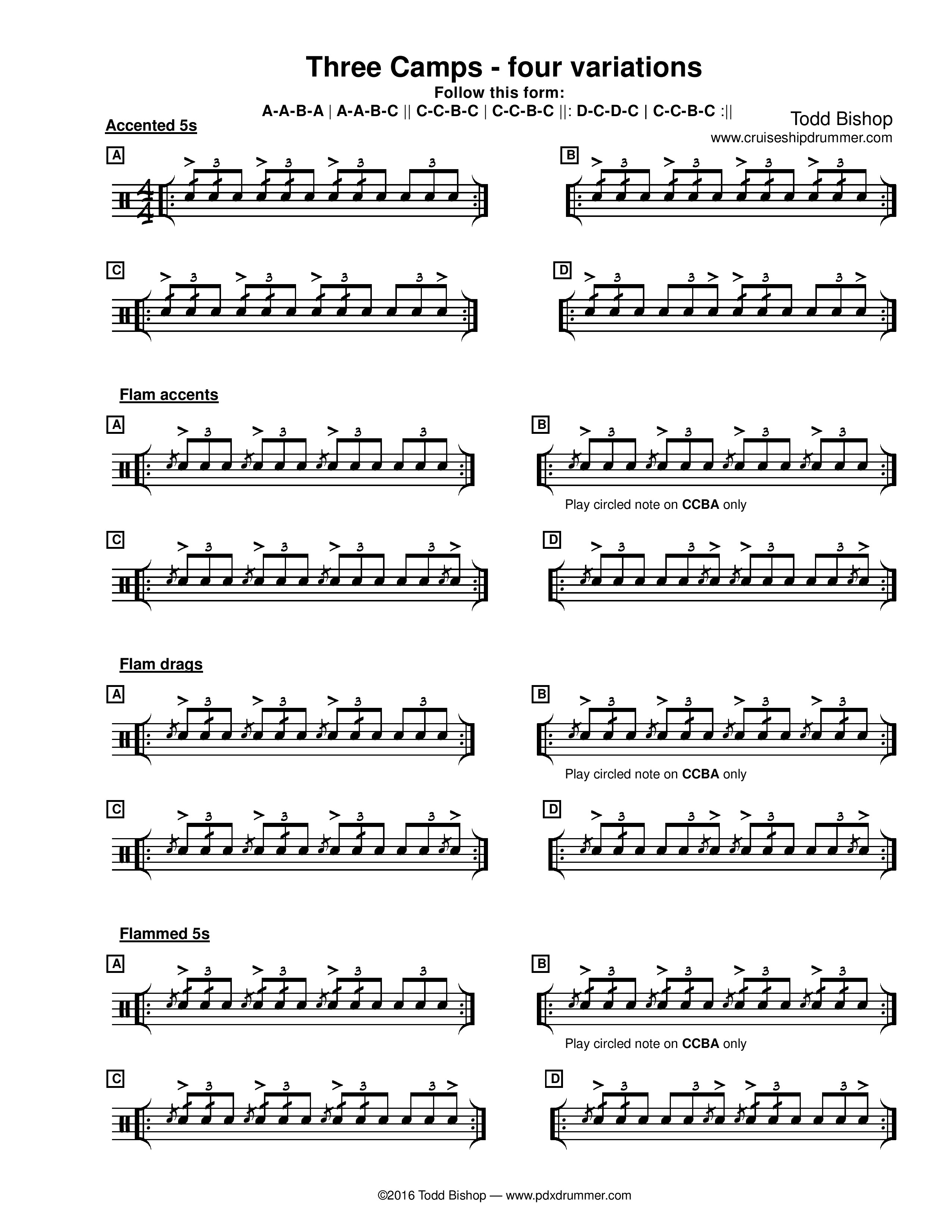
Four alternative ways of playing the rudimental piece Three Camps, that I'm practicing this week, accented 5 stroke rolls, flam accents, flam drags, and flammed 5s.
Learn each measure individually, then play them in the form given at the top of the page. Chop out.
Thursday, March 02, 2023
From the zone: SD chops
Another notebook item from the later 80s, as I get my act together following recent personal developments. Cleaning out my mom's basement, I found a bunch of my old notebooks and music materials.
Basically, I've been doing all this for a long time— here's a page summarizing my snare drum practice circa 1987:
My instructions to myself:
- Play from both Stone books [Stick Control and Accents & Rebounds]
- Slow down the things that are causing tension— don't play faster than you can [play] relaxed— but push yourself— don't play the same d*mn speed for six months.
- Cover as much material from the books as possible. [I'm not sure what books I meant, other than Stone— in my lessons I was working from Goldenberg, Cirone, Delecluse]
Identifying those rudiments by column, we have:
Paradiddles
Flamadiddles
Windmills
Flam taps
Inverted flam taps
Dragadiddles
Flamadiddles again
Flam drag-adiddles
Flam Accent #1
Swiss Triplets
Flam Drags
Flam Drag #2 - I made that name up just now
Flammed 5 stroke rolls
Paradiddle diddles
Flam tap-adiddles - another name I made up right now
Inverted flam tap-adiddles - no sticking indicated, I assume it's connected to the thing above it
Ratamacues - my own form, inverted
Double ratamacues
Triple ratamacues
Double paradiddles
Flam double paradiddles
Pataflaflas
Flams
Ruffs
Four stroke ruffs
Tap 7 stroke rolls
Tap 5 stroke rolls - triplets
6 stroke roll - taps at the beginning
5 stroke roll - triplets
6 stroke roll - taps at end
6 stroke roll - usual format
Drag pataflaflas
Friday, December 23, 2022
From the zone: left hand developer
Here's a cool little exercise from a great drummer from Los Angeles, Sinclair Lott:
Check out Sinclair's YouTube channel, which has some lovely playing, and cymbal demos. And get his latest record here. Buy people's records.
Send in your FROM THE ZONE items— any of your handwritten stuff. It doesn't have to be finished, or good, or anything. I just like seeing what people scribble out in the wood shed because it wasn't in any of the books, and they needed it. Take a picture with your phone and send it.
Thursday, December 01, 2022
Best books: revisiting Rubank
![]() |
| The matte industrial looking horizon blue cover has that depression era band room reek. |
I've never been completely happy with the available beginning snare drum books. Mitchell Peters's Elementary Snare Drum Studies is the best, but it's a little denser than it needs to be for average 5th-7th graders.
All of these books have a few pages of fundamentals at the beginning, with a lot of verbiage, instructions on how to tuck a calf skin head, a picture of some jerk standing at a drum... all of which every kid in the world ignores completely. In Rubank there are just two pages of that, which are actually useful, covering grip, explanation of a roll (double stroke only), and a table of rhythm values and time signatures.
The suggested right hand grip is interesting, a Moeller type grip with the fulcrum in back:
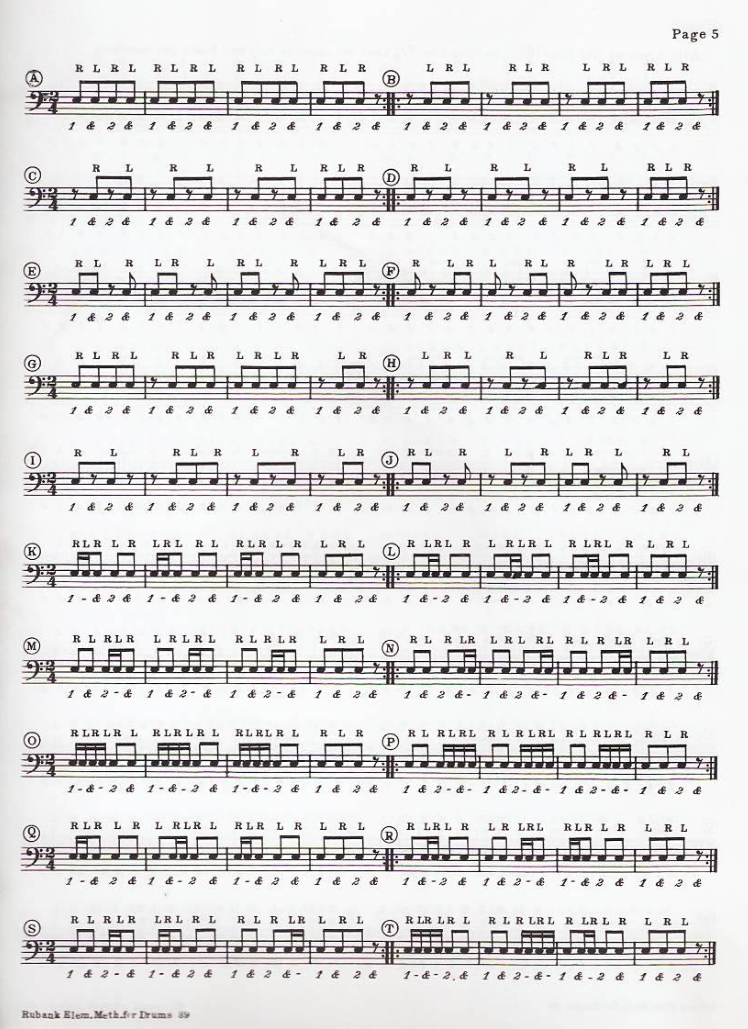
Then is the main body of the book, starting with four very useful pages of four measure rhythm studies, in 4/4, 2/2, 3/4, and 6/8 time. Then sections on 5, 7, and 9 stroke rolls, flams, and dotted notes, with more short studies— about 16 pages of those all together. All have stickings and counts marked in. They're well graded and presented— better for younger students than Peters, or the Vic Firth and Roy Burns methods, which I have also used.
It's a pretty quick introduction to the rhythms and time signatures they'll be playing in band class, with the more serious technical practice dedicated to rolls— that will be the hardest part for the target age group. The flam pages are good, and not over-technical.
There's not a lot of verbiage, and what there is is pretty concise, even if it's not always phrased in a way that will be clear to students. But the point of that is not just for the student to read it and understand it immediately— it's more about giving the teacher the major points to re-explain to the student until they get it.
There are pretty useless sections covering the bass drum, and some other band percussion instruments— cymbals, triangle, castanets, tom tom, woodblock, tambourine. And several pages of percussion parts for Rubank band pieces.
There are eight OK pages outlining the 26 snare drum rudiments, and a few extra variants. Most are written in quarter notes, 8th notes, and 16th notes, and with roll notation, if there are rolls involved. The author wants us to play them slow to fast— all are marked with an accelerando— which I don't agree with. Acceptable, better than the usual single page list of rudiments.
The Intermediate book was written Robert Buggert, who has his own very old snare drum method book, that is pretty good, and long out of print. The intermediate Rubank book is all performance pieces for band percussion section— solo snare drum, snare and bass drum, full section. And a few band pieces. It's dated, and not real useful to me. There's also an advanced volume that I haven't seen yet.
The elementary volume, even as it's pushing 90 years old, is still a pretty good first book for students in the 8-12 year old range. The roll section is a little out of balance for that age group, but rolls were important for that time and setting. Rudiments are covered but not over emphasized— it's not a hard core rudimental book a la Haskell Harr. It's a good overview of what a snare drummer, and band drummer, is. I'll probably use this with some younger students mainly for the rhythm portions.
Thursday, October 06, 2022
Three Camps in 3
Something about doing it in 3 encourages you do it faster— I like Three Camps for working on fast singles. And the piece is 50% longer, so it will help your endurance.
Wednesday, October 05, 2022
Cinquillodiddles
This one occurred to me thinking about Wilby Fletcher playing with McCoy Tyner...
The cinquillo rhythm— I'm calling it that now for ease of reference— is a very useful one measure Latin rhythm, and a common velocity cymbal rhythm, that can be played, with left hand accompaniment, as a paradiddle inversion: RLRR-LRRL.
So here are a few patterns for playing it on practice pad, with some RH flams added to develop left hand “independence”— the RH rhythm doesn't change.
And since we did it for the cinquillo, we may as well do it for tresillo. That works, too: RLLR-LLRL. The RH is sparser on that one, so I've added some LH flams to create some variations for the RH part.
The accents are a starting place, you can accent however you want. I suggest starting with any single left hand notes. I'm practicing these with drum set in mind, with the RH on a cymbal, so I'm not too worried about perfect snare drumistic form and dynamics on the flams or accents.
Tuesday, September 27, 2022
Triplets to paradiddles
A brief set of exercises illustrating the similarity of alternating triplets and paradiddle inversions. We want connections between things that seem different, even when there's a seeming hard mathematical difference, like between a triplet and a 16th note. We're looking for fine expressive control of rhythm, within a groove-music context.
Both measures of each exercise have the same sticking, with a different rhythm. 1-4 are the basic exercises, 5-8 are a little more involved, but are not essential to the basic concept.
Play the exercises with and without the drags. You could take this a little further and try to find some in-between versions of each thing— as long as the accents are steady, you have some room to play with everything in between. For example, you can take the 16th note measures in Brazilian direction by squashing them into the space of a triplet, so the # and a counts line up with the first and last triplet partials. In fact this is an excellent way to learn to do those Brazilian “tripteenths”, in some very useful stickings.
Tuesday, February 22, 2022
Stick control in 12/8 - “Afro logic”
Here's what that page of 6/8 sticking patterns was setting up— and that funny joke photoshopped page from Stone: sticking combinations in 12/8, oriented like the Afro “short bell” rhythm, with one pattern on beats 1 and 4, and another pattern on beats 2 and 3. This is for people like me, who do a lot with that Afro groove— it's one of my major personal things.
I'll be playing through this on the drums, with RH on the cymbal, possibly with the bass drum in unison, and with the left hand on the snare, playing around with some of the usual moves around the drums. Probably with dotted quarters played with the left foot.
Friday, February 18, 2022
Stick control patterns in 6/8
This is part of a larger writing project I'm doing— some things you have to write out to decide if they're going to be of any use. You can see that the logical sequence here is unusual. File this in your library with the myriad of other items in 6/8 on the site.
I rarely play any kind of stick control-type pattern just on the practice pad— except with students. I'll usually play them on the drum set, with one hand on a cymbal, with the bass drum in unison, or some variation of that. Or with one hand accented and the other hand ghosted.
Thursday, February 10, 2022
Stick Control with short bell logic
Another one of my little photoshop gags— I edited a jpeg of the first page of exercises in Stick Control to follow the logic of the Afro “short bell” pattern*, which has beats 1 and 4 the same, and beats 2 and 3 the almost the same. The page is written in cut time, so each beat is four 8th notes long. Look closely and you'll see what's happening:
I got the idea when I was teaching a student that linked Afro 6 page above, and was curious to see how it would play out when written out. I haven't decided if this is actually worth practicing, but this logical orientation is a real world thing— notice that if you play pattern 1 with your right hand on a cymbal, you'll get something very close to a partido alto rhythm— and I won't be surprised if it develops into something creatively useful, with some different stickings.
Monday, February 07, 2022
An Elvin-inspired lick
A page inspired by something that came up on Elvin Jones's solo on the tune Crisis, which I partially transcribed last week. It's not even a lick, it's something funny that happened with his timing, that's worth exploring.
Pattern 1 is the key part— the triplet portion is really just a distortion of the alternating 16th notes. The sticking for both parts is RLRL, we've just pushed the rhythm around and put in an odd accent. Apart from this thing as a solo idea, it would be worth playing pattern 1 for awhile as a stick control pattern— teaching your hands a triplet expression of that ordinary RLRL sticking.
The rest of the page are some possibilities for moving it to the drum set. Play around with it, move it around the drums, have some fun.