Showing posts with label playing in 2. Show all posts

Monday, December 12, 2022

Page o' coordination: hihat in the space

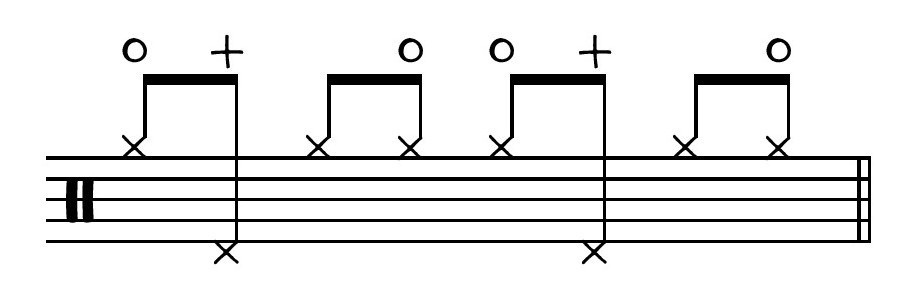
Here's a page based on this ongoing Elvin Jones transcription— I observed when he was playing time on the hihat, he would tend to close it before the beat. I also saw him doing that at a faster tempo, on Chasin' the Trane. And he often puts the hihat on the & of 1 in that Afro-waltz type feel. So let's work it out a little bit.    

Let's be clear that these are coordination patterns. Check out the transcriptions and recordings to see/hear how he actually does this— you don't want to go in and do this as an ongoing time feel. Though there's at least one kind of stock shuffle groove that does something like this. 


Swing the 8th notes, play the cymbal part on the hihat, observing the open sounds; also play it on the ride cymbal. Take care with articulating this distinctly from the normal hihat close on 2 and 4— doing it unthinkingly could mess with your time feel. 

Get the pdf

Friday, December 09, 2022

Transcription: Elvin plays in 2

A little transcription of Elvin Jones playing in 2, on the hihat, on the head of Foolin' Myself from the Lee Konitz album Motion. In case you're short of comping ideas, or phrasing ideas when playing in 2. I've never played the tune, but it's a regular old 32 bar standard.  


That's open hihat all the way through, except + is a closed sound, and a staccato mark is half-open. He plays it softly with the foot in a few spots too. In fact much of the time he closes the hihat before the beat:  


This happened a lot on my titanic yet-unfinished transcription of Chasin' The Trane, too— his hihat landed before the 2 and 4. 

The rhythm is swung all the way through, but there are a few spots where I marked a dotted 8th and 16th note rhythm— where a comping note was very tight against the following beat. Those were ghosted, generally. 

Get the pdf

Friday, March 29, 2019

Page o' coordination: that with interruptions - 02

Another page of basic jazz comping/independence patterns, coming from a slightly different angle. At a recent John Riley clinic, he talked about one pattern he had been practicing, with variations, for about 50 years: SSBB. He treated that as a kind of scale, dropping out notes to make variations. This page is based on the same idea, but doing the pattern with a samba-type rhythm in the bass drum: BSSB.

Since many of us will already know these patterns well, maybe this is a chance to think about some familiar ideas in a slightly different way. It could also be a good tactic for teaching jazz coordination to some beginning and novice jazz students.


Swing the 8th notes. In a jazz setting, this pattern is more conducive to playing a 2 feel, with the bassist playing half notes. Handle the bass drum on 1 and 3 carefully— be able to play it in a subtle way. You can accent the 2 and 4 on the snare drum to make a heavier shuffle feel, or vary the dynamics to put the snare drum in a normal comping role.

You can also play this in a samba feel. Use the written cymbal rhythm (not swung, of course), or play straight 8ths on the cymbal. Play the left hand as rim clicks on the snare drum, or vary the articulation: rim clicks, rim shots, buzzes, dead strokes.

Get the pdf

Thursday, March 29, 2012

Playing in 2

I got a nice note from Ben at the excellent Melbourne Drumming Online blog (adding him to the blogroll- be sure to pay him a visit), requesting that I write something about playing in 2- that is, playing in a jazz format when the bassist is playing half notes. You know: the thing people do while they're waiting to go in to 4. God knows I've done enough of it, but never much analyzed what makes it work- or not. And those who have are not really sharing, because I haven't seen much in print about it. I'm sure if you got a lesson with Peter Erskine or Ian Froman or John Riley or Kenny Washington, they could give you some hard and fast rules/suggestions about it.

But since I'm just a field rat, and just learned it by doing it, I know of no consensus theory of playing in 2. What I'll offer instead, then, are some strategies for going about it. For starters, here's the basic, universal time feel, played on the hihat:


Swing the 8th notes on this and all examples, of course. Note that the cymbals open on the & of 2 and the & of 4. Go into your record collection to get an idea of the sound.

Much more- the entire body of the piece, in fact- is after the break: