Showing posts with label Elvin Jones. Show all posts

Sunday, September 08, 2024

Daily best music in the world: Elvin recorded wrong

A little listening experiment. My brother played this record for me, I forget how he set it up— clearly there was something wrong with it, he wanted my reaction. 

I said, this is somebody I should know, but couldn't place it. Sounds weird.


You can see on the thing that it's Elvin Jones... recorded in a highly strange way, with this weird, thin, cymbal sound. He's a very distinctive, recognizable player. I have listened to him as much as anybody, on many recordings of vastly differing recording quality. We were both a little stunned— not that my ear wasn't good enough to tell it was him, but that you could make someone sound so alien to himself by recording him weirdly. And why would you do that. 

Fascination not in a good way. The playing of course is great.  

Monday, July 01, 2024

One measure 5/4 triplet fills with Reed!

Another one of my hack and slash jobs. This is something I improvised in a lesson— a student is working on some of the Pages o' Coordination in 5/4, based on an Elvin Jones groove, and we made some fills using the accented triplet pages from Syncopation, alternating between one measure of groove, one measure of fill. There's a good way of handling triplet stickings so you always come out on the right hand here, in whatever time signature. 

First, we'll be using the accented triplet pages from Syncopation, putting them into 5/4 time, playing the first five beats of each line, repeating, as I've brutally scribbled in here: 


Here are all the one line exercises copied and pasted in into 5/4, jammed onto one page: 

Get the pdf - Reed accented triplets in 5/4. There is another pdf to download below. 

On the drum set, the accented notes are played on a cymbal, with the right hand, supported by the bass drum, and the unaccented notes are played on the snare drum— and later moved around the drums. 

To get the cymbal notes onto the right hand, and to get in and out of the fill easily, we had to use some different stickings. Following some simple-ish rules:

All cymbal notes played with RH 

All snare notes start with LH: 

1-2 notes on SD: LH only
3 notes on SD: alternate - LRL
4 notes on SD: LH paradiddle or inversion: LRLL, LRRL
5 notes: alternate - LRLRL
6 notes: LH double paradiddle or inverion: LRLRLL, LRRLRL 
7 notes: alternate - LRLRLRL
8 notes: LH triple paradiddle or inversion: LRLRLRLL, LRRLRLRL

You get the picture:

•  odd number of SD notes = alternate
•  even number = alternate with LL double at end, or RR double after first note 


I prefer the second type of paradiddle sticking, but there are good reasons to do either. The timing of the next cymbal accent may influence what feels best to somebody. 

This page illustrates all the above possibilities, in the two-measure phrase I described:

When the fill begins with snare drum, you can add bass drum to the last note of the groove measure— to begin the fill more strongly. 

Get the pdf - Reed triplet patterns as fill with Elvin Jones groove

Monday, April 29, 2024

Groove o' the day: two by Elvin Jones

I have a couple of larger transcriptions going right now, from a couple of Elvin Jones live albums, but don't have time to complete them, so here are the major grooves from them. 

The first one is an Afro 6/8, on Tin Tin Deo on the album Very R.A.R.E.: 


He is using three tom toms there, but it barely matters. 

Note on the word feel, here: you see it's written in 4/4 as 8th note triplets— because the tune is in 4/4, if you were looking at a lead sheet. The 6/8 or 12/8 groove is being played as a feel within the 4/4 time, with the beat in the same place, which makes the 6/8 rhythm into triplets. Calling it 6/8 or whatever refers to the normal meter of the groove, not the meter of this setting. 


The other is on A Love Supreme, from Elvin Jones Jazz Machine Live in Japan— a Latin groove with a Mozambique rhythm on the cymbal bell— very timely as we've been working on an “Elvinized” Mozambique lately. Here's the groove as he plays it with one note on the tom tom, and with two: 


Again, he's playing this in 16th notes as a double time feel— the feet are stating the underlying 4/4, and they're in half time compared to what we would normally expect with this groove. 

Here's the groove written out as a two measure, 8th note based rhythm, which is how I would normally write it. Obviously the feet are in half time there, with the bass drum on 1 and the hihat on 3: 


He plays the repeating rhythm without a lot of major variations or fills, but he does a lot with it dynamically. At times he'll lean into these accents in the bell part: 


The groove comes in after the opening rubato section— it takes a few bars before it develops into the grooves we see here: 


Sunday, March 17, 2024

Elvinized Mozambique

An item I was working out with a student— making an Elvin Jones-like Latin groove/texture out of a Mozambique rhythm, for medium tempos, with swing 8th notes. It's an entry, just the first, most obvious things I could think of for taking the groove that direction. 


Swing the 8ths on everything here. At the top of the page is a Mozambique bell rhythm written Syncopation-style, then some basic left hand variations, which you can move around the drums however you like.

Then there is the bell rhythm written out as RH lead triplets— RH plays the complete cymbal part, LH plays the complete snare part. Which you can play as a fill at the end of the groove— note the circled bass drum notes on patterns 6-9, play them with those notes, and without them. As illustrated, you can end the fill with a cymbal/BD accent on 1, or on the end of beat 4.  

With item 10, as it says, play the hand parts with one, some, or all of the written bass drum notes. Try some combinations. We'll explore that more fully in another installment. 

Saturday, October 07, 2023

Elvin isolated

Obviously I'm posting really lightly lately, getting ready to head to Germany next week, so: here are some recordings Elvin Jones plays on, with his drums isolated. Enjoy!

Here's Passion Dance, from McCoy Tyner's album The Real McCoy: 


And here he is playing what I was calling his “Afro waltz” on Out Of This World, from the album Coltrane, one of my favorites: 


There are a number of other of these, check them out. Don't screw around, make sure you own the records! 

[h/t to JDA at Drummerworld and DFO.]

Tuesday, January 03, 2023

Transcription: Elvin Jones - Foolin' Myself - 04

UPDATE: Boy I suck. This is of course the third solo chorus, and the fourth total entry in this series. I'll fix that... sometime. 

Continuing that Elvin Jones transcription from late last year— Elvin Jones playing on Foolin' Myself, from Lee Konitz's album Motion. This page begins at 2:55 in the track. We're getting into some more involved stuff here. 


You can see he plays some denser 16th note stuff in the sixth line— that's the last four bars of the bridge. I've adjusted them slightly to make them practiceable licks. In the first three bars he's playing a three beat pattern: 


Play that in 6/4 to add hihat the way you'd play it in 4/4:  


In the last bar of that line he plays a six note pattern, twice, with one note different. You can practice it either way: 


Get the pdf

Wednesday, December 14, 2022

Transcription: Elvin Jones - Foolin' Myself - 03

We'll keep going with this. Part 3 of Elvin Jones playing on Foolin' Myself, from Lee Konitz's record Motion. This is the second chorus of Konitz's solo, starting at 1:57 in the track. 

The previous entries were pretty clean and straightforward, here there are a few unusual/organic things that don't resolve perfectly as something to practice. 


Like there are some 16th notes on the last beat of the fourth line— the 4e&a1 there. It didn't come out as intended, and there's no reason to practice it like it's deliberate vocabulary. And at the end of the 8th line there are four bass drum notes in a row, in a triplet rhythm— the first two are ghosted, the last two are played. It's an artifact of Elvin's technique, and of a certain physical momentum.  

Get the pdf

Tuesday, December 13, 2022

Elvin's Biddy Oats

No, this is an ALL Elvin Jones site. I think we have to earn it if we're going to talk about him, put in some work, have some humility, don't be a leech. I imagine at D*umeo they refer to him as a “premium name”, with the monetary impact every time they use him all mapped out. Optimizing the Elvin Jones product to attract high-value consumers and suck off the most credibility and appearance of soul algorithmically.  

It's not cool, Elvin Jones is special. 

Anyway, following up on that post about that Haskell Harr march he played, I've transcribed exactly what he plays, more or less. There were some minor variations on the different recordings. The main difference from the original version is the added bass drum, the fp rolls at the beginning of the second half, and the roll off at the end:


The rolls are all multiple-bounce. The 5 an d 7 stroke markings are from the original piece, I didn't check to see if he did them that way. On the fp rolls he sometimes does that Elvin thing of putting putting in an extra bass drum note before the downbeat.  

A scholarly cat could dedicate some study to just how he handled the roll off solo break off on all the different recordings. He played it pretty loose. My scholarly instructions would be to vibe it, and don't be too exact about it. Make them come in on the 1 where you put it, not where it would be if there was a metronome running. 

In fact I think the study of Elvin Jones requires a serious commitment to figuring things out by vibe. It can't all be done analytically. Let's talk about that sometime. 

Get the pdf

Here it is on the new bootleg recording they just put out: 

Saturday, December 10, 2022

Transcription: more medium tempo Elvin

Here's some more of Elvin Jones playing that same tune from yesterday, Foolin' Myself, from Lee Konitz's record Motion. This is the first chorus of Konitz's solo, starting at 0:58:


It's pretty straightforward if you want to learn what he's doing— take it 1, 2, or 4 measures at a time, ignoring the dynamic markings and articulations at first. Swing the 8th notes. 

Or just listen and follow along. You can approach it looking for “stuff to play”, but I listen now it just sounds like someone accomplishing time— I just hear attention to time. 

Get the pdf

Friday, December 09, 2022

Transcription: Elvin plays in 2

A little transcription of Elvin Jones playing in 2, on the hihat, on the head of Foolin' Myself from the Lee Konitz album Motion. In case you're short of comping ideas, or phrasing ideas when playing in 2. I've never played the tune, but it's a regular old 32 bar standard.  


That's open hihat all the way through, except + is a closed sound, and a staccato mark is half-open. He plays it softly with the foot in a few spots too. In fact much of the time he closes the hihat before the beat:  


This happened a lot on my titanic yet-unfinished transcription of Chasin' The Trane, too— his hihat landed before the 2 and 4. 

The rhythm is swung all the way through, but there are a few spots where I marked a dotted 8th and 16th note rhythm— where a comping note was very tight against the following beat. Those were ghosted, generally. 

Get the pdf

Saturday, December 03, 2022

Page o' coordination: Juju

I'm transcribing a little bit of Elvin Jones's playing on the Wayne Shorter tune Juju, which I originally did off the LP around 1988. It'll take some time to finish it, so here's a page developing the main groove from it— a version of the thing I've been calling an “Afro waltz.” Most people would probably say “Elvin waltz.”

Slightly different format from the usual POCs, exercises 1-10 build the particular groove Elvin played on the recording, and have specific drums assigned, including some changes to the bass drum rhythm. Exercises 11-18 have other left hand rhythms for basic fluency. 


Swing the 8th notes. Practice with and without the tie on the cymbal rhythm in the first measure. On exercises 11-18 you can do the stock left hand moves I use with these pages. 

Get the pdf

Here's the tune, it's a record you should know well:

Monday, October 17, 2022

Elvin's march

“I did go through [Harr's snare drum book] as a matter of fact. I went to public school in Pontiac, Michigan, so I didn't do anything extra. [...] I didn't have that advantage of being able to take private lessons, so I had to get everything that I had, at least up to that point, for myself. [...] So I got that book and that night I went home and sat over it and pored over it and read it from cover to cover, trying to make some sense out of it. Finally, all of a sudden I understood what it was. I knew exactly what it meant, what all of it (meant) from page one to the back cover. I pondered over that the next day, and so I learned how to do it. In two days, I mastered that book, and the rudiments.”

- Elvin Jones, Percussive Notes interview

UPDATE: See this post where I transcribed the way he actually plays this, usually. 

A little piece of Elvin Jones musical lore here today. Elvin has a march beat he plays, maybe most famously on Zoltan, from Larry Young's album Unity— I got this record in 1987:


Here he is playing it with his trio, I don't know this tune— maybe he wrote it?  

[Update: It's Keiko's Birthday March— thanks Ed Pierce! -t]

[Update again: It's also The Long 2/4 by Donald Bird! Same tune, released on Pepper Adams's 10 To 4 At The Five Spot in 1958— I don't know what happened there, but thanks Paul Wells! ]


I'm sure there are other recordings— he also played it at a clinic I attended in the early oughts.

It basically comes straight out of Haskell Harr, book 2— page 80 in my edition. He plays this almost verbatim on both records:  


He's playing bass drum on some of the accents. He plays longer rolls in the middle of the second line, after the repeat sign— 13 stroke rolls with an extra bass drum note at the end. He also hits the cymbals there. On the live thing he ends it with his own kind of roll off— it starts normally, and ends with a big Elvin style fill. 

On the live video he plays the full thing with repeats at the top, and after his solo. On Zoltan he switches to the Latin groove in the fourth measure of the repeat of the B section— the organ march vamp starts at the top of the repeat of the first part, then the horns come in with their fanfare thing in the fifth bar, and then the organ starts the Latin vamp in the fourth bar of the repeat of the B section. The fanfare section is 15 bars of 2/4 total. I wrote out the Latin groove from this tune in 2016. 

There you go— I've been listening to him play this for about 35 years, and just thought to look it up in Haskell Harr today. 

Tuesday, October 04, 2022

Daily(?) best music in the world: Elvin Jones Trio LIVE

Awesome live recording by one of the greatest trios ever, the Elvin Jones trio with Joe Farrell and Jimmy Garrison. Here they're playing in Berlin in 1968. Nothing to do here but listen: 

Thursday, February 17, 2022

Solo transcription: Elvin Jones - Crisis

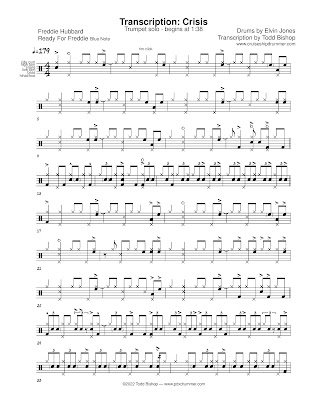
Here's Elvin Jones's drum solo on that tune Crisis, from Freddie Hubbard's Ready For Freddie, which we looked at a couple of weeks ago. It contains some classically Elvin stuff, and is good for some close study. 


The form is 56 bars long (AABA, 12+4 bar A sections, 8 bar B section), and he plays one full chorus, with a few odd measures— measure 18 is short by about an 8th note, and he adds three 16th notes to measure 25 (you can easily eliminate that when you practice the lick). And he drops two beats during the long roll in the last four bars— I've written a 6/4 bar instead of two measures of 4/4. 

I've given some possible stickings, which may be what he played— at least they'll get you in the correct spirit and sound. In measure 19 is the thing that inspired this other recent post. Starting at measure 50 there's a classic thing he does, RLB triplets nested in a quarter note triplet rhythm. The odd looking beat 1 of measure 52 is just a continuation of that— the last note of that beat falls on the last note of a regular 8th note triplet.  

This is kind of a special item— I'll go ahead and post the pdf, but if you're not a regular contributor on Patreon or PayPal, I request that you help me out by sending $3 to: 

Venmo: @Todd-Bishop-16
PayPal: toddbishop [at] cruiseshipdrummer [dot] com

Thank you! 

Get the pdf

Monday, January 31, 2022

Transcription: Elvin Jones - Crisis

Does the site need another Elvin Jones transcription? I don't know. I'm just putting in my devotional time listening very closely to Elvin. What you all do with it is up to you. 

This is his playing behind Freddie Hubbard's solo on the tune Crisis, from Hubbard's album Ready For Freddie. Form is 56 bars, AABA— A sections are 12+4 bars of Latin alternating with swing; the B section swings for 8 bars. Funnily enough, the tune is rather similar to my tune Headlights, and Jorge Rossy's identical tune Post-Catholic Waltz. 

The transcription begins at 1:38, tempo is quarter note = 179. The action really starts happening on the tenor solo— maybe I'll do that another time. He also plays a good drum solo. 


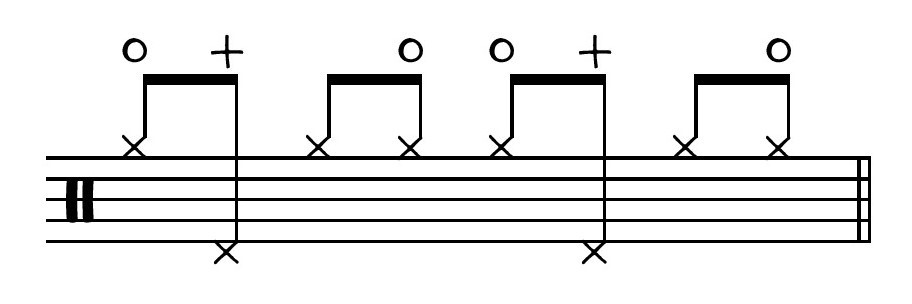
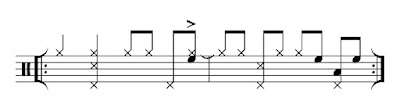
Here's the basic form of the Latin groove, played with a light swing feel. Those 8th notes on the toms are played with both hands— LRL sticking: 


On the third page he plays this three-beat triplet figure in basically textbook form: 


This is a free download— I am starting to ask for a donation for the more substantial downloads. If you feel like throwing in a few dollars: 

Venmo: @todd-bishop-16
PayPal: toddbishop@[cruiseshipdrummer dot com]

If you like what I'm doing, and want to contribute on an ongoing basis, you can do that through Patreon or one of the other services.

Get the pdf

Tuesday, September 14, 2021

Page o' coordination: yet another Elvin 5/4

Here's a page o' coordination based on Elvin Jones's playing on Lazy Afternoon, from Grant Green's album Street of Dreams. It's a medium slow 5/4— the tempo is about 109. He plays the ostinato below fairly regularly, with many small variations. I've given the approximate default thing he plays on the snare drum, and then my usual kind of independence exercises with the ostinato:


Try my dopey old Jesus Christ Superstar loop with this one. Once you learn the patterns, move your left hand around the drums— improvise the moves, or use this set of stock moves I do with all of these. Add the circled bass drum note in the ostinato if you feel like it. 

See my other Elvin-like POCs, based on his playing on Your Lady (adapted into 5/4), a variation on that, and on That 5/4 Bag, 

Get the pdf

Thursday, July 08, 2021

Transcription: Elvin Jones - Chasin' the Trane - 09

Continuing this project, here are the 49th-54th choruses of Elvin Jones's playing on Chasin' the Trane, from John Coltrane Live at the Village Vanguard. Transcription begins at 9:20 in the recording. 


I see there's a typo— it says part 8 when it should say part 9. I'll correct that whenever I get around to it. 

Get the pdf

Friday, July 02, 2021

Transcription: Elvin Jones - Chasin' the Trane - 08

When in doubt, keep doing what you're doing. Let's actually continue and complete my beginning of the year project, transcribing all of Elvin Jones's playing on John Coltrane's Chasin' the Train, from the Live At The Village Vanguard record. I think I got demoralized when I completed part 8 and realized I was only about halfway done. 

These are the 43rd-48th choruses of the performance— 8:10 to 9:20 in the recording. I have part 9 on deck, and then I'll only have six more installments to complete. Then some kind of analysis will be in order. 


There is a lot of repetition— how can there not be? It will be interesting to see what this all boils down to, in terms of total actual content, when this is complete. 

Get the pdf

Wednesday, February 10, 2021

Transcription: Elvin Jones - Chasin' the Trane - 07

I'm finally half done with this. This project is definitely streamlining my transcription methods. I use the program Transcribe, and loop two measures at a time, usually starting with the playback speed at 75%. Everything is basically audible on this track, and I haven't had to mess with the EQ. 

Because I'm using Finale, I first sketch in the combined rhythm for the full drum set— I'll put in the first sound I hear on every note of the combined rhythm. Cymbal, snare, whatever. Then I'll use the speedy entry tool to fill in everything else that's happening in the measure, using the keyboard. It's a pain poking around adding a lot of notes with the mouse. Then I add all of the articulations— accents, ghost notes, open hihat and whatnot. Finally, once I've completed a twelve measure chorus, I'll go back and loop the entire chorus and listen for mistakes in all four parts— cymbal, snare, bass, hihat. It's easy to miss things at the beginning/end of each two measure portion you looped.  

 So here is part 7, minutes 7:00-8:10, the 37th-42nd choruses of Elvin Jones playing Chasin' the Trane, from John Coltrane Live at the Village Vanguard: 


Things are getting slightly wilder; there are a couple of big fills, and a couple big accent passages. We're seeing more tied notes on the cymbals, more activity with unisons between the snare and bass, more multiple triplet rate notes played with the left hand. That thing with the bass drum in the middle of the triplet was no fluke, because we see it several times here. Lots of hihat on the & of 1/3, as well. Often the execution of those is slightly fluffy, with the hihat slightly late, so it's landing between the & and the following downbeat. I hope it's obvious what to do with the big 16th note fill in the second page— you don't play exactly what I wrote, you play the idea. Obviously he's playing in a kinetic kind of way, and every single note of the idea didn't connect with the drums. 

Through all of this the tempo is holding steady— maybe it picked up a few BPM, or maybe it's just a sampling error. I'm just letting the software tell me the tempo, based on my markers.    

Get the pdf

Monday, February 01, 2021

Transcription: Elvin Jones - Chasin' the Trane - 06

Part 6 of the Chasin' the Trane transcription project. Elvin Jones playing on that eternal classic track from John Coltrane Live at the Village Vanguard. My head isn't fully back into this series, so I don't have a lot to say about it. Perhaps we're getting a little bit wilder, seeing more triplets? The transcription runs from 5:49-7:00, so we're nearing ~45% completion. 


Keep an eye out for the the bass drum in the middle of the triplet lick— it happens several times. See how much of what follows it is similar, or the same. It's not like it's a major lick, it's just a little emergent pattern of the kind that develops when you play a lot. 

Get the pdf