Showing posts with label hihat. Show all posts

Monday, April 24, 2023

Whither the hihat foot

What does it do?
Right up front: in playing the drums, the left foot is basically subservient. A lot of people vaguely suspect they're not doing enough with it. Some go on to become fixated on made up ideological goals like the four limbs are supposed to contribute equally— seeing the drums as a four co-equal limb operated apparatus.  

Which it is not. The drum set was first a snare drum and bass drum instrument, which became a cymbal and snare drum and bass drum instrument (plus some other junk). And it still basically is. In some periods and styles of music, the hihat was the main cymbal sound in that equation. It doesn't matter. Hihat = cymbal. 

But the fact that it takes a dedicated limb to control it makes people think that it has some role beyond just cymbal. It's not about appendages, however, it's about the musical instrument they control.  

The hihat device itself controls two vertically clapping cymbals, and is not conducive to finessed technique. To get a dry sound we have to do essentially a dead stroke, which is hard to do fast. It's easier to play open sounds quickly, but then you lose definition— the ringing cymbals negate whatever intricate thing you were trying to accomplish. 

And to what end? What are the musical functions of its available sounds? If this is going to be a musical instrument, we have to be thinking about that. We don't just play whatever because it's a drumset and the stuff is there, and we practiced it. 

Tone control
When playing the hihats with your hands— holding the cymbals varying degrees of closed and open. There's a lot of very nuanced expression possible here, not limited to the obvious choking effects.  

Simple rhythm
Playing the 2 and 4, or quarter notes, or 8th notes. Supporting the cymbal rhythm, or providing a grounding rhythm while doing looser stuff with the rest of the set.  


Accents and color - splash sounds

Splashing the cymbals with your foot is a particular kind of sound, used to best effect on ballads, or where you want a raucous vibe.


Alternative comping/texture voice

This is where people get really active with it— playing independent comping statements, or playing as part of a rhythm texture with the snare drum and/or bass drum. Occasionally, or as part of the main groove. The sound of the instrument itself is just a little strange in that role. It's not real expressive played with the foot— the sound itself, and the difficulty of doing much with it.    

In that role it's really acting as an occasional contrasting sound to the snare drum. Some drummers will develop one big gratuitous show stopping lick with it— that seems to be a thing. 


Part of a composed groove

For example that shuffle groove we've seen on a couple of versions of Midnight Special. Or in a semi-repeating way as Elvin Jones did on a waltz or Latin feel, or as in Steve Gadd's well known 50 Ways To Leave Your Lover groove.


Complex ostinato

Clave rhythms, most notably, or repeating rhythms with open and closed sounds. The clave rhythm may be a necessity if you're playing Latin gigs where there's a shortage of percussionists, and you're having to cover multiple people's jobs. That's the reason for that. The ostinato with splash sounds is more a showy solo item. 


???

Multi-pedals, other percussion instruments, feats of independence, etc etc. We're entering the world of people whose entire job description is to be amazing. We're not talking music any more— maybe quasi-music. Some people don't see the distinction.

But Jack Dejohnette is often amazing, isn't Joe Blow the amazing clinic/YouTube drummer just an extension of that?
No, he isn't. This is something to think about and figure out. 

Still: there are real possibilities for people to develop a real personal musical thing with that, for music where the percussion is centered. If you're the person to do that, you already know who you are— everyone else, don't sweat it, you're not obligated. 


It's good to have clarity on stuff like this. It's just inherently a second order, supportive item, and it's fine. It's not just another thing we have to worry we're slacking on being amazing with.    

Sunday, January 08, 2023

Unpacking a groove: Predator

I'm getting into some finer points of playing the hihat two handed with a younger student, and was tempted to show him a groove I transcribed a long time ago: Predator, played by Omar Hakim on Weather Report's album Domino Theory. 

It's a good piece of literature, with a lot happening— accents with either hand on the hihat, either hand moving to the snare, an open roll, an open sound— a lot for a 12 year old to process all at once, though individually within his technical grasp. So I wrote this page breaking down every part of it, working it out precisely. This is like a piano lesson, learning technique through a piece, rather than through technical exercises.   


In the lesson we'll play each numbered pattern one time, until the dynamics/articulations are what I want, and then play them repeating. With the 3/4 measures I just want to leave some space after playing the thing; if a student leaves an extra beat of rest, making it 4/4, it doesn't matter. 

Normally I might do this same process just looking at the original transcribed beat, and giving the student orders— e.g. “play the last two beats of the second bar”, “play beat 3 of the first bar plus the snare hit on 4.” Not all students are adept at filtering that way, right away, hence this page. In fact, this will be a good way to teach him to filter that way.  

Get the pdf

Friday, December 09, 2022

Transcription: Elvin plays in 2

A little transcription of Elvin Jones playing in 2, on the hihat, on the head of Foolin' Myself from the Lee Konitz album Motion. In case you're short of comping ideas, or phrasing ideas when playing in 2. I've never played the tune, but it's a regular old 32 bar standard.  


That's open hihat all the way through, except + is a closed sound, and a staccato mark is half-open. He plays it softly with the foot in a few spots too. In fact much of the time he closes the hihat before the beat:  


This happened a lot on my titanic yet-unfinished transcription of Chasin' The Trane, too— his hihat landed before the 2 and 4. 

The rhythm is swung all the way through, but there are a few spots where I marked a dotted 8th and 16th note rhythm— where a comping note was very tight against the following beat. Those were ghosted, generally. 

Get the pdf

Saturday, October 09, 2021

Subtractive patterns for jazz hihat

What this new subtractive method is good for: making it easy to create and communicate rather specific, specialized orchestration/voicing systems on the drum set. Like, for the hihat in jazz— I have never cared for the normal Dawson methods, and I never came up with anything else really satisfactory on my own.  

With this method you can pick the exact thing you want to work on with the hihat, and get plenty of practice doing it, and variations of it, with a pretty realistic jazz texture overall, with normal density on the snare drum. 

To summarize the method again: the patterns below represent one measure of 8th notes, with S = snare drum, H = hihat played with the foot. Reading the top line rhythm from pp. 10-11 and 30-45 in Syncopation, play only the notes of the patterns that correspond with the rhythms in the book. See the previous posts for a more thorough explanation. Add a regular jazz cymbal rhythm. 

Warm up with these:

SHSH-SHSH
SSSH-SSSH
SHSS-SHSSS
SSHH-SSHH


Then these— note that the hihat will be on beats 2 or 4 in each of them:

SSHS-SHSS
SSHS-SHSH
SSHS-SSSH
SSSH-SSHS
SHSS-SSHS


Then try these more complex patterns: 

SHSS-HSSH
SHSS-HHSS
SHSS-HHSH
SHSH-SSHH
SSHH-SHSH


I usually don't want to mess with doubles with the left foot. I never do two triplet-rate notes in a row on the hihat at anything faster than ballad tempo. But you can practice that using: 

SHHS-SHHS 
SSHS-SHHS
SHSH-HSSS  


You'll find this works exceedingly well with the dreaded Exercise 2 (p. 39 in current edition of Reed)— it's very dense and is generally a pain in the neck, but these systems break it up nicely, and give you ample opportunity to practice the actual ideas behind the patterns. The sparser pages in Reed fragment the patterns so much that there would likely be a lot of redundancy. Play Reed Exercise 4 using SHSS-SHSS and then with SHHS-SHHS and you'll see what I mean. All this means is that, lucky us, we don't need to do endless systems this way. 

The systems above are mostly easy to interpret, and could be written as simple rules instead of a Stone-type pattern. You could describe SSSH-SSSH as play the hihat on any & of 2/& of 4 in the book rhythm, play everything else on the snare drum. But that's long winded when we're already used to memorizing these Stone-type patterns. You'll figure out the verbal rule as you practice them, which will make it easier to do them.  

Thursday, February 18, 2021

The three bloggers: the left foot, the hihat

New series: Fellow drumming bloggers Jon McCaslin (Four On The Floor), Ted Warren (Trap'd), and I are colluding on a series of posts, in which each of us independently write about the same topic. Whatever drumming-related subjects we can think of, where we have common experience, and where it's worth hearing from three guys about the same thing. Hopefully it will be a regular monthly thing. Obviously I'll have to get used to the deadline aspect, as I'm already late with my first post. 

The first group post is broadly about the hihat, and that odd member that plays it, the left foot. It can be a problematic element. I don't consider myself to be any kind of hihat visionary, so I'll talk about it broadly, hopefully inspiring some ideas for developing it beyond ordinary uses, while respecting its limitations. 

Here are Jon's post and Ted's post— I didn't read them before writing this, because I would probably feel bad about how much better they are, and not be able to finish. Anyway, here we go: 


The Hihat
:
 What is it, why is it? Why? What? Is it?


Ordinary uses

[UPDATE] All right, I read the other guys' posts and got embarrassed for including this. You know what a hihat is. 


What's the problem? 

It's a sluggish instrument; the normal foot stroke is a dead stroke, and it's not easy to develop a lot of dexterity with that. The rebound is entirely mechanical— it comes from a mediocre spring lifting up the 2-3 pound bronze plate, with zero assistance from gravity or physics. 

Maybe we could play complex things more easily using a splash sound, but I think most of us don't attempt that. The technique for that is problematic, too— the impact part of a splash stroke is soft. It's like playing in the air. 

The hihat's normal placement on the left side of the drum set creates a problem for some people; they don't like crossing over to play the it with the right hand. To the point that they'll spend many hours relearning everything backwards just to avoid doing it. Even for those of us who accept that crossover as one of life's little tragedies, it's an inescapable fact that you can't hit nearly as much crap with the left hand while crossing over it with your right. It's true.    

Finally, I have a little difficulty determining a musical role for very advanced uses of it, beyond what I described above. I don't hear much beyond that. 


Concepts/methods for developing it as a musical voice 

Simple awareness. There is a tendency to regard the drumset as a piece of scenery, and our job is to play stuff on it— I sympathize with that. But every part of it is also a musical voice on its own, and each part's presence or non-presence in a piece of music has an effect. As my playing matures, I want to be better at orchestrating effective percussion, as well as just playing the instrument.

So it's good to ask What is this sound? What is this thing? What am I doing? There's no way to work this through except through a lot of playing and listening. Start by with your own ordinary uses of it, and be able to not always do them. Be able to add them or take them away in the course of playing. 


Tone control for the cymbals played with the hands is possibly an underrated use of it— it is a purely personal musical thing, and somewhat difficult to talk about, and to “train” for. The cymbals are very sensitive to foot pressure on the pedal, and varying it can be very expressive— the difference between a mechanical, drum-machine sounding performance, and one that sounds human, and very engaged with the music in the moment.    


Both feet in unison. Either a dry sound or a splash sound. As coordination and as orchestration it's very fundamental, and I like being very fluent with fundamentals. Don't be afraid of things that are this dumb, and work them in occasionally when you don't have other grand designs for the hihat. You might try playing this page with a jazz cymbal rhythm, playing the melody part with both feet together. One other notable recent thing was in the ongoing Chasin' the Trane transcription, where we see a lot of HH/BD or HH/SD unisons from Elvin Jones, on the & of beat 1, or & of 3.  


In unison with the left hand. I don't have a particular musical concept for this, it's more a practice technique using the left hand to discipline the left foot. Some forms of my harmonic coordination system are good for developing this; or you can simply play Stick Control patterns as R=RH/cym+RF, L=LH/SD+LF. 


Choke effects are very useful and effective, but a little mysterious to a lot of students. You can improve them by focusing on the timing of the close, rather than the open. The close is coordinated, the open is typically finessed, and out of time. Practicing both feet in unison improves closes with the bass drum, praticing LH/LF in unison improves closing with the left hand. See my “Funk Control” series for practice methods for each of those— any exercises involving an open hihat.  

With linear solo patterns it can replace the bass drum, for a different texture. Try it with RLF, RLLF, FRRL, or Gary Chaffee's linear patterns. Practicing it in unison with the bass drum on this kind of thing should open up some other possibilities. Given that it is a more technically challenging instrument to play, I think it's a good idea to practice a lot of easy, obvious single-note things with it. 


A big area for exploitation in a funk idiom is to play mixed rhythms with both hands, most famously done by Zigaboo Modeliste with his groove on Cissy Strut. Also done by D.C. Gogo drummers, and Omar Hakim on a John Scofield record. Using natural sticking is the best way to do this, as it easily converts to alternating accented singles, with short roll/drag passages, like what Omar Hakim did this groove with Weather Report.


There we are, now I get to go read what Jon and Ted wrote! 

Tuesday, May 20, 2014

Groove o' the day: Neftali Santiago — Too Late

Because I don't think your funk is 70s is enough, here's some more Mandrill, with one of the greatest-named drummers ever, Neftali Santiago. And just a great drummer, period. This is Too Late, from the album New Worlds, by Mandrill. It's 1978, Disco is happening, and in keeping with the times, funk drummers are simplifying and cleaning things up a bit. Santiago is pretty freewheeling on the band's earlier records, but here he matches the vamp all the way through. And he still sounds absolutely great.


The great funk hihat accenting debate— which I started, with myself, and no one else is participating in— continues with track; there is no regular accenting the hihat on the beat here. He plays it generally pretty strong and even, but I notice he'll ghost the downbeat every so often; and he'll accent occasionally, usually off the beat, along with the bass drum, or not.


Monday, May 05, 2014

Page o' coordination: hihat splash in 5/4

Here's the disconcerting third dropped shoe in this recent spate of hihat splash pages o'..., now in 5/4, and I...

Wow, I think that may be the ugliest, most incomprehensible sentence I've ever written. I'm going to leave it. Don't write that way. Anyway, this page of stuff will help you anticipate the 1 when playing in 5, if using my previous methods haven't done the trick:


I play the hihat heel down, here, using a very small foot motion. It's not a bad idea to count out loud— 1-2-3-4-5, 2-2-3-4-5, up to 4 measures— while doing the tom moves, especially when the moves don't resolve back to the same drum every bar. If there are four notes in the move, like snare>high tom>snare>low tom, but only three left hand notes per measure, it will take four measures to come back to the beginning of the cycle, while creating a deceptive melodic cross rhythm. It's easy, at first, to lose the larger phrase if you don't count.
Get the pdf

Monday, April 28, 2014

Page o' coordination: hihat splash in 3/4 — 02

Hey, I kind of like these things— we'll see several more pages o'... with hihat splashes, in the near future. This format has become one of the major things we do here, as I've had less time to do a lot of heavy transcriptions, and such— so I hope people are digging it. I use these pages a lot, and while I don't think the format is the ideal one for getting your basic vocabulary together (that respect goes to all of the methodologies surrounding Ted Reed's Syncopation), it is a good way of getting some things into the mix, which would be difficult to acquire another way.

...and for polishing certain things you play with your feet— like with today's page, it looks like we're working on left hand independence, but we're actually getting really comfortable playing both sides of beat 1 with your feet, in 3/4. By making you learn all of these left hand parts, we're forcing you to do that with your bass drum many times, to help you not be one of those players who always hits the bass drum on 1 when playing a waltz.


Another fresh link for the tom moves. In my own practicing, if you want to know, I've been playing down several pages, without the moves, per session. It's a good idea to change gears once in a while.

Get the pdf

Wednesday, April 23, 2014

Page o' coordination: hihat splash

Here's a relatively easy jazz waltz page o' coordination, with a minor twist— we'll be incorporating an open sound on the hihat, played with the foot.


This is a jazz feel, so swing the 8th notes. I would probably play the hihat heel down, though there is a technique for making a splash with your heel up— you'll have to just fool around with it until you find it. Here's a fresh link for the tom moves I do with all the pages o'..., in case you don't have them memorized yet.

Get the pdf

Saturday, November 02, 2013

A few new vintage Paistes

I guess the 80's is vintage now. In the past few years I've been rebuilding my cymbal collection, after ruthlessly disposing of a lot of things during a lean patch, and have largely been focusing on older Paistes. After years of listening to Billy Higgins, Jon Christensen, Paul Motian, Al Foster, and ECM recordings in general, much of the sound in my head calls for them. And, as I've written before, I've also been on a clarity kick for several years, and the 602 and Sound Creation cymbals definitely fulfill that. The thin, warm, dark, lush, pretty-sounding, quiet cymbals jazz drummers have been favoring of late, while great for recording, I've felt have led to stage volume issues— mainly, a death-spiral of quietness— as well as being-heard-by-the-audience issues. I'm still generally playing these heavier cymbals quietly, but there is enough sound here to keep players from weirding out at their own finger noise competing volume-wise with the actual music. I believe a pianissimo on these cymbals gives you a true stage pp, which is louder than a practice room pp, where your ear is a couple of feet from the instrument.

That's the back story. These tend to be expensive cymbals, but through some very patient, unemotional shopping I've been able to get them very reasonably— for about half the expected price, actually. Here they are:


14" Sound Creation Dark Sound Edge Hihats — Black label, 1978

The sound here is dark and fairly complex, but these are very powerful cymbals, and high-pitched, the loudest hihats I've ever owned. The wavy sound edge bottom cymbal gives a very crisp, cutting foot sound. One of our local jazz guys, Ron Steen, has been using these exact cymbals and sounding great with them for years, in all settings— dinner music, vocalists, and everything. Players used to stomping on their hihat pedal would have trouble using these when any kind of delicacy is required; I've found it relaxes my whole physical set to just be able to step on the pedal and have the cymbals speak. They don't sound especially pretty by themselves from the playing position, but they blend nicely with the entire drumset, and with the rest of the ensemble.


20" 602 Heavy — Blue Label, 1985

I've been proceeding on the assumption that there are no bad 602s, and haven't been much disappointed so far. I saw Art Blakey playing what I guessed was a 22" heavy 602 back in 1985— his ride cymbal was extremely cutting. I don't feel this cymbal fits that profile at all; it's not overpowering or especially bright, despite its weight, which actually seems to have a dampening effect. It has that very refined 602 sound, and is not too bright. It is difficult to get a clean crash out of it, which I suppose you would normally expect, except that I can get that out of my 22" Dark Rides, which are not any thinner than this. Here the crash is long, without much of a peak, and you don't get much volume. It's obviously not a quiet cymbal, but it's not really a high-volume one, either; you could hurt yourself and the cymbal trying to play it really loudly. It would probably make a beautiful sizzle cymbal, but I'm going to take a break from drilling things for the moment.

I don't know the weight in grams— maybe around 2700-2800. Close to the weight of an A. Zildjian Ping Ride, but without that model's offensive qualities.


22" Sound Creation New Dimension Dark Ride — 1984, drilled for rivets, 3220 grams

 With the acquisition of a second one of these monsters— the other being a very early 22" 602 Dark Ride— I guess I'm officially an “SCDR” guy. Certainly Paul Motian's statement that “I’ve got a few of those…” has been working on my mind. I got a very good deal on this, mainly due to the fact that it has been played a lot; the top logo is worn away, there is a keyhole that appears to have been professionally drilled, and one minor nick in the edge. Plus cymbals drilled for rivets tend to sell a lot cheaper than “virgin” ones. People are silly that way. This is a creative tool to me, not a decoration or a vanity item, and I don't give a crap about any that stuff, so I was able to pick it up for about half of the normal low-end cost for this model.

This is the New Dimension model, and I don't know how those are distinct from the regular SCs— it's an addition to the line they introduced in the 80's. There are several iterations of 22" darks at cymbal smith Matt Bettis's site, and while he notes differences, he doesn't seem to particularly value one line (602, transitional, SC, SCND) over another. Compared to my 602 Dark, the ND is darker sounding, lower pitched, and more complex, with a fatter, gong-like overtone cushion. There's a fairly pronounced shoulder built in to the cymbals profile, which gives some distinctly different-sounding playing zones— you can draw a lot of sounds out of it. Like the 602, it is capable of producing a fast, explosive crash. It's rather an intimidating cymbal— when you first sit down with it, it feels like driving a large, 70's-vintage Cadillac. It handles like a boat at first, and you definitely have to find the right touch for it.

These Dark Rides were created by Paiste in partnership with Jack Dejohnette, and I wonder if the sound he was going for was not that of Jon Christensen's famous, heavy 22" K— it seems likely they crossed paths a fair amount in Europe in the early 70's— at least they were both being produced by Manfred Eicher a lot. It's remarkable how well the Sound Creations— heavy cymbals— handle in all sorts of situations. There's a lot of hype about them; maybe it's justified, and/or being what they are, maybe I give them a chance in settings where I would normally use something lighter.

By the way, if I've talked you into spending a lot of money on these types of cymbals— well, first think twice about it; they can be very challenging cymbals to work with— and then reread my tips on buying used cymbals online, then visit the following page by Zenstat, a moderator at the Cymbalholics forum who has compiled eBay sales statistics for Paiste 602 and Sound Creation cymbals from 2006-present. That should give you a ballpark idea of what you can expect to spend, keeping in mind that used prices are trending precipitously downward from the high points in his stats right now.

Thursday, March 29, 2012

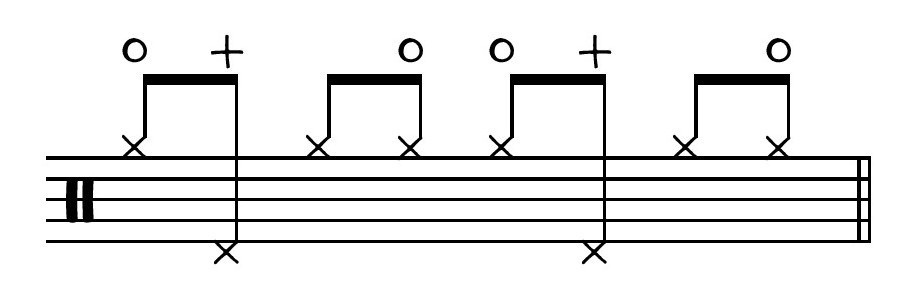
Playing in 2

I got a nice note from Ben at the excellent Melbourne Drumming Online blog (adding him to the blogroll- be sure to pay him a visit), requesting that I write something about playing in 2- that is, playing in a jazz format when the bassist is playing half notes. You know: the thing people do while they're waiting to go in to 4. God knows I've done enough of it, but never much analyzed what makes it work- or not. And those who have are not really sharing, because I haven't seen much in print about it. I'm sure if you got a lesson with Peter Erskine or Ian Froman or John Riley or Kenny Washington, they could give you some hard and fast rules/suggestions about it.

But since I'm just a field rat, and just learned it by doing it, I know of no consensus theory of playing in 2. What I'll offer instead, then, are some strategies for going about it. For starters, here's the basic, universal time feel, played on the hihat:


Swing the 8th notes on this and all examples, of course. Note that the cymbals open on the & of 2 and the & of 4. Go into your record collection to get an idea of the sound.

Much more- the entire body of the piece, in fact- is after the break:

Thursday, March 08, 2012

On “open-handed” drumming

Fine, now spend another hundred
years learning to do it almost
as well with your left hand.
This is a discussion I have to re-litigate on the internet every six months or so: the “open handed” thing. That is, playing the hihat with your left hand to avoid the crossover that happens when you play it normally, with the right. I have some reservations about the efficacy of that as a primary technique for most drummers.

It's a question that comes up with many students in the first five minutes of playing the drums: Why not play the hihat with your left hand? If all you have to do is tap-tap-tap the hihat and occasionally tap the snare drum thingy, wouldn't it make more sense? I generally put the subject to rest with a 1-minute explanation, and never hear about it again. The student understands that it's the normal way of playing, and adapts.

 But for some people it's just intolerably compromised and irrational-seeming, and they make egregious-sounding complaints about having to “cross your arms”, about the left hand being “trapped”, and the impossibility of hitting a lot of crap with your left while in that posture. There seems to be some kind of engineer's mentality at work; the people drawn to this way of playing seem to be the types more into tinkering around, devising and “perfecting” systems and theories than into actually playing. The instrument is conceived as a contraption to be fiddled with.

So, I have several big problems with “open handed” technique:
  • Lateral coordination = easy, cross-lateral coordination = hard Your body likes to play your right side together— your right hand and right foot— and the language of drumming is built around the coordination of the leading/"ride" hand and the bass drum. It's not as apparent in the early stages of development, when the roles of the limbs can seem arbitrary, but much of the more advanced improviser's language relies on right hand/right foot coordination.
     
  • Your lead is your voice
    Jazz drummers know this— we spend years or decades developing our touch on the cymbal with the right hand. But it applies to everyone. Your lead hand is your primary conduit for musical ideas— you develop a certain refinement and ease of expression with it, and largely orchestrate the rest of your playing around it.

  • The drumset is designed to favor a right hand lead.
    If you use a conventional set up, everything is weighted to the right. There is more stuff on the right, and your right hand can reach everything easily (even the hihat). There is less stuff on the left, and your left hand is more restricted, due mainly to having that tall hihat thing over there, topped with a long protruding metal stick. It's not a problem, because the most effective, efficient methods for learning to play creatively on the drumset favor a right hand lead. The instrument and the technique actually developed in tandem.

    I think part of the theory for “OH” people is that you can just park your left hand on the hihat while your right hand goes wild hitting all that crap on the right. This is a fundamentally different approach, based on off-hand independence. Maybe it's beyond the scope of this little little rant to fully explain why.

  • It's a pointless duplication of effort.
    Are we really going to learn an entirely different beat physically just to switch from the ride cymbal to the hihat?  


You could avoid this ridiculous duplication of effort by using a permanent left hand lead, with no ride cymbal on the right, and never riding on any available sound on the right. For me that would b a much greater creative limitation than just playing normally, and it also defeats part of the advertised purpose for using the technique in the first place. It's supposed to make you wondrously free to hit any crap in your set up at any time. 

More after the break:

Wednesday, March 07, 2012

MD column: hi-hat technique

OK, I'm not meaning to turn this into a fair-use abusing, exclusively old Modern Drummer stuff blog, but a longer post is taking its sweet time getting finished, and this is just what I happen to have on deck. This is from the January 1983 issue with Peter Erskine on the cover. I like doing these Tony Williams-style, adding the snare drum on the open notes and the bass drum on the foot notes, or the inverse:


He makes the jazz exercises by just swinging the 8th notes from the first twelve patterns, but note that the "funky" 12/8 pattern from the top of the right hand column on page two is comprised of the eight 8th notes of pattern 1, plus the first four notes of pattern 2 from page one, played in a triplet rhythm. That's a good thing to do with the rest of the exercises as well. If you're one of those thirst-for-patterns types, you can easily make similar things out of the one-measure syncopation exercises in Reed, selectively opening the hihat on the long notes and closing it in the gaps in the written part.

Get the pdf.