Here are some excellent YouTube clips of one of my favorite current painters, Brice Marden. The comments are entertaining- people are affronted when you talk about art as if it matters.
To weed out the kids, we'll start with something hard to watch from when he's younger- great insight if you can ignore the alcohol and the fedora:
Contemporary clips from his studio and a museum visit after the break:

A drumming blog written by Todd Bishop.
Saturday, March 05, 2011


Todd's Methods, pt. 3: Rock beats with Syncopation
Most drum books present their stuff fully written out verbatim for the drum set, which is fine for learning patterns, but not for thinking like a musician. This is something I made up to introduce the idea of taking a melody line (which could be the melody of the tune, the bass line, or a rhythm part) and making a drum part of it. It's simple enough that it probably exists elsewhere, though I've never seen it.
It's a good idea to already be able to play at least a few basic rock beats; that will isolate this as a thinking problem rather than a technical one. As always, we'll be using Ted Reed's Syncopation :
:

Get the pdf
It's a good idea to already be able to play at least a few basic rock beats; that will isolate this as a thinking problem rather than a technical one. As always, we'll be using Ted Reed's Syncopation
:
Get the pdf
Friday, March 04, 2011
Basic triplet solo ideas for jazz
I've been posting a lot of hard stuff lately, so I thought I should throw a bone to the earlier-stage people. So here is an introduction to soloing with triplets in jazz. Learned thoroughly in a range of tempos, this can cover your filling and soloing needs pretty completely:
 Download the pdf.

Thursday, March 03, 2011
Todd's Methods, Pt. 2: triplet partials in Syncopation
The second in a series of quick, sketchily-outlined demonstrations of my practice methods. Here I give a couple of my variations on common ways of using Ted Reed's Syncopation. If you've worked with that book much, you're aware that it can yield some very dense results. What I've done is simplify them a little to make them more musically appealing (and more Elvin-like), and to allow them to be used at faster tempos.
 Download the pdf.

Circumstances of a Monk record

Audio after the break:
Wednesday, March 02, 2011
Transcription: Zigaboo Modeliste - Stay Away
Another older transcription, Zigaboo Modeliste on Stay Away by the Meters. This one has a lot of fills.

Get the pdf

Get the pdf
4:3 metric modulation in jazz
Here's a little thing I put together to develop the 4:3 cross rhythm/metric modulation in jazz. Normally you actually want to explain an advanced concept like this, but really, if you don't recognize it right away, you're not at a stage where you should be working on it. Improperly applied, it's a recipe for all kinds of bad playing. Plus I screwed up my back a little bit today, and oddly enough explaining things makes it worse.
So here we are- basically I've translated the first batch of exercises in Jim Chapin's Advanced Techniques into dotted-8th pulse:

I recommend running each line very slowly, counting out loud in 3/4- the hardest thing about this modulation is remembering the original pulse. You could also do a few measures of jazz waltz time in between exercises.
As it gets more comfortable, put it into 4/4: count two lines of exercise as three measures of 4/4 (still counting quarter notes- at no point do you count in the "implied" meter). Then play one (or three, or five) measures of jazz time in 4/4 and then two or four repetitions of each exercise.
Download the pdf.
So here we are- basically I've translated the first batch of exercises in Jim Chapin's Advanced Techniques into dotted-8th pulse:
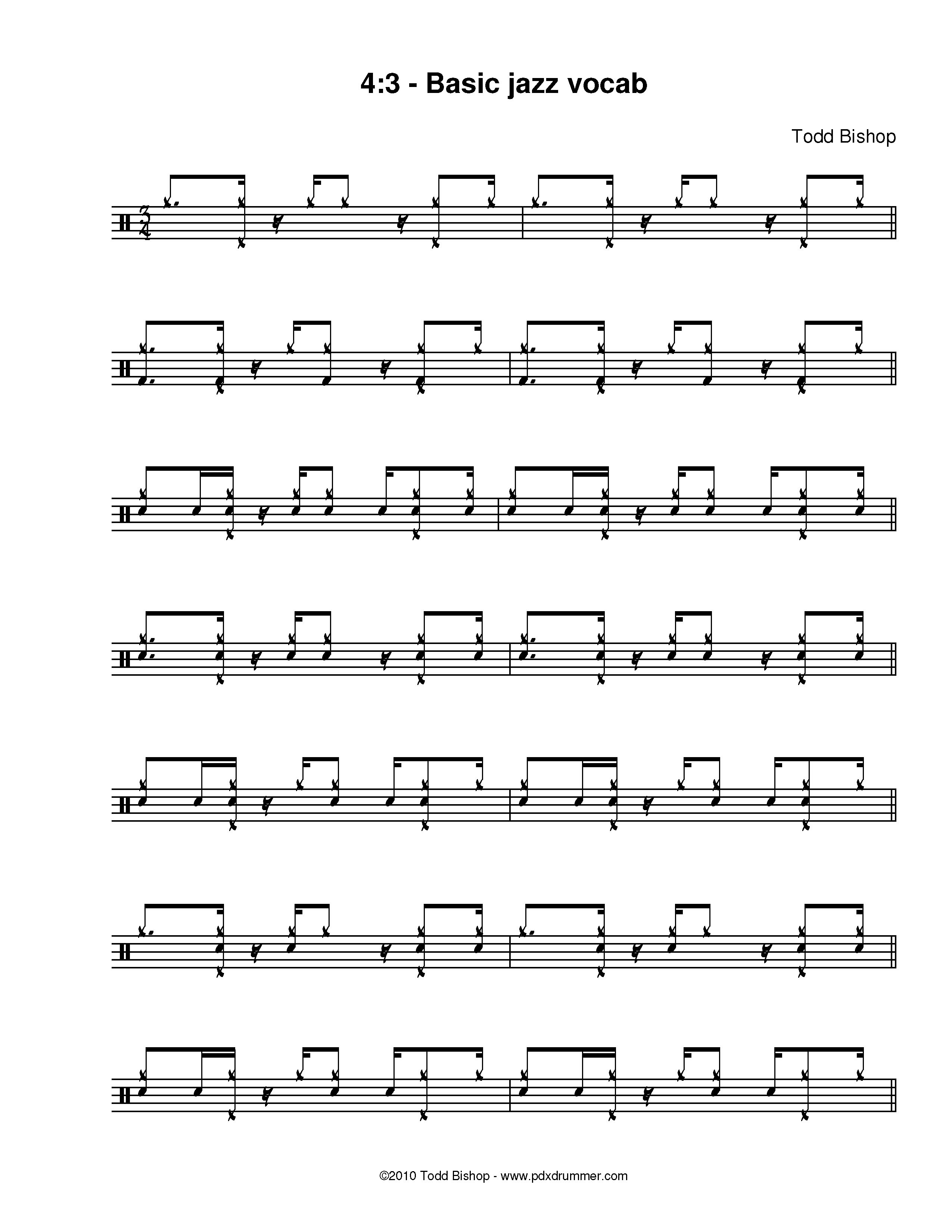

I recommend running each line very slowly, counting out loud in 3/4- the hardest thing about this modulation is remembering the original pulse. You could also do a few measures of jazz waltz time in between exercises.
As it gets more comfortable, put it into 4/4: count two lines of exercise as three measures of 4/4 (still counting quarter notes- at no point do you count in the "implied" meter). Then play one (or three, or five) measures of jazz time in 4/4 and then two or four repetitions of each exercise.
Download the pdf.
Tuesday, March 01, 2011
How fast can you take your time?

 , reprinted in it's entirety via Melancholia, which appears to be a Dutch literary blog. For me this is right up there with Zen in the Art of Archery:
DE is a way of doing. It is a way of doing everything you do. DE simply means doing whatever you do in the easiest most relaxed way you can manage which is also the quickest and most efficient way, as you will find as you advance in DE.
You can start right now tidying up your flat, moving furniture or books, washing dishes, making tea, sorting papers. Consider the weight of objects: exactly how much force is needed to get the object from here to there? Consider its shape and texture and function. Where exactly does it belong? Use just the amount of force necessary to get the object from here to there. Don't fumble, jerk, grab an object. Drop cool possessive fingers onto it like a gentle old cop making a soft arrest. Guide the dustpan lightly to the floor as if you were landing a plane. When you touch an object weigh it with your fingers, feel your fingers on the object, the skin, blood, muscles, tendons of your hand and arm. Consider these extensions of yourself as precision instruments to perform every movement smoothly and well.
Drum roll, please...

At some point our singer starts urgently signaling me to roll, which was surprising, because I knew for a fact she had less idea than I did of what the hell is going on- she always made a point of mentioning that the only Chinese she knew was "ho" ("good") and "ho ho" ("very good"). So now I have to try to detect some flicker of a cue from the speaker as well as mouth at the singer "LEAVE ME ALONE, YOU FREAK, I AM NOT GOING TO START PLAYING THE DRUMS AT RANDOM WHILE THIS WOMAN IS SPEAKING", or something to that effect. Then suddenly, it was all over- the drawing was done, and a child came to the stage to claim some impossible fruit basket. I defy anyone in that situation to figure out where the roll was supposed to go. The talk was totally seamless, with no detectable change in emotion to signal something was about to happen. No one so much as glanced in my direction, ever. After it was over they all seemed to feel that it came off splendidly, and we went on to play about a hundred choruses of Sugar until the end of the party.
With that, I'll announce the Stanton Moore DVD winner after the break:
Subscribe to:
Posts (Atom)