Showing posts with label Milton Banana. Show all posts

Thursday, September 15, 2022

Groove o' the day: Linha da Passe

Bright samba groove from one of my favorite Brazilian drummers, Milton Banana, who was most active in the 60s/70s. The tune is Linha da Passe, which you're most likely find on Banana's compilation album Sambas de Bossa. 

The format here is a little different— the first two measures of each line show how he begins the groove at the start of a section, and the last two measures with the repeat signs show the body of the groove. It's a tight arrangement with lots of stops, so how he begins the groove is important to work out. And the cymbal rhythm matches the melody rhythm on the piano, which hits the 1 at the beginning of the phrase, and the & of 4 for the rest of the phrase. 

Tempo is half note = 137.
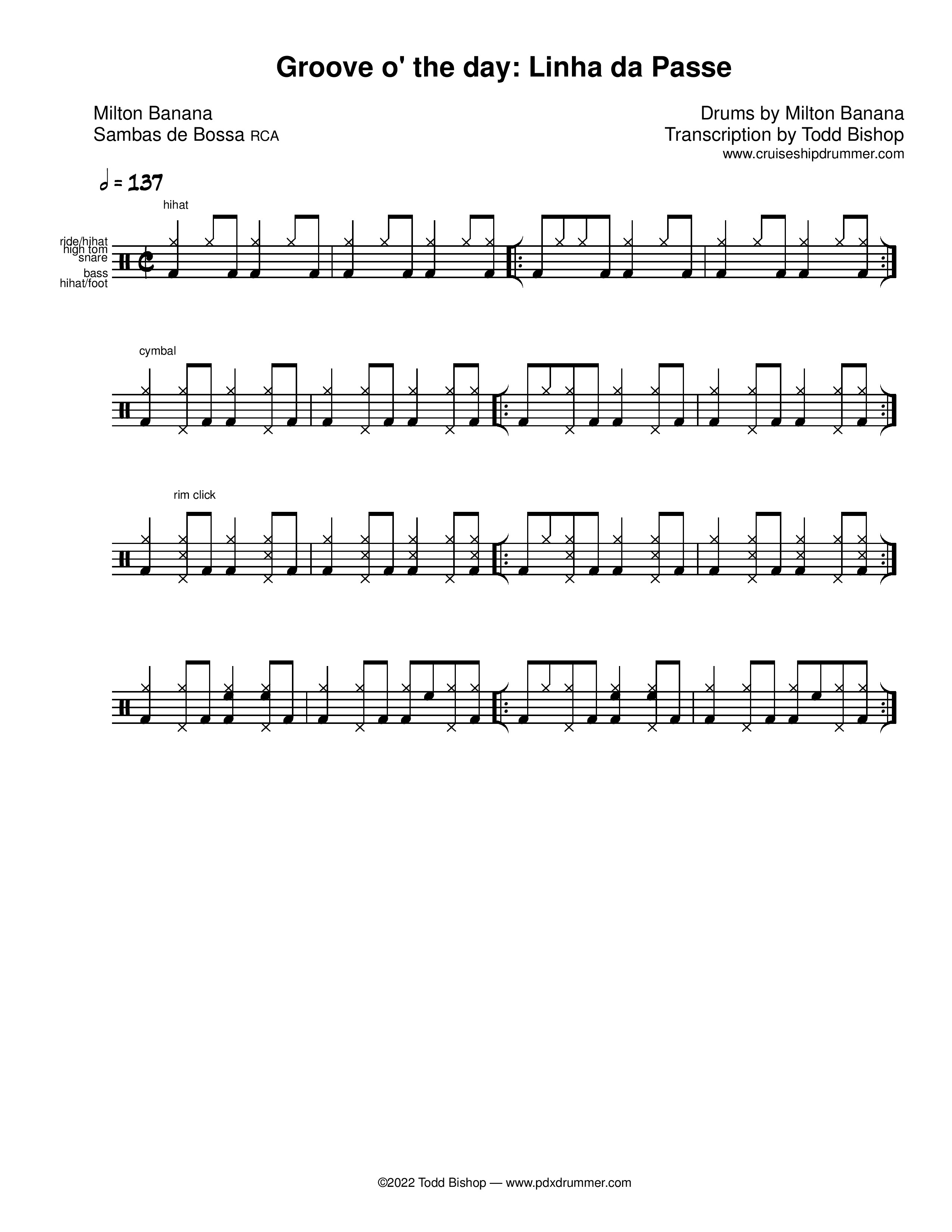

First line is closed hihat and bass drum; second line is cymbal and bass drum, with hihat played with the foot on beats 2 and 4. He may be playing some rim clicks on the snare drum during the early parts of the tune, but they're not really audible— we can assume there are a few LH notes in unison with the cymbal. Or not. Third line is how he plays rim clicks later in the tune, fourth line has a rhythm he plays on the tom tom near the end— again, maybe he's moving his LH to the snare drum around beats 1-2

Get the pdf

Thursday, October 17, 2019

Groove o' the day: Milton Banana - Samba do Perdão

A moderate samba groove using the tom toms, from one of my favorite Brazilian drummers, Milton Banana. He plays this briefly at the beginning, middle, and end of Samba do Perdão, from his album O Trio. Briefly is the only way to do it; the track is only 1:45 long. The entire record is under 29 minutes.

Here I've transcribed the groove from the end of the tune:


Note that there's no hihat played with the foot— as is often the case with a lot of drummers.

During the body of the tune he uses both of these one-measure grooves— mostly the first one, with the second one as a variation. A few times he plays them both in sequence (minus the rim click on the & of 4) to make a two measure groove.


This tune is the first one in the video, and the transcription above starts at 1:32. Banana has a way of sounding like a conductor when he plays figures and fills— the attitude feels different from someone who's just playing the arrangement.


Wednesday, May 13, 2015

Milton Banana

Here's a video of Milton Banana, one of my favorite Brazilian drummers, performing near the very end of his life. I don't know how much he was slowing up chops-wise at this point, but the fundamentals of his musical approach are all seemingly intact. It's a great lesson in how to play form, and how not to get locked into just playing a Bossa Nova beat when playing Brazilian styles.


You can't really hear what he's doing with the bass drum— the very open, hands-oriented things he's playing certainly don't feel constrained by having to fit with the standard repetitive bass drum rhythm.

Saturday, January 26, 2013

Another samba builder

Our previous “samba builder” was very batucada-focused (and probably in need of an update); this has more to do with samba as played on the drums, like in our Milton Banana pieces. The method is straightforward; work up a good feel with the feet/right hand parts, and add the various left hand parts to them. Treat the phrase-ending bass drum variations almost as fills; the left hand part can defer to them when you decide to throw them in.


Keep the feel light, but solid and driving. Play the right hand near the bell of the hihat or ride cymbal. You can play the left hand as rim clicks, high-pitched rimshots near the edge of the snare (not too loud!), or with a variety of accents and articulations; you can also improvise moves between drums. Also play the left hand parts with both hands in unison, along with the first, feet-only pattern. To develop the left hand more comprehensively, see the 16th note section of Louis Bellson's Modern Reading Text in 4/4, pp. 26-46

We've dedicated considerable ink— well, bytes, anyway— to the subject of the special type of swing found in samba, but in most drumset applications the 16ths are basically be played evenly. Exceptions to that would come when emulating the more folkloric styles, or a batucada feel. You can listen to, and play along with, the Salve a Mocidade recording to get an idea of the type of feel we're after here. 

Get the pdf

Friday, January 25, 2013

Drum chart: Salve a Mocidade

This is a chart and partial transcription for a Milton Banana track which I've been playing along with quite a bit this week. It's a lot of fun, and really instills a feel for the samba rhythm as played on the drum set— if your usual approach to samba doesn't groove well with this recording, there's a good chance you're doing it wrong. Our format is a little unusual; it's more of a partial transcription, with the ensemble rhythm included. Since that's pretty long, I also wrote up a straight one-page drum chart, which will be easier to read once you know what's going on with the drums and the arrangement.


I suggest giving it several listens through while following along with the transcription, making sure you understand how everything I've written relates to what you're hearing. It's also a good idea read through it playing the ensemble rhythm part on the snare drum alone. For much of the transcription I've given only the left hand part, to be played with a cymbal part of your choice, over the familiar samba bass drum/hihat pattern:


If you don't know what else to do with your right hand, try playing it in unison with the left hand, or quarter notes, on the cymbal or hihat.

Get the pdfs: partial trancription plus ensemble rhythm chart | lead sheet only

Audio after the break:


Friday, December 14, 2012

Transcription: Milton Banana — O Samba Da Minha Terra

Another Milton Banana transcription, this time the batucada-style intro to O Samba Da Minha Terra, from the same Sambas De Bossa album as last time. We'll probably be seeing more of these, because I really like listening to Banana's playing, and transcribing really makes you listen closely.


I've isolated the main groove at the bottom of the page, with my best guess at a sticking for it. It's a little awkward, with the three lefts in a row around beat 2, but it seems to be the most practical option given the accents— at one point or another there are snare drum accents everywhere but on the second or third notes of the three lefts. It's possible (likely?) he's doing something else, maybe a non-obvious sticking that facilitates the feel, and/or possibly using a unique sticking for each of the three or four different things that happen here. An easy solution to all of this would be to eliminate the left hand on beat 2, and do the entire pattern with an alternating sticking— that's the most common way of making this feel.

This would be a good time to revisit my posts on samba feel— I'd direct you to someone more authoritative, but none of those people seem to be writing about this on the Internet— while giving this a close listen. Here Banana plays a moderately swingy “tripteenth” feel (which basically squishes the four 16th notes into the space of the first and last notes of the triplet); the triplet pull is not extremely strong, but  he's obviously not playing even 16ths, either.

Get the pdf

Audio after the break:

Tuesday, November 20, 2012

Transcription: Milton Banana — Flor de Liz

As I mentioned before Milton Banana is one of the great Bossa Nova drummers, and since that tends to be an under-understood style (by the whole rhythm section, actually), I want to go a little bit deeper into what's happening with his playing. So here's a transcription the head of the tune Flor de Liz, from his 1984 album, Sambas de Bossa (originally titled Linha de Passe):


The first note of the piece— the pickup on 4 with the bass drum— is very commonly used for setting up the beginning of a tune or a new section after a stop. For the body of the tune he uses the partido alto pattern on the snare drum, with the quarter notes in the middle (often it's played with the measures reversed):


The accents that occur on the cymbal later in the tune are approximate; they are not exactly even in sound or in volume— you could play them on the cymbal near the bell, and different places on the bell itself. Also notice that the ensemble figures are very clean; he gives himself a little stop before them, and reenters with the groove on beat 2 after the hits on the & of 4 (as in measure 9). The fills at measures 26 and 49 are basically the same, except he pushes the first one a little faster, so it ends ahead of beat 3 slightly.

Get the pdf

Audio after the break:

Monday, October 08, 2012

DBMITW: Milton Banana

Here's some great playing from one of my favorite Brazilian drummers, Milton Banana:


Bonus Banana after the break: