Showing posts with label beats. Show all posts

Saturday, May 25, 2024

EZ fast rock - 02

The first EZ fast rock page was a hit with my students, so here's another like it, more in a fill/variation direction. Combining patterns to make two-measure phrases, most of these will be the second measure.

They're “EZ” in the sense that they're mostly single notes— rarely more than one 8th note-spaced note at a time on any limb— and very little complex coordination. It's a lot of vocabulary they can learn fast, with very little in the way of technical barriers. Towards the bottom of the page we ease into some slightly more demanding stuff. 


Get the first page— and the pages in 3/4 and in 5/4, for that matter— learn this page, then combine patterns in two measure phrases. Or four measure phrases— three bars of one thing, one bar of another. 

Get the pdf [Sorry, uploading is acting funny right now-- you'll have to print it from the jpeg above]

Monday, April 01, 2024

Beats to fills

Here's a connecter idea, using some rock beats written normally, a la Funky Primer, but playing them as cymbal accents with fills, as in this rock fill drill— hitting accents on the cymbal/bass drum, and filling in 8th notes on the snare and toms. 

That latter thing has been a regular part of my teaching for several years, usually starting with the 8th note accent pages in Syncopation. Those pages are a little dull though. This way will be better because a) the rhythms are more interesting, and b) it will give students some ideas about where to take an ordinary written-out rock beat. 

It's quite simple. For example, with beat number 4 from p. 13 of Funky Primer: 


You hit the bass drum/cymbal notes as crashes, supported with the bass drum, and hit the rest of the 8th notes on... some drums. Snare or toms, TBD later: 
 

With beat number 8: 


You would play: 


As exercises, you'd play those fill measures some different ways: 
  1. Right hand only 
  2. Left hand only
  3. Both hands in unison- two cymbals, two drums (or flams on one drum)
  4. Right hand on cymbal / left hand on drums
  5. Right hand on cymbal / both hands on drums
And the drum part could be played:
  1. On the snare drum.
  2. Moving around the drums in a set pattern you make up. 
  3. Moving around the drums freely.. 

Here's how you could play those in a two measure phrase— one measure of the written beat, one measure accents/fills:


Students get way too hung up on what cymbal or drum they should hit— in the second measure you can take the snare line to mean any drum, and the cymbal part to mean any cymbal. Keep it simple until you can play it, then get creative. You can follow sticking systems 1-5 above at first, then wing it. 

Sunday, March 31, 2024

Guy's cowbell beats

A page for a student, age 12, who bought a cowbell, and didn't know what to do with it. Basically two kinds of beats— basic rock beats, and a kind of Latin-rock beat with a cinquillo rhythm on the bell. We covered a number of these verbally in the lesson— several of them were his idea— this develops them further. 


Get the pdf, then get the vibe by listening to some Def Leppard: 


And Deep Purple:  

Thursday, December 21, 2017

Building the Tequila beat

A student has a gig coming up where she has to play the song Tequila, but didn't know a beat to play on it. This is what we worked out in her lesson. She was already able to play a Latin-type cymbal rhythm that works for the song, and we added snare drum and bass drum parts, figured out how to count it, and got all the coordination worked out so there was no mystery about how it all fit together. Drilling that plus the other optional versions on this page, she should be able to get through the gig,  make some variations on the beat, recover from mistakes, and generally relax while playing the song.


Count out loud part of the time while practicing— bot the rhythm of all the parts put together, as well as a straight 1-2-3-4. Figure out the hand parts as a sticking, using R, L, and B (for both hands). We spent some time isolating the complicated part starting at beat 4 in the first measure up to beat 3 in the second measure. We would work out the coordination, and play from 4 to 3 one time, with a long pause after. When working on the tom tom move, I would also isolate the 4 of the second measure to the 1 of the repeat, and then play from 4 of the first measure to the 1 of the repeat— always played one time, with a long pause after.

Repeat all of them many times, along with the recording, without stopping for mistakes.

Get the pdf

Monday, September 07, 2015

Rock beats displaced

You're not going to be seeing much of me for a few days— I'm getting married tomorrow, I've got a pre-wedding party today, then a micro-honeymoon at the Oregon coast Wednesday through Friday (the real one has us in France in December, so don't pity us)... so, yeah... light posting this week...

Displacement is a popular drummerland topic, but as a concept it's not a thing I'm real into. I think mostly people are trying to sell drum lessons, with cool, advanced/insider-y sounding techniques. We're not doing this to be hip, throw people off and then make fun of them for getting lost; this is more of a basic way of opening up basic grooves a little bit, in music where that is appropriate. A lot of drummery-drummers have been messing with it for some years, but the main precedent that concerns us in how it was used by James Brown's drummers— see Stanton Moore's book Groove Alchemy for an explanation of that. Being used in real music for the masses is sort of the gold standard for legitimacy for these “advanced” techniques. I don't want to do things just because an amazing drummer did them in a display of his awesomeness.

The idea here is pretty simple: in a two-measure phrase, we play a basic rock beat for one measure, and then the same rock beat shifted an 8th note late. Basically we're adding an 8th note (played on the hihat) at the beginning of the displaced measure, and losing the last 8th note of the displaced beat, so we can land on 1 at the top of the repeat. In the second section, the last two beats of the first measure, and the first two beats of the second measure are displaced— there's an extra 8th note on the hihat on 3 of the first measure, and we lose an 8th note of the displaced groove going back into the non-displaced pattern on 3 of the second  measure. Don't worry if this verbiage doesn't make sense— just look at the page and try to figure out why things are the way they are. If you can't figure it out, don't worry about that, either— just learn the notes and everything will be cool.


As a warmup, play the first measure of exercises 1-8, repeating many times, then play the exercises as written. For exercises 9-13, repeat the plain form of the beat (in the left hand colum) many times, then go into the displaced version— hopefully you'll be see/hear/think how they logically relate to each other. But if not, it doesn't really matter; just playing the patterns and learning their individual little melodies will be enough to add something to your playing. Learning to “do displacement” is not important, the sound of the patterns is.

Get the pdf

Saturday, January 26, 2013

Another samba builder

Our previous “samba builder” was very batucada-focused (and probably in need of an update); this has more to do with samba as played on the drums, like in our Milton Banana pieces. The method is straightforward; work up a good feel with the feet/right hand parts, and add the various left hand parts to them. Treat the phrase-ending bass drum variations almost as fills; the left hand part can defer to them when you decide to throw them in.


Keep the feel light, but solid and driving. Play the right hand near the bell of the hihat or ride cymbal. You can play the left hand as rim clicks, high-pitched rimshots near the edge of the snare (not too loud!), or with a variety of accents and articulations; you can also improvise moves between drums. Also play the left hand parts with both hands in unison, along with the first, feet-only pattern. To develop the left hand more comprehensively, see the 16th note section of Louis Bellson's Modern Reading Text in 4/4, pp. 26-46

We've dedicated considerable ink— well, bytes, anyway— to the subject of the special type of swing found in samba, but in most drumset applications the 16ths are basically be played evenly. Exceptions to that would come when emulating the more folkloric styles, or a batucada feel. You can listen to, and play along with, the Salve a Mocidade recording to get an idea of the type of feel we're after here. 

Get the pdf

Saturday, January 19, 2013

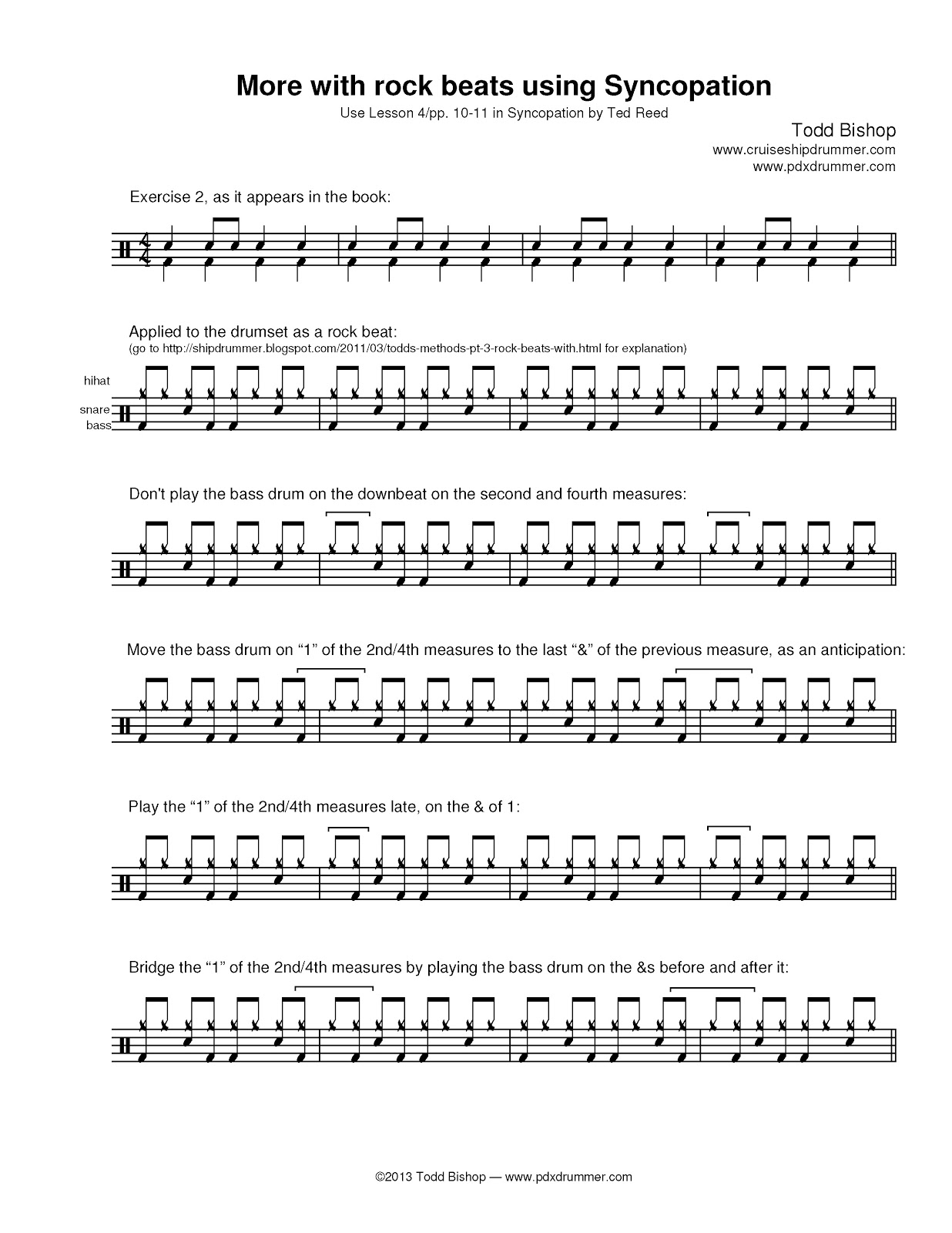
More with rock beats using Syncopation

Going a little further with my earlier piece on making rock beats using— say it with me— Ted Reed's Syncopation. In doing this, there will be many duplicate beats, but that's not important— our purpose is not to create new beats, it's to apply a thought process: taking a melody line, converting it to a drum beat, and then doing basic modifications to it. It's the beginning of playing with creative control over what you are doing, rather than just playing familiar beats. It's all simple enough that most people will internalize the concepts quickly, and begin applying them purely instinctively.


Be sure to review the previous thing first, and be able to play it with Reed Lesson 4 (pp. 10-11 in the old edition), #1-15, straight through without stopping. The current exercise involves shaping your phrases by doing things with beat one of the second and fourth measures— omitting the bass drum, moving it to one side or the other, or bridging beat one by playing on both sides of it.

Get the pdf

Monday, January 14, 2013

YouTubed: “basic rock beat”

Since I'm often told that the Internet, with its abundance of free materials, is rendering teachers obsolete, I thought I'd put that to the test, searching YouTube for beginning rock drumming “lessons”, and not stopping  until I found a truly good video, or until I thought of something better to do with what time I have left on this planet.

I'm taking these in the order they are returned by the search engine, filtering out a few things that are non-instructional. I've given a few notes, quickly, test-pilot style, on their strengths or shortcomings. My purpose is not to belittle anyone's efforts, or discourage anyone from trying to teach others what they know, but here I'd rather be entertaining than diplomatic; if you see your video here, and don't like what I say about it, be tough, and keep working on your craft, as we all do. If you tire of this faster than me, be sure to scroll to the end and give the winning entry some hits.


Drum Lesson:The Basic Rock Beat
by turdadactyl

Six and a half minute video explaining how to play the Back In Black beat, and not as terrible as you would expect from someone who self-identifies as “turdadactyl.” No tempo consistency between  the demonstration of the the beat and the counting the rhythms of the parts, which will confuse some of the beginners who are his audience. Uses the highly questionable method of speeding up the beat as you go. Not wild about his recommended benchmark for success: the ability to talk to someone while you play the beat. I'd rather students were able to play the beat while concentrating on what they are doing. Great speaking voice.
C+


Many more of these after the break:


Saturday, October 22, 2011

Page of funk beats

This is a fairly straightforward page of funk beats, which I wrote up for one of my middle school students. Each line starts with a fairly simple groove, with notes added in the following measures, mostly on the bass drum. It's a good idea to practice within one line, moving back and forth between the busier and simpler beats, and then improvising your own variations on the simple version. Where the snare drum part varies, emphasize the 2 and 4.


Get the pdf

2023 UPDATE: At the request of a reader, here is an iPhone video of me playing this page down— each measure played two times— plus a little improvising, because I felt like playing some more. 


Sunday, June 26, 2011

Things to do with a beat

Writing by making lists of things- it's just where I'm at right now. This is a quick run down of one of the main jobs/avenues for creativity on the drums- the manner in which you keep time. Often students will work through their books either thinking they've mastered the materials because they can play the patterns as written, or, better, feeling like they're missing something because they can't do anything but play the written beat. 

1. Play it repetitively at a comfortable volume and tempo.
Like I say, just the first step.

2. Play it from a dead stop. This hangs beginners up- they'll often need to put a beat together one limb at a time, over several measures. Usually I have them play just the first note of a beat and then rest for the rest of the measure, adding notes as they can do them perfectly, until they are into the beat and can keep going on their own.

3. Play it from a count-off. Meaning you are to come in in the right place, and at exactly the right speed when someone counts off a tempo for you.

4. Punctuate phrases. Be able to keep track of the number of measures you've played without relying on hearing the tune, and place a marker (like a cymbal crash) at the beginning of a phrase.

5. Make fills. The fills themselves are a separate issue, but you need to be able to smoothly get from the groove to the fill, and back into the groove.  

Keep reading, the interesting ones are all after the break: