Showing posts with label metric modulation. Show all posts

Friday, August 02, 2024

Transcription: Jeff Watts - Housed From Edward - 03

Part three of Branford Marsalis's Housed From Edward, from the album Trio Jeepy, with Jeff Watts on drums. Let's do the whole thing. This begins in the middle of Marsalis's solo at 3:21, and ends at the beginning of part 1 of this series, at 5:15.

Includes the very audacious/goofy displaced time feel, starting at bar 10. To me it takes exceptional self confidence, and faith in the other musicians, to try that on a recording session, but he had been doing some heavy rhythm stuff with Wynton Marsalis's band for several years before that, and clearly had it worked out. 


See also the quintuplet lick in bar 24— you can hear how the quintuplet cuts across the groove. It sounds off, but that's the nature of it. You could play that with a Chaffee-type sticking, RLBRL BRLBB. 

Get the pdf

Wednesday, March 01, 2023

Metric modulation a la Silverman - 01

A student brought in a copy of Chuck Silverman's Practical Applications: Afro-Caribbean Rhythms for Drum Set, and we worked through a part of it together, dealing with metric modulations— or more accurately superimposed metric modulations (Vinnie Colaiuta's term).

It means an illusory tempo/time change while remaining in the original meter. It's a drumming hot topic; as a musical device it's mainly a trap, a bad decision. But it's worth pursuing a little bit to learn something about rhythm. 


Patterns 1 and 2 are warm ups; line 3 is the pattern as it appears in Silverman's book. Lines 4-10 are my own variations, making some basic funk rhythms, superimposed. 

As an exercise, you could play four measures of a simple half time feel groove with the same cymbal rhythm, alternating with four measures of the above patterns: 


Try it along with a Afro 6 type loop— here's a reasonable-tempo one, and a faster one. 

Here's a similar page I wrote in 2019. 

Get the pdf

Wednesday, February 12, 2014

Page o' coordination: 2 over 3 metric modulation

We've done some jazz waltz POCs, and some metric modulation POCs, but some people will still have problems moving between the two in actual playing, so here's something that may help with that. The modulation we're doing is 2 over 3; playing a slower 2 over a measure of 3/4:


This is a jazz waltz study, so you're going to want to swing the 8th notes. You should probably do the previous metric modulation POC entries before doing this one. Make sure you can play each measure by itself before playing the entire line. If you want, you can double or halve each part of the line, so you're playing 4 measures, or 1 measure, of each pattern. Or you can vamp on each half of the the line— play the first two measures for a long time, then whenever you're comfortable, play the second two measures, and repeat. It will be tempting to feel the second two measures of each line at the slower, modulated tempo, but keep counting and feeling the original quarter note pulse, at least at first. And do the tom moves.

Get the pdf

Saturday, August 03, 2013

Page o' coordination: metric modulation — 2/3

Part 2 of this little three-page o'... unit. Actually, there are a couple of other previous pages you can work up as well— once you've learned any one page of this series, the others are much easier. See the last installment for an explanation of what we're doing here.


Get this together with swung 8th notes, then as even 8ths— that latter will sound like a straight triplet-based swing feel in two, by the way, so do keep track of the quarter note pulse in 3/4 as you do that.

As always: tom moves, tom moves, tom moves. Do them.

Get the pdf

Thursday, July 25, 2013

Page o' coordination: metric modulation — 1/3

Or rather superimposed metric modulation, per Vinnie Colaiuta's term, which few people use, but is actually correct. This is the first of three pages 'o... developing a swing feel in 2 within a measure of 3/4. We'll do the hard one first, which suggests the 2 in the cymbal and bass drum, while keeping the waltz feel with the hihat:


In case it's not clear from looking at it, here's how the superimposed feel works. Here's the base ostinato for this page:


The same rhythm rebeamed for 6/8, minus the hihat:


Which of course looks like this written as triplets in 4/4:


Playing the page in a swing feel will not give that rhythm exactly, so don't try— just render the exercises in 3/4, and the metric modulation will take care of itself later. Remember that the tom moves are a big part of the value of these exercises— counting out loud while doing them “1-2-3, 2-2-3, 3-2-3, 4-2-3” is also very helpful.

Get the pdf

Wednesday, September 07, 2011

My Vinnie Year - part 3 - superimposed metric modulation

This is a technical piece by Vinnie Colaiuta, which accompanied his 1987 Percussioner magazine interview, and he now shares with us on  vinniecolaiuta.com. I spent considerable time with this- way too much, actually, considering that it's not exactly a daily-user, and there were more ahem pressing matters for me to attend to.

Be sure to read his explanatory text, and remember his closing advice, with a big emphasis on the if:  

"...if you find that you have the place where you can use something like this, above all else, be musical!"


Wednesday, March 02, 2011

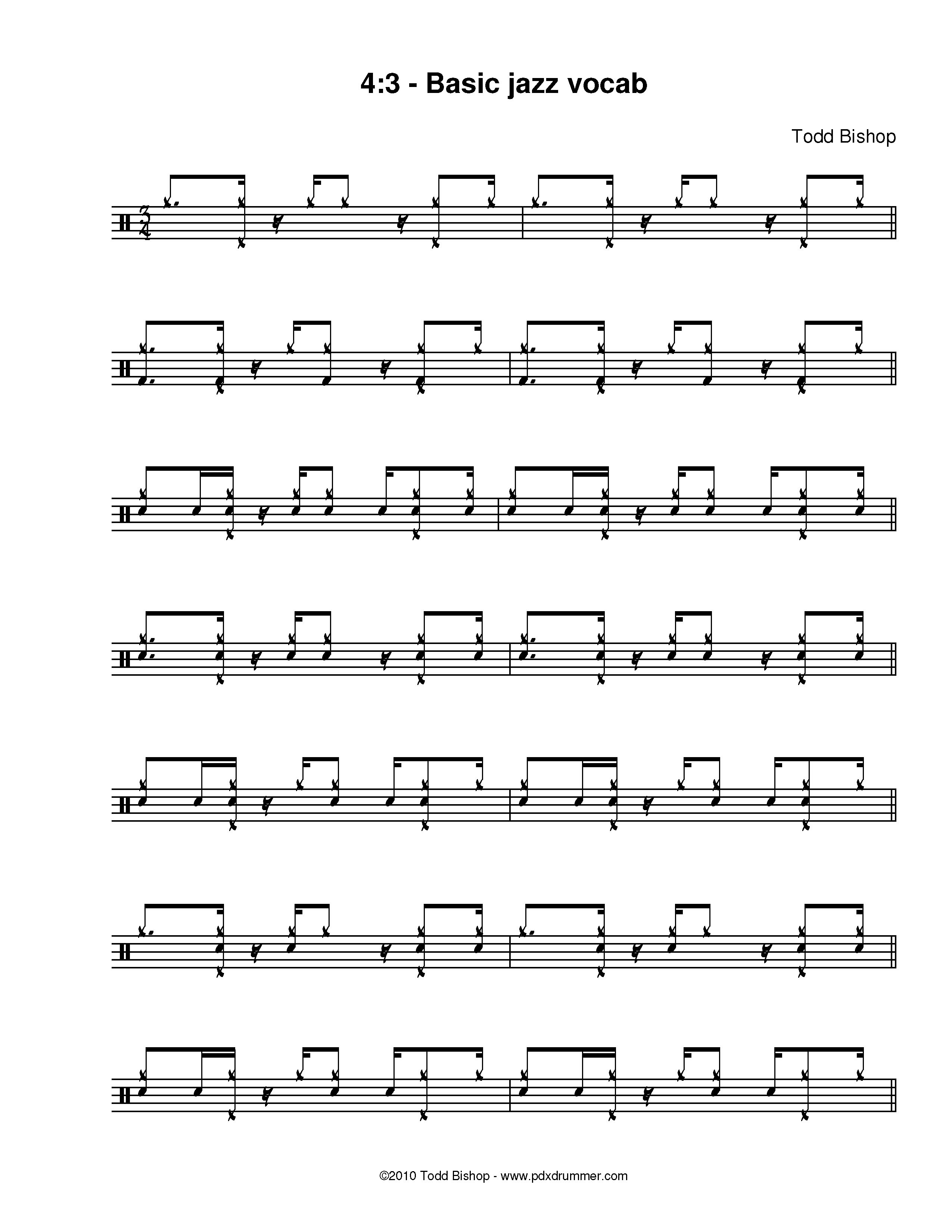
4:3 metric modulation in jazz

Here's a little thing I put together to develop the 4:3 cross rhythm/metric modulation in jazz. Normally you actually want to explain an advanced concept like this, but really, if you don't recognize it right away, you're not at a stage where you should be working on it. Improperly applied, it's a recipe for all kinds of bad playing. Plus I screwed up my back a little bit today, and oddly enough explaining things makes it worse.

So here we are- basically I've translated the first batch of exercises in Jim Chapin's Advanced Techniques into dotted-8th pulse:


I recommend running each line very slowly, counting out loud in 3/4- the hardest thing about this modulation is remembering the original pulse. You could also do a few measures of jazz waltz time in between exercises.

As it gets more comfortable, put it into 4/4: count two lines of exercise as three measures of 4/4 (still counting quarter notes- at no point do you count in the "implied" meter). Then play one (or three, or five) measures of jazz time in 4/4 and then two or four repetitions of each exercise.

Download the pdf.