Monday, September 23, 2024
Afro 6 - new basics
Monday, October 23, 2023
Half time funk shuffle - 01
Here's a page for my students, working through the basics of a half time funk shuffle groove. It gets mentioned a lot more online than it comes up in real life, but it's a thing.
There are a number of ways to write it; I've put it in 6/8 and 12/8. In real life I might expect it to come up most often as a sixtuplet feel in 4/4.
Pay careful attention to the dynamics on the snare drum; play the accent strongly and ghost the other notes. I also accent the downbeats of the cymbal rhythm, you can do that if you choose.
Thursday, May 18, 2023
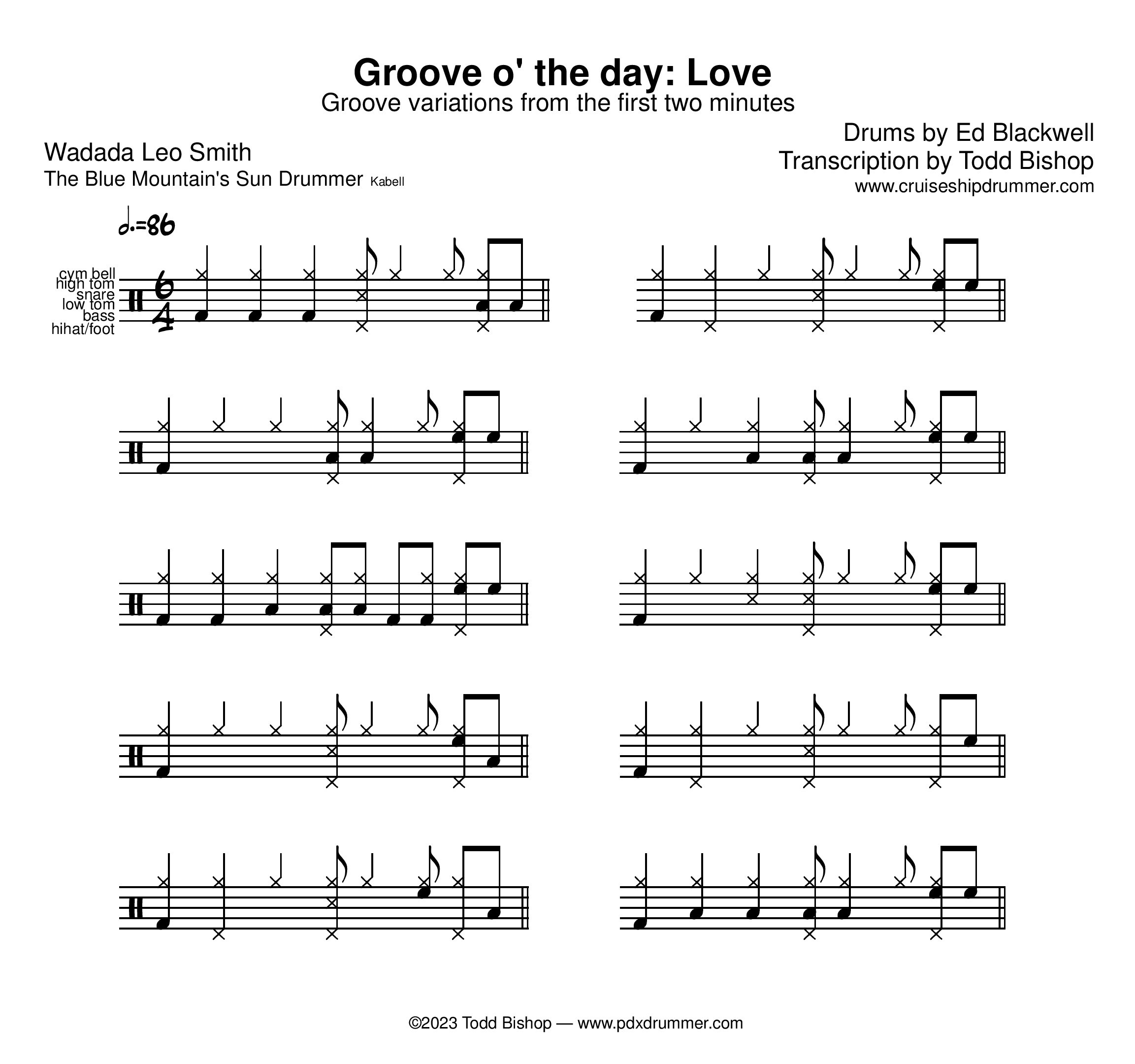
Groove o' the day: Ed Blackwell - Love
Here's a fast 6/4 Afro type of groove from Ed Blackwell, on the track Love, from a duo record with Wadada Leo Smith, The Blue Mountain's Sun Drummer. There's no tune, it's just free blowing over a groove. People should do that more. These are some variations from about the first 90 seconds of the track.
We're in kind of a compound 6/4 here— the dotted half note gets the beat, at about 86 bpm. Or if you're counting quarter notes, ~260.
Saturday, December 24, 2022
Page o' coordination: Airto's afro
Page o' coordination based on Airto's unique afro 12/8 groove played on the intro of Casa Forte, from Flora Purim's album Stories To Tell.
It's a good introductory groove for this style— the hands are mostly in unison, and the rhythm is easy to follow. The bell rhythm is only different from the normal short bell rhythm by one note, but it seems like a whole different thing, and it should be much easier to work out the coordination.
As always, work out the patterns, then drill them by doing some moves with the left hand.
Sunday, November 06, 2022
Counting system overhaul - 01
![]() |
| This guy gets it. |
Last year I was taken to task online by another drum teacher, for my late innovations in counting rhythm— I was told my ways are convoluted, inconsistent, confusing. “We have a working system in place, if it ain't broke don't fix it and we don't need to count things we can't already count anyway, and by what authority...”, etc etc.
So let's look at the current excellent extremely consistent and non-confusing ain't-broke methods for counting rhythm, with some kind of official acceptance somewhere, and I'll say everything I think is wrong with them. Next post I'll round up the way I'm doing it, which I've already written about piecemeal.
8th notes: 1&2&
Problems: fine
8th note triplets: 1 trip let 2 trip let, 1&a 2&a, 1 la li 2 la li
Problems: I prefer 1&a. Yes, the syllables duplicate a common 8th and two 16ths rhythm. We remedy that by teaching people the difference between the two.
1 trip let is ungainly to speak— too many consonant clusters from syllable to syllable. And, frankly, I'm not a child, I don't need to say the name of the rhythm I'm counting. And by baking the word triplet into it, we've made it useless for counting a common equivalent rhythm: compound 8th notes.
1 la li— part of the Eastman system— is just goofy, and had to have been cooked up by a vocalist. La is a syllable we make drummers/percussionists use to get them to play with a prettier tone, we don't use it to articulate rhythm.
Compound 8th notes: 1 2 3 4 5 6 (maybe emphasizing the 1 and 4); 1&a 2&a, 1 la li 2 la li
Problems: With 1 2 3 etc we're counting a subdivision, not the main beat. We don't count 8th notes in 4/4, why do it in 12/8? I would rather use the trip let syllables, but that's a non-starter because compound 8ths are not triplets, though they are functionally the same rhythm.
Sidebar: This is where pedantic individuals will make us have a long fight about the nature of a triplet, and of compound 8th notes. A three note subdivision of a beat is an ordinary kind of rhythm. It is native to 6/8 time, but foreign to 2/4 time, where it requires special notation— a numeral 3 printed above that beat. And it gets a special name: triplet. It's the same thing in either case: a single beat divided into thirds. There's no good reason to count it differently in different time signatures.
16th notes: 1e&a 2e&a, 1 ti te ta 2 ti te ta
Problems: none, 1e&a is universally accepted, and easy to say, and is extremely useful for counting and understanding complex 16th note rhythms, let's do more with it. Exploit its familiarity.
I've never met anyone who uses the Eastman 1 ti te ta syllables, not even people who otherwise defend that system like it was handed down by Socrates from Mt. Vesuvius*.
Quintuplets: hippopotamus or other funny five syllable word, 1 quin tu pl et 2 quin tu pl et
Problems: Funny words are OK for getting the rate of rhythm in isolation, you don't use them in counting an actual piece. How are you going to refer to partials of a quintuplet, the mus of 1, the pot of 3? Not an everyday need, but if we're going to do this, let's do it right.
1 quin tu pl et invents a pul syllable that isn't spoken in the word. And again, I don't need to pronounce or mispronounce the name of the rhythm to play it. And by saying QUIN TA PA LET we're sabotaging it for use with five note groups that are not quintuplets. Like, what are you going to say when you encounter a measure (or partial measure) phrased 5/16?
Sixtuplets/16th note triplets: nothing, 1 trip let & trip let, 1 ti ta & ti ta, 1 ta la ta li ta
Problems: None are easy to say fast. The consonant clusters in the trip let way really bog you down here.
The Eastman la li etc syllables are phrased wrong, like a subdivided 8th note triplet. Correctly, 16th triplets are a triplet subdivision of an 8th note. The distinction is important. To make those syllables work you could vocally accent the syllables WUNtala TAlita. Saying 1tala &tala— if we must use those syllables— would be better.
Compound meter 16ths: 1&2&3& 4&5&6&, 1 ta la ta li ta 2 ta la ta li ta
Problems: Same problems as with compound 8ths, but worse. Try using those Eastman syllables to count a complex passage of 8th and 16th notes and rests.
Septuplets: none, but take your pick of funny seven syllable words: aboriginality, absolute immunity, algorithmic randomness, cryptozoological, grammaticalization, hematochromatosis, impermeability, Kierkegaardianism, kleptoparasitism, monomorphological, ultramodularity, Zoroastrianism
Problems: are you kidding
32nd notes: nothing
Problems: There aren't many cases where I would want to count 32nd notes, but it would be nice to have an option.
CONCLUSION: The beauty of this well-lubricated* system is that no syllables conflict, except when syllables conflict. It may not be “broke”, but these methods are totally inadequate for anything other than 8ths and 16ths in */4 meters, and 8th notes in compound meters. People handle these limitations by basically never counting anything other than that... not very well. So big areas of rhythm are permanently not understood very well by a lot of people.
* - By which I mean how drunk would a man have to be to think this amalgamation of practices amounts to a system?
Speaking rhythm = knowing rhythm. The implications of that go beyond just knowing how to read a rhythm correctly. Even if we don't use all of these applications often, it's still worth having a system for it. Next post I'll round up my solutions to this musical crapperware. Mostly restating things I've written before, in the screed format I've embraced here.
Monday, October 03, 2022
Counting compound meters
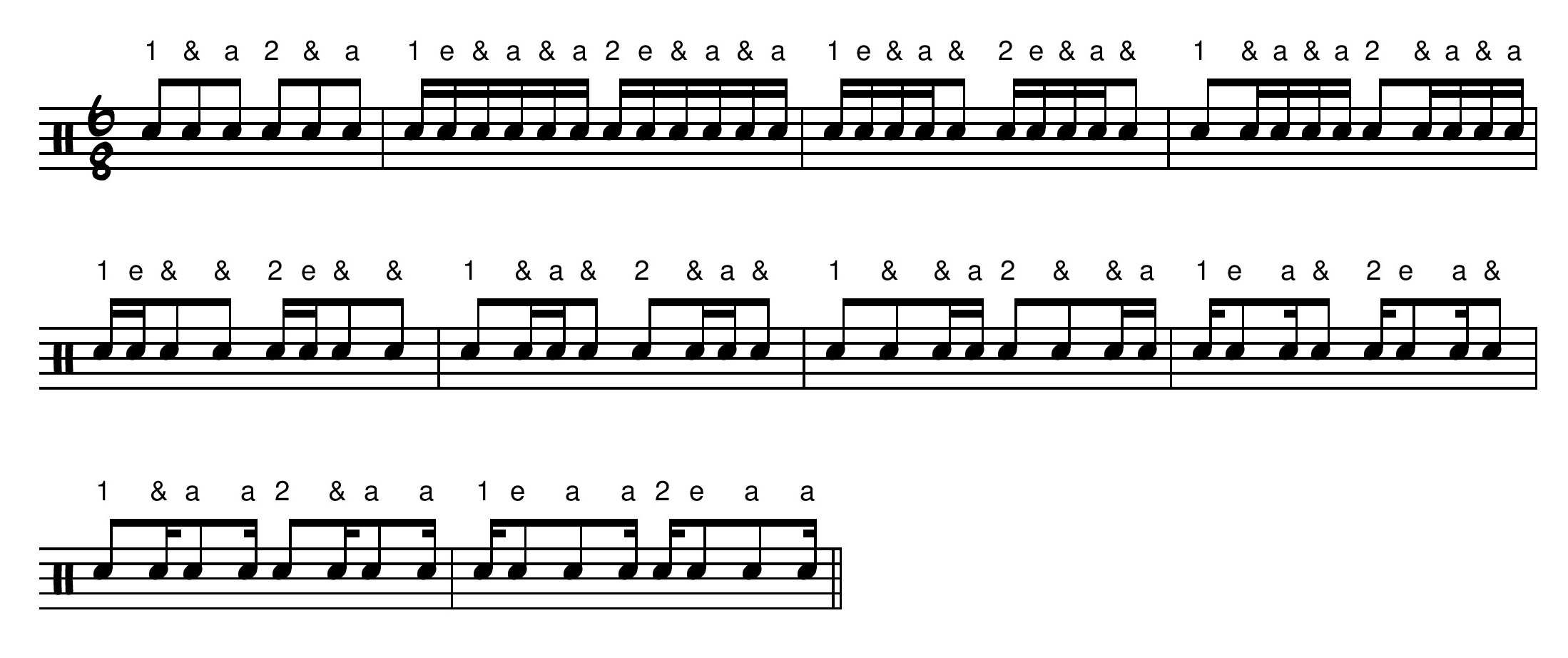
Basically, in any compound meter— 6/8, 12/8, 3/8, 9/8, 15/8— when 16th notes are involved, count 1e&a&a, instead of the 1&a we (I) use with 8th notes.
It works. It's easy to say it fast, and that repeated & syllable gives each beat of 16th notes a little waltz feel. The only part that doesn't flow easily is the 1e a& rhythm— in isolation the a& part requires a little extra articulation with your voice.
Sidebar for quibblers: Yes, the a partial, when we're counting 8th notes, becomes a second & when there are any 16ths involved. It's different! Not only is that, we've added two more as on the last two off-side 16th notes!
What can I say, the world's an imperfect place. I'm prioritizing ease of speaking over consistent or unique syllables with this one. The only reason you need unique syllables is so you can refer to parts of a rhythm easily, e.g. your timing is off on the a of 2 there. So now you say your timing is off on the second a of 2 there instead.
Thursday, September 08, 2022
Groove o' the day: Airto Afro 6
An Afro 6* groove played by Airto, on the intro of Casa Forte, on Flora Purim's 1974 record Stories To Tell. It has some big shot LA musicians on it, including saxophonist Hadley Caliman, who was a Seattle fixture for years, and trombonist George Bohannon, who was a grad student at USC when I went there.
It's a rather simplified groove, with the hands largely in unison. The percussion, also played by Airto, multitracked, fills out more of the rhythm.
We like thinking in terms of stickings, and filling in spaces, and playing linear, but unisons are powerful. It's worth thinking about.
There are some open sounds with the hihat played with the foot, that I didn't indicate.
Monday, May 02, 2022
Afro 6 - advanced bass drum ideas/coordination
A page of patterns I'm playing around with, in an Afro 6 feel, that are difficult or unusual for varying reasons— either the bass drum is in unison with the left hand, or the actual rhythm is unusual. Use it as a companion to a similar page I wrote a couple of years ago, to develop some possibilities for soloing and blowing, with maybe more of an African vibe.
Before even getting into this, you should develop line 1 as standalone groove. Vary the bass drum by playing it along with the cymbal, like on this page. The left hand part fills in the gaps in the cymbal rhythm— play it as rim clicks, or move it around the drums, varying the accents and articulations. Or do it funk style by accenting the snare on beat 3, and ghosting the rest. Add hihat however you like, on all four beats, or on beats 2/4.
Monday, March 21, 2022
More on that Latin system
Breaking down part of that short Latin method from the other day. I like it. It's easy, and gets us into some pretty fundamental things about rhythm, drumming, using the drum set. This is a page I'm handing out to my students.
To review, the system is based on the cymbal/bell part, that we're getting from the book Syncopation, or from one of my rhythm pages. We're mostly limiting it to the cinquillo rhythm (and its inversions), which is built out of 3+3+2 eighth notes.
This page has some warm-ups using just the 3+3 portion of the rhythm, in 3/4, in its inversions. As before we fill in the the gaps in the rhythm with the left hand, and add bass drum to different parts of the original rhythm from the book— add it to the written quarter notes, the written 8th notes, and to the written notes sounding on an &. And add it on 1 sometimes, if it's not already there.
Just play the patterns as written on the page:
I suggest playing the left hand as a rim click, then move it between the snare and the high tom, one note per drum. Play them along with one of my loops in 3/4, 6/8, 6/4, or 4/4.
Friday, February 18, 2022
Stick control patterns in 6/8
This is part of a larger writing project I'm doing— some things you have to write out to decide if they're going to be of any use. You can see that the logical sequence here is unusual. File this in your library with the myriad of other items in 6/8 on the site.
I rarely play any kind of stick control-type pattern just on the practice pad— except with students. I'll usually play them on the drum set, with one hand on a cymbal, with the bass drum in unison, or some variation of that. Or with one hand accented and the other hand ghosted.
Wednesday, November 24, 2021
Metal in 6/8
Following up on this post about that 80s Heavy Metal triplet groove— a student who is mainly a Metal drummer requested some help working out some vocabulary for a song in 6/8, and these are some things we went over in our lesson. The fill portion will be good for other things, too— like in a slow swing feel, a la Jack Dejohnette on the one John Scofield record, where he plays some fast stuff at a slow tempo.
It's hard to improvise in this type of groove environment; the main groove is easy, but the usual tempo range puts everything else at awkward rates of speed for drummers— the main dotted-quarter note beat is typically an uncomfortable moderato, the 8th notes feel kind of slow for fills, the 16th notes may be very fast. Your hands will want to lapse into four-note subdivisions, and that will usually sound very wrong. So you mostly have have to stay on the 8th notes— the triplet-feel subdivision. We had this same problem on Lopsy Lu, and any number of things using that 70s triplet feel, across a number of genres.
Here's another item that may be helpful in this general feel.
The fast doubles can be done with one or two bass drums— that's up to you guys who do that stuff to figure out.
Monday, February 08, 2021
Page o' coordination: grocery store hemiola - 01
So-called because I found myself unconsciously tapping this out in the grocery store parking lot while waiting for them to bring out my groceries.
...incidentally, for the sake of limiting your exposure to COVID-19, I highly recommend the curb side service when getting your groceries, if your store offers it. Right now the Fred Meyer where I get my groceries— a Kroger market— offers the service free of charge.
So I was tapping pattern 1 with my RH/LF while waiting for the guy to bring out my stuff, and for fun I wrote up a PAGE O' COORDINATION for it.
There are independent parts for snare drum and bass drum, but you can/should play them all on either drum. Use the stock tom moves when playing these with your left hand.
Tuesday, January 26, 2021
“Snare Conditioner” in 6/8
I mentioned to Adam Osmianski that I wanted a 6/8 version of his transcription of the found-music malfunctioning air conditioner drum solo, and he encouraged me to go ahead and do it myself, so here we are. It sounds really hip in 4/4 or in 6/8— it reminds me of Billy Higgins playing on Shimmy Shewobble, which I transcribed back in 2015. Sort of an Africanized march. These versions in 6/8 should be good for filling and soloing during an Afro 6 feel.
Tempo is about dotted-quarter note = 150. I've given two versions, one with the first note of the recording on beat 1, the other with the first note as an anticipation. The first one has a lot of successive measures leaning heavily on the middle subdivision— see the third and fourth lines on the first page; the second version has less of that. The second one will be a little easier for most people.
Go to thatdrumblog.blogspot.com to get the original version in 4/4.
Get the pdf of the 6/8 versions
Monday, January 11, 2021
Hemiola funk series: all basic patterns in 3/8
UPDATE: Download link works now!
There's an ongoing political crisis happening in the United States right now, and it's really hard to write, or do anything else productive. It's very serious and basically every human on the planet should be very concerned about it, because it does affect everyone.
So here is what I can manage— kicking around the hemiola funk concept some more. For me this is background work for a book; for you it could be a Stick Control-like thing, and play the patterns by themselves, and in all of their combinations. They're easy, so even though there are a lot of combinations, it should go quickly. There will be many duplicates of things on the other page of this from last week. I can't help you there.
I've only included proper hemiola patterns that have running 8th notes in the right hand— none of the linear RLB patterns I wrote about before, which are closely related, but really a different thing. Play the patterns in the 3/4 rhythms at the bottom of the page, or just play them in 6/8 or 12/8. After playing them individually, combine them like:
1-2, 1-3, 1-4... 1-26
2-3, 2-4, 2-5... 2-26
3-4, 3-5, 3-6... 3-26
By the time you get to 25, you'll just play 25-26 and be done.
Playing them in 6/8, you could also try playing patterns starting with a bass drum on 1, with patterns starting with the snare drum on 2. So you might play:
2-1, 2-3, 2-5, 2-7...
4-1, 4-3, 4-5, 4-7...
6-1, 6-3, 6-5, 6-7...
All the combinations with BD on 1, SD on 2, going up and down the page. Enjoy.
Wednesday, September 16, 2020
Paradiddle-diddle inversions
....
Anyhoo, I like that double paradiddle page, and I always keep it close at hand in my pile of practice materials. Here I've done the same thing with alternating paradiddle-diddles— writing them as 8th notes in 6/8, as a two-voice linear pattern, and as a rhythm (based on the right hand part) in 3/4. Doing them alternating makes the inversions a little more interesting, and also has us doing three notes in a row on each hand or part.
The accent on linear version is just so you can see where the inverted pattern begins— usually I would accent the right hand, and vary the accents with the left hand. The linear version is written as RH/cymbal-LH/snare, but you can play it on any two limbs/sounds. See the practice suggestions on the second page of the pdf.
Get the pdf
Sunday, August 09, 2020
Afro 6 warm up patterns
The foot pattern here is the same one used in the Freddie Waits groove we covered the other day, you could do that page after learning this one.
Count in 2. Use exercise 3 if you have any problem with the timing of exercise 2— those two should sound identical. Learn the patterns as a sticking, but put your focus on the right hand, and on how it relates to the rhythm played with the feet. Use the optional foot patterns if you want. Better to just give this thing a quick once over and then get into the real stuff on the Freddie Waits page.
Get the pdf
Wednesday, May 13, 2020
Three voice / three note patterns
Tuesday, April 14, 2020
3:2: varying the 3-side
It's pretty straightforward. Learn the patterns with your hands, then learn that page I linked to above, which includes variations on the straight 8th rhythm within an Afro 6 groove. You could play a dotted quarter note— or 8th note, or dotted 8th note— pulse with one or both feet while you play the exercises with your hands. You can also do the patterns on this page between all combinations of limbs. In order of priority, I would say— 3 side limb is first: RH/LF, RH/RF, LH/RH, LF/LH, RF/LH, RF/LF, LF/RF, etc.
Get the pdf
Friday, April 10, 2020
Afro 6 bass drum studies
You can try adding the rhythms on this page with your left hand for an extra challenge. Look through my practice loops and find an appropriate one to play along with. I'm using this one this week.
Get the pdf
Monday, February 17, 2020
Here is the deal with 6/8 time
A user is studying for a college entrance exam, and asked for help answering this example question:
![]() |
| Correct the rhythmic groupings / beamings in the following two bar extract. |
Among the forum users' responses:
There's nothing wrong with the way it's written. [There is.]
It's fine, Portraits in Rhythm has tons of things written that way. [It does not.]
There DEFINITELY aren't enough notes to make a complete measure of 6/8. [There are.]
Well, in West Side Story the rhythm varied between 3/4 and 6/8 so there's nothing wrong with it. [Exceptions do not invalidate the standard, and anyway most printed versions of Bernstein's America indicate 6/8-3/4]
How can we know? The instructions don't tell you how to do it. [You're supposed to know.]
A lot of confused replies about triplets [there are none], about how 6/8 is counted [not in 6], about accents [none], about where the snare drum backbeat goes [???], about note values changing depending on what you call “the beat” [they don't].
Basically, nobody on the internet understands 6/8 time well enough to pass a college entrance exam, or if they do understand it, they don't know how to explain it clearly and concisely. As always, the most uninformed people are the most vocal in opining about it.
The deal with 6/8 time is:
It is a compound meter, counted in 2. Compound duple is the descriptive name used in music theory.
Compound means a three note subdivision— a triplet feel, in drummer terms. The opposite of compound is simple, which refers to ordinary meters with a two note subdivision, e.g. 4/4, 3/4, 5/4, 2/2.
Duple means there are two beats per measure. Triple, quadruple, and quintuple meters have three, four, and five beats per measure, respectively.
The beat is the primary felt or conducted pulse in a piece of music. In compound meters like 6/8, that pulse is dotted quarter notes— which are three 8th notes long, which gives us the three-note subdivision.
In light of those facts, this is the correct answer the test writers above were looking for:
Of course there are exceptions— people like to talk their way out of being wrong by finding exceptions. Music in 6/8 played at a slow tempo may be conducted or counted in six. Or it may be played with a strong pull towards 3/4. The definition and notation above is still correct.
Why people are confused
This all gets sorted out quickly the first time you're forced to play The Liberty Bell in middle school band; you hear the music and you see it conducted, and even if the music looks crazy on the page, you figure out how it's supposed to go because the other kids were chicken and made you play snare drum on it*.
But many people are just trying to figure it out by themselves in the practice room, and they don't read in 6/8 often, if they read music at all. They think it is counted in six because a common hack explanation of time signatures confusingly includes the term beat: the top number is the number of beats per measure, the bottom number is what kind of note gets the beat. Obviously that is not the case with compound meters. Unfortunately, a lot of internet sources, including Wikipedia, use that explanation, and it won't go away any time soon.
There is no one-line explanation of time signatures that tells you both what they are, and how to count all of them correctly. What I tell my students is: time signatures tell you how many (top number) of what kind of note (bottom number) fit in one measure. That's it. I then usually explain how to count simple meters, and save explaining compound meters for later. It depends on how much I think the student can process at one time. Understanding it, and being fluent in reading it and playing it, is part of a process more involved than just giving a bumper sticker definition.
* - True story.