Showing posts with label 3/4. Show all posts

Sunday, February 18, 2024

Groove o' the day: Elvin waltz by Kenny Washington

Here's Kenny Washington playing an Elvin Jones-type of waltz groove on Simple Waltz, on Clark Terry's 1991 record Live at the Village Gate. It's kind of an obscure item now, I bought the record then to check out some Kenny Washington. I used to play along with it a lot. 

It's actually really Elvin like, though Washington has a different way of playing time from him— and sound, and touch. See my groove o' the day and transcription of John Coltrane's Your Lady. There's also a page o' coordination based on it. 


On the intro he plays the ties, when the band comes in he plays the straight cymbal rhythm as written, no ties. 

Wednesday, December 13, 2023

Hemiola inverted and combined

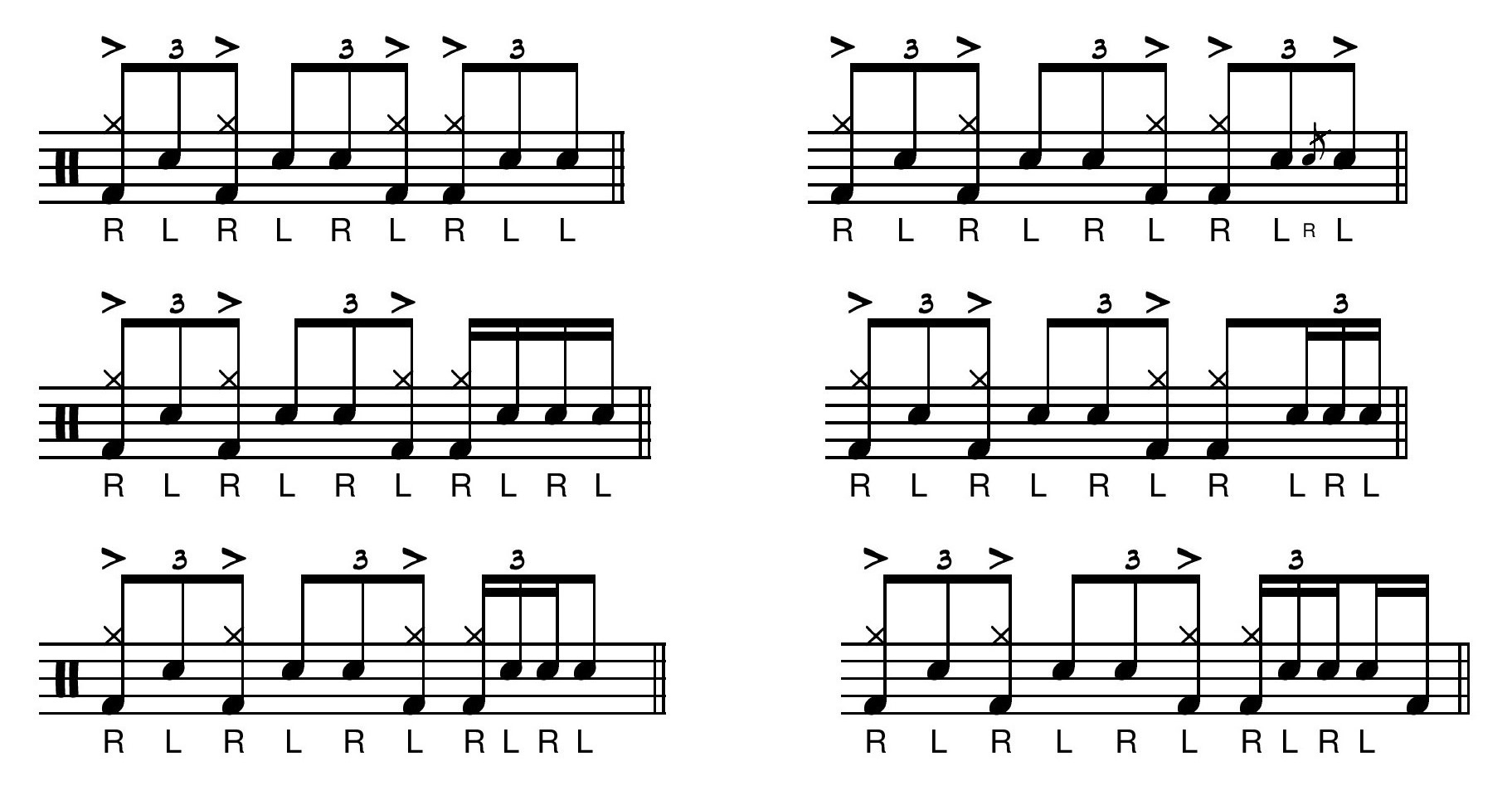
An easy page of rhythm exploration here, inverting a polyrhythm, combining inversions, and then inverting that. I've been encouraged to write these things after noticing that, starting with a simple 3:2 polyrhythm (or hemiola), running some simple mathematical permutations, and/or putting them into 2/4 or 4/4 time, we get some very common rhythms in north American and Latin music. 


There's no grand goal here, except to know rhythm a little better. Most people can play it in one or two practice sessions, then leave it. 

I encourage you to count the combined rhythm of each exercise, and think of them as sticking— variations on B RLR (B for both hands in unison). As we get into the inversions there are some RLRLR and RLB. Play first with hands only, then add the bass drum at the beginning of the pattern.

You can move your left hand between drums, and add some more bass drum. Try some things, it won't be difficult to make some interesting Afro-type grooves with this.   

Get the pdf

Tuesday, October 24, 2023

Solo ideas in 3/4

We'll be seeing more with this format— solo and fill ideas for a certain amount of space between cymbal/bass drum accents. It's the normal frame for fills, but I don't see fill studies written that way often.  

This page has some three beat ideas for soloing in 4/4— they aren't necessarily meant to be played in a 3/4 environment. See the 4/4 phrase at the bottom of the page to see how that works. It's a common thing. 


The ideas themselves are not difficult, the main practice concern will be to get fluent moving them around the drums, and speed, maybe. 

Note that 10 and 11 use a “Bishopdiddle” type sticking, with the diddle up front. Number 8 is sort of a special one— the sticking isn't easy; playing it a lot will be good conditioning. 

Get the pdf

Monday, July 17, 2023

A basic waltz vocabulary - 01

I was working with a student on a jazz waltz, played at a brighter tempo than he was real comfortable with, so we needed to come up with some easy things to add to his basic feel. The first thing to do with any style is to get some simple options for things to play.  

We'll use this as our basic time feel— everything else will be added to that, or modify it: 


Use the 8th rest pages from my book, Syncopation in 3/4, which you should own. The first three lines of p. 18 have a single beat of 8th notes/rests per measure, and some quarter notes:  


Normally people just tell you to play the rhythm on the snare drum, and play it on the bass drum, and move on, but let's change it to make it more like something we might actually play when playing this style:

1. Play just the 8th note.
2. Play the 8th note plus the note after it. 
3. Play all the notes. 
4. Play all the notes, minus the note after the 8th note. 

Using line 1 above, along with our time feel, that would go: 


Seem convoluted? Not really. You want to be able to look at a rhythm and just play part of it. 

In jazz, you don't generally play a repeating rhythm every single measure— let's play them every two measures: 


Simple. We're looking for basic, mundane vocabulary. 

We're not going to do a lot with the bass drum here, but try playing it on the note after the 8th note: 


When you do that in the two measure phrase, don't hit both 1s with the bass drum, for example: 


Use your own judgment in how you do that, which measure of the phrase gets the 1 on the bass drum. 

After you can do all of the above in the two measure phrases, improvise similar things, while thinking your way through a tune, or playing along with a record. Something like All Blues or Someday My Prince Will Come, or Up Jumped Spring.

We'll do a little more with this later in the week. 

Tuesday, May 23, 2023

That last Reed tweak: one further

Going one further with that last Reed tweak in 3/4, in which we played alternating triplets, beginning every measure with the right hand. Normally with alternating triplets, every second measure would start with the left hand, so to make that work we had to do some different things on beat 3 of each measure. 

Quick summary of the larger method: reading from my book Syncopation in 3/4, play alternating triplets, accenting according to the rhythm in the book, swing interpretation. Play those accents on a cymbal with bass drum in unison, and the rest of the rhythm on the snare drum. It's an ordinary thing. See the last post for how we made each measure start with the R hand. 

With this tweak of the first tweak, we're going to use an idea from another alternating triplet item, where we omitted any of the cymbal notes falling on the left hand— while continuing to play the bass drum there. 

Best to just illustrate it. Here are the first two lines of the full page Syncopation Exercise 1 from Syncopation in 3/4: 


Here's how you would play it with the original tweak (one way of doing that, there are other options for how to handle the third beat of each measure):  


Here's how to do it omitting the lefts on cymbals: 


The situation in measures 3 and 6 is a little funny to me,  but everything doesn't have to work perfectly. 

A good application for this is to play a repeating rhythm in 3/4, in 4/4. For example, the first measure from the above example, played over two measures of 4/4: 


Or four measures of 4/4:

Small typo: add bd/crash one 1 of the first measure only, every time you play the whole phrase.


There you go. I'm looking to develop living textures, not pure licks, so I do any part of this part of the time. I don't overwork it, I change it up.  

Tuesday, May 09, 2023

Reed tweak: alternating triplets in 3

This came up while I was practicing out of my book, Syncopation in 3. An extremely ordinary practice system used with Syncopation is to a) swing the top line rhythm, b) fill in the remaining triplets softly, and c) play the whole thing with an alternating sticking. For example: 

a) Book rhythm: 


b) That rhythm swung: 


c) Triplets filled in, played with alternating sticking: 


Using this on the drumset, there's some value to being able to consistently land with the right hand on 1— it takes a little extra attention to land on the left. With alternating triplets, your right hand lands on a downbeat every two beats— your hands are telling you you're playing in 2.    

So, following are some ways of always landing with the right hand on 1, some of which I've been doing for years, without thinking about it— it only just now occurred to me to write it down. We get into some cool Elvin-like stuff here. 

Playing book rhythms that have a quarter note on the third beat, like the one above, there are a number of interesting options— I'll write it out for drum set, playing the accents on the cymbals, with bass drum in unison: 


Typo alert: I left off the accents on some of the cymbal hits on 3. Accent all the cymbal notes, or don't.

Some of those work better than others, depending on what's happening on the 1 when you repeat, or in the next measure, if you're reading the full page syncopation exercises. 

If the book rhythm ends with an 8th note on the & of 3, it's simpler— just don't hit the cymbal on that note, but do play the bass drum. So these two rhythms: 


Would be played: 


And you can take that a little further with some Elvin type things: 


You have to take a loose attitude about all of this stuff— the goal is not always to do a pristine rendering of the system, it's to make something musical out of it that is personal to you.

Monday, April 03, 2023

EZ Rock in 3/4

Working on my EZ Fast Rock page, a younger student asked a question like what's the difference between playing in 3, 4, or 5? Well, here we go, some similar stuff written in 3/4. 

I like this format— one page with a lot of easy patterns, that all together = pretty OK baseline vocabulary for a basic style. 


Learn each measure, then combine measures in two measure phrases. 

Get the pdf

Saturday, December 03, 2022

Page o' coordination: Juju

I'm transcribing a little bit of Elvin Jones's playing on the Wayne Shorter tune Juju, which I originally did off the LP around 1988. It'll take some time to finish it, so here's a page developing the main groove from it— a version of the thing I've been calling an “Afro waltz.” Most people would probably say “Elvin waltz.”

Slightly different format from the usual POCs, exercises 1-10 build the particular groove Elvin played on the recording, and have specific drums assigned, including some changes to the bass drum rhythm. Exercises 11-18 have other left hand rhythms for basic fluency. 


Swing the 8th notes. Practice with and without the tie on the cymbal rhythm in the first measure. On exercises 11-18 you can do the stock left hand moves I use with these pages. 

Get the pdf

Here's the tune, it's a record you should know well:

Sunday, October 16, 2022

Three Camps in 3 - jazz waltz -02

Another set of Three Camps-form exercises in 3/4, for the drum set. The first two have alternating triplets between the snare and bass, the last two are based on a dotted quarter rhythm, with an extra note in there. 

Still digging this format— it makes you practice one thing for as long as you're supposed to, with minor variations. Good alternative to practicing out of Reed and having to deal with a lot of reading. 


Check out the forms carefully— the circled bass drum notes are added or swapped for the snare drum on some of them. Learn each two measure phrase, then put them in the form to make the complete exercise.  

Get the pdf

Saturday, October 08, 2022

Three Camps in 3 - jazz waltz - 01

Continuing the thing from the other day, here are some drum set variations on Three Camps, in 3/4 time, in a jazz waltz feel. I practice this same type of thing using my book Syncopation in 3, which you should own, but it's nice to have a clean, structured shot at some simple variations on one idea. And the Three Camps format makes you practice it for about as long as you should practice it. 


Practice each measure by itself, then put them together in the form given at the top of the page. Add hihat on beat 2, or beats 2 and 3, pencil it in on the a partial on 1, and on beat 3, Elvin-style. Anything. Scratch out that middle bass drum note on the D part of the dotted quarter version if you want— it doesn't fit the pattern, exactly. 

Practice it with my loop of All Blues. 

Get the pdf

Thursday, October 06, 2022

Three Camps in 3

A few practice items coming up. Here's the traditional rudimental item Three Camps converted into 3/4 time, two different ways— accenting the quarter notes, or accenting the swing dotted half notes. That latter is harder than I expected.  

Something about doing it in 3 encourages you do it faster— I like Three Camps for working on fast singles. And the piece is 50% longer, so it will help your endurance. 


Learn each phrase by itself, then put the phrases together according to the form description to make the complete piece. Play as accented triplets as written, and as rolls, doubling all the unaccented notes. 

Monday, March 21, 2022

More on that Latin system

Breaking down part of that short Latin method from the other day. I like it. It's easy, and gets us into some pretty fundamental things about rhythm, drumming, using the drum set. This is a page I'm handing out to my students.   

To review, the system is based on the cymbal/bell part, that we're getting from the book Syncopation, or from one of my rhythm pages. We're mostly limiting it to the cinquillo rhythm (and its inversions), which is built out of 3+3+2 eighth notes. 

This page has some warm-ups using just the 3+3 portion of the rhythm, in 3/4, in its inversions.  As before we fill in the the gaps in the rhythm with the left hand, and add bass drum to different parts of the original rhythm from the book— add it to the written quarter notes, the written 8th notes, and to the written notes sounding on an &. And add it on 1 sometimes, if it's not already there.

Just play the patterns as written on the page: 


I suggest playing the left hand as a rim click, then move it between the snare and the high tom, one note per drum. Play them along with one of my loops in 3/4, 6/8, 6/4, or 4/4. 

Get the pdf 

Saturday, February 26, 2022

Listening: Up Jumped Spring

I started transcribing this, but was too distracted by Ukraine developments to finish more than a page of it. It's Up Jumped Spring, by Freddie Hubbard, from his album Backlash— I'm listening to a lot of Freddie Hubbard lately. Otis Ray Appleton is on drums. This is one of the first tunes in 3/4 I ever learned, and like most tunes I know, I learned it on the job, playing a little gig.  

The form is AABA, with 16 bar A sections and 8 bar bridge, so here's most of one chorus [hahahaha, I suck- t] of the drumming on it, from the beginning of Hubbard's flugelhorn solo, starting at 2:09: 


The drumming is straightforward, grooving, driven by mostly a quarter note rhythm on the cymbal— not a lot of skip notes happening. He's playing the tune; not a lot of stock jazz waltz stylistic things happening. He plays the hihat on beat 2 sometimes. Comping on the snare drum is mostly simple offbeats (often the & of 3), with larger statements at phrase endings— often a roll on the snare or floor tom, singles or closed roll. He uses the bass drum and cymbal strongly to outline the form. He does a few basic combinations the bass drum and snare drum, which you can easily pick out. 

Overall it's a great example of how to play the form, and play great time, simply and functionally without just playing stock jazz waltz drum groove.

Nice cymbal sound, too— a rather dark, dry 20" cymbal, with good ride and accent sounds. 

Get the pdf

Saturday, October 30, 2021

Page o' coordination: basic triplet texture in 3/4

Same deal as the recent triplet texture in 4/4 page, done in 3/4. A simple linear triplet pattern with added bass drum variations. I already did this with a student, looking at the page in 4— we just ignored beat 4. Similar to the other thing we did recently putting Chapin in 5 by repeating beat 1 at the end of the measure. Both of them work surprisingly well. It's an easy way of adapting your normal jazz materials into other meters. 

Here I've rewritten the bass drum parts to put them in a more logical order for 3/4: 


Play them through, and have fun. This is an easy way to get novice students into an Elvin Jones type of texture. Try playing them along with my All Blues loop when you're ready. 

Get the pdf

Friday, June 04, 2021

Linear 8ths in 9/8 - 02

We're doing a lot with triplets and compound-meter 8th notes these days— here with a linear pattern in 9/8, with inversions. See this last similar page, and my page of linear double paradiddles/paradiddle-diddles— still one of the more useful single pages I've posted on this site. 


The first half of the page has the pattern starting on the snare drum, the second half has it starting with the bass drum. Practice these on the snare drum and bass drum, along with any cymbal rhythm of your choice. Right now I just play them in a jazz waltz feel. 

Get the pdf

Friday, May 14, 2021

Linear 8ths in 9/8 - 01

This is how it is, I get busy teaching, doing my taxes, preoccupied with other stuff, and not able to hit the drums for a week, and everything dries up. No ideas and I feel like a fraud. Then I sit down once and everything clicks, and it's hard not to stop to write things down. I'm just working on my stuff, I'm not trying to write more drum crap. 

This is similar to this recent page of double paradiddle / paradiddle-diddle inversions, voiced on the snare drum and bass drum. I use that page a lot in my own practicing, and wanted to extend the idea a little further. Here we're doing the same idea in 3 [9/8 = "triplet feel" in 3, yes?], mostly alternating, with one double. 1-9 have the double on the snare drum, 10-18 have the double on the bass drum. 


Use these however you like, I'm mostly doing them with a jazz waltz cymbal and hihat rhythm. You could also add cymbal in unison with the snare drum part, or in unison with the bass drum part. The real animals can add one of my quasi-Afro/Cuban cymbal rhythms in 9/8. Start with this one if you're going to try that.  

Get the pdf

Monday, October 05, 2020

Jazz fundamentals: playing basic rhythms on a cymbal

Usually people start with jazz coordination by playing snare drum independence patterns along with a static cymbal rhythm— see Jim Chapin's Advanced Techniques, for example. It's a thing to do, and it should be done. But it's not the only thing to do, and I don't think it's the directest way to becoming a functional jazz drummer. Jazz does not necessarily require a rigidly unvarying cymbal rhythm, and  complicated left hand activity. 

What it does require is a cymbal rhythm played with a strong quarter note pulse. If you can do that, and play some simple things with a little creativity, you're in OK shape as a novice jazz drummer— at least as far as pure timekeeping vocabulary is concerned. 

This is a summary of a lesson item I've done with a number of students— adding easy things to a varying basic rhythm played on the cymbal. Use the rhythms in pp. 10-11 in Syncopation, or pp. 14-15 in my book Syncopation in 3/4. Or pp. 6-7 in Joe Morello's New Directions in Rhythm. You could spend some extra time on the rhythms that are most like the normal ones; lines 2, 4, and 15 in Reed pp. 10-11, for example.

These are quite easy, so you can just memorize the concepts, and practice them in a free form way— after playing through them, with all of the cymbal rhythms from the books, working out the coordination with the standard hihat/bass drum rhythms.  


Play the rhythm on the cymbal
The top line rhythms in the book, on a cymbal, with your right hand. Swing the 8th notes, and play them with a strong quarter note pulse, and a steady rhythm.


I'll use those same two rhythms for all of the other examples.


Add standard rhythms with the feet 
In 4/4 play 2 & 4 on the hihat. In 3/4 play 1 on the bass drum and 2 on the hihat:


I won't write these parts into the remaining examples, but you can continue playing them while you do the other things. Or not. If the rhythms conflict with the later things, or if the groove starts suffering because there's too much going on coordination-wise, stop doing one of the things. There's time for punishing rigor later. Do what you can do reasonably quickly, while making the cymbal rhythm sound good.   


Hey, there are a lot of examples— let's put a page break....

Wednesday, September 16, 2020

Paradiddle-diddle inversions

Remember that page of double paradiddle inversions I wrote back in April? April 2020. Or, ~198,000 United States COVID deaths ago, for those of you who have abandoned calendars and moved over to a death-count based time scale.   

....

Anyhoo, I like that double paradiddle page, and I always keep it close at hand in my pile of practice materials. Here I've done the same thing with alternating paradiddle-diddles— writing them as 8th notes in 6/8, as a two-voice linear pattern, and as a rhythm (based on the right hand part) in 3/4. Doing them alternating makes the inversions a little more interesting, and also has us doing three notes in a row on each hand or part.


The accent on linear version is just so you can see where the inverted pattern begins— usually I would accent the right hand, and vary the accents with the left hand. The linear version is written as RH/cymbal-LH/snare, but you can play it on any two limbs/sounds. See the practice suggestions on the second page of the pdf.

Get the pdf

Thursday, September 03, 2020

Roy Haynes waltz lesson - practice suggestions

So, I wrote that Roy Haynes waltz lesson in about ten minutes— I just listened to the tune and picked out the most obvious possible ways to cop the basic thing he's doing there. And since I titled it WORLD'S SHORTEST ROY HAYNES WALTZ LESSON, one could get the impression that it's something you can learn to do quickly. Not so! Just playing through the things on the page takes some time, then you have to learn to improvise a texture from those ideas. When I sit down with something like that I inevitably do a lot more with each thing.

On this page we'll look at the first pattern for that lesson, and run through some of the things I play when I practice it. I do as many of these as I can on the fly, but a few of them I would need to see written down. Not all of these are suited for the tempo on the Chick Corea recording— not right away, anyway.


I would also play the bass drum one note per measure, on every single note of the cymbal rhythm, especially if trying to cop the Roy thing. There's only so much you can put on one page. You can add the hihat on beat 2 and/or the bass drum on beat 1 wherever you like. Swing the 8th notes.

Continue thusly with the other sticking patterns on the lesson page. I hope everybody knows you have to find your own groove with these things— you speed through some things, and work longer on the ones that are harder for you, or that have a lot of creative and musical possibilities for you. That goes for everything else on the site and everything else in drumming. No written materials anywhere are a linear map for getting good. 

Get the pdf

Friday, August 28, 2020

World's shortest Roy Haynes waltz lesson

UPDATE: See the page of practice suggestions for more on this!

Someone on the internet asked me to explain what Roy Haynes is doing on the Chick Corea tune Windows, from the album Now He Sings, Now He Sobs, so I wrote up a little lesson on some of the basic elements, on getting started making the approximate vibe:


Listen to the recording, play through the page in all of the suggested ways, then improvise combinations of things to make a continuously developing waltz texture— that's the part that will take some practice; the ideas themselves are not difficult. Vary the dynamics and articulations with your left hand— use buzzes, rim shots, etc. Roy really exaggerates his accents, and tends to put them in odd places.

Obviously there are some other things happening— he plays some triplets between the snare and bass drum, and plays both hands on the snare drum occasionally— usually 3- or 4- stroke ruffs, open, as singles.

To continue developing this beyond the scope of this page, you should be able to play a regular jazz waltz, and have some basic coordination together with that. See Joel Rothman's 3,5, 7, 9, Jazz! or Joe Morello's New Directions in Rhythm for materials. Get my book Syncopation in 3/4 for more practice resources.

Get the pdf