Showing posts with label counting. Show all posts

Wednesday, July 03, 2024

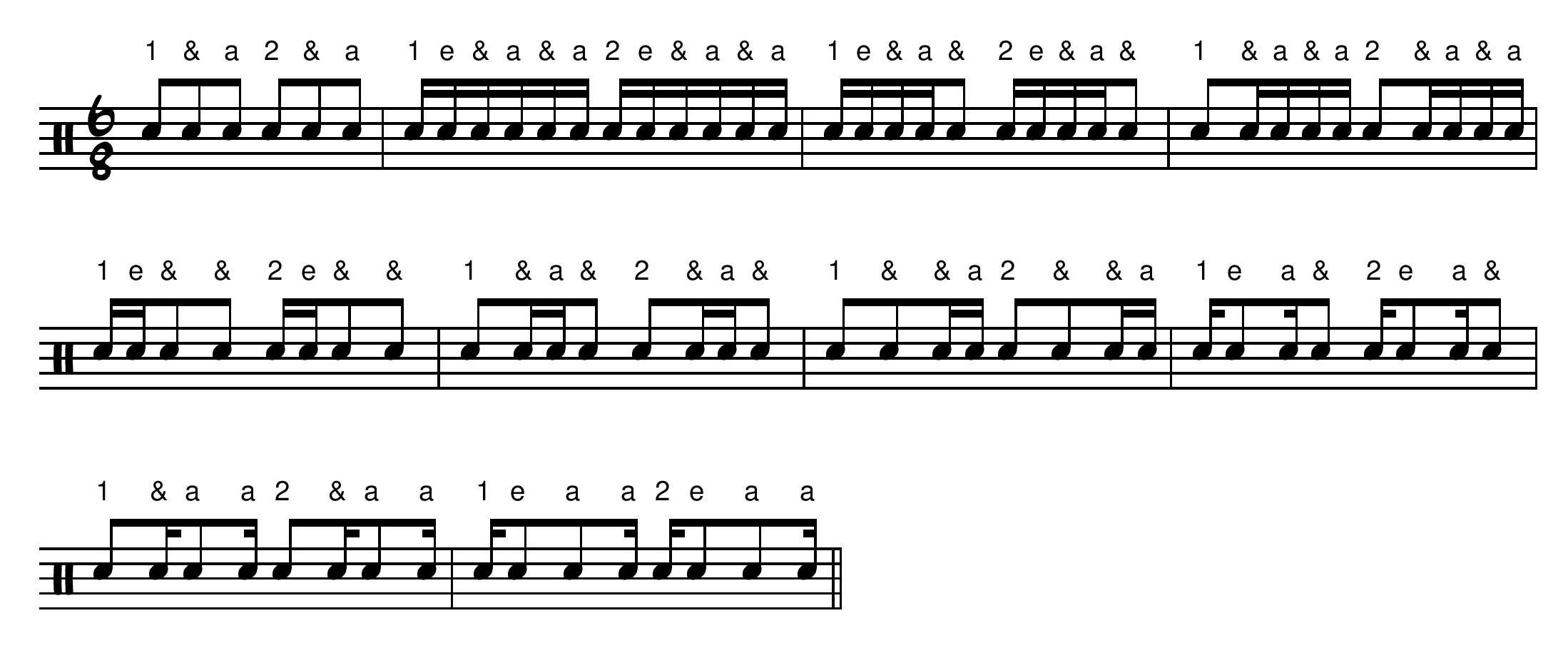
16th note reading boot camp

Plotting out an intensive couple of lessons with a younger student, who has been doing extremely well with his playing the past year, but who is deficient reading 16th note rhythms. It's not unexpected that there be some gaps. When you're young you learn a lot really fast, largely from the actual playing you do, and may not keep up so well with things requiring deliberate study. And the way I teach, I don't force things on people that they're not ready to get into. 

For a normal 14 year old he's about on schedule for getting this together. I'll be spending a pretty rigorous couple of hours with him on the subject to get him up to speed:


Counting 
First, just speaking the syllables counting the major single beat combinations of 8th notes and 16th notes, apart from reading them on the page. Including ghosting counts for rests— e.g., with a 16th rest at the beginning, 1e& becomes (w)e&. He is already good at this. 


Recognizing

Part of becoming functional in reading is simply recognizing a symbol or a one-beat group of symbols as representing a particular counted rhythm. That's mostly how reading is done, at first: people don't fractionally add their way through music, they look at one-beat symbols. 

Looking at the rhythms below, people can recognize that that's a 1e&, that's a 1-a, without actually knowing the values and accounting for each note of it. Which is why people will often mistake the 1e& rhythm for the similar looking 1-&a rhythm.   

When speaking the counts for these rhythms, say them with their proper spacing. Some students will say 1e&, 1-&a, or 1e-a, and space all the syllables evenly— they need to be spaced like the rhythm is played, even in conversation. 


The linear mathematics
Understanding the actual math of how a measure of music progresses, in linear order, from symbol to symbol: based on the value and placement of the current note, what is the count of the next note?

For example, in 4/4 time, a quarter note on beat 1 will be followed with something on beat 2— whatever kind of note or rest it is, it's happening on 2. An 8th rest on any downbeat will be followed by something on the &. A 16th note on the & will be followed by something on the a.  

For this we will be penciling in the counts for every single note or rest on the page. Using a throwaway printed page— not in the book or on the actual practice page. In his normal practicing, I don't want the counts written in. 


Once it's clear he's solid accounting for every single symbol in the measure, we'll do a little bit just putting in beat marks:


The person
Communication is a bitch. Everyone brings their own set of issues to the lesson, and is reprocessing the stuff you tell them their own way. You have to pay attention to your words, and to the person. There are a lot of ways to do it wrong. You don't want to lose the person— by bombarding them with detail, or by not making it easy enough... or by not making the easiness of it obvious to them. People overthink, and will look for a hard answer even when you give them a very clear, simple request or problem. 

You can also craft a lesson that progresses well, with easy steps, but they may also be impatient with that— with the easiness of it. They may have a strong urge to lunge right to the thing they can't do at all, and then give up because it's too hard. That's part of the problem for this student, I believe. He's already good with direct application of rhythm, and likely feels the reading is a hindrance.


Materials

I'll be using:

Syncopation - As briefly as possible, the 16th notes materials in it are boring and formulaic, but good for a specific state of learning them.  

New Breed -  Although it's not a real friendly environment for this student, the pages are well written, and in an engraving style I approve of. 

Funky Primer -  There's a good short 16th note rhythm summary at the beginning. 

Elementary Snare Drum Studies by Mitchell Peters - This has the best overall rhythm summary I've seen, with all ordinary 8th note/16th note rhythms, each written a variety of common ways. See the copied examples above.  

Reading Text in 4/4 by Louis Bellson - For the pencil and paper practice. I'll have him write in the counted syllables for each note or rest on the page. I've already given the reasons I don't like this book for regular practicing. Even for this it's barely useful to me.

Friday, July 07, 2023

Tri pa let

Related to my late forays into different systems of counting: in an online conversation, someone asked about counting 16th notes within an 8th note triplet, specifically a triplet-rate hemiola: 


Generally, people count 8th note triplets:
 

1-&-a 2-&-a - or - 1-trip-let 2-trip-let


A natural way to count the rhythm above would be to add a syllable to either of those ways—a, la and ta are common. I would most likely say:

1 an-a-da 2 an-a-da 


One could also say: 

1 tri-pa-let 2 tri-pa-let

Which is offensive for a couple of reasons:

First, a lot of people already wrongly count triplets tri-pa-let tri-pa-let, with the tri falling on the beat. So this could result in further confusion. 

Second, and worse, there's no pa syllable in the word triplet— we're violating the structure of the word! And it sounds extra-dumb. 

But people already chop up the word all the time when they have to count triplet partials, using a lot of isolated lets and trips:

I don't hear anyone complaining about
this... except me, because I hate it.
  

I didn't ask anyone to bring the word TRIPLET into it, whose morphological integrity I am now obligated to preserve, even if it hinders our ability to COUNT RHYTHMS— the alleged point of all of this. A system that is only good for one thing is not a system, it's a device. 

So the heck with it. When you see 16th notes within an 8th note triplet, and you refuse to give up the 1 trip let way of counting, you can add the syllables, as needed: 

1-da-tri-pa-le-ta 2-da-tri-pa-le-ta


We're essentially Italianizing the word, breaking up the consonant clusters with extra vowel sounds. It's the language of music for a reason.  

This even works pretty well as you get into more broken rhythms— if you say these out loud, you'll notice how the trip let syllables are ghosted even in the more remote rhythms:  


But those are pretty uncommon. It's fairly unusual to see it notated— most likely in drum set books, where the natural context is generally 4/4. The last pages of Dahlgren & Fine, for example. In snare drum books those types of rhythms are generally written in compound meters. Usually we just see the first or second partial, or first two or last two partials doubled to make 16ths. You can just touch the extra syllables and it's easy.  

Finally, let's be clear: nobody counts this way. But nobody did every other thing in drumming, until somebody started doing it. It's a natural extension of something widely done, that works well if you don't get too hung up on this imported restriction of maintaining word structure, which has nothing to do with the needs for counting rhythms.

Thursday, March 16, 2023

Counting system overhaul - 02

I was working on this last year, and never posted part 2, because it was an unreadable mass. Still is. But for people who teach and deal with this subject every day, here we go:  

Lately I use a counting system I improvised when I thought about it for five minutes. It's based on speakability and familiarity: the only syllables are the beat numbers, e, &, a, and da, usually spoken in that order. Some may prefer to use ta instead of da, especially with sixtuplets and 32nd notes. I find it works very well. 

See part 1 from November for my complaints about other ways of counting. I've bolded some syllables to help make this mess more readable— don't take it to mean you should accent them with your voice. 


8th notes:
 1& 2&


8th note triplets/compound 8th notes:
 
1&a 2&a


16th notes: 
1e&a 2e&a


Quintuplets: 
1e&a-da 2e&a-da
Alternative, phrased 3+2: 1ada-&a 2ada-&a


Sixtuplets / 16th note triplets: 
1ada-&ada 2ada-&ada
Problem: Slightly ungainly when speaking running sixtuplets— could use ta instead of da.  


Compound meter 16ths: 
1e&a-&a 2e&a-&a
Alternative: 1e&a-ada  2e&a-ada

Problem: Syllables are different for 8th notes and 16th notes. The 8th note a becomes a second & when 16th notes are involved. Also difficult to articulate the a-& syllables when isolated in a rhythm. 

Solution: Count compound 8th notes 1&& 2&&, or don't prosecute people making that mistake when counting a mixed passage. Or use the alternative 1e&a-ada, which has the 8th note syllables in their original places— but which will make some common rhythm combinations more difficult to pronounce. 

Saying the a-& syllables in isolation, I would say da-and.

Admittedly, this area requires the most tolerance for inconsistency and ambiguity. I still find this way of counting to be better than any other system I know of. 


Septuplets: 
1e&a-&ada 2e&a-&ada
Alternative, phrased 2+3+2: 1e-&ada-ada
Phrased: 3+2+2: 1ada-&a&a or 1ada-&e&a 


32nd notes: 
1da eda &a ada -2da eda &a ada  /  1ta eta &ta ata 2ta eta &a ata
This will be most useful when just a few 32nd notes are involved— you can just touch the extra syllables and communicate the rhythm. Of course it will be difficult above quite slow tempos, or with long runs of straight 32nds. Use the harder ta syllable at faster tempos.  

Counting complex passages of mixed 32nd notes and 16th note rhythms, it's probably best to count them in half time— using the more familiar 16th note syllables. 


PROBLEMS/COMPLAINTS: Parts of this bothered a couple of people on line. 


•  Reusing syllables with different subdivisions— as if the & should be the platonic 4/4 & forever, and saying & any other time is confusing. Like when speaking you use a duh sound in the word dog and everyone's cool, but then you say diaphragm and everyone says Huh? What? Did he say dog? 

Obviously absurd. Anytime it's not clear from the context, you can distinguish the subdivision you intend by mentioning the subdivision— the triplet &, the compound a, the quintuplet e, the second &. Complex situations will be complex situations no matter what, no counting system will make them into non-complex situations. 


•  Teaching people a non-standard counting system, I am dooming them to be unable to communicate rhythm to others. To which I say:

a) It's not that non-standard.
b) I'm not a cultist, I don't pretend to my students that there are no other ways of doing things.
c) There is no standard counting system for most of these things.
d) Most people you talk to will not know the convention you're using, and you have to clarify anyway. 


• By what authority do I just make up my own way of doing things? There is no authority, the entire literature of drumming is nothing but guys figuring stuff out and publishing it. Players and teachers (and communities thereof) adopted what worked, or what they liked. 

CONCLUSION: This system has been very useful in my teaching, clarifying some areas of rhythm that were previously a little mysterious, that had to be “just gotten”, or counted in an unsatisfactory way— especially compound 16ths, and odd meters like 5/8 and 7/8. No doubt I'll continue refining it. 

Saturday, January 28, 2023

Latest views and practices on time

Rounding up my current views and practices on the subject rhythm and time, in teaching and practicing: knowing rhythm, holding a tempo in playing. This is mostly about beginner to intermediate level students. A lot of returning students— people getting back into drumming after taking years off— need a lot of help with this. 

What people do
Often students will look at a page of drumming materials and just start playing, at whatever is their personal natural tempo for playing something. Often they won't be able to play slower, if asked, or they'll creep up to their natural speed, more or less gradually. Obviously that won't work in real life playing, and it will slow them down in learning new things in the practice room, so breaking people of that is a big issue for teachers. A lot of us have vestiges of that in our own playing.  

Set the tempo
Before starting, decide what the tempo is going to be. This is always done in real playing, and very often not done in practicing— when not using a metronome or playalong track. Think about it for a second or two before starting. 

I'll be loose about this at first, and then more strict as a student can get through the pattern— or if they are having problems playing a pattern at all.  


Rhythms are shapes

Or structures, if you prefer, the architecture of our playing. They're the ideas we have to work with. Students need to learn their proportions, and learn to structure them with their voices. 


Rubato for figuring it out
While keeping the same basic proportions, we can allow some freedom to take the time to identify the next note in a pattern, from the page, and play it correctly. Students can slow down or pause, but we want to keep the proportions of the rhythm, broadly. I don't let them rush through the easy parts and then slow way down when it gets hard. 

Counting
Usually I have students count the combined rhythm of all the parts— all limbs— before playing something. For these purposes I usually don't want them to count while playing, I want them to focus on making their hands move in the rhythm we just counted. I'm insistent about always counting rhythms articulately, and always proportionally, even when referencing them in conversation. 

I usually do not have students count a full grid— usually just as a remedial thing if they're having problems with some other aspect of it. 

Use ears
Forming sound ideas or memories, using your ears.

People are universally pretty good at using their voice to copy something they heard. I'll count a rhythm for a student, and have them count it back to me, and when they can do it, matching my tempo exactly, then they play it, one time. Often that will sort out any coordination problems they were having with a drum set pattern. 


Hands must follow the voice

Increasingly I think the voice-hands connection the foundation of drumming technique. The hands will take over and run away with the time if you let them. Students need to be able to speak the rhythm in question accurately, and make their hands state it.  


Slow click
For advanced students. Practicing with a metronome sounding on beat 1 only— or on beat 1 every other measure. For me this has become the major way of learning to conceptualize time the way professionals do. It forces you subdivide, and to make your hands state time all the time, while also allowing your playing to breathe.  

It's a persistent false idea that people have to just “feel” time, and some people have it, and some don't. What we don't have is people who know how to teach it. I've handled some pretty rough cases using the above approaches— with a lot of patience and attentive teaching on my part, they eventually get it. 

Sunday, November 06, 2022

Counting system overhaul - 01

This guy gets it.
Severely long two-part nerd item alert— the following post is an embarrassing mess that will be perhaps useful/entertaining for music teachers and others who think about this stuff all day every day. All others proceed with caution. 

Last year I was taken to task online by another drum teacher, for my late innovations in counting rhythm— I was told my ways are convoluted, inconsistent, confusing. “We have a working system in place, if it ain't broke don't fix it and we don't need to count things we can't already count anyway, and by what authority...”, etc etc. 

So let's look at the current excellent extremely consistent and non-confusing ain't-broke methods for counting rhythm, with some kind of official acceptance somewhere, and I'll say everything I think is wrong with them. Next post I'll round up the way I'm doing it, which I've already written about piecemeal.


8th notes:
1&2&

Problems: fine


8th note triplets: 1 trip let 2 trip let, 1&a 2&a, 1 la li 2 la li

Problems: I prefer 1&a. Yes, the syllables duplicate a common 8th and two 16ths rhythm. We remedy that by teaching people the difference between the two. 

1 trip let
is ungainly to speak— too many consonant clusters from syllable to syllable. And, frankly, I'm not a child, I don't need to say the name of the rhythm I'm counting. And by baking the word triplet into it, we've made it useless for counting a common equivalent rhythm: compound 8th notes. 

1 la li—
part of the Eastman system— is just goofy, and had to have been cooked up by a vocalist. La is a syllable we make drummers/percussionists use to get them to play with a prettier tone, we don't use it to articulate rhythm. 


Compound 8th notes:
1 2 3 4 5 6 (maybe emphasizing the 1 and 4); 1&a 2&a, 1 la li 2 la li

Problems: With 1 2 3 etc we're counting a subdivision, not the main beat. We don't count 8th notes in 4/4, why do it in 12/8? I would rather use the trip let syllables, but that's a non-starter because compound 8ths are not triplets, though they are functionally the same rhythm. 

Sidebar: This is where pedantic individuals will make us have a long fight about the nature of a triplet, and of compound 8th notes. A three note subdivision of a beat is an ordinary kind of rhythm. It is native to 6/8 time, but foreign to 2/4 time, where it requires special notation— a numeral 3 printed above that beat. And it gets a special name: triplet. It's the same thing in either case: a single beat divided into thirds. There's no good reason to count it differently in different time signatures. 


16th notes:
1e&a 2e&a, 1 ti te ta 2 ti te ta

Problems: none, 1e&a is universally accepted, and easy to say, and is extremely useful for counting and understanding complex 16th note rhythms, let's do more with it. Exploit its familiarity.

I've never met anyone who uses the Eastman 1 ti te ta syllables, not even people who otherwise defend that system like it was handed down by Socrates from Mt. Vesuvius*.

* - ???  


Quintuplets: hippopotamus or other funny five syllable word, 1 quin tu pl et 2 quin tu pl et

Problems: Funny words are OK for getting the rate of rhythm in isolation, you don't use them in counting an actual piece. How are you going to refer to partials of a quintuplet, the mus of 1, the pot of 3? Not an everyday need, but if we're going to do this, let's do it right. 

1 quin tu pl et invents a pul syllable that isn't spoken in the word. And again, I don't need to pronounce or mispronounce the name of the rhythm to play it. And by saying QUIN TA PA LET we're sabotaging it for use with five note groups that are not quintuplets. Like, what are you going to say when you encounter a measure (or partial measure) phrased 5/16? 


Sixtuplets/16th note triplets:
nothing, 1 trip let & trip let, 1 ti ta & ti ta, 1 ta la ta li ta

Problems: None are easy to say fast. The consonant clusters in the trip let way really bog you down here.

The Eastman la li etc syllables are phrased wrong, like a subdivided 8th note triplet. Correctly, 16th triplets are a triplet subdivision of an 8th note. The distinction is important. To make those syllables work you could vocally accent the syllables WUNtala TAlita. Saying 1tala &tala— if we must use those syllables— would be better. 


Compound meter 16ths:
1&2&3& 4&5&6&, 1 ta la ta li ta 2 ta la ta li ta

Problems: Same problems as with compound 8ths, but worse. Try using those Eastman syllables to count a complex passage of 8th and 16th notes and rests.  


Septuplets:
none, but take your pick of funny seven syllable words: aboriginality, absolute immunity, algorithmic randomness, cryptozoological, grammaticalization, hematochromatosis, impermeability, Kierkegaardianism, kleptoparasitism, monomorphological, ultramodularity, Zoroastrianism

Problems: are you kidding


32nd notes:
nothing 

Problems: There aren't many cases where I would want to count 32nd notes, but it would be nice to have an option. 

CONCLUSION: The beauty of this well-lubricated* system is that no syllables conflict, except when syllables conflict. It may not be “broke”, but these methods are totally inadequate for anything other than 8ths and 16ths in */4 meters, and 8th notes in compound meters. People handle these limitations by basically never counting anything other than that... not very well. So big areas of rhythm are permanently not understood very well by a lot of people.

* - By which I mean how drunk would a man have to be to think this amalgamation of practices amounts to a system? 


Speaking rhythm = knowing rhythm. The implications of that go beyond just knowing how to read a rhythm correctly. Even if we don't use all of these applications often, it's still worth having a system for it. Next post I'll round up my solutions to this musical crapperware. Mostly restating things I've written before, in the screed format I've embraced here.

Monday, October 03, 2022

Counting compound meters

Recently I've begun teaching that way of counting 16th notes in compound meters that I mentioned before. It's going good. I never had a good way of counting those rhythms, so they were always a little mysterious. You miss the step of vocalizing them, which I think is important for understanding rhythm. 

Basically, in any compound meter— 6/8, 12/8, 3/8, 9/8, 15/8— when 16th notes are involved, count 1e&a&a, instead of the 1&a we (I) use with 8th notes. 

Here, count through some basic rhythms that way, and see how it goes:   


It works. It's easy to say it fast, and that repeated & syllable gives each beat of 16th notes a little waltz feel. The only part that doesn't flow easily is the 1e a& rhythm— in isolation the a& part requires a little extra articulation with your voice. 

Sidebar for quibblers: Yes, the a partial, when we're counting 8th notes, becomes a second & when there are any 16ths involved. It's different! Not only is that, we've added two more as on the last two off-side 16th notes!

What can I say, the world's an imperfect place. I'm prioritizing ease of speaking over consistent or unique syllables with this one. The only reason you need unique syllables is so you can refer to parts of a rhythm easily, e.g. your timing is off on the a of 2 there. So now you say your timing is off on the second a of 2 there instead.     


It has been extremely helpful for odd meters, too. The difference between having a good system and a weak system, or no system, is huge. Here are some basic rhythms in 5/8, counted as a lopsided 2: 


I like it. Before, if I needed to count out this type of rhythm for a student, I had to do it very laboriously in the top number of the time signature— counting in 6 or 12 or whatever— 1&2&3&4&5&6&— which is hard to do at tempo, and is also just not how we count these time signatures. More often I would sing the rhythm, which is OK, but the numbers and other syllables give us a little more to hold onto. 

Tuesday, November 16, 2021

Gaps in our counting system

In the comments on that extremely valuable izquierdadiddles post, a friend of the site from the Czech Republic remarked on stickings in his native language, and on the American system for counting 16th notes:
 

[We] Czech drummers get to deal with two syllables per hand, making everything sound as if it were meant to be eight-note based.

I never realised the English speaking players had a certain advantage in this regard, but what I am really envious of is your ability to count subdivisions in such an organized manner as one-e-&-a. While it's obvious for you, it's nothing short of genius for us.


He's right— the #-e-&-a system is extremely effective, for reading and singing a rhythm, while relating it to a metric grid. You can get very fluent at playing complex 16th note passages accurately while counting some very fragmented series of numbers, as, es, and &s. I've been doing it so long I don't even know what the alternative systems are.

But the world is imperfect, and our counting system is nevertheless incomplete, and so it's only a partial tool for learning rhythm— combined with playing, and with working personally with teachers, conductors, and other musicians. 

In my music career up until now I've only counted beats using numbers, plus 8th notes using added &s, plus 16th notes using added es and as, plus &-a for triplets and compound 8th notes. For teaching I sometimes need a little bit more. We're talking about counting rhythm only, here— leaving aside counting for keeping track of phrases or form. 

Here are a few of the gray areas, and blank areas, and how I deal with them:  [2023 UPDATE: As I've noted several times below, I've since settled on some better ways of handling these situations.]

More than one &
“And” is a convenient sound to put between two numbers. Yes, the rhythmic & is most familiar as an off beat 8th note (counted 1-&-2-&); but it may also be the middle triplet partial (1-&-a-2-&-a), or middle 8th note in compound meters (e.g. 6/8 or 12/8, also counted 1-&-a-2-&-a). We'll find some other places for it later on. 


Ultimate confusion sets in when we talk about swing 8th notes, where the & falls (broadly) on the last triplet partial, but if we happen to play a triplet in that setting, the middle triplet partial is also called &:


When talking through jazz rhythms, I deal with that by distinguishing between the swing & and the triplet &. Most people get it.  

You could avoid that ambiguity by counting triplets 1-tri-plet-2-tri-plet— sometimes I do. But I'm put off by all those flammy consonant clusters. It's also just kind of childish to be saying the name of the rhythm while counting it, like: 

this-is-a-tri-pul-et-this-is-a-tri-pul-et 

six-teenth-notes-are-fun-e-&-a


Forget it. 


Sixtuplets
I consider sixtuplets to be generally uncountable, and I never count them— except one time, very slowly, for students who have never played them:

1-tri-plet-&-tri-plet, or 1-&-a-&-&-a

[2023 UPDATE: lately I'll count sixtuplets 1-ada-an-ada— it works very well.]

When playing sixtuplets, I count 8th notes. When counting or singing a rhythmic passage, I'll sing something like digada-digada for any sixtuplets in the passage. Digada-dat for a single 16th triplet followed by a release. 


32nd notes
I also do not count 32nd notes, and do count 8th notes while playing them. They're usually played too fast to say a syllable for each note, or to differentiate the partials during a complex 32nd note passage. 

On complex passages (like you see in some etudes in Portraits in Rhythm), we just apply our acquired knowledge of 16th note rhythms, in double time, without counting. A few times in my teaching career, for a student, I've probably counted them out as 1-e-&-a-&-e-&-a.

Again, when counting through a passage, I may sing 32nd notes as diga-diga-diga-diga-dat, diga-diga-dat, diga-dat:

[2023: It's crazy, but you can simply add an a or da in between the normal 1e&a syllables: 1-da-e-da-&-a-a-da. Thankfully there's rarely a need to count a lot of 32nd notes fast.]

16th notes in compound meters
That's 6/8, 12/8, 9/8, etc. I've never seen a good system for this, or any system, which may be a hindrance to people becoming fluent in this area of rhythm. We also just don't see much of this type of thing day to day. Usually we just deal with it as best we can knowing what we already know about rhythm. When you know something about rhythm, and use it all the time, that's not difficult.  

To precisely block out rhythms for students new to these meters, I'll sometimes count them out in 6, or 12, or whatever the top number of the meter is: 

1-&-2-&-3-&-4-&-5-&-6-& 


That's the only time I count that way. In compound meters generally the dotted-quarter beats are counted, or dotted quarter notes plus the major subdivision: 1-&-a-2-&-a, as in one of the examples above.

After thinking about it for a few minutes just now, I may phase in something like 1-e-&-a-&-a:


I just counted through a couple of snare drum pieces in 6/8 that way, and I like it a lot. It's a little weird to call the last 8th note in a beat a when there are only 8th notes involved, and calling it & when there are any 16th notes in that beat. And there's some ambiguity in having two &s and two as, but it's far superior to the alternatives. It took me about five minutes to become fluent with it. Open up your Podemski/Goldenberg/Peters and give it a try. 

[2023: More recently I've settled on 1-e-&-a-a-da. If one were using trip let syllables in compound meters, there's even a way to make that work.]


Odd tuplets
This  is the first time I've ever thought about it, but you can try these out: 

16th note 5s: 1-e-&-a-da
16th note 7s: 1-e-&-a-&-a-da 
8th note 5s: 1-&-a-&-a
8th note 7s: I don't know, man. 1-&-a-&-a-&-a 

Hell, why not: 
32nd note 9s or 16th note 9s (triplets nested in a quarter note triplet): 1-&-a-&-a-da-&-a-da

Those all work great. They're nice and flowing, and are easy enough to say fast, that there's no reason not to use them. 

Tuesday, June 16, 2020

Counting the grid

It's a *mechanical* tool, from way back.
I had a conversation with a student about counting subdivisions when you practice— “the grid.” It's a common thing to do, that I don't recommend— not all the time. It's an execution aid for playing rhythms accurately, that I find to not be great for general musicianship. My students who learned it from someone else have been prone to reading errors— they often don't seem to know what rhythm they're playing.

General principle: open your copy of Syncopation, turn to page 34— each of those repeating one measure rhythms is a piece of language, a clave. Particular rhythms like that are our point of reference for everything we do on the drums.

The grid is not a rhythm, it's a pulse. It's shapeless. If you tell your brain to think of everything as 1&2&3&4&, you're not really learning rhythm, any more than reciting the alphabet teaches you words. Thinking primarily in terms of grid, and being shaky on your basic fluency with rhythm, you're giving up creative awareness and control.

Some thoughts and guidelines:


Count the rhythm 
Be able to count the rhythms in Syncopation exactly, without saying any syllables that are not sounding in the written part. Count them in 4/4, and also in 2/2, using the syllables 1e&a 2e&a. If counting e&as with Syncopation is weird, do it with the 16th note exercises in Louis Bellson's reading book, or the reading exercises in The New Breed.


Set ups and anticipations 
Implied additions to syncopated rhythms, with special meaning for drummers, that help the other musicians play their part, and help maintain accuracy. On ensemble rhythms starting with an 8th rest, drummers will typically set up the rhythm by playing a note on the rest— that's an absolute nutshell description for playing big band style kicks. On anticipations— long notes on an &, or the equivalent with a rest (again, an extreme nutshell definition)— we want to know where the following downbeat is, for accuracy.

Two single measure examples, with the set up added, and with the downbeat after the anticipation:


Note that the second example would be problematic if you played it as a repeating rhythm, as in the one line exercises in Syncopation: on the repetitions there would be no room to add the set up on 1.


Locking parts
Grid orientation is more useful if you think in terms of interlocking parts. There is still a primary rhythm, but we are also aware of the rhythm of its gaps; together they form an interlocking grid. It's a useful way of thinking in funk and rock drumming; in jazz it sets up a rubadub type of feel.


Count before you play
Generally, I'm just not a proponent of always counting while you're playing. In music listening— even to yourself— is as important as anything else, and it's not easy to listen while you're talking.


Count beats, measures
This is a normal skill, that appears similar to counting a grid, but that actually serves a different function— counting quarter notes— 1234— while you play. Or counting 1234 2234 3234 4234. The purpose of this is just to stay oriented in 4/4, or within a larger phrase. Counting a grid is an aid for playing grid notes accurately. It's a different purpose.


“Think like a horn”
A standard piece of advice for playing the drums more musically, less like a drummer. Horn players don't typically count a grid. It's not conducive to lyrical phrasing. When counting the Syncopation rhythms, I suggest that you sing them with a horn like phrasing, with the correct note lengths— drummers will tend to sing the rhythms with all staccato sounds.

For another approach, see Dave di Censo's Rhythm And Drumming Demystified. He has developed what appears to be a very effective method for grid playing. See also my related post from last year, Time and Whatnot.

Tuesday, July 02, 2019

Q & A: Turned around

I received this question in the comments a while ago:

I wanted to ask you a quick question about listening to (not playing) up tempos. I find that sometimes my brain shifts the hi-hat 2&4 so that I am hearing them as the downbeats 1&3. I find it hard to correct this once it “settles in” and the music is flying by, unless there are some clear accents on the 1, for example. Do you have any tips for correcting my brain if this happens? Also, should I continue to listen if I know I'm not hearing it right? I know that sounds strange, but I feel like listening in the “wrong” way is training my brain to hear in the “wrong” way.

It's probably not a good idea to just go along hearing it wrong.

Although it's not a wrong instinct, if Michael Longo's book is any authority. Those are the accented beats. The problem is how we resolve what you're hearing with the real agreed-upon rhythmic structure, which says those beats are the 2 and 4.

You can try actually saying “2” (or “2, 4”) along with the hihat. Hopefully your counting instincts are developed enough to tell you that the 1 is therefore somewhere else. Or you could say “&” along with the hihat. That should really drive it home that these are not the downbeats. That would be counting the fast 4/4 in 2/2— 1 & 2 & instead of 1 2 3 4, both at the same rate. You could also try saying 4-1 or &-1 out loud.

I find that lapses like that happen to me less often as my rhythm and time improve— a not-insignificant part of which has centered around developing a healthy relationship with the 1 and 3. And with quarter notes in general. For many years I thought myself too hip to be thinking about that, and it ended up being a point of weakness in my playing.

Thursday, September 01, 2011

Another way of counting odd meters

Here's something new to me- though for all I know it's a common thing- for stupid dogmatic reasons I for years stayed pretty willfully ignorant about the finer points of playing in odd meters. Probably this method is best for faster */4 meters and moderate */8 meters.

Anyway: Ed Uribe explains one way samba in 7/4 (yes, that's a real thing) is counted:
Note that beat 4 does not get an &, which implies a 2+2+3 grouping. I suppose for 3+2+2 you could count it: "1-&-2 3-& 4-&"

It's a little strange at first, but maybe at least as good as the other options- if they weren't a little bit odd I guess they would call them "happy" meters, or something. I think once you get used to slurring the 4 into the 1 you're not going to make the mistake of playing a 4 &.

This idea could be a life-saver in five, one of the most annoying meters to count and play:

For that matter, you could try doing it in three:  
 Since most people don't have a problem counting 3/4, I don't know what is gained by that, except that the half note + quarter note interpretation is built into it. Maybe it's something to fool around with. Maybe I need more coffee.