Showing posts with label rhythm. Show all posts

Wednesday, July 03, 2024

16th note reading boot camp

Plotting out an intensive couple of lessons with a younger student, who has been doing extremely well with his playing the past year, but who is deficient reading 16th note rhythms. It's not unexpected that there be some gaps. When you're young you learn a lot really fast, largely from the actual playing you do, and may not keep up so well with things requiring deliberate study. And the way I teach, I don't force things on people that they're not ready to get into. 

For a normal 14 year old he's about on schedule for getting this together. I'll be spending a pretty rigorous couple of hours with him on the subject to get him up to speed:


Counting 
First, just speaking the syllables counting the major single beat combinations of 8th notes and 16th notes, apart from reading them on the page. Including ghosting counts for rests— e.g., with a 16th rest at the beginning, 1e& becomes (w)e&. He is already good at this. 


Recognizing

Part of becoming functional in reading is simply recognizing a symbol or a one-beat group of symbols as representing a particular counted rhythm. That's mostly how reading is done, at first: people don't fractionally add their way through music, they look at one-beat symbols. 

Looking at the rhythms below, people can recognize that that's a 1e&, that's a 1-a, without actually knowing the values and accounting for each note of it. Which is why people will often mistake the 1e& rhythm for the similar looking 1-&a rhythm.   

When speaking the counts for these rhythms, say them with their proper spacing. Some students will say 1e&, 1-&a, or 1e-a, and space all the syllables evenly— they need to be spaced like the rhythm is played, even in conversation. 


The linear mathematics
Understanding the actual math of how a measure of music progresses, in linear order, from symbol to symbol: based on the value and placement of the current note, what is the count of the next note?

For example, in 4/4 time, a quarter note on beat 1 will be followed with something on beat 2— whatever kind of note or rest it is, it's happening on 2. An 8th rest on any downbeat will be followed by something on the &. A 16th note on the & will be followed by something on the a.  

For this we will be penciling in the counts for every single note or rest on the page. Using a throwaway printed page— not in the book or on the actual practice page. In his normal practicing, I don't want the counts written in. 


Once it's clear he's solid accounting for every single symbol in the measure, we'll do a little bit just putting in beat marks:


The person
Communication is a bitch. Everyone brings their own set of issues to the lesson, and is reprocessing the stuff you tell them their own way. You have to pay attention to your words, and to the person. There are a lot of ways to do it wrong. You don't want to lose the person— by bombarding them with detail, or by not making it easy enough... or by not making the easiness of it obvious to them. People overthink, and will look for a hard answer even when you give them a very clear, simple request or problem. 

You can also craft a lesson that progresses well, with easy steps, but they may also be impatient with that— with the easiness of it. They may have a strong urge to lunge right to the thing they can't do at all, and then give up because it's too hard. That's part of the problem for this student, I believe. He's already good with direct application of rhythm, and likely feels the reading is a hindrance.


Materials

I'll be using:

Syncopation - As briefly as possible, the 16th notes materials in it are boring and formulaic, but good for a specific state of learning them.  

New Breed -  Although it's not a real friendly environment for this student, the pages are well written, and in an engraving style I approve of. 

Funky Primer -  There's a good short 16th note rhythm summary at the beginning. 

Elementary Snare Drum Studies by Mitchell Peters - This has the best overall rhythm summary I've seen, with all ordinary 8th note/16th note rhythms, each written a variety of common ways. See the copied examples above.  

Reading Text in 4/4 by Louis Bellson - For the pencil and paper practice. I'll have him write in the counted syllables for each note or rest on the page. I've already given the reasons I don't like this book for regular practicing. Even for this it's barely useful to me.

Friday, June 07, 2024

Pulse memory

From one of the better YouTube channels, for bassists, here's a video on the subject of time, in which the guy works through practicing with a slow click— which I highly recommend, practicing with the click on the 1 only, or on the 1 every two measures. Or every four measures, at fast tempos. 


The basic idea there is sound, I don't agree with the word choices: “groove automation”, the idea of feeling the time. “Pulse memory.” It don't work that way, in my opinion. I think they attached some buzzwords to a partially formed concept, to promote the video. 

Partially formed concepts are not bad, they're most of how the fine points of music are taught. Somebody gives you a clue about how things work, and you're left alone to figure it out through your practicing and playing. Some people do that correctly and use the clues effectively, others struggle with them because they were misled by the choice of words. They drew a wrong implication from it, and wasted a lot of time trying to develop something that doesn't work. Probably most of us have done it, one one topic or another. 

Like saying groove automation makes it sound like a background process— a subroutine, while we're using techy language— as if the goal is to not think about it. The same way people talk about an “internal clock”— suggesting a mechanism that gives you perfect time without you knowing anything about it. The goal is the opposite of that, time/groove awareness

“Pulse memory” is also misleading— the hardest thing to memorize is a naked pulse, as you get it from a metronome. It's one dimensional. Maybe someone can do it well enough to have functionally good time, but it's more natural to use memorized sound— the actual sound of a recorded piece of music, or of someone counting off a tune, or of a rhythm, counted or played. Those are complex structures, we have a better, more precise memory for them. 

And feeling time; time feelings are easily influenced by your other physical and emotional feelings. Feeling is extremely unreliable. Instead, we want to be able to conceptualize time. That's what using the the slow click is all about: you're forced to subdivide, which is a conceptualizing process.  

I've written more about all of this here. Like I said, this is basically a good video. If somebody just started working with a slow click all the time, they'd get their time together to a satisfactory level. 

Monday, May 20, 2024

One note / two notes

A little rhythm project, building rhythms based on sequences of one and two notes, spaced in a natural way for one hand— bell rhythms, essentially. It's a good approach for teaching people who are new to Latin rhythms, and not very skilled at reading complex rhythms. And good for anyone to grasp those kinds of rhythms more directly, without the interloping notation and counting.

Let's notate some simple combinations without time signatures, as single long notes, and short/long doubles.

⦿ = short note / 8th note, ⦾ = long note / quarter note

1-1:  ⦾  ⦾

2-2:  ⦿⦾  ⦿⦾

1-2:  ⦾  ⦿⦾  


1-1-2:  ⦾  ⦾  ⦿⦾

1-2-2:  ⦾  ⦿⦾  ⦿⦾ 

1-1-2-2:  ⦾  ⦾  ⦿⦾  ⦿⦾


If you count those out, you'll notice we found a natural entry to some odd meters; though a lot of people will round those rhythms out to fit in more conventional meters. The 1-2-2 group makes the familiar cinquillo rhythm.

The same rhythms notated normally: 


Longer combinations create a number of odd meters; I'm most interested in the rhythms that resolve to 4/4 or 12/8, like:
  

1-2-1-2-2:  ⦾  ⦿⦾  ⦾  ⦾  ⦿⦾


If you displace that so the second beat is the 1, you get the African “long” bell rhythm, with one of the doubles crossing the barline on the repeat, ending on the 1:


The same thing happens with a similar pattern metered in 4: 

1-2-1-2-2-2: ⦾  ⦿⦾  ⦾  ⦿⦾  ⦿⦾  ⦿⦾


If you displace that so the last note falls on 1, you get a Mozambique rhythm, again with one of the doubles bridging the barline on the repeat: 


And inverting the cinquillo rhythm— the 1-2-2 pattern— so each of the doubles end on 1, we get a couple easily recognizable Latin rhythms, or roots of Latin rhythms: 


So, some Afro/Latin bell rhythms are composed out of single notes and doubles, with the metered beginning of the pattern often falling on the second note of a double— a clue about how we should be feeling those rhythms. The idea of a “1” seems to clearly be an import from a European metering conception.

The 1 is important to us now, to the way music is understood, played, written, and arranged— it's just deceptive. It's the beginning of the the rhythm visually; musically the rhythm may start more naturally from the pickups, before the 1:


Or we could treat the 1 as the end of the rhythm, and the natural beginning is after the 1, which happens to be the same form as the original 1-2-1-2-2-2 rhythm above:  


So there's a little ambiguity there, having the start of the pattern being felt as a syncopation, different from the metered 1. Good to remember when learning these types of rhythms on the drums— don't always start on the 1.  

And just as a rhythm study we can sense its evolution as a multicultural thing— a complex intersection of natural and formalized rhythm; simple sequences of singles and doubles comfortably played with one hand, combined with a walking or dancing pulse, resolved into a European-style metered structure. 

Sunday, November 26, 2023

Very occasional quote of the day: you call it swing

“You call it swing, but what I’m saying is it’s a rhythmic sophistication that causes a euphoric reaction, and on a folk level that reaction can go anywhere from sensual feelings, to partying, to dancing, to actual meditation… That positive feeling can actually cause healing. 

I sincerely believe that’s one of the main purposes for rhythm, if not for music period, to cause that kind of healing effect.”  

- Billy Hart, Billy Higgins memorial roundtable, by Ted Panken

[h/t to @thenuge at DFO for the link]

Thursday, March 16, 2023

Counting system overhaul - 02

I was working on this last year, and never posted part 2, because it was an unreadable mass. Still is. But for people who teach and deal with this subject every day, here we go:  

Lately I use a counting system I improvised when I thought about it for five minutes. It's based on speakability and familiarity: the only syllables are the beat numbers, e&a, and da, usually spoken in that order. Some may prefer to use ta instead of da, especially with sixtuplets and 32nd notes. I find it works very well. 

See part 1 from November for my complaints about other ways of counting. I've bolded some syllables to help make this mess more readable— don't take it to mean you should accent them with your voice. 


8th notes:
 1& 2&


8th note triplets/compound 8th notes:
 
1&a 2&a


16th notes: 
1e&a 2e&a


Quintuplets: 
1e&a-da 2e&a-da
Alternative, phrased 3+2: 1ada-&a 2ada-&a


Sixtuplets / 16th note triplets: 
1ada-&ada 2ada-&ada
Problem: Slightly ungainly when speaking running sixtuplets— could use ta instead of da.  


Compound meter 16ths: 
1e&a-&a 2e&a-&a
Alternative: 1e&a-ada  2e&a-ada

Problem: Syllables are different for 8th notes and 16th notes. The 8th note becomes a second when 16th notes are involved. Also difficult to articulate the a-& syllables when isolated in a rhythm

Solution: Count compound 8th notes 1&& 2&&, or don't prosecute people making that mistake when counting a mixed passage. Or use the alternative 1e&a-ada, which has the 8th note syllables in their original places— but which will make some common rhythm combinations more difficult to pronounce. 

Saying the a-& syllables in isolation, I would say da-and.

Admittedly, this area requires the most tolerance for inconsistency and ambiguity. I still find this way of counting to be better than any other system I know of. 


Septuplets: 
1e&a-&ada 2e&a-&ada
Alternative, phrased 2+3+2: 1e-&ada-ada
Phrased: 3+2+2: 1ada-&a&a or 1ada-&e&a 


32nd notes: 
1da eda &a ada -2da eda &a ada  /  1ta eta &ta ata 2ta eta &a ata
This will be most useful when just a few 32nd notes are involved— you can just touch the extra syllables and communicate the rhythm. Of course it will be difficult above quite slow tempos, or with long runs of straight 32nds. Use the harder ta syllable at faster tempos.  

Counting complex passages of mixed 32nd notes and 16th note rhythms, it's probably best to count them in half time— using the more familiar 16th note syllables. 


PROBLEMS/COMPLAINTS: Parts of this bothered a couple of people on line. 


•  Reusing syllables with different subdivisions— as if the should be the platonic 4/4 forever, and saying any other time is confusing. Like when speaking you use a duh sound in the word dog and everyone's cool, but then you say diaphragm and everyone says Huh? What? Did he say dog? 

Obviously absurd. Anytime it's not clear from the context, you can distinguish the subdivision you intend by mentioning the subdivision— the triplet &, the compound a, the quintuplet e, the second &. Complex situations will be complex situations no matter what, no counting system will make them into non-complex situations. 


•  Teaching people a non-standard counting system, I am dooming them to be unable to communicate rhythm to others. To which I say:

a) It's not that non-standard.
b) I'm not a cultist, I don't pretend to my students that there are no other ways of doing things.
c) There is no standard counting system for most of these things.
d) Most people you talk to will not know the convention you're using, and you have to clarify anyway. 


• By what authority do I just make up my own way of doing things? There is no authority, the entire literature of drumming is nothing but guys figuring stuff out and publishing it. Players and teachers (and communities thereof) adopted what worked, or what they liked. 

CONCLUSION: This system has been very useful in my teaching, clarifying some areas of rhythm that were previously a little mysterious, that had to be “just gotten”, or counted in an unsatisfactory way— especially compound 16ths, and odd meters like 5/8 and 7/8. No doubt I'll continue refining it. 

Tuesday, February 07, 2023

Tyranny of the barline or something else

Headline: TED Video Irritating

Alt headline: Media Company Declares Own Take On 15th Century Graphic Concept Groundbreaking 

Alt alt headline: tEd Dopes Find Music Unintuitive


Getting back to my usual form: complaining about a dumb, currently circulating tED video from 2014. It could be seen as nitpicky, but hell, rhythm is our trade, the fine points of it are supposed to matter. And it's fun. 


Per normal, the video producers have compressed the timing of the speech into a rapid fire alien chatter, spewing a lot of colorful facts all over us, so we don't have time to notice that what they're saying is possibly scientifically a lot of crap. 

This is the major thrust of it, and I don't like any part of it: 

“The continuity of a wheel can be a more intuitive way to visualize rhythm than a linear score which requires moving back and forth along the page.”


Massive irritation:

1. What is it with these guys and “intuitive”? Is the English language, for example, intuitive? Or any language? Languages take years to acquire— reading them, speaking them, understanding them. Even if you believe music should be a people's art, doable by everyone, people's art, like language, still requires immersion. People don't pick it up like playing Tetris or driving a Honda.


2.
I've never heard reading music described as “back and forth.” Usually we read from left to right, one line at a time, down the page. Like reading most languages— which billions of humans, starting around age 5, do every single day, processing fantastic quantities of information quickly and efficiently. 


3.
They say visualizing rhythm like it's a thing. They try to slide these things past you.  

Musicians deal with rhythm primarily as an aural phenomenon, and also as a physical phenomenon, and as an information phenomenon. We learn rhythm by hearing it, playing it, counting or singing it. We may conceive it as a mathematical form. And we read it— which is visual, but not visualizing. Is the word reading a visualization of the act of reading? No. 

Yes, an animated wheel graphic is way to visually represent simple repeating rhythms, and to an extent, illustrate how subdivisions work. Clock faces and sun dials are very old technology, it's fine. We can have visual aids. But normally we don't promote our visual metaphors as being possibly superior to the information system they are in aid of understanding. 


Interlude:
I believe if a person is going to re-invent music, he should know its basic terms. For example:
 

“In standard notation, rhythm is written on a musical bar line”


...illustrated with a line of music written on a staff, of course— the horizontal thingy with five lines where music is written.. The bar line is the actual vertical line demarking bars or measures. It's like a mechanic calling the catalytic converter the muffler. You want to find a new mechanic.   

Even the guy who can't spell treble knows
the difference between staff and bar line.

[... ... ...]


So I just fail to see how some colored dots on ungraded concentric circles is more intuitive or precise than standard notation. Anything off the 12, 3, 6, or 9 o'clock position, you have to guess what the subdivision is supposed to be. Maybe we're just supposed to space out on the spinning dial hand and just hit something when it hits a dot. 


Or maybe it's it's not supposed to be a notation system for humans playing instruments, and he's developing a beat programming interface, and is doing a little advance publicity with an “educational” video. 


The closing bit about “tyranny of the barline”... based on the above maybe he means tyranny of the staff? If we're talking about the actual bar line— not the staff— it's only tyrannical if we don't teach people how to use it, understanding that it does have limitations. To me a closed looping circle is tyrannical. 

I actually think we're dealing with someone for whom music = something done on a laptop. If somebody lives their whole musical life in a 16 chamber grid, yes, that will seem “tyrannical”: 


Looking at a blank page of manuscript, knowing that you can put the barlines anywhere you want, or nowhere, where's the tyranny? Does he know that measures are only used for organization, and that measures can be any size you like, and you can change that any time you like? 

No built in forced repeat signs, even.

 
It's like saying tyranny of the paragraph. Tyranny of the comma. It's completely stupid. 


Their big discovery:
 rhythms become other rhythms if you invert them (as a musician would say), or “rotate wheels” (as they say in the video).

It's not a big discovery, it did not require wheel magic to learn it. They made a graphical representation of an ordinary concept, without teaching the concept. Check that— they explain it in terms of their animated graphic— rotate the wheel. Of course, there is no way for you to “rotate the wheel” yourself, you have no tool for doing that. You would need whatever proprietary app this person is/was apparently developing. Normally it can be done by anyone in the world with a pencil and paper and a little bit of knowledge. No computer device or animation software required whatsoever.


Postscript:
 I was digging around in vain for any evidence of a musical career of the guy who made the video, and came across some comments by a musicology professor.   

Saturday, January 28, 2023

Latest views and practices on time

Rounding up my current views and practices on the subject rhythm and time, in teaching and practicing: knowing rhythm, holding a tempo in playing. This is mostly about beginner to intermediate level students. A lot of returning students— people getting back into drumming after taking years off— need a lot of help with this. 

What people do
Often students will look at a page of drumming materials and just start playing, at whatever is their personal natural tempo for playing something. Often they won't be able to play slower, if asked, or they'll creep up to their natural speed, more or less gradually. Obviously that won't work in real life playing, and it will slow them down in learning new things in the practice room, so breaking people of that is a big issue for teachers. A lot of us have vestiges of that in our own playing.  

Set the tempo
Before starting, decide what the tempo is going to be. This is always done in real playing, and very often not done in practicing— when not using a metronome or playalong track. Think about it for a second or two before starting. 

I'll be loose about this at first, and then more strict as a student can get through the pattern— or if they are having problems playing a pattern at all.  


Rhythms are shapes

Or structures, if you prefer, the architecture of our playing. They're the ideas we have to work with. Students need to learn their proportions, and learn to structure them with their voices. 


Rubato for figuring it out
While keeping the same basic proportions, we can allow some freedom to take the time to identify the next note in a pattern, from the page, and play it correctly. Students can slow down or pause, but we want to keep the proportions of the rhythm, broadly. I don't let them rush through the easy parts and then slow way down when it gets hard. 

Counting
Usually I have students count the combined rhythm of all the parts— all limbs— before playing something. For these purposes I usually don't want them to count while playing, I want them to focus on making their hands move in the rhythm we just counted. I'm insistent about always counting rhythms articulately, and always proportionally, even when referencing them in conversation. 

I usually do not have students count a full grid— usually just as a remedial thing if they're having problems with some other aspect of it. 

Use ears
Forming sound ideas or memories, using your ears.

People are universally pretty good at using their voice to copy something they heard. I'll count a rhythm for a student, and have them count it back to me, and when they can do it, matching my tempo exactly, then they play it, one time. Often that will sort out any coordination problems they were having with a drum set pattern. 


Hands must follow the voice

Increasingly I think the voice-hands connection the foundation of drumming technique. The hands will take over and run away with the time if you let them. Students need to be able to speak the rhythm in question accurately, and make their hands state it.  


Slow click
For advanced students. Practicing with a metronome sounding on beat 1 only— or on beat 1 every other measure. For me this has become the major way of learning to conceptualize time the way professionals do. It forces you subdivide, and to make your hands state time all the time, while also allowing your playing to breathe.  

It's a persistent false idea that people have to just “feel” time, and some people have it, and some don't. What we don't have is people who know how to teach it. I've handled some pretty rough cases using the above approaches— with a lot of patience and attentive teaching on my part, they eventually get it. 

Thursday, January 19, 2023

Reading round up

I've been using my pages of syncopation rhythms a lot in teaching lately— similar to what's in Ted Reed, but written for a specific purpose, either for a specific drum set application, or to do something not covered in Reed.  

These are all collected under the label reading, but let's get links for the most useful ones all on one page: 

One line exercises: 

Charleston inversions
Tresillo/cinquillo inversions
Tresillo combinations - two measures
Dotted quarter spacing - no more than two in a row w/8th note spacing
Quarter note triplets
Two notes per measure - quarter note or greater spacing - mostly use Charleston page instead
Three note rhythms - mostly use tresillo pages instead
3/4 rhythms - with note on first beat, with no more than two notes in a row


Full page exercises:

Downbeats or &s
Single notes - quarter or dotted-quarter spacing
One or two notes - quarter or dotted-quarter spacing
Two notes per measure - quarter note or greater spacing
P. 38 with ties
Exericise in 3/4 - quarter and dotted-quarter spacing 


Special pages:

Reed in 7/4
7/8 rhythms
Marking up Reed
P. 38 inverted
Reed rhythms in 16th notes - in 2/4
P. 38 (née 37) in 16th notes
Partido alto variations


I also recommend my book Syncopation in 3/4, and Syncopated Rhythms for the Contemporary Drummer by Chuck Kerrigan, if you can find it. Louis Bellson's Reading Text in 4/4 is recommended, with caveats.  

Saturday, November 12, 2022

View from the outside of a swing feel

Another item from the outer limits of usefulness, for most people. Sorry. The main interesting thing about that misguided jazz quintuplets page is that it gets us pulling around a jazz rhythm a little bit, hopefully leading to some organic flexibility. It's like an actor trying different ways of saying a line. 

...which— there's a wrong way to do both things. My wife, a trained actress, likes pointing out bad line readings in movies— places where the actor clearly didn't know what he or she was saying, and sounds wrong for the context. And with the drums— there's a tradition. Good players expect you to sound connected to it somehow. There's a lot of freedom in jazz, but it's got to serve an expressive end.  

Having thus established pure intent, here are a few different patterns for exploring that. 

We'll do it by mutating this: 


None of what follows requires any kind of swing interpretation— play the notes exactly as written as best you can. So long as the quarter note pulse is steady, drum corps precision isn't necessary.  

Same notes, in some different 16th note rhythms: 


And in quintuplets— see the other page for a some supporting patterns to get the timing: 


“Tripteenths”— a way of playing 16th notes in Brazilian music, fitting four notes in the space of a triplet. The 1 and the a of the 16ths land on the first and last notes of the triplet. The timing is literally this: 


Here's a snare drum exercise for developing the timing of that— the accents should sound the same all the way through: 


Mid-beat subdivision change— at slow tempos, Elvin Jones will sometimes push the last note of a beat into a different subdivision than the beginning of the beat. The first two notes in a triplet timing, and the last note with a 16th note timing. Or the first two notes in a 16th timing, and the last note in a triplet timing. I've noticed him doing this in a single beat, at phrase endings, but he may do it more often— it's where part of the organic quality of his rhythm comes from.  

I'll illustrate the concept with this phrase:


We'll change the timing of the last note of each measure to match the rhythm of the measure after it: 


It's highly weird to write that in 4/4, it's not so bad in 2/2: 


It reflects something that I think is essential to swing— the last note of a beat treated not as the end of the beat, but as a pickup to the following beat. So rhythm is perceived not as: 

1& 2& 3& 4&
1&a 2&a 3&a 4&a
1e&a 2e&a 3e&a 4e&a

But as: 

&1 &2  &3  &4  &1
a1a2a3a4a1
a1e& a2e& a3e& a4e& a1


So, a little view from the outside that will hopefully strengthen your fundamentals. Enjoy it, but not too much. In the field your job is still to swing. 

Get the pdf

Sunday, November 06, 2022

Counting system overhaul - 01

This guy gets it.
Severely long two-part nerd item alert— the following post is an embarrassing mess that will be perhaps useful/entertaining for music teachers and others who think about this stuff all day every day. All others proceed with caution. 

Last year I was taken to task online by another drum teacher, for my late innovations in counting rhythm— I was told my ways are convoluted, inconsistent, confusing. “We have a working system in place, if it ain't broke don't fix it and we don't need to count things we can't already count anyway, and by what authority...”, etc etc. 

So let's look at the current excellent extremely consistent and non-confusing ain't-broke methods for counting rhythm, with some kind of official acceptance somewhere, and I'll say everything I think is wrong with them. Next post I'll round up the way I'm doing it, which I've already written about piecemeal.


8th notes:
1&2&

Problems: fine


8th note triplets: 1 trip let 2 trip let1&a 2&a, 1 la li 2 la li

Problems: I prefer 1&a. Yes, the syllables duplicate a common 8th and two 16ths rhythm. We remedy that by teaching people the difference between the two. 

1 trip let
is ungainly to speak— too many consonant clusters from syllable to syllable. And, frankly, I'm not a child, I don't need to say the name of the rhythm I'm counting. And by baking the word triplet into it, we've made it useless for counting a common equivalent rhythm: compound 8th notes. 

1 la li—
part of the Eastman system— is just goofy, and had to have been cooked up by a vocalist. La is a syllable we make drummers/percussionists use to get them to play with a prettier tone, we don't use it to articulate rhythm. 


Compound 8th notes:
1 2 3 4 5 6 (maybe emphasizing the 1 and 4); 1&a 2&a, 1 la li 2 la li

Problems: With 1 2 3 etc we're counting a subdivision, not the main beat. We don't count 8th notes in 4/4, why do it in 12/8? I would rather use the trip let syllables, but that's a non-starter because compound 8ths are not triplets, though they are functionally the same rhythm

Sidebar: This is where pedantic individuals will make us have a long fight about the nature of a triplet, and of compound 8th notes. A three note subdivision of a beat is an ordinary kind of rhythm. It is native to 6/8 time, but foreign to 2/4 time, where it requires special notation— a numeral 3 printed above that beat. And it gets a special name: triplet. It's the same thing in either case: a single beat divided into thirds. There's no good reason to count it differently in different time signatures. 


16th notes:
1e&a 2e&a, 1 ti te ta 2 ti te ta

Problems: none, 1e&a is universally accepted, and easy to say, and is extremely useful for counting and understanding complex 16th note rhythms, let's do more with it. Exploit its familiarity.

I've never met anyone who uses the Eastman 1 ti te ta syllables, not even people who otherwise defend that system like it was handed down by Socrates from Mt. Vesuvius*.

* - ???  


Quintuplets: hippopotamus or other funny five syllable word, 1 quin tu pl et 2 quin tu pl et

Problems: Funny words are OK for getting the rate of rhythm in isolation, you don't use them in counting an actual piece. How are you going to refer to partials of a quintuplet, the mus of 1, the pot of 3? Not an everyday need, but if we're going to do this, let's do it right. 

1 quin tu pl et invents a pul syllable that isn't spoken in the word. And again, I don't need to pronounce or mispronounce the name of the rhythm to play it. And by saying QUIN TA PA LET we're sabotaging it for use with five note groups that are not quintuplets. Like, what are you going to say when you encounter a measure (or partial measure) phrased 5/16? 


Sixtuplets/16th note triplets:
nothing, 1 trip let & trip let, 1 ti ta & ti ta, 1 ta la ta li ta

Problems: None are easy to say fast. The consonant clusters in the trip let way really bog you down here.

The Eastman la li etc syllables are phrased wrong, like a subdivided 8th note triplet. Correctly, 16th triplets are a triplet subdivision of an 8th note. The distinction is important. To make those syllables work you could vocally accent the syllables WUNtala TAlita. Saying 1tala &tala— if we must use those syllables— would be better. 


Compound meter 16ths:
1&2&3& 4&5&6&, 1 ta la ta li ta 2 ta la ta li ta

Problems: Same problems as with compound 8ths, but worse. Try using those Eastman syllables to count a complex passage of 8th and 16th notes and rests.  


Septuplets:
none, but take your pick of funny seven syllable words: aboriginality, absolute immunity, algorithmic randomness, cryptozoological, grammaticalization, hematochromatosis, impermeability, Kierkegaardianism, kleptoparasitism, monomorphological, ultramodularity, Zoroastrianism

Problems: are you kidding


32nd notes:
nothing 

Problems: There aren't many cases where I would want to count 32nd notes, but it would be nice to have an option. 

CONCLUSION: The beauty of this well-lubricated* system is that no syllables conflict, except when syllables conflict. It may not be “broke”, but these methods are totally inadequate for anything other than 8ths and 16ths in */4 meters, and 8th notes in compound meters. People handle these limitations by basically never counting anything other than that... not very well. So big areas of rhythm are permanently not understood very well by a lot of people.

* - By which I mean how drunk would a man have to be to think this amalgamation of practices amounts to a system? 


Speaking rhythm = knowing rhythm. The implications of that go beyond just knowing how to read a rhythm correctly. Even if we don't use all of these applications often, it's still worth having a system for it. Next post I'll round up my solutions to this musical crapperware. Mostly restating things I've written before, in the screed format I've embraced here.

Tuesday, October 25, 2022

Afro 6 in 4

Purely exploring an idea that occurred to me during a lesson— this has nothing to do with anything. Except I'm writing a new book about developing the Afro 6 groove, so I'm thinking about the following ideas a lot. And I've noticed, in dealing with Latin rhythms and the 3:2 polyrhythm, that by doing some elementary things with them, even if they're purely mathematical, you often end up with an ordinary existing piece of drumming vocabulary. So I'll work through this and see what we get. 

Update: After having played through this, the results are nothing special playing-wise— we get a Latin-type rhythm in 4/4 with a dotted quarter rhythm happening. I found it difficult to perceive the Afro 6-ness of it. See just below for something interesting though. 

First, here's the Afro 6 bell pattern, written in its usual 6/8, and in 3/4:


Working on p. 38 in Syncopation with a student, I noticed there were two measures that were very similar to that 3/4 version, the second measure is just extended by two beats: 


Update:
 Apparently a common Brazilian rhythm, according to Ed Uribe. And notice that in the 6/8 rhythm the last beat is the same as the first beat— if we extended the 3/4 pattern that way, by adding the beginning notes at the end, we'd get this very familiar Latin rhythm: 


So what happens if play that over a dotted quarter note rhythm, like 6/8— to make it fit I have to write it in 16/8— two measures of 8/8. It's that 6/8 rhythm above exactly, plus some extra stuff at the end: 


Play this pattern to get a feel for that type of phrasing. Count it in 4, and also count it with the beats I've marked in— 1&a 2&a 3&a 4&a 5e&a:  


Here's that 16/8 rhythm written in 4/4, as a drum pattern:   


Adding hihat— on beats 2 and 4, and suggesting a waltz type phrasing— 3/4+3/4+2/4: 


Here we'll play the rhythm with the right on a cymbal, and fill in the remaining 8th notes with the left hand on the snare. Here's that, hands only, and with bass drum added, and with hihat added:


It's also instructive to look at the filled-in original Afro groove as 5/8+7/8— alternating sticking, with each part starting with the right hand: RLRLR-RLRLRLR


With our thing that would have to be 5/8+11/8— RLRLR-RLRLRLRLRLR. You could count it the way I've indicated: 


Adding bass drum on all the Rs except the last one, and on the first and last Rs only:  


Here are those written in 4/4, with hihat added on the second one:  


Back to the original 6/8 rhythm— adding a drum corresponding to all the Rs above but the last one gives us the Rumba clave rhythm: 


Here's the same thing in our 16/8 pattern— the left hand part is the “clave” of the made-up item we're looking at today: 


Absent the dotted quarter groove it's similar to a partido alto rhythm. I won't get into it here, but it's how these things work. Things tend to connect with each other. I won't be shocked if I stumble on, or if someone else informs me of, existing music similar to any of this stuff. 

Get the pdf if you want to play through all of this. There are a few page o' coordination style practice patterns there as well. 

A lot of learn about rhythm here, and meter, and about how things are orchestrated on the drum set. When you're operating essentially within a western music system, this is the level you have to get into with rhythm— consciously or not— to not just be boxed in by its structure. 


Wednesday, June 15, 2022

Chaffee linear phrases in other rhythms/meters

In the comments of the recent Chaffee linear phrases in 4/4 post, someone asked about other rhythm possibilities for the same phrases. The phrases there were ten notes long, so basically any rhythm and meter with ten notes in a measure would work. 

Here are some possibilities for a 3/3/4 note pattern phrase— RLB/RLB/RLBB:  


Of course there are other possibilities, but part of the point of linear patterns is continuity— introduce too long of a space to the pattern and the deal breaks down a bit. It also shouldn't be so complicated you can't figure it out on the fly with a lot of different phrases without writing it out. 

We could also do this with partial measures, but that's a whole other post. 

Get the pdf

Monday, May 23, 2022

Dodge Drum Chart

An interesting item: the Dodge Drum Chart, by Frank Dodge, edited and published by George Lawrence Stone. It was advertised on the back cover of my first copy of Stick Control, so it's one of the first pieces of drumming literature I was ever aware of, but I never saw what's in it until recently. 

It's basically a key to interpreting rhythm notation, using technical charts converting a grid of equal-value notes and rests— the same format as most drum machines and sequencers use today—  into standard notation. 

It's also about one apparent common way of snare drumming, historically: it gives a sticking system based on natural sticking— so the right hand plays any #s and &s in the rhythm, the left hand plays any es and as— and flamming on the downbeats. The book describes the stickings as being based on the flamacue and the flam accent #1; it doesn't indicate the usual left hand accent we expect on the e of the beat with a flamacue. 

The key row at the top shows how the grid is counted in 2/4 time (today we generally say 1 e & a). Below that is the sequential count for each place in the grid— 1-8. Below that is the sticking— Right hand, Left hand, right hand Flam, left hand Flam, and below that is the full rhythm.

In the left hand column is the time signature, and the pattern numbers. To the right of that is the pattern grid, which has the rhythm in question in notes and rests. To the right of that is the sequential count (1-8) of the rests, and to the right of that is one common way of writing the rhythm. 


The idea is that you look up a rhythm that's troubling you in the right hand column, then look at the columns to the left to explain how to play it.  

The target audience appears to be professional and semi-professional drummers who nevertheless don't read very well. Possibly that was the norm when the book was published, and there wasn't a ton of practice literature available, so people needed a reference pamphlet like this in their trap case. Using it takes some knowledge— it's not a tutorial, and total non-readers would likely be lost using it.

The book could be occasionally useful today, in teaching, but we generally now just learn to read. We get a teacher, and get Podemski, Goldenberg, Reed, or whatever book, and do it. I was fluent with these kinds of rhythms in high school, without ever needing anything like this. 

It's somewhat interesting historically— it suggests some things about the playing of show/vaudeville drummers in the early 20th century. The major genres of “groove” it covers are the 2/4 march, the 6/8 march, and the foxtrot— there's a similar emphasis in the collection of Stone articles, Technique of Percussion. That 6/8 march was apparently a big part of people's lives then. Flamming on the downbeats was evidently standard enough practice that they don't mind baking it into the method. As well as using natural sticking (or “Straight” sticking, after Edward B. Straight.

All together it's a sort of quasi-rudimental performance language for snare drum, that is different from current common practice in band/orchestra playing. Today alternating sticking is the default, and we generally perform written parts literally— no ad lib embellishments. The march grooves are not a huge part of our playing lives, but the foxtrot category and type of notation survives in jazz.    

Most regular online stores are sold out of the book right now. You can also look at it on Scribd. Best to contact Stone publications directly if you want to buy it. 

Tuesday, February 01, 2022

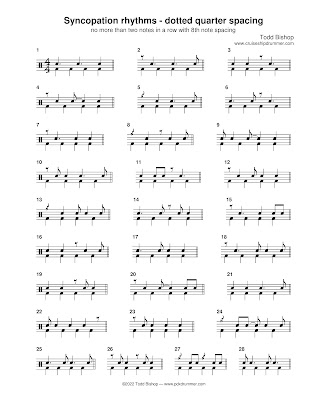
Syncopation rhythms - dotted quarter note spacing

A page of practice rhythms, with dotted quarter note spaced notes, and no more than two notes in a row with an 8th note spacing. Most of these are already scattered all over the book Syncopation, but I like working on a specific thing without having to turn a lot of pages. Later on I'll show you the thing I was practicing, for which I wanted this.   

These will be good for speed—when practicing systems with the 8th notes are filled in, there will be no more than two 8th note spaced notes in a row on either part. 


See also my pages of tresillo/cinquillo inversions— there are some similarly useful rhythms there. Scroll through the reading label to find more pages like this, focused around a certain type of rhythm. 

Get the pdf

Thursday, December 16, 2021

What time signature it's “really” in

A little sidebar on the subject of time signatures, everyone's favorite topic to be confused about. We're resolving a lot of little outstanding issues here lately. 

Time signatures (I prefer the word meter) are a little bit of a slippery subject when you're talking about jazz music— which may be played in a different meter or time feel than is indicated on the original chart— or when discussing any music not played from a written arrangement. 

In those situations, the meter is, effectively, what is apparent from listening to it. We determine that by counting, and by determining whether there is a two-note (straight 8th) or three-note (triplet feel) subdivision. There are also stylistic conventions associated with certain meters, and broader conventions in all of music. And there are meters associated with certain rhythm section or drum grooves.   

A tune like All Blues may be written in 6/8 in The Real Book, or wherever, but it's typically played with a jazz waltz feel— 3/4 time— the performed drum rhythm is effectively in 3/4. Two measures of 3/4 waltz feel = one measure of 6/8 on the lead sheet. It has that famous little vamp figure, which can be counted in 6, or as two measures of 3. 

Making a drum transcription of it— where the drummer is playing a regular old jazz waltz— it would be stupid to try to write out a in 6/8 with an 8th note as the main pulse just to agree with the lead sheet. You could write it in 6/4, but to me 6/4 suggests a 2+2+2 or 4+2 phrasing. I would at least put a dashed imaginary barline in between measures.  

With a drum transcription, we're giving a representation of what the drummer played, with the time signature reflecting the phrasing of the drumming performance. If a tune is written in 4/4, but the drummer plays an persistent triplet feel* through out, why not write it in 12/8? 

* - Not simply swing 4/4 with a lot of triplets.

Time signatures and style indications also have certain implications for the performing musicians. 12/8 indicates a triplet feel. 8/8 means you're playing in 4/4, but they want strong 8th notes all the way through. 6/4 suggests 2+2+2, usually not 3+3. 6/8 may suggest an Afro-Cuban feel. Those may be the actual time signature of the written chart, or they may be given in the style description— like a tune written in 4/4, with “12/8 feel” indicated at the upper left of the page. 

If you decide a piece is counted in 4, with a straight 8th feel, how do you decide what kind of 4? Technically it could possibly be 4/4, 4/2, 4/8, 4/16, 4/32, and so on. The answer is: it's 4/4. 

I don't believe I've ever been handed a piece of music in 4/2. Usually, to me, #/2 meters suggest some fast activity in the equivalent #/4 meter. A piece with a moderato time feel, but with a lot of double time activity in the rest of the accompaniment, could be assigned a #/2 time signature. 

I've also never seen a 4/8 in the field, but it suggests an interpretation of 2/4 with persistent 8th notes. For example a lot of Brazilian arrangements are written in 2/4, with 8th notes as the beat, and a lot of 16th note activity. It wouldn't be unreasonable to call that 4/8, though I've never seen it done. Sambas also emphasis the 2 of the 2/4, so maybe that's not a great idea; bossa novas, which have a 4 feel, would be better candidates for that. 

4/16 and 4/32 would be used strictly for connecting complex changing meters. If you see them as the main ongoing time signature in a piece of music, it means that the composer hates you, and you should pack your drums and leave.  

I'll get deeper into that topic another time— what different time signatures suggest to me as a drummer. 

So there's more than one right answer, often, depending on what aspect you're considering— the paper chart, the general style of the performance, the drum groove. Sometimes there's just simple ambiguity about whether a tune is best counted in 4 or in 2. You may also have to consider rhythm activity in the accompaniment, and what other meters are used in the same piece. 

Monday, December 13, 2021

Very occasional quote of the day: the hands are like monsters

From the late Barry Harris: 

“Are the hands doing something they're used to doing, or is the mind leading the hands? Because the hands are like monsters— and they have a separate entity— and they like certain grooves. And if you aren't careful with the hands, they'll just play those grooves that they like.

If I just think of rhythmic things— don't think of notes to go with the rhythm, just think of the rhythm— then I think I come closest to being original, if I think of the rhythm first.”