Showing posts with label 12/8. Show all posts

Thursday, November 21, 2024

Reed tweak: RH lead triplets - fast within slow

This has been an item of interest for a long time— playing fast in a slow tempo. In a master class Peter Erskine mentioned that Jack Dejohnette was the only drummer he knew who could play fast on a slow tempo. He was referring to Jack's playing on John Scofield's Time On My Hands, which Erskine had produced the year before. I've mentioned it a bunch of times here.   

Here are a couple of ways of doing this as a Reed system, reading out of Syncopation, with both 16th notes and 16th triplets, within 8th note triplets. 


I've chosen to lead the filler with the left hand, favoring an inverted diddle sticking, with the diddle up front, beginning with a LRR where possible. See this page from last year for some other options. Obviously there are a lot of possibilities for stickings, and linear patterns. And it's real similar to some things on the recent 3/8 and 4/8 fills pages. And see this page as well. 

Where there are two cymbal hits in a row, you can also play them with the R then L hand. 

Get the pdf

Monday, September 23, 2024

Afro 6 - new basics

For one of my students, a new page of warmups introducing an Afro 6 groove— or various forms of it. It's as deep a thing as there is in drumming, and to begin understanding it we want to approach it from a few different angles. This is mostly for the hands, see also this page which works out the coordination with the feet


Play those, be able to count in 3 or in 4, depending on the time signature, as in ex. 1 and 2. It may help to count the combined rhythm of all the parts before playing a pattern, and/or to work it out as a sticking— including R hand, L hand, and Both hands. 

Get the pdf

Sunday, July 14, 2024

Transcription: Steve Gadd Afro 12/8

Here's Steve Gadd playing the whole first part of Full Compass, from George Benson's record Bad Benson— it's a fully arranged thing, with some drum breaks. It's an Afro-feel 12/8, modulating to 4/4 at the end. I could do a lot more with this track, but this is all I have time for today. 

As always we're struck by his incredibly deep time concept and execution— people should be thinking how do I sound that solid


The meter change happens in the middle of the last drum break, with the 8th notes in 12/8 becoming 16th notes in 4/4. The arranged four-8th note rhythm in bars 21-22 sets it up— the accent in that pattern, which is a cross rhythm in 12/8, is the new tempo in 4/4. The real tempo change is 12/8 = ~131 to 4/4 = ~103.   

In measure 18 there is a very Steve Gadd lick, I think I've written the rhythm correctly. Use a LRLR sticking, or go into the videos of him playing and see if he does this anywhere. There's something similar in the video at that link, but the bass drum is placed differently. Also visit the following link, where I've described how to work it up.  

 Get the pdf


Saturday, March 30, 2024

Embellished filler with RH lead triplets - 01

I'm pretty sure I've written something like this before, but navigating my voluminous archives is no easier for me than it is for you. This is a sketch of some ideas in an upcoming[??? -tb] book release I'm working on. It's part of a larger system, but for now you can work on them as individual patterns:


RH on cymbal / LH on snare unless otherwise indicated. The repetitive format here is for practice purposes, in real music you would mostly do these one time only as part of a larger swing or 12/8 texture. Move them around the drums however you like.  

Try them with this loop or this loop. For example of the type of playing I have in mind, see Jack Dejohnette playing on a couple of slow tunes on John Scofield's album Time On My Hands. 

Get the pdf

Monday, October 23, 2023

Half time funk shuffle - 01

Here's a page for my students, working through the basics of a half time funk shuffle groove. It gets mentioned a lot more online than it comes up in real life, but it's a thing.

There are a number of ways to write it; I've put it in 6/8 and 12/8. In real life I might expect it to come up most often as a sixtuplet feel in 4/4.  


Pay careful attention to the dynamics on the snare drum; play the accent strongly and ghost the other notes. I also accent the downbeats of the cymbal rhythm, you can do that if you choose. 

Get the pdf

Friday, August 04, 2023

Reed tweak of a tweak: ending a solo phrase

Here's a very small but useful tweak of a tweak: remember the Reed system with alternating triplets, hitting the accents on cymbals + bass drum... except we'd leave out the LH cymbal hits? It's a good little system, creating a bridge between linear materials and ordinary alternating triplets. I recommend learning it. It's good for jazz, good for 12/8 settings. 

A student and I figured out a good way to end a solo phrase or fill: Do hit the last left hand accent of the phrase. 

So: line 3 from p. 34 of Syncopation (look it up), which would be played like this* the normal alternating triplet way: 

* - I've put all the cymbal hits on one line, but use two cymbals— hit a cymbal on your right with your RH, and a cymbal on your left with your LH. 


...and played like this with the LH cymbal hits omitted: 


...would be played like this as a two measure solo break, catching only the last LH cymbal hit: 


Instead of hitting another accent with the RH on 1 after the solo part, you could tie that last LH accent, and come in with the time feel on 2: 


Often that final LH cymbal accent will fall on beat 4, and there are some possibilities for that. Here's line 6 from p. 34, the normal alternating way, and the no-left accents way: 


Hitting an accent on 4 and an accent on 1 is a little hokey— not that there's never a reason to do it: 


You could just end the solo with an anticipation, accenting the 4, without completing that triplet: 


Depending on the tempo you might come in with the time feel on 1, as written there, or on faster tempos, come in on 2.  

For the sake of illustrating the system I've used the one-line exercises— and you should be very clear on all the rhythms individually with this system— but you'll get more plausible sounding solo ideas using excerpts from the full page exercises— you could trade 2s, or 4s. Play 2 or 4 measures of solo/fill this way, then 2 or 4 measures of time. 

Saturday, December 24, 2022

Page o' coordination: Airto's afro

Page o' coordination based on Airto's unique afro 12/8 groove played on the intro of Casa Forte, from Flora Purim's album Stories To Tell.

It's a good introductory groove for this style— the hands are mostly in unison, and the rhythm is easy to follow. The bell rhythm is only different from the normal short bell rhythm by one note, but it seems like a whole different thing, and it should be much easier to work out the coordination.


As always, work out the patterns, then drill them by doing some moves with the left hand

Get the pdf

Monday, October 03, 2022

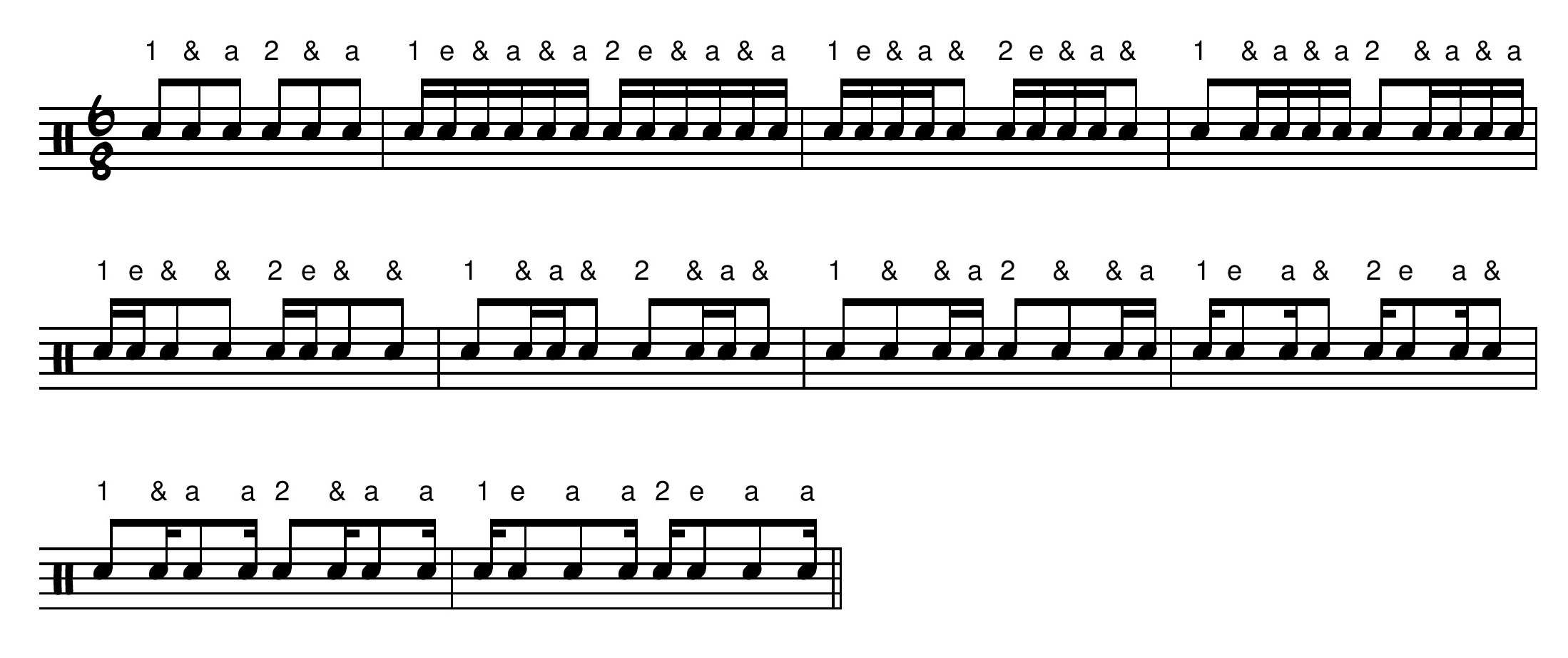
Counting compound meters

Recently I've begun teaching that way of counting 16th notes in compound meters that I mentioned before. It's going good. I never had a good way of counting those rhythms, so they were always a little mysterious. You miss the step of vocalizing them, which I think is important for understanding rhythm. 

Basically, in any compound meter— 6/8, 12/8, 3/8, 9/8, 15/8— when 16th notes are involved, count 1e&a&a, instead of the 1&a we (I) use with 8th notes

Here, count through some basic rhythms that way, and see how it goes:   


It works. It's easy to say it fast, and that repeated syllable gives each beat of 16th notes a little waltz feel. The only part that doesn't flow easily is the 1e a& rhythm— in isolation the a& part requires a little extra articulation with your voice. 

Sidebar for quibblers: Yes, the partial, when we're counting 8th notes, becomes a second when there are any 16ths involved. It's different! Not only is that, we've added two more as on the last two off-side 16th notes!

What can I say, the world's an imperfect place. I'm prioritizing ease of speaking over consistent or unique syllables with this one. The only reason you need unique syllables is so you can refer to parts of a rhythm easily, e.g. your timing is off on the a of 2 there. So now you say your timing is off on the second of 2 there instead.     


It has been extremely helpful for odd meters, too. The difference between having a good system and a weak system, or no system, is huge. Here are some basic rhythms in 5/8, counted as a lopsided 2: 


I like it. Before, if I needed to count out this type of rhythm for a student, I had to do it very laboriously in the top number of the time signature— counting in 6 or 12 or whatever— 1&2&3&4&5&6&— which is hard to do at tempo, and is also just not how we count these time signatures. More often I would sing the rhythm, which is OK, but the numbers and other syllables give us a little more to hold onto. 

Monday, September 12, 2022

The paradiddle inversion method, with triplets

Here's how to fit that late paradiddle inversion system into a triplet or 12/8 environment. For clarity, we'll base it off the accented triplets pages from Syncopation— pp. 53-58. Advanced students can then figure out how to do it while reading the regular syncopation rhythms.  

This is the key for practicing this system reading out of Syncopation. Or you can just practice this page and nothing else. 


The basic environment we're operating in is a right hand lead sticking— the accents are played with the right hand, the non-accents are played with the left. This is an extension of that. We're doubling the value of the filler notes, and using a LRRL sticking, and adding more RLs as necessary. It's still RH lead to the extent that all the cymbal hits will fall on the right hand.  

I'm doing these on drum set, with some or all of the accents on a cymbal, with the bass drum in unison. If you're going to play an accent on a drum, don't add bass drum. At the bottom of the page is a bonus item where you can substitute bass drum for the last left hand in a run of 16ths. 

Get the pdf

Thursday, September 08, 2022

Groove o' the day: Airto Afro 6

An Afro 6* groove played by Airto, on the intro of Casa Forte, on Flora Purim's 1974 record Stories To Tell. It has some big shot LA musicians on it, including saxophonist Hadley Caliman, who was a Seattle fixture for years, and trombonist George Bohannon, who was a grad student at USC when I went there.  

It's a rather simplified groove, with the hands largely in unison. The percussion, also played by Airto, multitracked, fills out more of the rhythm. 

* - Right, I notated it in 12/8, but Afro 6 is the generic name I've chosen to use for this kind of groove. 


We like thinking in terms of stickings, and filling in spaces, and playing linear, but unisons are powerful. It's worth thinking about.

There are some open sounds with the hihat played with the foot, that I didn't indicate. 

Wednesday, August 17, 2022

Reed interpretations: triplet feel R&B

This is a triplet-feel R&B groove practice method we did in a lesson with a student recently. It has a snare drum backbeat on 2 and 4, quarter notes on the cymbal, and some triplet filler on the snare drum. You can do this with pp. 10-11, 30-31, and 34-45 of Syncopation by Ted Reed. 

To make this kind of groove it would be simple enough to just play a swing version of our regular rock beat method, but where's the fun in that? This way has more notes.  

To illustrate it clearly we'll go through a few steps, but once it's learned it's easy to do the finished method on the fly while reading out of Syncopation.

To begin, let's use the humble line 1 from p. 4: 


Play the top line rhythm (coincidentally the same as the bottom line rhythm) on the bass drum, fill in with the left hand on the snare drum to make triplets, add quarter notes on the hihat (coincidentally the same as the pattern rhythm), like so: 


We want to have a snare drum backbeat, so let's move the notes on the 2 and 4 to the snare drum— accent them, and play the rest of the triplets softly: 


Now see p.11, line 11: 


Again, play the top line rhythm with a swing interpretation on the bass drum, fill in the middle of the swing 8th notes on the snare drum, to make triplets; add quarter notes on the hihat: 


Move the 2 and 4 to the snare drum, accented: 


Now do this rhythm  from page 30: 


Again: play top line rhythm on bass drum, swing interpretation; fill in with snare drum to make triplets, add quarter notes on the hihat: 


When there's bass drum sounding on the & only of beat 1 or 3, like that, you can drop out the first snare drum note on those beats, making a RLB pattern: 


So— open your book now— here is how you would play the second line of the famous p. 38 (née 37) exercise: 


And the same thing again with the RLB thing where appropriate: 


You could also do this method while playing a shuffle rhythm on the cymbal, or a jazz-type rhythm, if you choose. This type of thing is more useful in a jazz setting than you might expect. In that case, I might drop out more of the snare drum filler like so:  


In the end, there are no more variations for this than there are for standard rock beats— this is way easier than the large amount of materials in the book suggests. 

Monday, May 02, 2022

Afro 6 - advanced bass drum ideas/coordination

A page of patterns I'm playing around with, in an Afro 6 feel, that are difficult or unusual for varying reasons— either the bass drum is in unison with the left hand, or the actual rhythm is unusual. Use it as a companion to a similar page I wrote a couple of years ago, to develop some possibilities for soloing and blowing, with maybe more of an African vibe. 


Before even getting into this, you should develop line 1 as standalone groove. Vary the bass drum by playing it along with the cymbal, like on this page. The left hand part fills in the gaps in the cymbal rhythm— play it as rim clicks, or move it around the drums, varying the accents and articulations. Or do it funk style by accenting the snare on beat 3, and ghosting the rest. Add hihat however you like, on all four beats, or on beats 2/4. 

Get the pdf

Monday, February 21, 2022

Reed interpretations: 16th notes in a triplet feel

A simple system here, that nevertheless has a number of possibilities, that I was playing using with my own book, Syncopation in 3/4, along with the Bill Frisell / Where In The World loop in 9/8. It's fast filler for slower triplet-feel tempos. I was also sloppy in writing this, creating an opening to make your own decisions on how to do it.  

Here are the basic things you do with any single beat of rhythm in Syncopation. As always, we're interpreting the top line rhythm from the book, ignoring the bottom line part. 


So if you see this rhythm in the book, you'd play:


There's nothing sounding on beat 4 there, so you fill out the entire beat with the triplet 16ths*. Also note the sticking on beat 3— the basic interpretation has all of the cymbal notes played with the right hand, but you can alternate when there are two cymbal note in a row with triplet spacing. You can then make the quick move to fill the middle of the triplet with either hand, or leave it open, as in the next example. 

You don't need to play wall-to-wall notes— you can introduce some space to mostly do only five stroke singles as filler, like so: 


Let's review the options for this rhythm:


The basic thing, alternating all the 16ths:  


With some space added:


If you have any problem with the timing of the 16th notes, play the fill as left handed flams, triplet rhythm— a good thing to practice in its own right:


After that's very solid, you can adjust the timing of the left hand to make the 16th notes. 


* - Sidebar: about 16th notes in a triplet-feel environment
The 16th notes here are played at the same rate as ordinary sixtuplets, but we're playing them off of a three-note, 8th note triplet subdivision, like 16th notes in compound meters— 6/8 or 12/8:


Regular sixtuplets and 16th note triplets in 4/4 have an implicit 8th note subdivision:


The rhythm is exactly the same, but with this system we're basing them off of 8th note triplets rather than 8th notes. 

Here's the loop I was using— and again, I was practicing out of my book, Syncopation in 3/4... which you can purchase instantly in an abbreviated form in e-book format.


Wednesday, November 24, 2021

Metal in 6/8

Following up on this post about that 80s Heavy Metal triplet groove— a student who is mainly a Metal drummer requested some help working out some vocabulary for a song in 6/8, and these are some things we went over in our lesson. The fill portion will be good for other things, too— like in a slow swing feel, a la Jack Dejohnette on the one John Scofield record, where he plays some fast stuff at a slow tempo.  


It's hard to improvise in this type of groove environment; the main groove is easy, but the usual tempo range puts everything else at awkward rates of speed for drummers— the main dotted-quarter note beat is typically an uncomfortable moderato, the 8th notes feel kind of slow for fills, the 16th notes may be very fast. Your hands will want to lapse into four-note subdivisions, and that will usually sound very wrong. So you mostly have have to stay on the 8th notes— the triplet-feel subdivision. We had this same problem on Lopsy Lu, and any number of things using that 70s triplet feel, across a number of genres. 

Here's another item that may be helpful in this general feel. 

The fast doubles can be done with one or two bass drums— that's up to you guys who do that stuff to figure out.  

Get the pdf

Tuesday, August 10, 2021

Heavy Metal triplet groove

This is a 70s type of rock triplet feel groove that doesn't seem to be used much any more— I don't know why, it's easy and fun to play, and must have an easy guitar equivalent. Mostly the hands just alternate, with the bass drum played in unison with the right hand:


The patterns are mostly normal things you might do with this type of feel, except 12 and 13, which... they're exercises, and your results with them may vary. 

I worked it out from this dumb song by the band Anvil— Kerrang! magazine included it as a floppy 45 in one of their issues in about 1983— my Metal phase lasted from about summer 1982 through summer 1983. The drummer on the record plays it weirdly, with two bass drums.


I also heard it on Phantom of the Opera from Iron Maiden's first LP: 


More recently, from a band I never heard of, Ocean Colour Scene, that had a good song on the Lock, Stock, And Two Smoking Barrels soundtrack. They borrowed the figure from the Maiden song, which is pattern 11 on the page. 


The basic feel turns up on some Deep Purple records (Burn and Machine Head), although Ian Paice doesn't do the alternating hands thing on it. What he does is more like pattern 9— which happens to be the groove on the rock section of Bohemian Rhapsody. It's probably on a lot of other British rock records from the 70s— Thin Lizzy, Rainbow, Judas Priest, or whoever. Butthole Surfers do a sort of a punkified Gary Glitter type tom tom groove with two drummers on the song Dum Dum

Get the pdf

Tuesday, January 26, 2021

“Snare Conditioner” in 6/8

I mentioned to Adam Osmianski that I wanted a 6/8 version of his transcription of the found-music malfunctioning air conditioner drum solo, and he encouraged me to go ahead and do it myself, so here we are. It sounds really hip in 4/4 or in 6/8— it reminds me of Billy Higgins playing on Shimmy Shewobble, which I transcribed back in 2015. Sort of an Africanized march. These versions in 6/8 should be good for filling and soloing during an Afro 6 feel


Tempo is about dotted-quarter note = 150. I've given two versions, one with the first note of the recording on beat 1, the other with the first note as an anticipation. The first one has a lot of successive measures leaning heavily on the middle subdivision— see the third and fourth lines on the first page; the second version has less of that. The second one will be a little easier for most people. 

Go to thatdrumblog.blogspot.com to get the original version in 4/4.

Get the pdf of the 6/8 versions

Saturday, September 12, 2020

Transcription: Billy Cobham - Introspective

Ahhh good times here in the Pacific Northwest, with the forests burning, and the entire city blanketed in smoke so it looks like we're in Blade Runner, or the Mexico sequences from Breaking Bad, with lunatic heavily armed country folk creating their own ad hoc checkpoints to hinder evacuations and catch imaginary antifa arsonists who they believe have swarmed to the countryside to destroy the forests for reasons unknown.

It's good stuff. So I'm just going to post this transcription and leave it. I can't think of anything intelligent to say about it. This is Billy Cobham playing rhythm figures on the head of a swing tune, alternating with an Afro 6 feel. The tune is Introspective, from Stanley Turrentine's album Cherry. I've included a rhythm part outlining the kicks. Maybe it will help in analyzing Cobham's interpretation of them.

Making the transcription I did notice what Wilson Taylor mentioned in the comments on the recent Cobham piece— that Cobham plays very much on the front of the beat. It does sound like it would be challenging to play with him here.


The transcription begins at the start of the track. The meter change is no big deal; he just switches to an Afro 6 groove at the same tempo.

Get the pdf

Wednesday, May 13, 2020

Three voice / three note patterns

The sort of thing you write when you're under quarantine— a library item strictly for maniacs, in the same ballpark of extremity/uselessness as Gary Chaffee's jazz patterns, from Patterns vol. 3. In fact that's exactly what I'm working on right now, and what led to this.

I've written some three-note sticking patterns for three voices: R, L, B. Then I wrote them out for drumset, with R on cymbal, L on snare drum, and B meaning either Both hands or Bass drum. Then I did some additional patterns including right hand/bass drum unisons; and some more patterns including both hands unisons. 


Like Chafee's thing, these are ordered by a mathematical logic, not the way a rational person would use them. Very useful patterns are mixed in with not very useful ones, and normal vocabulary items are mixed in with not at all normal ones. It limits how fast you can do the complete system, and doesn't lead you directly to normally-useful material. So the only people who should be using this are hardcore practicers, or lifers like me who can already play, but who want to fill in some gaps. It should be helpful for developing a triplet-feel version of a ECM feel, or a ballad in the manner of Tony Williams playing Fall, maybe. 

Friday, April 10, 2020

Afro 6 bass drum studies

A page of practice rhythms for the bass drum, in an Afro 6 feel. For the most part these are not conventional bass drum rhythms, though a lot of them will sound cool, and will open up a lot of creative possibilities.


You can try adding the rhythms on this page with your left hand for an extra challenge. Look through my practice loops and find an appropriate one to play along with. I'm using this one this week.

Get the pdf

Thursday, March 19, 2020

Velocity patterns in 3/4

Here's something I've been working with, similar to the patterns in these alternative versions of Three Camps. They're easy to play fast, and so are good for blazing, double-timey playing. These can be played on snare drum and cymbal, plus bass drums, or all around the drums, or whatever. Sound hip and amazing by setting stuff on your drums and moving around a lot, while doing these really fast. That's the current thing.

For some reason I wanted to see the 12/8 versions of the same patterns, so I have included those here. That's the way I do things— everything is always what it is, and something else.


Play the bass drum with all of the cymbal notes, or none of them, or some of them. A good way to streamline for speed is to add bass drum to just one note of the RH doubles, for example:


Try it with the All Blues loop.

Get the pdf