Showing posts with label drumming videos. Show all posts

Monday, June 10, 2024

YouTube solo analyzed

Elaborating on a question I answered on a forum— someone was asking about the playing in the video below. Here is a little bit of analysis of it, and some suggestions about how you should proceed in learning to play like this.  


The drummer sent a transcription of part of this, written as 16th notes in 6/8 time, but it's plainly in 3/4 time. 

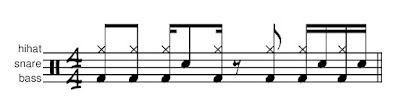
Here is the main groove, played after the short little intro fill. He's improvising, it's not played as a strictly repeating thing. 


And the same thing written in 6/8:


To be 6/8, it has to be stated somewhere— either in the drumming or in the context. Maybe he was getting it from the metronome, and playing off of it. If so, we don't hear it, all we have is his drumming, which, with the dotted 8th/16th BD rhythm at the beginning, and SD backbeat on 3, clearly states 3/4. Both those things are contrary to stating 6/8— they're suggestive of a cross rhythm. 

The form is an 8 measure phrase, with fills every two bars, and a long fill at the end of the phrase. Longer fills come more frequently towards the end of the video. The bass drum rhythm at the beginning of the measure is the major unifying thing throughout it. 

The solo activity is mostly alternating singles, with a lot of hand movement— with both hands— and embellishments. There is some right hand lead activity— or you could call them mixed diddle stickings. And a little bit of hands in unison. And a little bit of linear activity with the bass drum, a few single notes inserted in the ongoing 16th texture. There are a few spots where he plays with rhythm a little bit, and he plays across the barline on the longer fills, often leaving some space in the first measure of the new phrase. 


To copy this way of playing, you can't get caught up in the particulars. There are a number of general things (“skills”, I guess) you would have to be fluent improvising with: 

1. Learn the basic groove as above. I've written it as a linear pattern, which is what he plays there, but much of the time he just plays alternating 16ths there. Which fits with the linear pattern, which uses natural sticking.


2. Play alternating 16th notes in 3
, moving both hands around the drums, and cymbals. Open ended, practicing the movements. Play over the bass drum rhythm, or add bass drum later.


3. Add dynamics
— accents, crescendo/decrescendo. These should follow naturally from the hand movements. You would have to be reasonably fluent with making accents just on a practice pad, reading snare drum solos or exercises. 


4. Add embellishments
, broad fill ideas:

  • Short 32nd note singles— three notes or five notes
  • 16th triplets, one or two
  • Mixed 16th stickings— diddles, RH lead
  • Flammed 16ths— adding one flam to the ongoing alternating texture
  • Solo rhythm with both hands in unison on snare and cymbal


5. Starting and ending fills
— fills start loosely, part of the continuing alternating 16ths of the groove. Fills ending with a cymbal accent usually end on the 1, or on the a of 3. Or the & of 3, or on 3. There is one spot where he ends with two crashes, on the a of 3 and & of 1.   


6. Add space
— usually that comes after the big phrase ending cymbal accent on 1, or near the 1. The groove returns in the middle of the measure, after a short rest. 


7. Figure out the funny rhythmic things
he does early in the solo: 

  • At 0:28 he plays two cym/SD accents with bass drum in between. Clue: the first note falls on the a of the beat, the second two fall on the last two partials of an 8th note triplet. 
  • At 0:30 he plays something between the snare and high tom. You could get there by fooling around with an 8th note quintuplet, plus some very wide flams. Starting off a downbeat and ending before a downbeat.
  • Everything else falls on a 16th grid, except for the obvious 16th note triplets. 


He gets his left hand onto the cymbals enough that it gives the illusion of switching leads, or playing “open handed” or whatever. But the whole thing leads with the right. Just hitting a cymbal with your left hand doesn't change that. 

This is the level you have to deal with things to improvise— broad fluency with basic things. You can't get too hung up in specifics. A transcription would clarify a few things, but the incidental details would obscure what's important. Which is: this is fundamentally pretty simple. 

Monday, June 03, 2024

Messing with the EAD 10

I got a Yamaha EAD 10 recently— a popular interface/recording device for making drum cover videos. It's suddenly clear why there has been such a proliferation of those videos— there's infrastructure for it now. You can really do it with just the EAD 10, a phone and phone app, and a drum set.  

It's pretty cool, getting a reasonably decent recorded sound from the drums with just a little unit that clips on to the bass drum hoop. It has a lot of audio effects and triggering capability, which aren't of much interest to me. I'll do a more detailed post on it soon.   

I may as well share some videos I've made while figuring out the device, and my set up— like this one, playing along with a loop sampled from the intro of Herbie Hancock's Watermelon Man, from Headhunters:

The first part is drums and loop, at 4:50 you hear it again with the drums soloed. 

Here's another one of me playing with a longer sampled section of Tunji, from the John Coltrane album Coltrane. Drums are soloed after 5:18.  


I'm not trying to make good music or a good accompaniment to the recording, I'm practicing being at ease playing my stuff while being really self conscious about how my timing is going to sound with the recording. I had a lot to say about that, but it's not forming itself well into writing right now, so that'll have to wait for another post... 

Friday, May 03, 2024

Something strange

This person is making a lot of videos composing accompaniment for drum solo videos by some well known players, “adding music”, as he says. The first few minutes explain this was done, then there's an extended drum solo by Simon Phillips, with his added accompaniment:


That's highly strange and ethically suspect on a number of levels: 

1. The solo was music in the first place, calling it a drum solo “with music” puts me in a bad mood about it from the get go. 

2. Did he get permission to do it? From the people who own the videos, or the drummers involved? Did they consent to having their playing used this way? There's no indication of that. Why not call them up and ask permission, and then put a big thank you in the video description? 

3. Are they getting paid for it? Well... very likely they are. At least the entity that was getting paid for the original video probably is. YouTube is good about detecting copyright violations and paying the infringed party. So if you make a cat video with Coltrane's Interstellar Space on the soundtrack, or if I sample somebody's recording to make a practice loop, the rights holder there will probably get paid, you and I would not get paid.   

4. Copyright is weirdly inverted. He's mimicking something uncopyrighted (the musical content of the drum solo) to make something copyrighted. Basically the melodic content was created by the drummer, and he seized ownership of it by assigning pitches to it.

5. He's involuntarily reassigning these players' performances to be accompaniment for his music, but those drummers would not necessarily make the same choices interpreting that piece if it had been written first— as in normal playing situations. Making choices in how we play an arrangement is a major aspect of a drummer's voice, and of how you judge someone's performance. While it is clear that the drum solo came first, by creating this context around it he's putting words in the drummer's mouth: here is how you will handle this situation

7. Usually you don't steal somebody's performance in its entirety. Even making a fair use legal argument, that's not fair use. 

8. Mickey Mousing is a term from film scoring, where the music exactly mimics the action on screen, and it is considered to be very bad writing. Here the added orchestration is flashy but primitive, Mickey Mousing the drum solo exactly in unison with it— drummer hits a high note / orchestra plays a high note with him, drummer plays a low note, orchestra plays a low note. There's no interaction. It does open up a bit on the groove portions of the solo, but it's 95% simple mimicry. 

Here, here's a quick lesson in doing things other than that in creating an accompaniment, and in altering a melodic line generally. 

9. If he wants to create a derivative work that is largely a note-for-note copy of someone else's improvised performance, he can do that, but his piece should be able to stand on its own. There's nothing here anyone would want to listen to without the original drumming performance. 


My complaints in rapid fire. Maybe none of it really matters. For people trying to make it in social media, whatever gets me attention = good. I expect that's the position of the person who made the videos, and maybe even for some of the drummers involved, if they were informed of it. Music has been so devalued in the last 25 years that, for many people, its major (or only) purpose may be as a device for grabbing social media attention. 

There are artistic/critical theories supporting this kind of thing— e.g. “appropriation”, sampling in hip hop— but which do not make it legal or ethical, when done non-consensually. Other artists' performances are not your found objects. You have to clear it, there has to be consent.  

Whether or not you personally agree with any part of this, there are legal issues you have to be aware of, and answer for when engaging in this kind of work, if you're doing music professionally, or want to be doing it professionally. It's going to matter to some people, possibly to the point of making your work unpresentable publicly. 

Thursday, September 07, 2023

On the massive overabundance of things to practice

A nagging question with every single thing I post: Am I putting up too much, am I part of the problem— the problem being: there's way too much stuff to practice on the drums now, and it's leading people away from fundamental principles*, stealing their focus, making them neurotic. Promoting the wrong idea that playing the drums requires a lot of preparation and prior knowledge.

* - Which are: you should be playing a lot and listening a lot... and, in third place, also practicing lot. Why did I put this in the fine print? 

Maybe— for people who are going about it the wrong way, through media. The right way is to be involved in music with people. If you're playing music, and hearing people play, all of the excess junk media ideas fall away— not my ideas, which are obviously splendid, I mean all that other junk. It's hard to force that stuff into a real musical life. 
 
So, here are some justifications for the continued existence of this site, some general notes on why I continue writing, and how I think you should relate to my content, and other people's, and to the seeming tsunami of practice materials and media-created demands on your time:


Use your judgment
Who's life is it, again? Everything advertised in drumming media as “crucial” is not actually crucial. Work on what seems relevant to your actual, immediate playing life— your next few years, anyway. You do have to have a playing life, though. Talk to some people, set up a weekly session to play some tunes. 


Practical vs. background
A lot of drummers seem to think that if they just work on some abstract exercises, played in a “neutral” way— Stick Control, say— for a long time, it will translate into freedom to play anything. A lot of materials are oriented that way, and it doesn't work that way. There may be good reasons to do that sometimes, it's not the main thing. Practice mostly what you're going to play, in the way you're going to play it.  


It's a library
Libraries are there for reference, for the future. Maybe you'll use something in ten years, or twenty, maybe never. Maybe you got everything it truly has to offer in glancing at it one time, seeing one other possible way of doing something. 


It's a very long game
Again, some of these things you may not get to for 10 or 20 years, or ever. A lot happens over the course of a playing life— a lot of phases of attitudes about playing, practicing, and everything else to do with music. We're dealing with long term concepts here. 


My niche

I have a pretty specific doctrine: everything is about what you can play with people. Everything should be as easy, natural, and non-technical as possible, so you can focus on the music. And as similar to the real act of playing music as possible. If we do something technical, there's got to be a good reason for it, respecting the time and attention it demands from the user. I tell you when we're doing something non-essential, or non-essential for most people. 


Virtually all Reed systems are worth doing

They're the major proven method for the above thing. You can learn a complete drumming vocabulary, in a form that is relatable to actually playing music, just by learning my Reed systems, and the traditional systems, and nothing else.  


My stuff is normal
What I do is not new. Mostly I fill gaps in proven existing methods— or expand upon them, or occasionally improve on them. Often I'm rewriting an existing thing to make it easier to do what I want with it. See my Chaffee linear phrases. Chaffee's stuff has so much potential it was impossible for him to put it all in a few volumes. Or I'll rewrite / edit / reinvent things just so I don't have to turn pages and edit while I practice.  


There's not that much to do

There's a lot, but most of us got passably up to speed with it in a few years, practicing ordinary stuff. The fundamentals have not changed in the last 50 years. I played my first professional gig five years after I started playing. Hardcore maniacs will spend some years practicing 4+ hours every day. I certainly did that. But getting started does not take much in terms of vocabulary or technique. 

Even for maniacs, there are basically two major areas of drumming: jazz and funk. Those cover every type of music you're going to do. Latin drumming can be another big area, but it's usually up to the individual how deep they want to get into it. 


Massive redundancy
There's a lot of duplication in the hundreds of pages of practice materials I've posted, which is good. Doing the same thing a different way helps you understand it and use it creatively, and develop it for different drumming uses and musical contexts. The same thing different ways = understanding it.  


There are a lot of obsolete materials

Yes, there are a ton of drum books, but a lot of them duplicate each other, or they're formatted badly, or they're badly dated, or they're just not very good. A lot of them are just orphans, out of print or barely in print, and not easy to get, and no one uses them.  


Visit the piano music aisle sometime
If you think there's too much drum stuff to practice, go to a sheet music store and check out the piano section. It's insane. Czerny alone will dominate your entire existence if you let him. 

Printed materials are not the problem 
Videos are the problem. Anyone dealing primarily with printed materials is going to be working more effectively than people watching videos. Partly because you play written music— you watch videos. I don't think anyone just sits there and stares at drum books for hours at a time. 


Narrow your focus

You can't be looking at a page of materials and worrying about all the different ways you're not “mastering” it, or exhausted its potential. Not every page of materials deserves to have its potential exhausted. Maybe it only has a small lesson to teach you. 

Work it out in an hour, day, or week, maybe work at it and meet a reasonable short term goal with it, then reassess. Do something else, or continue working on it, if you find another short term goal you want to meet with it.  


I hope that clarifies some things. As a student in the 80s, this was always a big issue— seemingly so much to do, and being unsure how to prioritize, far to take any of it. It's a 500 times worse now, as drum media has become what it is. Good luck!  

Sunday, April 30, 2023

Beware of formulas

Making that Shadow Wilson transcription, I was reminded of this video fellow blogger Jon McCaslin shared with me (and Ted Warren of Trap'd), in which drummer Bernie Dresel shares his formula for comping with the snare drum in jazz: 


Basically he says:

    •  Play lots of & of 1 / & of 3
    •  & of 2 / & of 4 “doesn't swing”, save it for the end of the phrase

Now: on that Monk record, Shadow Wilson, you'll recall, plays mostly &s of 2s and 4s, all throughout the phrase. The idea that he doesn't swing or doesn't know how to comp would be absolutely ludicrous, if anyone dared to state it. 

Dresel mentions developing this formula from listening to Billy Higgins. But we just have to go to the records to discover that he plays plenty of &s of 2/4, all the time. Part of what's nice about the way he does it is that he mixes it up.

As an aside Dresel notes that accenting the cymbal on the & of 2 / & of 4 also “doesn't swing”, which... Elvin Jones famously plays his cymbal that way, as do many others following him, so case closed on that. I also recall Paul Motian somewhere saying that Monk suggested accenting his cymbal that way. I don't have more examples because I never thought it would need defending. It's an established thing. 


Certainly a lot of people are active with the snare drum around the & of 1/3— Kenny Clarke and Max Roach, for example. I've written some stuff based on the idea. For a stone beginner with no idea what to do, Dresel's formula is not a terrible place to start. 

But it's very, very reductive. Approaching jazz as a formula is a terrible idea. Jazz is not Rockabilly. It's better to do what everyone great did: practice some stuff, play a lot, listen to a lot of records, listen to the people you're playing with, play the tune, and play what you hear. In the video Dresel asks is it random?— the answer is, no, it's based on all those things. 

Wednesday, April 12, 2023

It's about records, it's about records, it's about records

I'm noticing— online, and to a lesser degree with some students— a lot of people approaching the drums mainly in terms of drumming media. Books and videos, and the drumming concerns they promote, are the main things they think about. 

Promoting that is a deliberate project with YouTubers. And people are comfortable with it, and bring that attitude to, for example, John Riley's excellent book, The Art of Bop Drumming; the book is 100% of their experience of jazz, and they make a doctrine out of it. There are other examples, I don't feel like thinking about it to list them.  

Think of that manufactured laundry list of drumming concerns, and then put on a record, and listen to the whole thing:


That is what we're doing, that is the musical act, that is natural motivation.

The list of concerns just vanishes. You can't listen to that and be thinking what's his finger technique? Would that have been better if he played open handed? Was that a herta? Was he feathering the bass drum? The categories of things the Joe Blow YouTuber advertised are totally, obviously, made up and irrelevant.  

That's what records are all about, forming an idea of what music is, what kind of musician we want to be, how we want to play the drums. There's actual joy, love, and art in it, which are ultimately the only things that can sustain you for decades of being a musician. 

Now my Generation X self also believes that actual hard media are important— putting on a record, CD, or tape, and running it over and over— because changing the record takes some effort, and because you've been drawn into the world of the album. No shuffling, no skipping. You have the cover art sitting around the house, you don't have to go through an interface to read the liner notes and credits. It's tangible and immediate and it's part of your life. 

The false abundance of the digital age has to go. You're one human, you cannot process infinite free music. 

What you do is: be with one thing, now. And keep doing that. Pay the $4-18 for the record, pay it respect and form an attachment to it. That guides your progress as a musician, and is the foundation of an identity.  

Friday, April 22, 2022

My objections to drumming videos

Posting this instead of the bilious, totally unproductive anti-YouTube drumming video rant I was working on, entitled Satan's Vomitorium. Don't worry, it wasn't any good, or even finished— you're not missing anything. See this post if you want to watch me flail around on this topic. 

I liked drumming videos better when there were virtually none of them— like, my first 20-25 years of playing the instrument. Now they're unavoidable, creating their own weird reality, largely dedicated to creating a dependent tribal audience of non-musician, non-student media consumers. 

Apart from that despicable aspect, there are just problems with the medium, reducing it to a general distraction and waste of time.
  

I want to control my time
Inherent to the video format— they all take a fixed amount of time to watch. Every single video I see, if it has any new information in it, I could have learned it in a few seconds of reading. I could have scanned the entire page visually and found the parts the interested me, and skimmed the rest. There's no way to skim videos, you just have to sit and wait for them to feed you the next bit of information, whenever they feel like it. 

Yes, you can run videos on 1.5 speed, but then you're filling your ears with twitchy, hyperactive chatter, and they still take a fixed amount of time out of your control. You're a musician, the sounds you listen to are important. 

It's not about information anyway
Most of being a musician is in doing it— that's how musical knowledge is acquired not by telling someone about it, not even in showing it to them. The real process of learning music is interactive, and 5% information, 95% doing. 

Time wasting
Big chunks of most videos I see, on any subject, are dedicated to the video makers d*cking around. They're all padded with a certain amount of nonsense, because most of their creators are not able to fill the time with actual substance. And they know that most viewers don't want substance. Maybe the guy is personable enough that you don't mind listening to him d*ck around, but in that case you might as well just watch some Gilligan's Island reruns. You're wasting time, on the pretext that you're learning something about music.

It's fine, wasting time is somewhat unavoidable, and may not even be a bad thing, sometimes. Just don't have any illusions about it, and don't mislabel it as productive time.  


All the wrong stuff, the wrong way
The vast majority of videos are about what everyone else is making videos about: technique, “techniques”, how to do X named lick/beat/rudiment, fussing with gear, explaining elementary points of musicianship badly. The “importance” of John Bonham. How to play whatever song— the classic topic of hack drum teachers. Whatever's easy that someone else has already done. “Open handed” technique.

These are described as “crucial” topics— this hive lore is the educational program YouTube offers you, and it has little to do with musical reality. 

Even when the topics are worthwhile, they're mostly going out to the wrong people, at the wrong time in their development. People who should be going out and getting playing experience bombard themselves with a lot of nuance that's really none of their business yet. They think they have to cover all that stuff before even daring to leave the house. 

Hello, you suck, pay me
Probably the most loathsome thing about this enterprise. A lot of youtubers really want you to feel insecure, under-prepared and over-scrutinized. Scroll through some videos and see how many are negatively focused— you probably suck at this, your bad habits, your bad technique, you're doing this wrong, etc etc. Basically 1000% more negative words than I ever use in a live drum lesson. It's a toxic mentality that seems to be very attractive and comfortable for a lot of people, even as it drives them insane.  

Some video lowlifes can't be bothered to be subtle about it— one even named his channel “you suck at drums.” People are so indoctrinated on this point, there are hundreds of videos titled “I suck at drums”, many of them by little kids. It's sick.  

Teachers do not do this, real teachers empower people, they don't try to manufacture self-loathing neurotic dependents.  

Media consumers, not students, not musicians
Videos are made to get you to watch the videos. Every commercial product is designed to be used and to make money for someone, but there's a difference between products people use because they serve an outside goal really well, versus products that just service the addictions they created.  

The real practice of music is something else altogether— it's not any of the things in these videos, the video format itself is foreign to it. It's a live act that you do by yourself, listening and practicing, and with other humans, playing music and working through the learning process interactively. 

Here are some videos I like, by the way, made by fellow blogger Ted Warren. They're short and without BS; they demonstrate the thing and then send you off to practice. 

Wednesday, December 22, 2021

“Worst drummer ever”

Bookending Sunday's false prodigies rant, I suppose. Worst drummer ever is title of this video shared by Paul Mason (@tempusdrums) on Twitter. I watched the whole thing, which is more than I can say for most drumming content on YouTube:


Another 12 year old kid bashing on his drums badly, yeah, but here's what I like about it: 

•  The first instinct of any drummer is to wail and make some noise. I wish I could train that desire into some of my past students. That's got to be in your DNA somewhere. We work hard to become sensitive musicians and all of that crap, but there's got to be some edge of chaos lurking in there somewhere, a basic instinct for impact. For me to be interested, anyway. 

•  He has a band. Maybe they played five times total, I don't know, but it's step one: wanting to have a band and then figuring out what the hell to play together. Increasingly it seems not to be a thing kids do. 

•  He figured out a lot of things about how the drums are actually played on his own, apparently without any help from a teacher or anyone else. He plays a lot of bass drum and cymbal, I play a lot of bass drum and cymbal. The thing he does at 2:14 is a lot like “Jack's method” that I posted recently. 

Here's the non-independent groove he sort-of settles on at 0:50: 


He does quite a bit of stuff like that, that connects very directly with what I do every day as a grown-up played-the-drums-for-40+-years artiste. RH = cymbal/bass drum, LH = snare drum. It's a basic orientation. Of course the first thing a teacher will do is toss this thing he learned naturally, and make him learn a beginner rock beat, and drumming will become nothing but a big independence problem for him.   

•  He picked up a couple of beats that are apparently just in the DNA of every child on the planet, at 2:54 and at 3:03. After 3:10 he almost figures out how to do the Elvin/Bonham triplets lick— what he's doing is exactly how rock drummers learn to do it. After about 3:40 he's got an OK start on a kind of rock & roll jungle beat. He does some mixed stickings on the Rototoms, which is interesting, maybe somebody showed him a paradiddle once?    

•  There's kind of an episodic structure to his solo, where he does a thing for awhile, until he thinks of the next thing to do. I've seen lots of adult professionals who basically solo that way. There's a good deal of melodic content, and a kind of climax at the end where he's playing the tom toms. The only thing he repeats is the four note run down the tom toms— perhaps he's a little over-reliant on that piece of vocabulary, if we're going to be critical. He does that universal kid's thing of starting a beat kind of slow, and then speeding up until it falls apart.     

This stuff interests me. What do kids who have no idea how to play the drums, but play anyway, play? 

Sunday, December 19, 2021

False prodigies

My apologies for the many wordy posts lately. I don't want to be a words/opinions guy. I'm working on a lot of outside stuff, so I have to post what I have, and that happens to be this. 

I suppose we should talk about the amazing kid drummer videos. Many of them are varying degrees of fraudulent, here's one that's pretty impressive— it's from several months ago, so it has already been forgotten by everyone. But the kid in it can actually do what he's doing. The video is captioned with the expected histrionic self-loathing and despair:

Actually, I've just decided to quit drumming after watching this... from r/drums

There are adults who do the exact thing we're seeing there, or who try to do it, and the kid sounds basically 98% as good as any of them. Same level of artistry, which is not a compliment to the kid. To me it demonstrates what a dead end this type of playing is. If a little kid can play badly this impressively, it drags down the whole endeavor. 

The cause of this is that in a number of areas of drumming, teachers have figured out how to get make essentially non-musical but goal-motivated people sound impressive. The kid got one of those teachers, and had a very good aptitude for learning that way.

Terror-stricken viewers always ask: 

Q: He sounds this good when he's 10, what's he going to sound like when he's 20? 

A: Not necessarily better.

He doesn't sound good now. I never want to listen to anyone do this, at any age. 

What job is this playing in service of, what gig is in danger of being stolen? Right now, it's a neo-vaudevillian child wonder show item for the purpose of getting views or partial views on YouTube. Maybe being a social media performer is a valid career. It's not the same as being a musician.

Musicians are not in competition with things that are not music. Not having musical concept does not inevitably lead to having a musical concept. Like not understanding existentialism doesn't inevitably lead to understanding existentialism. 

People who play a lot of music do usually figure it out to some extent. Emphasis on play, and music. People who just do drum stuff on social media do not figure it out. 

The reality is, there is no competition, there is just you and your life learning and playing, and making whatever music you have to make, in the situations available to you in the real world, off the internet.

You could ask yourself is could Billy Higgins do any of what that kid is playing? Zigaboo Modeliste? Elvin Jones, Philly Joe Jones? Mel Lewis? James Gadson? If not, what does this say about them? Does it say the kid is better than them? 

Answer: No. It says what kids do, however impressive, does not matter

Thursday, April 01, 2021

Youtubed: practicing Syncopation

I'm feeling a little irked at the existence of YouTube drumming videos today, so let's do a search of a subject near and dear to me, practicing the book Progressive Steps to Syncopation, and see what the YouTube folk have to say about it, and I'll write my thoughts about them. I've been wondering about this; the Reed-associated methods are the professional system for becoming a reading, improvising professional drummer, yet very few people on the web talk about them. And the few that do, don't seem to grasp their full implications. 

I'll talk about the first videos that come up, in order. I'll list but not imbed any I just can't take. For example, the first one: an Expert Village thing entitled Syncopation for Drums : Drum Techniques— but every Expert Village video absolutely sucks going in. So I'm skipping that one. Or number 2: 15 Famous Syncopated Rock Grooves (That Inspire Creativity), a drum cover video in the guise of a lesson. I'm sorry, I cannot look at a clean young guy rocking out for the camera— all of these guys look that same to me. God love him, best of luck, I know he's going to get a million views, I just can't. 


So, the actual videos: 


Bruce Becker “Syncopation” Lesson Series 01: Left Hand Separation
Four minute video, obviously a great teacher, great drummer. Here one pattern is covered, briefly, with a whole lot of side comments. Hopefully he gets more in depth in the other videos.  

I don't dig using the word “separation.” It's not separation, it's coordination— the limbs are both plainly attached to the same human torso. If not, something is drastically wrong. Coordination is simply hands/feet playing opposite each other, and in unison with each other, to make a new, combined rhythm. Words matter, and words like separation and independence communicate a false concept of drumming coordination— the reality of which is we have a single controlling entity, the drummer, coordinating different body parts to create a drumming performance. 

I think a difficulty with prestige teachers like Becker, is that you get the impression that he has all the answers, and that they are the correct answers for everyone. So your study stops becoming a search, and starts becoming about how well are you doing what he says. But if you're into Mickey Roker, and a guy isn't reflecting any of that in his presentation, you may need to look elsewhere for those qualities. For me the exploration is more important than having this level of correct answer Becker gives. The answers you come up with yourself through seriously studying and performing music, will be at least correct enough for you to play well. 

It would be dumb to ignore information, and Becker has plenty. But it's one man's answer, which is not even directed at you personally— it's a video made for a general audience to demonstrate and share his general expertise, it's not a lesson plan for your development as a performer and artist.    


How to use Ted Reed’s Syncopation - Episode #1 jazz basics
Not a jazz drummer, but the verbal explanations are pretty solid. Strange cymbal technique, like a lot of these guys— they copied a video really hard, and took it to the next, wrong level. You get the feeling he did some studying and made the video, and luckily he basically studied the right stuff. Ends with some BS playing the ride cymbal with the left hand. No, no, no. But basically solid otherwise. It is not your imagination, on the demo starting at 2:30, he plays straight 8th and swing rhythms exactly the same— he swings them both. 


I play Ted Reed's "Syncopation" for 3 hours straight
Rock drummer plays Reed for 3 hours. Starts with a not great explanation of a complicated four limb triplet system. Weird mix, loud snare drum, everything else too quiet. I actually don't mind his cymbal technique. I could never do this— just flatly drill patterns for hours and hours. I need to practice like I'm playing something. It's not a question of  “optimal practice techniques”, that's just how I live. 


Syncopated Funk Groove I Drum Lesson
A Mike Johnston video, and I just. Can't. Do it. This is everything that is wrong with videos. Teaching a single hip(?) groove— the essence of hack teaching— that bull sh*t Drumeo manuscript, with one measure stretched across the whole screen, like that makes it easier to read. I don't need to you wish me an amazing day, I don't want to see your dog.

I'm not linking to this— I'm sure he's a lovely man— I mean obviously, listen to him, his loveliness unavoidable, even as you thought you signed on to learn something about the drums. But I can't. Search the video if you want to see it. 


Mel Brown Beat Syncopation Exercise
Here we go, the GREAT Mel Brown— Motown drummer, Diana Ross's drummer for many years, winner of a national Playboy Jazz award, student of Philly Joe Jones. And he taught my older brother. Catching his quintet at The Hobbit in Portland was one of the performance highlights of my college years. A GREAT drummer, band leader, and teacher.

He goes over all of the major basic jazz systems used with Reed, and one funk thing I've never done(!!!). Take the structure of this lesson seriously, everything about this is 100% correct and informative, right down to the short pants, and the cymbal that is pingier than you or I would like. If there's anything “wrong” with it, it's only because that thing doesn't matter.  


Using Ted Reed's "Syncopation" for Drumming Independence

Demonstrations of some basic methods on an electric set. They're not technically flawless, but so what. He does something close to my(""?) cut time funk thing. This is actually a reasonable video, even if it's not exactly dripping with jazz cred— real or fraudulent— so you're not going to take it over-seriously— it's just a demonstration of playing the notes and for that it's good. I like that he just demonstrates and doesn't talk.  


12 Ways to Use Reed's Syncopation - Part 1
Good teacher, nice clear way of explaining the premise. On topic the whole time. I don't need to hear about somebody's day, or listen to them butter me up with a lot of bro crap. Not exactly a real sophisticated jazz touch, but it seems more designed to demonstrate a feeling to her students. I prefer this to the hyper navel gazing technocratic style of the big video accounts. She shows you the thing, and a few things to try with it, and a few little special touches. And then you get to figure out where to go with it yourself. Teachers aren't supposed to be the last word on everything, they're supposed to show you how to something, and inspire you a little bit to go and do something with it. 


Syncopation: Expert Mode - Drum Lesson

Here we go. Why do people have to be so FULL OF IT. I understand that people put themselves under a lot of pressure to be on and to be appealing. By the time he gets to explaining the musical part I'm bored, I'm done, spent. Demonstrates some weird systems for practicing Reed, I don't have any use for any of them. This project, this playing of the drums, is not just about thinking up hard stuff. If we're going to do hard stuff, there's got to be a reason.  


Helpful Jazz Exercises for Drummers!

Good video, that is actually worth its 18 minute duration, and some further analysis to get the more advanced things he's talking about. The exercises he calls right hand lead and right foot lead are really important. A little bit of that macho L.A. touch on the drums with the hickory 5A sticks, that reminds me of Tom Brechtlein— that doesn't really fly as a default volume unless you're playing with fusion musicians. That's a minor quibble, it's an excellent video, and he's obviously a knowledgeable teacher and an excellent drummer. 


Friday, November 27, 2020

We get mentioned on YouTube sort of

Hey, it looks like one of my posts was a catalyst for a video by a semi well-known opaquely-named YouTuber. He has been the victim of some kind of smear campaign to make his videos seem negative, competition-oriented, and status-obsessed. Which they are, but he wants them not to be thought of that way. 

At least the few I've seen. I tried to “research” this further by watching a couple more videos, but I couldn't hang with it. Clearly I am not the intended audience. Looking at the list of his videos en masse I'm getting a very similar vibe as some YouTube nitwits I've written about previously. Not good. I know he he's had an education, but I'm not seeing any evidence of any depth at all. If it's there I wish he would put it in his videos. But he doesn't. I'm starting to feel cheated for the 15 minutes it costs to watch them.  

Sidebar: If you want to know what substantive, positively-focused content looks like, take a snoop through the archives of fellow bloggers Jon McCaslin and Ted Warren.  


So, this new video is partly a reaction to my post Authenticity, which he quotes and screencaps, but doesn't mention this site by name, or link to the post. Normal etiquette would be to at least identify the subject of your quote, but YouTubing is not really about that. 

My post was partly about my own experiences with the concept of authenticity, as a young white jazz student and musician from the Pacific Northwest; and it was partly about my reaction to his video “DOES AUTHENTICITY MATTER?”, in which goes at great length about authenticity in jazz as being about achieving supreme status, and surviving punishing combat, and people being mean to you— a lot of sturm und drang.   

Anyway, here, because I link to things I talk about, is the new video: 

Noted that it wraps up with a pitch for his method of learning jazz by learning hiphop instead, which I also reviewed in a previous post


So, I feel I'm seeing a strange act of deflection; he argues against himself being perceived as a kind of mean, gatekeeping “music school jazz nerd” drummer, while putting that same criticism onto others, who presumably are guilty of it. 

The opening is pure fear and adversary— the frame is that people are trying embarrass you for being interested in what they're interested in... jazz drumming... to which the natural response is to be scared and aggrieved and run away and give up. 

Marketing adolescent fear is very popular on the internet. People love the idea that there are disapproving, purely ego-motivated jazz snobs who will correct your errors unapologetically, and to punish them by quitting and not listening to them is awesome. Hop over there and look at the comments. It's one big celebration of quitting jazz for the hatred of mythical jazz snobs.      

He claims to be encouraging to newcomers, but saying I am encouraging is not the same thing as being encouraging. Especially when, in the very next sentence, he helplessly reverts to the old crucible of high performance competition business. 

Arguing with that framing is like turning on Fox News and saying “well, at least they put their bias up front.” But it's influencing you in ways you don't even understand. You think “well, I know this is bullshit, so the truth must be the opposite of that.” But you're still living on their terms, while the real truth is in another country and time zone, speaking a language you've never heard of. Like, I'm talking about making wine and you're talking about clawing your way to the top writing an android app. Bringing the mentality of the latter into the former is a recipe for some fucked-up wine. 

I'll close by saying I don't care about the superficial conflict aspect of this— beyond being a little bit irked at not being credited for my quote— none of this is personal, it is about the content of a line of video product, which happens to reflect some very common negative attitudes promoted on the internet. I only comment on it because we can learn something about being musicians, teachers, and media consumers from it. Today the lesson is beware of living in other people's narratives, doing so may mess you up in ways you don't expect or understand. And maybe don't sell fear and ego

[h/t to Anthony Amodeo, an excellent drummer and teacher living in New York, for alerting me to this video]

Thursday, March 21, 2019

Anything at all, with energy

Why do they always look surprised.
Today there is two big pieces in The Atlantic about social media advancing some very dark ideas, and about trolling and fascism, so maybe it's a good day to post a long-form rant about a somewhat related, relatively minor irritant, which has been kicking around my drafts folder for a couple of weeks.

We've been seeing a new ilk of drumming video lately, that is a kind of hyperactive bastard offspring of the famously terrible old “Expert Village” videos, mated with that crummy, lazy clickbait you see on Fxcebook:

“9 out of 10 can't name the capitals of three states.” 
“PERSONALITY TEST: What kind of omelette are you?” 
Answer: DENVER

That kind of blather. These new videos follow a similar formula, that is extremely simple:

1. Think of a dippy, urgent-sounding title.
2. Babble about nothing on video for 5-12 minutes.
3. Cut in footage of you acting funny. Edit out every microsecond of dead air. Plaster the video with text. Make a title card showing you looking non-specifically surprised.
4. Make a couple of hundred of those.
5. Beg for follows and likes.
6. PROFIT$$$

Titles and concepts can be anything you can think of in one second:

IS YOUR RIDE CYMBAL MAKING PEOPLE MAD
DON'T HURT YOURSELF WITH STICKS
WATCH OUT FOR BEATER KNOCK
HIHATS CAN PINCH YOU  
BEATS THAT DRIVE PEOPLE CRAZY

You have to really activate your 5-year-old brain. The idea is to monetize people's intolerance for uncertainty, their fear of doing something wrong, and their unwillingness to trust themselves to figure anything out; so play up the consequences of screwing up:

BAD HABITS THAT RUIN YOUR DRUMMING 
DON'T BUY THE WRONG THING 
YOU ARE SCREWING UP WITHOUT KNOWING IT


There is frequently a subtext is preteen insecurity. Play on these kinds of emotions:

PEOPLE ARE TALKING ABOUT YOU 
PEOPLE KNOW EVERYTHING YOU DO 
PEOPLE THINK YOU LOOK FUNNY

But what is most important is that you do not try. The “answers” you provide don't have to be good. You have only to offer a dim hope that you will address the thing you have triggered the target to care about, which he feels powerless to solve without the aid of a *kof* smart phone.

I'm serious: any crap idea at all that sounds like a drumming problem— take it and GO! Now! Run! Make the video. There is no such thing as being too inane. Don't try to improve it or make it good or valuable in any way. Every second you waste thinking about that nonsense, you are being denied the money and attention that are rightfully yours.

You can't worry that you are in any way unqualified to be making instructional videos, or that you lack any kind of talent as a media personality. This is about seizing attention, not about giving anything of value. Just be willing to say anything at all, with energy.

It doesn't hurt if you have a face that looks like an undisturbed plate of milk.

I hate to link to these people, but look at this once. You lose nothing by jumping ahead frequently.


Now, if you watched that and thought “Did I just give up nine minutes of my life for him to tell me to move my hand over here a little bit? Is that what just happened” you are not the target audience of that video. Your attitude is all wrong. You need to just be mesmerized by the screen for a few hours, letting the wash of drum-sounding nonsense cascade over you. Let the algorithm take you, and stop being so me focused— what can learn, blah blah blah. Sit there and be monetized.

It's pointless to criticize the substance of the videos, because that is absolutely not the point. The only point is attention. If you are interacting with them in any way— even to hate them, as we are doing here— you are serving their purpose. If you know or care anything about the subject, the videos are actually a form of monetized trolling.

This guy has made half a dozen versions of this same video:


Watching that, anyone who knows anything will observe:

1. What the hell was the point of that? What's the “lesson”? 
2. What he's doing doesn't even work. Playing an AC-DC beat badly along with a recording of Take 5... what???

The fundamental dynamic of this kind of trolling is that knowledgeable people will attempt to make an ordered statement out of nonsense, and correct it on its merits, while the troll just wants to prolong the argument and get more views. So much the better. It gives their followers someone to fight with, something to defend.

Normally when I criticize drumming videos I feel a little bit bad about it. I care about the quality of the information, so I'm going to make my criticism, but often the videos are made by well-intentioned people just overstepping what they know. I usually hope they don't see my responses.

Not so with these exploiters. I want them to know. I want them to know that I want them to know. This puts me in the category of being a “hater”, another type of essential character in this grift.

You never hear ethical people calling others haters. It's always people doing something indefensible. Scammers can't be fielding criticisms on their merits, so they have turn it into these people are jealous of my youth, good looks, and success. There's also a primitive amoral egoism at work, that says I am me so I am good so what I do is right, and people against me are bad.

Happily, you can only run a business on vapor for so long. YouTube is managed by very clever people who are rabidly jealous of every cent they have to pay out to people making the actual videos. They frequently burn video makers by changing the rules on monetizing, collapsing their businesses overnight. I don't begrudge anyone a living, but if you're going to pretend to teach people about the drums, make an effort not to suck, and don't be a scumbag.

Friday, June 10, 2016

Why I hate “drum lesson” videos.

The guy making the thing has to guess what parts of it you're not going to get, and guess how to explain it in a way you'll understand, meanwhile wasting everyone else's time who either didn't need quarter notes explained, or who wasn't helped by his explanation of them. 

Tuesday, June 23, 2015

How to really play jazz drums

I received this question by email:

I wondered if I might trouble you with a small query about a video I recently watched: It's called 'How To (Really) Play Jazz Drums' and it's presented by a guy who does a channel on more advanced playing (you know, Guilliana, Nate Smith and others). It struck me as an odd way to develop a jazz vocabulary, and I wondered what you take is on this? Is learning how to 'really' play Jazz is through the filter of hip hop?! 
He's not a massive fan of the syncopation method (it seems), and his videos are pretty popular. Is this a worrying trend, or a valid gateway?


I think I've watched one of this drummer's videos before (can't find his name, just many repetitions of the 80/20 Drummer trademark)— the only biographical info I found states that he was a student of John Riley's, and that he lives in New York. I'll watch the video and state any observations as they come up. The presentation is pretty meta, so you have to have been playing the music for several years to know what he's talking about. I like that for myself, because I hate sitting through a lot of re-explanation of basic things, but novices might be lost or misled.

Learning to play swing
Good: He says swing is a way of playing 8th notes. As you know, it makes me angry when people say “it's triplets” and move on. Not angry, but I don't like it as an explanation of swing.
OK/questionable: He says the way to learn to play swing rhythm is to play along with hip hop. It's not a bad exercise, but usually the first suggestion would be that you play and listen to jazz music.

“Bottom up”
He suggests that jazz is usually thought of as “top down” playing, by which I assume he means that it is ride cymbal-driven, or hands-driven. So when  he says bottom up, he apparently means playing in a bass drum-driven way, like in backbeat-oriented styles. It's a good exercise, not so good as your primary concept. It takes some musicianship to pull it off in a way that doesn't sound like a funk or rock drummer trying to play jazz, and that doesn't draw some pointed questions from the more experienced musicians you play with.

The hihat conversation
The presentation about the hihat doesn't cut it for me— I need a little more to work with by way of explanation. I can see what he's doing, but his job is to explain it. He says conversation the way other people use interaction, or coordination, or independence, which is a good idea. The words you choose matter, and conversation suggests a more musical way of thinking than independence does.

How he plays the drums
With all of this talk about jazz drumming, but no talk about jazz music, you want to check if you're ending up in the right place. He has a nice touch, has a command over the instrument, plays things that are stylistically “correct”, and probably sounds great playing with a band. In his demonstrations I'm not hearing what I consider a jazz musician's phrasing, which is going to be oriented around four measure or longer phrases. Basically, if I'm not able to hear Bye Bye Blackbird— a blues, something— as a backdrop to what you play, it sounds wrong to me.

Not a great title
At the 8 1/2 minute mark, it occurs to me we're not really talking about jazz here— he's more sketching out some ways of doing creative independence, with, it happens, a swing feel. “Jazzy” hip hop, maybe.

The feel
Hmm, all we get here is “practice with the metronome on the swing & of 2/4.” Not a bad suggestion, but I'd think that subject would merit a fuller treatment.

Conclusion
Objectively what he's done is sketch out some ways of practicing hip hop with a jazz-like feel; so the title's no good. You can't have a jazz video without some kind of reference to jazz music, and the common practice of it. He's clearly educated, and able to play, but what I'm hearing feels curiously detached from the tradition. Normally jazz musicians make references to that stuff without even thinking about it, so it makes me wonder to what extent it's part of his background in a serious way at all, or what's going on here. Overall not a bad sketchpad for alternative ways of practicing a jazz feel, and coordination, not good as a primary concept. B-

Thursday, October 13, 2011

Friday, April 29, 2011

The only two videos available.

Another great post at Jon McCaslin's Four on the Floor- the complete Elvin Jones documentary Different Drummer- reminds me of how scarce information used to be. Up through at least the beginning of my college years- 1985-88 or so- the only serious drumming videos I was aware of were DD, and Steve Gadd Up Close. That was it. I didn't get to see Dejohnette on video until the mid-90's, shortly before I got to see him live. I never got to see Paul Motian, Philly Joe, 90% of other important people until YouTube came along. It seems absurd now.

So, here are some excerpts (someone was kind enough to remove all the pesky "verbal information" for us) from the other drum video available through most of my early drummerhood, Steve Gadd Up Close:


More after the break: