Showing posts with label beginners. Show all posts

Sunday, June 23, 2024

Open handed redux

This but just me looking like an A-hole
This is a long one. This is what happens every time the subject of “open handed” drumming is raised online— a kind of church revival of drumming wrongness forms. 

It's why I have a blog, so I can correct rafts of grossly wrong things said about drumming, without having to fight every single person I see. Remember the “Crazy 88s” fight in Kill Bill? It'd be like that, except the end result is that I just look like kind of an A-hole. 

So here we have a forum question from someone experiencing problems playing open-handed— they're playing left handed on a right handed drum set— greatly edited for length:

Been playing off and on for four years— open-handed, which felt natural. I hit random hard brick walls with my playing and thought it was due to the following:

Left hand = weaker/slower/less endurance. Fingers don't have finesse. 

My body wants to lead with the right and I'd struggle with getting back to the groove unless I lead with my left. [Unclear to me what this means. -tb]

I felt I should be further along, so I got a teacher this year, who let me continue playing open. Then I was struggling with some parts to songs I'm learning, and he suggested trying playing crossed. [That's what open-handed people call playing right handed on a right handed set. -tb] and I have been. 

I suck at it. It feels like I'm starting over. I feel clumsy, sticks are clashing, dropping sticks, etc. My teacher advised me to take it SLOW and basically build myself back up. It has been humbling.

I'm getting bummed out. Feels like I ran 7 miles down the wrong path. Part of me is like, "if you keep strengthening that left hand and working on left hand leads you can do it" and the other part is like "if you just learn to play cross you'll probably blow past those barriers that were originally giving you issues in the first place".


Clearly, he's struggling with some fundamentals— his cymbal hand, which should be his most practiced hand by now, is weak. That his teacher, who wasn't against him playing open-handed, suggested that he switch to playing normal right handed drums, suggests to me that his playing is in such a rough state that making such a big change doesn't matter— he was going to have to rebuild the student's playing from scratch anyway. That was the situation when I made the same recommendation to a couple of students.     

He unknowingly created a difficult situation for himself, playing open handed and trying to copy things played by people who weren't playing that way. He'll have to make up a lot of one-off solutions to play things that were part of a natural flow for the person he's copying. We've replaced a naturalistic approach with a contrived one.  

On the forum where the question was posted, people were quick to give a lot of beliefs framed as definitive answers. Most of them should have been phrased as questions, like is my thinking about this right? Here I'm going to treat them as questions. I have seen all the major points below again and again, suggesting they're sources of confusion for a lot people. 


Let's put all of that below a page break— it really does go on awhile...

Tuesday, December 28, 2021

EZ Reed method - Jack's way - 02

Continuing a very easy system I'm using with a younger student— I feel kind of cheated that I wasn't taught this myself, and that I haven't been teaching it all these years. This is as elementary to playing drumset as RLRL is to playing snare drum. Everybody should be teaching this. This should be just about the first thing anyone plays on the drum set.  

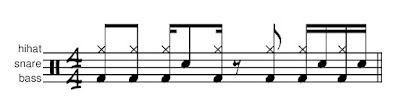
Last time we played a simple rhythm from Syncopation, alternating between RH/RF in unison, and LH on snare. This time we'll alternate between both hands in unison, and bass drum. 

Once again we'll be reading from Progressive Steps to Syncopation, pp. 10-11, top line part only. At first play RH on cym / LH on snare, start with the hands and alternate. This is how you would play line 2:  


Also do them pseudo-alternating, starting every measure with the hands: 


And starting every measure with the bass drum: 


Measures that naturally start the same way every measure should be played starting with either thing. For example, play line 5 both of these ways:  


When I think of all the frustrating first drum set lessons I've given... I've always tried hard to simplify that first rock beat, to what ever extent an individual student needs, and it's still very difficult for many of them. This is completely natural expression of a rhythm on the full drum set, using normal drum set language, and it takes no independence at all. See the “worst drummer ever” post where the kid does this in the wild with no apparent instruction from anyone, because it's a totally natural thing to do. 

We've been doing this a*-backwards, people. We start them with a lot of rock beats, which take a fair amount of independence for a beginner, and save this entire area of easy non-independent stuff— which people use all the time for ordinary things like playing ensemble accents and set ups— for more advanced jazz students. No wonder the drum set is a strange, intimidating instrument to so many students.  

Wednesday, December 22, 2021

“Worst drummer ever”

Bookending Sunday's false prodigies rant, I suppose. Worst drummer ever is title of this video shared by Paul Mason (@tempusdrums) on Twitter. I watched the whole thing, which is more than I can say for most drumming content on YouTube:


Another 12 year old kid bashing on his drums badly, yeah, but here's what I like about it: 

•  The first instinct of any drummer is to wail and make some noise. I wish I could train that desire into some of my past students. That's got to be in your DNA somewhere. We work hard to become sensitive musicians and all of that crap, but there's got to be some edge of chaos lurking in there somewhere, a basic instinct for impact. For me to be interested, anyway. 

•  He has a band. Maybe they played five times total, I don't know, but it's step one: wanting to have a band and then figuring out what the hell to play together. Increasingly it seems not to be a thing kids do. 

•  He figured out a lot of things about how the drums are actually played on his own, apparently without any help from a teacher or anyone else. He plays a lot of bass drum and cymbal, I play a lot of bass drum and cymbal. The thing he does at 2:14 is a lot like “Jack's method” that I posted recently. 

Here's the non-independent groove he sort-of settles on at 0:50: 


He does quite a bit of stuff like that, that connects very directly with what I do every day as a grown-up played-the-drums-for-40+-years artiste. RH = cymbal/bass drum, LH = snare drum. It's a basic orientation. Of course the first thing a teacher will do is toss this thing he learned naturally, and make him learn a beginner rock beat, and drumming will become nothing but a big independence problem for him.   

•  He picked up a couple of beats that are apparently just in the DNA of every child on the planet, at 2:54 and at 3:03. After 3:10 he almost figures out how to do the Elvin/Bonham triplets lick— what he's doing is exactly how rock drummers learn to do it. After about 3:40 he's got an OK start on a kind of rock & roll jungle beat. He does some mixed stickings on the Rototoms, which is interesting, maybe somebody showed him a paradiddle once?    

•  There's kind of an episodic structure to his solo, where he does a thing for awhile, until he thinks of the next thing to do. I've seen lots of adult professionals who basically solo that way. There's a good deal of melodic content, and a kind of climax at the end where he's playing the tom toms. The only thing he repeats is the four note run down the tom toms— perhaps he's a little over-reliant on that piece of vocabulary, if we're going to be critical. He does that universal kid's thing of starting a beat kind of slow, and then speeding up until it falls apart.     

This stuff interests me. What do kids who have no idea how to play the drums, but play anyway, play? 

Monday, February 25, 2019

Beginning snare drum books

Winner 1
A brief roundup of some available beginning snare drum books— books for first year students who have never played before, roughly age 10 and up. May also use them with more experienced players with little reading background.

This is one of the main types of books I use in my teaching, for learning to read, count, and play rhythm, and understand basics of drumming and of musical structure. Technical issues and rudiments are secondary, but I appreciate a summary of rudiments.

I generally prefer short one or two line exercises covering basic rhythm in 4/4, 3/4, and 6/8. Covering single notes, flams, ruffs, and rolls. I like for there to be duets included.

Most of these books include an introductory chapter explaining the very basics of what a drum is, how to hold the sticks, maybe a picture of a dude in horn rimmed glasses wearing a parade drum. Some attempt to teach drum technique via print, resulting some very cluttered-looking books. I think technique should be handled by the teacher, and I prefer books that don't try too hard in that respect. I like a clean page.


Here are the books:


Elementary Drum Method by Roy Burns and Sandy Feldstein
For about the last ten years this is the book I used younger beginning students. It has a little bit of everything, none of it is too hard, and the studies are short. It has a few too many studies written in school band style notation, for snare drum and bass drum, which I do not dig— learning how to count endless measures of boom-chuck is what band class is for. But overall it is solid. Includes a summary of drum rudiments.


Vic Firth Snare Drum Method - Book 1 by Vic Firth
Excellent book, with short studies in 2/4, 3/4, 4/4, and 6/8. Well-designed one page lessons, which I like a lot. I live for well-designed one-page lessons. Rudiments covered are flams and various short rolls— mostly 5-stroke. Studies are short— 1-4 lines long usually. No duets, but I can print those from other sources. I'm currently phasing out Burns/Feldstein, and starting most of my beginner students on this book.


Winner 2

Elementary Snare Drum Studies by Mitchell Peters
I'm very fond of Peters's materials, and this may be the best book here for serious, talented, mature beginners. More in depth than the others, with lessons covering some finer points of musicality than the other books. The book is thorough, but the pace of the materials is nice and brisk— Peters keeps the studies to a moderate length. I'm not as wild about the style of notation (stems-down) and the page design, but you can't have everything.


Primary Handbook for Snare Drum by Garwood Whaley
Very good, well-organized book. Progressive daily assignment pages include two short musical studies, a rudiment, and a stick control-type pattern. Rudiments are presented in textbook form, with no context or supporting studies. Odd meters are prioritized more than you would expect— there are studies in 5/8 (including a long duet) and 7/8 even before 16th notes are introduced. Gentle learning curve for technical elements like rolls, flams, and ruffs. Includes some multi-drum studies, and student composition assignments. Has practice logs on every page, which I don't like seeing, but they're probably effective. I would reserve this for more talented, engaged students. Includes a CD. Whaley has another beginner book which predates this one, Fundamental Studies for Snare Drum, which I have not seen.


Basic Drumming by Joel Rothman
Not a snare drum method per se, but it could be pressed into service as one. It's a compendium of all standard snare drum and drum set vocabulary from beginning to moderately advanced. A lot of technical studies, somewhat fewer musical studies. Mostly easy to read, with some good things not found in other books. There is a lot of material, and little explanation, so a teacher will definitely be needed to give appropriate assignments. With so much stuff, you have a lot of flexibility assigning things helpful for the individual student.


Runner up
Alfred's Drum Method - Book 1 by Sandy Feldstein & Dave Black
Not a terrible book, but I have a difficult time with it, for a lot of small reasons. The introduction is good, and I like the general scope of it. A number of style elements bother me. For me there is a general uncomfortable institutional feel. I don't like seeing two measures of an exercise spread across a full page. The one line exercises are just multiple measures of the same rhythm— if that was what I wanted for this purpose, I would use Reed. In a snare drum book, I prefer that the studies make a musical phrase. The “solos” are long school band-style pieces for snare drum and bass drum. They're exactly like any number of junior high band parts, without rests. The whole enterprise feels like it's made for creating school band percussion section students, rather than musicians.


Snare Drum for Beginners by Morris Goldenberg
Very good, maybe not for its advertised target audience. Mostly focused on reading rhythms, including ties. Flams are the only technical/rudimental element included. Rather strangely, there are no dynamics indicated anywhere in the book, and no triplets, no compound meters. My major criticism is the pace of the materials. It starts out glacially slow, with six dense pages covering quarter notes and quarter rests, rapidly progressing to complex 8th note/8th rest and 16th note studies. By the end we're reading pretty advanced jazz style syncopation. To me the tie studies are unnecessary at this level. The practice pieces are longer than they need to be— mostly full page. I've used this with a few younger students, and found that it needlessly tried their patience.


Haskell Harr Drum Method by Haskell W. Harr
Book 2 of the Haskell Harr method continues to be one of my favorite books for traditional rudimental drumming. Book 1 is definitely a beginner book; probably the definitive book of its type circa mid-20th century. It is heavily marked up with technical detail, and is too rudimentally oriented for me. Most studies written in band music format. At this point I think Book 1 is out of date, and there are better options for beginning drummers.


Stick Control by George Lawrence Stone
This is not a method book at all, but it is mentioned so often on the internet as the only snare drum book people use, I should talk about it on the same terms as these other books— how it functions as a beginning snare drum book. I do teach beginners some exercises from its first page, and sometimes the first short roll combinations. There is nothing in it dealing with the other things I need for beginners. Using Stick Control as your only snare drum book would be like taking up the piano and only working on fingering patterns, never learning an actual piece.


Progressive Steps to Syncopation by Ted Reed
I should also include this, because though it's not supposed to be a general purpose beginner's book, it kind of looks like one, and it's very tempting to use it as one. I do use it in in lessons before the student has his own book, for first learning rhythmic basics. And of course I use it for all levels of drumset instruction. But as a snare drum book it's really boring, and doesn't cover rhythm and meter as broadly as is needed to give novices a true understanding of it. And of course there are no other technical or musical elements present at all. Get a real snare drum book.

Tuesday, December 09, 2014

Advice for beginning drummers

Obligatory inspirational picture
1. Play every day.
Consistency is the main thing. At some point in your playing career, you will need to put in many hours every day, for several years at least, if you want to become an impressive, well-rounded professional player. If you're not ready to do that now, you can at least continue to improve steadily if you play for a little while every single day, no exceptions.


2. Don't give up.
The other big thing is not to give up. As a beginner you are not qualified to judge your future potential as a musician, so, if this is something you want to do, give it a chance to happen by continuing to do it. Any person of normal physical abilities should be able to play drums functionally at a professional level given time, a considerable amount of practice, and playing experience. This means you.


3. Talent is overrated.
Playing music comes easier to some people than others, but what actually matters is interest, persistence, and a reasonable work ethic (at least when it comes to music). Declaring yourself to be “not talented enough” is not an excuse for not being able to play the drums.


4. Be music-centric.
Everything you do in drumming follows from music you love, and music you play, so listen a lot, and play with people a lot. For all of the fascinating drum junk available to look at and practice— it's boring. Without any musical context and meaning, it's empty stuff, and you're going to get bored with it. Being in love with music is what will hook you to continue playing and improving for the rest of your life.


5. Learn to read music.
It's strange to have to mention this, but this is the Internet, and everyone seems to think they can learn just by watching videos. Video demonstrations are fine, but in 2014, real drummers read. With a little bit of familiarity, you will take in information a lot faster by reading it off the page.


6.  Be around other musicians
Being around other drummers, you're always thinking about the drums, and seeing what other people are doing well, or badly; and it fills out a lot of background knowledge you don't get by just playing alone in your basement and looking at web videos. Non-drumming musicians are the people you're going to actually play music with, so you need to be friends with them to have a chance to do that.


7. Take every playing opportunity.
When you get a chance to play music with people, take it, no matter what. I don't care if it's a country gig, a church gig, a musical that looks really bad, or playing triangle in junior orchestra; it doesn't matter. If your friend who doesn't play bass very well wants to come over and play with you, say yes. Say yes to everything.


8. Playing is sacrosanct.
Treat all playing situations seriously, no matter how bad you think it is, or how much everyone around you thinks its a joke. You don't have to be a jerk about it, showing off how serious you are; just be focused on doing the best, most professional job you can, no matter what. You can joke about how messed up the situation was after you're done playing, after the gig or rehearsal.

Monday, January 14, 2013

YouTubed: “basic rock beat”

Since I'm often told that the Internet, with its abundance of free materials, is rendering teachers obsolete, I thought I'd put that to the test, searching YouTube for beginning rock drumming “lessons”, and not stopping  until I found a truly good video, or until I thought of something better to do with what time I have left on this planet.

I'm taking these in the order they are returned by the search engine, filtering out a few things that are non-instructional. I've given a few notes, quickly, test-pilot style, on their strengths or shortcomings. My purpose is not to belittle anyone's efforts, or discourage anyone from trying to teach others what they know, but here I'd rather be entertaining than diplomatic; if you see your video here, and don't like what I say about it, be tough, and keep working on your craft, as we all do. If you tire of this faster than me, be sure to scroll to the end and give the winning entry some hits.


Drum Lesson:The Basic Rock Beat
by turdadactyl

Six and a half minute video explaining how to play the Back In Black beat, and not as terrible as you would expect from someone who self-identifies as “turdadactyl.” No tempo consistency between  the demonstration of the the beat and the counting the rhythms of the parts, which will confuse some of the beginners who are his audience. Uses the highly questionable method of speeding up the beat as you go. Not wild about his recommended benchmark for success: the ability to talk to someone while you play the beat. I'd rather students were able to play the beat while concentrating on what they are doing. Great speaking voice.
C+


Many more of these after the break: