Title track from Earth Beams, a great record by George Adams & Don Pullen, with Dannie Richmond on the drums— all three are Charles Mingus band alumni. Richmond was a key partner in that relationship for a long time, and is one of my favorite drummers.
This is really fundamental to what a jazz musician is— the groundedness in blues, the way they handle the jazz musical environment. Not about chops, or even pure groove— in the details the time and rhythm can be a little squishy, though the overall feeling of drive is there, and overwhelming. You can tell players who just live in that playing environment. Polish is not the point.
Here's another one, a gospel 5/4, which you didn't even know was a thing. It's so deep it took me a minute to realize they were playing in 5.
This is what anyone would call modern playing, but it's defiant to analysis— by me, anyway. I can't approach it looking for vocabulary. The point is the total playing entity.
Here's a nice performance on brushes by Tootie Heath, on Five Spot After Dark, from McCoy Tyner's album Today And Tomorrow. I don't know how it passed under my radar that he died just last month.
I've had the record for years, but never gave it the close listen it deserves— I always reach for the high energy records from McCoy. I should know more about Tootie Heath than I do, too— he was close to some people at USC when I was there. He did a clinic— from which I honestly did not draw a lot— and my combo leader played with him regularly. Their regular gig was someplace too classy for me to go to. For whatever reason, I haven't listened closely to much he played on, and I have him filed as another second generation hard bop guy— which is not fair or good, you have to actually listen to people.
He plays real clean here, hanging all his comping/fill ideas off the straight time feel. It's not a “texture” performance, everything he does is a statement. It's a nice catalog of things you can do that way. He's playing the context, but you could cop what he's doing as generic vocabulary.
Pay attention to his sound and touch as well— nice definition, he lays into his accents, the cymbals sound strong. He's real alert, supports the tune and form well, and interacts with McCoy nicely. Very chipper.
Speaking of Mickey Mousing, we hear a little bit of that after his first solo chorus, after 3:25. McCoy grabs a rhythm from the end of Tootie's solo, and then Tootie jumps back on it hard while McCoy is playing it. Normally that's not now thought to be good comping practice. Then again, you can't always avoid it in the moment. Stuff happens, and before you know it, you did it.
I was half an hour early for an appointment with Tim at Cymbal & Gong— picking out a career ride cymbal for one of my students— so I hopped over to Music Millenium, the venerable SE Portland record store, for a few minutes, and bought some CDs.
And, gang, buying records has really never been cheaper. I got used CDs of Sketches of Spain, Bill Evans with Joe La Barbera, and a Joey De Francesco record with Idris Muhammad, for $16. For $50 you could get enough of Miles Davis's catalog to occupy your listening for the rest of the year.
For the rest of the year— that's how you're supposed to listen: to one thing over and over for a long time, until it occupies a corner of your mind, soul, and musical ear. There's a limited amount of music you can take in that way. For a relative pittance you get all the music you can realistically absorb, and you're supporting an economy that is healthy for music.
And anybody serious about music needs to control their own library. You can't have your stuff be sitting on somebody else's server, with your access to it beholden to your internet connection, and the good graces of whatever corporate streaming platform. Beholden to the state of their licensing contracts, whether those are sufficiently lucrative for them. The streaming people don't care what business they're in, if they can figure a way of making more money without having to handle music, they'll take it, and you'll get stuck.
See Spotify— offering up virtual ownership of all the music in the world for $0 was a good way to drive everyone else out of business, but— shocking everyone— they can't figure out how to make that profitable. Right now it's dawning on them that they can do better with inflammatory podcasts, and are paying millions to broadcast “Joe Rogan” doing what he does. While cutting royalties for music.
They have a much better feel for that kind of “content” than for music, which is a more difficult product to predict. Listeners' attraction to music is less than tangible than a guy talking and deliberately trying to make you mad about nothing real in your life. Manipulating people to anger is a mechanical skill, and easily drowns out fulfilling, happiness-producing things like music.
See also the movie streaming platforms: having driven every video store in the country out of business, they've decided they don't like being in that business very much, and are cutting a lot of movies:
No s***.
“Consumers, the poor ridiculous saps, thought they'd be able to see what they want forever.”
No, they will screw you at the first opportunity, regardless of what promises they made about being “the future of movies” going in. The director Guillermo Del Toro recently made this statement:
So there's a larger picture. They tried to sell you an image of a future reality that benefitted them, where there would be no physical media, but then they decided there are easier ways of making money than giving you the things they promised. Thus you become stuck— potentially or actually— without access to art that is an essential part of your life.
Last point: buy people's CDs— at shows, gigs, clinics. Pay the extra $10. Doesn't matter how many times you think you'll listen to it, just buy it. They lost money making this record and need a little encouragement that there is value in losing money making the next one. Thus this whole music making ecosystem is able to continue to exist. You can afford it— how many shows do you go to?
You have to be a part of the money machine— you have to pay into it.
Listening to a Miles Davis record I never really heard before: The Musings of Miles. It's a lower profile item in Miles's catalog. These listening to albums posts are a test for me, because I normally don't feel I have a lot to say about what I hear.
It was Miles's first LP album, recorded and released in 1955, with Red Garland and Philly Joe Jones, who would soon be members of Miles's regular quintet. Oscar Pettiford rounds out the quartet recorded here.
Will You Still Be Mine One of those tunes I've played many times, but nobody calls the titles so I can hear them, so I never learned a lot of them. Half my reason for writing this post is so I can finally memorize the title: WILL YOU STILL BE MINE.
WILL YOU STILL BE MINE.
Bright little item, and they play it moderately fast, the tempo is about 256. They cruise through it.
Form is a long AABA, 56 bars; A sections are 16 bars long, bridge is 8. On the head the last A has a four bar tag.
Miles solos for two choruses, Garland plays a chorus and a half; Miles finishes his second chorus, then plays another chorus, and solos through the head out, finally playing the tune on the last A only. Pettiford pedals on the first 8 bars of the first two As of the head out.
Jones plays brushes behind Garland's solo; switching back to sticks for Miles to come in in the middle of Garland's second chorus, so I guess that was planned, or Miles signaled he was coming back in, and Joe was on it.
There's no mistaking his cymbal beat, is there? It's dominant on the recording, you don't hear the rest of the drums real well, though his left hand is very active— all his slick stuff is there. He seems more polished with that than players before him.
I See Your Face Before Me Lovely ballad I wasn't aware of, they really set a mood here. I'll have to dig up the Johnny Hartman recording of it.
32 bars, form is ABAC, tempo 59 beats a minute. Walking ballad, Pettiford plays in 4 on all of it except the first 8 bars of the piano solo, where he plays in 2. They play two choruses total, all Miles except for the first half of the second chorus. Plus there's a four bar piano intro.
Jones is playing with brushes, obviously, mostly lovely long quarter notes, playing the bell of the cymbal with the metal loop especially during the piano solo. Skip note is present in his brush rhythm in a subtle way, and very late, suggesting double time— I think his skip note lands right before Pettiford's attack, and his downbeat right after. He double times the hihat briefly on the end of the C section.
I Didn't Cool Miles Davis tune based on Thelonious Monk's Well, You Needn't. I had to look that up, I figured it was based on a show tune, because Miles took it a whole different direction. But you can clearly hear Monk's changes happening on the solos. The title is a hip play on Monk's title. Form is 32 bars, AABA of course, tempo around 272. 8 bars of drums up front.
At 1:10 you can hear a familiar cue Miles plays on later recordings. I don't know what the deal is with it, but you should recognize it. Like on Four & More Miles sets up Tony Williams's solo with it, and Tony cues the end of his solo with the rhythm figure.
After the piano solo Miles and Jones do some irregular trading— Miles plays a chorus, gives Joe the bridge, Miles plays the last A; the next chorus they trade 4s, except Miles plays the tune on the last A. Then he solos for another chorus, and again plays the tune on the last A, and they're done.
Jones and Pettiford are kind of brawling in a nice way here— both playing very muscularly, not exactly together. Things don't have to be perfectly in unison to swing.
A Gal In Calico Kind of a mundane standard. Miles must have heard Ahmad Jamal play it. Maybe there's some interest in it for the horns, I find it a rather insipid, uninteresting tune. 32 bars, tempo is about 186.
A Night In Tunisia The centerpiece of the album, which it has to be. The tune is AABA with an interlude; the A sections are six bars Latin / two bars swing, the bridge swings. There's also a shout chorus that frequently gets played over the A sections the last time through, as it is here— I don't know where that originated. Tempo is about 174.
There's a free time intro by Pettiford, with Jones playing jingle sticks, for a tambourine effect. On the head they do the normal Latin/swing switching thing, on the solos they swing, but it's pulling all kinds of directions. Pettiford's playing very independently at times.
On the solos they just play the AABA form— no interlude. Then they trade fours kind of roughly with Jones for 1 and a half choruses, sketching in the shout chorus line on the A sections. Actually on the last A of the first chorus, Miles plays the whole 8 bars— Jones doesn't get a break there. Then they play the head out from the bridge. The end gets drawn out, they're clearly winging it.
Green Haze 12 bar blues, tempo about 78 beats per minute. Miles gets composer credit, but there's no tune that I can discern, it's just a blues.
Piano plays two choruses, then Miles plays four, then Pettiford. Double time feel in 2 on the second chorus of Miles's solo, back to the slow 4 on Pettiford's solo, back to double time on the head out. Jones plays brushes all the way, except he plays time on the cymbal on Miles's solo. Again, his feel suggests double time even while he's playing the slow 4.
Pettiford is doing hip stuff at the end of the first chorus of piano, and into the second and then third chorus of Miles's solo, where he forces the double time. He's playing like an arranger, and leader. To me he's the star of this record.
There you go— you'll notice a lot of it simple description of what happened. It's important information, knowing the parameters of what happens when people play, and knowing what's out of the ordinary. You could ask for deeper insight to what they're really doing, beyond he's doing something hip here, but that's on the record, that's not translatable into words. Or if it were it wouldn't be communicable.
Charisma: Compelling attractiveness or charm that can inspire devotion in others.
- some dictionary
In becoming better drummers and musicians— and in being lovers of music, and of percussion in music— I think, finally, we're looking for charisma. In the music itself— not stage presence, bravura, or manner in performing. Whatever our abilities, whether we're playing busy, simple, whatever. It's an energetic thing, an immediate sense that this is a thing. A feeling of real substance, personality, presence, and likability. A sense that you're hearing a living event, even on a decades old recording.
It's Brad Pitt vs. Ben Affleck. You know it when you see it, or hear it. Think John Bonham playing Black Dog, vs. whatever recording with Carmine Appice you may have checked out and immediately forgotten (sorry Carmine!).
Non-charisma feels flat, colorless, lacking in impact— even when it's loud and busy. It's hard to stay interested in it, and hard to remember it. It may feel generic, over-correct, unsurprising, non-specific. Whatever emotion it inspires is non-durable. Like daytime television.
I don't want to get into “rating” famous drummers; that is not what this is about— but let's look at some familiar examples illustrating the quality, and its relative presence— I think if you know these players, you know what I'm talking about. I'm not judging anyone's artistry or greatness at their job, I'm talking only about what gives me joy, what attracts me to percussion.
Roy Haynes and Brian Blade are both hugely charismatic— very flamboyant, dramatic. Charli Persip, Dannie Richmond and Pete La Roca had some of that same very bright edge.
Philly Joe Jones, Jeff Watts, Al Foster, Vernel Fournier, Ed Blackwell, all have a feeling of massive substance, they sound grounded. And Jim Gordon, Jim Keltner, Greg Errico. Mickey Roker is seemingly a workhorse kind of persona, but he sounds substantive. Grady Tate also.
Billy Higgins is quietly charismatic, musical, strikingly unpretentious. Paul Motian is different— he's often not quiet— but similar. Mel Lewis is maybe the ultimate pure working musician, but he doesn't make the strong impression Higgins does— on me.
Elvin Jones and Ed Blackwell have such substance they seem to be speaking for history, speaking for Africa. People write about them that way. You have to remind yourself that they're just individual guys with the same amount of time on the planet as the rest of us, who played a lot, hung around with musicians, listened to Max Roach records, practiced their Haskell Harr, and did a lot of gigs.
Tony Williams in the 60s had massive playing charisma, that was later replaced by pure power, and some not very nice drum sounds. His cymbal beat that everyone loved was replaced by a quarter note pulse that was like getting a refrigerator dropped on your head. Terry Bozzio in the 70s was in a similar bag, but is much more likable— hear him on the Brecker Brothers' Heavy Metal Bebop.
Buddy Rich is a titanic presence; he demands to be perceived as charismatic, but I don't find his playing attractive or likable. He's like watching a Tom Cruise performance— you feel like you're being assaulted. He does have a very big presence.
Steve Gadd is massively charismatic. Vinnie Colaiuta is the Lamborghini version of Steve Gadd, but Gadd has much greater charisma. Same with Dave Weckl— that is graphically illustrated if you watch their famous three-way drum battle video. Everyone makes the same comment about it:
It seems to be hard for supercar-type drummers to make a big impression beyond their obvious titanic technical abilities. Overwhelming in the moment, but ultimately not a real deep experience. Still, Colaiuta and Weckl are both on some recordings that are very attractive in the way I'm talking about.
Of the famous rock players, Ringo Starr's playing with the Beatles was charismatic; Charlie Watts, God rest him, never made a huge impression on me. Keith Moon: very charismatic for pure energy, despite having kind of a weak sound.
Mitch Mitchell played a lot of notes, but doesn't make a big impression. Bill Ward attempted to be a John Bonham-like presence with Black Sabbath, but he sounds smaller, less interesting. Ginger Baker was the prototype for that role, but compared to Bonham he sounds boxy, abrasive, uninteresting. Later on we have that clown Stewart Copeland, whose playing was very charismatic back when he worked for Sting— people are still trying, and failing, to duplicate his snare sound. They never get the same energy.
Neil Peart is a giant nerd, but his playing has inspired near religious devotion in millions of fans. Whatever you think about his audience's level of sophistication, they have real musical interest— they're attracted to the way the percussion is featured in the music. He must have done a really great job with those worked-out parts. What other drummer has inspired that level of attention?
Dave Grohl is a charismatic person, but on the Nirvana records he was not a charismatic drummer. He's loud, but his sound is unpleasant, and whatever playing personality he has is buried under those rigidly composed parts. Paul Rudd and Rick Allen were also heavily produced, but are much more likable on those recordings— maybe that's Mutt Lange's doing.
I think people who know these players know what I'm talking about. It's not a worked out theory. It may not even be a purely desirable quality, professionally: there are a lot of musicians who are great, very successfulplayers who are relatively uncharismatic in the way I'm talking about. You'll see them play and feel, oh, he's just a guy. They'll sound like a record, like, finished, perfect; but you don't come away from the experience with a creative feeling, excited about percussion. Maybe they excel at making other people's job easier— see Mel Lewis— another subject worth thinking about.
In fact this entire level of thought isn't really anything we can address directly in our playing life— doing our real job you can't be thinking in grand aesthetic/critical terms, there are more pressing concerns: playing good time and dynamics, playing the arrangement correctly, making everyone happy.
So on the one hand it's a topic for fans and critics, on the other... I think as an artist you have to keep a basic naive enthusiasm for the pure thing itself, and have an idea of what actually moves you apart from the pure job of it.
Obviously I'm posting really lightly lately, getting ready to head to Germany next week, so: here are some recordings Elvin Jones plays on, with his drums isolated. Enjoy!
Here's Passion Dance, from McCoy Tyner's album The Real McCoy:
Somethin' Else is a very famous record by Cannonball Adderley, that really belongs in that “the one jazz record I know” list, along with Kind of Blue and Moanin'. When I was in school nobody could afford to own everything, so between the 4-5 of us that were hanging out, we had an OK record collection.
Recorded in 1958, when Cannonball was in Miles Davis's band— shortly after Milestones was recorded. Somethin' Else has Miles as a sideman, and Hank Jones, Sam Jones, and Art Blakey on drums. Miles basically produced the session, evidently.
I don't know how insightful these comments are— I'm putting down what strikes me that I'm able to put into words, in a reasonable amount of time. The first thing you do in writing about any art is to say what you hear, or see.
Autumn Leaves This tune has been so beaten to death in school and in jam sessions, it's really hard to play it without feeling this heavy existential dread. This is a very cool rendition, and one of the classic renditions. Composed intro/outro a la Ahmad Jamal, that makes me think of Gil Evans. No stop time— the popular way to do it at jam sessions. Outro is slower than the original tune.
As a player, I want people to be ready to do intros/outros like that spontaneously, to have ideas for doing that. Blakey just plays time throughout, sometimes doing a Latin percussion effect on the snare drum and tom tom. He does that often on this record, simulating a conga player.
Centerpiece of the record. The intro figure is really part of the book of this tune that everybody should know, especially piano and bass players.
Love For Sale One of the first tunes I learned— we played the Blue Wisp arrangement of this in high school. The tune's not a blank slate, it's a little journey, with some events for the rhythm section to support.
Listening here, it feels like there's a lot of action. There's a rubato solo piano intro, then a brief Ahmad-like Latin vamp (again, cop that figure, pianists). Blakey plays a strong accent when he comes in there. Swing 2 feel with brushes on when Miles comes in with the tune. Latin vamp comes back before the bridge— Blakey uses sticks briefly there, before going back to the brushes for the bridge and last A. At the end of the form there are some arranged kicks and four bars of the Latin vamp. Apart from the Latin parts, Sam Jones plays in 2 for the whole head.
Cannonball is the only soloist, and he plays two choruses. Rhythm section swings in 4 the whole time, except in the first chorus Blakey momentarily plays the Latin groove going into the bridge. Blakey plays sticks, with a bongo groove with the left hand. They play the straight through the form, none of the added kicks or Latin parts.
Back to brushes on the head out, Miles plays the A sections, Hank Jones plays the bridge. Sam Jones walks until the last A, where he goes into 2. None of the added Latin parts happen, except at the very end, as an outro. It seems to come as a surprise, because Blakey plays the first few bars with brushes, and then switches to sticks.
There's a lot of power to having everything clean and in its place like this. These changes like going from brushes to sticks have a big impact when there aren't a lot of distractions.
Somethin' Else Bright tempo blues written by Miles, with an oblique kind of melody and some funny changes— somebody with more harmonic knowledge than me could tell you what's happening here. There's more comping activity from Blakey here, but it's all balanced to be softer than the ride cymbal. There's a tight little dynamic envelope happening there.
There's a little air between the attack on the cymbal and Sam Jones's attack on the bass. It's fooling my ear a little bit— I think Jones is in front, Blakey in back, and could totally be wrong. They're both absolutely solid and come off as being right on the beat, and driving. There's just a little space between their attacks.
Around 3:57 Blakey double times in a way I don't hear much any more. Dick Berk, a great drummer I used to see a lot in the 90s, used to do that a lot.
One For Daddy-O Slow blues in 2, again with the conga beat on the drums, brush in the right hand, stick in the left hand. The brush is beating quarter notes out of a circular motion, from the sound of it.
Blakey goes to sticks and the bass goes into 4 as Cannonball's solo starts. Blakey continues the conga beat through the rest of the tune. On the head out, the bass goes back into 2, Blakey continues that beat.
Dancing In The Dark This is a Cannonball feature, he plays the head and has the only solo. Bass walks during the solo, Blakey plays a basic time feel with the brushes all the way. Like on the rest of the record, it takes a lot of patience to play that way. It's its own effect, just playing time and not doing anything else. That doesn't even register as a way to play for most ambitious players today, it's off the table. Change it up.
In my years working the titular gig of this site I played this tune a lot, with several excellent, though young, tenor players, and this was the type of tune they always hated play, and they could never do much with it. Listening here, obviously the problem was not the tune. They were prepared to do a lot of modern improvising and playing hip stuff, but had a harder time just playing a tune and making that good. They all learned, because they were good, but it took some time.
Alison's Uncle Bonus track, a loose medium up bebop tune. Blakey plays a little more, and gets to solo— he gets a chorus, and the bridge on the head out. He plays a hip variation on his conga beat for part of Miles solo. You could pull a lot of clichés (that's not a pejorative) out of Blakey's solo, if you were inclined that way. Not a lot happening with the bass drum, he's mostly using his hands, with the hihat strongly on 2 and 4 all the way through. One of these days I'll check out more closely how he phrases his solos— here they're basically neat little four bar phrases that develop nicely, they take a little turn in the second two measures.
This is an interesting record from 2014, by Bobby Hutcherson, with David Sanborn, Joey DeFrancesco, and Billy Hart on drums. The whole thing is real loose, and basically the opposite of everything happening in music lately— like a titanic expression of the performer's great abilities. Not that.
Billy Hart is 74 years old here, and has played and recorded as much music as anyone alive, and is working from a level of familiarity with act of playing— and through levels of burnout— it's hard to conceive, and hard for me to write about— what I'm hearing with his playing here.
You wouldn't mistake him for being a stylist. He's more a “contextist”— and the context is all of modern jazz from ~1960-1980. Including free jazz and early fusion, as well as R&B and funk. Which largely means playing interactively and not just playing idiomatic stuff.
They're playing familiar music, but there's nothing routine here— everything sounds present and in the moment and there to serve a purpose. More like music behavior than a performance for an audience, or even necessarily for musical effect. All very unforced. When he plays assertively, it's not coming from a personality intruding, he's more riding an energy.
It's easy to hear the vocabulary items he's using, and basically why. He'll do one thing for awhile, and you can hear how he uses it, where it goes. You can pick stuff out and use it yourself.
Just did a gig playing all samba and bossa nova, so I've got Brazilian music on the brain. Here's an old record offering a little round up of styles in Brazilian percussion: Batucada, by Paulinho e sua Bateria. Things will have evolved somewhat in the 60 years since this was made, but hey, jazz records from 60 years ago are still relevant. This is good for getting the broad concept. We're just looking to inform the way we play sambas and bossas in a combo setting, ideas to draw from beyond a groove in a drum book.
Open it up on YouTube for the track listing, which names the styles involved.
Another set of three records is by Luciano Perrone: Batucada Fantastica, also from the 60s, which rounds up some percussion styles, and the individual instruments. Here's one of the volumes on Soundcloud. Here's a track demonstrating the tamborim, accompanied by surdo and snare drum:
Some notes on the record Thelonious Monk With John Coltrane. I've been listening to Monk's Carnegie Hall record a lot this week, let's get into this one. I never owned it, and haven't listened to it much. I always gravitated to the Monk records with the bigger name drummers on them, and we used to be more limited to records a) that we could afford, b) that our friends owned, c) that the record stores carried... second-hand, especially...
This record is mostly a quartet with Shadow Wilson on drums; two tracks are septet with Art Blakey, apparently from the same session as the album Monk's Music, which also had Blakey and Coleman Hawkins.
A drummer named Chris Conrade— a very knowledgeable and rather prickly Portland character— once asked me who I thought was Monk's favorite drummer. I said Art Blakey, he told me it was Shadow Wilson. I guessed it was because he was basically a swing drummer; the only thing I knew about him I got from the Dejohnette/Perry book, which mentions him as an example of “updated swing style” playing— swing drumming reflecting bebop innovations, which became the new standard way of playing the drums, with time played on the ride cymbal, less pronounced bass drum, hihat played with the foot on beats 2 and 4, more or less independent snare drum. While generally reflecting a time-keeping, arrangement-playing, big band-like approach to the drums.
Jon McCaslin @ Four On The Floor has written about Wilson, and given some other examples of his playing, that's highly worth reading.
Ruby, My Dear Very famous ballad that doesn't seem to get played as much as it once did. Shadow Wilson playing time on the hihat on the head, with brushes, then on the snare drum during Coltrane's solo, then double time on Monk's solo— notice his left hand is also sweeping the slow 4 feel during that.
Monk's tunes are so well structured— the tunes, and the background/supporting figures, form a very distinct interlocking structure for you to work with. There'a never any question about where you are, and you always have options for what to play off of.
Trinkle Tinkle There's a classic jazz sounding cymbal for you. Probably an 18" K., and he plays it beautifully. Sounds like a 22" bass drum. He is playing it as part of his time feel (“FEATHERING” it, if you insist), in a fairly pronounced way. The things he plays on the head in support of the tune are very slick— on the head he plays extremely smooth rolls going into the second A section, and the bridge. The tune is quirky, and he plays some quirky stuff in support of it.
The cymbal is the main voice we hear from him; the snare drum, bass drum, and hihat, all of which he plays pretty constantly/actively, are balanced underneath it.
Off Minor Art Blakey here. The triplet thing on the snare drum is real distinctively Blakey, as is the strong 2/4 with the hihat. He's really rocking the hihat here. He doesn't play as ferociously as he does on his own records, but he's more aggressive with his dynamics than Wilson. Drummers get into a macho thing where that's automatically thought the better way to be, but I honestly enjoy Wilson's playing on this record more than Blakey's.
Nutty Back to Shadow Wilson. Coming off of Art Blakey, Wilson plays the snare drum and hihat much more discreetly. There's this lovely buoyancy in the way he plays the cymbal. We also get a good picture how he plays the hihats with sticks— another completely classic sounding set of cymbals there.
It strikes me here how much Coltrane was basically not about swinging. He immediately goes into double time on his solo, and plays a lot of stuff. He would play very lyrically at times, and he did play rhythm, but he wasn't really a groove guy, was he? Compare with Coleman Hawkins's solo on Off Minor. Coltrane's like listening to Bach, he's on some other kind of mission here.
Epistrophy Blakey, obviously. Big aggressive drum intro, strong hihat again— the hihats dominate the time feel, the way Blakey plays the ride cymbal is fuzzier than Wilson. There's a driving quarter note pulse happening, but the articulated cymbal rhythm is not what's swinging the time.
You hear the contrast between Blakey's and Wilson's playing here— Blakey makes bigger statements, that are more distinctively “modern”, and draw more attention to themselves. He's also not always strictly in time with some things— on the head out, he's playing some percussion/rhythm effects that are not perfectly in rhythm. You can hear what he's basically doing, but it floats a little bit.
Some of the things Blakey plays with Monk are practically part of the arrangement of the tunes, in my mind— at least, they're distinct enough that you can refer to them when you play these tunes, and people will know what you're doing. What he does on the head out here is an example of that.
Functional Solo piano, a blues. Blues is more than just a 12-bar form. Learning to say something real with the form is a major mission for any jazz drummer— everybody should be listening to piano players and copying their moves— however you would make that happen on the drums.
Phew, long post here, but the topic merits it. Let's listen to the Miles Davis record Sorcerer, with his famous 60s quintet including Wayne Shorter, Herbie Hancock, Ron Carter, and Tony Williams. I bought it around 1987 as a vinyl reissue— I never heard of it before I saw it at the store, and was real excited to find another Miles record with Tony Williams on it.
Recorded in 1967, mostly. Several of the tunes appear in the original Real Book, but are not often played. Among records by this group (and the George Coleman iteration) Sorcerer is a little bit of a dark horse— compared to Nefertiti, Miles Smiles, Four & More, for example. Maybe there's more stuff music students get excited about on the other records.
Overall the frame here is very loose, very open— nobody's nailing down the time for much of it. The time modulations of the earlier records have evolved into a general floating feeling. Much of it is straight 8ths, but we're not yet getting into the rock direction we hear evolving on Filles de Kilimanjaro and Miles In The Sky. This one is more about time areas, sketched out by everyone together— the time often seems like it's somewhere in between what everyone's playing. Same with the form.
Lots of beautiful playing here, individually and as an ensemble, my focus here is on what I'd be thinking if I were playing or learning these tunes.
Put on your record, or run this, and read on:
Prince of Darkness 16 bar tune, played twice. Tempo is about 239. Nominally a samba, played with very open modern jazz language. You can broadly hear the form going by, but they're handling it in a very open way, no piano comping, and not a lot of firm markers being played. It kind of hangs off those dotted half note accents in bars 11 and 13— listen for who suggests that during the solos. Wayne Shorter wrote some tunes like this— El Gaucho is another one— very concentrated, distinct forms. Like Giant Steps but way more interesting, speaking as a drummer.
Ron Carter's foundation groove is a samba rhythm, but much of the time he's playing off of dotted quarter notes or half note triplets. Tony is supplying the regular pulse, but a lot of angular stuff too. Texture opens up on Herbie Hancock's solo.
Pee Wee I forget if Tony Williams actually composed this, or if Wayne did, and they wanted to give Tony a writing credit. Low key waltz, tempo is about 124. 21 bar form. This may be the most commonly played tune on the record? Miles don't play at all on this track.
Phrased 8+7+6— though my hear hears the melody itself as 6+9+6. It lays across the chord structure in a funny way. But it's 8+7+6— on the blowing there are two measures of the same chord at the end of the first 8 bars, and a big change in bar 9, beginning the odd phrase. The key spot is in bar 16, the one measure that has two chords in it— it's easy to hear even if you're lost the whole rest of the time, and easy to finish the form from there. It's worth listening through a couple of times just listening for bar 16, while not otherwise keep tracking of the form. The change at bar 9 is also distinctive, get that in your ear.
You see how my mind works on these things. I don't want to count, and I don't want to fight my ears, I want to know how to recover from getting lost. Learning this tune, I would first learn to orient myself around what's obvious to my ears, however feeble, and then learn to hear the parts where I don't know what I'm doing— which I've here narrowed down to bars 13-15.
Tony plays light time and textural stuff with brushes through the first chorus of Wayne's solo, after which he switches to sticks. Mostly plays off a quarter note pulse, double timing and playing off a dotted quarter pulse in a few spots. Phrases are broad swells or arcs, both in dynamics and density.
Masqualero The very dramatic 2001 recording of this tune on Wayne Shorter's Footprints Live! is possibly more famous now, with Brian Blade on drums, channeling the whole world's love and enthusiasm for this band. Very loose playing from everyone here, but there is a clear tempo and they mostly follow the form... with modifications.
The tune is a modal ABA, with a short form that is very drawn out. Played with a straight 8th feel. Below is a chart from the Jazz Ltd fake book, illicit pdfs of which are widely distributed digitally. The choice to write it in 4/2 is strange to me, playing it I would count it in 4/4— one measure of 4/2 on the chart = two measures of 4/4 @ 134 bpm.
The first line is the intro, the second line is the A section, and the third line is the B section. The last A section is indicated by the “D.S. (first 4)” at the end, and by the sign at the beginning of the second line, and by the fine at the end of the second line. So the form is 4+3+4 bars of 4/2, or 8+6+8 counted in 4/4. The whole thing is played in the key of G. Phrygian, except the B section. On the blowing Ron also implies a change in bar 4 of the A section.
The intro is very loose, with Tony playing free, and settling on the tempo as the A section begins.
During the blowing, except on his own solo, Herbie always hits the first dotted quarter figure in the last bar of the B section— Ron hits it during Herbie's solo. That really sounds like the end of the form, and sometimes it is treated as the end of the form. Like the last chorus of Miles's last chorus is just AB, then Wayne's solo's begins with a fresh ABA.
The end of Wayne's solo gets a little flaky; Herbie drops out at the beginning of his last chorus, from there they seem to play AB+AB+mystery phrase. Herbie's solo starts very fluidly, though it's still in time and still adhering to normal phrase lengths. At some point the bridge is cued, and they finish it on the form from there, including a final A section before going into the head out— where the play AB-AB and out, with no horns on the second AB.
If you get lost in space on the A sections you should be able to hear when they go to the B section; at least the end of the B section is always 100% clear. And the top of the repeated A sections is clear as well— they don't just play 8 (in 4/2) bars of vibe. And you can hear the implied chord change in the last bar of the A section as well.
Listening to it I would learn to first hear those markers when they happen, and notice how they're handled. Sometimes they're the one definitive thing in the phrase, other times they're touched lightly, sometimes dramatic, sometimes not. Generally not everyone is hitting them at once.
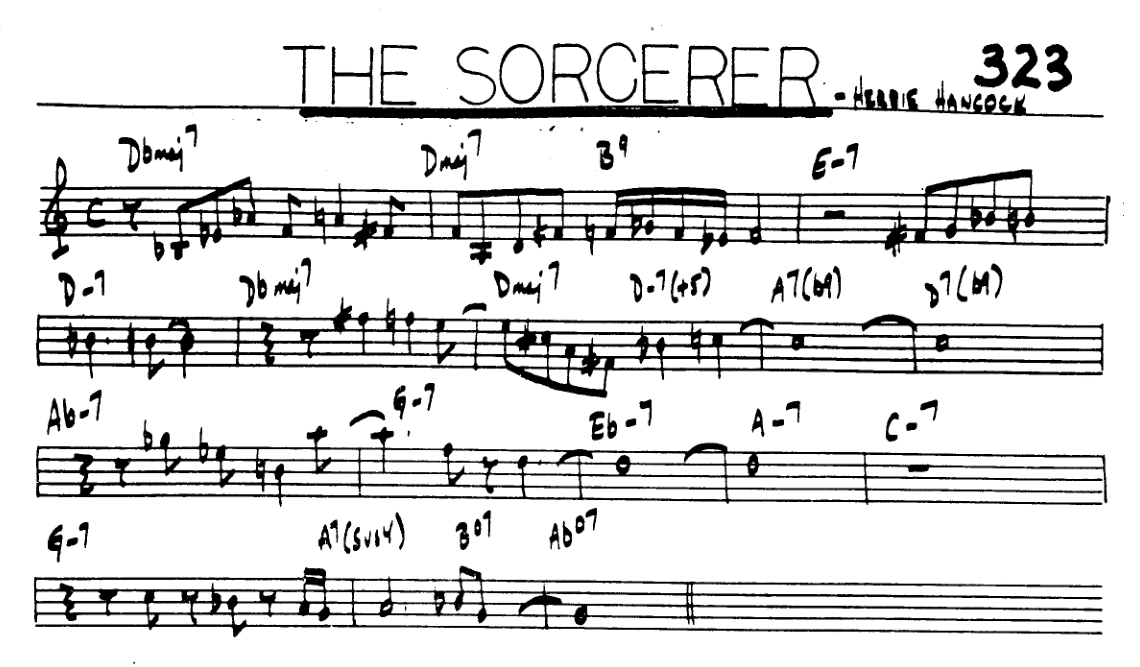
The Sorcerer Uptempo through-composed Herbie Hancock tune, 16 bars, AB, 8+8. On the blowing Miles and Wayne trade 8s, then play the head again, twice.
Form-wise, there's not a lot for me to grab onto, aurally— the chords don't really allude to the melody, and we never feel like we've arrived anywhere, which is deliberate. From my perspective it might as well be free bop. You can't play it looking to resolve to a big down beat, because it's not going to be there, you have to leave everything open. Counting 16 bar phrases from when they play the head after the trading, the horns come in with the head out on bar 9, so something off the form happened there.
In terms of learning this tune, I would listen to the version on Herbie's record Speak Like A Child. It's still real ambiguous, but they play more conservatively, and there are some arranged figures on the head that give you a little more to hang onto.
Limbo Another taken from the Jazz Ltd book— who knows how similar it is to how Wayne wrote it. Form is basically 8 bar AB, with two extra beats in the middle. Kind of a funny choice writing it the way they did; on the head Tony plays a fast 3, based on the quarter note triplet on the written chart (listen to his hihat), then on the solos they go into that double time samba like on Prince of Darkness. They play a medium 4/4 on Herbie's solo, then back to the fast 3 on the head out. Tempo is ~ quarter note = 123.
The 2/4 bar and the chord changes every two beats suggest that this could have been written as a fast 2/2, or a fast 3/4, with one chord change per measure, 9+8 bars long. That's probably how I would think of it.
Figuring out how closely they're following the form on the blowing takes better ears than I have. There is harmonic movement, but they might as well be playing totally open, if they aren't. They bring it around to some semblance of the form on Herbie's solo. It takes some nerve to try to do what Tony's doing here— it's well beyond routine combo intensity.
Vonetta Cool walking ballad by Wayne Shorter, I can't locate a chart for it online or in my books. Too bad.
The form is 14 bars long, let's call it AB, 8+6. Bar 4 of the B section is in 5/4.
Rubato on the head, Miles plays the first half, both horns play the second half. On the solos they play a medium 4, and Tony makes the interesting choice of playing the solos on the snare drum with sticks. Miles and Wayne solo, Herbie gets two half choruses, with the horns playing the head on the B sections, ending the tune on the second chorus.
Great tune, maybe I'll write a chart for it.
Nothing Like You Recorded in 1962 with the singer Bob Dorough, who was very much in the Blossom Dearie/Dave Frishberg cute/hip mode. With Jimmy Cobb on drums, arranged by Gil Evans. I like the opening, Jimmy Cobb is all over that. He has a real particular sound, that's very staccato and on the front of the beat, distinct from other players like that— maybe Roy Haynes or Charli Persip, or Alan Dawson.
Another choice item from a 1981 column in Modern Drummer, in which Scott K. Fish talks to a lot of great bass players, about drummers:
“Faults I hear in drummers? Mainly that they play too loud. They're too insensitive. A drummer can lead whatever band he's in. He can force himself to be the leader, just by the nature of the instrument. He can play the loudest, he can cover everybody up and he can make everybody go in the direction that he wants to make the music go. But, he should be sensitive enough to realize that if he's not the leader of the band, then he is just another member of the band. That everybody else's role in the band is just as important as his is.
Drummers have said to me 'I can't hear you. I can't hear what you're doing.' And a lot of times I do that on purpose because I want them to stop and listen. I'm saying musically what I could be verbally saying: 'I can't hear the piano player or the horn player because you're playing so loud. You can't hear me because you're playing too loud, not because I'm playing too soft.'
I think that the greatest drummers had the ability to really burn with intensity while still playing soft. I don't say that a drummer shouldn't play loud. I remember listening to Elvin Jones with John Coltrane! To an extent it's volume but it's also space. A lot of drummers are just so busy that they don't leave spaces for other instruments.”
I'm noticing— online, and to a lesser degree with some students— a lot of people approaching the drums mainly in terms of drumming media. Books and videos, and the drumming concerns they promote, are the main things they think about.
Promoting that is a deliberate project with YouTubers. And people are comfortable with it, and bring that attitude to, for example, John Riley's excellent book, The Art of Bop Drumming; the book is 100% of their experience of jazz, and they make a doctrine out of it. There are other examples, I don't feel like thinking about it to list them.
Think of that manufactured laundry list of drumming concerns, and then put on a record, and listen to the whole thing:
That is what we're doing, that is the musical act, that is natural motivation.
The list of concerns just vanishes. You can't listen to that and be thinking what's his finger technique? Would that have been better if he played open handed? Was that a herta? Was he feathering the bass drum? The categories of things the Joe Blow YouTuber advertised are totally, obviously, made up and irrelevant.
That's what records are all about, forming an idea of what music is, what kind of musician we want to be, how we want to play the drums. There's actual joy, love, and art in it, which are ultimately the only things that can sustain you for decades of being a musician.
Now my Generation X self also believes that actual hard media are important— putting on a record, CD, or tape, and running it over and over— because changing the record takes some effort, and because you've been drawn into the world of the album. No shuffling, no skipping. You have the cover art sitting around the house, you don't have to go through an interface to read the liner notes and credits. It's tangible and immediate and it's part of your life.
The false abundance of the digital age has to go. You're one human, you cannot process infinite free music.
What you do is: be with one thing, now. And keep doing that. Pay the $4-18 for the record, pay it respect and form an attachment to it. That guides your progress as a musician, and is the foundation of an identity.
Since he commented about playing with loops vs. whole tunes— and I do a lot with loops— I should clarify some things.
2. Try to play with whole tunes rather than loops.
I've mentioned this before, and I don't want to step on anyone's toes around this, but I feel playing with loops never gives us the whole story. By loops I mean just taking a small section of an already existing tune and have it playing endlessly. When we do this we miss out on a lot of form. Not only the structure of the tune (AABA, 12 Bar Blues etc.) but the form of the whole performance. How do we differentiate between sections of the song like in head to solos, different solos, and last solo to out head? Does the tempo of the tune change from beginning to end? What about the relative volume of the drums at differing sections of the tune? These are important issues!
He's absolutely right. In jazz form is not dispensable, it is the whole thing. A jazz environment is not complete without considering form. All of my jazz loops will include at least one complete time through the form— except when there's a special purpose involved, like learning a figure, or learning to hear the connection from the last A section to the first A section on Stablemates.
Once or twice through the form looping is still not the complete picture of performing a jazz tune, but I think we're talking about different practice goals here. Most of what I use the loops for is to take regular focused drumming practice— like, stuff from books— in a more musical direction. So we can hear these book ideas in a context, and try to match them to a musical vibe, and play them in a way that makes sense within a musical phrase, with some continuity. To an extent it's about concentrated exposure to a single figure or vamp, or a single solo.
Ted's concerns above are bigger picture items re: playing a complete performance of a tune. For me it's hard to do the kind of practice above with complete tracks— the temptation is to just play.
But it's true, no one should have any illusions that playing with a recording is a replacement for playing with people. They're really entirely different things. The track doesn't listen to you and fall apart when you play something so dumb you caused a train wreck. Or get mad at you and never call you again because you played selfishly. You don't learn anything about support playing with a track. So you have to be very cautious about the lessons you take from playalong practice to playing with people.
“Listening is the whole thing. I'll tell you exactly how I play. My whole approach to playing is reaction. I don't listen to myself play. I'm not aware of myself because I'm too busy listening to everything going on around me. All my body is doing is reacting to that. Sometimes I'm forcing things, making things happen another way, but I'm reacting to everything I hear. The composition I'm creating as I play is because of what I'm hearing. How can you work out how you're going to accompany somebody? You can't! You're supposed to be complementing and accompanying.
Everything depends on your ears. If I'm busy listening to me, then I'm not hearing the rest of the band.”
- Mel Lewis, 1978 Modern Drummer interview by Scott K. Fish
Responding to a forum question, referencing Delfeayo's Dilemma, a Wynton Marsalis tune, as recorded by Kenny Garrett on his record Triology, with Blade on drums.
How does one even beginning practicing playing time the way someone like Brian Blade does? There are some modern jazz drummers such as Brian Blade who almost never sound like they’re playing a groove or pattern. They’re constantly reacting to what’s happening around them.
So let's listen to that a bunch of times, and talk about it.
First, what Brian Blade is doing is not primarily reacting, he's proactively playing the form. The main thing is the form. You and Brian Blade both have the same job playing this tune: keep up and play the form. That's what all the drum stuff is in aid of.
In fact that's all let's talk about— the question is not how do I play that drum stuff, it's how do I have the same job as him. Once you know what your job is, you can play whatever you want— know the vibe you're after, and try to make it with whatever playing resources you have available.
Here's a chart, which I found on some sleazebag pdf site. The first few listens through make sure you can follow the chart, and hear harmonic movement in the bass— look at the chords on the page, and listen to the changes in color from the bass. Count out loud if you have to.
It goes down exactly like the chart— they play from the top of the page, take the first ending, play from the top of the page again, take the second ending, play the solo form however many times they play it, go back to the top of the chart, play to the coda sign, take the coda, and you're done.
The form is 6 + 6 | 4 + 4 | 3 + 1 bar 3/4 + 4 (or 2 the second time, head only). We could call that ABC— 12 bars + 8 bars + 8* bars.
* - Don't screw up the 3/4 bar!
And no, there is no good bloody reason to have the 3/4 bar— it has zero effect, it's just there to trap and punish people. Typical Marsalis BS.
When you can keep up with the form, listen to the solo choruses. Here's the solo form helpfully color coded to make it easy to correspond what you hear Blade playing with where it falls in the phrase. Listen many times while following this, and notice where the activity is happening. Where do the big cymbal accents happen? Where do the big fills or big comping statements happen? Where do the big dynamic/density changes happen? How contained is he within the phrases?
This video has a transcription of Garrett's playing— you can follow along to hear how Blade's playing interacts with it, but don't hang too much on the interaction aspect. The form is what's important.
So yeah, I suggest listening about 20 times. The solo begins at 0:47.
Put on your headphones, here's a little listening this morning: this is Blues On My Mind from Blue Mitchell's album Out Of The Blue. A lot of blue there, and blues. Playing on it are Benny Golson, Wynton Kelly, Sam Jones, and Art Blakey on drums. Everybody sounds fantastic on it, I'm particularly in love with Sam Jones here.
The tune is a 12-bar blues, the feel is a nice relaxed shuffle. It's a hip tune, written by Benny Golson, not a stock hard bop item at all. There's no lead sheet for it in any of the usual books, you can purchase a transcription of the complete track (the head and solos anyway) via Qpress, a site that looks to be an excellent source for brass players.
Drummers tend to overplay when somebody mentions Blakey, shuffles, and hard bop. And when you give them/us an arrangement to play. So it's good to pay close attention to what's happening here, and dispel some perhaps one-dimensional concepts of those things. I know how you guys are, because I'm that way. Away from the actual thing you form these simplistic ideas about them. Maybe it's just me.
I would listen to this at least a half dozen times, including a couple times just paying attention to the quality of the groove, and the dynamics:
There are a number of stops and rhythm figures on the head, Blakey doesn't set them up except at the end of the form. He's very sensitive with the dynamics— the bar 1 is strong, bars 2-5 are soft, bars 6-12 are stronger. Each of those parts has dynamic movement within it. Check where he catches the cymbal and mutes it, or let's it ring out.
Blakey takes it easy, mostly playing straight time throughout, but he hits some pretty strong accents— usually at the end of solos. Most of us would be shy about punching them that hard when playing this smoothly overall.
As you would expect with a shuffle, he's keeping a straight rhythm on the cymbal, and there's some activity on the snare drum— a backbeat, and usually some part of the expected shuffle rhythm. At no point does he wail on the snare drum. He's playing the cymbal with a strong quarter note pulse, accenting on all four beats— he's not accenting just the 2 and 4, as if often stated about him. The hihat is on a solid regular 2 and 4 all the way. Blakey played the bass drum in his time feel, but I'm hearing none of it except for the accents. Maybe during the bass solo.
An aside: I don't know, once again, I think the popular concept of “feathering” is just misguided— especially as I see people focused on it to the exclusion of the audible elements. And as if it's one thing and one technique. The feeling I'm getting here is of a little pressure on the bottom with the foot, like the beater isn't even coming off the head.
The groove is seated very deep, and is definitely human created. As is often the case, you can feel the swing element being pulled some different directions. And the main pulse. There are some wild factors there. Religiously resolving everything to a perfect grid is a 21st century deformity— it's not what swing is. Blakey's cymbal beat is close to a dotted-8th/16th rhythm here; between the cymbal and the snare drum there's a suggestion of a double time feel at times. The soloists are generally swinging off more of a triplet foundation, when they're not double timing. The swing comes from the tension between the different concepts. In part.
For a moment I was going to say that this track is a lesson in not playing based on genre stereotypes, but stepping back it really is just a straightforward shuffle. I think the fact that I'm listening to this straightforward shuffle, and all I can hear is the ways that it's a unique piece of music, and not a genre stereotype, is a clue about how you're supposed to listen. It does help that these players are all so great, it makes the fact that we're hearing living music pretty unavoidable.
Nothing serious here, just a serendipitous thing that came up in my listening today. In about 15 minutes of digging around my files, two tunes came up that sound a lot like the familiar John Coltrane tune, Mr. P.C.— a 12-bar blues, from the album Giant Steps:
On Grant Green's record Gooden's Corner, from 1961, he plays a jazz arrangement of Shadrack, a pseudo-spiritual pop tune from the 1930s, previously recorded by Louis Armstrong and others. It has a 32 bar AABA form.
Sonny Rollins recorded more or less the same arrangement of the tune in 1952. It seems pretty clear that Mr. P.C., written in 1959, was based on this, adding a blues turnaround to the A section melody.
Here's Louis Armstrong singing the tune with Benny Goodman in 1939— a kind of spiritual-like set piece. Louis Prima did something similar with it. Most the vocal arrangements of it feature these kind of vaudeville elements; the jazz version is pretty stripped down in comparison.
I then happened upon Separation Blues by Hadley Caliman, from his 1977 record Celebration, with Elvin Jones on drums. This is a blues, and is clearly an homage, following the same basic rhythm format as Mr. P.C., with a more abstract melody.
Hey, I should make some kind of effort to hear some new music. I'm in danger of being a total dinosaur, only listening to decades-old music, and not knowing anything happening this century, let alone decade. Let's make this a new regular feature— I'll listen to something new, and give some thoughts on it. There's no excuse not to, with Spotify generously enriching themselves by forcibly demonetizing all the music in the world so it's free to everyone.
I put on Antonio Sanchez's Spotify channel, looking for something to be annoyed by— that's my attitude going into any new record, my peculiar attitude problem. Three Times Three, released in 2015, features three different trios: Sanchez plus Brad Mehldau and Matt Brewer, Joe Lovano and John Patitucci, John Scofield and Christian McBride.
It's great. Of course it's great. The tunes are all great, the performances are great. It's almost a throwback— other than Sanchez and Brewer, these players all came into prominence in the 80s/early 90s, and you can hear the depth, they're in a comfortable modern bag, that's very heavy. Everybody's playing with a lot of power.
Watching Sanchez can feel like watching drum corps, but I can't argue with what he's actually doing— this is all foundationally solid. What I'm hearing is, he is an incredibly skilled performer who has taken a lot of cool things I like and ruthlessly perfected them. It's just a taste thing of mine that I don't like listening to ruthless perfection— when I sense that, it puts me at a distance.
There are some percussive things happening that read like special effects— which I'm not sure how to process. With any instrument you've got the primary thing it does, the normal sounds it makes while doing its role; when you get into a lot of things that are anomalous that, without developing them... I don't know what it is. We could be expanding the sonic possibilities of the drum set, or we could just be getting into vaudeville, with the bulb horns, Acme sirens and whatnot, I'm not sure.
I like this record a lot. There are some times when I would like a break from the finer subdivisions and total obvious mastery. I start feeling twitchy, like I've been hitting a practice pad for a couple of hours. I can't enjoy the few spaces there are, because I've been set up to read them as further expressions of somebody's genius.
I started transcribing this, but was too distracted by Ukraine developments to finish more than a page of it. It's Up Jumped Spring, by Freddie Hubbard, from his album Backlash— I'm listening to a lot of Freddie Hubbard lately. Otis Ray Appleton is on drums. This is one of the first tunes in 3/4 I ever learned, and like most tunes I know, I learned it on the job, playing a little gig.
The form is AABA, with 16 bar A sections and 8 bar bridge, so here's most of one chorus [hahahaha, I suck- t] of the drumming on it, from the beginning of Hubbard's flugelhorn solo, starting at 2:09:
The drumming is straightforward, grooving, driven by mostly a quarter note rhythm on the cymbal— not a lot of skip notes happening. He's playing the tune; not a lot of stock jazz waltz stylistic things happening. He plays the hihat on beat 2 sometimes. Comping on the snare drum is mostly simple offbeats (often the & of 3), with larger statements at phrase endings— often a roll on the snare or floor tom, singles or closed roll. He uses the bass drum and cymbal strongly to outline the form. He does a few basic combinations the bass drum and snare drum, which you can easily pick out.
Overall it's a great example of how to play the form, and play great time, simply and functionally without just playing stock jazz waltz drum groove.
Nice cymbal sound, too— a rather dark, dry 20" cymbal, with good ride and accent sounds.