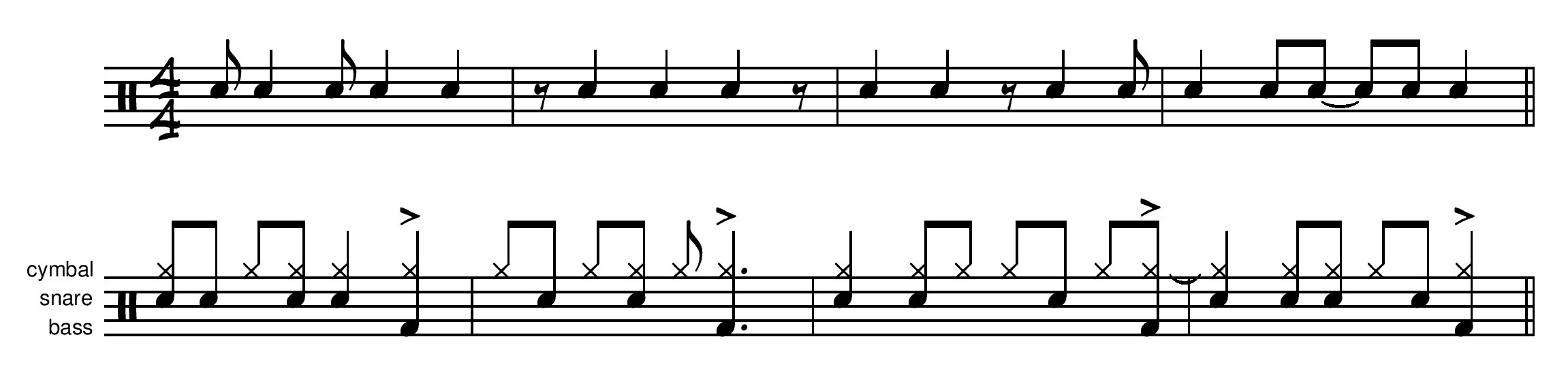
Another cut-and-paste, hack-and-slash job, extracting some two measures phrases from the full page exercises in Syncopation. For when I want a particular kind of phrase, and don't want to hunt around the eight pages for it, and don't feel like writing it my damn self. These ones all end the same, with a dotted quarter note's worth of space. And they all start with a note on 1, not a rest.
Another one of my hack and slash jobs. This is something I improvised in a lesson— a student is working on some of the Pages o' Coordination in 5/4, based on an Elvin Jones groove, and we made some fills using the accented triplet pages from Syncopation, alternating between one measure of groove, one measure of fill. There's a good way of handling triplet stickings so you always come out on the right hand here, in whatever time signature.
First, we'll be using the accented triplet pages from Syncopation, putting them into 5/4 time, playing the first five beats of each line, repeating, as I've brutally scribbled in here:
Here are all the one line exercises copied and pasted in into 5/4, jammed onto one page:
Get the pdf - Reed accented triplets in 5/4. There is another pdf to download below.
On the drum set, the accented notes are played on a cymbal, with the right hand, supported by the bass drum, and the unaccented notes are played on the snare drum— and later moved around the drums.
To get the cymbal notes onto the right hand, and to get in and out of the fill easily, we had to use some different stickings. Following some simple-ish rules:
All cymbal notes played with RH
All snare notes start with LH:
1-2 notes on SD: LH only 3 notes on SD: alternate - LRL 4 notes on SD: LH paradiddle or inversion: LRLL, LRRL 5 notes: alternate - LRLRL 6 notes: LH double paradiddle or inverion: LRLRLL, LRRLRL 7 notes: alternate - LRLRLRL 8 notes: LH triple paradiddle or inversion: LRLRLRLL, LRRLRLRL
You get the picture:
• odd number of SD notes = alternate • even number = alternate with LL double at end, or RR double after first note
I prefer the second type of paradiddle sticking, but there are good reasons to do either. The timing of the next cymbal accent may influence what feels best to somebody.
This page illustrates all the above possibilities, in the two-measure phrase I described:
When the fill begins with snare drum, you can add bass drum to the last note of the groove measure— to begin the fill more strongly.
Get the pdf - Reed triplet patterns as fill with Elvin Jones groove
Another one of my cut and paste jobs, this time inflicted on Syncopation Exercise 1, from Reed. P. 37 or 38, depending on the edition. I've modified it so there are no more than two 8th note spaced notes or rests at a time. I've written some other things with that limitation. It's good for speed, with many practice systems— right hand lead especially.
Enjoy. There is no pdf, you'll have to print it from the image above.
In the last few months we've done a number of tweaks to the basic right hand lead method used with the book Syncopation, and I thought it would be good to summarize them on one page. It's a good collection of stuff for rock and funk, and other straight 8th feels. The examples are all based on line 8 from p. 38 of Syncopation.
The examples are:
Basic RH lead system.
Alternate sticking on runs of three or more notes, in either part. Click link for the exception on longer runs of notes.
Play backbeat; SD accent on beat 3, replacing BD if necessary. Cym rhythm stays the same.
Practical tempo range for this is up to around 200 bpm, or the cut time equivalent.
It's kind of hard to read crammed onto one page like this, but that's not how you do it. Learn the principle, and then practice it by reading out of Syncopation.
You can develop these using pp. 6-7, 10-11, 30-33, 34-45. Depending on how simply you or your student needs to begin. A good practice drill would be to run all the systems with p. 38, or with any single long exercise from the above pages. You could also alternate one measure groove / one measure system— groove could be an ad lib beat, or a rock or funk beat based on the book rhythm, or the backbeat system above.
This is purely a writing experiment, pay no attention. Like, run away to some other web site right now.
Actually this is a pretty good exercise for working up an Ed Blackwell kind of solo texture, if you played it on the tom toms. I just took good old p. 38 from Reed and transcribed it for two hands, with the second part displaced by an 8th note. This kind of coordination happens a lot in Latin drumming as well.
There are really just two major combinations at work here, which I've highlighted on the segments labeled “warm up pattern.” Practice those a little bit by themselves, and you should be good to go. To make an Ed Blackwell thing out of it, play your hands on two different tom toms, add BD on 1/3, HH on 2/4, or both feet in unison on 1/3.
It is funny, I find myself typing the words SYNCOPATION and REED an awful lot, but this entire category of thing is not owned by that one book and that one author. We really talking about things you do with rhythm.
Say it again:
THINGS YOU DO WITH RHYTHM
It just happens that Ted Reed's book is a convenient and widely used practice library for that type of thing. We could just as well slap Louis Bellson's name and book all over this, except I hate Louis Bellson's book. There are some other books you could use (and I see that list is in dire need of updating)— I really like Chuck Kerrigan's book.
Anyhow, this whole field of study is nothing but common ways (and ways that are personal to me) professional drummers interpret rhythm.
This is a little bit of a half baked item, illustrating something we did in a lesson. Should be useful for teachers, may not make a ton of sense if you're not familiar with this system. I'll probably think of a better way to communicate this idea.
When doing the highly useful right hand lead triplet method using Syncopation, there are a few measures from p. 38 that are good to play in isolation. Some of them can be used as templates for improvisation, if we freely repeat parts of them, a couple are just good to play as repeating practice rhythms:
Those are:
Third line, third measure— repeating those running &s.
Fourth line, first two measures— repeating the quarter notes, or that three-note figure &3&.
Sixth line, first two measures— repeating the quarter notes, or the running &s.
Fifth line, first six beats of the last two measures, hihat added every two beats.
Seventh line, first six beats of the last two measures, hihat added every two beats.
Let's start with the bottom two: they can simply be played as a repeating meter-within-meter pattern in 4/4. Each of those six-beat excerpts played twice = three measures of 4/4. Good rhythms for any practice system, actually.
With the first three, you can play the repeated portions as many times as you want— really just repeating the triplet sticking pattern.
It's simpler if you think in terms of the triplets with the RH lead sticking, we can pare those three excerpts down further:
Play each of the repeated portion as many times as you want— one or more times. That sets us up with an open, freely developing triplet solo texture with no hiccups— all the parts connect easily. Once you're fluent with that, you can worry about staying in 4/4 time with it, and playing four or eight measure phrases.
I could have just gotten into Finale and written that in the first place, but I'm a traditionalist— I'd rather take a good old graphite pencil and mark it into the book itself. There should be some other unique opportunities for this type of thing— look at the one-line patterns on pp. 34-37, and see how they flow repeating any 1-3 beats of the pattern.
Continuing the kicks/set-ups Reed tweak— in aid of that kind of practicing, let's mark up the full-page exercises in Syncopation some more. You may not want to look at these changes all the time, so print out those pages, or get a second copy.
Exercise 4 on p. 41 has the most of the kind of activity we're looking for, so I'll use that.
In the last post I suggested penciling in housetop accents on any off-beat long notes after a long space— three 8th notes worth of space before them, or more:
You'll notice a couple of those are not actual long notes— they're 8th notes with a rest after them. In the second and sixth lines. For these purposes we can treat them the same.
Syncopation has a shortage of long notes on the &s of beats 2 and 4. They happen a lot in real life, they're rare in Reed. So let's make some by adding ties/accents to 8th notes on the & of 2/4, after a long space:
To make it easier to read, let's mark the spaces where the set ups go. I put a little line there, you could write FILL, or whatever:
Oops, I missed one in the third line.
You can do this with all eight of the regular syncopation exercises in Reed— some are better than others. Start with 1 and 4, exercise 2 is not great. There are also a couple of the syncopation exercises in Louis Bellson's Reading Text in 4/4 that are usable, as well— pp. 18, 21-22. And my book, Syncopation in 3/4.
This is a small change to a very basic Reed method, that makes it a lot more interesting, to me. I don't seek these things out, they just happen while I'm practicing. I play with it for a minute, and realize there's a usable system for it. If it's worth doing, I'll put it on the site.
The basic method is to play the book rhythm on the cymbal, with bass drum in unison, and fill out the spaces with 16th notes, alternating sticking. It's like Wipeout, with all of the accents falling on the right hand. It's rather dumb and I never practice it.
Here we will play two 16ths on the cymbal/BD for each book note— where there was a note on a numbered count or an &, we'll play #e or &a. With a big exception for notes spaced an 8th apart, you do that only on the last one. We're only doubling the notes that have some space after them. Sticking is still alternating, RLRL throughout.
Below is the rhythm as written in the book— that's Progressive Steps to Syncopation— then as it's played with the simple interpretation, and then how it's played with this interpretation:
And here's how you would play the first line of the p. 38 exercise:
I should point out, the idea here is not to pile on more practice obligations— it's to give us options, and make normal things more useful, and more interesting to practice, and more relevant to whatever we want to do as individuals.
Another one of my little photoshop* pranks of an existing drum book— here putting some rhythms from Progressive Steps to Syncopation into 7/4 time. It's fun.
I was doing this on the fly this when I was practicing along with a loop in 7/4 yesterday— playing four variations for each line in the book. Looking at two measures of Reed:
First variation: drop the last beat of the second measure
Second variation: drop the last beat of the first measure
Third variation: drop the first beat of the first measure
Fourth variation: drop the first beat of the second measure.
Some of those will be duplicates, which is why there are only three examples for some things on my photoshopped page.
TOTAL nerd stuff here. I use the accent pages in Progressive Steps to Syncopation (pp. 47-49) with my students for convenience, but I find them be a pain. They're thorough, but poorly balanced— so if students (e.g. me) just start on line 1 and try to plow through it, they (e.g. me) are going to burn out about halfway through the first page, and never get to the interesting ones. To do this stuff year after year you have to manage your interest, and that of your students. You can't reasonably expect people to motivate themselves by brute force forever.
I think I need to start marking this book up with a four-color pen. Bracket off each section in black, circle the good exercises in green, the critical ones in red, whatever. Get out my 50mm acrylic marker and black out everything I hate. Something.
Here are how those pages are organized, with my suggestions on which ones to include in general practicing. Whether you like my line choices or not, when covering this topic students should be playing at least a few lines from each category:
Lead hand accents - Lines 1-10 Most of the first page of exercises, and quite dull. I may have students play four or five of these, for different reasons. Shave it down to lines 1, 2, 6, and 9.
Two accents together - Lines 11-14 Only four lines, no problem. Always do lines 11 and 14.
Off hand accents - Lines 15-22 Inverse of the lead hand accents. Lines 16, 18, 21, 22.
Mixed accents - Lines 23-28 These are the interesting ones, and the most useful for learning to play accents well. There aren't many of them, but we're just using this as preparation for playing accented 8ths as an interpretation, using the regular exercises earlier in the book.
Single accent displaced - Lines 1-2, 15-16 That's an important set of exercises, too bad they're on two different pages.
Here: I've pared down those pages by about 30%, and dragged things around into the order I would have wanted them, with the four single accent patterns grouped together at the end. Print these out and put them in your copy of Syncopation:
By the way, I don't just use these pages for their intended purpose— playing alternating accented singles on the snare drum. I'll use them for getting into applications like my rock drill, or harmonic coordination method.
I rarely use the other non-8th note accent pages. Never the dotted-8th/16th pages. The triplet pages are most useful, they're also an organizational mess. Perhaps I'll pick them apart on another occasion.
If you like reading my complaining about this book, also check out my itemized critique of it from another occasion.
This swingy country, folky, gospel type of half time feel groove is all over the music of the late 60s/early 70s. You Can't Always Get What You Want, The Night They Drove Old Dixie Down, for example. It happens on a couple of tunes I was working on for a show with my wife, Casey Scott, on Friday, and I realized I wasn't very good at it. At least in the practice room, at the tempo of that song— in the show it worked out fine.
But let's talk about a strategy for working on that— it requires some creativity and interpretation on your part.
We're in a half time feel, so when reading out of Syncopation, the backbeat will fall on beat 3. The 8th notes will swing in a legato way, which will give it a feel not unlike a sixtuplet funk shuffle, though different. Don't overdo the swing feel.
For the grooves, use lines 1, 3, 4, 13-18, 42-43, 46-47 from pp. 34-36 of Syncopation. Play most of the book rhythm on the bass drum, except put beat 3 (not the &) on the snare drum. Play quarter notes on the cymbal. Get out your four color pen and circle those lines in green or whatever. Note that all of those lines have notes sounding on beats 1 and 3.
Basically do this, except play quarter notes on the cymbal instead of 8th notes:
To simplify the bass drum and add some interaction with the snare, play line 4, alternating notes between bass drum and snare drum:
That 8th-quarter-8th rhythm happens a lot— when it happens on beat 1, start with the bass drum; when it happens on beat 3, start with the snare, so lines 1 and 3 would be played:
You can then voice the other groove rhythms similarly— start and end on the bass drum on beats 1-2, start and end on the snare drum with beats 3-4:
For the fills, you can use any of the book rhythms, played down the drums, with whatever sticking you like:
You don't always have to go high to low— improvise the moves around the drums and see what else is effective.
If the book rhythm has a rest on 1, play the cymbal or cymbal/bass drum there just to mark it:
You could play quarter notes on the bass drum through the fill, to nail down the time. Especially on the sparser rhythms. If you watch the Dixie video linked to at the top of the post, you'll notice that Levon Helm played this type of groove with four on the floor bass drum all the way:
This is the phrase I was practicing, from a particular song— but it's universal enough:
Improvise the groove portion, and get the fill rhythms out of the book, and focus on the timing. For me the big problem was laying back enough. The vocabulary isn't necessarily new; this is more a template for refining it and nailing down the proper phrasing.
You know, I think we should all own multiple copies of Syncopation— first because they tend to get destroyed through use, second so we can pencil in our own changes without turning the book into an unreadable mess. And copies are cheap, so why not.
Here are some possibilities. Some you can just do mentally while reading, others you'll need to actually mark in the book. Many of them will create duplicate patterns, and some can be applied to more than one part of the book. I just whipped this thing out, so I'll probably be revising it over time. Most of these I've done at some point, some I've never done, but there's no reason not to do them.
Lesson 4 - 8th notes and quarter notes
1. Add tie to last 8th note before a quarter.
2. Rest on the remaining quarter notes.
Lesson 6 - triplets and quarter notes
3. Add tie to the last quarter note before a triplet.
4. Add tie to last triplet partial.
5. Rest on remaining quarter notes.
Lesson 7 - triplets and 8th notes
6. Add tie to last 8th note before a triplet.
7. Add tie to last triplet partial before an 8th note.
8. Add 8th rest or triplet 8th rest on beat 1, or on beat 1 and beat 3.
9. Add tie on last note before the beat 1, and/or the last note before beat 3.
10. Rest on first partial of every triplet.
Lessons 9-10 - full beats of 16ths, quarters, 8ths
11. Substitute any broken 16th rhythm not found elsewhere in the book for 16th notes: 1e, 1e-a, e&a, e&, e-a, e.
12. Tie the a of the 16ths (or substitute rhythm) to the following quarter or 8th note.
Lesson 11 - mixed 8ths and 16ths
13. Play in 3/4: first three beats of each measure
14. Play in 3/4: phrase marks every three beats.
Lesson 12 - 8th rests
15. Tie 8th notes to a following quarter note
16. Add tie on last note in measure to first note in next measure— only if no intervening rests.
17-A: Play in 3/4: play first three beats of the line
B: Play in 6/4: play first six beats of the line
18-A:. Play in 5/4: play first five beats of line
B: Play in 7/4 (4+3): play first seven beats of line
C: Play in 7/4 (3+4): play first two measures of the line, skip first beat
Entire syncopation section, p. 34-45 :
19. Add tie to last note in measure to first note in next measure— only if no intervening rests.
The cosmos gave me a couple of instances of Jack Dejohnette yesterday— I got to work on that Jack Dejohnette transcription, and also happened to also catch him on the radio (KMHD.org, The Afternoon Bridge, hosted by my friend Ben Turner), playing with Michael Brecker. I thought about it for a few minutes and wrote this. I wish I had thought about it 30 years ago, I could have used this.
It's another way of practicing Ted Reed's Syncopation— or any other rhythm book in the world— to develop some Dejohnette-like free flowing busy stuff. Good for soloing, or for that dense accompanying textural playing that nobody ever talks about as a thing.
Its major elements: • Play the melody part on the cymbal and bass drum with the right hand. • Fill in 16th notes on the snare drum with the left hand, ending with bass drum, where it fits. • Break up the longer runs of filler by bringing the right hand to the snare drum.
It's relatively difficult method to read—you need to be really quick at identifying how much space there is between notes. Here's the key— I've included syncopated versions of a couple of them, and a couple of longer values not found or not common in Reed:
Note that I accent the singles at the end of the snare drum part. That just happened naturally when I was practicing it. Practice the patterns, then practice them substituting the appropriate pattern for the rhythms in the book.
I'm practicing this along with my John Zorn / Beeroth practice loop, or with Betty Davis / If I'm In Luck...— in cut time, so the 16ths of the exercises are 32nd notes in the meter of the loop. I think you'll find it goes easier if you practice Reed pp. 35, 37, 34, 36 in that order, before getting into the full page exercises.
One minor gap in the rhythms covered in Syncopation— that's a drumming book, hahaha omg— is that there aren't so many syncopated long notes on the “weak” beats, 2 and 4. There are relatively few ties from the & of 2, and none on the & of 4, crossing the barline— and few of the functional equivalent: an 8th note on the & of 4, followed by a rest on 1— and no quarter rests on 1 at all in the full page exercises.
Sounds arcane, is actually important— in jazz we do a lot of accenting on the & of 4, coming back in with the time on 2 of the following measure.
So: let's add a tie on the last note of the measure, through the first note in the following measure... where there are no intervening rests. Here I've added them to the well known Syncopation Ex. 1 in Reed— notice where the ties aren't:
I think the full page Ex. 2 is the only one where you can add the ties every measure— there are no rests at the beginning or end of any measure.
The idea is not just to have some slighly-different rhythms to practice, so let's also accent that tied note— make a long sound, let the cymbal ring out.
Here's how you might play the first two lines of the above exercise played with a common jazz interpretation— exercise rhythm played on the snare drum, jazz rhythm played on the cymbal, accenting the added ties on both instruments. For clarity I haven't written a hihat part:
Depending on the style, and which pages you're practicing, you may not want to do it every single measure, so maybe do it every two measures. Usually at the end of the second measure, but also try it in the first measure, and see how it affects the sound of the phrase— especially when doing a funk interpretation.
I'm feeling a little irked at the existence of YouTube drumming videos today, so let's do a search of a subject near and dear to me, practicing the book Progressive Steps to Syncopation, and see what the YouTube folk have to say about it, and I'll write my thoughts about them. I've been wondering about this; the Reed-associated methods are the professional system for becoming a reading, improvising professional drummer, yet very few people on the web talk about them. And the few that do, don't seem to grasp their full implications.
I'll talk about the first videos that come up, in order. I'll list but not imbed any I just can't take. For example, the first one: an Expert Village thing entitled Syncopation for Drums : Drum Techniques—but every Expert Village video absolutely sucks going in. So I'm skipping that one. Or number 2: 15 Famous Syncopated Rock Grooves (That Inspire Creativity), a drum cover video in the guise of a lesson. I'm sorry, I cannot look at a clean young guy rocking out for the camera— all of these guys look that same to me. God love him, best of luck, I know he's going to get a million views, I just can't.
So, the actual videos:
Bruce Becker “Syncopation” Lesson Series 01: Left Hand Separation Four minute video, obviously a great teacher, great drummer. Here one pattern is covered, briefly, with a whole lot of side comments. Hopefully he gets more in depth in the other videos.
I don't dig using the word “separation.” It's not separation, it's coordination— the limbs are both plainly attached to the same human torso. If not, something is drastically wrong. Coordination is simply hands/feet playing opposite each other, and in unison with each other, to make a new, combined rhythm. Words matter, and words like separation and independence communicate a false concept of drumming coordination— the reality of which is we have a single controlling entity, the drummer, coordinating different body parts to create a drumming performance.
I think a difficulty with prestige teachers like Becker, is that you get the impression that he has all the answers, and that they are the correct answers for everyone. So your study stops becoming a search, and starts becoming about how well are you doing what he says. But if you're into Mickey Roker, and a guy isn't reflecting any of that in his presentation, you may need to look elsewhere for those qualities. For me the exploration is more important than having this level of correct answer Becker gives. The answers you come up with yourself through seriously studying and performing music, will be at least correct enough for you to play well.
It would be dumb to ignore information, and Becker has plenty. But it's one man's answer, which is not even directed at you personally— it's a video made for a general audience to demonstrate and share his general expertise, it's not a lesson plan for your development as a performer and artist.
How to use Ted Reed’s Syncopation - Episode #1 jazz basics Not a jazz drummer, but the verbal explanations are pretty solid. Strange cymbal technique, like a lot of these guys— they copied a video really hard, and took it to the next, wrong level. You get the feeling he did some studying and made the video, and luckily he basically studied the right stuff. Ends with some BS playing the ride cymbal with the left hand. No, no, no. But basically solid otherwise. It is not your imagination, on the demo starting at 2:30, he plays straight 8th and swing rhythms exactly the same— he swings them both.
I play Ted Reed's "Syncopation" for 3 hours straight Rock drummer plays Reed for 3 hours. Starts with a not great explanation of a complicated four limb triplet system. Weird mix, loud snare drum, everything else too quiet. I actually don't mind his cymbal technique. I could never do this— just flatly drill patterns for hours and hours. I need to practice like I'm playing something. It's not a question of “optimal practice techniques”, that's just how I live.
Syncopated Funk Groove I Drum Lesson
A Mike Johnston video, and I just. Can't. Do it. This is everything that is wrong with videos. Teaching a single hip(?) groove— the essence of hack teaching— that bull sh*t Drumeo manuscript, with one measure stretched across the whole screen, like that makes it easier to read. I don't need to you wish me an amazing day, I don't want to see your dog.
I'm not linking to this— I'm sure he's a lovely man— I mean obviously, listen to him, his loveliness unavoidable, even as you thought you signed on to learn something about the drums. But I can't. Search the video if you want to see it.
Mel Brown Beat Syncopation Exercise Here we go, the GREAT Mel Brown— Motown drummer, Diana Ross's drummer for many years, winner of a national Playboy Jazz award, student of Philly Joe Jones. And he taught my older brother. Catching his quintet at The Hobbit in Portland was one of the performance highlights of my college years. A GREAT drummer, band leader, and teacher.
He goes over all of the major basic jazz systems used with Reed, and one funk thing I've never done(!!!). Take the structure of this lesson seriously, everything about this is 100% correct and informative, right down to the short pants, and the cymbal that is pingier than you or I would like. If there's anything “wrong” with it, it's only because that thing doesn't matter.
Using Ted Reed's "Syncopation" for Drumming Independence Demonstrations of some basic methods on an electric set. They're not technically flawless, but so what. He does something close to my(""?) cut time funk thing. This is actually a reasonable video, even if it's not exactly dripping with jazz cred— real or fraudulent— so you're not going to take it over-seriously— it's just a demonstration of playing the notes and for that it's good. I like that he just demonstrates and doesn't talk.
12 Ways to Use Reed's Syncopation - Part 1 Good teacher, nice clear way of explaining the premise. On topic the whole time. I don't need to hear about somebody's day, or listen to them butter me up with a lot of bro crap. Not exactly a real sophisticated jazz touch, but it seems more designed to demonstrate a feeling to her students. I prefer this to the hyper navel gazing technocratic style of the big video accounts. She shows you the thing, and a few things to try with it, and a few little special touches. And then you get to figure out where to go with it yourself. Teachers aren't supposed to be the last word on everything, they're supposed to show you how to something, and inspire you a little bit to go and do something with it.
Syncopation: Expert Mode - Drum Lesson Here we go. Why do people have to be so FULL OF IT. I understand that people put themselves under a lot of pressure to be on and to be appealing. By the time he gets to explaining the musical part I'm bored, I'm done, spent. Demonstrates some weird systems for practicing Reed, I don't have any use for any of them. This project, this playing of the drums, is not just about thinking up hard stuff. If we're going to do hard stuff, there's got to be a reason.
Helpful Jazz Exercises for Drummers! Good video, that is actually worth its 18 minute duration, and some further analysis to get the more advanced things he's talking about. The exercises he calls right hand lead and right foot lead are really important. A little bit of that macho L.A. touch on the drums with the hickory 5A sticks, that reminds me of Tom Brechtlein— that doesn't really fly as a default volume unless you're playing with fusion musicians. That's a minor quibble, it's an excellent video, and he's obviously a knowledgeable teacher and an excellent drummer.
Here's a tweak to an ordinary straight 8th note Syncopation practice method: right hand plays the melody rhythm, left hand fills in the remaining 8th notes. Usually with the RH on a cymbal, with the bass drum in unison, left hand on the snare drum, like so:
We could call this the stick control interpretation, because the result is exactly what we'd get if you played the first pages of Stone with the Rs on the cym/bass drum, Ls on the snare drum, each played with the indicated hand. This is the major Reed method you use to get an ECM-type feel.
With that basic drill, the left hand fills in one, two, or three 8th notes in a row. With this tweak we're going to play a left handed paradiddle where the left would have played two notes, and a left handed double paradiddle where the left would have played three. Play the single lefts normally. Do this with pp. 30-32 and 34-45 of Reed (current edition).
First play these warmups— they cover all the forms the paradiddle fills will occur when practicing the method out of Syncopation:
Here are the first six lines of the well known p. 38 (née 37) Syncopation Exercise 1, written out with this tweak. I don't feel like writing up a full-blown key, so you'll have to get out your book and compare the two.
This is not unlike my recent uptempo method, in that we have to do some next-level reading— we have to do different things with spaces (or runs of 8ths) of different lengths. It seems daunting in the abstract, but it's reasonably easy when you just do it.
Finally, try using your own four or six note stickings or patterns as well. Best if they start with the left hand, and release with the right, at first. I'll share some of mine soon.
You can play melody part on the same drum as Elvin by following the common long note/short note interpretation— short notes go on the snare drum, long notes go on the bass drum. Except in some places it was impossible to write that, or unnecessarily difficult to read, so play quarter notes with a staccato mark as short notes, and 8th notes with a tenuto mark as long notes. Staccato = snare drum, tenuto = bass drum.
Let's take a break from watching the national degradation of the United States and its democratic form of government reach its apex live on Twitter/TV, wanna?
Yesterday I was practicing one of my recent Reed tweaks, with the bass drum filling in the gaps in the melody rhythm, and I made a mistake, which immediately led to something new— at least I've never done it before. Between this, and all of the Three Camps for drum set stuff, and these recent Reed posts, you should be killing it at making a jazz texture in pretty short order— some months of serious practice, anyway.
This is a jazz method., so play the normal cymbal rhythm plus hihat on 2/4, and read out of Syncopation by Ted Reed, pp. 34-45 of the current edition. Play the book rhythm on the snare drum, fill in with the bass drum thusly:
Play the bass drum on the & on every beat where:
The snare drum sounds on the downbeat
No snare drum sounds
Play the bass drum on the middle of the triplet on every beat where:
The snare drum sounds on the both 8th notes
The snare drum sounds on the & only
So the first line of Ex. 1 on p. 38:
Would be played like (I've omitted the hihat):
Or the fourth line of Ex. 4 on p. 41— that page may be a little confusing at first, with its many dotted quarter notes:
Goes like:
There's one typo: no snare drum on beat 1 of the second measure.
The long exercises with some space are the most interesting for doing this— the ones that give you a good balance of bass drum on the middle of the triplet, and on the &. Exercise 2, which is mostly 8th notes, is maybe not as cool.
Another minor tweak on a normal Reed method, in a jazz feel. It's good to have some easy options to relieve the tedium, and to bring more of the texture of real playing into it.
Do this with the ordinary Reed snare drum comping method— jazz rhythm on the cymbal, melody rhythm on snare, 2 and 4 on the hihat. But now let's hit the last note of the melody as an accent on the cymbal and bass drum— usually on 4, the & of 4, or the & of 3.
Here are a couple of lines of Reed played this way:
Catch the accent with the shoulder of the stick in the riding area— that's a technique you never hear discussed, that I do all the time. It's a normal part of playing the ride cymbal.
While practicing you can hit that accent every measure, or every two measures. In real life you'll do it more sparsely of course.
Making that accent disrupts the cymbal rhythm, so come back in with it on beat 1 of the next measure, except with an accent on the &of 4; then play the cymbal accent as a tied note, and come in on 2. But play the complete melody rhythm on the snare drum regardless. You might not ordinarily do that in real playing, but doing it in the practice room it will help you perfect the timing— it's easy to rush from the & of 4 to the 2.
I didn't include a hihat part in the examples. You could keep it going on beats 2 and 4 throughout this, except maybe when the accent is on the & of 3, you could drop it out on the 4. Do what you want.